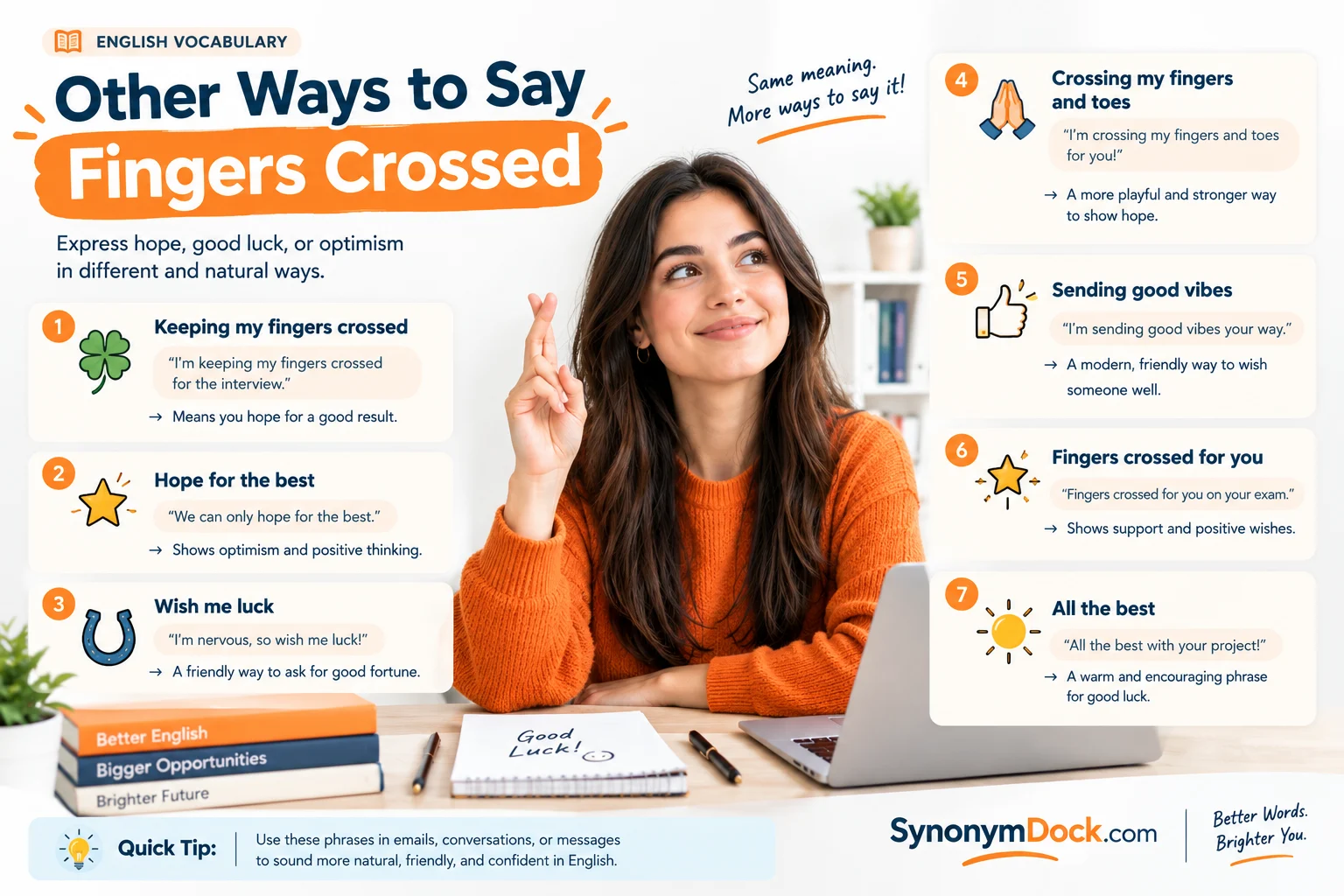
Other ways to say “fingers crossed” include “I hope so,” “Let’s hope for the best,” “I’m keeping my fingers crossed,” “Here’s hoping,” and “I’m hoping it works out.” The best choice depends on tone and context.
“Fingers crossed” is a common English expression used to show hope that something will happen successfully. It is especially common in everyday conversation, texts, and friendly messages.
You may search for alternatives to “fingers crossed” when you want to sound more natural, professional, formal, or expressive. Knowing other ways to say “fingers crossed” also helps you avoid repeating the same phrase.
Some alternatives work better in professional emails, while others are more suitable for casual conversations. The key is choosing an expression that matches your relationship with the listener and the situation.
“The best alternative depends on the tone, not just the meaning.”
Formal Alternatives
- I hope for a positive outcome.
- I remain hopeful that it will work out.
- I sincerely hope for the best.
- I am optimistic about the outcome.
Pro Tip
Use these expressions when “fingers crossed” feels too conversational, especially in formal writing, professional communication, or carefully worded messages.
Professional Alternatives
- I hope everything goes well.
- I’m hopeful that things will work out.
- Let’s hope for a good outcome.
- I’m optimistic about our chances.
Pro Tip
In workplace communication, simple expressions such as “I hope everything goes well” usually sound more natural than trying to make the idiom itself formal.
Business Email Alternatives
- I hope this works out well.
- I’m hopeful that we’ll receive good news.
- I hope we get a positive response.
- We’ll hope for the best.
Pro Tip
For business emails, choose a phrase that clearly communicates hope without sounding overly emotional or informal.
Academic Alternatives
- I hope the results are favorable.
- I remain hopeful about the outcome.
- Hopefully, the results will be positive.
- I anticipate a positive result.
Pro Tip
Academic writing generally favors precise language. “Fingers crossed” is conversational, so a more neutral expression may fit better in formal academic work.
Casual Alternatives
- I hope so!
- Let’s hope for the best!
- Here’s hoping!
- Hopefully!
Pro Tip
These expressions work well with friends, classmates, and people you know comfortably. “Here’s hoping!” is especially natural in friendly conversation.
Informal Expressions
- Wish me luck!
- Hope it works out!
- Let’s keep our fingers crossed!
- I’m rooting for it!
Pro Tip
Informal expressions are useful in texts, chats, social posts, and relaxed conversations. They can sound warm and encouraging without being overly formal.
“Professional English often sounds better when it is simple rather than unnecessarily formal.”
Common Mistakes
1. Treating “fingers crossed” as formal English
Why it can be a problem: It is an idiomatic and conversational expression.
Better version: “I hope everything goes well.”
Example:
Instead of “Fingers crossed the client approves it,” write “I hope the client approves it” in a formal email.
2. Using “fingers crossed” in every situation
Why it matters: Repetition can make your vocabulary sound limited.
Better version: Vary your expression according to context.
Example: “I remain hopeful about the outcome” works well in a formal message.
3. Confusing hope with certainty
Why it matters: “Fingers crossed” expresses hope, not confidence that something will happen.
Better version: Use “I’m confident” only when you genuinely want to express confidence.
Example: “I hope we receive good news tomorrow.”
4. Using overly formal language in casual conversation
Why it can sound awkward: “I anticipate a favorable outcome” may sound stiff between friends.
Better version: “I hope it works out.”
Example: “I hope you get the job!”
5. Assuming every alternative has exactly the same meaning
Why it matters: Some expressions emphasize hope, while others express optimism, encouragement, or support.
Correct approach: Choose the phrase that matches your intended feeling.
Example: “I’m rooting for you” shows support, while “I hope so” mainly expresses hope.
What Does “Fingers Crossed” Mean?
“Fingers crossed” is an idiomatic expression used to show that you hope something happens successfully or that a desired result occurs.
It is commonly used before an uncertain event or while waiting for an outcome.
Example:
“I have my interview tomorrow fingers crossed!”
The expression is usually informal or neutral in everyday speech. It is much more common in conversation than in formal academic or business writing.
When to Use “Fingers Crossed”
You can use “fingers crossed” in situations such as:
- Daily conversation: When talking about an uncertain outcome.
- Texts and chats: When sending an encouraging message.
- Workplace conversation: In relaxed conversations with colleagues.
- Job searches: When waiting to hear about an interview or application.
- Exams: When hoping for a good result.
- Travel plans: When hoping everything goes smoothly.
- Events: When hoping something goes according to plan.
- Spoken English: Especially among friends and acquaintances.
- Informal writing: Such as messages and social posts.
For formal emails, reports, academic papers, or official documents, a neutral alternative is usually more appropriate.
Is “Fingers Crossed” Professional or Polite?
Polite? ✔ Yes
Professional? ✔ Sometimes, depending on the setting
Formal? Usually not
Natural? ✔ Very natural in conversation
For example, a colleague might say:
“The proposal is with the client now. Fingers crossed!”
That sounds friendly and natural in an informal workplace conversation. In a formal client email, however, “I hope we receive a positive response” is more suitable.
The distinction is important: polite does not always mean formal, and professional does not always mean stiff.
Pros and Cons
Pros
- Easy for native speakers to understand
- Common in everyday English
- Friendly and encouraging
- Natural in spoken conversation
- Expresses hope without sounding overly serious
Cons
- Too informal for some formal documents
- Less suitable for academic writing
- Can become repetitive
- Does not clearly express confidence
- May sound too casual in a formal client message
Other Ways to Say “Fingers Crossed” With Examples
These 15 alternatives give you a wider range of expressions. Some are close in meaning, while others add a slightly different feeling such as optimism or encouragement.
1. Phrase: I Hope So
Meaning: You hope that the desired result will happen.
Explanation: “I hope so” is one of the simplest natural alternatives. It is common in spoken English and works well when someone has just mentioned a possible positive outcome. It sounds neutral, natural, and conversational.
Example Sentence: “Do you think the package will arrive today?” “I hope so.”
Best Use: Daily Conversation
Avoid Using In: Formal Reports
Tone: Natural, Hopeful
Formality Level: ⭐⭐⭐ Neutral
Usage Frequency: Very Common
CEFR Level: B1
Common Collocations:
- hope so
- really hope so
- certainly hope so
- hope so too
Context Variability:
- Spoken: “I hope so.”
- Professional: “I hope so as well.”
- Casual: “Yeah, I hope so!”
2. Phrase: Let’s Hope for the Best
Meaning: You are encouraging yourself or others to remain hopeful.
Explanation: This phrase acknowledges uncertainty while maintaining a positive attitude. It is natural in conversation and can also work in relaxed workplace settings.
Example Sentence: “The results should arrive tomorrow, so let’s hope for the best.”
Best Use: Everyday Conversation
Avoid Using In: Formal Academic Paper
Tone: Positive, Encouraging
Formality Level: ⭐⭐⭐ Neutral
Usage Frequency: Common
CEFR Level: B1
Common Collocations:
- hope for the best
- let’s hope
- hope for a good result
- hope for good news
Context Variability:
- Spoken: “Let’s hope for the best.”
- Professional: “Let’s hope for a positive outcome.”
- Casual: “Well, let’s hope for the best!”
3. Phrase: Here’s Hoping
Meaning: A friendly way to express hope for a favorable result.
Explanation: “Here’s hoping” is idiomatic and slightly more expressive than “I hope so.” It is natural in casual and conversational English but less suitable for formal documents.
Example Sentence: “The weather forecast looks better for Saturday here’s hoping!”
Best Use: Friendly Conversation
Avoid Using In: Formal Proposal
Tone: Friendly, Optimistic
Formality Level: ⭐⭐ Casual
Usage Frequency: Common
CEFR Level: B2
Common Collocations:
- here’s hoping
- here’s hoping for good news
- here’s hoping it works
- here’s hoping everything goes well
Context Variability:
- Spoken: “Here’s hoping.”
- Professional: “I hope we receive good news.”
- Casual: “Here’s hoping it all works out!”
4. Phrase: I Hope It Works Out
Meaning: You hope a situation ends successfully.
Explanation: This is a highly useful alternative because it focuses on the desired result. It sounds warm and natural without being strongly informal.
Example Sentence: “You’ve put so much effort into the application. I hope it works out.”
Best Use: Personal Support
Avoid Using In: Legal Documents
Tone: Warm, Supportive
Formality Level: ⭐⭐⭐ Neutral
Usage Frequency: Very Common
CEFR Level: B1
Common Collocations:
- hope it works out
- really hope it works out
- hope everything works out
- hope things work out
Context Variability:
- Spoken: “I hope it works out.”
- Professional: “I hope everything works out well.”
- Casual: “Hope it works out!”
5. Phrase: I’m Keeping My Fingers Crossed
Meaning: You are continuing to hope for a positive outcome.
Explanation: This is a direct variation of the original expression. It emphasizes continued hope while someone waits for a result.
Example Sentence: “You should hear from the university next week, so I’m keeping my fingers crossed for you.”
Best Use: Friendly Support
Avoid Using In: Formal Report
Tone: Warm, Encouraging
Formality Level: ⭐⭐ Casual
Usage Frequency: Common
CEFR Level: B2
Common Collocations:
- keep my fingers crossed
- keeping my fingers crossed
- fingers crossed for you
- fingers crossed that
Context Variability:
- Spoken: “I’m keeping my fingers crossed.”
- Professional: “I’m hopeful that we’ll receive good news.”
- Casual: “Keeping my fingers crossed for you!”
Native Speaker Tip
“I hope so” and “I hope it works out” are among the most flexible choices for everyday English. “Here’s hoping” is more idiomatic and casual, while formal writing usually benefits from a direct expression of hope.
6. Phrase: I’m Hopeful That It Will Work Out
Meaning: You express a positive expectation about an uncertain result.
Explanation: This phrase sounds more deliberate and polished than “fingers crossed.” It fits professional conversations and supportive messages when you want to sound positive without being overly casual.
Example Sentence: “Although the process has taken longer than expected, I’m hopeful that it will work out.”
Best Use: Professional Conversation
Avoid Using In: Very Casual Text
Tone: Positive, Professional
Formality Level: ⭐⭐⭐⭐ Formal
Usage Frequency: Common
CEFR Level: B2
Common Collocations:
- remain hopeful
- hopeful that
- hopeful about
- hopeful for a positive outcome
Context Variability:
- Spoken: “I’m hopeful it will work out.”
- Professional: “I’m hopeful that we’ll reach a positive outcome.”
- Casual: “I’m hopeful it works out.”
7. Phrase: I’m Hoping for the Best
Meaning: You are waiting for an uncertain result while staying positive.
Explanation: This expression is straightforward and natural. It works in both personal and moderately professional conversations.
Example Sentence: “We have submitted everything requested, and now I’m hoping for the best.”
Best Use: Waiting for Results
Avoid Using In: Formal Research Paper
Tone: Hopeful, Calm
Formality Level: ⭐⭐⭐ Neutral
Usage Frequency: Common
CEFR Level: B1
Common Collocations:
- hoping for the best
- really hoping for the best
- hope for good news
- hoping for a positive result
Context Variability:
- Spoken: “I’m hoping for the best.”
- Professional: “We’re hoping for a positive outcome.”
- Casual: “Just hoping for the best!”
8. Phrase: I’m Optimistic About the Outcome
Meaning: You believe the result may be positive.
Explanation: This is more confident than “fingers crossed.” It works especially well in professional settings when you want to communicate a positive outlook rather than simple hope.
Example Sentence: “The team has addressed the main concerns, so I’m optimistic about the outcome.”
Best Use: Workplace Discussion
Avoid Using In: Casual Text
Tone: Confident, Professional
Formality Level: ⭐⭐⭐⭐ Formal
Usage Frequency: Common
CEFR Level: B2
Common Collocations:
- optimistic about the outcome
- optimistic about our chances
- remain optimistic
- cautiously optimistic
Context Variability:
- Spoken: “I’m optimistic about the outcome.”
- Professional: “We remain optimistic about the outcome.”
- Casual: “I’m pretty optimistic about it.”
9. Phrase: I Hope We Get Good News
Meaning: You express hope that upcoming information will be favorable.
Explanation: This phrase is direct and easy to understand. It is useful when you are waiting for an email, decision, result, response, or announcement.
Example Sentence: “The committee meets tomorrow, so I hope we get good news.”
Best Use: Waiting for News
Avoid Using In: Academic Thesis
Tone: Warm, Direct
Formality Level: ⭐⭐⭐ Neutral
Usage Frequency: Very Common
CEFR Level: B1
Common Collocations:
- get good news
- receive good news
- hope for good news
- waiting for good news
Context Variability:
- Spoken: “I hope we get good news.”
- Professional: “I hope we receive a positive response.”
- Casual: “Hopefully, we get good news!”
10. Phrase: I Remain Hopeful
Meaning: You continue to expect a favorable possibility despite uncertainty.
Explanation: “I remain hopeful” is more formal than “fingers crossed.” It can work in professional correspondence, formal discussions, and carefully written statements.
Example Sentence: “Despite the delay, I remain hopeful that the issue will be resolved soon.”
Best Use: Formal Communication
Avoid Using In: Casual Text
Tone: Formal, Calm
Formality Level: ⭐⭐⭐⭐ Formal
Usage Frequency: Common
CEFR Level: C1
Common Collocations:
- remain hopeful
- remain optimistic
- remain hopeful that
- remain hopeful about
Context Variability:
- Spoken: “I remain hopeful.”
- Professional: “I remain hopeful that we can resolve this matter.”
- Casual: “I’m still hopeful.”
Expert Insight
In professional emails, choose direct language such as “I hope we receive a positive response” instead of relying on an idiom. In academic writing, “I remain hopeful” or “a positive outcome is anticipated” may fit better depending on the sentence.
11. Phrase: I Hope for a Positive Outcome
Meaning: You express hope that a situation will end favorably.
Explanation: This phrase is clear, neutral, and suitable for formal communication. It avoids the conversational imagery of “fingers crossed.”
Example Sentence: “We have addressed the committee’s concerns, and I hope for a positive outcome.”
Best Use: Formal Email
Avoid Using In: Friendly Text
Tone: Formal, Respectful
Formality Level: ⭐⭐⭐⭐ Formal
Usage Frequency: Common
CEFR Level: B2
Common Collocations:
- positive outcome
- hope for a positive outcome
- favorable outcome
- desired outcome
Context Variability:
- Spoken: “I hope for a positive outcome.”
- Professional: “We hope for a positive outcome following the review.”
- Casual: “I really hope it goes well.”
12. Phrase: I’m Rooting for You
Meaning: You are showing personal support and hoping someone succeeds.
Explanation: This expression is not a direct replacement in every situation. It focuses more strongly on supporting a person than simply hoping for an event.
Example Sentence: “Your audition is tomorrow, and I’m rooting for you!”
Best Use: Personal Encouragement
Avoid Using In: Formal Email
Tone: Friendly, Supportive
Formality Level: ⭐⭐ Casual
Usage Frequency: Common
CEFR Level: B2
Common Collocations:
- rooting for you
- really rooting for you
- rooting for your success
- always rooting for you
Context Variability:
- Spoken: “I’m rooting for you.”
- Professional: “I wish you every success.”
- Casual: “I’m definitely rooting for you!”
13. Phrase: Hopefully, It Goes Well
Meaning: You hope that an upcoming event or situation has a positive result.
Explanation: This is a natural conversational alternative. It is particularly useful when discussing interviews, meetings, presentations, trips, exams, or other events.
Example Sentence: “Your presentation starts at ten, so hopefully, it goes well.”
Best Use: Everyday Conversation
Avoid Using In: Formal Report
Tone: Casual, Positive
Formality Level: ⭐⭐ Casual
Usage Frequency: Very Common
CEFR Level: B1
Common Collocations:
- hopefully it goes well
- hope everything goes well
- hopefully everything works out
- hope it goes smoothly
Context Variability:
- Spoken: “Hopefully, it goes well.”
- Professional: “I hope the meeting goes smoothly.”
- Casual: “Hopefully, it goes well!”
14. Phrase: I’m Confident Things Will Work Out
Meaning: You express stronger belief in a positive result.
Explanation: This is stronger than “fingers crossed” because it communicates confidence rather than uncertainty alone. Use it when you genuinely want to reassure someone.
Example Sentence: “You’ve prepared carefully, and I’m confident things will work out.”
Best Use: Encouraging Someone
Avoid Using In: Uncertain Forecast
Tone: Confident, Supportive
Formality Level: ⭐⭐⭐ Neutral
Usage Frequency: Common
CEFR Level: B2
Common Collocations:
- confident things will work out
- confident it will succeed
- confident about the result
- confident in the outcome
Context Variability:
- Spoken: “I’m confident things will work out.”
- Professional: “I’m confident that the project will succeed.”
- Casual: “I’m sure it’ll work out!”
15. Phrase: Wishing You the Best
Meaning: You express positive hopes for someone’s situation or future result.
Explanation: This phrase is especially useful when you want to encourage someone without making a prediction. It can work in personal messages, supportive notes, and some professional contexts.
Example Sentence: “You’ve done everything you can, so wishing you the best for tomorrow.”
Best Use: Personal Support
Avoid Using In: Technical Report
Tone: Warm, Respectful
Formality Level: ⭐⭐⭐ Neutral
Usage Frequency: Common
CEFR Level: B1
Common Collocations:
- wishing you the best
- wishing you all the best
- wish you the best of luck
- wishing you success
Context Variability:
- Spoken: “Wishing you the best.”
- Professional: “Wishing you every success with the project.”
- Casual: “Wishing you the best!”
Native Speaker Tip
“Fingers crossed” is already very natural in casual spoken English, so you do not need to replace it every time. For a more neutral option, “I hope so” is highly flexible, while “I remain hopeful” clearly raises the level of formality.
Avoid These in Formal Situations
Some expressions are natural in casual conversation but can sound too relaxed in formal professional or academic writing:
| Casual Expression | Why Avoid It Formally | Better Alternative |
| Fingers crossed! | Idiomatic and conversational | I hope for a positive outcome. |
| Here’s hoping! | Informal and expressive | I remain hopeful. |
| Wish me luck! | Personal and casual | I hope the process goes well. |
| Hope it works out! | Conversational | I hope everything proceeds successfully. |
| I’m rooting for you! | Strongly personal | I wish you every success. |
“Formal English does not have to sound complicated; clarity usually works best.”
Best Phrases by Situation
| Situation | Suitable Phrase |
| Business Email | I hope for a positive outcome. |
| Client Meeting | I hope everything goes well. |
| Academic Essay | I remain hopeful about the outcome. |
| Presentation | Hopefully, it goes well. |
| Workplace Discussion | I’m hopeful that it will work out. |
| Job Interview | I hope we get good news. |
| Team Collaboration | Let’s hope for a good outcome. |
| Everyday Conversation | I hope so. |
Top 10 Alternatives Compared
| Phrase | Tone | Formality | Best Use | Frequency |
| I hope so | Natural | Neutral | Daily conversation | Very Common |
| I hope it works out | Warm | Neutral | Personal support | Very Common |
| Let’s hope for the best | Encouraging | Neutral | General conversation | Common |
| I’m hoping for the best | Hopeful | Neutral | Waiting for results | Common |
| Hopefully, it goes well | Positive | Casual | Everyday situations | Very Common |
| Here’s hoping | Friendly | Casual | Informal conversation | Common |
| I’m hopeful that it will work out | Positive | Formal | Professional settings | Common |
| I’m optimistic about the outcome | Confident | Formal | Workplace communication | Common |
| I remain hopeful | Calm | Formal | Formal communication | Common |
| I hope for a positive outcome | Respectful | Formal | Business writing | Common |
Which Expression Fits Your Situation?
Rather than looking for one universal replacement, match the expression to your context:
Everyday Conversation
“I hope so” is simple, natural, and easy to use.
Professional Communication
“I’m hopeful that it will work out” communicates optimism without sounding overly casual.
Academic Writing
“I remain hopeful about the outcome” can work when the context genuinely calls for an expression of hope.
Business Email
“I hope for a positive outcome” is direct and suitably professional.
Personal Encouragement
“I’m rooting for you” adds warmth and personal support.
Casual Conversation
“Here’s hoping” is a friendly idiomatic choice.
Commonly Confused Phrases
“I hope so” vs. “I hope it works out”
“I hope so” normally responds to something already mentioned.
“Do you think we’ll get the job?”
“I hope so.”
“I hope it works out” focuses more broadly on the success of a situation.
“I hope so” vs. “I’m optimistic”
“I hope so” expresses desire for a positive result. “I’m optimistic” suggests a stronger positive expectation.
“I’m rooting for you” vs. “Fingers crossed”
“I’m rooting for you” focuses on support for a person. “Fingers crossed” focuses more generally on hoping for a good outcome.
“I remain hopeful” vs. “Fingers crossed”
“I remain hopeful” is more formal and controlled. “Fingers crossed” is more conversational and idiomatic.
“Small changes in wording can change the strength, warmth, and formality of your message.”
Scenario Practice
1. Business Meeting
Your team has submitted a proposal and is waiting for the client’s decision.
Which phrase would you choose?
Answer: “I hope we receive a positive response.”
Why: It sounds professional and avoids an overly casual idiom.
2. Job Interview
Your friend has just completed an interview and is waiting for an update.
Which phrase would you choose?
Answer: “I’m rooting for you!”
Why: The phrase is personal, encouraging, and natural between friends.
3. Presentation
A colleague is about to give an important presentation.
Which phrase would you choose?
Answer: “Hopefully, it goes well!”
Why: It is friendly and natural in everyday workplace conversation.
4. Class Discussion
A student is waiting to hear whether their project received a good result.
Which phrase would you choose?
Answer: “I hope so.”
Why: It is short, natural, and appropriate for casual conversation.
5. Email Reply
A professional contact is waiting for a decision from a committee.
Which phrase would you choose?
Answer: “I remain hopeful about the outcome.”
Why: It communicates optimism while maintaining a formal tone.
Mini Quiz
1. Which phrase is most casual?
A. I remain hopeful.
B. I hope for a positive outcome.
C. Here’s hoping!
D. I anticipate a positive result.
Answer: C
2. Which expression is most suitable for a formal email?
A. Fingers crossed!
B. Here’s hoping!
C. I hope for a positive outcome.
D. Wish me luck!
Answer: C
3. Someone asks, “Do you think we’ll hear back tomorrow?” Which response is natural?
A. I hope so.
B. I anticipate favorability.
C. I remain optimistic thereof.
D. I wish for correspondence.
Answer: A
4. Which phrase gives stronger confidence than “fingers crossed”?
A. I’m confident things will work out.
B. Here’s hoping.
C. I hope so.
D. Hopefully.
Answer: A
5. Which expression directly supports a person?
A. I hope for a positive outcome.
B. I’m rooting for you.
C. I remain hopeful.
D. Hopefully, it goes well.
Answer: B
Answer Key
- C “Here’s hoping” is informal and conversational.
- C It fits formal professional communication.
- A “I hope so” is a natural response to a possibility.
- A “I’m confident” expresses stronger belief.
- B “I’m rooting for you” emphasizes personal support.
Frequently Asked Questions
What is the most formal way to say “fingers crossed”?
For formal communication, you can say “I hope for a positive outcome” or “I remain hopeful about the outcome.” Both express hope without using the conversational idiom “fingers crossed.” The best choice depends on the sentence and whether you are discussing a decision, result, application, or other uncertain event.
Which phrase is best for professional emails?
“I hope for a positive outcome” is a useful choice for professional emails because it is clear, neutral, and respectful. You can also write “I hope we receive a positive response” when you are waiting for a decision or reply. These expressions usually sound more appropriate than casual idioms.
What is the difference between “fingers crossed” and “I’m optimistic”?
“Fingers crossed” expresses hope while acknowledging uncertainty. “I’m optimistic” suggests a more positive expectation about what will happen. For example, “Fingers crossed we get approval” shows hope, while “I’m optimistic that we’ll get approval” communicates stronger confidence.
Which alternative sounds most natural in everyday English?
“I hope so” is one of the most natural and flexible choices. “I hope it works out” is also very common when discussing a situation. In casual conversations, “Here’s hoping” and “Hopefully, it goes well” can add variety without sounding unnatural.
Can I use “fingers crossed” in business meetings?
Yes, but context matters. In a relaxed conversation with colleagues, “Fingers crossed” can sound perfectly natural. In a formal presentation, client communication, official email, or written report, a clearer phrase such as “I hope we receive a positive response” may fit the professional tone better.
Conclusion
Learning other ways to say “fingers crossed” gives you more control over your English. “I hope so” is simple and versatile, while “here’s hoping” adds a casual, friendly touch. For professional or formal communication, expressions such as “I remain hopeful” and “I hope for a positive outcome” are often more suitable. The right phrase depends on your audience, purpose, and level of formality.
Try using these alternatives in real conversations, emails, meetings, and messages. Notice how small changes in wording affect the tone of your communication. With regular practice, you can express hope naturally while making your English more flexible, precise, and confident.
