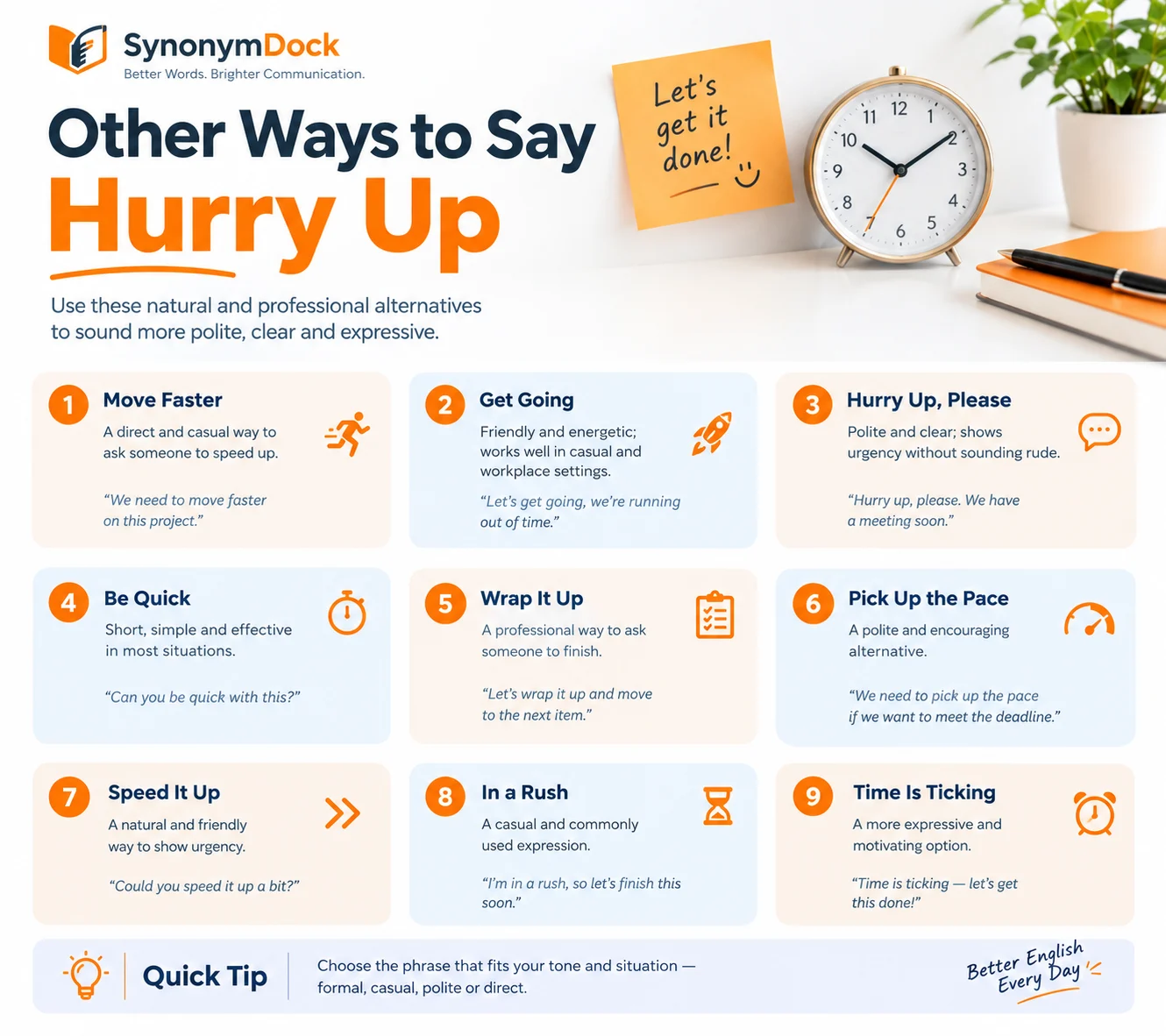
If you need other ways to say hurry up, try please be quick, let’s get moving, pick up the pace, we’re short on time, or let’s get a move on. Choose based on urgency, politeness, and context.
The phrase “hurry up” tells someone to do something faster or stop delaying. It is common in everyday spoken English, but it can sometimes sound impatient or demanding.
Learning other ways to say hurry up gives you more control over tone. You can sound polite in a business email, urgent during a meeting, or relaxed when speaking with friends.
The best alternative depends on your relationship with the listener and the situation. A workplace request needs different language from a message to a close friend.
“Urgency is useful, but the right tone keeps urgency from sounding rude.”
Formal Alternatives
- Please proceed promptly.
- Please prioritize this.
- We are working within a tight timeframe.
- We should avoid further delay.
- Time is becoming limited.
Pro Tip
Formal English usually communicates urgency indirectly. Instead of commanding someone to move faster, explain the deadline or requested priority.
Professional Alternatives
- Could you speed things up?
- Let’s keep things moving.
- We’re short on time.
- Let’s pick up the pace.
- Please prioritize this.
Pro Tip
In professional communication, focus on the task and deadline rather than criticizing someone’s speed.
Business Email Alternatives
- Could you please prioritize this?
- We would appreciate a prompt response.
- Please proceed at your earliest convenience.
- Could you expedite the request?
- We are working against a tight deadline.
Pro Tip
Email language should remain respectful even when something is urgent. A clear deadline often sounds more professional than simply saying “hurry up.”
Academic Alternatives
- Please proceed promptly.
- We should move forward.
- Let’s stay on schedule.
- Time is limited.
- We need to complete this shortly.
Pro Tip
Academic writing generally avoids direct commands. Use neutral expressions that communicate timing without sounding impatient.
Casual Alternatives
- Let’s get moving.
- Let’s get a move on.
- Pick up the pace.
- We need to get going.
- Come on, let’s go.
Pro Tip
These expressions work well with friends, classmates, or people you know comfortably. Your voice and relationship still affect how they sound.
Informal Expressions
- Move it!
- Step on it!
- Get a move on!
- Chop-chop!
- Come on!
Pro Tip
These expressions can sound playful, impatient, or bossy. Use them carefully because they are rarely suitable for professional communication.
“Professional urgency explains the deadline; casual urgency pushes the moment.”
Common Mistakes
1. Using “hurry up” with everyone
Mistake: Saying “Hurry up” to a manager, client, or unfamiliar colleague.
Why it can be a problem: The expression is direct and may sound like a command.
Better version: “Could you please prioritize this?”
Example: “Could you please prioritize this request? We have a client deadline this afternoon.”
2. Assuming “hurry up” is always rude
Mistake: Avoiding the phrase completely.
Why it is misleading: “Hurry up” is normal English and can be perfectly natural in friendly situations.
Correct approach: Match it to the relationship and situation.
Example: “Hurry up! The movie is about to start.”
3. Using “chop-chop” professionally
Mistake: “Chop-chop, please send the report.”
Why it is unsuitable: It is informal and can sound playful, old-fashioned, or commanding.
Better version: “Could you please send the report as soon as possible?”
4. Saying “move it” to a client
Mistake: “Move it so we can finish the order.”
Why it is inappropriate: “Move it” is very direct and may sound rude.
Better version: “Could we move forward with the order?”
5. Using “ASAP” without context
Mistake: “Send this ASAP.”
Why it can be weak: The recipient may not know whether you mean within minutes, today, or tomorrow.
Better version: “Could you send this by 3 p.m. today?”
What Does “Other Ways to Say Hurry Up” Mean?
“Other ways to say hurry up” refers to alternative English expressions that communicate speed, urgency, or the need to avoid delay.
The original phrase is an imperative verb phrase:
Hurry up.
It means do something faster than you are currently doing it or stop taking so much time.
For example:
“Hurry up, or we’ll miss the train.”
The expression itself is grammatically correct. The issue is usually tone, not grammar. Depending on context, it can sound urgent, impatient, playful, or demanding.
When to Use “Hurry Up”
You can use “hurry up” in many situations, especially informal spoken English.
- Daily conversation: “Hurry up; breakfast is getting cold.”
- With friends: “Hurry up! We’re waiting for you.”
- Family situations: “Hurry up or we’ll be late.”
- Casual messages: “Hurry up, the game is starting.”
- Workplace conversations: Possible, but often too direct.
- Business emails: Usually replace it with a more polite expression.
- Academic writing: Avoid it in formal prose.
- Presentations: Use more neutral language such as “Let’s move forward.”
- Client communication: Explain the deadline rather than giving a command.
The phrase is especially natural when urgency is obvious and the relationship is informal.
Is “Hurry Up” Professional or Polite?
| Question | Answer |
| Polite? | Depends on context |
| Professional? | Usually not ideal |
| Formal? | No |
| Natural? | Yes |
| Common? | Very common |
| Direct? | Yes |
“Hurry up” is natural but direct. With friends, it can sound completely normal. In a workplace, it may sound impatient if there is no explanation.
Business-style example:
“Could you please prioritize the report? We need to send it to the client by noon.”
This communicates the same basic urgency without ordering someone to move faster.
“Politeness does not remove urgency; it changes how urgency is delivered.”
Pros and Cons
Pros
- Easy to understand.
- Extremely common in spoken English.
- Clearly communicates urgency.
- Natural among friends and family.
- Useful when time is genuinely limited.
Cons
- Can sound impatient.
- Too direct for some workplace situations.
- Usually unsuitable for formal writing.
- Can feel commanding when said sharply.
- Does not explain why something is urgent.
Transition to the Main List
The alternatives below give you more precise ways to communicate urgency. Some focus on speed, while others emphasize deadlines, priorities, or avoiding delay.
Choose an expression based on your audience, relationship, and level of urgency rather than replacing “hurry up” mechanically.
Expert Tip
Expert Tip: Native speakers often communicate urgency more politely by explaining the time pressure. “We’re short on time” can feel more cooperative than “Hurry up.”
Other Ways to Say “Hurry Up” (With Examples)
These 15 alternatives cover professional English, workplace conversations, emails, academic contexts, everyday speech, and informal situations.
The goal is not to memorize every phrase. Instead, learn which expressions fit naturally into different situations.
1. Phrase: Please Be Quick
Meaning:
This politely asks someone to complete an action quickly.
Explanation:
“Please be quick” is clearer and slightly softer than “Hurry up,” although it still communicates urgency. It works best when the listener already understands why speed matters.
Example Sentence:
“Please be quick; the registration desk closes in ten minutes.”
Best Use:
Daily Conversation
Avoid Using In:
Formal Business Emails
Tone:
Direct, Polite
Formality Level:
⭐⭐⭐ Neutral
Usage Frequency:
Common
CEFR Level:
B1
Common Collocations:
- please be quick
- be quick about it
- quick response
- quick decision
Context Variability:
- Spoken: “Please be quick; we’re almost ready to leave.”
- Professional: “Please be quick with the final check because the presentation begins shortly.”
- Casual: “Please be quick I saved you a seat.”
2. Phrase: Let’s Get Moving
Meaning:
This encourages people to start moving or begin an activity.
Explanation:
“Let’s get moving” is less confrontational because it includes the speaker. It often suggests that everyone should take action rather than blaming one person for being slow.
Example Sentence:
“Let’s get moving so we can reach the venue before traffic builds.”
Best Use:
Team Activities
Avoid Using In:
Formal Reports
Tone:
Friendly, Urgent
Formality Level:
⭐⭐⭐ Neutral
Usage Frequency:
Very Common
CEFR Level:
B1
Common Collocations:
- get moving
- get moving quickly
- get things moving
- get the project moving
Context Variability:
- Spoken: “Let’s get moving; everyone is ready.”
- Professional: “Let’s get moving on the proposal before the deadline.”
- Casual: “Come on, let’s get moving!”
3. Phrase: Let’s Get a Move On
Meaning:
This means people should start moving or act faster.
Explanation:
It is common in conversational English and sounds more informal than “Let’s get moving.” It can be friendly, but depending on your voice, it may also sound impatient.
Example Sentence:
“Let’s get a move on if we want to catch the early train.”
Best Use:
Casual Conversation
Avoid Using In:
Client Emails
Tone:
Casual, Urgent
Formality Level:
⭐⭐ Casual
Usage Frequency:
Common
CEFR Level:
B1
Common Collocations:
- get a move on
- better get a move on
- need to get a move on
- get a move on quickly
Context Variability:
- Spoken: “We’d better get a move on.”
- Professional: “We need to get a move on with the preparations.”
- Casual: “Get a move on we’re already late.”
4. Phrase: Pick Up the Pace
Meaning:
This asks someone to work, walk, or progress faster.
Explanation:
“Pick up the pace” is useful when something is already happening but needs to become faster. It is common in work, sports, projects, and physical activities.
Example Sentence:
“We need to pick up the pace if we want to finish before lunch.”
Best Use:
Workplace Meeting
Avoid Using In:
Sensitive Feedback
Tone:
Direct, Motivating
Formality Level:
⭐⭐⭐ Neutral
Usage Frequency:
Common
CEFR Level:
B2
Common Collocations:
- pick up the pace
- pace of work
- pace of progress
- increase the pace
Context Variability:
- Spoken: “Let’s pick up the pace.”
- Professional: “We need to pick up the pace on this project.”
- Casual: “Pick up the pace we’re almost there.”
5. Phrase: We’re Short on Time
Meaning:
This explains that there is not much time remaining.
Explanation:
This is one of the most useful indirect alternatives. Instead of commanding someone, you describe the situation. That makes it especially helpful in professional communication.
Example Sentence:
“We’re short on time, so let’s focus on the final two points.”
Best Use:
Business Meeting
Avoid Using In:
Long-Term Planning
Tone:
Professional, Urgent
Formality Level:
⭐⭐⭐⭐ Formal
Usage Frequency:
Very Common
CEFR Level:
B2
Common Collocations:
- short on time
- running short on time
- very short on time
- short on time today
Context Variability:
- Spoken: “We’re short on time, so let’s go.”
- Professional: “We’re short on time, so I suggest we move to the final item.”
- Casual: “We’re short on time grab your things.”
Native Speaker Tip
“Please be quick” and “let’s get moving” sound natural in everyday speech. “We’re short on time” is especially useful at work because it communicates urgency without directly criticizing anyone.
6. Phrase: Could You Speed Things Up?
Meaning:
This politely asks someone to make a process faster.
Explanation:
This expression is useful when a task or process is taking longer than expected. The word “could” makes the request less forceful than “Speed things up.”
Example Sentence:
“Could you speed things up a little so we can submit the application today?”
Best Use:
Workplace Request
Avoid Using In:
Formal Complaint
Tone:
Polite, Direct
Formality Level:
⭐⭐⭐⭐ Formal
Usage Frequency:
Common
CEFR Level:
B2
Common Collocations:
- speed things up
- speed up the process
- speed up production
- speed up the review
Context Variability:
- Spoken: “Could you speed things up?”
- Professional: “Could you speed up the review process?”
- Casual: “Can you speed things up? We’re almost late.”
7. Phrase: Let’s Keep Things Moving
Meaning:
This encourages continued progress without unnecessary delays.
Explanation:
“Let’s keep things moving” is collaborative and positive. It is particularly natural in meetings and project discussions.
Example Sentence:
“Let’s keep things moving and review the final proposal.”
Best Use:
Team Meeting
Avoid Using In:
Academic Definition
Tone:
Collaborative, Professional
Formality Level:
⭐⭐⭐⭐ Formal
Usage Frequency:
Common
CEFR Level:
B2
Common Collocations:
- keep things moving
- keep the project moving
- keep work moving
- keep the process moving
Context Variability:
- Spoken: “Let’s keep things moving.”
- Professional: “Let’s keep things moving so we can meet the deadline.”
- Casual: “Let’s keep things moving; we still have two stops.”
8. Phrase: We Need to Get Going
Meaning:
This means it is time to leave or start an activity.
Explanation:
This phrase focuses more on starting or leaving than on someone’s speed. It is natural in everyday English and can sound polite because it avoids directly telling another person to hurry.
Example Sentence:
“We need to get going if we want to arrive before sunset.”
Best Use:
Daily Conversation
Avoid Using In:
Formal Correspondence
Tone:
Natural, Urgent
Formality Level:
⭐⭐⭐ Neutral
Usage Frequency:
Very Common
CEFR Level:
B1
Common Collocations:
- need to get going
- better get going
- time to get going
- get going soon
Context Variability:
- Spoken: “We need to get going now.”
- Professional: “We need to get going if we want to stay on schedule.”
- Casual: “Come on, we need to get going!”
9. Phrase: Please Proceed Promptly
Meaning:
This formally asks someone to continue or act without unnecessary delay.
Explanation:
This is considerably more formal than “hurry up.” It works in official correspondence, instructions, and formal workplace communication, but it can sound stiff in ordinary conversation.
Example Sentence:
“Please proceed promptly once all documents have been verified.”
Best Use:
Formal Instructions
Avoid Using In:
Friendly Texts
Tone:
Formal, Respectful
Formality Level:
⭐⭐⭐⭐⭐ Very Formal
Usage Frequency:
Occasional
CEFR Level:
C1
Common Collocations:
- proceed promptly
- proceed with caution
- proceed with the application
- proceed immediately
Context Variability:
- Spoken: “Please proceed promptly with the next step.”
- Professional: “Please proceed promptly once approval is received.”
- Casual: Usually sounds too formal.
10. Phrase: Please Prioritize This
Meaning:
This asks someone to treat a task as especially important or urgent.
Explanation:
“Please prioritize this” does not literally mean “work faster.” Instead, it communicates that the task should receive attention before less urgent work. It is excellent for workplace communication.
Example Sentence:
“Please prioritize this request because the client needs an answer today.”
Best Use:
Business Email
Avoid Using In:
Casual Conversation
Tone:
Professional, Clear
Formality Level:
⭐⭐⭐⭐ Formal
Usage Frequency:
Common
CEFR Level:
B2
Common Collocations:
- prioritize this request
- prioritize the task
- prioritize urgent work
- prioritize the project
Context Variability:
- Spoken: “Please prioritize this before the other tasks.”
- Professional: “Could you please prioritize this request?”
- Casual: Usually unnecessary among close friends.
Expert Insight
In professional English, “Please prioritize this” can be more useful than “hurry up” because it identifies what needs attention. When possible, combine the request with a clear deadline.
11. Phrase: Let’s Not Delay
Meaning:
This encourages action without unnecessary waiting.
Explanation:
“Let’s not delay” sounds more formal and measured than “Hurry up.” It works well when discussing decisions, projects, applications, or next steps.
Example Sentence:
“Let’s not delay the decision because the deadline is approaching.”
Best Use:
Professional Discussion
Avoid Using In:
Playful Conversation
Tone:
Firm, Professional
Formality Level:
⭐⭐⭐⭐ Formal
Usage Frequency:
Common
CEFR Level:
B2
Common Collocations:
- avoid delay
- unnecessary delay
- delay the decision
- further delay
Context Variability:
- Spoken: “Let’s not delay; we can decide now.”
- Professional: “Let’s not delay the approval process.”
- Casual: “Let’s not delay or we’ll miss the show.”
12. Phrase: Time Is Running Out
Meaning:
This states that very little time remains.
Explanation:
The expression creates urgency without directly blaming another person. It is natural in presentations, meetings, competitions, and everyday situations.
Example Sentence:
“Time is running out, so let’s make a final decision.”
Best Use:
Urgent Situation
Avoid Using In:
Routine Requests
Tone:
Urgent, Neutral
Formality Level:
⭐⭐⭐ Neutral
Usage Frequency:
Very Common
CEFR Level:
B1
Common Collocations:
- time is running out
- running out of time
- time is almost up
- little time remains
Context Variability:
- Spoken: “Time is running out!”
- Professional: “Time is running out, so we should finalize the proposal.”
- Casual: “Time is running out; choose one!”
13. Phrase: Could You Expedite This?
Meaning:
This formally asks someone to make a process happen faster.
Explanation:
“Expedite” is common in professional and administrative contexts. It is useful for requests involving documents, orders, applications, approvals, or procedures.
Example Sentence:
“Could you expedite this request so we can meet the client’s deadline?”
Best Use:
Business Email
Avoid Using In:
Casual Conversation
Tone:
Formal, Professional
Formality Level:
⭐⭐⭐⭐⭐ Very Formal
Usage Frequency:
Occasional
CEFR Level:
C1
Common Collocations:
- expedite the request
- expedite the process
- expedite delivery
- expedite approval
Context Variability:
- Spoken: “Could you expedite the approval?”
- Professional: “Could you expedite this request before Friday?”
- Casual: Usually replace it with “Can you speed this up?”
14. Phrase: Come On, Let’s Go
Meaning:
This encourages someone to leave or start moving immediately.
Explanation:
It is highly conversational and can sound friendly, impatient, or encouraging. The meaning depends heavily on voice and relationship.
Example Sentence:
“Come on, let’s go; everyone is waiting outside.”
Best Use:
Friendly Conversation
Avoid Using In:
Formal Meetings
Tone:
Casual, Energetic
Formality Level:
⭐⭐ Casual
Usage Frequency:
Very Common
CEFR Level:
A2
Common Collocations:
- come on
- let’s go
- come on, hurry
- come on, we’re late
Context Variability:
- Spoken: “Come on, let’s go!”
- Professional: Usually replace it with “Let’s get started.”
- Casual: “Come on, let’s go before it rains.”
15. Phrase: Step on It
Meaning:
This informal expression tells someone to move or act faster.
Explanation:
“Step on it” is strongly conversational and is sometimes associated with driving. It can sound playful among friends but is too informal for professional requests.
Example Sentence:
“Step on it if we want to make the train.”
Best Use:
Informal Speech
Avoid Using In:
Business Communication
Tone:
Very Casual, Urgent
Formality Level:
⭐ Very Casual
Usage Frequency:
Occasional
CEFR Level:
B2
Common Collocations:
- step on it
- really step on it
- step on it a little
- step on the gas
Context Variability:
- Spoken: “Step on it we’re running late.”
- Professional: Avoid it in workplace communication.
- Casual: “Step on it if you want to catch the bus.”
Native Speaker Tip
“Let’s get moving,” “we’re short on time,” and “let’s keep things moving” are broadly useful modern expressions. “Please proceed promptly” and “expedite” are more formal, while “step on it” is clearly informal.
Avoid These in Formal Situations
1. “Chop-chop!”
This is playful and highly informal. It can sound old-fashioned or bossy.
Better: “Could you please prioritize this?”
2. “Move it!”
This is a blunt command. It may sound aggressive when directed at another person.
Better: “Could we move forward with this?”
3. “Step on it!”
This is informal and often associated with urgent movement or driving.
Better: “Could you speed things up?”
4. “Get a move on!”
Although common in casual speech, it can sound impatient.
Better: “Let’s keep things moving.”
5. “Hurry up!”
It is perfectly natural English, but it can sound demanding in professional settings.
Better: “We’re short on time, so let’s move to the next item.”
“The more formal the situation, the more useful indirect urgency becomes.”
Best Phrases by Situation
| Situation | Recommended Phrase |
| Business Email | Please prioritize this |
| Client Meeting | We’re short on time |
| Academic Essay | We should avoid further delay |
| Presentation | Let’s keep things moving |
| Workplace Discussion | Could you speed things up? |
| Job Interview | We’re working within a tight timeframe |
| Team Collaboration | Let’s get moving |
| Everyday Conversation | We need to get going |
Top 10 Alternatives Compared
| Phrase | Tone | Formality | Best Use | Frequency |
| Please be quick | Direct, polite | ⭐⭐⭐ | Daily speech | Common |
| Let’s get moving | Friendly, urgent | ⭐⭐⭐ | General conversation | Very Common |
| Let’s get a move on | Casual, urgent | ⭐⭐ | Informal speech | Common |
| Pick up the pace | Motivating, direct | ⭐⭐⭐ | Work and activity | Common |
| We’re short on time | Professional, urgent | ⭐⭐⭐⭐ | Meetings | Very Common |
| Could you speed things up? | Polite, direct | ⭐⭐⭐⭐ | Workplace | Common |
| Let’s keep things moving | Collaborative | ⭐⭐⭐⭐ | Meetings | Common |
| Please proceed promptly | Formal, respectful | ⭐⭐⭐⭐⭐ | Formal instructions | Occasional |
| Please prioritize this | Professional, clear | ⭐⭐⭐⭐ | Emails | Common |
| Could you expedite this? | Formal, professional | ⭐⭐⭐⭐⭐ | Business requests | Occasional |
Which One Should You Use?
Best Overall
Let’s get moving is a flexible choice when you want to encourage action without sounding overly harsh.
Best Professional
Please prioritize this works well when urgency relates to workload or deadlines.
Best Academic
We should avoid further delay fits formal discussions and academic contexts better than a direct command.
Best Business Email
Could you please prioritize this? clearly communicates urgency while maintaining professional courtesy.
Best Everyday Conversation
We need to get going is natural when you want people to leave or start an activity.
Most Natural
Let’s get moving is conversational, familiar, and easy to adapt to different situations.
Most Polite
Could you speed things up? turns the command into a request and gives the listener room to respond.
Commonly Confused Phrases
“Hurry up” vs. “Please be quick”
Both ask someone to act faster. “Please be quick” adds politeness, but it remains fairly direct.
“Hurry up” vs. “Let’s get moving”
“Hurry up” focuses on another person’s speed. “Let’s get moving” includes everyone, which makes it feel more collaborative.
“Hurry up” vs. “Pick up the pace”
“Pick up the pace” suggests increasing an existing speed. It is useful for work, walking, sports, and project progress.
“Hurry up” vs. “We’re short on time”
“We’re short on time” describes the situation rather than commanding the listener. That makes it particularly useful in professional settings.
“Hurry up” vs. “Please expedite this”
“Expedite” is formal and usually relates to a process, request, delivery, or approval. It is not a natural replacement in ordinary conversation.
Scenario Practice
1. Business Meeting
Your team has five minutes left, and several agenda items remain.
Which phrase would you choose?
Answer: “We’re short on time, so let’s move to the final item.”
Why: It communicates urgency without sounding like you are criticizing the team.
2. Job Interview
You need to tell the interviewer that another appointment requires you to leave at a certain time.
Which phrase would you choose?
Answer: “I’m working within a tight timeframe today.”
Why: This sounds professional and explains the time constraint without demanding speed from anyone.
3. Presentation
A presentation is running behind schedule.
Which phrase would you choose?
Answer: “Let’s keep things moving so we can cover the final section.”
Why: The phrase sounds collaborative and keeps the audience focused on progress.
4. Class Discussion
Students are taking too long to finish a group task.
Which phrase would you choose?
Answer: “Let’s pick up the pace so we can finish on time.”
Why: It encourages students without sounding unnecessarily harsh.
5. Email Reply
A client needs a response before the end of the day.
Which phrase would you choose?
Answer: “Could you please prioritize this request? We need to respond to the client today.”
Why: It is clear, polite, and appropriate for workplace communication.
Mini Quiz
1. Which expression is most suitable for a formal business email?
A. Move it!
B. Chop-chop!
C. Could you please prioritize this?
D. Step on it!
2. Which phrase is most natural with close friends?
A. Please proceed promptly.
B. Come on, let’s go.
C. Could you expedite this?
D. We request prompt action.
3. Which phrase explains that little time remains?
A. We’re short on time.
B. Move it.
C. Chop-chop.
D. Step on it.
4. Which expression is strongly informal?
A. Please prioritize this.
B. Please proceed promptly.
C. Step on it.
D. Let’s keep things moving.
5. Which phrase is collaborative rather than commanding?
A. Hurry up.
B. Move it.
C. Let’s get moving.
D. Step on it.
Answer Key
- C It is professional and respectful.
- B It is natural in casual conversation.
- A It directly describes limited available time.
- C “Step on it” is highly conversational.
- C “Let’s” includes the speaker and creates a cooperative tone.
FAQs
What is the most formal way to say “hurry up”?
“Please proceed promptly” is one formal alternative when you need someone to continue without unnecessary delay. For business communication, however, “Could you please prioritize this?” may sound more practical because it connects urgency with a specific task. In many workplace situations, stating the deadline is even clearer than simply requesting speed.
Which phrase is best for professional emails?
“Could you please prioritize this?” is a strong professional option when a task needs attention quickly. If you need to emphasize a deadline, add a specific time or date. For example, “Could you please prioritize this request? We need to respond to the client by 3 p.m.” This sounds clearer than simply writing “Hurry up.”
What is the difference between “hurry up” and “pick up the pace”?
“Hurry up” is a general command asking someone to become faster. “Pick up the pace” usually means increasing an existing speed or rate of progress. It works naturally for walking, work, projects, and activities. It can also sound more motivating and less abrupt than “Hurry up.”
Which alternative to “hurry up” sounds most natural?
“Let’s get moving” is a very natural option in everyday English. It works when you want someone or a group including yourself to start moving or take action. For professional situations, “Let’s keep things moving” or “We’re short on time” can communicate the same urgency more appropriately.
Can I use these expressions in business meetings?
Yes, but choose carefully. Expressions such as “Let’s keep things moving,” “We’re short on time,” and “Could you speed things up?” can work well in workplace conversations. Very informal expressions such as “Move it,” “Chop-chop,” and “Step on it” are better avoided in professional meetings.
Conclusion
Learning other ways to say hurry up helps you communicate urgency without relying on one repeated expression. “Hurry up” is natural and useful in casual speech, but alternatives such as “let’s get moving,” “we’re short on time,” and “please prioritize this” give you better control over tone. The right phrase depends on whether you are speaking with a friend, colleague, client, student, or manager.
Practice these expressions in everyday conversations, emails, meetings, presentations, and professional writing. Start by learning a few flexible phrases, then adjust them according to the situation. When you can express urgency clearly and politely, your English sounds more natural, confident, and precise.

1 thought on “Funny Other Ways to Say Hurry Up |69+ Examples For 2026”