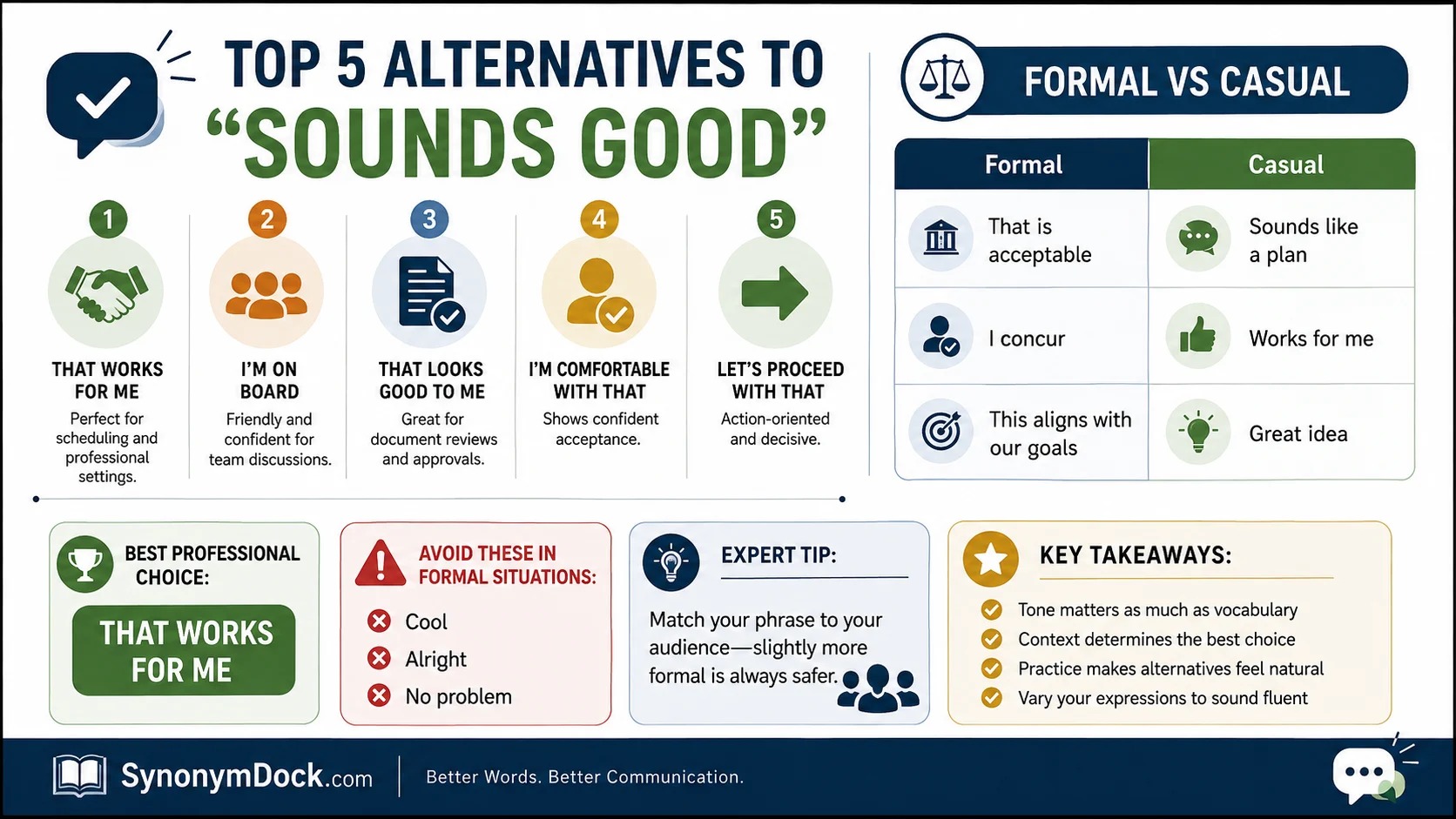
“Sounds good” is a casual way to express agreement or approval. Professional alternatives include “That works for me,” “I’m on board,” “That aligns with our goals,” “That’s acceptable,” and “I agree with this approach.” Choose based on your audience and context.
“Sounds good” is one of those go-to English phrases we use constantly. Whether you’re confirming a meeting time, approving a plan, or simply agreeing with someone, it feels natural and easy . But let’s be honest using it repeatedly can make your English sound repetitive and, at times, too casual for professional settings.
That’s why we’ve put together this comprehensive guide. You’ll discover 15 practical alternatives that will help you sound more fluent, professional, and confident in any situation from business emails to everyday conversations.
Quick Categories
Formal Alternatives
- That is acceptable
- I concur
- This aligns with our goals
- That would be suitable
- I approve of this
Pro Tip: Use these in official correspondence, legal documents, or when communicating with senior leadership to convey professionalism and respect.
Professional Alternatives
- That works for me
- I’m on board with this approach
- That’s a solid plan
- I agree with this approach
- This looks good to me
Pro Tip: These phrases are perfect for the workplace they sound polished without being overly stiff .
Business Email Alternatives
- That works on my end
- I’m comfortable with that
- Let’s proceed with that
- Consider it confirmed
- That’s manageable
Pro Tip: Email communication benefits from clarity and action. Choose phrases that confirm understanding and next steps .
Academic Alternatives
- I concur with your findings
- This proposal is satisfactory
- That appears methodologically sound
- I agree in principle
- That is a reasonable suggestion
Pro Tip: Academic writing values precision. These alternatives demonstrate thoughtful engagement with ideas.
Casual Alternatives
- Works for me
- Sounds like a plan
- I’m good with that
- Let’s do it
- Sure thing
Pro Tip: Use these with colleagues you know well or in relaxed social settings where formality isn’t required.
Informal Expressions
- Cool
- Perfect
- Great idea
- I’m in
- No problem
Pro Tip: These are great for text messages, team chats, or friendly conversations but avoid them in formal contexts .
Common Mistakes
| Mistake | Why It’s Incorrect | Correct Version | Example |
|---|---|---|---|
| Using “sounds good” in every situation | Overuse makes you sound repetitive and unprofessional | Vary your expressions based on context | Instead of “Sounds good” to your boss, say “That works for me |
| Saying “duly noted” without context | Sounds dismissive and passive-aggressive | Pair with a follow-up action | “Noted, I’ll review and get back to you by Friday” |
| Using “that’s fine” with negative tone | “Fine” can sound reluctant or annoyed | Use “That works well” or “I’m happy with that” | Instead of a flat “That’s fine,” say “That works well, thank you |
| Confusing formal and casual in emails | Mixing tones confuses the reader | Match tone to your audience | Save “Cool” for Slack, use “I’m on board” for email |
| Using “I approve this” when not in authority | Sounds presumptuous | Use “This looks good to me” | Instead of approving a colleague’s work, say “This looks good to me” |
What Does “Sounds Good” Mean?
Definition: “Sounds good” is an informal English expression used to show agreement, approval, or acceptance of a suggestion, plan, or idea.
Grammar Explanation: Technically, it’s a shortened version of “That sounds good,” where “that” refers to something previously mentioned . The verb “sound” in this context means “to convey an impression” .
Simple Explanation: When someone proposes something and you reply “Sounds good,” you’re saying “I agree with that” or “That plan works for me.
Example: “Let’s meet at 3 PM tomorrow.” “Sounds good, I’ll see you then.”
When to Use “Sounds Good”
Common Situations:
- Confirming plans with friends
- Responding to casual suggestions
- Acknowledging simple requests
Business Context:
- Use sparingly in professional emails
- Acceptable in internal team chats
- Avoid with new clients or senior leadership
Academic Context:
- Generally considered too casual
- Use formal alternatives in academic writing
Spoken vs. Written:
- Very common in spoken English
- Appears frequently in text messages and casual emails
- Should be used cautiously in formal writing
Formal vs. Informal:
- More informal than professional
- Use alternatives for formal situations
Is It Professional or Polite?
Polite? ✔ Yes, generally speaking.
Professional? Depends on context. With colleagues you know well, yes. With clients or leadership, no .
Formal? Sometimes, but it’s primarily neutral-to-informal.
Natural? ✔ Very natural in everyday conversation.
“The right tone makes your English sound more confident.”
Business Example: In a Slack message to a teammate, “Sounds good” is perfectly fine. In a client-facing email, “That works for me” would be more appropriate .
Pros and Cons
Pros
- Easy to understand
- Friendly and approachable
- Common and natural
- Short and efficient
Cons
- Overused and repetitive
- Limited range of tone
- Too casual for many workplaces
- Not ideal for formal writing
- Can sound dismissive if overused
15+ Best Alternatives to “Sounds Good”
1. That works for me
Meaning: I confirm that this plan or suggestion fits my needs.
Explanation: This is one of the most versatile professional alternatives. It’s neutral enough for most workplace situations while being more polished than “sounds good” . Native speakers use it constantly in both spoken and written English.
Example: “Can we move the meeting to 2 PM?” “That works for me. I’ll update the calendar.”
Best Use: Scheduling, planning, task confirmation
Avoid Using In: Very formal contracts or legal documents
Tone: Professional, Neutral
Formality Level: ⭐⭐⭐⭐ Formal
Usage Frequency: Very Common
CEFR Level: B1
Common Collocations:
- works for me
- works well for me
- that works perfectly
- works on my end
Context Variability:
- Spoken: “Works for me, let’s do it.”
- Professional: “The 10 AM slot works for me. I’ll prepare the agenda.”
- Casual: “Tuesday works for me. See you then!”
2. I’m on board with this
Meaning: I fully support and agree with this idea or plan.
Explanation: This phrase comes from the idea of being physically on a ship, ready to sail you’re metaphorically “on board” with someone else’s direction . It’s friendly yet professional, making it perfect for team discussions and project planning .
Example: “We’re thinking of launching the campaign earlier.” “I’m on board with this. Let’s adjust the timeline.”
Best Use: Team discussions, project proposals, collaborative settings
Avoid Using In: Very formal legal documents
Tone: Friendly, Confident
Formality Level: ⭐⭐⭐ Neutral (leaning professional)
Usage Frequency: Very Common
CEFR Level: B2
Common Collocations:
- fully on board
- on board with the plan
- on board with the idea
- on board with the approach
Context Variability:
- Spoken: “I’m on board, let’s go.”
- Professional: “I’m on board with this approach and ready to contribute.”
- Casual: “I’m on board with that idea.”
3. That’s a solid plan
Meaning: The proposal is well-structured, reliable, and has your approval.
Explanation: This phrase does more than just agree it compliments the other person’s planning ability. It’s particularly effective in professional settings where you want to encourage team members .
Example: “I suggest we break the project into three phases.” “That’s a solid plan. I’ll draft the timeline.”
Best Use: Project planning, proposal responses, team meetings
Avoid Using In: Very formal or academic settings
Tone: Encouraging, Professional
Formality Level: ⭐⭐⭐ Neutral (leaning professional)
Usage Frequency: Common
CEFR Level: B2
Common Collocations:
- solid plan
- sounds like a solid plan
- solid approach
- solid foundation
Context Variability:
- Professional: “That’s a solid plan. Let’s present it to the client.”
- Spoken: “Solid plan, I’m in.”
4. I agree with this approach
Meaning: I support the method or direction being suggested.
Explanation: This phrase sounds analytical and thoughtful, making it excellent for decision-making conversations. It shows you’ve considered the proposal, not just accepted it automatically .
Example: “I think we should focus on content marketing first.” “I agree with this approach. It’s more sustainable long-term.”
Best Use: Strategy meetings, decision-making, proposals
Avoid Using In: Quick, informal exchanges
Tone: Professional, Analytical
Formality Level: ⭐⭐⭐⭐ Formal
Usage Frequency: Common
CEFR Level: B2
Common Collocations:
- agree with the approach
- agree with the strategy
- agree with the direction
- completely agree
Context Variability:
- Professional: “I agree with this approach given our current resources.”
- Spoken: “I agree with this approach completely.”
5. That is acceptable
Meaning: The proposal or plan meets the minimum requirements for approval.
Explanation: This is a more formal alternative that’s ideal for official communication. However, it’s also more neutral and reserved it doesn’t convey enthusiasm but does communicate clear approval . Use it when you want to sound professional without being overly cheerful.
Example: “Can we extend the deadline to Friday?” “That is acceptable, as long as we deliver quality work.”
Best Use: Corporate emails, negotiations, formal communication
Avoid Using In: Casual conversations, friendly emails
Tone: Formal, Reserved
Formality Level: ⭐⭐⭐⭐⭐ Very Formal
Usage Frequency: Occasional
CEFR Level: C1
Common Collocations:
- acceptable to me
- acceptable under the circumstances
- mutually acceptable
- deemed acceptable
Context Variability:
- Professional: “Your proposal is acceptable. We can proceed.”
- Formal: “The revised terms are acceptable to both parties.”
6. This aligns with our goals
Meaning: The idea or plan matches existing objectives or direction.
Explanation: This phrase sounds strategic and business-savvy. It shows you’re thinking about the bigger picture, not just giving a quick agreement. Perfect for management-level communication .
Example: “We’re shifting focus to customer retention.” “This aligns with our goals for the quarter. Let’s support it.”
Best Use: Strategy meetings, leadership discussions, planning sessions
Avoid Using In: Casual or social settings
Tone: Strategic, Professional
Formality Level: ⭐⭐⭐⭐ Formal
Usage Frequency: Common in business
CEFR Level: C1
Common Collocations:
- aligns with our objectives
- aligns with our strategy
- aligns perfectly
- aligns well
Context Variability:
- Professional: “This aligns with our goals for Q3.”
- Spoken: “That aligns with what we discussed earlier.”
7. Let’s proceed with that
Meaning: I agree and want to move forward with this plan.
Explanation: This is an action-oriented phrase that shows you’re ready to move from discussion to execution. It’s motivating and demonstrates leadership .
Example: “I’ve outlined the next steps in the document.” “Great. Let’s proceed with that. I’ll assign the tasks.”
Best Use: Meetings, project transitions, decision points
Avoid Using In: Casual contexts
Tone: Action-oriented, Confident
Formality Level: ⭐⭐⭐⭐ Formal
Usage Frequency: Common
CEFR Level: B2
Common Collocations:
- proceed with the plan
- proceed with the strategy
- proceed as discussed
- proceed accordingly
Context Variability:
- Professional: “Let’s proceed with that and review next week.”
- Spoken: “Proceed, I trust your judgment.”
8. That looks good to me
Meaning: After reviewing, I approve or accept this.
Explanation: This is a friendly yet professional way to give approval, particularly when someone has shared work or a proposal for your review. It’s common in document reviews and email responses .
Example: “Here’s the revised draft of the report.” “That looks good to me. Thanks for the quick turnaround.”
Best Use: Email responses, document reviews, file approvals
Avoid Using In: Very formal legal documents
Tone: Friendly, Professional
Formality Level: ⭐⭐⭐ Neutral (leaning professional)
Usage Frequency: Very Common
CEFR Level: B1
Common Collocations:
- looks good to me
- looks great
- looks perfect
- looks clean
Context Variability:
- Professional: “That looks good to me. Please share it with the team.”
- Casual: “Looks good to me, send it.”
9. I’m comfortable with that
Meaning: I accept this and have no concerns or reservations.
Explanation: This phrase shows both agreement and confidence. It’s particularly useful in negotiations or when you want to reassure colleagues that you’re at ease with the decision .
Example: “We’ll need to reduce the budget by 10%.” “I’m comfortable with that. We can adjust the scope.”
Best Use: Negotiations, project adjustments, sensitive discussions
Avoid Using In: Very formal corporate settings
Tone: Confident, Professional
Formality Level: ⭐⭐⭐ Neutral
Usage Frequency: Common
CEFR Level: B2
Common Collocations:
- comfortable with the plan
- comfortable with the timeline
- comfortable with the decision
- perfectly comfortable
Context Variability:
- Professional: “I’m comfortable with that approach. Let’s move forward.”
- Spoken: “I’m comfortable with that plan.”
10. That works on my end
Meaning: From my side, everything is compatible and acceptable.
Explanation: This phrase is perfect for confirming scheduling, technical compatibility, or coordination. It’s friendly but professional, and shows you’ve checked your own availability or situation .
Example: “Is Friday at 3 PM good for you?” “That works on my end. I’ll send a calendar invite.”
Best Use: Schedules, agreements, task coordination
Avoid Using In: Formal written documents
Tone: Friendly, Professional
Formality Level: ⭐⭐⭐ Neutral
Usage Frequency: Very Common
CEFR Level: B2
Common Collocations:
- works on my end
- works from my side
- works on your end
- works for everyone
Context Variability:
- Professional: “That works on my end. I’ll confirm with the team.”
- Casual: “Works on my end, see you then.”
11. That’s a reasonable suggestion
Meaning: The idea is logical, fair, and makes sense.
Explanation: This diplomatic phrase shows thoughtfulness and respect. It acknowledges the other person’s contribution while demonstrating your own judgment .
Example: “I think we should start with a pilot program.” “That’s a reasonable suggestion. Let’s plan the scope.”
Best Use: Problem-solving, decision-making, negotiations
Avoid Using In: Quick, enthusiastic confirmations
Tone: Thoughtful, Professional
Formality Level: ⭐⭐⭐⭐ Formal
Usage Frequency: Occasional
CEFR Level: B2
Common Collocations:
- reasonable suggestion
- reasonable approach
- reasonable proposal
- perfectly reasonable
Context Variability:
- Professional: “That’s a reasonable suggestion. Let’s explore it further.”
- Spoken: “Reasonable. Let’s try it.”
12. I concur
Meaning: I agree with the stated position or opinion.
Explanation: This is a more formal and intellectual way to agree. It comes from Latin and is commonly used in academic, legal, and high-level professional settings . Use it when you want to sound precise and authoritative.
Example: “The data suggests we should expand into new markets.” “I concur. The analysis is compelling.”
Best Use: Academic writing, legal documents, formal meetings
Avoid Using In: Casual conversations, everyday emails
Tone: Intellectual, Formal
Formality Level: ⭐⭐⭐⭐⭐ Very Formal
Usage Frequency: Rare (academic/business only)
CEFR Level: C1
Common Collocations:
- concur with the findings
- concur with your assessment
- concur completely
- concur wholeheartedly
Context Variability:
- Academic: “I concur with your interpretation of the results.”
- Professional: “I concur with the recommendation.”
13. That would be suitable
Meaning: This option is appropriate and fits the requirements.
Explanation: This polished alternative works well in formal communication. It implies you’ve considered the proposal and found it appropriate .
Example: “We could use the conference room for the presentation.” “That would be suitable. I’ll book it now.”
Best Use: Project confirmations, formal emails, official communications
Avoid Using In: Fast-paced team chats
Tone: Polished, Formal
Formality Level: ⭐⭐⭐⭐ Formal
Usage Frequency: Occasional
CEFR Level: B2
Common Collocations:
- suitable for the occasion
- suitable for our needs
- perfectly suitable
- deemed suitable
Context Variability:
- Professional: “That would be suitable for the upcoming review.”
- Formal: “The selected option is suitable for our requirements.”
14. That’s fine with me
Meaning: I have no objections and accept the suggestion.
Explanation: This neutral phrase is safer than “sounds good” for everyday workplace communication. It shows you’re flexible and easygoing .
Example: “Can we start the meeting at 4 PM instead?” “That’s fine with me. I’ll adjust my schedule.”
Best Use: Neutral responses, flexible situations, workplace chat
Avoid Using In: Highly formal documents
Tone: Calm, Neutral
Formality Level: ⭐⭐ Casual/Neutral
Usage Frequency: Very Common
CEFR Level: B1
Common Collocations:
- fine with me
- fine by me
- perfectly fine
- absolutely fine
Context Variability:
- Spoken: “That’s fine with me, let’s do it.”
- Professional: “That’s fine with me. I’ll update the team.”
15. Excellent, let’s move forward
Meaning: This is great, and I want to start action.
Explanation: This enthusiastic and decisive phrase combines agreement with momentum. It works well in both formal and neutral settings, signaling both approval and readiness .
Example: “I’ve gotten final approval from the client.” “Excellent, let’s move forward. I’ll assemble the team.”
Best Use: Key decision points, project kickoffs, leadership communication
Avoid Using In: Very casual settings
Tone: Enthusiastic, Decisive
Formality Level: ⭐⭐⭐⭐ Formal
Usage Frequency: Common
CEFR Level: B2
Common Collocations:
- excellent plan
- excellent idea
- excellent work
- absolutely excellent
Context Variability:
- Professional: “Excellent, let’s move forward with implementation.”
- Spoken: “Excellent! Let’s get started.”
“Choosing the right phrase matters as much as choosing the right words.”
Native Speaker Tips
After Alternative 5:
Native English speakers rarely use “I concur” in daily conversation it sounds quite formal and academic. Reserve it for legal documents, academic writing, or situations where you want to sound highly professional . For most workplace settings, “That works for me” or “I’m on board” will serve you better .
After Alternative 10:
Notice how native speakers choose different phrases depending on medium. In Slack or Teams, you’ll hear “Sounds good” and “Works for me” constantly. But in a formal email, they shift to “That’s acceptable” or “I’m comfortable with that.” Pay attention to this medium-based variation to sound more natural .
Expert Insight
The most effective communicators don’t just have a bigger vocabulary they match their language to their audience. A phrase that works perfectly with a team member might not work with a new client. The key is developing awareness of context, not just memorizing alternatives . When you’re unsure, lean slightly more formal it’s safer than being too casual.
Quick Recap
- Best Professional Choice: That works for me
- Best Casual Choice: Sounds like a plan
- Best Formal Choice: That is acceptable
- Most Natural Choice: I’m on board
- Most Polite Choice: I’m comfortable with that
Top 10 Alternatives Compared
| Phrase | Tone | Formality | Best Use | Frequency |
|---|---|---|---|---|
| That works for me | Professional | Formal | Scheduling, planning | Very Common |
| I’m on board | Friendly | Neutral | Team discussions | Very Common |
| That’s a solid plan | Encouraging | Neutral | Project proposals | Common |
| I agree with this approach | Analytical | Formal | Strategy meetings | Common |
| That is acceptable | Reserved | Very Formal | Corporate emails | Occasional |
| This aligns with our goals | Strategic | Formal | Leadership talks | Common |
| Let’s proceed | Action-oriented | Formal | Decision points | Common |
| That looks good to me | Friendly | Neutral | Document reviews | Very Common |
| I’m comfortable | Confident | Neutral | Negotiations | Common |
| That’s fine with me | Calm | Casual/Neutral | Everyday responses | Very Common |
Which One Should You Use?
Best Overall: That works for me it works in almost any situation and sounds professional .
Best Professional: I’m on board with this friendly yet polished for workplace use .
Best Academic: I concur precise and intellectual .
Best Business Email: That looks good to me perfect for document review and approval .
Best Everyday Conversation: Sounds like a plan casual and encouraging .
Most Natural: That works for me native speakers use this constantly .
Most Polite: I’m comfortable with that shows you’ve considered the proposal .
Commonly Confused Phrases
“I agree” vs “I concur”
While both mean the same thing, “concur” is significantly more formal and intellectual. “I agree” works in almost any context; “I concur” belongs in formal writing or meetings .
“That works for me” vs “That’s fine with me”
“That works for me” sounds like you’ve actively considered it. “That’s fine with me” can sometimes sound reluctant or passive .
“I’m on board” vs “I’m comfortable with that”
“I’m on board” is more confident and enthusiastic. “I’m comfortable with that” suggests you’re accepting something rather than eagerly agreeing .
Scenario Practice
Scenario 1: Your manager proposes a new deadline.
Which phrase would you choose?
Correct Answer: “That works for me. I’ll adjust the schedule.”
Scenario 2: A colleague shares a draft for your review.
Which phrase would you choose?
Correct Answer: “That looks good to me. Nice work.”
Scenario 3: You’re in a strategy meeting and support a new direction.
Which phrase would you choose?
Correct Answer: “I agree with this approach. It’s the right move.”
Scenario 4: A client proposes formal terms.
Which phrase would you choose?
Correct Answer: “That is acceptable. We can proceed with the agreement.”
Scenario 5: Your team wants to try a new idea.
Which phrase would you choose?
Correct Answer: “I’m on board. Let’s test it and see results.”
Avoid These in Formal Situations
| Expression | Why to Avoid | Better Alternative |
|---|---|---|
| Cool | Too casual for professional settings | That works for me |
| Alright | Vague and informal | That’s acceptable |
| Sure thing | Friendly but unprofessional | I’m on board |
| No problem | Downplays seriousness in formal contexts | I’m comfortable with that |
| Got it | Can sound dismissive | I’ve noted that and will proceed |
Mini Quiz
1. Which phrase is most appropriate for a formal business email?
A) Cool
B) That works for me
C) Sounds like a plan
D) Alright
2. What tone does “I’m comfortable with that” convey?
A) Enthusiasm
B) Hesitation
C) Confident acceptance
D) Dismissiveness
3. Which phrase is best for agreeing in a strategy meeting?
A) I concur
B) Great idea
C) This aligns with our goals
D) Works for me
4. “That’s fine with me” is most suitable for:
A) Legal contracts
B) Everyday workplace conversation
C) Academic essays
D) Client proposals
5. Which phrase means “I approve after reviewing”?
A) Let’s proceed
B) That works on my end
C) That looks good to me
D) I’m on board
Answer Key
1. B “That works for me” is professionally appropriate for email. “Cool” and “Alright” are too casual .
2. C “I’m comfortable with that” signals confident acceptance without enthusiasm or reluctance .
3. C “This aligns with our goals” sounds strategic and business-savvy in leadership discussions .
4. B It’s neutral and suitable for workplace conversations but not formal documents .
5. C “That looks good to me” specifically indicates review and approval of submitted work .
FAQs
What is the most formal way to say “sounds good”?
The most formal alternatives include “That is acceptable,” “I concur,” and “This proposal is satisfactory” . These are appropriate for legal documents, academic writing, and highly formal corporate communication.
Which phrase is best for professional emails?
“That works for me” and “I’m on board” are both excellent choices for professional emails . They sound polished without being overly formal or stiff. For client-facing emails, “That looks good to me” is also a safe and professional option .
What is the difference between “That’s fine with me” and “That works for me”?
“That works for me” sounds like you’ve actively considered the proposal and find it suitable. “That’s fine with me” is more neutral and can sometimes sound reluctant or less engaged . In professional settings, “That works for me” is usually the better choice.
Which alternative sounds most natural to native speakers?
“That works for me” and “I’m on board” sound very natural to native English speakers . These phrases appear frequently in both workplace and casual settings and don’t sound forced or overly formal.
Can I use these expressions in business meetings?
Yes, most of these alternatives work well in business meetings. For formal meetings, choose “I agree with this approach,” “This aligns with our goals,” or “Let’s proceed with that.” For more casual team meetings, “I’m on board” or “That works for me” are excellent choices .
Conclusion
Learning alternatives to “sounds good” is about more than just expanding your vocabulary it’s about developing the communication skills that help you succeed in professional environments. Whether you’re writing emails, participating in meetings, or simply having conversations, choosing the right expression demonstrates confidence, professionalism, and cultural awareness .
Start by practicing one or two alternatives this week. Notice how native speakers respond to your word choices. With time and practice, these alternatives will become second nature, and you’ll communicate with greater precision and confidence in every situation.

11 thoughts on “Other Ways to Say “Sounds Good” |5+ Examples For 2026”