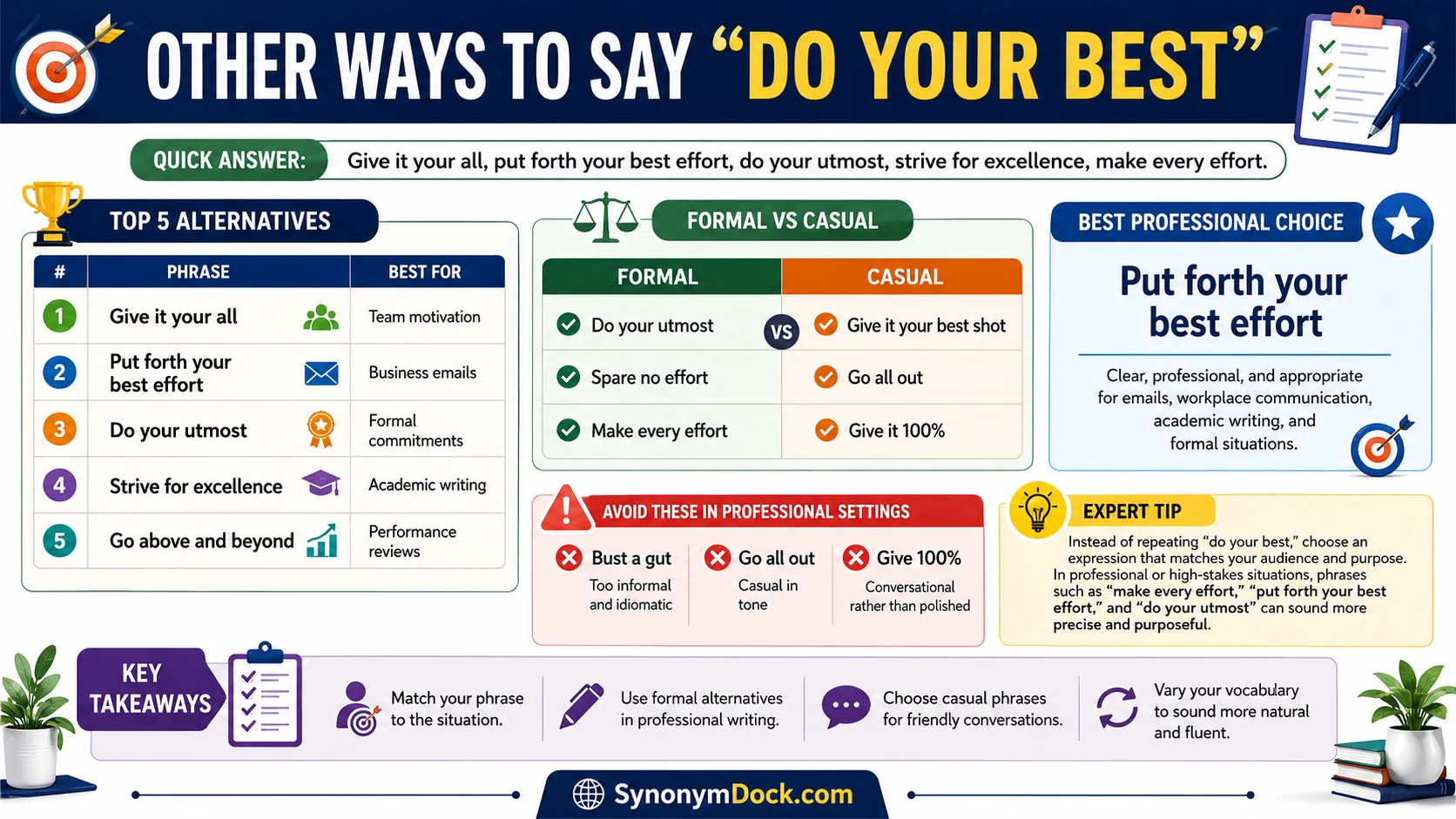
Looking for other ways to say “do your best”? You can say give it your all, put forth your best effort, do your utmost, strive for excellence, or leave no stone unturned. The best choice depends on your situation formal, professional, casual, or academic. Top 5 alternatives: Give it your all, put forth your best effort, do your utmost, strive for excellence, leave no stone unturned.
We’ve all been there. You’re in a meeting, writing an email, or encouraging a colleague, and the words “do your best” roll off your tongue. It’s a perfectly fine phrasebut it’s also one of the most overused expressions in English.
The problem? When you say “do your best” too often, it loses its impact. It starts to sound like a cliché rather than genuine encouragement or commitment. That’s why learning other ways to say “do your best” can transform your communication.
Whether you’re writing a performance review, motivating a team, or promising to tackle a challenging project, having a variety of expressions at your disposal makes you sound more fluent, more professional, and more confident. Let’s explore the best alternatives to “do your best” for every situation.
Quick Categories
Formal Alternatives
- Do your utmost
- Exert your utmost effort
- Make every effort
- Spare no effort
- Do everything in your power
Pro Tip: Formal alternatives work best in official documents, academic writing, and high-stakes professional communication where you need to sound serious and committed.
Professional Alternatives
- Put forth your best effort
- Give it your all
- Strive for excellence
- Go above and beyond
- Commit fully to the task
Pro Tip: In workplace settings, these phrases show dedication without overpromising. They’re confident but realistic.
Business Email Alternatives
- I am fully committed to delivering great results
- You can count on my best effort
- I will handle this to the best of my ability
- Rest assured, I’ll give this my full attention
- I aim to bring my best to the table
Pro Tip: Email communication requires clarity and professionalism. These phrases reassure your reader while maintaining a polished tone.
Academic Alternatives
- Strive for academic excellence
- Apply oneself diligently
- Pursue the highest standards
- Engage fully with the material
- Demonstrate one’s full potential
Pro Tip: Academic contexts value precision and dedication. These phrases show intellectual commitment and serious engagement.
Casual Alternatives
- Give it your best shot
- Try your hardest
- Give 100%
- Go for it
- Give it everything you’ve got
Pro Tip: Casual alternatives are perfect for friends, family, and relaxed conversations. They’re warm, encouraging, and natural.
Informal Expressions
- Bust a gut
- Go all out
- Leave no stone unturned
- Pull out all the stops
- Move heaven and earth
Pro Tip: Informal idioms add color and personality to your speech. Use them with people you know well, but avoid them in formal writing.
“The right phrase can turn a simple encouragement into genuine motivation.”
Common Mistakes
| Mistake | Why It’s Incorrect | Correct Version | Example |
| Using “do your best” in every situation | It becomes repetitive and loses meaning | Vary your expressions based on context | Instead of “I’ll do my best,” try “I’m fully committed” |
| Saying “try your best” when you mean “do your best” | “Try” focuses on effort; “do” focuses on performance | Use “do your best” for performance, “try your best” for effort | “Try your best in the race” vs “Do your best on the exam” |
| Overusing “give 100%” in professional writing | It sounds clichéd and informal | Use more specific professional phrases | Instead of “I’ll give 100%,” say “I’ll put forth my best effort” |
| Using “bust a gut” in a formal email | It’s too casual and inappropriate | Choose formal or professional alternatives | Use “make every effort” instead |
| Promising “I’ll do my best” without specifics | It sounds vague and uncertain | Be more specific about your commitment | Say “I’ll complete this by Friday” instead |
What Does “Do Your Best” Mean?
Definition: To make the greatest possible effort in a task or activity; to perform to the best of one’s abilities.
Grammar: “Do your best” is a verb phrase. “Do” is the main verb, “your” is the possessive adjective, and “best” functions as a noun meaning “the most excellent effort.”
Simple Explanation: When you say “do your best,” you’re encouraging someone to put in maximum effortnot necessarily to achieve perfection, but to give everything they have.
Example: “Just do your best on the presentation, and don’t worry about the outcome.”
When to Use “Do Your Best”
- Everyday conversation: Encouraging a friend or family member
- Workplace motivation: Boosting team morale
- Academic settings: Encouraging students before an exam
- Sports and competitions: Motivating teammates
- Personal goals: Reminding yourself to give full effort
- Parenting: Encouraging children to try hard
- Written communication: Expressing commitment in emails
Note: While “do your best” works in many situations, it can sound vague or overused in formal or high-stakes contexts.
Is It Professional or Polite?
| Aspect | Rating | Explanation |
| Polite? | ✔ Yes | It’s encouraging and supportive |
| Professional? | ⚠️ Depends | Works in casual professional settings but sounds vague in formal ones |
| Formal? | ❌ No | It’s neutral, not formal |
| Natural? | ✔ Yes | Native speakers use it daily |
Example in a business email: “I’ll do my best to get this to you by Friday.” (Acceptable but could be stronger: “I’m fully committed to delivering this by Friday.”)
Pros and Cons
Pros
- Easy to understand for all English learners
- Friendly and encouraging tone
- Commonly used by native speakers
- Works in many everyday situations
- Shows humility and honesty
Cons
- Overused and can sound like a cliché
- Vaguedoesn’t specify what “best” actually means
- Can sound uncertain or weak in professional settings
- Not ideal for formal writing or official documents
- May come across as lacking confidence
30+ Other Ways to Say “Do Your Best”
Ready to expand your vocabulary? Here are 30+ powerful alternatives to “do your best,” organized from the most useful to the least common. Each entry includes everything you need to use it correctly.
[1]. Give It Your All
Meaning: To put maximum effort and energy into something.
Explanation: This phrase is energetic and passionate. Native speakers use it when they want to emphasize total commitment. It sounds more powerful than “do your best” because it suggests giving everything you havenot just trying.
Example Sentence: “This project means a lot to the team, so let’s give it our all.”
Best Use: Team motivation, personal commitment, sports
Avoid Using In: Formal contracts, legal documents
Tone: Passionate, Positive
Formality Level: ⭐⭐ Casual
Usage Frequency: Very Common
CEFR Level: B2
Common Collocations:
- give it your all
- give your all to the project
- give it everything you’ve got
Context Variability:
- Spoken: “I’m going to give it my all in the game tomorrow.”
- Professional: “We need everyone to give it their all on this campaign.”
- Casual: “Just give it your all and see what happens.”
[2]. Put Forth Your Best Effort
Meaning: To make your best attempt at something.
Explanation: This is a professional and polished alternative. It sounds more deliberate and thoughtful than “do your best.” Native speakers often use it in workplace contexts when they want to sound committed without overpromising.
Example Sentence: “I’ll put forth my best effort to ensure this campaign succeeds.”
Best Use: Business emails, performance reviews, professional commitments
Avoid Using In: Casual conversations with friends
Tone: Professional, Confident
Formality Level: ⭐⭐⭐⭐ Formal
Usage Frequency: Common
CEFR Level: B2
Common Collocations:
- put forth effort
- put forth maximum effort
- put forth your best effort
Context Variability:
- Spoken: “I’ll put forth my best effort on this assignment.”
- Professional: “Our team will put forth its best effort to meet the deadline.”
[3]. Do Your Utmost
Meaning: To make the greatest possible effort.
Explanation: “Utmost” means the highest degree or maximum. This is a more formal and sophisticated version of “do your best.” Native speakers use it in serious or formal contexts when they want to sound especially committed.
Example Sentence: “The doctors will do their utmost to save the patient.”
Best Use: Formal communication, official statements, serious commitments
Avoid Using In: Casual text messages, everyday conversation
Tone: Serious, Formal
Formality Level: ⭐⭐⭐⭐⭐ Very Formal
Usage Frequency: Occasional
CEFR Level: C1
Common Collocations:
- do your utmost
- do one’s utmost
- do their utmost to help
Context Variability:
- Spoken: “I’ll do my utmost to get there on time.”
- Professional: “We will do our utmost to resolve this issue.”
[4]. Strive for Excellence
Meaning: To make great efforts to achieve a high standard.
Explanation: This phrase focuses on quality rather than just effort. It suggests aiming for the highest possible standard, not just “trying.” Native speakers use it in academic, professional, and personal development contexts.
Example Sentence: “Our company culture encourages every employee to strive for excellence.”
Best Use: Academic writing, company mission statements, personal goals
Avoid Using In: Casual conversation, informal emails
Tone: Ambitious, Professional
Formality Level: ⭐⭐⭐⭐ Formal
Usage Frequency: Common
CEFR Level: B2
Common Collocations:
- strive for excellence
- strive for perfection
- strive to achieve
Context Variability:
- Spoken: “I always strive for excellence in my work.”
- Professional: “We strive for excellence in everything we do.”
“The difference between ‘do your best’ and ‘strive for excellence’ is the difference between effort and ambition.”
[5]. Make Every Effort
Meaning: To try very hard to achieve something.
Explanation: This is a clear, professional way to express commitment. It suggests that no effort will be spared. Native speakers use it in both formal and professional contexts when they want to sound determined.
Example Sentence: “We will make every effort to complete the project ahead of schedule.”
Best Use: Business communication, formal promises, client commitments
Avoid Using In: Very casual conversations
Tone: Determined, Professional
Formality Level: ⭐⭐⭐⭐ Formal
Usage Frequency: Very Common
CEFR Level: B1
Common Collocations:
- make every effort
- make every possible effort
- make every effort to ensure
Context Variability:
- Spoken: “I’ll make every effort to be there.”
- Professional: “The team will make every effort to deliver on time.”
[6]. Go Above and Beyond
Meaning: To do more than what is expected or required.
Explanation: This phrase implies exceeding expectations, not just meeting them. Native speakers love this expression because it shows exceptional commitment. It’s commonly used in performance reviews and workplace praise.
Example Sentence: “She always goes above and beyond to help her colleagues.”
Best Use: Performance reviews, workplace praise, job interviews
Avoid Using In: Formal academic writing
Tone: Praising, Inspiring
Formality Level: ⭐⭐⭐ Neutral
Usage Frequency: Very Common
CEFR Level: B2
Common Collocations:
- go above and beyond
- go above and beyond the call of duty
- above and beyond expectations
Context Variability:
- Spoken: “He really went above and beyond on that project.”
- Professional: “We encourage employees to go above and beyond for clients.”
[7]. Leave No Stone Unturned
Meaning: To do everything possible to achieve something.
Explanation: This is an idiom that means being thorough and exhaustive in your efforts. Native speakers use it when they want to emphasize that every possible avenue will be explored. It’s colorful but still professional enough for many contexts.
Example Sentence: “The detective left no stone unturned in the investigation.”
Best Use: Problem-solving, investigations, thorough searches
Avoid Using In: Very formal legal documents
Tone: Thorough, Determined
Formality Level: ⭐⭐ Casual
Usage Frequency: Common
CEFR Level: C1
Common Collocations:
- leave no stone unturned
- left no stone unturned
- leaving no stone unturned
Context Variability:
- Spoken: “We’ll leave no stone unturned to find a solution.”
- Professional: “Our team left no stone unturned during the audit.”
[8]. Pull Out All the Stops
Meaning: To make a maximum effort; to use all available resources.
Explanation: This idiom comes from organ music, where “stops” control the volume. Pulling out all the stops means using everything you have. Native speakers use it to describe going all out, especially for important events or deadlines.
Example Sentence: “We pulled out all the stops to make the conference a success.”
Best Use: Events, presentations, important projects
Avoid Using In: Formal business reports
Tone: Energetic, Committed
Formality Level: ⭐⭐ Casual
Usage Frequency: Common
CEFR Level: C1
Common Collocations:
- pull out all the stops
- pulled out all the stops
- pulling out all the stops
Context Variability:
- Spoken: “Let’s pull out all the stops for the party.”
- Professional: “The marketing team pulled out all the stops for the product launch.”
[9]. Spare No Effort
Meaning: To make every possible effort; to not hold back.
Explanation: This phrase emphasizes that you will give everything you have without holding anything back. Native speakers use it in formal and professional contexts when they want to sound completely committed.
Example Sentence: “We will spare no effort to ensure customer satisfaction.”
Best Use: Formal commitments, official statements, customer service
Avoid Using In: Casual conversation, friendly chats
Tone: Serious, Committed
Formality Level: ⭐⭐⭐⭐⭐ Very Formal
Usage Frequency: Occasional
CEFR Level: C1
Common Collocations:
- spare no effort
- spare no expense
- spare no trouble
Context Variability:
- Spoken: “They spared no effort to make the event perfect.”
- Professional: “We will spare no effort to resolve your complaint.”
[10]. Give It Your Best Shot
Meaning: To try as hard as you can.
Explanation: This is a friendly, encouraging idiom. It suggests giving something your best attempt without worrying too much about the outcome. Native speakers use it frequently in casual and semi-professional settings.
Example Sentence: “Just give it your best shotthat’s all anyone can ask.”
Best Use: Encouragement, sports, friendly advice
Avoid Using In: Formal writing, official documents
Tone: Friendly, Encouraging
Formality Level: ⭐⭐ Casual
Usage Frequency: Very Common
CEFR Level: B1
Common Collocations:
- give it your best shot
- give something your best shot
- best shot
Context Variability:
- Spoken: “Give it your best shotyou’ve got nothing to lose.”
- Professional: “Give the presentation your best shot.”
“Encouragement works best when it’s specific. ‘Give it your best shot’ feels personal; ‘do your best’ feels generic.”
Expert Insight
Native speakers rarely use “do your best” in high-stakes professional situations because it sounds like a hedgea way of saying “I might fail, but at least I tried.” Instead, they choose phrases that project confidence and commitment. In a job interview, saying “I’m fully committed to delivering results” sounds far stronger than “I’ll do my best.”
[11]. Do Everything in Your Power
Meaning: To make every possible effort.
Explanation: This phrase suggests using all available resources and abilities. Native speakers use it when they want to emphasize that nothing will be left undone. It’s formal but still clear and natural.
Example Sentence: “I’ll do everything in my power to get this resolved today.”
Best Use: Formal promises, customer service, serious commitments
Avoid Using In: Casual conversation
Tone: Serious, Committed
Formality Level: ⭐⭐⭐⭐ Formal
Usage Frequency: Common
CEFR Level: B2
Common Collocations:
- do everything in your power
- do everything in one’s power
- everything in our power
Context Variability:
- Spoken: “I’ll do everything in my power to help.”
- Professional: “We will do everything in our power to satisfy our clients.”
[12]. Go the Extra Mile
Meaning: To make more effort than is expected.
Explanation: This phrase means doing more than what’s requiredgoing beyond the minimum. Native speakers use it to praise people who show exceptional dedication. It’s warm and positive.
Example Sentence: “Our customer service team always goes the extra mile.”
Best Use: Workplace praise, customer service, personal dedication
Avoid Using In: Formal academic writing
Tone: Praising, Warm
Formality Level: ⭐⭐⭐ Neutral
Usage Frequency: Very Common
CEFR Level: B2
Common Collocations:
- go the extra mile
- going the extra mile
- went the extra mile
Context Variability:
- Spoken: “She always goes the extra mile for her friends.”
- Professional: “We appreciate employees who go the extra mile.”
[13]. Exert Your Utmost Effort
Meaning: To use the greatest possible effort.
Explanation: This is a very formal version of “do your best.” “Exert” means to apply or use, and “utmost” means maximum. Native speakers use it in official or academic contexts when they want to sound especially serious.
Example Sentence: “All students are expected to exert their utmost effort in their studies.”
Best Use: Academic writing, official documents, formal instructions
Avoid Using In: Everyday conversation, casual emails
Tone: Formal, Serious
Formality Level: ⭐⭐⭐⭐⭐ Very Formal
Usage Frequency: Rare
CEFR Level: C1
Common Collocations:
- exert effort
- exert maximum effort
- exert your utmost effort
Context Variability:
- Spoken: Rarely used in speech.
- Professional: “Employees should exert their utmost effort to meet company goals.”
[14]. Give 100%
Meaning: To put in full effort.
Explanation: This is a straightforward, slightly informal way to say “do your best.” It’s numerical and cleareveryone understands what 100% means. Native speakers use it in casual and semi-professional settings.
Example Sentence: “Just give 100% and don’t worry about the rest.”
Best Use: Sports, casual motivation, team talks
Avoid Using In: Formal business documents
Tone: Motivating, Direct
Formality Level: ⭐⭐ Casual
Usage Frequency: Very Common
CEFR Level: B1
Common Collocations:
- give 100%
- give 110%
- give it 100%
Context Variability:
- Spoken: “Give 100% in practice every day.”
- Professional: “We need everyone to give 100% on this project.”
[15]. Try Your Hardest
Meaning: To make the greatest possible effort.
Explanation: This is a close cousin to “do your best.” The difference? “Try” emphasizes effort, while “do” emphasizes performance. Native speakers use “try your hardest” when they want to encourage effort regardless of outcome.
Example Sentence: “Try your hardest and don’t worry about winning.”
Best Use: Encouragement, sports, children
Avoid Using In: Formal professional commitments
Tone: Encouraging, Supportive
Formality Level: ⭐⭐ Casual
Usage Frequency: Very Common
CEFR Level: A2
Common Collocations:
- try your hardest
- try one’s hardest
- tried my hardest
Context Variability:
- Spoken: “Just try your hardestthat’s all that matters.”
- Professional: “Try your hardest to meet the deadline.”
[16]. Be at Pains to Do Something
Meaning: To make a special effort to do something.
Explanation: This is a slightly old-fashioned but still correct phrase. It means taking extra care or making a special effort. Native speakers use it less frequently today, but it still appears in formal writing.
Example Sentence: “The manager was at pains to explain the new policy clearly.”
Best Use: Formal writing, official explanations
Avoid Using In: Casual conversation
Tone: Careful, Formal
Formality Level: ⭐⭐⭐⭐ Formal
Usage Frequency: Rare
CEFR Level: C1
Common Collocations:
- be at pains to
- take pains to
- go to great pains
Context Variability:
- Spoken: Rarely used.
- Professional: “The company was at pains to reassure its investors.”
[17]. Move Heaven and Earth
Meaning: To do everything possible to achieve something.
Explanation: This is a dramatic idiom that means making extraordinary efforts. Native speakers use it when they want to emphasize that nothing will stop them from achieving a goal. It’s colorful and expressive.
Example Sentence: “I’ll move heaven and earth to make this project a success.”
Best Use: Dramatic promises, strong commitments
Avoid Using In: Formal writing, official documents
Tone: Dramatic, Passionate
Formality Level: ⭐ Very Informal
Usage Frequency: Occasional
CEFR Level: C1
Common Collocations:
- move heaven and earth
- moved heaven and earth
- moving heaven and earth
Context Variability:
- Spoken: “I’ll move heaven and earth to get there.”
- Professional: Use sparingly; it’s very informal.
[18]. Apply Yourself
Meaning: To work hard and with focus.
Explanation: This phrase emphasizes concentration and dedication rather than just effort. Native speakers use it especially in academic and learning contexts. It suggests directed effort, not just any effort.
Example Sentence: “If you apply yourself, you can achieve great results.”
Best Use: Academic settings, personal development, study advice
Avoid Using In: Casual conversation about everyday tasks
Tone: Encouraging, Focused
Formality Level: ⭐⭐⭐ Neutral
Usage Frequency: Common
CEFR Level: B2
Common Collocations:
- apply yourself
- apply oneself
- apply your mind
Context Variability:
- Spoken: “You need to apply yourself more in class.”
- Professional: “Apply yourself to the task and you’ll succeed.”
[19]. Commit Fully
Meaning: To give complete dedication to something.
Explanation: This phrase focuses on dedication rather than effort. It suggests that you’re not just tryingyou’re all in. Native speakers use it in professional contexts when they want to sound serious and reliable.
Example Sentence: “I’m ready to commit fully to this role and its responsibilities.”
Best Use: Job interviews, professional commitments, personal promises
Avoid Using In: Casual chats about minor tasks
Tone: Serious, Professional
Formality Level: ⭐⭐⭐⭐ Formal
Usage Frequency: Common
CEFR Level: B2
Common Collocations:
- commit fully
- fully committed
- commit to the task
Context Variability:
- Spoken: “I’m committed fully to this goal.”
- Professional: “We are fully committed to our clients’ success.”
[20]. Go All Out
Meaning: To make a maximum effort.
Explanation: This informal phrase means using all your energy and resources. Native speakers use it when they want to sound enthusiastic and determined. It’s casual but powerful.
Example Sentence: “We’re going all out for the product launch.”
Best Use: Events, celebrations, sports
Avoid Using In: Formal business communication
Tone: Energetic, Enthusiastic
Formality Level: ⭐⭐ Casual
Usage Frequency: Very Common
CEFR Level: B2
Common Collocations:
- go all out
- going all out
- went all out
Context Variability:
- Spoken: “Let’s go all out for the party.”
- Professional: Use sparingly; “go all out” is informal.
“The most powerful phrases are the ones that match the moment. Formal situations demand formal language; casual moments call for warmth.”
Native Speaker Tip
Among all the alternatives, native speakers use “give it your all” and “go the extra mile” most frequently in everyday conversation. “Do your utmost” sounds quite formal and is less common in casual speechyou’ll hear it more in official statements or serious contexts. If you want to sound natural, reach for “give it your all” or “go above and beyond” in most professional situations.
[21]. Do Your Level Best
Meaning: To do as well as you possibly can.
Explanation: This phrase adds “level” to emphasize the highest possible standard. It’s a bit old-fashioned but still used, especially in British English. Native speakers use it when they want to sound sincere and slightly formal.
Example Sentence: “Just do your level best, and that’s all anyone can ask.”
Best Use: Encouragement, sincere advice
Avoid Using In: Modern business writing
Tone: Sincere, Slightly Old-Fashioned
Formality Level: ⭐⭐⭐ Neutral
Usage Frequency: Occasional
CEFR Level: B2
Common Collocations:
- do your level best
- one’s level best
- level best
Context Variability:
- Spoken: “Do your level best on the exam.”
- Professional: Less common in modern professional contexts.
[22]. Endeavor to Succeed
Meaning: To try hard to achieve success.
Explanation: “Endeavor” is a more formal verb meaning “to try.” This phrase sounds polished and ambitious. Native speakers use it in formal writing and speeches.
Example Sentence: “We will endeavor to succeed despite the challenges.”
Best Use: Formal writing, speeches, official statements
Avoid Using In: Everyday conversation
Tone: Ambitious, Formal
Formality Level: ⭐⭐⭐⭐⭐ Very Formal
Usage Frequency: Occasional
CEFR Level: C1
Common Collocations:
- endeavor to succeed
- endeavor to achieve
- endeavor to improve
Context Variability:
- Spoken: Rarely used.
- Professional: “We endeavor to succeed in all our ventures.”
[23]. Put Your Heart and Soul Into It
Meaning: To do something with great passion and effort.
Explanation: This is a warm, emotional idiom. It means giving not just effort but also passion and care. Native speakers use it to describe deep commitment to something meaningful.
Example Sentence: “She put her heart and soul into the charity event.”
Best Use: Emotional commitments, creative work, personal projects
Avoid Using In: Formal business documents
Tone: Passionate, Warm
Formality Level: ⭐⭐ Casual
Usage Frequency: Common
CEFR Level: B2
Common Collocations:
- put your heart and soul into
- put one’s heart and soul into
- heart and soul
Context Variability:
- Spoken: “I put my heart and soul into that painting.”
- Professional: Use cautiously; it’s quite emotional.
[24]. Rise to the Occasion
Meaning: To perform well in a difficult situation.
Explanation: This phrase means meeting a challenge successfully. It’s not just about tryingit’s about succeeding when it matters most. Native speakers use it to praise people who handle pressure well.
Example Sentence: “The team rose to the occasion and delivered outstanding results.”
Best Use: Performance reviews, praise, motivational speeches
Avoid Using In: Casual conversation about routine tasks
Tone: Inspiring, Praising
Formality Level: ⭐⭐⭐ Neutral
Usage Frequency: Common
CEFR Level: B2
Common Collocations:
- rise to the occasion
- rose to the occasion
- rising to the occasion
Context Variability:
- Spoken: “You really rose to the occasion today.”
- Professional: “Our staff rose to the occasion during the crisis.”
[25]. Give Your All
Meaning: To make a complete effort.
Explanation: This is a shorter version of “give it your all.” It’s direct and powerful. Native speakers use it when they want to emphasize total commitment.
Example Sentence: “I’m ready to give my all to this project.”
Best Use: Personal commitment, team motivation
Avoid Using In: Formal writing
Tone: Passionate, Committed
Formality Level: ⭐⭐ Casual
Usage Frequency: Common
CEFR Level: B2
Common Collocations:
- give your all
- give one’s all
- gave my all
Context Variability:
- Spoken: “Give your all in every game.”
- Professional: “I’ll give my all to make this work.”
[26]. Push Yourself
Meaning: To make a strong effort beyond your comfort zone.
Explanation: This phrase emphasizes going beyond what’s comfortable. Native speakers use it to encourage growth and improvement. It’s about stretching your limits.
Example Sentence: “You need to push yourself if you want to improve.”
Best Use: Personal development, fitness, learning
Avoid Using In: Formal professional writing
Tone: Motivating, Challenging
Formality Level: ⭐⭐ Casual
Usage Frequency: Very Common
CEFR Level: B1
Common Collocations:
- push yourself
- push yourself harder
- push yourself to the limit
Context Variability:
- Spoken: “Push yourself in training.”
- Professional: “We encourage employees to push themselves.”
[27]. Bring Your A-Game
Meaning: To perform at your highest level.
Explanation: This idiom comes from sports, where “A-game” means your best performance. Native speakers use it in professional and casual contexts to mean giving your absolute best.
Example Sentence: “We need everyone to bring their A-game to this presentation.”
Best Use: Motivation, sports, professional performance
Avoid Using In: Very formal writing
Tone: Energetic, Motivating
Formality Level: ⭐⭐ Casual
Usage Frequency: Common
CEFR Level: B2
Common Collocations:
- bring your A-game
- bring one’s A-game
- A-game
Context Variability:
- Spoken: “Bring your A-game to the match.”
- Professional: “We need to bring our A-game to win this contract.”
[28]. Do All You Can
Meaning: To make every possible effort.
Explanation: This is a simple, clear alternative. It means using all available resources and abilities. Native speakers use it when they want to be straightforward and honest.
Example Sentence: “Just do all you can, and don’t worry about the rest.”
Best Use: Encouragement, sincere advice
Avoid Using In: Formal business documents
Tone: Honest, Encouraging
Formality Level: ⭐⭐⭐ Neutral
Usage Frequency: Very Common
CEFR Level: A2
Common Collocations:
- do all you can
- do everything you can
- do what you can
Context Variability:
- Spoken: “Do all you can to help.”
- Professional: “Do all you can to meet the deadline.”
[29]. Give Everything You’ve Got
Meaning: To use all your energy and ability.
Explanation: This is a warm, encouraging phrase that means total effort. Native speakers use it to motivate others in both casual and semi-professional settings.
Example Sentence: “Give everything you’ve got in the final round.”
Best Use: Sports, performances, personal challenges
Avoid Using In: Formal writing
Tone: Encouraging, Warm
Formality Level: ⭐⭐ Casual
Usage Frequency: Common
CEFR Level: B1
Common Collocations:
- give everything you’ve got
- give it everything
- everything you’ve got
Context Variability:
- Spoken: “Give everything you’ve got in the race.”
- Professional: “Give everything you’ve got to this project.”
[30]. Bust a Gut
Meaning: To work extremely hard.
Explanation: This is a very informal, slightly crude idiom. It means working so hard that you might hurt yourself. Native speakers use it only in very casual contexts, usually with friends or close colleagues.
Example Sentence: “I busted a gut to get this finished on time.”
Best Use: Very casual conversation, storytelling
Avoid Using In: Any professional or formal context
Tone: Very Informal, Humorous
Formality Level: ⭐ Very Informal
Usage Frequency: Occasional
CEFR Level: C1
Common Collocations:
- bust a gut
- busted a gut
- busting a gut
Context Variability:
- Spoken: “I busted a gut to get here.”
- Professional: Never use in professional contexts.
Avoid These in Formal Situations
| Phrase | Why to Avoid | Better Alternative |
| Bust a gut | Too crude and informal | Make every effort |
| Give 100% | Sounds like a sports cliché | Put forth your best effort |
| Try your best | Focuses on trying, not achieving | Strive for excellence |
| Do your level best | Sounds old-fashioned | Do your utmost |
| Go all out | Too casual for formal writing | Spare no effort |
Top 10 Alternatives Compared
| Phrase | Tone | Formality | Best Use | Frequency |
| Give it your all | Passionate | Casual | Team motivation | Very Common |
| Put forth your best effort | Professional | Formal | Business emails | Common |
| Do your utmost | Serious | Very Formal | Official statements | Occasional |
| Strive for excellence | Ambitious | Formal | Academic writing | Common |
| Make every effort | Determined | Formal | Client commitments | Very Common |
| Go above and beyond | Praising | Neutral | Performance reviews | Very Common |
| Leave no stone unturned | Thorough | Casual | Problem-solving | Common |
| Pull out all the stops | Energetic | Casual | Events, presentations | Common |
| Spare no effort | Serious | Very Formal | Formal promises | Occasional |
| Give it your best shot | Friendly | Casual | Encouragement | Very Common |
Which One Should You Use?
Best Overall: Give it your all It’s natural, powerful, and works in most situations.
Best Professional: Put forth your best effort It sounds committed and polished.
Best Academic: Strive for excellence It shows ambition and intellectual dedication.
Best Business Email: Make every effort It’s clear, professional, and reassuring.
Best Everyday Conversation: Give it your best shot It’s friendly and encouraging.
Most Natural: Go above and beyond Native speakers use it frequently.
Most Polite: I’ll handle this to the best of my ability It’s humble but confident.
Commonly Confused Phrases
| Phrase | Meaning | When to Use |
| “Do your best” | Give maximum effort | General use |
| “Try your best” | Make an effort, even if you might fail | When outcome is uncertain |
| “Give it your all” | Give everything you have | When you want to sound passionate |
| “Do your utmost” | Make the greatest possible effort | Formal situations |
| “Strive for excellence” | Aim for the highest standard | Academic/professional goals |
Scenario Practice
Scenario 1: Business Meeting
Your team is facing a tight deadline. You want to motivate them.
Which phrase would you choose? “Let’s give it our all and make this deadline.”
Why? “Give it your all” is energetic and motivationalperfect for rallying a team.
Scenario 2: Job Interview
The interviewer asks if you can handle a challenging role.
Which phrase would you choose? “I’m fully committed to delivering great results in this position.”
Why? This sounds confident and professional, unlike “I’ll do my best,” which can sound uncertain.
Scenario 3: Academic Essay
You’re writing about a company’s commitment to quality.
Which phrase would you choose? “The company strives for excellence in every product it creates.”
Why? “Strive for excellence” sounds academic and ambitious.
Scenario 4: Encouraging a Friend
Your friend is nervous about a performance.
Which phrase would you choose? “Just give it your best shotyou’ll be great.”
Why? This is warm, friendly, and takes the pressure off.
Scenario 5: Formal Email to a Client
You’re promising to resolve an issue.
Which phrase would you choose? “We will make every effort to resolve this matter promptly.”
Why? “Make every effort” is professional and reassuring without overpromising.
Mini Quiz
1. Which phrase is best for a formal business email?
- A) Bust a gut
- B) Give it your best shot
- C) Make every effort
- D) Go all out
2. Which phrase means “to do more than expected”?
- A) Do your utmost
- B) Go above and beyond
- C) Try your hardest
- D) Give 100%
3. Which is the MOST formal alternative?
- A) Give it your all
- B) Strive for excellence
- C) Spare no effort
- D) Give everything you’ve got
4. Which phrase should you AVOID in a professional email?
- A) Put forth your best effort
- B) Make every effort
- C) Bust a gut
- D) Do your utmost
5. Which phrase is best for encouraging a friend?
- A) Exert your utmost effort
- B) Give it your best shot
- C) Endeavor to succeed
- D) Spare no effort
Answer Key
- C) Make every effort It’s professional and clear.
- B) Go above and beyond This specifically means exceeding expectations.
- C) Spare no effort It’s very formal and serious.
- C) Bust a gut It’s too informal and crude for professional contexts.
- B) Give it your best shot It’s friendly and encouraging.
“Language is a tool. The more tools you have, the better you can build your message.”
FAQs
What is the most formal way to say “do your best”?
The most formal way to say “do your best” is “spare no effort” or “do your utmost.” Both phrases are used in official statements, formal writing, and serious commitments. They convey maximum dedication without sounding casual or uncertain.
Which phrase is best for professional emails?
“Make every effort” and “put forth your best effort” are excellent choices for professional emails. They sound committed and professional without being overly formal or vague. For example: “We will make every effort to deliver the project on time.”
What is the difference between “try your best” and “do your best”?
“Try your best” focuses on making an effort, even if success isn’t guaranteed. “Do your best” focuses on performing to the best of your abilities. Use “try” when the outcome is uncertain; use “do” when you’re focused on performance.
Which alternative sounds most natural to native speakers?
“Give it your all” and “go above and beyond” sound most natural to native speakers in everyday conversation. They’re commonly used, warm, and professional enough for most situations. “Give it your best shot” is also very natural in casual contexts.
Can I use these expressions in business meetings?
Yes, but choose carefully. “Give it your all” and “go above and beyond” work well in team meetings. For formal presentations or client meetings, use “make every effort” or “put forth your best effort.” Avoid overly casual idioms like “bust a gut” or “go all out” in professional settings.
Conclusion
Learning other ways to say “do your best” is more than just expanding your vocabularyit’s about communicating with confidence, clarity, and authenticity. The phrases you choose shape how others perceive your commitment, professionalism, and personality.
Start using these alternatives today. Practice them in emails, meetings, and everyday conversations. The more you use them, the more natural they’ll feel. Remember, the goal isn’t just to sound fluentit’s to express yourself with precision and confidence. You’ve got this. Now go out there and give it your all.

1 thought on “Other Ways to Say “Do Your Best” |30+ Examples For 2026”