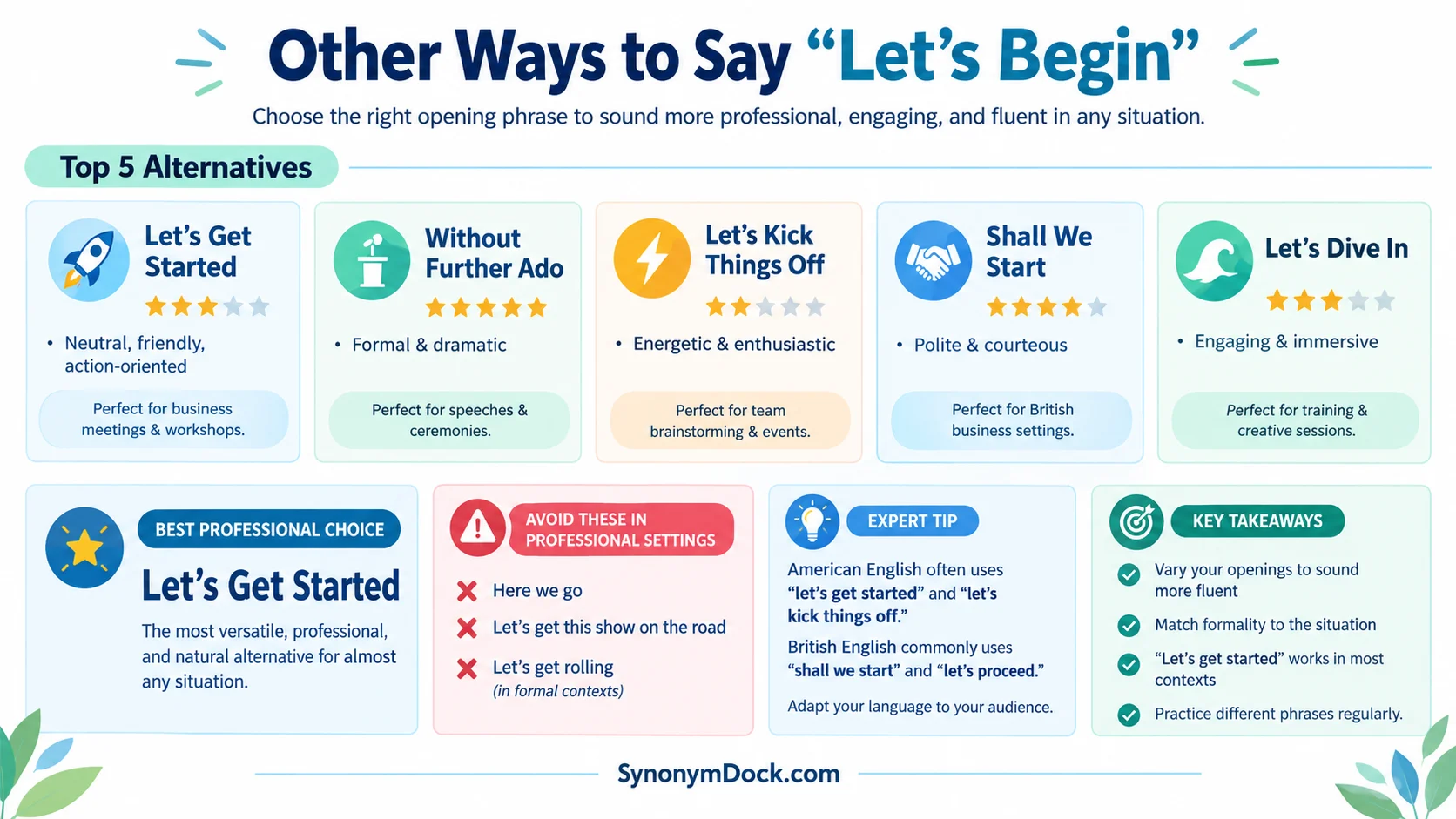
What are other ways to say “let’s begin”? “Let’s begin” can be replaced with more professional or engaging phrases like “let’s get started,” “without further ado,” “shall we start,” “let’s kick things off,” or “let’s dive in.” The right alternative depends on whether you’re in a formal business meeting, academic setting, or casual conversation.
Top 5 alternatives:
Let’s get started, Without further ado, Shall we start, Let’s kick things off, Let’s dive in.
Starting a meeting, presentation, or class sets the tone for everything that follows. The phrase “let’s begin” works perfectly in many situations, but using it too often can make you sound repetitive or even unprofessional.
That’s why knowing strong alternatives matters. Whether you’re leading a team meeting, teaching a class, or presenting to clients, having a range of options helps you sound confident, polished, and engaging. The best speakers and writers naturally vary their vocabulary based on their audience and the situation.
Think of this article as your go-to guide for professional English alternatives to “let’s begin.” By the end, you’ll know exactly which phrases to use in business emails, academic essays, workplace meetings, and everyday conversations.
Quick Categories
Formal Alternatives
- Without further ado
- Shall we commence
- Let us proceed
- We shall begin
Professional Alternatives
- Let’s get started
- Let’s kick things off
- Let’s dive in
- Let’s get down to business
Business Email Alternatives
- To get started
- Let’s begin by
- We’ll start with
- Kicking off with
Academic Alternatives
- Let us begin
- We shall start by
- To commence
- Let’s turn our attention to
Casual Alternatives
- Let’s get rolling
- Let’s jump in
- Here we go
- Let’s get this show on the road
Pro Tip
Match your opening phrase to your audience and setting. A boardroom meeting calls for “shall we commence,” while a team huddle works better with “let’s get rolling.”
Scroll-Stopping Pull Quote
“The way you start a conversation often determines how it will end.”
What Does “Let’s Begin” Mean?
Definition:
“Let’s begin” is a contraction of “let us begin,” used to signal the start of an activity, presentation, meeting, class, or discussion.
Grammar Explanation:
“Let’s” is a contraction of “let us,” functioning as a first-person plural imperative. It invites the speaker and listeners to participate together in starting something.
Simple Explanation:
When you say “let’s begin,” you’re telling everyone that it’s time to start. It’s a friendly, inclusive way to transition from preparation to action.
Example Sentence:
“We have a full agenda today, so let’s begin with the first item.”
When to Use “Let’s Begin”
Common Situations:
- Business Meetings: Starting a team meeting or client call
- Academic Settings: Beginning a lecture or class session
- Emails: Opening a professional message that outlines a plan
- Presentations: Transitioning from introduction to content
- Daily Conversation: Starting any group activity
- Written English: Academic essays and business reports
- Formal Events: Ceremonies and official gatherings
- Informal Settings: Group projects or social activities
Is It Professional or Polite?
| Aspect | Assessment |
| Polite? | ✅ Yes |
| Professional? | ✅ Yes (generally appropriate) |
| Formal? | ⚠️ Sometimes (depends on context) |
| Natural? | ✅ Yes |
| Overused? | ⚠️ Can be |
Business-Style Example:
“Let’s begin by reviewing the quarterly results.”
Explanation:
“Let’s begin” is both polite and professional enough for most workplace situations. It’s inclusive and friendly without being overly casual. However, in highly formal contexts like legal proceedings or academic papers, more formal alternatives may be preferred.
Pros and Cons of “Let’s Begin”
Pros
- Easy to understand for all English levels
- Friendly and inclusive tone
- Common and widely accepted
- Natural in both spoken and written English
- Short and direct
Cons
- Can sound repetitive when overused
- May be too casual for very formal situations
- Lacks variety and engagement
- Doesn’t convey excitement or energy
- May be too generic for professional presentations
Transition to the Main List
Now that you understand the basics, let’s explore the best alternatives to “let’s begin.” These phrases will help you:
- Sound more fluent and natural
- Adapt your language to different situations
- Communicate with greater confidence
- Make your English more engaging
Remember: the best choice depends on your audience, setting, and communication goal.
Expert Tip Box
Expert Tip:
Native English speakers rarely use the same opening phrase twice in a row. Vary your language based on formality, audience, and the energy you want to create. A business proposal needs different language than a team brainstorming session.
Main Section: Other Ways to Say “Let’s Begin” (15+ Examples)
Here are 15 powerful alternatives to “let’s begin,” organized from most useful to less common.
[1]. Phrase: Let’s Get Started
Meaning:
A friendly, direct invitation to begin an activity or process.
Explanation:
This is the most common and versatile alternative to “let’s begin.” Native speakers use it constantly in both professional and casual settings. It’s slightly more informal and energetic than “let’s begin,” making it perfect for team meetings and workshops. The phrase feels action-oriented and inclusive.
Example Sentence:
“Everyone ready? Let’s get started with today’s training session.”
Best Use:
Business Meetings, Workshops, Team Huddles
Avoid Using In:
Highly Formal Ceremonies, Legal Proceedings
Tone:
Friendly, Action-Oriented
Formality Level:
⭐⭐⭐ Neutral
Usage Frequency:
Very Common
CEFR Level:
B1
Common Collocations:
- get started on
- get started with
- ready to get started
- let’s get started right away
Context Variability:
- Spoken English: “Let’s get started, everyone.”
- Professional English: “Let’s get started on the agenda.”
- Casual Conversation: “Let’s get started on dinner.”
[2]. Phrase: Without Further Ado
Meaning:
Said before starting something after a brief delay or introduction.
Explanation:
This formal, slightly dramatic expression means “without any more delay.” It’s commonly used in speeches, presentations, and ceremonies. While it sounds sophisticated, it can feel old-fashioned in everyday conversation. Native speakers often use it humorously in casual settings to mock formality.
Example Sentence:
“Without further ado, let’s welcome our keynote speaker.”
Best Use:
Formal Presentations, Ceremonies, Speeches
Avoid Using In:
Casual Team Meetings, Daily Conversations
Tone:
Formal, Dramatic
Formality Level:
⭐⭐⭐⭐⭐ Very Formal
Usage Frequency:
Occasional
CEFR Level:
C1
Common Collocations:
- without further ado
- so without further ado
- and without further ado
Context Variability:
- Spoken English: “Without further ado, let’s begin.”
- Professional English: “Without further ado, I present the results.”
[3]. Phrase: Let’s Kick Things Off
Meaning:
A lively expression that means to start an event or activity with energy.
Explanation:
This informal phrase comes from sports, where a kickoff starts a game. It’s perfect for setting an energetic, positive tone in meetings, workshops, and presentations. Native speakers use it to inject enthusiasm and make everyone feel excited about what’s coming. It’s particularly common in American English.
Example Sentence:
“Welcome everyone! Let’s kick things off with a quick icebreaker.”
Best Use:
Team Meetings, Workshops, Events
Avoid Using In:
Academic Essays, Formal Business Reports
Tone:
Energetic, Enthusiastic
Formality Level:
⭐⭐ Casual
Usage Frequency:
Common
CEFR Level:
B2
Common Collocations:
- kick things off with
- let’s kick things off by
- ready to kick things off
Context Variability:
- Spoken English: “Let’s kick things off!”
- Professional English: “Let’s kick things off with the quarterly review.”
- Casual Conversation: “Let’s kick things off with some music.”
Scroll-Stopping Pull Quote
“First impressions matter and your opening words are your first impression.”
[4]. Phrase: Shall We Start
Meaning:
A polite, slightly formal question inviting others to begin.
Explanation:
Shall we start” is the quintessential polite British English way to suggest beginning. It’s more formal and courteous than “let’s get started” and works beautifully in professional settings. The question format makes it inclusive and respectful. It’s especially common in UK business culture and formal events.
Example Sentence:
“Shall we start the presentation, or do you have any questions first?”
Best Use:
Business Meetings, Formal Events, Academic Settings
Avoid Using In:
Casual Conversations, Very Informal Groups
Tone:
Polite, Formal, Courteous
Formality Level:
⭐⭐⭐⭐ Formal
Usage Frequency:
Common (British English)
CEFR Level:
B1
Common Collocations:
- shall we start now
- shall we start with
- shall we start the meeting
Context Variability:
- Spoken English: “Shall we start the lesson?”
- Professional English: “Shall we start the budget review?”
- Formal Events: “Shall we start the ceremony?”
[5]. Phrase: Let’s Dive In
Meaning:
To start something enthusiastically and with full engagement.
Explanation:
This metaphor suggests jumping into water it implies full commitment and excitement. Native speakers use “let’s dive in” when they want to skip formalities and get straight into the interesting parts. It’s perfect for workshops, brainstorming sessions, and any situation where you want to create energy and engagement.
Example Sentence:
“There’s a lot to cover today, so let’s dive in and get started.”
Best Use:
Workshops, Brainstorming Sessions, Training
Avoid Using In:
Formal Ceremonies, Legal Proceedings
Tone:
Enthusiastic, Engaging
Formality Level:
⭐⭐⭐ Neutral-Casual
Usage Frequency:
Common
CEFR Level:
B2
Common Collocations:
- dive right in
- dive into
- ready to dive in
Context Variability:
- Spoken English: “Let’s dive in!”
- Professional English: “Let’s dive into the data.”
- Workshop Setting: “Let’s dive in and start brainstorming.”
[6]. Phrase: Let’s Proceed
Meaning:
To continue or begin with a planned course of action.
Explanation:
Let’s proceed” is a formal, professional way to say “let’s begin.” It suggests a structured, organized approach and is commonly used in business, legal, and academic contexts. The word “proceed” implies following a plan or agenda, making it perfect for formal meetings and official events.
Example Sentence:
“We’ve covered the introductions. Let’s proceed with the main agenda.”
Best Use:
Business Meetings, Legal Settings, Academic Events
Avoid Using In:
Casual Conversations, Social Gatherings
Tone:
Formal, Professional
Formality Level:
⭐⭐⭐⭐ Formal
Usage Frequency:
Common
CEFR Level:
B2
Common Collocations:
- proceed with
- proceed to
- let’s proceed accordingly
Context Variability:
- Spoken English: “Let’s proceed to the next point.”
- Professional English: “Let’s proceed with the presentation.”
- Academic Setting: “Let’s proceed with the examination.”
[7]. Phrase: Let’s Commence
Meaning:
A formal way to say “let’s begin” often used in official or ceremonial contexts.
Explanation:
This is one of the most formal alternatives available. “Commence” has a ceremonial, official feel and is rarely used in everyday conversation. You’ll hear it at graduations, award ceremonies, and formal business events. Using it in casual settings would sound overly dramatic or even humorous.
Example Sentence:
“people, let’s commence the awards ceremony.”
Best Use:
Graduation Ceremonies, Award Events, Formal Gatherings
Avoid Using In:
Daily Conversation, Casual Meetings
Tone:
Very Formal, Ceremonial
Formality Level:
⭐⭐⭐⭐⭐ Very Formal
Usage Frequency:
Rare
CEFR Level:
C1
Common Collocations:
- commence with
- commence proceedings
- let’s commence the ceremony
Context Variability:
- Spoken English: “Let’s commence the meeting.” (formal)
- Ceremonial: “Let’s commence the graduation ceremony.”
Native Speaker Tip
Native speakers rarely use “let’s commence” in everyday situations. It sounds very formal and almost theatrical. If you want to sound natural in a business meeting, choose “let’s proceed” or “shall we start” instead. Save “commence” for truly formal occasions.
[8]. Phrase: Here We Go
Meaning:
An informal expression signaling that something is about to start.
Explanation:
“Here we go” is a casual, conversational phrase that indicates immediate action. It’s common in everyday speech and carries a sense of excitement or anticipation. However, it’s too informal for business settings and professional writing. Native speakers often use it with friends, family, or in relaxed situations.
Example Sentence:
“Alright, here we go let’s start the game.”
Best Use:
Casual Events, Games, Social Activities
Avoid Using In:
Business Meetings, Formal Presentations
Tone:
Casual, Excited
Formality Level:
⭐ Very Casual
Usage Frequency:
Very Common
CEFR Level:
A2
Common Collocations:
- here we go again
- here we go now
- and here we go
Context Variability:
- Spoken English: “Here we go!”
- Casual: “Here we go, starting the movie.”
[9]. Phrase: Let’s Get Rolling
Meaning:
To start something, suggesting momentum and continued progress.
Explanation:
This casual, friendly expression suggests beginning with energy and continuing smoothly. It’s commonly used in American English in team environments, group projects, and any situation where you want to sound approachable and action-oriented. The image of rolling implies effortless forward movement.
Example Sentence:
“Everyone’s here. Let’s get rolling on the project plan.”
Best Use:
Team Meetings, Group Projects, Workshops
Avoid Using In:
Formal Business Letters, Academic Essays
Tone:
Friendly, Action-Oriented
Formality Level:
⭐⭐ Casual
Usage Frequency:
Common
CEFR Level:
B2
Common Collocations:
- get rolling on
- get rolling with
- let’s get rolling
Context Variability:
- Spoken English: “Let’s get rolling!”
- Professional English: “Let’s get rolling on the new campaign.”
- Casual: “Let’s get rolling on the road trip.”
[10]. Phrase: Let’s Get Down to Business
Meaning:
To stop being casual and start focusing on serious work.
Explanation:
This classic phrase signals a shift from socializing or small talk to focused work. It’s common in business settings and suggests that the real work is about to begin. Native speakers use it when they want to create a clear boundary between casual conversation and productive work time.
Example Sentence:
“Let’s get down to business and review the budget proposals.”
Best Use:
Business Meetings, Negotiations, Work Sessions
Avoid Using In:
Social Events, Casual Gatherings
Tone:
Professional, Direct
Formality Level:
⭐⭐⭐ Neutral-Formal
Usage Frequency:
Common
CEFR Level:
B2
Common Collocations:
- get down to business
- time to get down to business
- let’s get down to business now
Context Variability:
- Spoken English: “Let’s get down to business.”
- Professional English: “Let’s get down to business and address the issues.”
- Meeting Setting: “Let’s get down to business, shall we?”
Expert Insight
“Let’s get down to business” works particularly well in American corporate culture. However, in some British business environments, it might sound slightly abrupt. Consider your workplace culture some teams prefer more diplomatic phrasing like “shall we start.”
[11]. Phrase: Let’s Embark On
Meaning:
To begin a journey, project, or significant undertaking.
Explanation:
“Embark” suggests starting something important or adventurous. It’s a more formal, literary choice than “let’s begin.” While beautiful and expressive, it’s best suited to written communication or speeches rather than daily conversation. Native speakers use it to suggest significance and purpose.
Example Sentence:
“Let’s embark on this new project with enthusiasm and creativity.”
Best Use:
Project Launches, Formal Speeches, Written Reports
Avoid Using In:
Daily Conversation, Casual Meetings
Tone:
Formal, Inspirational
Formality Level:
⭐⭐⭐⭐ Formal
Usage Frequency:
Occasional
CEFR Level:
C1
Common Collocations:
- embark on a journey
- embark on a project
- embark on a new venture
Context Variability:
- Professional English: “Let’s embark on this initiative.”
- Written English: “Let’s embark on a new chapter.”
Scroll-Stopping Pull Quote
“Every meeting leader needs a full toolkit of opening phrases. One size never fits all.”
[12]. Phrase: Let’s Open the Floor
Meaning:
To begin discussion or invite participation from others.
Explanation:
This phrase is specifically used in meetings and discussions when you want to invite contributions. Opening the floor” means creating space for others to speak. It’s formal and respectful, commonly used in business, academic, and public settings. Native speakers use it to transition from presentation to discussion.
Example Sentence:
“I’ve shared our proposal. Now let’s open the floor for questions.”
Best Use:
Business Meetings, Panel Discussions, Q&A Sessions
Avoid Using In:
One-Way Presentations, Informational Sessions
Tone:
Professional, Inclusive
Formality Level:
⭐⭐⭐⭐ Formal
Usage Frequency:
Common
CEFR Level:
B2
Common Collocations:
- open the floor to
- open the floor for
- let’s open the floor now
Context Variability:
- Professional English: “Let’s open the floor to questions.”
- Academic: “Let’s open the floor for discussion.”
[13]. Phrase: Let’s Begin By
Meaning:
A transitional phrase that introduces the first step or topic.
Explanation:
This phrase is perfect when you need to provide structure or guide the audience through specific steps. It signals the start of a sequence and helps create clarity. Native speakers use it frequently in presentations, lessons, and written instructions to provide direction and organization.
Example Sentence:
“Let’s begin by outlining the three main goals for today.”
Best Use:
Presentations, Lesson Plans, Structured Meetings
Avoid Using In:
Open-Ended Discussions, Brainstorming Sessions
Tone:
Professional, Structured
Formality Level:
⭐⭐⭐⭐ Formal
Usage Frequency:
Very Common
CEFR Level:
B1
Common Collocations:
- begin by saying
- begin by looking at
- begin by reviewing
Context Variability:
- Spoken English: “Let’s begin by introducing ourselves.”
- Professional English: “Let’s begin by reviewing the agenda.”
- Academic: “Let’s begin by defining our terms.”
[14]. Phrase: Let’s Turn Our Attention To
Meaning:
A formal way to direct focus toward a specific topic.
Explanation:
This phrase guides your audience’s attention to a particular subject. It’s more polished and sophisticated than simply saying “let’s begin.” Native speakers use it in presentations, academic lectures, and formal meetings to create smooth transitions and emphasize importance.
Example Sentence:
“Let’s turn our attention to the marketing strategy for next quarter.”
Best Use:
Presentations, Academic Lectures, Formal Meetings
Avoid Using In:
Casual Conversations, Quick Updates
Tone:
Formal, Directing
Formality Level:
⭐⭐⭐⭐ Formal
Usage Frequency:
Common
CEFR Level:
B2
Common Collocations:
- turn our attention to
- turn attention toward
- let’s turn our focus to
Context Variability:
- Professional English: “Let’s turn our attention to the budget.”
- Academic: “Let’s turn our attention to the research findings.”
- Spoken English: “Let’s turn our attention to the main issue.”
[15]. Phrase: Let’s Get This Show on the Road
Meaning:
A highly informal expression meaning to get started or get moving.
Explanation:
This colorful American idiom suggests getting an event or activity underway. It’s playful, energetic, and distinctly informal. Native speakers often use it in casual business environments or when they want to inject humor into a situation. However, it’s not appropriate for formal or serious contexts.
Example Sentence:
“Alright everyone, let’s get this show on the road!”
Best Use:
Casual Meetings, Team Events, Informal Presentations
Avoid Using In:
Formal Business Meetings, Client Presentations
Tone:
Playful, Energetic
Formality Level:
⭐ Very Casual
Usage Frequency:
Occasional
CEFR Level:
C1
Common Collocations:
- get the show on the road
- let’s get this show on the road
- time to get the show on the road
Context Variability:
- Casual English: “Let’s get this show on the road!”
- Informal Meeting: “Alright, let’s get this show on the road.”
Comparison Table: Top 10 Alternatives Compared
| Phrase | Tone | Formality | Best Use | Frequency |
| Let’s Get Started | Friendly, Action-Oriented | Neutral | Business Meetings | Very Common |
| Without Further Ado | Formal, Dramatic | Very Formal | Speeches | Occasional |
| Let’s Kick Things Off | Energetic, Enthusiastic | Casual | Workshops | Common |
| Shall We Start | Polite, Courteous | Formal | Formal Events | Common (UK) |
| Let’s Dive In | Enthusiastic, Engaging | Neutral-Casual | Brainstorming | Common |
| Let’s Proceed | Formal, Professional | Formal | Legal Settings | Common |
| Let’s Commence | Very Formal, Ceremonial | Very Formal | Award Ceremonies | Rare |
| Let’s Get Rolling | Friendly, Action-Oriented | Casual | Team Meetings | Common |
| Let’s Get Down to Business | Professional, Direct | Neutral-Formal | Business Meetings | Common |
| Let’s Embark On | Formal, Inspirational | Formal | Project Launches | Occasional |
Which One Should You Use?
Best Overall:
Let’s Get Started – The most versatile and natural alternative, appropriate for almost any situation.
Best Professional:
Let’s Proceed – Formal, structured, and perfect for business environments.
Best Academic:
Let’s Begin By – Clear, structured, and ideal for lessons and lectures.
Best Business Email:
To Get Started – Concise, professional, and perfect for written communication.
Best Everyday Conversation:
Here We Go – Natural, casual, and commonly used by native speakers.
Most Natural:
Let’s Get Started – The most native-sounding alternative in most situations.
Most Polite:
Shall We Start – Respectful and courteous, especially in British English.
Commonly Confused Phrases
“Let’s Begin” vs “Let’s Get Started”
“Let’s begin” is more formal and structured. “Let’s get started” is more casual and energetic. In most business meetings, both work well, but “let’s get started” feels more modern and inclusive.
“Let’s Proceed” vs “Let’s Commence”
“Let’s proceed” suggests following a plan. “Let’s commence” suggests beginning something official or ceremonial. “Proceed” is more common and less dramatic.
“Let’s Kick Things Off” vs “Let’s Get Rolling”
Both are casual and energetic. “Kick off” is more common in American business culture. “Get rolling” has a slightly more relaxed, friendly feel.
Native Speaker Tip
In American business culture, “let’s get started” and “let’s kick things off” are the most common and natural choices. In British business culture, “shall we start” and “let’s proceed” are more frequently used. Adapt your language to your audience.
Scenario Practice
Scenario 1: Formal Board Meeting
Which phrase would you choose?
Answer: “Let’s proceed with the agenda” or “Let’s begin by reviewing the quarterly results.”
Scenario 2: Creative Team Brainstorming
Which phrase would you choose?
Answer: “Let’s dive in” or “Let’s kick things off” – energetic phrases that encourage creativity.
Scenario 3: Graduation Ceremony
Which phrase would you choose?
Answer: “Let’s commence the ceremony” – formal and appropriate for the occasion.
Scenario 4: Team Meeting After Small Talk
Which phrase would you choose?
Answer: “Let’s get down to business” – signals a transition to serious work.
Scenario 5: Academic Lecture
Which phrase would you choose?
Answer: “Let’s begin by” or “Let’s turn our attention to” – provides structure and direction.
Common Mistakes
Mistake 1: Using overly formal phrases in casual settings
Why It’s Incorrect: It sounds pretentious and out of place.
Correct: Use “let’s get started” instead of “let’s commence” in a team meeting.
Example: “Let’s get started on the project plan” (not “Let’s commence the project plan”).
Mistake 2: Using casual phrases in formal contexts
Why It’s Incorrect: It sounds unprofessional and can undermine your credibility.
Correct: Use “let’s proceed” instead of “let’s get rolling” in a board meeting.
Example: “Let’s proceed with the presentation” (not “Let’s get rolling on the presentation”).
Mistake 3: Using “without further ado” incorrectly
Why It’s Incorrect: It’s often used as filler without understanding its meaning.
Correct: Use it only when there’s actually been a delay or introduction.
Example: “Without further ado, let’s welcome our guest” (after an introduction).
Mistake 4: Mixing British and American preferences
Why It’s Incorrect: It can sound inconsistent or confuse your audience.
Correct: Be aware of regional differences and adapt accordingly.
Example: “Shall we start” (British) vs “Let’s get started” (American).
Mistake 5: Using the same phrase repeatedly
Why It’s Incorrect: It makes you sound repetitive and unengaging.
Correct: Vary your language based on the situation and audience.
Example: Use “let’s dive in” for brainstorming, “let’s proceed” for formal meetings.
Expert Insight
The most professional communicators develop a personal toolkit of 3-5 opening phrases they use regularly. Having a small set of go-to expressions ensures you sound natural while maintaining variety. Practice using different phrases in different contexts until they feel comfortable.
Mini Quiz
1. Which phrase is most appropriate for a formal board meeting?
- A) Let’s get rolling
- B) Let’s commence
- C) Let’s kick things off
- D) Here we go
2. Which alternative is most commonly used by native speakers in American business meetings?
- A) Let’s get started
- B) Let’s commence
- C) Let’s embark on
- D) Without further ado
3. What’s the tone difference between “let’s begin” and “let’s kick things off”?
- A) Same tone
- B) “Kick things off” is more casual and energetic
- C) “Begin” is more casual
- D) No difference
4. Which phrase suggests following a structured plan?
- A) Let’s dive in
- B) Let’s proceed
- C) Let’s get rolling
- D) Let’s get this show on the road
5. Which expression is British English more likely to use?
- A) Let’s get started
- B) Shall we start
- C) Let’s dive in
- D) Let’s kick things off
Answer Key
1. B) Let’s commence – It’s the most formal and appropriate for official ceremonies.
2. A) Let’s get started – It’s the most common and versatile alternative in American business culture.
3. B) “Kick things off” is more casual and energetic – “Begin” is formal and neutral.
4. B) Let’s proceed – It suggests following a structured agenda or plan.
5. B) Shall we start – This polite, formal expression is more common in British English.
Scroll-Stopping Pull Quote
“Good English isn’t just about grammar. It’s about choosing the right word for the right moment.”
Avoid These in Formal Situations
1. “Here we go”
- Sounds too casual for professional settings
- Better: “Let’s get started” or “Let’s proceed”
2. “Let’s get rolling”
- Too informal for business clients or senior management
- Better: “Let’s begin” or “Let’s start”
3. “Let’s get this show on the road”
- Playful and unprofessional
- Better: “Let’s begin” or “Let’s get started”
4. “Let’s jump in”
- Too casual for formal contexts
- Better: “Let’s proceed” or “Let’s commence”
5. “Here we go again”
- Suggests negativity or repetition
- Better: “Let’s begin” or “Let’s start fresh”
Native Speaker Tip
The safest choices in almost any professional situation are “let’s get started” and “let’s proceed.” These phrases work across industries, countries, and contexts. If you’re unsure, choose one of these neutral, professional alternatives.
FAQs
What is the most formal way to say “let’s begin”?
The most formal alternative is “let’s commence” or “without further ado.” These phrases are used in ceremonies, official events, and highly formal business settings. “Let’s proceed” is also formal but slightly less dramatic and more commonly used in business contexts.
Which phrase is best for professional emails?
“Let’s begin by” or “to get started” are excellent choices for professional emails. They’re clear, structured, and help you organize your message. For example: “Let’s begin by reviewing the attached proposal.” Avoid casual phrases like “let’s kick things off” in formal business writing.
What’s the difference between “let’s begin” and “let’s get started”?
“Let’s begin” is slightly more formal and structured. “Let’s get started” is more casual, energetic, and action-oriented. In most business meetings, both are appropriate, but “let’s get started” feels more modern and inclusive. Use “let’s begin” in more formal contexts like academic lectures.
Which alternative sounds most natural to native speakers?
“Let’s get started” sounds most natural to native English speakers in almost any situation. It’s friendly, professional, and works in both casual and formal contexts. In British English, “shall we start” is also very natural and polite.
Can I use these expressions in business meetings?
Yes, but choose carefully based on the meeting’s formality. “Let’s get started” and “let’s proceed” are safe choices for most business meetings. Save “let’s kick things off” for creative sessions and “let’s get down to business” for decision-making meetings. Avoid very casual phrases like “let’s get this show on the road” in formal client meetings.
Conclusion
Learning different ways to say “let’s begin” is about more than just vocabulary it’s about becoming a more confident, adaptable communicator. Whether you’re leading a team meeting, teaching a class, or writing a professional email, the right opening phrase sets the right tone.
Start practicing these alternatives today. Use “let’s get started” in your next meeting, try “shall we start” in a formal setting, or use “let’s dive in” to energize a brainstorming session. The more you practice, the more natural these alternatives will feel. Soon, you’ll never feel stuck using the same phrase twice and your English will sound more fluent, professional, and engaging than ever before.

21 thoughts on “Other Ways to Say “Let’s Begin” |18+ Professional & Casual Alternatives”