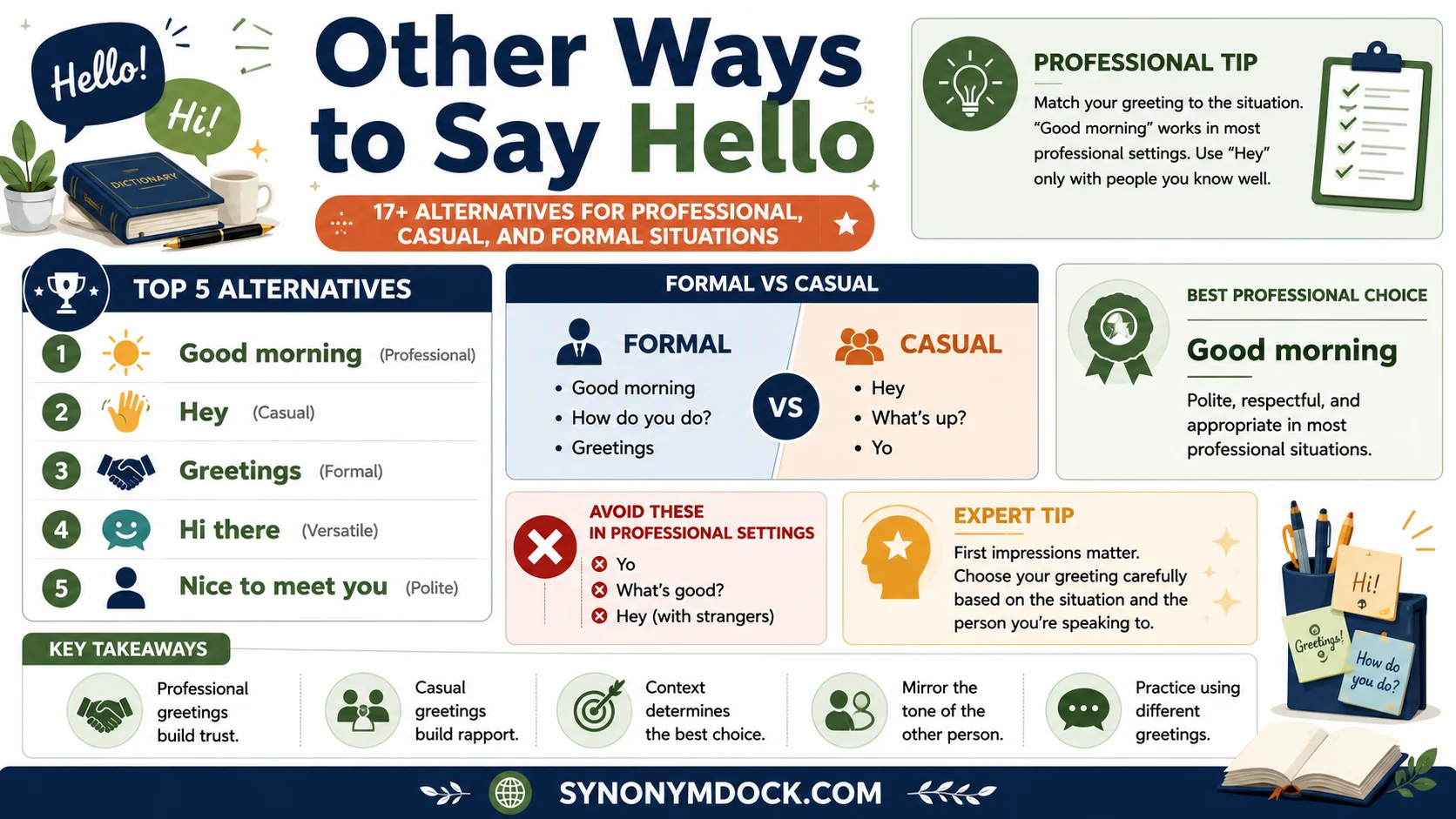
Looking for other ways to say hello? Try “Good morning” for professional settings, “Hey” for friends, “Greetings” for formal writing, “Hi there” for everyday use, or “Howdy” for casual conversations. The best alternatives include: Good morning, Hey, Greetings, Hi there, Howdy, What’s up, Nice to meet you, How are you, Good afternoon, and Welcome.
“Hello” is the first word many English learners master. It’s simple, safe, and works almost anywhere. But using the same greeting every time can make you sound repetitive and, frankly, boring.
Whether you’re starting a business email, meeting a new client, or greeting a friend, having other ways to say hello shows you understand social context and cultural nuances. The right greeting sets the tone for the entire conversation. This article explores 15+ powerful alternatives to “hello” organized by tone and situation, so you can choose the perfect greeting with confidence.
Quick Categories
Formal Alternatives
- Good morning / Good afternoon / Good evening
- Greetings
- It’s a pleasure to meet you
- How do you do?
- Welcome
Pro Tip: Use formal greetings in professional emails, business meetings, and when meeting someone for the first time. They show respect and professionalism.
Professional Alternatives
- Hello everyone
- Good to see you
- Nice to meet you
- How are you doing?
- I hope you’re well
Pro Tip: Professional greetings work well in workplace settings, client meetings, and business correspondence. They build rapport while maintaining professionalism.
Business Email Alternatives
- Dear [Name]
- I hope this email finds you well
- I trust you’re having a good week
- Good morning team
- I hope you’re doing well
Pro Tip: Email greetings should be warm but professional. Personalize them when possible and match the company culture.
Academic Alternatives
- Good morning, everyone
- Hello, class
- Greetings, colleagues
- Welcome, students
- Good day
Pro Tip: Academic greetings should be respectful and inclusive. They set a professional tone for learning environments.
Casual Alternatives
- Hey
- Hi there
- What’s up?
- How’s it going?
- Hey there
Pro Tip: Casual greetings are perfect for friends, family, and informal situations. They feel warm and natural.
Informal Expressions
- Yo
- What’s good?
- Howdy
- Sup? (What’s up?)
- Hey hey
Pro Tip: Use informal greetings with close friends or in very relaxed settings. Avoid them in professional or formal situations.
“The right greeting can make or break your first impression.”
What Does “Hello” Mean?
“Hello” is a greeting used when meeting someone or starting a conversation. It expresses acknowledgment, welcome, or a friendly intention to communicate.
Example: “Hello, how are you today?”
Grammar: “Hello” is an interjection. It’s often followed by a comma or exclamation point. It can stand alone or be followed by additional words like “hello, everyone.”
Is It Professional or Polite?
“Hello” is both professional and polite in most situations. However, it can feel too casual in formal written communication.
Polite? ✅ Yes
Professional? ✅ Yes, but context matters
Formal? ⚠️ Sometimes – can feel informal in formal writing
Natural? ✅ Yes
Example: “Hello, Mr. Smith” works in professional settings. For a formal letter, consider “Dear Mr. Smith” instead.
Common Mistakes
Mistake #1: Using “Hey” in Professional Emails
Why it’s incorrect: “Hey” is too casual for most professional emails, especially with people you don’t know well.
Correct version: Use “Hello” or “Dear [Name]” instead.
Example: “Hello, Ms. Johnson” is appropriate. “Hey, Ms. Johnson” is not.
Mistake #2: Not Adjusting to Cultural Context
Why it’s incorrect: Different cultures have different expectations for greetings. Some prefer formal, others casual.
Correct version: Research the appropriate greeting for the culture and situation.
Example: In Japan, formal greetings are preferred. In Australia, casual greetings are common.
Mistake #3: Forgetting to Use Titles
Why it’s incorrect: In professional situations, using first names without permission can seem disrespectful.
Correct version: Use titles like Mr., Mrs., Dr., or Professor unless invited to use first names.
Example: “Good morning, Dr. Patel” is respectful. “Good morning, Raj” may be inappropriate.
Mistake #4: Using “What’s Up?” in Formal Settings
Why it’s incorrect: “What’s up?” is very casual and sounds unprofessional in business or academic contexts.
Correct version: “How are you doing?” or “How are you?” are more appropriate.
Example: “How are you doing today?” works in a meeting. “What’s up?” does not.
Mistake #5: Not Matching the Response
Why it’s incorrect: If someone greets you formally, you should respond formally. Matching the tone shows social awareness.
Correct version: Mirror the greeting style of the other person.
Example: If someone says “Good morning, Dr. Smith,” respond with “Good morning, Dr. Johnson.
When to Use “Hello”
Common Situations:
- Starting conversations
- Answering the phone
- Meeting new people
- Entering a room
- Beginning a presentation
Business:
- Client meetings
- Professional emails
- Phone calls
- Networking events
- Interviews
Academic:
- Starting class
- Meeting professors
- Academic conferences
- Study groups
Daily Conversation:
- Greeting neighbors
- Starting casual chats
- Meeting friends
- Shopping interactions
Written English:
- Emails
- Letters
- Online messages
- Professional documents
“Professional greetings show respect and build trust instantly.”
Pros and Cons of “Hello”
Pros
- Universally understood
- Safe in any situation
- Simple and clear
- Works in formal and casual contexts
Cons
- Overused
- Generic and impersonal
- Doesn’t show personality
- Not memorable
- Can feel robotic
15 Other Ways to Say Hello
[1]. Good Morning / Good Afternoon / Good Evening
Meaning: A formal greeting that acknowledges the time of day.
Explanation: These time-specific greetings are among the most professional alternatives to “hello.” Native speakers use them in business settings, formal events, and when meeting someone for the first time. They show attention to detail and respect. Always match the greeting to the actual time of day.
Example Sentence: “Good morning, everyone. Thank you for joining today’s meeting.”
Best Use: Business Meetings, Professional Emails, Formal Events
Avoid Using In: Casual Text Messages
Tone: Formal, Professional
Formality Level: ⭐⭐⭐⭐⭐ Very Formal
Usage Frequency: Very Common
CEFR Level: A1
Common Collocations:
- good morning everyone
- good afternoon everyone
- good evening distinguished guests
- have a good morning
- good day to you
Context Variability:
- Spoken English: “Good morning, how are you?”
- Professional English: “Good afternoon, I’m pleased to meet you.”
[2]. Hey
Meaning: A casual, friendly greeting used with people you know.
Explanation: “Hey” is one of the most common casual greetings. Native speakers use it constantly with friends, family, and colleagues they know well. It sounds warm and approachable. However, it’s too informal for professional settings with people you don’t know.
Example Sentence: “Hey, great to see you! How was your weekend?”
Best Use: Friends, Family, Casual Conversations
Avoid Using In: Professional Emails, Formal Meetings
Tone: Casual, Friendly
Formality Level: ⭐⭐ Casual
Usage Frequency: Very Common
CEFR Level: A1
Common Collocations:
- hey there
- hey you
- hey everyone
- hey buddy
- hey guys
Context Variability:
- Spoken English: “Hey, what’s going on?”
- Casual Conversation: “Hey, I’ve been waiting for you!”
[3]. Greetings
Meaning: A formal, slightly old-fashioned greeting.
Explanation: “Greetings” sounds sophisticated and literary. Native speakers use it in formal writing, speeches, and when addressing groups. It can feel a bit formal for everyday use, but it’s excellent for professional correspondence. It works well when you don’t know the recipients personally.
Example Sentence: “Greetings, everyone. I appreciate you joining this meeting.”
Best Use: Formal Speeches, Group Emails, Official Correspondence
Avoid Using In: Casual Conversation
Tone: Formal, Sophisticated
Formality Level: ⭐⭐⭐⭐ Formal
Usage Frequency: Occasional (Formal Contexts)
CEFR Level: B2
Common Collocations:
- greetings everyone
- greetings and salutations
- warm greetings
- season’s greetings
- greetings from abroad
Context Variability:
- Written English: “Greetings, valued customers.”
- Spoken English: More common in presentations or formal speeches.
[4]. Hi There
Meaning: A friendly, neutral greeting that’s slightly more casual than “hello.”
Explanation: “Hi there” is a warm and welcoming greeting. Native speakers use it in both casual and light professional situations. The word “there” adds a friendly, approachable quality. It’s excellent for starting conversations with people you know or don’t know well.
Example Sentence: “Hi there, I’m here for the interview.”
Best Use: Everyday Conversation, Light Professional Settings, Customer Service
Avoid Using In: Formal Legal Documents
Tone: Friendly, Neutral
Formality Level: ⭐⭐⭐ Neutral
Usage Frequency: Very Common
CEFR Level: A2
Common Collocations:
- hi there, how are you
- hi there, nice to meet you
- hi there, what can I help you with
- hi there, long time no see
Context Variability:
- Spoken English: “Hi there, I’m looking for the manager.”
- Professional English: Works in casual work environments.
[5]. What’s Up?
Meaning: A casual greeting asking what someone is doing or how they are.
Explanation: “What’s up?” is an informal greeting that’s very common among native English speakers, especially younger generations. It’s friendly and shows interest in the other person. However, it’s strictly for casual situations. Never use it in professional or formal contexts.
Example Sentence: “What’s up? I haven’t seen you in ages!”
Best Use: Friends, Family, Text Messages
Avoid Using In: Professional Emails, Formal Meetings
Tone: Casual, Friendly
Formality Level: ⭐⭐ Casual
Usage Frequency: Very Common
CEFR Level: B1
Common Collocations:
- what’s up with you
- what’s up, man
- what’s up, dude
- what’s up, how are things
- what’s up, what are you doing
Context Variability:
- Spoken English: “What’s up? How was your weekend?”
- Text Message: “Hey, what’s up?”
“Native speakers judge your professionalism from your very first word.”
[6]. Nice to Meet You
Meaning: A polite, professional greeting used when meeting someone for the first time.
Explanation: “Nice to meet you” is the standard polite greeting for first-time introductions. Native speakers use it in professional, social, and casual contexts. It shows respect and genuine pleasure in meeting someone. Always use it when you’re being introduced to someone new.
Example Sentence: “Nice to meet you, Mr. Chen. I’ve heard so much about your work.”
Best Use: First Introductions, Business Meetings, Networking Events
Avoid Using In: Text Messages (unless first meeting)
Tone: Polite, Professional
Formality Level: ⭐⭐⭐⭐ Formal
Usage Frequency: Very Common
CEFR Level: A2
Common Collocations:
- nice to meet you too
- pleasure to meet you
- great to meet you
- wonderful to meet you
- lovely to meet you
Context Variability:
- Spoken English: “Nice to meet you, I’m Sarah.”
- Professional English: “Nice to meet you, I’ve been looking forward to this.”
[7]. How Do You Do?
Meaning: An extremely formal, traditional greeting used in formal introductions.
Explanation: “How do you do?” is a very formal greeting that sounds quite old-fashioned. Native speakers rarely use it in daily conversation. However, it’s still used in some formal settings, particularly in British English. The correct response is “How do you do?” (not “I’m fine, thank you”).
Example Sentence: “How do you do? I’m delighted to make your acquaintance.”
Best Use: Royal Events, Extremely Formal Gatherings, Traditional Settings
Avoid Using In: Everyday Conversation
Tone: Very Formal, Traditional
Formality Level: ⭐⭐⭐⭐⭐ Very Formal
Usage Frequency: Rare
CEFR Level: B2
Common Collocations:
- how do you do, sir
- how do you do, madam
- pleased to meet you, how do you do
Context Variability:
- Formal English: “How do you do? I’m Dr. Smith.”
- British English: Still used in certain formal circles.
[8]. How Are You Doing?
Meaning: A professional, caring greeting asking about someone’s wellbeing.
Explanation: “How are you doing?” is a warm, professional greeting. It shows you care about the other person’s welfare. Native speakers use it in both professional and casual contexts. It invites a genuine response, making it more engaging than a simple “hello.”
Example Sentence: “How are you doing? I hope you’re settling in well.”
Best Use: Professional Meetings, Client Interactions, Colleague Conversations
Avoid Using In: Very Formal Legal Correspondence
Tone: Warm, Professional
Formality Level: ⭐⭐⭐⭐ Formal
Usage Frequency: Very Common
CEFR Level: A2
Common Collocations:
- how are you doing today
- how are you doing lately
- how are you doing, my friend
- how are you doing, sir
- how are you doing, I hope you’re well
Context Variability:
- Spoken English: “How are you doing? I haven’t seen you in a while.”
- Professional English: “How are you doing today, Mrs. Patel?”
[9]. Welcome
Meaning: A warm greeting used to receive someone into a place or group.
Explanation: “Welcome” is a welcoming greeting that makes people feel appreciated. Native speakers use it when someone arrives at a location, joins a team, or starts a new role. It’s inclusive and warm. It can be used in both formal and casual contexts.
Example Sentence: “Welcome to the team! We’re so glad you’re here.”
Best Use: New Employees, Guests, Events, Church, Community
Avoid Using In: Everyday Passing Greetings
Tone: Warm, Inclusive
Formality Level: ⭐⭐⭐ Neutral
Usage Frequency: Very Common
CEFR Level: A1
Common Collocations:
- welcome to our home
- welcome to the team
- welcome to the club
- welcome back
- welcome aboard
Context Variability:
- Spoken English: “Welcome, make yourself at home.”
- Professional English: “Welcome to our company, we’re excited to have you.”
[10]. Good to See You
Meaning: A warm, friendly greeting showing pleasure at meeting someone.
Explanation: “Good to see you” is a genuine, friendly greeting. Native speakers use it when they’re happy to see someone. It’s common in both professional and casual contexts. It adds a personal touch that “hello” lacks.
Example Sentence: “Good to see you, Sarah. It’s been too long!”
Best Use: Workplace Meetings, Social Gatherings, Reunions
Avoid Using In: First-time Introductions
Tone: Warm, Friendly
Formality Level: ⭐⭐⭐ Neutral
Usage Frequency: Very Common
CEFR Level: A2
Common Collocations:
- good to see you again
- great to see you
- wonderful to see you
- nice to see you
- so good to see you
Context Variability:
- Spoken English: “Good to see you, how have you been?”
- Professional English: “Good to see you, thanks for coming.”
[11]. Hey There
Meaning: A casual, friendly greeting similar to “hi there.”
Explanation: “Hey there” is a very casual greeting. Native speakers use it with friends, family, and people they know well. It’s warm and approachable. However, avoid it in professional contexts unless you’re greeting close colleagues.
Example Sentence: “Hey there, I was just thinking about you!”
Best Use: Friends, Family, Casual Conversations
Avoid Using In: Professional Emails, Formal Meetings
Tone: Casual, Friendly
Formality Level: ⭐⭐ Casual
Usage Frequency: Common
CEFR Level: A2
Common Collocations:
- hey there, how are you
- hey there, you look nice
- hey there, what’s new
- hey there, stranger
- hey there, good to see you
Context Variability:
- Spoken English: “Hey there, I’m so glad you could make it.”
- Text Message: “Hey there, let’s catch up soon.”
[12]. Howdy
Meaning: A casual greeting popular in the southern United States, short for “how do you do?”
Explanation: “Howdy” is an informal greeting associated with American Western culture. Native speakers use it in casual settings, especially in Texas and the southern US. While it’s friendly and unique, avoid it outside casual contexts or the southern US.
Example Sentence: “Howdy, partner! Come on in.”
Best Use: Casual Settings, Southern US, Western Events
Avoid Using In: Professional Meetings, International Business
Tone: Casual, Regional
Formality Level: ⭐⭐⭐ Casual
Usage Frequency: Occasional (Regional)
CEFR Level: B1
Common Collocations:
- howdy partner
- howdy stranger
- howdy neighbor
- howdy y’all
- howdy, how are you
Context Variability:
- Spoken English: “Howdy, welcome to Texas!”
- Casual Conversation: “Howdy, I haven’t seen you in a while.”
[13]. Yo
Meaning: A very casual greeting popular in urban and youth culture.
Explanation: “Yo” is a highly informal greeting. Native speakers use it among close friends, in texting, and in casual environments. It’s associated with urban culture and younger generations. Never use it in professional or formal contexts.
Example Sentence: “Yo, what’s good? Ready for the game?”
Best Use: Close Friends, Youth Culture, Text Messages
Avoid Using In: Any Professional Setting
Tone: Very Casual
Formality Level: ⭐ Very Casual
Usage Frequency: Common (Youth/Urban Contexts)
CEFR Level: B1
Common Collocations:
- yo, what’s up
- yo, how are you
- yo, let’s go
- yo, I’m here
- yo, listen
Context Variability:
- Spoken English: “Yo, we’re going to the park.”
- Text Message: “Yo, are you coming tonight?”
[14]. Good Day
Meaning: A formal, somewhat traditional greeting.
Explanation: “Good day” is a formal greeting. Native speakers use it in some professional contexts and official correspondence. It sounds a bit old-fashioned but is still acceptable in formal writing and speaking. It’s more common in British English.
Example Sentence: “Good day, sir. I’m here to apply for the position.”
Best Use: Formal Situations, Official Events, Traditional Settings
Avoid Using In: Casual Conversation
Tone: Formal, Traditional
Formality Level: ⭐⭐⭐⭐ Formal
Usage Frequency: Occasional (Formal Contexts)
CEFR Level: A2
Common Collocations:
- good day to you
- good day, sir
- good day, madam
- I wish you a good day
- good day everyone
Context Variability:
- Formal English: “Good day, I’m delighted to meet you.”
- Written English: Sometimes used in formal letters or emails.
[15]. What’s Good?
Meaning: A very casual, youthful greeting asking what’s happening or exciting.
Explanation: “What’s good?” is an ultra-casual greeting popular among young native speakers. It’s used in texts, social media, and informal conversation. It’s vibrant and energetic. However, it’s strictly for casual contexts with peers.
Example Sentence: “What’s good, bro? Long time no see!”
Best Use: Friends, Youth, Text Messages
Avoid Using In: Professional Settings, Formal Writing
Tone: Very Casual, Youthful
Formality Level: ⭐ Very Casual
Usage Frequency: Common (Youth Contexts)
CEFR Level: B1
Common Collocations:
- what’s good, man
- what’s good, homie
- what’s good, I’ve been waiting for this
- what’s good, let’s do this
Context Variability:
- Spoken English: “What’s good? How have you been?”
- Social Media: “What’s good, everyone?”
“The greeting you choose tells people how you view them.”
Native Speaker Tip
Native speakers often choose different greetings based on where they are. In the UK, “How do you do?” is still heard but sounds formal. In the US, “Hey” is very common. In the southern US, “Howdy” is a cultural marker. In Australia, “G’day” is common. Always consider the culture and region when choosing your greeting.
Expert Insight
In workplace communication, your greeting sets the entire tone. “Good morning” sounds professional and respectful. “Hey” with a colleague you know well shows rapport. Using the wrong greeting can create an awkward first impression. Observe how your colleagues and clients greet each other, and mirror that tone.
Avoid These Expressions in Formal Situations
| Expression | Why to Avoid | Better Alternative |
|---|---|---|
| Yo | Too casual | Good morning |
| What’s good? | Too casual | How are you doing? |
| Hey | Too informal | Hello or Good morning |
| Howdy | Regional and casual | Hello or Good to see you |
| ‘Sup | Slang | Hi there or Hello |
Top 10 Alternatives Compared
| Phrase | Tone | Formality | Best Use | Frequency |
|---|---|---|---|---|
| Good morning | Professional | ⭐⭐⭐⭐⭐ | Business, Formal | Very Common |
| Hey | Casual | ⭐⭐ | Friends, Family | Very Common |
| Greetings | Formal | ⭐⭐⭐⭐ | Speeches, Writing | Occasional |
| Hi there | Friendly | ⭐⭐⭐ | Everyday | Very Common |
| What’s up? | Casual | ⭐⭐ | Friends, Texts | Very Common |
| Nice to meet you | Polite | ⭐⭐⭐⭐ | First meetings | Very Common |
| Welcome | Warm | ⭐⭐⭐ | Arrivals, New people | Very Common |
| Good to see you | Warm | ⭐⭐⭐ | Reunions | Very Common |
| How do you do? | Very Formal | ⭐⭐⭐⭐⭐ | Royal/Formal | Rare |
| Yo | Very Casual | ⭐ | Friends only | Common |
Which One Should You Use?
Best Overall: Hi there – works in almost any situation
Best Professional: Good morning / Good afternoon – respectful and appropriate
Best Business Email: Dear [Name] – professional and personal
Best Everyday Conversation: Hey or Hi there – natural and friendly
Most Natural: Hi there – native speakers use it constantly
Most Polite: Nice to meet you – shows respect for introductions
Commonly Confused Phrases
“Hey” vs. “Hello”
“Hey” is casual and friendly. “Hello” is neutral and safe. Use “hello” with people you don’t know well and “hey” with friends and colleagues you know well.
“How do you do?” vs. “How are you?”
“How do you do?” is a formal greeting used with introductions. The expected response is “How do you do?” “How are you?” is a question that expects a response like “I’m fine, thank you.”
“Hi” vs. “Hi there”
Both are similar. “Hi there” is slightly warmer and more engaging. It’s excellent for starting conversations with people you don’t know well.
Scenario Practice
Scenario 1: You’re meeting a new client for the first time.
Which greeting would you choose?
Correct Answer: “Good morning, Mr. Williams. Nice to meet you.”
Why: Professional, respectful, and appropriate for first introductions.
Scenario 2: You’re greeting a close friend at a coffee shop.
Which greeting would you choose?
Correct Answer: “Hey! Good to see you!”
Why: Casual, warm, and friendly for close relationships.
Scenario 3: You’re sending a professional email to a potential employer.
Which greeting would you choose?
Correct Answer: “Dear Ms. Rodriguez” or “Good morning, Ms. Rodriguez”
Why: Formal and professional for job applications.
Scenario 4: You’re greeting a group of students at the start of class.
Which greeting would you choose?
Correct Answer: “Good morning, everyone. I hope you’re all well.”
Why: Professional, inclusive, and respectful of the learning environment.
Scenario 5: You’re walking into a casual office where everyone knows you.
Which greeting would you choose?
Correct Answer: “Hey everyone, how’s it going?”
Why: Warm, professional enough for a casual office, and inclusive.
Mini Quiz
1. Which greeting is most appropriate for a formal business meeting?
- A) Hey
- B) Good morning
- C) What’s up?
2. Which greeting should you avoid in professional emails?
- A) Dear Mr. Smith
- B) Hi there
- C) Hey
3. What greeting is best for meeting someone for the first time?
- A) What’s up?
- B) Nice to meet you
- C) Yo
4. Which greeting is associated with the southern United States?
- A) Howdy
- B) Greetings
- C) Good day
5. What is the best response to “How do you do?”
- A) I’m fine, thank you
- B) How do you do?
- C) Good, how about you?
Answer Key
- B) Good morning – Formal and respectful for business settings.
- C) Hey – Too casual for professional emails.
- B) Nice to meet you – The standard polite greeting for introductions.
- A) Howdy – Associated with southern US and Western culture.
- B) How do you do? – The traditional formal response to this greeting.
FAQs
What is the most formal way to say “hello”?
“How do you do?” is one of the most formal greetings, though it’s old-fashioned. “Good morning” and “Good afternoon” are also very formal and more commonly used. “Greetings” is another formal option for written communication.
Which greeting is best for professional emails?
“Dear [Name]” is the most professional for emails. “Good morning” or “Good afternoon” also work well. Avoid “Hey” or “Hi there” unless you know the recipient well and the workplace is casual.
What is the difference between “Hi” and “Hello”?
“Hi” is more casual and friendly than “Hello.” “Hello” is neutral and safe for almost any situation. “Hi” is better for people you know or casual settings. “Hello” is better for formal situations or when you’re unsure.
Which alternative sounds most natural to native speakers?
“Hi there” and “Hey” sound very natural to native speakers. “Good to see you” is also natural when meeting someone you know. The most natural choice depends on the situation and relationship.
Can I use these expressions in business meetings?
Yes, professional greetings like “Good morning,” “Nice to meet you,” and “How are you doing?” are perfect for business meetings. Avoid “Hey,” “Yo,” and “What’s up?” in professional settings.
Conclusion
Learning other ways to say hello transforms how you communicate. Instead of using the same greeting repeatedly, you now have powerful alternatives for every situation – from formal business meetings to casual conversations with friends.
The key is choosing the right greeting for the right context. “Good morning” and “Nice to meet you” show professionalism and respect. “Hey” and “Hi there” build warmth and rapport with friends. “Greetings” adds sophistication to formal writing. With practice, choosing the perfect greeting will become second nature.
Start today – pick one new greeting and use it in your next conversation. You’ll sound more fluent, confident, and culturally aware.

4 thoughts on “Other Ways to Say Hello |17+ Professional & Casual Greetings 2026”