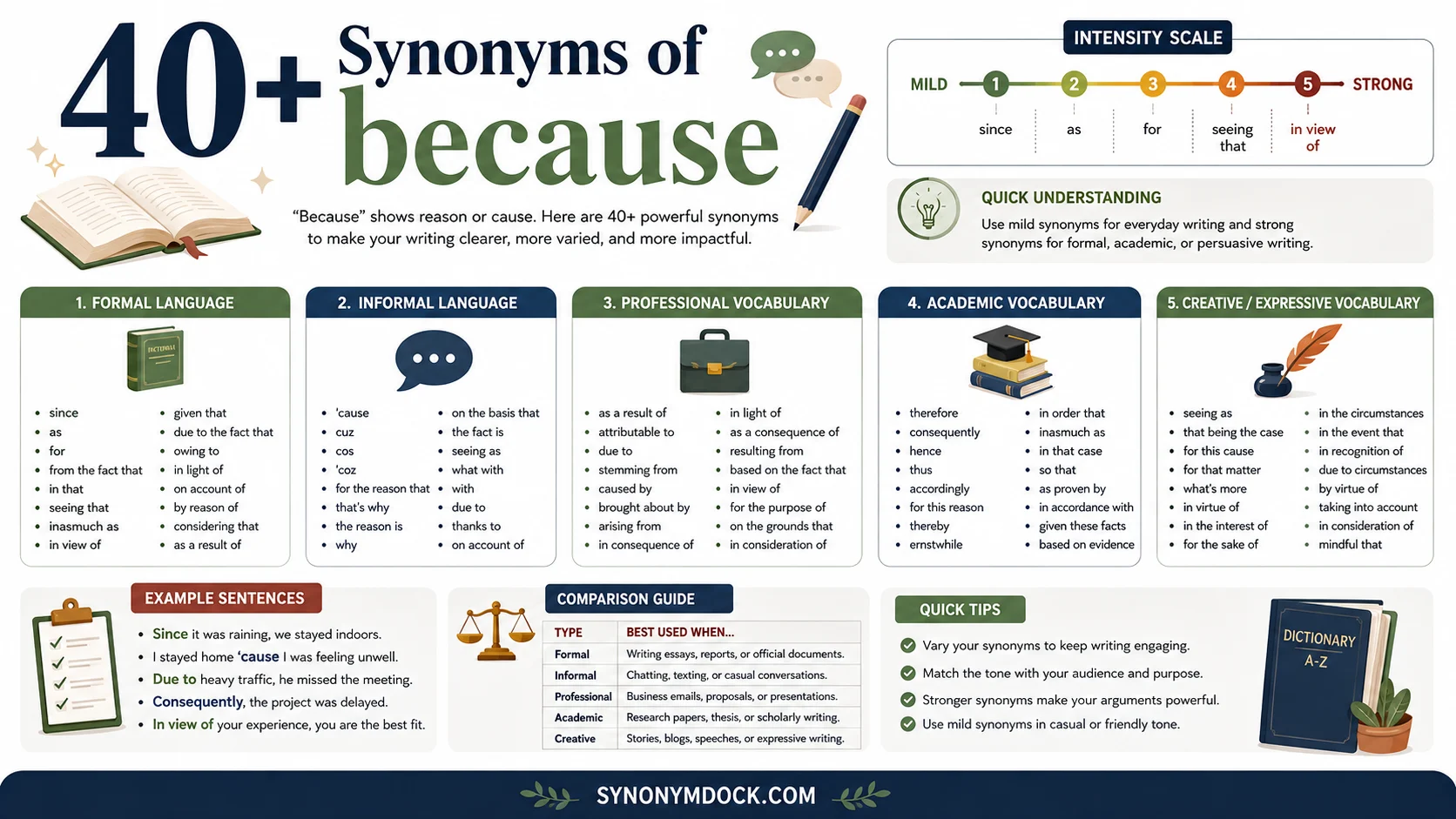
The best synonyms of because depend on your context. For formal writing, use since, as, or due to. For casual conversation, try as long as or seeing that. In professional communication, owing to and by virtue of sound authoritative. For creative writing, for adds a literary touch.
Have you ever read through an email, essay, or blog post and noticed the same word appearing over and over? Many writers fall into the habit of using “because” repeatedly when explaining reasons or causes. This repetition makes writing feel dull and less engaging. The search for a stronger synonym of because often begins when someone realizes their writing could sound more polished and precise. Choosing the right alternative improves clarity and helps you communicate with greater impact. Whether you are writing a school assignment, a professional email, or a social media caption, having a variety of synonyms of because at your disposal will elevate your writing instantly.
Meaning, Tone, and Context
Simple Definition
Because is a conjunction used to show the reason or cause for something . It answers the question “why?” and connects a result with its explanation.
Part of Speech
Because functions primarily as a subordinating conjunction that links a dependent clause to a main clause . It can also work as a preposition in informal speech, such as “because reasons” or “because tired.”
Overall Tone
Because is neutral and factual. It simply states a cause without adding emotional weight.
Formality Level
Because is considered neutral. It works well in formal, semi-formal, and informal situations alike.
Common Uses
Native speakers use because in nearly every type of communication. You will find it in academic essays, business emails, casual conversations, news reports, and creative writing.
Word Forms
- Conjunction: The most common form.
- Preposition: Informal use, such as “because of” before a noun phrase .
- Because of: A prepositional phrase that must be followed by a noun or noun phrase, not a clause .
When and How to Use “Because”
Choose because when you need to state a reason or cause in a straightforward way. It serves as the default choice for explaining why something happened or why someone did something.
Here are seven realistic examples showing how to use because in different contexts.
- Professional: “We extended the project timeline because the client requested additional features.”
- Academic: “The experiment yielded inconsistent results because the temperature fluctuated throughout the testing period.”
- Workplace: “I scheduled the meeting for Thursday because most team members are available that afternoon.”
- Personal: “I chose the blue paint because it matches the furniture better.”
- Email: “I am writing to follow up because we have not received your response yet.”
- Resume: “Improved team efficiency because I introduced a streamlined approval process.”
- Social Media: “I love this café because their latte art is incredible.”
Best Synonyms of “Because”
No synonym is identical to because in every situation. The right choice depends on your audience, the formality of your writing, and the exact shade of meaning you want to express.
Professional Writing:
Use since. It sounds polished and professional. For example, “Since the quarterly report is due Friday, we need to finalize the numbers today.”
Academic Writing:
Use inasmuch as. This phrase sounds precise and scholarly. For example, “Inasmuch as the data were collected over five years, the findings are robust.”
Business Communication:
Use due to. This phrase works well in formal business contexts. For example, “The shipment was delayed due to weather conditions.”
Casual Conversation:
Use as long as. It sounds natural and conversational. For example, “As long as you are coming to the party, I will bring dessert.”
Emotional Writing:
Use seeing that. It adds a personal, empathetic tone. For example, “Seeing that you were so tired, I let you sleep in.”
Creative Writing:
Use for. This choice lends a poetic or literary quality to your writing. For example, “She stayed silent, for she had no words to express her grief.”
Resume Writing:
Use by virtue of. This phrase conveys authority and achievement. For example, “By virtue of my leadership, the team exceeded its sales targets.”
Workplace Communication:
Use owing to. It sounds professional and appropriate for internal communication. For example, “Owing to the server outage, we lost two hours of work.”
Stronger Meaning:
Use on the grounds that. This phrase creates a firm, justified reason. For example, “The complaint was dismissed on the grounds that it lacked evidence.”
Softer Meaning:
Use given that. It feels less assertive and more considerate. For example, “Given that you are new to the role, we will provide extra training.”
When Not to Use “Because”
Sometimes using because makes your writing feel too general, too weak, or too repetitive.
When It Sounds Too General:
The sentence “We won because we tried harder” is vague. Replace it with a more specific reason: “We won due to our superior preparation and strategy.”
When It Sounds Too Repetitive:
Repeating because in consecutive sentences is dull. Instead of “I arrived late because traffic was bad. I was stressed because I had an important meeting,” write “I arrived late due to heavy traffic, which left me stressed before my important meeting.”
When It Sounds Too Formal or Too Informal:
Because is neutral, but some contexts demand a more formal choice. Use “in light of” or “in view of” in formal reports: “In light of the recent findings, we recommend a policy review.”
When It Sounds Too Weak:
The sentence “I declined the invitation because I was busy” is weak. Use a stronger alternative: “I declined the invitation on the grounds that I had prior commitments.”
When It Is Outdated:
For is an older use of because. While beautiful in poetry, it sounds old-fashioned in modern business or casual writing.
Words Commonly Confused With “Because”
Because vs Since
The main difference is that since can refer to time as well as reason. “Since we met last year” refers to time. “Since we are friends” refers to reason. Use because when you want to avoid any time-related confusion.
Because vs As
As is often used for reasons in formal writing, but it can also mean “while” or “in the same way.” To avoid ambiguity, choose because for clear causation.
Because vs Due To
Because introduces a clause with a verb. Due to is followed by a noun phrase. “The game was canceled because it rained” is correct. “The game was canceled due to rain” is also correct.
Because vs Since vs For
For is more literary and often appears in poetry. Since and because are more common in everyday and professional writing.
Because vs As Long As
As long as implies a condition as well as a reason. “As long as you are here, let us start” means “because you are here, and also we can start now.”
Best Synonyms of “Because” by Context
| Context | Best Synonym | Why It Works | Example |
|---|---|---|---|
| Formal writing | Inasmuch as | Sounds precise and intellectual | “Inasmuch as the evidence supports this conclusion, we accept it.” |
| Academic writing | As | Concise and widely accepted in academic texts | “As the sample size was small, the results are preliminary.” |
| Professional communication | Since | Professional and commonly understood | “Since you are the subject matter expert, we need your input.” |
| Business emails | Due to | Standard phrase in business correspondence | “Due to high demand, prices have increased.” |
| Resume writing | By virtue of | Shows authority and achievement | “By virtue of my negotiation skills, I secured a major contract.” |
| Workplace communication | Owing to | Professional and clear | “Owing to budget cuts, we must reduce expenses.” |
| Casual conversation | As long as | Conversational and friendly | “As long as you are going to the store, grab some milk.” |
| Everyday speaking | Seeing that | Natural and empathetic | “Seeing that you are tired, let us take a break.” |
| Creative writing | For | Adds literary elegance | “He wept, for he had lost everything.” |
| Storytelling | Considering that | Sets up a narrative explanation | “Considering that they were strangers, they got along well.” |
| Emotional writing | In view of | Expresses thoughtful empathy | “In view of your loss, we offer our deepest condolences.” |
| Strong emphasis | On the grounds that | Strong and formal justification | “The motion was rejected on the grounds that it was unconstitutional.” |
| Mild tone | Given that | Gentle and considerate | “Given that you are new, we will help you get started.” |
| Social media captions | So | Short and trendy | “Loving this weather, so we headed to the beach.” |
How to Choose the Best Synonym of “Because”
Choosing the right synonym of because starts with understanding your audience and purpose.
Meaning: What exactly are you trying to explain? If you need to be precise, use inasmuch as or on the grounds that. If you just need a simple reason, since or as will work.
Tone: Are you writing a formal report or a friendly text message? Use owing to or due to in formal contexts. Use seeing that or as long as in casual situations.
Audience: Who is reading your writing? Professionals expect business-like language. Use by virtue of or in light of. Friends and family prefer natural, simple words. Use since or as.
Emotional Strength: Do you want to sound empathetic? Use given that or in view of. Do you want to sound firm? Use on the grounds that.
Writing Purpose: Are you trying to persuade, inform, or entertain? For persuasive writing, inasmuch as sounds authoritative. For informative writing, since is clear. For entertainment, for can add flair.
Formality Level: Match your synonym to the formality of the situation. Very formal situations call for inasmuch as or by virtue of. Neutral situations allow since or as. Informal situations welcome as long as or seeing that.
Natural Sounding Usage: Read your sentence aloud. Does the synonym sound natural? If it feels forced or awkward, choose a different word.
Real Life Examples of “Because”
- School: “The teacher gave me extra time because I had a doctor’s appointment.”
- College: “I chose this university because of its excellent engineering program.”
- Workplace: “Because you completed the project early, you can take Friday off.”
- Business: “Because of the economic downturn, we have revised our forecasts.”
- Email: “I am following up because we need your approval by Friday.”
- Resume: “Increased sales by 20% because I implemented a new marketing strategy.”
- Conversation: “I am staying home because it is snowing outside.
- Storytelling: “She turned around, for she heard a noise behind her.”
- Blogging: “I love this recipe because it is quick and easy.”
- Social Media: “This view is amazing because the sunset is perfect.”
25 Best Synonyms of “Because”
| Synonym | Simple Meaning | Best Used For | Example Sentence |
|---|---|---|---|
| Since | For the reason that | Formal writing and everyday conversation | “Since you are here, let us begin the meeting.” |
| As | For the reason that | Academic and professional writing | “As the weather was poor, the event was postponed.” |
| Due to | Caused by | Business and formal contexts | “The flight was delayed due to fog.” |
| Owing to | Because of | Formal reports and professional communication | “Owing to budget constraints, we hired fewer staff.” |
| For | For the reason that | Creative writing and poetry | “She smiled, for she knew the secret.” |
| Inasmuch as | To the extent that | Academic and legal writing | “Inasmuch as the contract is valid, we proceed.” |
| In light of | Considering | Formal reports and decision-making contexts | “In light of recent events, we changed the policy.” |
| In view of | Taking into account | Formal and professional writing | “In view of your experience, you are hired.” |
| On account of | Because of | Formal and written English | “The match was canceled on account of rain.” |
| By reason of | Because of | Legal and very formal contexts | “By reason of his age, he was exempt from service.” |
| By virtue of | Because of a quality | Resumes and formal achievements | “By virtue of her leadership, the team succeeded.” |
| Thanks to | Because of, often positive | Casual and conversational contexts | “Thanks to your help, I passed the exam.” |
| Seeing that | Considering that | Empathetic and conversational writing | “Seeing that you were tired, I made coffee.” |
| Given that | Taking into account | Considerate and neutral contexts | “Given that you are new, I will guide you.” |
| As a result of | Because of a cause | Showing cause and effect clearly | “As a result of the storm, power was lost.” |
| On the grounds that | With the justification that | Formal arguments and debates | “The objection was raised on the grounds that it was irrelevant.” |
| Considering that | Taking into consideration | Thoughtful and analytical writing | “Considering that prices are rising, we should act now.” |
| As long as | Given that | Conditional and conversational contexts | “As long as you are here, we can start.” |
| Now that | Because something is true now | Informal cause-and-effect statements | “Now that everyone is ready, we can go.” |
| Being that | Because | Informal American English | “Being that you asked nicely, I will help.” |
| In that | For the reason that | Formal explanations | “This approach is better in that it saves time.” |
| Through | Because of effort or means | Explaining causes and methods | “Through her hard work, she achieved success.” |
| Out of | Because of a feeling | Emotional and personal contexts | “She acted out of kindness.” |
| Resulting from | Caused by | Formal and technical writing | “The delays were resulting from supply chain issues.” |
| Attributable to | Caused by | Formal and analytical writing | “The success is attributable to the team’s effort.” |
Synonyms of “Because” by Usage
Professional vs Personal Synonyms
In professional settings, use “due to,” “owing to,” and “by virtue of.” These phrases sound polished and authoritative. In personal conversations, use “since,” “as,” and “seeing that.” These words sound friendly and natural.
Formal vs Conversational Synonyms
- Formal: inasmuch as, by reason of, on the grounds that, in view of
- Conversational: as long as, seeing that, being that, thanks to
Academic Synonyms
“Inasmuch as,” “in light of,” and “in view of” are excellent for research papers and essays. They sound authoritative and precise. Academic readers expect this level of vocabulary.
Professional and Business Synonyms
“Due to,” “owing to,” and “as a result of” are standard in business writing. Use them in reports, presentations, and client communication to sound professional and clear.
Creative and Literary Synonyms
“For” is the classic poetic alternative. “Inasmuch as” can also add a literary ring. These choices add elegance to storytelling and descriptive writing.
Slang or Modern Synonyms
In modern speech, “cuz,” “cause,” and “cos” are used informally in text messages and social media. Avoid these in professional writing.
Strongest to Mildest Synonyms
Mild: “given that,” “as long as”
Moderate: “since,” “as,” “seeing that”
Strong: “by virtue of,” “on the grounds that,” “inasmuch as”
Very Strong: “by reason of”
Emotional vs Neutral Synonyms
Emotional: “seeing that,” “out of,” “thanks to” (positive)
Neutral: “since,” “as,” “due to,” “owing to”
Antonyms of “Because”
| Antonym | Meaning | Example Sentence |
|---|---|---|
| Although | In spite of the fact that | “We went outside, although it was raining.” |
| Though | Despite the fact that | “He succeeded, though he faced many challenges.” |
| Even though | In spite of | “Even though she was tired, she finished the work.” |
| Despite | Without being affected by | “Despite the rain, we enjoyed the picnic.” |
| In spite of | Regardless of | “In spite of the obstacles, he persevered.” |
| Regardless of | Without consideration of | “Regardless of the cost, we must proceed.” |
| Nevertheless | Despite what has been said | “The weather was bad; nevertheless, we had fun.” |
| Nonetheless | In spite of that | “The task was difficult; nonetheless, we finished it.” |
| Whereas | In contrast or comparison | “He prefers coffee, whereas I prefer tea.” |
| While | At the same time as | “While she is shy, he is outgoing.” |
| But | Introducing a contrast | “She is talented, but she lacks experience.” |
| Yet | Nevertheless | “He is young, yet he is very wise.” |
| However | In whatever way | I will help, however, I need more time.” |
| On the other hand | In contrast | “He is fast; on the other hand, she is accurate.” |
| Conversely | Opposite to what has been stated | “He works hard; conversely, she works smart.” |
[Citation:1]
Comparison: “Because” vs Similar Words
Because vs Since
Main Difference: Since can indicate time or reason, while because only indicates reason. “Since 2010, I have lived here” uses time. “Since I am here, let us start” uses reason.
Which Is Stronger?: Because is more direct and unambiguous. Since is slightly softer.
Which Is More Formal?: Since is slightly more formal in academic writing.
When to Use Each: Use because when you need clarity and directness. Use since when you are comfortable with a softer reason and when the time meaning is unlikely to be confused.
Examples:
- Because: “I stayed home because I was sick.”
- Since: “Since you asked, I will tell you.”
Because vs As
Main Difference: As can mean “while,” “since,” or “in the same way.” Because is always about reason.
Which Is Stronger?: Because is stronger and more direct. As is more subtle.
Which Is More Formal?: As is common in formal writing, but because is more straightforward.
When to Use Each: Use because in direct explanations. Use as in academic or professional writing where the reason is clear from context.
Examples:
- Because: “She left because she was angry.”
- As: “As she was angry, she left.”
Because vs Due To
Main Difference: Because introduces a clause with a verb. Due to is followed by a noun phrase.
Which Is Stronger?: Due to sounds more formal and authoritative.
Which Is More Formal?: Due to is more formal.
When to Use Each: Use because when you need a full clause. Use due to when you can use a noun phrase.
Examples:
- Because: “The game was canceled because it rained.”
- Due to: “The game was canceled due to rain.”
Because vs For
Main Difference: For is poetic and old-fashioned. Because is modern and common.
Which Is Stronger?: For has stronger literary weight.
Which Is More Formal?: For is formal but outdated.
When to Use Each: Use because in everyday and professional writing. Use for only in creative or literary works.
Examples:
- Because: “I stayed home because I was tired.”
- For: “I stayed home, for I was tired.”
Because vs As Long As
Main Difference: As long as implies a condition as well as a reason. Because only states a reason.
Which Is Stronger?: As long as is less direct and adds a conditional element.
Which Is More Formal?: As long as is informal.
When to Use Each: Use because for straightforward reasons. Use as long as when you want to combine reason and condition.
Examples:
- Because: “We left because the party ended.”
- As long as: “As long as the party is over, let us go.”
Because vs Considering That
Main Difference: Considering that emphasizes thought or deliberation. Because is more factual.
Which Is Stronger?: Because is more direct. Considering that is more reflective.
Which Is More Formal?: Considering that is slightly more formal.
When to Use Each: Use because for simple facts. Use considering that when you want to show empathy or thoughtfulness.
Examples:
- Because: “We stayed inside because it was raining.”
- Considering that: “Considering that it was raining, we stayed inside.”
Common Phrases and Expressions with “Because”
Phrase: Because of
Meaning: A prepositional phrase that introduces a reason with a noun phrase.
Example Sentence: “Because of the snow, school was canceled.”
Phrase: The reason is because
Meaning: A common but redundant construction. It is better to say “the reason is that.”
Example Sentence: “The reason is because I was tired.” (Consider “The reason is that I was tired.”)
Phrase: Just because
Meaning: Used to show that one reason is not sufficient.
Example Sentence: “Just because you are older does not mean you are wiser.”
Phrase: Because reasons
Meaning: An informal humorous way to give a vague explanation.
Example Sentence: “Why did you do that? Because reasons.”
Phrase: Because of the fact that
Meaning: A wordy way to say because. Avoid in concise writing.
Example Sentence: “We succeeded because of the fact that we worked hard.” (Better: “We succeeded because we worked hard.”)
Common Mistakes to Avoid
Mistake 1: Using “due to” instead of “because of” incorrectly.
Incorrect: “He was late due to he overslept.”
Better: “He was late because he overslept.” (Use due to with a noun: “due to oversleeping.”)
Mistake 2: Using “since” when time is ambiguous.
Incorrect: “Since I started working here, I am happy.” (Could mean time or reason.)
Better: “Because I started working here, I am happy.”
Mistake 3: Choosing “for” in modern professional writing.
Incorrect: “We will proceed, for the data supports this.”
Better: “We will proceed because the data supports this.”
Mistake 4: Using overly formal synonyms in casual contexts.
Incorrect: “Inasmuch as it is raining, I will stay home.”
Better: “Since it is raining, I will stay home.”
Mistake 5: Repeating because too often.
Incorrect: “I ate early because I was hungry. I left early because I was tired.”
Better: “I ate early because I was hungry, and I left early owing to tiredness.”
Mistake 6: Using slang “cuz” in academic or professional writing.
Incorrect: “Cuz the deadline is near, we must hurry.”
Better: “Because the deadline is near, we must hurry.”
Mistake 7: Starting a sentence with “because” without a main clause in formal writing.
Incorrect: “Because I was tired.”
Better: “Because I was tired, I went to bed.”
Frequently Asked Questions
1. What are the best synonyms of “because”?
The best synonyms depend on context: use “since” and “as” for formal and neutral contexts, “due to” and “owing to” for professional writing, and “seeing that” and “as long as” for casual conversation.
2. What are the best formal synonyms of “because”?
The best formal synonyms are “inasmuch as,” “by reason of,” and “in view of.” These phrases are commonly used in academic, legal, and professional writing to sound authoritative.
3. What are common informal synonyms of “because”?
Common informal synonyms include “as long as,” “seeing that,” “being that,” and “now that.” These are used in everyday conversation and casual writing.
4. What is another word for “because” in professional writing?
In professional writing, use “due to,” “owing to,” or “as a result of.” These phrases are standard in business communication and sound polished.
5. What is the difference between “because” and “since”?
“Because” is a straightforward reason, while “since” can also refer to time. Use “because” for clarity when you want to avoid any confusion with time.
6. What is the opposite of “because”?
The opposite of “because” is “although,” “though,” “even though,” or “despite.” These words introduce contrast rather than reason.
Conclusion
Because is a fundamental English conjunction that connects causes to effects. It is neutral, clear, and widely used. Choosing the right synonym of because depends on your context, audience, and purpose. Formal writing benefits from inasmuch as and due to. Creative writing shines with for and in light of. Conversation flows naturally with since and seeing that. Remember, no synonym works in every situation. Always consider your tone, message, and audience. A practical tip: read your sentence aloud. If the synonym sounds unnatural, choose a different one. Expanding your vocabulary starts with small steps, and mastering the synonyms of because is a powerful step toward clearer, more varied writing.

2 thoughts on “40+ Synonyms of Because| Meanings, Uses and Best Alternatives”