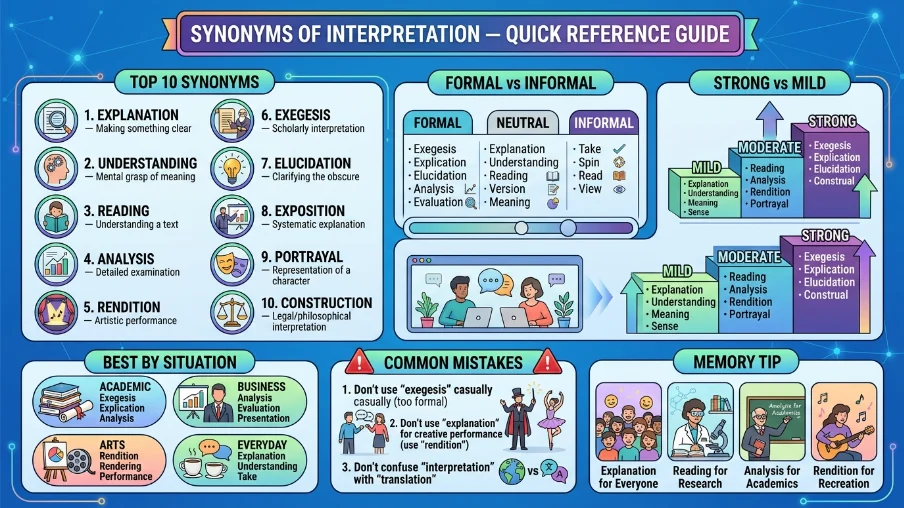
Interpretation means explaining or understanding the meaning of something a text, a situation, a dream, or even a piece of music. The best synonyms include explanation, understanding, reading, version, analysis, rendering, rendition, construction, and elucidation. But each synonym has a slightly different meaning, tone, or context, so choosing the right one depends on your situation.
Have you ever needed another word for interpretation? Maybe you’re writing an academic essay, reviewing a film, or simply trying to express yourself more clearly. The word interpretation is useful, but using it too often can make your writing sound repetitive.
That’s where synonyms come in. Learning alternative words for interpretation will help you speak and write more naturally, just like a native speaker. In this guide, you’ll discover 30 powerful synonyms for interpretation, complete with meanings, examples, and practical usage tips. By the end, you’ll know exactly which word to use in any situation whether you’re writing a university paper, having a casual conversation, or analyzing a work of art.
What Does “Interpretation” Mean?
Definition
In simple terms, interpretation is the act of explaining or understanding the meaning of something. It’s how you make sense of things that aren’t immediately obvious. When you read a poem and decide what it means, that’s an interpretation. When you watch a movie and form an opinion about its message, that’s also an interpretation. It can also refer to the way a performer presents a creative work, like a musician’s interpretation of a classical piece.
Pronunciation
| Feature | Value |
|---|---|
| US IPA | /ɪnˌtɜrprɪˈteɪʃən/ |
| UK IPA | /ɪnˌtɜːprɪˈteɪʃən/ |
| Syllables | 5 |
| Tip | Stress the fourth syllable: in-TUR-pri-TAY-shun |
Grammar
| Grammar Feature | Information |
|---|---|
| Part of Speech | Noun (countable and uncountable) |
| Common Position | Subject or object of a sentence |
| Typical Pattern | interpretation of X or interpretation that… |
Example Sentences:
- His interpretation of the poem was completely different from mine.
- The data is open to various interpretations.
- Her interpretation of the role won her an award.
Grammar Note: Interpretation can be countable (many interpretations) or uncountable (the act of interpretation). It’s often used with the preposition of.
Word Family
| Word | Part of Speech | Meaning |
|---|---|---|
| Interpret | Verb | To explain or understand the meaning of something |
| Interpretation | Noun | The act or result of explaining or understanding |
| Interpretive | Adjective | Relating to or providing interpretation |
| Interpretative | Adjective | Same as interpretive (alternative spelling) |
| Interpreter | Noun | A person who translates or explains |
| Misinterpret | Verb | To understand or explain incorrectly |
| Misinterpretation | Noun | An incorrect understanding or explanation |
| Reinterpret | Verb | To interpret again in a new way |
| Reinterpretation | Noun | A new or different interpretation |
30 Synonyms of “Interpretation”
1. Explanation
Meaning: A statement that makes something clear or easy to understand.
Best Used For: Daily conversation, teaching, and general writing.
Formality: Neutral
Tone: Neutral, clear
Frequency: ⭐⭐⭐⭐⭐ Very Common
CEFR Level: A2
Example Sentence 1: The teacher gave a clear explanation of the grammar rule.
Example Sentence 2: I need an explanation for why the project was delayed.
Usage Tip: Explanation is the most general and common synonym. Use it when you simply want to make something clear. It’s less formal than interpretation and doesn’t suggest as much personal viewpoint. Native speakers use it daily in almost any context.
2. Understanding
Meaning: A mental grasp of the meaning or significance of something.
Best Used For: Describing how someone comprehends a situation or idea.
Formality: Neutral
Tone: Neutral, thoughtful
Frequency: ⭐⭐⭐⭐⭐ Very Common
CEFR Level: A2
Example Sentence 1: It is my understanding that the meeting has been postponed.
Example Sentence 2: She has a deep understanding of the subject.
Usage Tip: Understanding focuses on how someone mentally grasps something. It’s slightly more personal than explanation it’s about what’s in your head, not what you say to others. Use it when you want to emphasize comprehension rather than verbal explanation.
3. Reading
Meaning: A particular way of understanding a text, situation, or piece of data.
Best Used For: Literary analysis, academic writing, and discussing texts.
Formality: Neutral to formal
Tone: Analytical, academic
Frequency: ⭐⭐⭐⭐ Common
CEFR Level: B1
Example Sentence 1: My reading of the novel is that it’s about the loss of innocence.
Example Sentence 2: There are several possible readings of this passage.
Usage Tip: Reading is a sophisticated way to say interpretation, especially in academic contexts. It suggests a thoughtful, analytical approach to a text. Native speakers use it in literature classes, book clubs, and intellectual discussions.
4. Version
Meaning: A particular form or variation of something, often based on personal perspective.
Best Used For: Describing different accounts of events or different adaptations.
Formality: Neutral
Tone: Neutral, factual
Frequency: ⭐⭐⭐⭐ Common
CEFR Level: B1
Example Sentence 1: She gave her version of what happened at the meeting.
Example Sentence 2: The director’s version of the film is much darker than the original.
Usage Tip: Version suggests that there are multiple ways to present the same thing, and yours is one of them. It’s often used when people disagree about events. Use it when you want to acknowledge that other perspectives exist.
5. Analysis
Meaning: A detailed examination of something to understand its parts and meaning.
Best Used For: Academic writing, business reports, and technical contexts.
Formality: Formal
Tone: Analytical, professional
Frequency: ⭐⭐⭐⭐⭐ Very Common
CEFR Level: B2
Example Sentence 1: The analysis of the data revealed several important trends.
Example Sentence 2: We need to do a careful analysis of the problem before we act.
Usage Tip: Analysis is more technical and systematic than interpretation. It suggests breaking something down into parts to understand it better. Use it in academic, scientific, and professional contexts.
6. Rendering
Meaning: A performance or representation of something, especially a creative work.
Best Used For: Music, art, and creative performance contexts.
Formality: Formal
Tone: Artistic, professional
Frequency: ⭐⭐⭐ Moderate
CEFR Level: B2
Example Sentence 1: Her rendering of the Beethoven sonata was breathtaking.
Example Sentence 2: The artist’s rendering of the landscape captured its beauty perfectly.
Usage Tip: Rendering is specifically used for artistic or creative interpretations. It’s common in music, visual art, and performance reviews. It suggests skill and craftsmanship in presenting something.
7. Rendition
Meaning: A particular performance or version, especially of a dramatic or musical work.
Best Used For: Performances, music, and artistic presentations.
Formality: Formal
Tone: Artistic, expressive
Frequency: ⭐⭐⭐ Moderate
CEFR Level: B2
Example Sentence 1: The band’s rendition of the classic song was unforgettable.
Example Sentence 2: She gave a powerful rendition of the role of Juliet.
Usage Tip: Rendition is very similar to rendering but is more commonly used for performances. It’s the perfect word for reviewing concerts, plays, or any live performance.
8. Construction
Meaning: A particular way of understanding or interpreting something.
Best Used For: Academic writing, especially in law and philosophy.
Formality: Formal
Tone: Analytical, intellectual
Frequency: ⭐⭐⭐ Moderate
CEFR Level: B2
Example Sentence 1: He put a very different construction on the events than I did.
Example Sentence 2: The court’s construction of the law was controversial.
Usage Tip: Construction is a formal way to say interpretation, especially in legal and philosophical contexts. It suggests that meaning is “built” or “constructed” by the interpreter.
9. Elucidation
Meaning: An explanation that makes something clear by removing confusion.
Best Used For: Academic writing, complex explanations, and formal contexts.
Formality: Very Formal
Tone: Intellectual, clarifying
Frequency: ⭐ Rare
CEFR Level: C1
Example Sentence 1: The professor’s elucidation of the theory helped everyone understand it.
Example Sentence 2: This book is an elucidation of the philosopher’s most difficult ideas.
Usage Tip: Elucidation is a beautiful, formal word. It suggests making something obscure or difficult become clear. Use it in academic writing when you want to sound sophisticated. It’s too formal for everyday conversation.
10. Explication
Meaning: A detailed explanation of the meaning of something, especially a text.
Best Used For: Literary criticism, academic writing, and philosophy.
Formality: Very Formal
Tone: Analytical, scholarly
Frequency: ⭐ Rare
CEFR Level: C1
Example Sentence 1: The essay provides a careful explication of the poem’s central themes.
Example Sentence 2: His explication of the scientific concepts was masterful.
Usage Tip: Explication is more detailed than explanation. It often involves analyzing a text word by word or line by line. It’s common in literary studies and academic writing.
11. Exposition
Meaning: A systematic explanation or presentation of an idea or topic.
Best Used For: Formal presentations, academic writing, and speeches.
Formality: Formal
Tone: Systematic, clear
Frequency: ⭐⭐⭐ Moderate
CEFR Level: B2
Example Sentence 1: Her exposition of the theory was clear and well-organized.
Example Sentence 2: The book is an exposition of the author’s political philosophy.
Usage Tip: Exposition suggests a thorough, organized presentation of information. It’s commonly used for formal explanations of complex ideas. It’s more structured than a simple explanation.
12. Exegesis
Meaning: A critical interpretation or explanation of a text, especially religious scripture.
Best Used For: Religious studies, biblical scholarship, and literary criticism.
Formality: Very Formal
Tone: Scholarly, serious
Frequency: ⭐ Very Rare
CEFR Level: C1
Example Sentence 1: The scholar’s exegesis of the biblical passage was widely respected.
Example Sentence 2: She wrote an exegesis of the ancient text for her thesis.
Usage Tip: Exegesis is a specialized academic term. It’s most commonly used for interpreting religious or ancient texts. Use it only in scholarly or theological contexts. For general use, explanation or analysis are better choices.
13. Construal
Meaning: A personal interpretation or understanding of something.
Best Used For: Academic writing, psychology, and philosophy.
Formality: Very Formal
Tone: Analytical, personal
Frequency: ⭐ Very Rare
CEFR Level: C1
Example Sentence 1: His construal of the events differed significantly from hers.
Example Sentence 2: The study examined children’s construal of social situations.
Usage Tip: Construal emphasizes that interpretation is personal and subjective. It’s a technical term in psychology and philosophy. It’s not used in everyday conversation.
14. Performance
Meaning: The act of presenting a creative work, especially in music or theater.
Best Used For: Music, theater, dance, and any live art.
Formality: Neutral
Tone: Artistic, expressive
Frequency: ⭐⭐⭐⭐ Common
CEFR Level: A2
Example Sentence 1: Her performance of the role was unforgettable.
Example Sentence 2: The orchestra’s performance of the symphony was magnificent.
Usage Tip: Performance is used when interpretation involves acting, singing, or playing music. It focuses on the execution rather than the meaning. Use it for live arts.
15. Portrayal
Meaning: The way someone represents or depicts a character or subject.
Best Used For: Acting, character analysis, and artistic representation.
Formality: Neutral to formal
Tone: Descriptive, artistic
Frequency: ⭐⭐⭐ Moderate
CEFR Level: B2
Example Sentence 1: His portrayal of the king was both powerful and moving.
Example Sentence 2: The film’s portrayal of rural life is very realistic.
Usage Tip: Portrayal focuses on how a character or subject is represented. It’s commonly used in acting reviews, art criticism, and media analysis. It suggests a conscious choice in representation.
16. Presentation
Meaning: The way something is shown or explained to others.
Best Used For: Formal talks, business contexts, and academic settings.
Formality: Neutral to formal
Tone: Professional, clear
Frequency: ⭐⭐⭐⭐ Common
CEFR Level: B1
Example Sentence 1: Her presentation of the research findings was very clear.
Example Sentence 2: The presentation of data in the report could be improved.
Usage Tip: Presentation focuses on how information is shown or delivered. It’s common in business and academic contexts. It’s less about meaning and more about delivery.
17. Execution
Meaning: The way a performance or task is carried out.
Best Used For: Performances, tasks, and artistic execution.
Formality: Formal
Tone: Skill-focused, evaluative
Frequency: ⭐⭐⭐ Moderate
CEFR Level: B2
Example Sentence 1: The execution of the dance was flawless.
Example Sentence 2: His execution of the difficult piano piece was masterful.
Usage Tip: Execution emphasizes the skill and technique involved in performing something. It’s about how something is done rather than what it means. Use it when you want to comment on technical skill.
18. Depiction
Meaning: The way something is shown or described in words or images.
Best Used For: Art, literature, and media analysis.
Formality: Neutral to formal
Tone: Descriptive, visual
Frequency: ⭐⭐⭐ Moderate
CEFR Level: B2
Example Sentence 1: The novel’s depiction of wartime life is very realistic.
Example Sentence 2: The painting is a vivid depiction of a winter landscape.
Usage Tip: Depiction is about how something is shown or described. It’s common in art criticism and literary analysis. It focuses on representation rather than meaning.
19. Meaning
Meaning: What is meant by a word, text, concept, or action.
Best Used For: General use, discussing what something signifies.
Formality: Neutral
Tone: Straightforward, clear
Frequency: ⭐⭐⭐⭐⭐ Very Common
CEFR Level: A2
Example Sentence 1: The meaning of the poem isn’t obvious at first.
Example Sentence 2: What’s the meaning of this symbol?
Usage Tip: Meaning is the most basic synonym. It refers to what something signifies. It’s less active than interpretation it’s about the message itself rather than the act of understanding it. Use it when you want to talk about significance.
20. Sense
Meaning: A particular meaning or way of understanding something.
Best Used For: Discussing different meanings of words or situations.
Formality: Neutral
Tone: Clear, direct
Frequency: ⭐⭐⭐⭐ Common
CEFR Level: B1
Example Sentence 1: In a sense, we are all responsible for what happened.
Example Sentence 2: The word has several different senses.
Usage Tip: Sense is often used to talk about different meanings of a word or different ways to understand a situation. It’s useful when you want to acknowledge that something can be understood in multiple ways.
21. Clarification
Meaning: The act of making something clearer or easier to understand.
Best Used For: Asking for or providing more information.
Formality: Neutral
Tone: Helpful, clear
Frequency: ⭐⭐⭐⭐ Common
CEFR Level: B1
Example Sentence 1: I need some clarification on the instructions.
Example Sentence 2: The manager provided clarification about the new policy.
Usage Tip: Clarification is about removing confusion. It’s what you ask for when something isn’t clear. It’s more specific than explanation and suggests that something was previously unclear.
22. Definition
Meaning: A concise explanation of the meaning of a word or concept.
Best Used For: Dictionaries, academic writing, and teaching.
Formality: Neutral to formal
Tone: Precise, clear
Frequency: ⭐⭐⭐⭐ Common
CEFR Level: B1
Example Sentence 1: The dictionary gives a clear definition of the word.
Example Sentence 2: We need a working definition of “success” for this project.
Usage Tip: Definition is more precise than interpretation. It’s about stating the exact meaning of something, often in a formal way. Use it when you want to be precise.
23. Evaluation
Meaning: An appraisal or judgment of the value or quality of something.
Best Used For: Business, education, and professional contexts.
Formality: Formal
Tone: Judgmental, analytical
Frequency: ⭐⭐⭐ Moderate
CEFR Level: B2
Example Sentence 1: The evaluation of the project’s success was positive.
Example Sentence 2: We need an evaluation of the risks before we proceed.
Usage Tip: Evaluation goes beyond interpretation it involves making a judgment about quality or value. Use it when you need to assess or appraise something.
24. Examination
Meaning: A close inspection or analysis of something.
Best Used For: Academic writing, research, and formal analysis.
Formality: Formal
Tone: Analytical, thorough
Frequency: ⭐⭐⭐ Moderate
CEFR Level: B2
Example Sentence 1: The examination of the evidence took several weeks.
Example Sentence 2: Her examination of the text revealed several hidden meanings.
Usage Tip: Examination suggests a careful, detailed look at something. It’s more thorough than a simple explanation. Use it in academic and research contexts.
25. Diagnosis
Meaning: The identification of the nature of a problem by examining symptoms.
Best Used For: Medical contexts and problem-solving.
Formality: Formal
Tone: Analytical, professional
Frequency: ⭐⭐⭐ Moderate
CEFR Level: B2
Example Sentence 1: The doctor’s diagnosis was accurate.
Example Sentence 2: We need a diagnosis of why the project is failing.
Usage Tip: Diagnosis is primarily a medical term, but it’s also used metaphorically for identifying problems. It’s more specific than interpretation and suggests identifying a cause.
26. Connotation
Meaning: An idea or feeling that a word invokes in addition to its literal meaning.
Best Used For: Linguistics, literary analysis, and discussing word choice.
Formality: Formal
Tone: Analytical, linguistic
Frequency: ⭐⭐⭐ Moderate
CEFR Level: B2
Example Sentence 1: The word “home” has positive connotations for most people.
Example Sentence 2: She chose her words carefully, aware of their connotations.
Usage Tip: Connotation is about the emotional or cultural associations of a word. It’s a type of interpretation that focuses on implied meaning rather than literal meaning.
27. Inference
Meaning: A conclusion reached on the basis of evidence and reasoning.
Best Used For: Academic writing, logic, and research.
Formality: Formal
Tone: Logical, analytical
Frequency: ⭐⭐⭐ Moderate
CEFR Level: B2
Example Sentence 1: What inference can we draw from this data?
Example Sentence 2: Her inference that he was lying turned out to be correct.
Usage Tip: Inference is about drawing conclusions from evidence. It’s more about reasoning than about explaining. Use it when you want to emphasize the logical process of reaching a conclusion.
28. Conclusion
Meaning: A judgment or decision reached after consideration.
Best Used For: Academic writing, reports, and decision-making.
Formality: Formal
Tone: Decisive, analytical
Frequency: ⭐⭐⭐⭐ Common
CEFR Level: B1
Example Sentence 1: The conclusion of the study was that the treatment works.
Example Sentence 2: She came to the conclusion that she needed to change careers.
Usage Tip: Conclusion is the result of interpretation it’s what you decide after thinking about something. Use it when you want to emphasize the final judgment or decision.
29. Review
Meaning: A formal assessment or examination of something with the intention of giving an opinion.
Best Used For: Book reviews, film reviews, and performance evaluations.
Formality: Neutral to formal
Tone: Evaluative, critical
Frequency: ⭐⭐⭐⭐ Common
CEFR Level: B1
Example Sentence 1: The review of the film was generally positive.
Example Sentence 2: We need a review of the company’s performance this year.
Usage Tip: Review often involves interpretation and evaluation. It’s common in media, business, and education. Use it when you want to assess and comment on something.
30. Study
Meaning: A detailed investigation and analysis of a subject or situation.
Best Used For: Academic contexts and research.
Formality: Formal
Tone: Academic, thorough
Frequency: ⭐⭐⭐⭐ Common
CEFR Level: B1
Example Sentence 1: The study of the text revealed several layers of meaning.
Example Sentence 2: She published a study on the effects of climate change.
Usage Tip: Study suggests a systematic, detailed investigation. It’s more comprehensive than a simple interpretation. Use it in academic and research contexts.
Synonyms Comparison Table
| Synonym | Best Context | Formality | Tone | Frequency |
|---|---|---|---|---|
| Explanation | General, teaching | Neutral | Clear | ⭐⭐⭐⭐⭐ |
| Understanding | Comprehension, ideas | Neutral | Thoughtful | ⭐⭐⭐⭐⭐ |
| Analysis | Academic, technical | Formal | Analytical | ⭐⭐⭐⭐⭐ |
| Reading | Literary analysis | Neutral | Academic | ⭐⭐⭐⭐ |
| Version | Different accounts | Neutral | Factual | ⭐⭐⭐⭐ |
| Rendering | Music, art | Formal | Artistic | ⭐⭐⭐ |
| Rendition | Performances | Formal | Artistic | ⭐⭐⭐ |
| Construction | Legal, philosophy | Formal | Intellectual | ⭐⭐⭐ |
| Elucidation | Complex ideas | Very Formal | Clarifying | ⭐ |
| Explication | Literary criticism | Very Formal | Scholarly | ⭐ |
| Exposition | Formal presentations | Formal | Systematic | ⭐⭐⭐ |
| Exegesis | Religious texts | Very Formal | Scholarly | ⭐ |
| Performance | Live arts | Neutral | Expressive | ⭐⭐⭐⭐ |
| Portrayal | Acting, art | Neutral | Descriptive | ⭐⭐⭐ |
| Presentation | Business, talks | Neutral | Professional | ⭐⭐⭐⭐ |
Best Synonyms by Situation
| Situation | Best Synonym | Why It Works |
|---|---|---|
| Daily Conversation | Explanation or Understanding | Natural and easy to understand |
| Business Email | Analysis or Presentation | Professional and clear |
| Academic Writing | Exegesis or Explication | Formal and precise |
| School Assignment | Explanation or Reading | Simple and appropriate |
| Professional Meeting | Analysis or Evaluation | Business-like and thorough |
| Presentation | Exposition or Presentation | Clear and organized |
| Creative Writing | Rendering or Depiction | Artistic and imagery-rich |
| Social Media | Take or Version | Modern and relatable |
| Movie Review | Performance or Portrayal | Describes acting naturally |
| Book Review | Reading or Interpretation | Captures literary analysis |
Formal vs Informal Synonyms
Formal Alternatives
| Synonym | Best Used For |
|---|---|
| Analysis | Academic papers, research |
| Exegesis | Religious or ancient texts |
| Explication | Literary criticism |
| Elucidation | Clarifying complex ideas |
| Exposition | Formal presentations |
| Construction | Legal and philosophical contexts |
| Construal | Psychology and philosophy |
| Evaluation | Professional assessments |
| Examination | Research and analysis |
| Inference | Logical reasoning |
Neutral Alternatives
| Synonym | Best Used For |
|---|---|
| Explanation | Almost any context |
| Understanding | Comprehension |
| Reading | Literary analysis |
| Version | Different accounts |
| Meaning | Significance |
| Sense | Different meanings |
Informal Alternatives
| Synonym | Best Used For |
|---|---|
| Take | Personal opinion (e.g., “What’s your take?”) |
| Spin | Biased interpretation |
| Read | Casual understanding |
| View | Personal perspective |
When to Choose Each Level of Formality: Use formal synonyms in academic papers, legal documents, and professional reports. Use neutral synonyms in everyday writing, emails, and most conversations. Use informal synonyms with friends, in casual writing, and on social media. The key is matching your word to your audience and situation.
Strong vs Mild Synonyms
Mild
- Explanation — A basic clarification
- Understanding — A simple grasp of meaning
- Meaning — What something signifies
- Sense — A basic interpretation
These words are suitable for everyday situations. They don’t carry strong analytical or artistic weight.
Moderate
- Reading — A thoughtful understanding of a text
- Analysis — A systematic examination
- Rendition — A performance or version
- Portrayal — A representation
These words suggest a more developed interpretation. They imply some thought, skill, or perspective.
Strong
- Exegesis — A deep, scholarly interpretation
- Explication — A detailed, line-by-line analysis
- Elucidation — Making something profoundly clear
- Construal — A highly personal, subjective interpretation
Use these words carefully. They convey depth, sophistication, and intensity. They should be reserved for situations where a truly deep or scholarly interpretation is being discussed.
Real-Life Examples
In the Classroom:
- “The teacher asked us to give our interpretation of the poem.”
- “My reading of the novel is that it’s about the search for identity.”
In Business:
- “We need a thorough analysis of the market before we invest.”
- “The CEO’s interpretation of the quarterly results was optimistic.”
In Academic Writing:
- “This paper provides an exegesis of the philosopher’s central argument.”
- “The study offers a new interpretation of the historical data.”
In the Arts:
- “Her rendition of the song brought the audience to tears.”
- “The actor’s portrayal of the character was both subtle and powerful.”
In Everyday Conversation:
- “What’s your take on the situation?”
- “I have a different understanding of what happened.”
In Legal Contexts:
- “The judge’s construction of the law was controversial.”
- “The lawyer offered a different interpretation of the contract.”
Common Collocations
| Common Phrase | Better Alternative |
|---|---|
| Interesting interpretation | Insightful reading, compelling analysis |
| Different interpretation | Alternative reading, divergent view |
| Personal interpretation | Personal reading, subjective view |
| Literal interpretation | Literal reading, strict construction |
| Broad interpretation | Broad reading, expansive view |
| Narrow interpretation | Narrow reading, restrictive view |
| Open to interpretation | Open to debate, subject to interpretation |
| Simultaneous interpretation | Live translation, real-time interpretation |
| Interpretation of data | Data analysis, data reading |
Common Phrases
| Phrase | Meaning | Stronger Alternative |
|---|---|---|
| Open to interpretation | Can be understood in different ways | Subject to multiple readings |
| Put a different interpretation on | Understand differently | Offer an alternative reading |
| Interpretation of events | Understanding what happened | Account of events |
| Artistic interpretation | A creative version | Artistic rendition |
| Interpretation of the law | Legal understanding | Legal construction |
| Data interpretation | Making sense of data | Data analysis |
| Interpretation of dreams | Understanding dreams | Dream analysis |
Context Guide
| Situation | Best Synonym | Reason |
|---|---|---|
| Essay | Analysis or Explication | Academic and precise |
| Speech | Explanation or Exposition | Clear and impactful |
| Business Email | Analysis or Evaluation | Professional and clear |
| Novel | Reading or Interpretation | Literary and thoughtful |
| Presentation | Exposition or Presentation | Clear and organized |
| Conversation | Explanation or Take | Natural and easy |
| Academic Writing | Exegesis or Explication | Formal and scholarly |
| Marketing Copy | Interpretation or Reading | Engaging and modern |
Related Words
Near Synonyms
- Explanation — Making something clear
- Understanding — Mental grasp of meaning
- Reading — A particular understanding of a text
- Analysis — Systematic examination
- Rendition — A performance or version
Antonyms
- Misinterpretation — An incorrect understanding
- Misunderstanding — A failure to understand correctly
- Misreading — An incorrect reading or interpretation
- Confusion — A lack of understanding
- Literalness — Adherence to exact meaning without interpretation
Related Adjectives
- Interpretive — Relating to interpretation
- Interpretative — Same as interpretive
- Analytical — Relating to analysis
- Exegetical — Relating to exegesis
- Hermeneutic — Relating to interpretation, especially of texts
Related Nouns
- Interpreter — A person who interprets
- Interpretation — The act or result of interpreting
- Translator — A person who translates
- Critic — A person who evaluates and interprets
Related Verbs
- Interpret — To explain or understand meaning
- Explain — To make something clear
- Analyze — To examine in detail
- Construe — To interpret in a particular way
- Render — To perform or represent
- Elucidate — To make clear
- Explicate — To analyze in detail
Frequently Asked Questions
What is another word for interpretation?
The most common synonyms for interpretation are explanation, understanding, reading, and analysis. The best choice depends on your context. For general use, explanation works in most situations. For academic writing, analysis or reading are better choices.
Which synonym sounds the most professional?
Analysis, evaluation, and exposition sound the most professional. Use analysis for examining data or problems, evaluation for assessing quality or value, and exposition for presenting ideas clearly. These words are common in business and academic writing.
What is the strongest synonym for interpretation?
Exegesis is the strongest synonym, but it’s very specific it’s used for scholarly interpretation of religious or ancient texts. For general use, explication and elucidation are also strong, formal options that suggest deep, careful analysis.
Which synonym is best for essays?
Analysis, reading, and explication work best in essays. Analysis is versatile and academic. Reading is great for literary essays. Explication is perfect for detailed text analysis. Choose based on what you’re analyzing.
What’s the difference between interpretation and explanation?
Interpretation involves personal understanding and often includes subjective judgment. Explanation is more about making something clear and objective. An explanation tells you how something works; an interpretation tells you what it means.
Which synonym is most common in everyday English?
Explanation is the most common synonym in everyday English. Native speakers use it constantly in conversation. Understanding is also very common. For casual contexts, people often say “What’s your take?” instead of “What’s your interpretation?”
What is the opposite of interpretation?
The main opposites are misinterpretation, misunderstanding, and misreading. Misinterpretation means an incorrect understanding, misunderstanding means failing to understand correctly, and misreading means reading something incorrectly.
Is interpretation countable or uncountable?
Interpretation is both countable and uncountable. It’s countable when referring to specific instances (There are several interpretations of this poem) and uncountable when referring to the general act (Interpretation is a skill). Most of the time, it’s used as a countable noun.
Conclusion
Interpretation is one of the most versatile words in English. It describes everything from explaining a simple idea to performing a complex piece of music to analyzing an ancient text. But using the same word over and over can make your writing dull.
Now you have 30 powerful synonyms to choose from. Remember:
- Use explanation for general, everyday contexts
- Use analysis for academic and professional contexts
- Use reading for literary and textual interpretation
- Use rendition or rendering for artistic performances
- Use exegesis or explication for scholarly, detailed analysis
The key to choosing the right synonym is understanding your context, tone, and audience. A word that works perfectly in a business report might sound odd in a casual conversation. Practice using these synonyms in your daily writing and speaking, and soon they’ll feel completely natural.
Start small try replacing interpretation with explanation or reading in your next conversation. Then experiment with more advanced words like elucidation or exegesis when the situation is right. Your vocabulary will grow, and your English will sound more fluent and natural.
