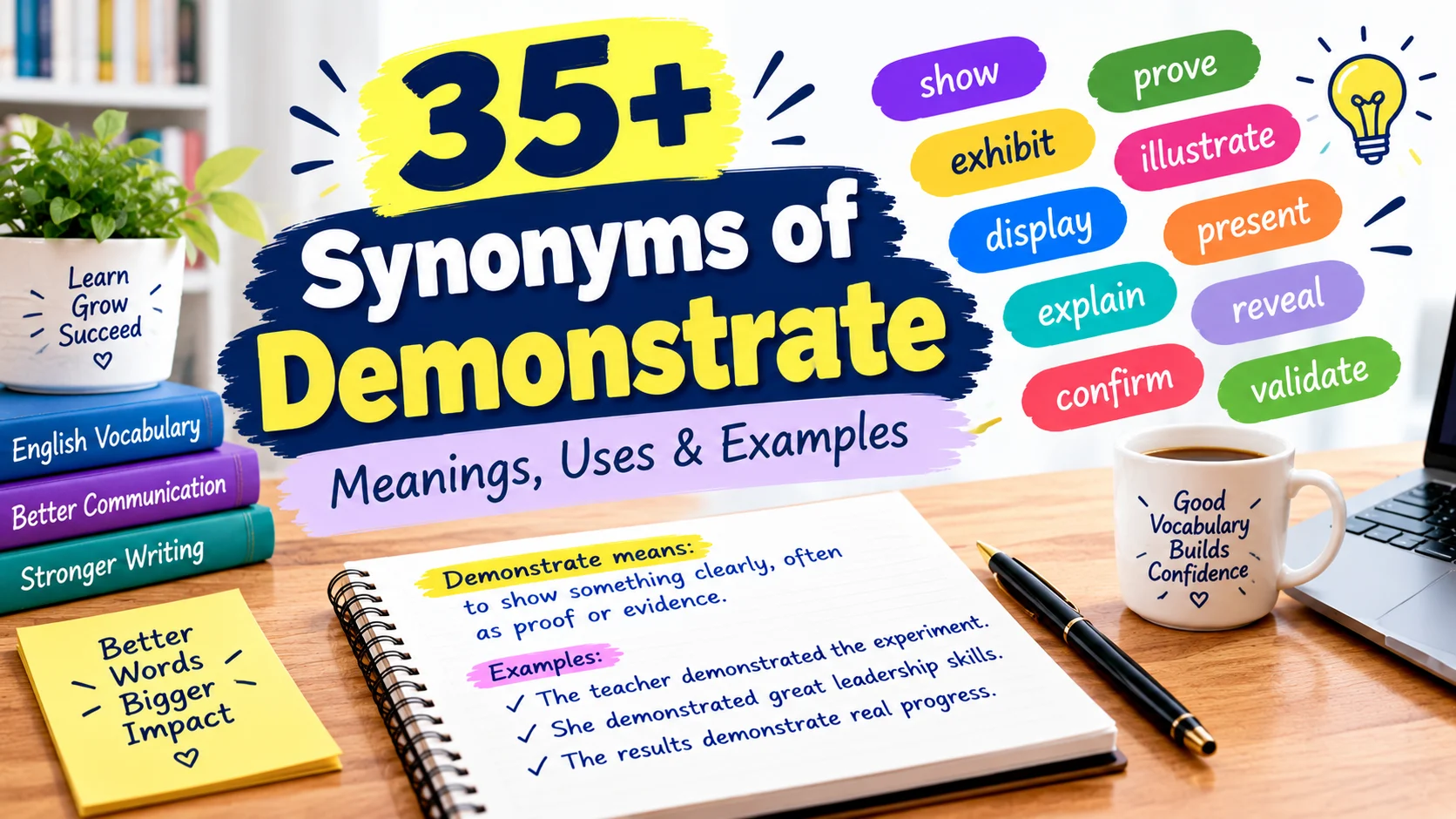
“Demonstrate” means to show something clearly through evidence, explanation, or action. For formal writing, use “illustrate” or “substantiate.” For professional communication, try “display” or “exhibit.” For academic work, choose “establish” or “validate.” In casual conversation, “show” works perfectly. In emotional contexts, “manifest” expresses stronger meaning .
Have you ever written an email, essay, or report and realized you used the word “demonstrate” five times in two paragraphs? You are not alone. Many writers fall into this habit because “demonstrate” feels safe and familiar. But relying on the same word repeatedly makes your writing dull and less persuasive. Choosing the right synonym of demonstrate can transform a flat sentence into something memorable.
The word “demonstrate” is useful, but it does not fit every situation. Sometimes you need a stronger word. Other times you need a softer touch. The best synonym depends on your audience, your purpose, and the emotion you want to convey. This guide will help you select the perfect alternative every time.
Meaning, Tone, and Context
Simple Definition
To demonstrate means to show something clearly by giving proof, evidence, or a practical example. It can also mean to explain how something works or to take part in a public protest .
Part of Speech
Verb (transitive and intransitive)
Overall Tone
Neutral to slightly formal. The word itself does not carry strong emotional weight. It simply communicates that something is being shown or proven.
Formality Level
Semi-formal to formal. “Demonstrate” appears frequently in academic writing, professional reports, and business communication. It is less common in casual conversation, where “show” is preferred.
Common Uses
Native English speakers use “demonstrate” in several ways :
- To prove something with evidence: “The study demonstrates a clear link.”
- To show a skill or quality: “She demonstrated excellent leadership.”
- To explain how something works: “He demonstrated the new software.”
- To participate in a protest: “Thousands demonstrated against the policy.”
Word Forms
| Form | Word |
| Verb | Demonstrate |
| Noun | Demonstration |
| Adjective | Demonstrative |
| Adverb | Demonstrably |
| Opposite | Conceal, hide, disprove |
When and How to Use “Demonstrate”
Use “demonstrate” when you need to show something with clarity and authority. It works best in situations where evidence, proof, or clear explanation matters.
7 Realistic Examples
Professional
The quarterly report demonstrates our company’s steady growth in the European market.
Academic
The researcher’s findings demonstrate a strong correlation between sleep quality and cognitive performance.
Workplace
Her presentation demonstrated how the new workflow would save the team approximately ten hours per week.
Personal
His actions throughout the crisis demonstrated his true character and commitment to his family.
Email
I would like to demonstrate the new features during our team meeting on Thursday.
Resume
Successfully demonstrated the ability to manage cross-functional teams and deliver projects on time.
Social Media
This behind-the-scenes video demonstrates exactly how we handcraft each leather bag.
Best Synonyms of “Demonstrate”
No synonym perfectly replaces “demonstrate” in every situation. The right choice depends on context, audience, and what you want to emphasize.
Best Synonym by Context
| Context | Best Synonym | Why It Works |
| Professional writing | Illustrate | Suggests clarity and visual understanding |
| Academic writing | Establish | Implies rigorous proof and validation |
| Business communication | Exhibit | Conveys professionalism and visibility |
| Casual conversation | Show | Simple, direct, and natural |
| Emotional writing | Manifest | Adds depth and emotional weight |
| Creative writing | Evince | Literary and expressive |
| Resume writing | Display | Action-oriented and confident |
| Workplace communication | Present | Professional and clear |
| Stronger meaning | Substantiate | Emphasizes proof and backing |
| Softer meaning | Suggest | Implies without demanding agreement |
When Not to Use “Demonstrate”
When the Word Sounds Too General
If you are describing something highly specific, “demonstrate” may be too vague.
Weak: The data demonstrates the problem.
Better: The data highlights the problem.
Best: The data exposes the problem.
When the Word Sounds Too Formal
In casual conversation or text messages, “demonstrate” sounds stiff and unnatural.
Awkward: I want to demonstrate my new phone.
Natural: I want to show you my new phone.
When the Word Sounds Too Weak
If you need strong conviction, “demonstrate” may not carry enough weight.
Weak: He demonstrated his commitment.
Stronger: He proved his commitment.
Strongest: He embodied his commitment.
When the Word Sounds Outdated
In some modern contexts, “demonstrate” can feel old-fashioned.
Dated: Let me demonstrate how to use the app.
Modern: Let me walk you through the app.
Words Commonly Confused With “Demonstrate”
Demonstrate vs Show
Difference: “Show” is simpler and more general. “Demonstrate” implies proof or method. “Show” can be used in almost any situation, while “demonstrate” suggests explanation or evidence .
When to Use Each: Use “show” for everyday situations. Use “demonstrate” when you need to prove something or explain a process.
Show Example: Can you show me how to do this?
Demonstrate Example: Can you demonstrate the correct technique?
Demonstrate vs Exhibit
Difference: “Exhibit” means to display something publicly, often in a formal setting. “Demonstrate” focuses on showing how something works or proving a point .
When to Use Each: Use “exhibit” for displaying objects or qualities. Use “demonstrate” for explaining processes or proving arguments.
Exhibit Example: The museum exhibits ancient artifacts.
Demonstrate Example: The scientist demonstrates the experiment’s procedure.
Demonstrate vs Prove
Difference: “Prove” is stronger and more conclusive. “Demonstrate” can suggest showing evidence without necessarily reaching a final conclusion .
When to Use Each: Use “prove” when you have definitive evidence. Use “demonstrate” when you are showing evidence that supports a claim.
Prove Example: DNA evidence proved his innocence.
Demonstrate Example: The data demonstrates a pattern worth investigating.
Demonstrate vs Display
Difference: “Display” emphasizes visibility and presentation. “Demonstrate” emphasizes showing how something works or providing evidence .
When to Use Each: Use “display” for showing objects or qualities. Use “demonstrate” for showing processes or proving points.
Display Example: The store displays its products in the front window.
Demonstrate Example: The trainer demonstrates each exercise carefully.
Demonstrate vs Explain
Difference: “Explain” focuses on words and description. “Demonstrate” focuses on showing through action or evidence .
When to Use Each: Use “explain” when you are describing something verbally. Use “demonstrate” when you are showing something in action.
Explain Example: Please explain your reasoning.
Demonstrate Example: Please demonstrate your technique.
Best Synonyms of “Demonstrate” by Context
| Context | Best Synonym | Why It Works | Example |
| Formal writing | Substantiate | Adds weight and credibility | The evidence substantiates the claim |
| Academic writing | Validate | Implies rigorous testing | The results validate the hypothesis |
| Professional communication | Illustrate | Emphasizes clarity | The chart illustrates the trend |
| Business emails | Present | Direct and professional | I will present the proposal tomorrow |
| Resume writing | Execute | Action-oriented | Executed strategic initiatives successfully |
| Workplace communication | Outline | Structured and clear | She outlined the new procedure |
| Casual conversation | Show | Natural and effortless | Show me what you mean |
| Everyday speaking | Point out | Direct and conversational | He pointed out the error immediately |
| Creative writing | Evince | Literary and sophisticated | Her art evinces deep emotion |
| Storytelling | Reveal | Adds discovery and depth | The plot reveals hidden motives |
| Emotional writing | Manifest | Connects to inner feelings | His grief manifested in silence |
| Strong emphasis | Confirm | Adds certainty | The test confirmed our suspicions |
| Mild tone | Suggest | Gentle and tentative | The data suggests a pattern |
| Social media captions | Feature | Engaging and modern | This video features our latest collection |
| American English | Show | Universal and natural | Show your work step by step |
How to Choose the Best Synonym of “Demonstrate”
Choosing the right synonym is easier when you consider a few key questions.
Step 1: Identify Your Meaning
What exactly are you trying to communicate? Are you proving a point, showing a process, or displaying a quality?
- If proving, consider: substantiate, validate, establish, confirm
- If showing a process, consider: illustrate, present, outline, walk through
- If displaying a quality, consider: exhibit, display, manifest, evince
Step 2: Consider Your Audience
Who is reading or listening to you?
- Formal audience (academic, legal): Use validate, substantiate, establish
- Professional audience (business, corporate): Use illustrate, present, exhibit
- Casual audience (friends, social media): Use show, point out, feature
Step 3: Consider Your Tone
What feeling do you want to convey?
- Neutral and informative: Use demonstrate, show, present
- Strong and confident: Use prove, establish, confirm
- Subtle and gentle: Use suggest, indicate, point toward
Step 4: Consider Your Format
Where is your writing appearing?
- Academic paper: Use validate, substantiate, establish
- Business presentation: Use illustrate, present, demonstrate
- Email: Use show, point out, outline
- Social media: Use feature, show, reveal
Real Life Examples of “Demonstrate”
School
The student demonstrated the scientific method by presenting a clear hypothesis and testable predictions.
College
Her thesis demonstrated a comprehensive understanding of postcolonial literary theory.
Workplace
The team leader demonstrated exceptional problem-solving skills during the system outage.
Business
The annual report demonstrates the company’s commitment to environmental sustainability.
I would like to demonstrate the updated software features at our next departmental meeting.
Resume
Demonstrated consistent revenue growth through strategic account management and client retention.
Conversation
“Can you demonstrate how you fixed the issue so I can learn for next time?”
Storytelling
The old photograph demonstrated just how much the city had changed over fifty years.
Blogging
These five examples demonstrate why minimalist design often outperforms complex layouts.
Social Media
Our latest tutorial demonstrates exactly how to achieve this look at home.
Improved Writing: Replacing “Demonstrate” with Stronger Synonyms
Original: The results demonstrate the importance of the program.
Improved: The results underscore the importance of the program.
Original: Her actions demonstrate her dedication.
Improved: Her actions embody her dedication.
Original: The evidence demonstrates their guilt.
Improved: The evidence proves their guilt.
18 Best Synonyms of “Demonstrate”
| Synonym | Simple Meaning | Best Used For | Example Sentence |
| Show | To make something visible or known | Everyday situations | Please show me how the machine operates |
| Prove | To establish truth with evidence | Definitive conclusions | The test proved the product is safe |
| Illustrate | To clarify with examples or visuals | Making complex ideas clear | The graph illustrates the growth pattern |
| Exhibit | To display openly or publicly | Formal presentations | The artist exhibited her work at the gallery |
| Display | To show prominently | Visual presentation | The store displays seasonal items front and center |
| Establish | To set up or prove conclusively | Academic and legal contexts | The study establishes a clear connection |
| Substantiate | To provide strong evidence | Formal arguments | New research substantiates the original findings |
| Validate | To confirm as accurate | Testing and verification | We need to validate these results first |
| Confirm | To strengthen with evidence | Verifying existing beliefs | The data confirms our initial hypothesis |
| Manifest | To show clearly and visibly | Emotional or quality expression | His kindness manifested in everyday actions |
| Evince | To reveal or show clearly | Literary and formal writing | Her poetry evinces remarkable emotional depth |
| Present | To formally show or introduce | Professional and business settings | I will present the findings on Friday |
| Indicate | To point out or suggest | Scientific and analytical writing | The survey indicates shifting consumer preferences |
| Reveal | To make something known | Storytelling and discovery | The investigation revealed hidden connections |
| Outline | To summarize with structure | Organizational contexts | He outlined the project timeline clearly |
| Uncover | To bring to light | Investigative writing | The journalist uncovered evidence of wrongdoing |
| Disclose | To reveal previously hidden information | Official and formal contexts | The company disclosed its financial results |
| Highlight | To draw attention to | Emphasizing key points | The report highlights areas for improvement |
Synonyms of “Demonstrate” by Usage
Professional vs Personal Synonyms
Professional settings require words that sound confident and credible:
- Exhibit (shows professionalism)
- Illustrate (shows clarity)
- Present (shows organization)
- Substantiate (shows thoroughness)
Personal conversations use simpler, warmer words:
- Show (universal and comfortable)
- Point out (direct and friendly)
- Reveal (engaging and personal)
Formal vs Conversational Synonyms
Formal writing (reports, essays, academic papers):
- Demonstrate itself works well
- Substantiate adds authority
- Validate implies rigorous testing
- Establish suggests firm proof
Conversational use (texting, casual emails, social media):
- Show is the go-to choice
- Feature works for product mentions
- Point out works for observations
Academic Synonyms
For research papers and scholarly writing, these words add precision and credibility:
- Validate – confirms through testing
- Substantiate – provides solid proof
- Establish – sets up a proven conclusion
- Confirm – strengthens existing knowledge
- Illustrate – clarifies with examples
These synonyms sound more authoritative because they are commonly used in published research .
Professional and Business Synonyms
For resumes, interviews, and corporate communication:
- Execute – strong action word
- Present – professional and organized
- Exhibit – formal and confident
- Feature – modern and engaging
- Outline – structured and clear
Creative and Literary Synonyms
For storytelling, fiction, and descriptive writing:
- Reveal – adds mystery and discovery
- Evince – sophisticated and literary
- Manifest – connects to internal states
- Uncover – suggests investigation
- Disclose – implies secrecy
These words add emotion and imagery to your writing.
Slang or Modern Synonyms
“Demonstrate” does not have common slang equivalents. In modern usage:
- Show (informal, universal)
- Walk through (explain step by step)
- Lay out (present clearly)
Use these in casual contexts, but avoid them in formal writing.
Strongest to Mildest Synonyms
| Intensity | Synonym | Explanation |
| Mild | Suggest | Simply points toward without demanding agreement |
| Mild | Indicate | Softly points out information |
| Moderate | Show | Straightforward and neutral |
| Moderate | Illustrate | Clarifies without adding pressure |
| Moderate | Display | Presents information openly |
| Strong | Demonstrate | The original word with moderate authority |
| Strong | Establish | Sets up a definitive conclusion |
| Strong | Confirm | Strengthens existing knowledge |
| Very Strong | Prove | No room for doubt |
| Very Strong | Substantiate | Backed by undeniable evidence |
Emotional vs Neutral Synonyms
Emotional Synonyms
These words express stronger feelings or personal connection:
- Reveal (suggests hidden emotion coming to light)
- Evince (suggests deep feeling expressed through art or action)
- Manifest (suggests internal states becoming visible)
- Disclose (suggests vulnerability or trust)
Use these when you want to add emotional depth to your writing.
Neutral Synonyms
These words simply communicate information without emotion:
- Show (pure information)
- Indicate (suggests without feeling)
- Present (formal and neutral)
- Outline (organizational and neutral)
Use these when you want to remain objective and factual.
Antonyms of “Demonstrate”
| Antonym | Meaning | Example Sentence |
| Conceal | To hide intentionally | She tried to conceal her disappointment |
| Hide | To keep out of sight | The evidence was hidden from investigators |
| Disprove | To prove something is false | New research disproves the earlier theory |
| Refute | To prove something is wrong | The lawyer refuted the witness’s claim |
| Contradict | To go against established evidence | His story contradicts the documented facts |
| Obscure | To make unclear | The technical jargon obscures the main point |
| Cover up | To prevent from being known | The company tried to cover up the incident |
| Suppress | To prevent from being revealed | They suppressed the unfavorable data |
| Confuse | To make less clear | The conflicting reports confuse the issue |
| Mislead | To cause someone to believe wrongly | The advertisement misleadingly suggests easy results |
| Deny | To refuse to accept or believe | He denies any involvement in the matter |
| Discredit | To damage the reputation of evidence | The defense sought to discredit the witness |
| Invalidate | To make something not valid | The procedural error invalidates the study |
| Rebut | To offer opposing evidence | The defense rebutted each prosecution claim |
| Mask | To hide or disguise | His calm expression masked his anxiety |
Comparison: “Demonstrate” vs Similar Words
Demonstrate vs Prove
Main Difference: “Prove” is more conclusive and absolute. “Demonstrate” suggests showing evidence without necessarily reaching a final, unassailable conclusion .
Which Is Stronger? “Prove” is significantly stronger.
Which Is More Formal? Both are formal, but “prove” is common in legal and scientific writing.
When to Use Each: Use “demonstrate” when showing evidence or explanation. Use “prove” when you have reached an undeniable conclusion.
Demonstrate: The study demonstrates a correlation between the two factors.
Prove: The experiment proves the chemical reaction occurs.
Demonstrate vs Exhibit
Main Difference: “Exhibit” focuses on public display or showing. “Demonstrate” focuses on showing how something works or providing evidence .
Which Is Stronger? “Demonstrate” is stronger for showing process or proof.
Which Is More Formal? “Exhibit” is often used in formal settings like museums. “Demonstrate” is formal but more versatile.
When to Use Each: Use “exhibit” for displaying objects or qualities. Use “demonstrate” for explaining processes.
Exhibit: The museum exhibits ancient Mayan artifacts.
Demonstrate: The guide demonstrates how to prepare traditional Mayan cuisine.
Demonstrate vs Display
Main Difference: “Display” emphasizes visual presentation. “Demonstrate” emphasizes explanation or proof .
Which Is Stronger? “Demonstrate” carries more weight for proof. “Display” is better for visual emphasis.
Which Is More Formal? “Demonstrate” is slightly more formal.
When to Use Each: Use “display” for visual presentation. Use “demonstrate” for explaining how something works.
Display: The store window displays the latest collection.
Demonstrate: The salesperson demonstrates how the product works.
Demonstrate vs Illustrate
Main Difference: “Illustrate” specifically means to clarify with examples. “Demonstrate” can mean to prove or to show how something works .
Which Is Stronger? For proof, “demonstrate” is stronger. For clarity, “illustrate” is more specific.
Which Is More Formal? Both are formal and academic.
When to Use Each: Use “illustrate” when you want to clarify with examples. Use “demonstrate” when you want to prove a point.
Illustrate: These figures illustrate the concept clearly.
Demonstrate: These figures demonstrate our success.
Demonstrate vs Establish
Main Difference: “Establish” means to set something up or prove it definitively. “Demonstrate” means to show evidence or explanation .
Which Is Stronger? “Establish” is stronger for permanent conclusions.
Which Is More Formal? Both are highly formal.
When to Use Each: Use “establish” when something is conclusively proven. Use “demonstrate” when showing evidence or explanation.
Establish: The scientists established the link between smoking and cancer.
Demonstrate: The study demonstrates a potential link worth exploring.
Demonstrate vs Indicate
Main Difference: “Indicate” is milder and more tentative. “Demonstrate” suggests stronger evidence .
Which Is Stronger? “Demonstrate” is noticeably stronger.
Which Is More Formal? Both are formal and common in academic writing.
When to Use Each: Use “indicate” for suggestions or trends. Use “demonstrate” for clearer proof.
Indicate: The data indicates a possible trend.
Demonstrate: The data demonstrates a clear trend.
Common Phrases and Expressions with “Demonstrate”
Demonstrate a Point
Meaning: To clearly show or prove a particular argument.
Example: The lawyer demonstrated her point through careful cross-examination.
Demonstrate an Ability
Meaning: To show you possess a particular skill or quality.
Example: The candidate demonstrated an ability to lead large teams effectively.
Demonstrate Commitment
Meaning: To show dedication through action, not just words.
Example: She demonstrated her commitment to the project by working long hours.
Demonstrate One’s Worth
Meaning: To prove that you are valuable or capable.
Example: The new employee demonstrated his worth within the first week.
Demonstrate Against
Meaning: To take part in a public protest.
Example: Thousands demonstrated against the proposed legislation .
Demonstrate for
Meaning: To take part in a public protest in support of something.
Example: Environmental activists demonstrated for stricter pollution controls .
Demonstrate How
Meaning: To show a method or process step by step.
Example: The instructor demonstrated how to use the equipment safely.
Common Mistakes to Avoid
Mistake 1: Using “Demonstrate” in Casual Conversation
Incorrect: Let me demonstrate my new bicycle trick.
Better: Let me show you my new bicycle trick.
Why: “Show” is more natural and conversational in everyday situations.
Mistake 2: Choosing “Show” When Stronger Proof Is Needed
Incorrect: The evidence shows the defendant committed the crime.
Better: The evidence proves the defendant committed the crime.
Why: “Prove” conveys the necessary finality in legal contexts.
Mistake 3: Confusing “Demonstrate” with “Display”
Incorrect: The recipe demonstrates how to make the dish.
Better: The recipe explains how to make the dish.
Why: For written instructions, “explain” or “outline” is more precise. “Demonstrate” suggests showing in person.
Mistake 4: Using an Informal Synonym in Formal Writing
Incorrect: The findings show the effectiveness of the treatment.
Better: The findings demonstrate the effectiveness of the treatment.
Why: In academic writing, “demonstrate” sounds more authoritative.
Mistake 5: Overusing “Demonstrate”
Incorrect: The study demonstrates the effect. The data demonstrates the results. The author demonstrates the method.
Better: The study demonstrates the effect. The data supports the results. The author explains the method.
Why: Repeating the same word weakens your writing. Vary your word choice.
Mistake 6: Choosing an Overly Dramatic Synonym
Incorrect: The email reveals my appreciation for your work.
Better: The email shows my appreciation for your work.
Why: “Reveal” is too dramatic for routine professional communication.
Mistake 7: Using Slang in Professional Writing
Incorrect: The report lays out the quarterly projections.
Better: The report presents the quarterly projections.
Why: “Lays out” is informal and inappropriate for formal business writing.
Frequently Asked Questions
What are the best synonyms of “demonstrate”?
The best synonyms depend on context. For formal writing, use “illustrate” or “substantiate.” For professional settings, use “present” or “exhibit.” For everyday conversation, “show” is the most natural choice.
What are the best formal synonyms of “demonstrate”?
The most formal synonyms of demonstrate are “substantiate,” “validate,” “establish,” “corroborate,” and “verify.” These words are common in academic writing, legal documents, and official reports .
What are common informal synonyms of “demonstrate”?
Common informal synonyms include “show,” “point out,” “lay out,” and “walk through.” “Show” is the most universal and natural choice for everyday situations.
What is another word for “demonstrate” in professional writing?
In professional writing, strong alternatives include “present,” “exhibit,” “illustrate,” and “outline.” “Present” works especially well for business communication .
What is the difference between “demonstrate” and “prove”?
The main difference is intensity. “Demonstrate” means to show evidence or explanation. “Prove” means to establish something as unquestionably true. “Prove” carries a stronger meaning of finality and certainty .
What is the opposite of “demonstrate”?
The main opposites of demonstrate are “conceal,” “hide,” and “disprove.” “Conceal” and “hide” mean to keep from being visible. “Disprove” means to show that something is false .
Conclusion
“Demonstrate” is a valuable word that means to show something clearly through evidence, action, or explanation. It works well in many contexts, from academic papers to business reports. However, no single word works perfectly in every situation.
The best synonym depends on your audience, your purpose, and the strength of the message you want to convey. For formal writing, “substantiate” and “validate” add authority. For professional contexts, “present” and “exhibit” sound polished. For everyday conversation, “show” is the most natural choice.
Choosing the right word transforms your writing from adequate to excellent. The next time you reach for “demonstrate,” pause and ask yourself whether another word would communicate your meaning more precisely. Your readers will notice the difference, and your writing will become more effective and engaging.
Definitions, meanings, and usage recommendations should be verified with trusted language references before publication. Recommended sources include Cambridge Dictionary, Oxford English Dictionary, Merriam Webster, Collins Dictionary, and Britannica.

6 thoughts on “35+ Synonyms of Demonstrate| Meanings, Uses & Examples”