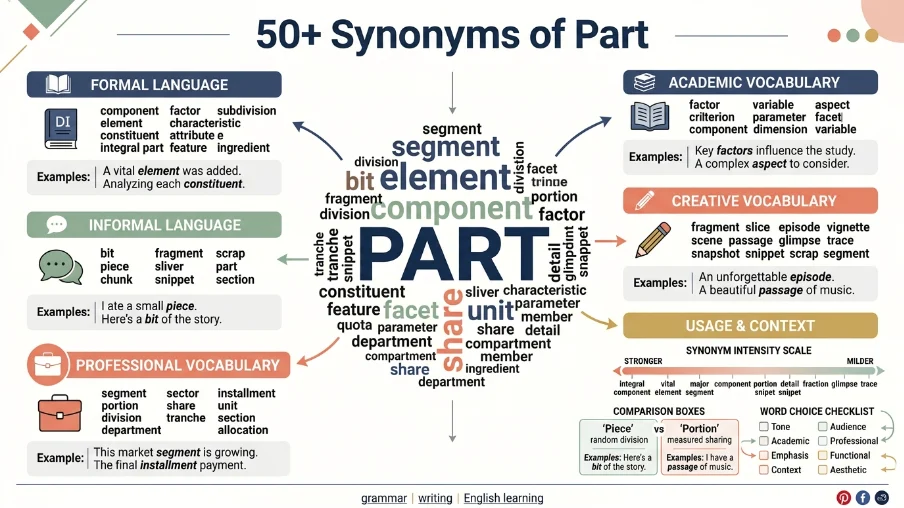
The word “part” refers to a piece, portion, or segment of a larger whole. It carries a neutral tone and works in almost any context. For formal writing, choose “component” or “element.” For casual conversation, use “bit” or “piece.” For professional communication, select “segment” or “section.” For creative writing, consider “fragment” or “fraction.” Emotional contexts call for “share” or “portion.” The best synonym depends entirely on your audience, purpose, and the specific meaning you want to convey.
Have you ever caught yourself using the word “part” repeatedly while writing an essay, composing an email, or revising a blog post? You’re not alone. Part is an extremely common English word, but because it can describe a section, component, role, share, element, or portion, repeatedly using it can sometimes make your writing feel vague or repetitive.
If you’re searching for a part synonym, part synonyms, synonyms of part, or a synonym for part, the best alternative depends on the meaning you intend. For example, section works well for a division of a document, component is appropriate for something that forms part of a larger system, portion can describe a share or amount, and element can refer to an important feature of something. Understanding these distinctions helps you choose words that are both grammatically accurate and appropriate for your context.
You may also come across searches such as parts synonym, part of synonym, another word for part, synonym of part, synonym part, and part synonyms in English. Although these queries may look similar, the right word can change significantly depending on whether “part” refers to a physical piece, a section of writing, someone’s role, participation in an activity, or a portion of something.
Building a stronger vocabulary isn’t simply about replacing common words with complicated ones. Effective synonym choice is about precision, tone, and context. A professional report may benefit from words such as component or section, while creative writing might use element, aspect, or fragment to create a more specific effect. In everyday English, simpler alternatives such as piece, share, or role may sound more natural.
This guide draws on standard English usage and contextual distinctions found in dictionaries and established writing practices. We’ll explore the most useful synonyms of part, explain their meanings and differences, provide example sentences, and show which alternatives work best in academic, professional, formal, informal, and creative writing. Whether you’re looking for another word for part or simply want to make your vocabulary more precise, you’ll find practical options throughout this guide.
Meaning, Tone, and Context
Simple Definition
A part is any piece, portion, or segment that belongs to a larger whole. It can refer to physical objects, abstract concepts, time periods, roles, or contributions.
Part of Speech
Noun and verb (though this article focuses primarily on noun usage)
Overall Tone
Neutral and versatile. The word itself carries no strong emotional weight, which makes it useful across many contexts but also somewhat bland.
Formality Level
Neutral. Works in formal writing, casual conversation, and everything in between. The word “part” never sounds out of place, but more precise alternatives often communicate your meaning better.
Common Uses
Native English speakers use “part” constantly in everyday conversation, professional writing, academic work, and creative expression. It appears in discussions about objects, ideas, relationships, organizations, and processes. People use it to describe physical pieces, abstract components, time segments, and individual contributions to group efforts.
Word Forms
Noun: part
Verb: to part (meaning to separate)
Adjective: part (as in part-time)
Adverb: partly
Related forms: partial, partially, parting
When and How to Use “Part”
Choose “part” when you need a simple, neutral word to describe any piece of a larger whole. It works well for general statements where precision is not essential. Use it when the specific nature of the piece is obvious or unimportant. However, consider whether a more specific synonym might communicate your message more effectively.
Professional Context
The marketing team played a crucial part in the product launch success.
Academic Context
This study examines the part that socioeconomic factors play in educational outcomes.
Workplace Context
Quality control is an essential part of our manufacturing process.
Personal Context
Traveling has been a big part of my life for the past decade.
Email Context
I have attached the relevant part of the report for your review.
Resume Context
Played a key part in developing the company’s social media strategy.
Social Media Context
This recipe has been a part of our family traditions for generations.
Best Synonyms of “Part”
No synonym matches “part” perfectly in every situation. Each alternative carries subtle differences in tone, formality, and emotional weight. Choose the word that best fits your specific context.
Professional Writing
Segment works best in professional writing because it suggests a distinct, identifiable division within a larger structure. It sounds polished and precise.
Academic Writing
Component is the strongest academic choice. It implies something essential that contributes to a functional whole, which aligns with analytical writing.
Business Communication
Portion conveys fairness and distribution, making it suitable for business contexts involving resources, time, or responsibilities.
Casual Conversation
Bit sounds natural and relaxed in everyday speech. It is the synonym most native speakers actually use when speaking casually.
Emotional Writing
Share adds warmth and implies participation or contribution. It works well when describing personal involvement or shared experiences.
Creative Writing
Fragment creates imagery of something broken or incomplete. It adds texture and visual detail to descriptive writing.
Resume Writing
Role sounds active and accomplishment focused. It emphasizes what you contributed rather than just what existed.
Workplace Communication
Piece feels straightforward and accessible. It works well for team discussions and informal workplace communication.
Stronger Meaning
Chunk suggests a substantial, noticeable amount. It adds emphasis when describing size or significance.
Softer Meaning
Element feels gentler and more abstract. It works well when discussing intangible aspects of situations or ideas.
When Not to Use “Part”
Sounding Too General
Using “part” when you could be more specific weakens your writing. It tells readers something belongs to a whole but gives them no real information about its nature.
Less effective: The machine has many parts.
Better: The machine contains mechanical components, electronic modules, and wiring harnesses.
Sounding Too Vague
“Part” becomes vague when you need to distinguish between different types of pieces. A replacement word clarifies whether you mean a physical piece, a role, a time segment, or an abstract element.
Less effective: This is an important part of the project.
Better: This is a critical phase of the project.
Sounding Too Informal
Some contexts demand more sophisticated vocabulary. While “part” is not informal, more precise alternatives often sound more professional.
Less effective: She plays an important part in the company.
Better: She plays a pivotal role in the company.
Sounding Too Weak
When you want to emphasize significance, “part” lacks impact. Stronger synonyms communicate importance more effectively.
Less effective: This forms part of our strategy.
Better: This forms the foundation of our strategy.
Sounding Outdated
“Part” never sounds outdated, but using it exclusively in modern writing feels unsophisticated. Contemporary writing benefits from varied vocabulary.
Less effective: Part of our plan includes digital marketing.
Better: Our plan includes digital marketing as a key element.
Words Commonly Confused With “Part”
Part vs Piece
Difference: “Piece” typically refers to a physical fragment or individual unit, while “part” is more abstract and versatile. “Piece” often implies something that was separated from a whole.
When to Use Part: Use “part” for abstract concepts, roles, and general references to portions.
When to Use Piece: Use “piece” for physical objects, individual items, and concrete fragments.
Example with Part: Collaboration is an essential part of our team culture.
Example with Piece: She found a small piece of the broken vase.
Part vs Portion
Difference: “Portion” specifically refers to a share or allocation of a larger amount, often with implications of distribution or division. “Part” is more general.
When to Use Part: Use “part” when describing any segment of any whole, physical or abstract.
When to Use Portion: Use “portion” when describing allocated shares, servings, or divided amounts.
Example with part: The first part of the movie was the most exciting.
Example with Portion: She ate only a small portion of her meal.
Part vs Component
Difference: “Component” implies something essential that works together with other elements to create a functioning whole. “Part” simply indicates belonging to something larger.
When to Use Part: Use “part” for general references where the relationship to the whole is the main point.
When to Use Component: Use “component” when the piece has a specific function within a system.
Example with Part: Walking is part of my daily routine.
Example with Component: The processor is a vital component of every computer.
Part vs Segment
Difference: “Segment” suggests a clearly divided section of something, often with natural boundaries. “Part” is more fluid and less precisely defined.
When to Use Part: Use “part” for flexible references to portions of anything.
When to Use Segment: Use “segment” when referring to distinct divisions of time, markets, or populations.
Example with Part: The middle part of the book dragged a little.
Example with Segment: We target the luxury segment of the market.
Part vs Element
Difference: “Element” refers to a fundamental, often abstract aspect of something more complex. “Part” can refer to both physical and abstract pieces.
When to Use Part: Use “part” for both physical and abstract pieces.
When to Use Element: Use “element” primarily for abstract or fundamental aspects.
Example with Part: Parking is part of the building’s amenities.
Example with Element: Trust is a key element of any relationship.
Part vs Fraction
Difference: “Fraction” implies a mathematical or proportional part of a whole, often small. “Part” carries no proportional implication.
When to Use Part: Use “part” for general references to any portion.
When to Use Fraction: Use “fraction” when emphasizing small proportion or mathematical division.
Example with Part: The first part of the project took three months.
Example with Fraction: Only a small fraction of applicants were accepted.
Best Synonyms of “Part” by Context
| Context | Best Synonym | Why It Works | Example |
|---|---|---|---|
| Formal writing | Component | Suggests essential, functional pieces within a system | The curriculum includes several core components |
| Academic writing | Element | Conveys fundamental aspects of complex concepts | Social factors are an important element of this analysis |
| Professional communication | Segment | Implies distinct, organized divisions | We will examine each market segment separately |
| Business emails | Portion | Suggests fair distribution of resources | Your portion of the budget has been approved |
| Resume writing | Role | Emphasizes contribution and action | Played a leadership role in product development |
| Workplace communication | Piece | Sounds direct and approachable | Let me explain the next piece of this plan |
| Casual conversation | Bit | Sounds natural and relaxed | I’d like to have a bit of your time |
| Everyday speaking | Part | Simple and universally understood | This is the hard part of the task |
| Creative writing | Fragment | Creates imagery of something broken or incomplete | She found a fragment of the ancient scroll |
| Storytelling | Episode | Suggests a narrative segment | The third episode of the series was thrilling |
| Emotional writing | Share | Implies personal contribution and connection | I had my share of struggles growing up |
| Strong emphasis | Chunk | Conveys a substantial, noticeable amount | He inherited a large chunk of the estate |
| Mild tone | Aspect | Focuses on features rather than physical pieces | We need to consider every aspect of the problem |
| Social media captions | Slice | Gives a modern, visual feel | A slice of everyday life |
| American English | Part | Universally understood across all US contexts | This is a standard part of the process |
How to Choose the Best Synonym of “Part”
Choosing the right synonym requires thinking about your message, audience, and purpose. Ask yourself these questions before selecting a word.
What Meaning Am I Trying to Convey?
If you mean a physical piece, choose “piece,” “fragment,” or “chunk.” If you mean an abstract concept, choose “element,” “aspect,” or “component.” If you mean a role, choose “role” or “function.” The specific meaning should guide your choice.
What Tone Does My Audience Expect?
Professional audiences appreciate precise vocabulary like “component,” “segment,” and “element.” Casual audiences respond better to “bit,” “piece,” and “part.” Academic audiences expect “component,” “factor,” and “element.” Match your word to your reader’s expectations.
How Much Emotional Impact Do I Want?
Neutral words like “part,” “portion,” and “segment” communicate information without emotional weight. Emotional words like “share,” “fragment,” and “chunk” add feeling and emphasis. Consider whether your message benefits from emotional coloring.
What Is My Writing Purpose?
If you are explaining technical information, choose precise words like “component” or “element.” If you are telling a story, choose descriptive words like “fragment” or “episode.” If you are writing a resume, choose action oriented words like “role” or “function.”
What Level of Formality Does the Situation Require?
Formal writing calls for “component,” “element,” and “segment.” Informal writing welcomes “bit,” “piece,” and “chunk.” Match your vocabulary to the expectations of your writing context.
Will This Sound Natural?
Read your sentence aloud with the synonym in place. If it sounds awkward or forced, choose a different word. Natural sounding writing always communicates more effectively.
Real Life Examples of “Part”
School Context
The students were asked to identify every part of the plant during their biology lesson. The teacher explained how each part contributes to the plant’s growth.
College Context
Research methodology forms an essential part of the graduate program curriculum.
Workplace Context
Your team will handle the technical part of the presentation while we manage the client relationship.
Business Context
The company split the project into several manageable parts to streamline the workflow.
Email Context
I have highlighted the important part of the proposal that requires your immediate attention.
Resume Context
Contributed to every part of the product lifecycle from concept development to market launch.
Conversation Context
“That was the best part of the movie. I could watch that scene again and again.”
Storytelling Context
The final part of the journey tested every ounce of the travelers’ courage and determination.
Blogging Context
The most useful part of this strategy is its adaptability to different business models.
Social Media Context
This part of town has so much character and history.
25 Best Synonyms of “Part”
| Synonym | Simple Meaning | Best Used For | Example Sentence |
|---|---|---|---|
| Piece | A single unit or fragment | Physical objects and general use | She found a small piece of the puzzle |
| Portion | An allocated share or serving | Distribution and amounts | He ate a generous portion of the meal |
| Component | An essential functional unit | Technical and systematic contexts | The engine has many complex components |
| Segment | A clearly divided section | Marketing, markets, and time | The company targets the youth segment |
| Element | A fundamental abstract aspect | Abstract concepts and analysis | Honesty is a key element of trust |
| Section | A distinct part of something larger | Dividing written works or spaces | The first section of the book is engaging |
| Fragment | A broken or incomplete piece | Creative writing and broken objects | They discovered fragments of the ancient pottery |
| Fraction | A small proportional part | Mathematical and proportional contexts | Only a fraction of the population attended |
| Bit | A small amount or piece | Casual conversation | Let me give you a bit of advice |
| Share | A portion belonging to someone | Emotional and distribution contexts | She had her share of challenges |
| Chunk | A substantial, solid piece | Strong emphasis on size | He owns a chunk of the company |
| Aspect | A particular feature or perspective | Abstract discussions | We considered every aspect of the proposal |
| Role | A function or position | Resume writing and professional contexts | She played a vital role in the team |
| Episode | A distinct event or period | Storytelling and narratives | The next episode of the series airs tonight |
| Member | An individual belonging to a group | Group and organizational contexts | She is a member of the board |
| Division | A separate unit within an organization | Business and military contexts | The sales division exceeded its targets |
| Branch | A secondary division of something larger | Organizations and knowledge areas | Psychology is a branch of science |
| Detail | A small, often overlooked element | Careful analysis and descriptions | The report explains every detail of the plan |
| Feature | A distinctive attribute or aspect | Product descriptions and characteristics | Safety features are a vital part of the design |
| Volume | A book forming part of a series | Publishing and academic contexts | The library has all volumes of the encyclopedia |
| Chapter | A main division of a book | Writing and life events | The next chapter of her life began |
| Constituent | A part that makes up a whole | Political and formal contexts | The constituents of the mixture were unknown |
| Ingredient | A component of a mixture | Cooking, recipes, and formulas | The main ingredient in the sauce is tomatoes |
| Facet | One side of a many sided thing | Abstract and complex topics | We explored every facet of the argument |
| Slice | A thin, flat piece | Modern, visual contexts | A slice of her daily routine |
Synonyms of “Part” by Usage
Professional vs Personal Synonyms
Professional settings reward precise vocabulary. Words like “component,” “segment,” “division,” and “unit” communicate professionalism and attention to detail. Personal conversations welcome simpler alternatives like “bit,” “piece,” “share,” and “chunk.” These words feel familiar and approachable.
When writing a professional email, choose “segment” or “component.” When texting a friend, choose “bit” or “piece.” Matching your synonym to the situation signals social awareness and communication skill.
Formal vs Conversational Synonyms
Formal writing requires elevated vocabulary. “Component,” “element,” “constituent,” and “division” belong in reports, essays, and business presentations. These words sound authoritative and carefully chosen.
Conversational writing and speaking prefer accessible words. “Bit,” “piece,” “chunk,” and “slice” sound natural in everyday discussions. They do not distract from your message with unnecessary complexity.
Academic Synonyms
Academic writing demands precision and authority. Component,” “element,” “factor,” and “variable” serve as excellent academic alternatives. These words suggest careful analysis and systematic thinking.
Researchers and scholars use these synonyms to discuss abstract concepts, research variables, and theoretical frameworks. They convey intellectual rigor without sounding pretentious.
Professional and Business Synonyms
Business communication benefits from confident, action oriented vocabulary. “Role,” “function,” “division,” and “segment” project professionalism. “Component” and “element” work well in technical business discussions.
Resumes should emphasize “role,” “function,” and “contribution.” Meetings and presentations call for “segment,” “section,” and “portion.” Client communication uses “element” and “aspect” for discussions about projects and proposals.
Creative and Literary Synonyms
Creative writing thrives on evocative vocabulary. “Fragment” suggests beautiful imperfection. “Slice” creates visual imagery. “Episode” implies narrative structure. “Chunk” adds texture and weight.
Poets and storytellers choose words that paint pictures in readers’ minds. “Shard,” “morsel,” “scrap,” and “tatter” offer even more creative alternatives. These words add color and emotion to descriptive passages.
Slang or Modern Synonyms
Modern English offers a few casual alternatives. “Bits” and “pieces” work in casual conversation. “Chunk” has gained popularity in modern business and casual speech. “Slice” appears frequently in lifestyle and social media content.
Avoid slang in formal, academic, or professional writing. Stick to standard vocabulary when clarity and professionalism matter most.
Strongest to Mildest Synonyms
Mild
Bit, aspect, piece
Moderate
Part, portion, section, element
Strong
Segment, component, share, chunk
Very Strong
Division, fraction, fragment (when emphasizing breaking apart)
Emotional intensity changes how readers perceive your message. Mild words feel neutral and harmless. Moderate words feel balanced and normal. Strong words add emphasis and importance. Very strong words create emotional impact and urgency.
Emotional vs Neutral Synonyms
Emotional Synonyms
“Share” expresses personal involvement. “Fragment” suggests loss or damage. “Chunk” implies significance. “Slice” adds visual appeal. These words carry feelings and create connections with readers.
Neutral Synonyms
“Part,” “portion,” “section,” “segment,” and “component” simply communicate information. They do not add emotional weight, which makes them suitable for professional and academic contexts.
Choose emotional synonyms when you want your reader to feel something. Choose neutral synonyms when you want your reader to understand something without emotional influence.
Antonyms of “Part”
| Antonym | Meaning | Example Sentence |
|---|---|---|
| Whole | The entire thing | She read the whole book in one day |
| Entirety | The complete state of something | He enjoyed the performance in its entirety |
| Total | The complete amount | The total cost exceeded our budget |
| All | The complete number or amount | All of the students passed the exam |
| Entire | Every part of something | The entire building was renovated |
| Complete | Having all necessary parts | The complete collection is worth a fortune |
| Full | Containing as much as possible | The full report covers every detail |
| Sum | The total amount resulting from addition | The sum of their efforts led to success |
| Unity | The state of being united | The unity of the team ensured success |
| Wholeness | The state of being whole | The wholeness of the experience was remarkable |
| Aggregate | A whole formed by combining parts | The aggregate of all donations exceeded expectations |
| Mass | A large unified body | The mass of data was overwhelming |
| Ensemble | A group of parts considered together | The ensemble of musicians performed beautifully |
| Complement | Something that completes | The new software is the perfect complement |
| Intact | Not damaged or impaired | The ancient vase remained intact |
“Part” vs Similar Words
Part vs Piece
Main Difference: “Part” is abstract and versatile. “Piece” is concrete and often implies something separated.
Which Is Stronger? “Piece” feels slightly more concrete. “Part” feels more abstract.
Which Is More Formal? Neither is inherently formal, but “part” works more easily in formal writing.
When to Use Each: Use “part” for abstract concepts, roles, and general references. Use “piece” for physical objects, individual items, and concrete fragments.
Examples:
Part: Teamwork is an essential part of our success.
Piece: He gave me a piece of his artwork.
Part vs Portion
Main Difference: “Portion” implies allocation or division. “Part” is broader and more general.
Which Is Stronger? “Portion” feels more specific. “Part” feels more general.
Which Is More Formal? “Portion” is slightly more formal and precise.
When to Use Each: Use “part” for general references to any segment. Use “portion” for allocated shares, servings, or divided amounts.
Examples:
Part: This is the challenging part of the course.
Portion: Each employee received a portion of the profits.
Part vs Component
Main Difference: “Component” suggests something essential with a specific function. “Part” simply indicates belonging.
Which Is Stronger? “Component” is more technical and precise.
Which Is More Formal? “Component” is significantly more formal and academic.
When to Use Each: Use “part” for general references. Use “component” for functional units within systems.
Examples:
Part: Walking is part of my exercise routine.
Component: The motherboard is a critical component of the computer.
Part vs Segment
Main Difference: “Segment” suggests clear boundaries and divisions. “Part” is less precisely defined.
Which Is Stronger? “Segment” is more definitive and structured.
Which Is More Formal? “Segment” is more formal and often used in business contexts.
When to Use Each: Use “part” for flexible references. Use “segment” for distinct divisions of markets, time, or populations.
Examples:
Part: The first part of the day was productive.
Segment: We are entering a new market segment.
Part vs Element
Main Difference: “Element” refers to fundamental, often abstract aspects. “Part” can refer to both physical and abstract pieces.
Which Is Stronger? “Element” suggests foundational importance.
Which Is More Formal? “Element” is more formal and academic.
When to Use Each: Use “part” for any piece. Use “element” primarily for abstract or fundamental aspects.
Examples:
Part: The garage is part of the house.
Element: Speed is an important element of the strategy.
Part vs Fraction
Main Difference: “Fraction” implies mathematical proportion, often a small one. “Part” carries no proportional meaning.
Which Is Stronger? “Fraction” is more precise and scientific.
Which Is More Formal? “Fraction” is more formal and technical.
When to Use Each: Use “part” for general references. Use “fraction” when emphasizing a small proportion.
Examples:
Part: She played a part in the decision.
Fraction: Only a tiny fraction of the data was useful.
Part vs Role
Main Difference: “Role” specifically refers to a function or position. “Part” can refer to any piece.
Which Is Stronger? “Role” is more action oriented and specific.
Which Is More Formal? “Role” is widely used in professional and formal contexts.
When to Use Each: Use “part” for general pieces. Use “role” for functions, positions, and contributions.
Examples:
Part: The chorus is a part of the song.
Role: She played a leadership role in the project.
Common Phrases and Expressions with “Part”
Part and Parcel
Meaning: An essential and inseparable component of something.
Example Sentence: Long hours are part and parcel of working in the medical field.
Take Part
Meaning: To participate or be involved in something.
Example Sentence: Everyone is encouraged to take part in the charity run.
In Part
Meaning: To some degree; partially.
Example Sentence: The delay was caused in part by the weather.
Play a Part
Meaning: To have a role or influence in something.
Example Sentence: Good nutrition plays a large part in maintaining health.
For the Most Part
Meaning: Generally; mostly.
Example Sentence: The event was, for the most part, a great success.
Do Your Part
Meaning: To fulfill your responsibility or contribute your share.
Example Sentence: We all need to do our part to protect the environment.
Parting Shot
Meaning: A final comment, often cutting or critical, made before leaving.
Example Sentence: His parting shot left everyone in the room speechless.
Common Mistakes to Avoid
Choosing a Vague Synonym Instead of a Precise One
Using weak synonyms when more precise alternatives exist can make your writing feel unspecific.
Incorrect: This is a part of the problem.
Better: This is a contributing factor to the problem.
Why it works: “Factor” identifies the nature of the contribution more specifically.
Confusing “Part” with “Piece” in Abstract Contexts
“Piece” typically describes physical objects. Using it for abstract concepts can feel awkward.
Incorrect: Trust is an important piece of their relationship.
Better: Trust is an important element of their relationship.
Why it works: “Element” sounds natural for abstract concepts.
Using an Informal Synonym in Formal Writing
Casual words like “bit” and “chunk” do not belong in academic papers or professional reports.
Incorrect: This bit of the research requires more attention.
Better: This component of the research requires more attention.
Why it works: “Component” matches the formal tone of research writing.
Selecting an Overly Dramatic Synonym for Neutral Situations
Emotional words feel out of place when you simply want to state facts.
Incorrect: The fragment of the meeting schedule changed.
Better: The portion of the meeting schedule changed.
Why it works: “Portion” communicates the change without unnecessary drama.
Repeating the Same Word Too Often
Repeating “part” throughout a document makes your writing feel amateurish.
Incorrect: This part of the plan requires funding. Another part needs approval. The final part must be reviewed.
Better: This phase of the plan requires funding. Another component needs approval. The final section must be reviewed.
Why it works: Varying your vocabulary makes the writing more professional.
Choosing a Synonym with the Wrong Emotional Tone
Using emotionally charged words in neutral contexts confuses readers.
Incorrect: Only a fragment of the team attended.
Better: Only a portion of the team attended.
Why it works: “Fragment” suggests damage or breakage. “Portion” simply states the number without added meaning.
Using Slang in Academic or Professional Writing
Slang synonyms like “bit” and “chunk” undermine professionalism in formal contexts.
Incorrect: The company is acquiring a big chunk of the market.
Better: The company is acquiring a significant portion of the market.
Why it works: “Significant portion” sounds professional and credible.
Frequently Asked Questions
What are the best synonyms of “part”?
The best synonyms depend on your context. “Component” and “element” excel in formal and academic writing. “Bit” and “piece” work well in casual conversation. “Segment” and “portion” suit professional and business contexts.
What are the best formal synonyms of “part”?
Formal synonyms include “component,” “element,” “constituent,” “division,” and “segment.” These words sound authoritative and precise in academic papers, professional reports, and business presentations.
What are common informal synonyms of “part”?
Informal synonyms include “bit,” “piece,” “chunk,” and “slice.” These words work naturally in everyday conversation, casual emails, and social media posts.
What is another word for “part” in professional writing?
In professional writing, use “segment,” “component,” “element,” “division,” or “section.” “Role” and “function” work well when discussing contributions and positions.
What is the difference between “part” and “component”?
A part is any piece of a larger whole. A component is a specific part that has a function within a system. Components are parts, but not all parts are components.
What is the opposite of “part”?
The most direct opposite is “whole.” Other antonyms include “entirety,” “total,” “complete,” “full,” and “unity.” These words describe the complete, undivided state of something.
Conclusion
The word “part” serves as a versatile and useful foundation for describing pieces of larger wholes. Understanding synonyms of part opens up a world of more precise and expressive vocabulary choices. No single synonym works perfectly in every situation. The best alternative depends on your audience, your purpose, and the specific meaning you want to convey. Professional contexts reward “component,” “segment,” and “element.” Casual conversations welcome “bit,” “piece,” and “chunk.” Creative writing benefits from “fragment,” “slice,” and “episode.” The next time you reach for the word “part,” pause and consider whether a more specific synonym might communicate your message more clearly and powerfully. Your readers will notice the difference.

2 thoughts on “50+ Synonyms of Part | Meanings, Uses, Examples and Best Alternatives For 2026”