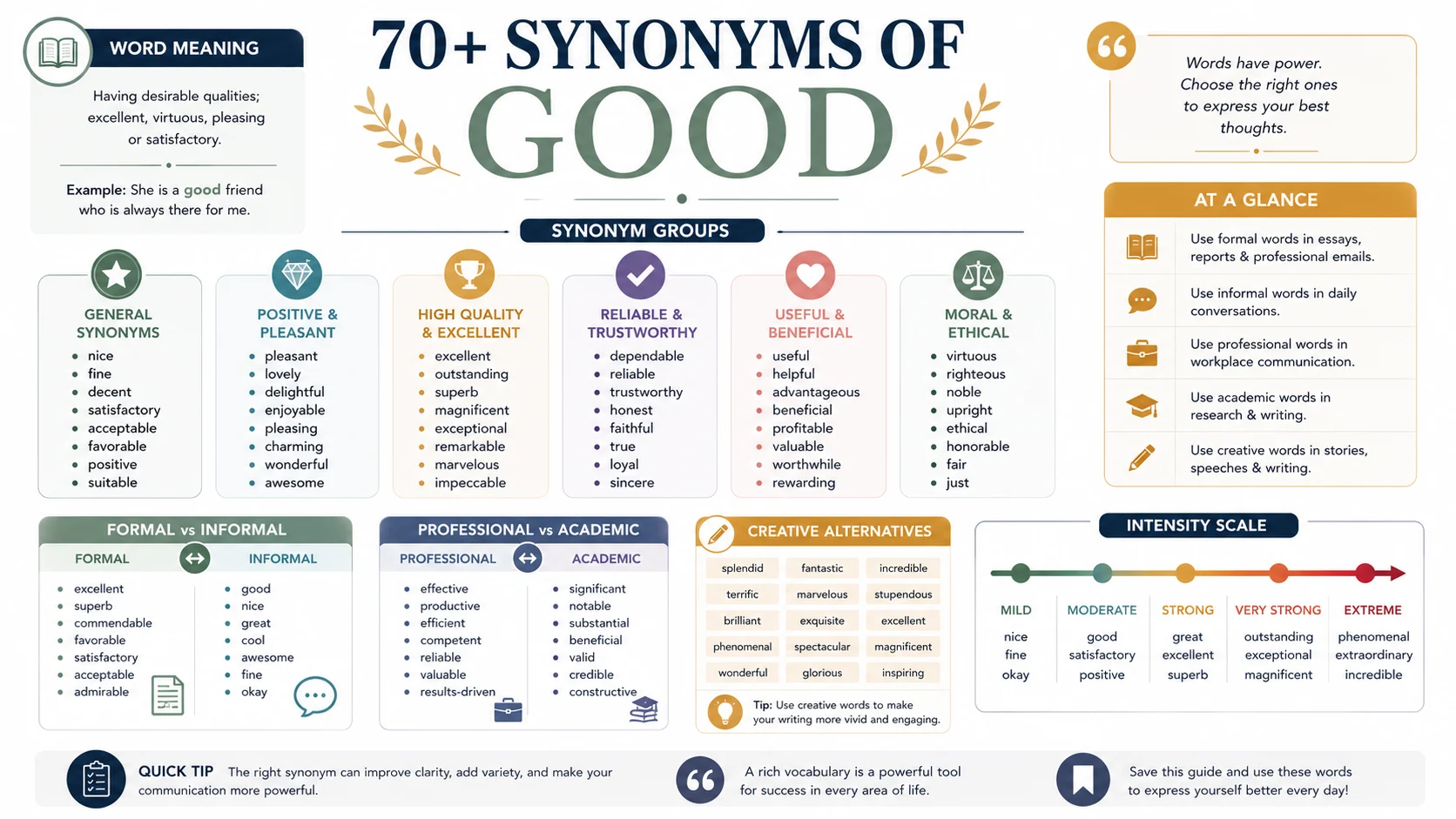
“Good” describes something positive, desirable, or of high quality. The best synonym depends on context. For formal writing, use excellent or superior. For casual conversation, great or nice work well. For professional settings, effective, capable, or valuable are often better choices. In academic work, choose sound, valid, or beneficial .
Have you ever found yourself writing an email, essay, or social media caption and realized you have used the word “good” five times in three sentences? It happens to everyone. The word is useful, but it can make your writing feel repetitive and vague. Finding the right synonym of good can transform your communication from bland to precise. Whether you are a student working on an essay, a professional drafting a report, or someone simply trying to express yourself more clearly, choosing the right word matters. This guide will help you understand the nuances of “good” and find the perfect alternative for every situation.
Meaning, Tone, and Context
Simple Definition
“Good” means having positive or desirable qualities. It can refer to moral excellence, high quality, competence, or something beneficial .
Part of Speech
- Adjective: “She is a good writer.”
- Noun: “He volunteers for the good of the community.”
Overall Tone
The tone of “good” is generally positive and neutral.
Formality Level
“Good” is neutral. It works in almost any setting, from casual conversation to formal writing. However, it can be too vague for situations that demand more precise language.
Common Uses
Native speakers use “good” constantly in everyday conversation. It appears in greetings (“Good morning”), expressions of approval (“That’s good”), and descriptions of people, food, experiences, and ideas. The word is incredibly versatile, but that versatility can be a weakness in writing.
Word Forms
- Adjective: good (positive)
- Adverb: well (She sings well.)
- Noun: good (benefit or moral virtue)
- Opposite: bad, poor, evil
When and How to Use “Good”
“Good” is best used in situations where a simple, positive description is enough. It is appropriate in everyday conversation, informal emails, and general writing where precision is not critical. However, when you need to be specific, convincing, or vivid, consider a stronger synonym.
Here are seven realistic examples of how “good” is used in different contexts.
- Professional (Employee Review): “She has good communication skills and works well with the team.”
- Academic (Student Essay): “The study provides a good overview of the historical period.”
- Workplace (Team Meeting): “That is a good suggestion; let’s explore it further.”
- Personal (Conversation): “How are you? I am good. How about you?”
- Email (Casual): “Sounds good. I will see you at the meeting.”
- Resume: “Good time management and organizational skills.”
- Social Media: “Good vibes only on this sunny day.”
Best Synonyms of “Good”
No synonym is identical. Choosing the right synonym of “good” depends on what you are trying to say, who you are saying it to, and the emotion you want to convey. Here are the best choices for specific situations.
Professional Writing
Excellent is a strong and formal choice. It suggests something is outstanding and of superior quality. Use it in business reports, performance reviews, and formal proposals.
Academic Writing
Valid is a precise and academic term. It means logically sound or well-founded. It is perfect for arguments, research findings, and theoretical discussions.
Business Communication
Valuable indicates that something is useful, important, or profitable. This word works well when discussing resources, advice, or contributions.
Casual Conversation
Great is the go-to informal alternative. It is enthusiastic and friendly. Use it with friends, family, and colleagues in relaxed settings.
Emotional Writing
Wonderful expresses a high degree of delight or admiration. It adds warmth and personal feeling. Use it in personal letters, storytelling, and descriptive writing.
Creative Writing
Splendid is a colorful and elegant choice. It suggests beauty, grandeur, or impressive qualities. This word adds literary flair to descriptions and narratives .
Resume Writing
Proficient or Capable are stronger, more descriptive words than “good.” They demonstrate competence and skill. Use them to describe your abilities and experience .
Workplace Communication
Constructive is a productive word. It suggests something is helpful, positive, and contributes to improvement. Use it in feedback, brainstorming sessions, and project planning .
Stronger Meaning
Superior means higher in quality, rank, or importance. It is a confident and powerful word. Use it when comparing things and clearly stating which is better.
Softer Meaning
Nice is a mild and inoffensive synonym. It is pleasant but lacks intensity. Use it when you want to be polite without making a strong statement.
When Not to Use “Good”
When It Sounds Too General
“If you say the movie was good, you are not giving your listener much information.”
Saying something is “good” is so general that it communicates almost nothing. It fails to explain what made the experience, object, or person positive.
Better: “The movie was captivating.”
When It Sounds Too Vague
“Your performance was good.”
This feedback is not helpful. It does not explain what was good or how the person can improve. The word “good” is too vague for meaningful critique.
Better: “Your performance was impressive, especially your presentation skills.”
When It Sounds Too Informal
“I am good at mathematics.”
While common in conversation, “good” can sound too informal for a job application or an academic statement.
Better: “I am proficient in mathematics.”
When It Sounds Too Weak
“The food was good.”
This is a bland description. It does not capture the taste, the presentation, or the dining experience.
Better: “The food was exquisite.”
When It Sounds Too Old-Fashioned
“That is a good idea.” or “That is a swell idea.”
While “good” is timeless, some synonyms are dated. Using overly old-fashioned synonyms like “swell” or “capital” can make you sound out of touch .
Better: “That is a brilliant idea.”
Words Commonly Confused With “Good”
Good vs. Well
Difference: “Good” is an adjective, and “well” is usually an adverb. “Good” describes a noun, while “well” describes a verb.
When to Use It: Use “good” to describe a thing or a person’s state of being. Use “well” to describe how an action is performed.
Example (Good): “She is a good musician.”
Example (Well): “She plays the piano well.”
Good vs. Nice
Difference: “Nice” is mild and focuses on pleasantness. “Good” is broader and can refer to quality, morality, or competence.
When to Use It: Use “nice” when you mean pleasant or agreeable. Use “good” when you mean something is of high quality or morally right.
Example (Nice): “We had a nice chat.”
Example (Good): “He is a good person.”
Good vs. Great
Difference: “Great” implies a higher degree of positivity than “good.” It suggests something is exceptional.
When to Use It: Use “great” when you are enthusiastic or when something exceeds expectations.
Example (Good): “She is a good singer.”
Example (Great): “She is a great singer.”
Good vs. Fine
Difference: “Fine” is neutral and often used as an acceptable substitute. It can sometimes sound unenthusiastic.
When to Use It: Use “fine” when you want to say something is acceptable or satisfactory, but not outstanding.
Example (Good): “That is a good plan.”
Example (Fine): “That is a fine plan.”
Good vs. Excellent
Difference: “Excellent” is a much stronger and more formal word than “good.” It signifies top quality.
When to Use It: Use “excellent” when you want to praise something highly in a professional or formal setting.
Example (Good): “The service was good.”
Example (Excellent): “The service was excellent.”
Best Synonyms of “Good” by Context
| Context | Best Synonym | Why It Works | Example |
|---|---|---|---|
| Formal writing | Excellent | Sounds professional and precise. | “The committee provided an excellent analysis.” |
| Academic writing | Valid | Indicates logic and sound reasoning. | “The experiment produced valid results.” |
| Professional communication | Valuable | Emphasizes worth and contribution. | “Her insights were valuable to the project.” |
| Business emails | Constructive | Suggests helpful and positive input. | “Thank you for your constructive feedback.” |
| Resume writing | Proficient | Demonstrates skill and competence. | “Proficient in data analysis and reporting.” |
| Workplace communication | Effective | Means producing a successful result. | “He is an effective manager.” |
| Casual conversation | Great | Friendly and enthusiastic. | “That sounds like a great idea.” |
| Everyday speaking | Nice | Simple, polite, and inoffensive. | “We had a nice dinner.” |
| Creative writing | Splendid | Adds literary flair and elegance. | “The view from the mountain was splendid.” |
| Storytelling | Marvelous | Creates a sense of wonder. | “It was a marvelous adventure.” |
| Emotional writing | Wonderful | Expresses genuine delight. | “We had a wonderful time at the party.” |
| Strong emphasis | Superb | Indicates the highest quality. | “The performance was superb.” |
| Mild tone | Pleasant | Gives a calm, agreeable feeling. | “We had a pleasant conversation.” |
| Social media captions | Amazing | Catchy and attention-grabbing. | “An amazing sunset to end the day.” |
| American English | Awesome | Informal, enthusiastic, commonly used. | “That concert was awesome.” |
How to Choose the Best Synonym of “Good”
Choosing the right synonym is about understanding your purpose and audience. Here is a practical decision guide.
- Identify Your Meaning: What kind of “good” are you describing?
- Quality: excellent, superior, fine .
- Morality: virtuous, honorable, righteous .
- Competence: proficient, capable, skilled .
- Usefulness: valuable, beneficial, helpful .
- Consider Your Audience and Tone:
- Formal (Academic, Business): Use excellent, valid, superior, proficient.
- Informal (Friends, Social Media): Use great, awesome, amazing .
- Assess Emotional Strength:
- Strong Feeling: Superb, magnificent, marvelous .
- Neutral Feeling: Satisfactory, fine, acceptable .
- Check for Natural Sounding Usage: Read your sentence aloud. Does the new word fit naturally? If it sounds forced or overly complex, choose a simpler option.
Real Life Examples of “Good”
Here are examples of “good” replaced with stronger synonyms in different situations.
School
Original: “I got a good grade on my science project.”
Improved: “I got a superior grade on my science project.”
College
Original: “The professor gave good feedback on my paper.”
Improved: “The professor gave constructive feedback on my paper.”
Workplace
Original: “She is a good leader.”
Improved: “She is an effective leader who inspires her team.”
Business
Original: “We have a good relationship with our clients.”
Improved: “We have a strong relationship with our clients.”
Original: “That sounds good. Let us proceed.”
Improved: “That sounds excellent. Let us proceed.”
Resume
Original: “Good communication and leadership skills.”
Improved: “Exceptional communication and leadership skills.”
Conversation
Original: “The food was good.”
Improved: “The food was delicious.”
Storytelling
Original: “The knight was a good man.”
Improved: “The knight was a virtuous man.”
Blogging
Original: “This is a good recipe for beginners.”
Improved: “This is an ideal recipe for beginners.”
Social Media
Original: “Good weather today.”
Improved: “Glorious weather today.”
18 Best Synonyms of “Good”
| Synonym | Simple Meaning | Best Used For | Example Sentence |
|---|---|---|---|
| Excellent | Very high quality . | Formal praise, academic work. | “Her research is excellent.” |
| Great | Very good; excellent . | Casual conversation, everyday use. | “We had a great time.” |
| Superior | Higher in quality . | Comparisons, professional settings. | “This product is superior to the rest.” |
| Virtuous | Having high moral standards . | Describing character, ethical discussions. | “She is a virtuous person.” |
| Proficient | Skilled and competent . | Resumes, job performance. | “He is proficient in coding.” |
| Beneficial | Producing good results . | Advice, health, and business. | “Exercise is beneficial for health.” |
| Splendid | Impressive and excellent . | Creative writing, elegant descriptions. | “They hosted a splendid event.” |
| Marvelous | Extraordinarily good . | Storytelling, expressing wonder. | “We had a marvelous vacation.” |
| Sound | In good condition and reliable . | Advice, decisions, and investments. | “That is a sound investment.” |
| Effective | Producing a desired result. | Workplace, problem-solving. | “She is an effective speaker.” |
| Valuable | Worth a lot; very useful . | Contributions, advice, and items. | “Your help was valuable.” |
| Honorable | Deserving respect . | Character, professional conduct. | “He made an honorable decision.” |
| Exceptional | Unusually good . | Outstanding performance, unique items. | “She has an exceptional talent.” |
| Superb | Excellent; of the highest quality . | Formal praise, reviews. | “The food was superb.” |
| Worthy | Deserving of respect . | People, causes, and efforts. | “He is a worthy candidate.” |
| Commendable | Deserving praise . | Formal praise, official recognition. | “Her efforts are commendable.” |
| Pleasant | Enjoyable and agreeable . | Mild compliments, everyday use. | “We had a pleasant conversation.” |
| Satisfactory | Acceptable and meeting requirements . | Meeting standards, neutral feedback. | “The results were satisfactory.” |
Synonyms of “Good” by Usage
Professional vs Personal Synonyms
Professional: Use excellent, valuable, effective, proficient, superior, sound when discussing work performance, business strategy, and career skills. These words sound competent and confident .
Personal: Use great, amazing, wonderful, awesome, nice with friends and family. These words are warm and expressive.
Formal vs Conversational Synonyms
Formal: Excellent, superior, valid, commendable, honorable are perfect for reports, academic essays, business presentations, and formal emails .
Conversational: Great, awesome, amazing, cool, good are common in everyday speech, texting, and social media.
Academic Synonyms
In research and academic writing, precision is key. Valid implies logical soundness. Sound indicates a reliable methodology. Beneficial is used to describe positive outcomes. Significant means important and meaningful .
Professional and Business Synonyms
For resumes and interviews, choose words that showcase your skills. Proficient means you are skilled. Capable shows you can handle tasks. Effective means you produce results. Valuable shows your contribution to the team .
Creative and Literary Synonyms
In fiction and poetry, more expressive words add depth. Splendid, glorious, marvelous, exquisite, sublime create imagery and evoke emotion .
Slang or Modern Synonyms
Words like awesome, cool, amazing, fantastic are informal and used widely in modern American English. They are acceptable in casual conversation and social media but should be avoided in formal or academic writing.
Strongest to Mildest Synonyms
Here is an intensity scale from mild to very strong.
Mild:
- Nice
- Satisfactory
- Pleasant
Moderate:
- Fine
- Good
- Sound
Strong:
- Great
- Excellent
- Beneficial
Very Strong:
- Superb
- Superior
- Exceptional
- Marvelous
Emotional vs Neutral Synonyms
Emotional Synonyms: Wonderful, marvelous, glorious, amazing, splendid express excitement, admiration, and joy . Use these when you want to connect with your reader’s feelings.
Neutral Synonyms: Sound, valid, effective, satisfactory, beneficial simply describe positive qualities without adding emotion . Use these when you want to present facts objectively, especially in professional or academic settings.
Antonyms of “Good”
| Antonym | Meaning | Example Sentence |
|---|---|---|
| Bad | Of poor quality or morally wrong. | “The weather was bad today.” |
| Poor | Lacking in quality or value. | “The service was poor.” |
| Inferior | Lower in quality or rank. | “This brand is inferior to that one.” |
| Evil | Morally wrong or bad. | “He has committed evil deeds.” |
| Corrupt | Dishonest or immoral for personal gain. | “The system is corrupt.” |
| Inadequate | Not enough or insufficient. | “The response was inadequate.” |
| Unacceptable | Not satisfactory. | “This behavior is unacceptable.” |
| Useless | Not having a useful purpose. | “This tool is useless.” |
| Harmful | Causing damage or injury. | “Smoking is harmful to health.” |
| Incorrect | Not right or accurate. | “Your answer is incorrect.” |
| Vague | Not clearly expressed. | “Your explanation is vague.” |
| Unsatisfactory | Not meeting standards. | “The results were unsatisfactory.” |
| Immoral | Not conforming to accepted standards of morality. | “His actions were immoral.” |
| Wicked | Evil or morally wrong. | “She played a wicked character.” |
| Unethical | Not morally correct. | “That was an unethical practice.” |
Comparison: “Good” vs Similar Words
Good vs. Excellent
Main Difference: “Excellent” is much stronger and indicates top-tier quality. “Good” is more general.
Which Is Stronger? Excellent.
Which Is More Formal? Excellent is formal, while good is neutral.
When to Use Each: Use good for everyday satisfaction. Use excellent for formal praise.
Examples:
- Good: “She did a good job.”
- Excellent: “She did an excellent job.”
Good vs. Great
Main Difference: “Great” is more enthusiastic and often more casual. “Good” is more reserved.
Which Is Stronger? Great.
Which Is More Formal? Neither is very formal, but good is slightly more neutral.
When to Use Each: Use good for a simple positive statement. Use great when you are excited.
Examples:
- Good: “The movie was good.”
- Great: “The movie was great.”
Good vs. Superior
Main Difference: “Superior” implies a direct comparison and being better than others.
Which Is Stronger? Superior.
Which Is More Formal? Superior.
When to Use Each: Use superior when you are ranking or comparing quality.
Examples:
- Good: “This is a good phone.”
- Superior: “This phone is superior to its competitors.”
Good vs. Beneficial
Main Difference: “Beneficial” specifically means good for one’s health or well-being. “Good” is more general.
Which Is Stronger? Beneficial is more precise and specific.
Which Is More Formal? Beneficial.
When to Use Each: Use beneficial to describe positive effects on health, business, or development.
Examples:
- Good: “Milk is good for you.”
- Beneficial: “Milk is beneficial for bone health.”
Good vs. Virtuous
Main Difference: “Virtuous” describes moral excellence. “Good” can be moral or simply satisfactory.
Which Is Stronger? Virtuous is much stronger in terms of morality.
Which Is More Formal? Virtuous is more formal and literary.
When to Use Each: Use virtuous to describe a person’s character and ethical standing.
Examples:
- Good: “He is a good person.”
- Virtuous: “He is a virtuous person.”
Common Phrases and Expressions with “Good”
Good Morning / Good Afternoon / Good Evening
Meaning: Polite greetings used at different times of day.
Example: “Good morning, everyone. Let us begin the meeting.”
Good Luck
Meaning: A wish for success.
Example: “Good luck on your interview tomorrow.”
Good Job
Meaning: A compliment meaning someone did well.
Example: “You did a good job on the presentation.”
For Good
Meaning: Permanently or forever.
Example: “After years of conflict, he left the city for good.”
Good to Go
Meaning: Ready or prepared.
Example: “We have all the supplies, so we are good to go.”
Good Intentions
Meaning: Having a sincere purpose, even if the outcome is not perfect.
Example: “His plan did not work, but he had good intentions.”
Good Point
Meaning: A valid or excellent idea raised in a discussion.
Example: “That is a good point; I had not considered that angle.”
Common Mistakes to Avoid
Using a Vague Synonym Instead of a Precise One
Incorrect: “She is a nice manager.”
Better: “She is a capable manager.”
Why: Capable is more professional and descriptive of her skills.
Confusing “Good” with “Well”
Incorrect: “You did good on the test.” (Using an adjective to describe a verb).
Better: “You did well on the test.” (Using an adverb to describe a verb).
Using an Informal Synonym in Formal Writing
Incorrect: “We had an awesome quarter.” (Business report).
Better: “We had an excellent quarter.”
Why: Excellent is more appropriate for formal business communication.
Selecting an Overly Dramatic Synonym
Incorrect: “The cake was magnificent.” (Description of a simple homemade cake).
Better: “The cake was delicious.”
Why: Magnificent is too strong for describing a simple cake. It is better for grand things.
Repeating the Same Synonym Too Often
Incorrect: “The team did a great job. The results were great. It was a great day.”
Better: “The team did a fantastic job. The results were impressive. It was a wonderful day.”
Why: Varying your word choice makes your writing more interesting.
Choosing a Synonym with the Wrong Emotional Tone
Incorrect: “I am satisfactory.” (Saying how you feel).
Better: “I am good.”
Why: Satisfactory sounds like an evaluation of a product, not a personal state of being.
Using Slang in Academic or Professional Writing
Incorrect: “The research data is cool.” (Academic paper).
Better: “The research data is significant.”
Why: Cool is casual slang. Significant is precise and academic.
Frequently Asked Questions
1. What are the best synonyms of “good”?
The best synonyms depend on context. Excellent is great for formal praise, great for casual conversation, and virtuous for moral character. Choose the word that fits your meaning and audience .
2. What are the best formal synonyms of “good”?
The best formal synonyms include excellent, superior, valid, commendable, and proficient. These words are suitable for academic writing, business reports, and professional communication .
3. What are common informal synonyms of “good”?
Common informal synonyms include great, awesome, amazing, cool, and fantastic. These are widely used in conversation, texting, and social media .
4. What is another word for “good” in professional writing?
In professional writing, consider valuable, effective, constructive, or proficient. These words convey competence, usefulness, and success, which is more specific than “good” .
5. What is the difference between “good” and “well”?
“Good” is an adjective used to describe nouns, like a good book. “Well” is an adverb used to describe verbs, like singing well. “Good” can also describe a state of being, such as “I feel good.”
6. What is the opposite of “good”?
The opposite of “good” depends on context. Common antonyms include bad, poor, inferior, evil, and unsatisfactory. The best choice depends on whether you are describing quality, morality, or usefulness .
Conclusion
“Good” is a versatile word that serves a purpose in everyday language, but relying on it too often can make your writing feel weak and vague. By understanding its various meanings and choosing more precise synonyms, you can communicate more clearly and effectively. Remember, no synonym works perfectly in every situation. The key is to consider your audience, your purpose, and the exact meaning you want to convey. Whether you use excellent in a formal report, great in a conversation, or virtuous in a story, choosing the right synonym of “good” will elevate your communication.

1 thought on “70+ Synonyms of Good| Meanings, Uses, and Examples For 2026”