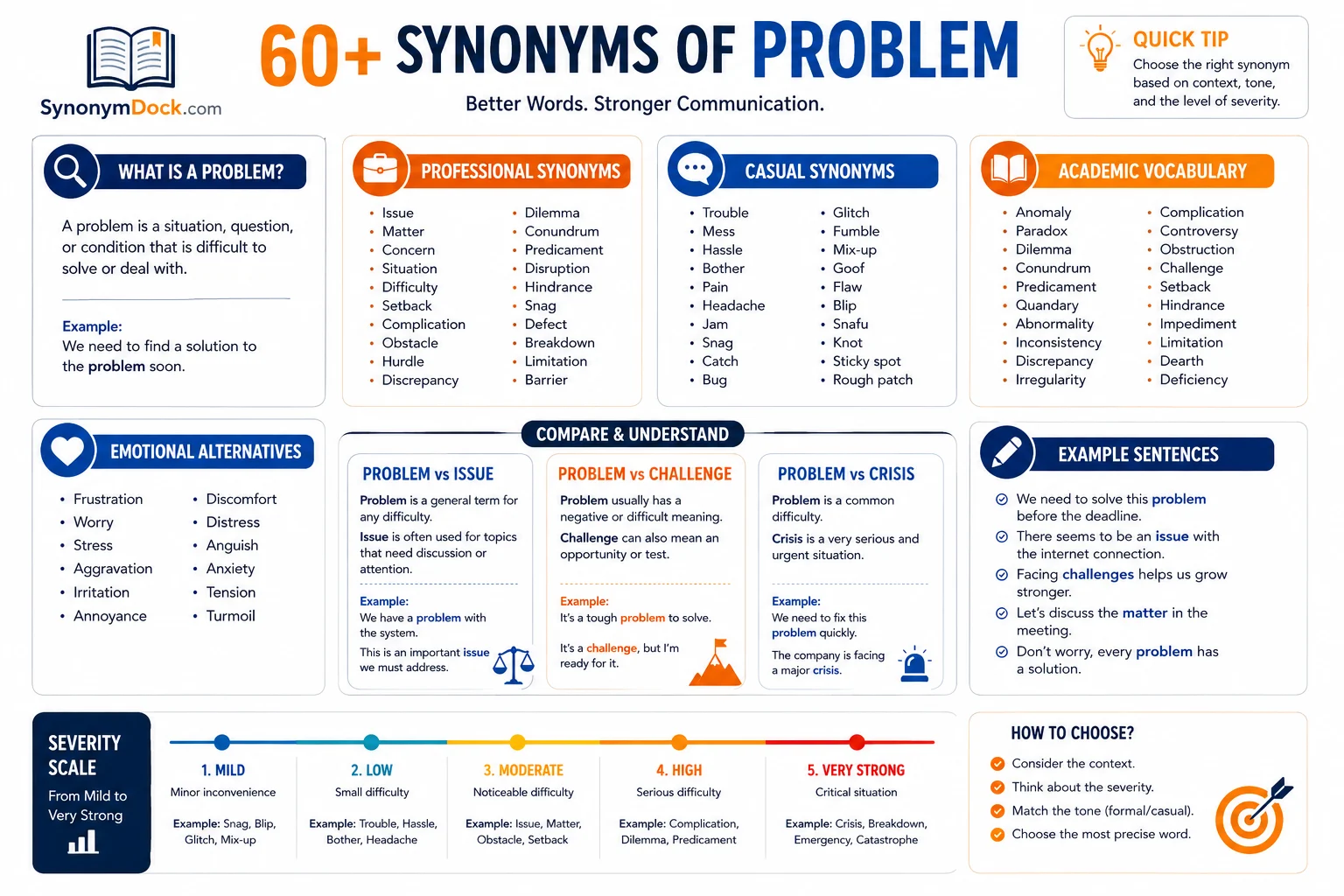
Problem means a situation or matter that is difficult, unwelcome, or needs to be solved. The best synonym depends on your context. For professional writing, use challenge or issue. For casual conversation, use trouble or hassle. For academic work, choose dilemma or obstacle. For creative writing, use predicament or quandary.
Have you ever written an email, an essay, or a report and realized you used the same word over and over? Many writers rely on “problem” repeatedly because it feels clear and direct. But this repetition makes writing feel dull and less engaging. Whether you are working on a school assignment, a professional email, or a creative project, you need a strong vocabulary to communicate challenges effectively. Finding the right synonym of problem can transform your writing from repetitive to precise.
Choosing a more accurate word helps your reader understand exactly what kind of challenge you face. A well chosen synonym can clarify whether something is a minor setback, a complex dilemma, or a serious crisis. The best synonym of problem also sets the right tone for your audience. This guide will teach you everything you need to know about problem synonyms so you can write with confidence and clarity.
Meaning, Tone, and Context
Simple Definition
A problem is a situation that causes difficulty or requires a solution. It can be a question to answer, a challenge to overcome, or an obstacle in your path. Problems range from minor everyday annoyances to major life challenges.
Part of Speech
Problem is primarily used as a noun. It describes the situation itself. For example, you might say “the problem is complex” or “we need to solve this problem.
Overall Tone
Problem is a neutral word. It does not carry strong emotional weight on its own. The tone depends on the words you pair with it. A “serious problem” sounds urgent while a “minor problem” sounds manageable.
Formality Level
Problem is neutral in formality. It works in almost any context. You can use it in professional emails, academic papers, casual conversations, and formal reports. This flexibility makes it useful but sometimes too vague.
Common Uses
Native English speakers use problem in many situations. They discuss work problems at their jobs. Students talk about math problems and homework issues. Managers address business problems with teams. People face personal problems at home. Problem also appears in phrases like “no problem,” which means something is easy or acceptable.
Word Forms
- Problem (noun): A difficult situation or question
- Problematic (adjective): Causing difficulty or trouble
- Problematical (adjective): Doubtful or uncertain
- Problem-solving (noun/adjective): The process of finding solutions
When and How to Use “Problem”
You should choose problem when you want a simple, clear, and neutral word for a difficulty or challenge. It works well when the specifics of the situation matter less than the fact that something needs attention. Here are examples in different situations.
Professional: “The supply chain problem affected delivery times across all regions.”
Academic: “The research problem required careful analysis of historical data.”
Workplace: “We need to address the communication problem between departments.”
Personal: “Finding affordable housing in the city has become a serious problem.”
Email: “I am writing to discuss the budget problem you mentioned last week.”
Resume: “Solved complex technical problems by developing innovative software solutions.”
Social Media: “When life gives you problems, find creative ways to solve them.
Best Synonyms of “Problem”
No synonym perfectly matches problem in every situation. Each alternative brings its own nuance. Here is the best synonym for different contexts.
Professional writing: Challenge. This word reframes difficulties as opportunities for growth. It sounds positive and proactive in business settings.
Academic writing: Issue. This word sounds sophisticated and appropriate for formal research. It suggests something worth examining carefully.
Business communication: Obstacle. Use this when you want to emphasize something that blocks progress. It implies a path forward exists.
Casual conversation: Trouble. This is the most common synonym in everyday speech. It sounds natural and relatable.
Emotional writing: Predicament. Use this when you want to express a difficult situation with personal stakes. It adds drama and tension.
Creative writing: Quandary. This adds a sense of confusion or uncertainty. It works well for characters facing difficult choices.
Resume writing: Challenge. Use this to frame difficulties as opportunities you overcame. It shows problem-solving skills positively.
Workplace communication: Issue. This sounds professional without being too dramatic. It acknowledges difficulties without blame.
Stronger meaning: Crisis. This suggests urgent, serious problems requiring immediate action.
Softer meaning: Snag. Use this for minor, temporary problems that are easy to fix.
When Not to Use “Problem”
Problem is a safe choice, but it is not always the best choice. Here are situations where you should use a stronger synonym instead.
When Problem Sounds Too Negative
Sometimes problem sounds too pessimistic. It focuses on difficulty rather than opportunity.
Incorrect: “The new software presented many problems.”
Better: “The new software presented many challenges.”
Challenge sounds more positive and suggests growth.
When Problem Sounds Too Vague
Problem can mean almost anything. If you need to be specific about the type of difficulty, choose a more precise word.
Incorrect: “The ethics problem required careful consideration.”
Better: “The ethics dilemma required careful consideration.”
Dilemma suggests a difficult choice between options.
When Problem Sounds Too Weak
Some difficulties deserve stronger language. Problem does not communicate urgency or severity.
Incorrect: “The financial problem threatened the entire company.”
Better: “The financial crisis threatened the entire company.”
Crisis suggests immediate danger and urgency.
When Problem Sounds Too Formal
In casual conversation with friends, problem can feel stiff or serious.
Incorrect: “This math problem is so confusing.”
Better: “This math headache is so confusing.”
Headache sounds more natural for minor frustrations.
When Problem Sounds Too Informal
In academic or formal writing, problem might not sound sophisticated enough.
Incorrect: “The climate change problem requires global cooperation.”
Better: “The climate change issue requires global cooperation.”
Issue sounds more formal and appropriate for scholarly work.
When Problem Suggests Blame
Problem can imply someone made a mistake. Sometimes you need a more neutral word.
Incorrect: “Your problem is poor time management.”
Better: “Your challenge is poor time management.”
Challenge feels less accusatory and more supportive.
Words Commonly Confused With “Problem”
Several words are similar to problem but have important differences. Understanding these distinctions will help you choose the right word.
Problem vs Issue
Difference: Issue is often more neutral and formal. Problem suggests something that needs fixing. Issue can mean a topic of discussion or a matter of concern.
When to Use Each: Use issue for formal topics or matters that require discussion. Use problem for things that need solutions.
Example Problem: “The broken printer is a problem we need to fix.”
Example Issue: “The budget issue will be discussed at the next meeting.”
Problem vs Challenge
Difference: Challenge suggests something difficult but potentially rewarding. Problem often has negative connotations. Challenge implies opportunity and growth.
When to Use Each: Use challenge when you want to sound positive or motivational. Use problem when you simply need to describe difficulty.
Example Problem: “The software bug is a problem for the development team.”
Example Challenge: “Learning a new language is an exciting challenge.”
Problem vs Dilemma
Difference: A dilemma involves a difficult choice between two or more options. A problem can be any difficulty, not necessarily a choice.
When to Use Each: Use dilemma when the difficulty involves making a hard decision. Use problem for general difficulties.
Example Problem: “Finding a parking spot is always a problem.”
Example Dilemma: “She faced the dilemma of choosing between two job offers.”
Problem vs Obstacle
Difference: An obstacle is something that blocks progress. A problem can be anything difficult, not necessarily a barrier.
When to Use Each: Use obstacle when something stands in your way. Use problem for any difficulty.
Example Problem: “The puzzle was a difficult problem.”
Example Obstacle: “Lack of funding was the main obstacle to completing the project.”
Problem vs Predicament
Difference: A predicament is a difficult, unpleasant, or embarrassing situation. Problem is more general.
When to Use Each: Use predicament when the situation is personally difficult or embarrassing. Use problem for any difficulty.
Example Problem: “The car won’t start.”
Example Predicament: “I locked my keys in the car and my phone died.”
Problem vs Crisis
Difference: A crisis is an urgent, dangerous, or extremely difficult situation. Problem is much less severe.
When to Use Each: Use crisis for emergencies or serious threats. Use problem for ordinary difficulties.
Example Problem: “We need more paper for the printer.”
Example Crisis: “The factory fire created an urgent safety crisis.”
Best Synonyms of “Problem” by Context
| Context | Best Synonym | Why It Works | Example |
|---|---|---|---|
| Formal writing | Issue | Sounds sophisticated and scholarly | The research issue requires further investigation. |
| Academic writing | Dilemma | Suggests complex decision-making | The ethical dilemma challenged existing theories. |
| Professional communication | Challenge | Reframes difficulties positively | The team embraced the challenge with enthusiasm. |
| Business emails | Concern | Sounds professional and less negative | Please address the client’s concerns as soon as possible. |
| Resume writing | Obstacle | Shows you overcame barriers | Overcame significant obstacles to complete the project. |
| Workplace communication | Issue | Professional and neutral | We need to resolve the scheduling issue. |
| Casual conversation | Trouble | Sounds natural and relatable | The car is giving me trouble again. |
| Everyday speaking | Hassle | Perfect for minor annoyances | Finding parking downtown is such a hassle. |
| Creative writing | Quandary | Adds confusion and drama | She found herself in a moral quandary. |
| Storytelling | Predicament | Creates tension and interest | The hero faced a difficult predicament. |
| Emotional writing | Burden | Conveys weight and difficulty | The burden of debt was overwhelming. |
| Strong emphasis | Crisis | Suggests urgent, serious danger | The environmental crisis demands immediate action. |
| Mild tone | Snag | Softens the sense of difficulty | We hit a small snag in the planning process. |
| Social media captions | Challenge | Sounds positive and motivational | New challenges, new opportunities for growth. |
| American English | Issue | Most common professional alternative | The issue was resolved quickly. |
How to Choose the Best Synonym of “Problem”
Use this decision guide to pick the perfect synonym for your situation.
Start with your audience. Professional audiences expect issue, challenge, or concern. Casual audiences understand trouble, hassle, or snag best.
Consider your tone. If you want to sound positive and proactive, choose challenge or opportunity. If you want to sound neutral, choose issue. If you want to sound serious, choose crisis or emergency.
Think about emotional weight. Problem is emotionally neutral. Crisis and emergency are emotionally heavy. Challenge and opportunity are positive. Snag and hassle are light.
Match the severity of the situation. Minor issues are snags, hassles, or concerns. Moderate problems are challenges, obstacles, or issues. Serious problems are crises, emergencies, or catastrophes.
Consider your purpose. Professional writing benefits from issue and challenge. Resumes need obstacle and challenge. Academic writing uses dilemma and issue. Creative writing uses predicament and quandary.
Avoid guessing. If you are unsure, problem is always acceptable. But choosing a more specific word nearly always improves your writing.
Real Life Examples of “Problem”
School Example
Original: The math problem was too hard for the students.
Improved: The math challenge was too difficult for the students.
Challenge sounds more like a learning opportunity.
College Example
Original: The problem of plagiarism is common in colleges.
Improved: The issue of plagiarism is common in colleges.
Issue sounds more formal and academic.
Workplace Example
Original: We have a problem with the new software system.
Improved: We have a challenge with the new software system.
Challenge sounds proactive and less negative.
Business Example
Original: The company faced a major problem with its supply chain.
Improved: The company faced a major obstacle with its supply chain.
Obstacle suggests something to overcome.
Email Example
Original: I am writing about the problem in the production line.
Improved: I am writing about the issue in the production line.
Issue sounds professional and neutral.
Resume Example
Original: Solved problems using creative thinking.
Improved: Overcame obstacles using creative thinking.
Hiring managers see initiative and resilience.
Conversation Example
Original: This computer problem is driving me wild.
Improved: This computer hassle is driving me wild.
Hassle sounds natural for everyday frustrations.
Storytelling Example
Original: The knight faced a problem on his journey.
Improved: The knight faced a predicament on his journey.
Predicament adds drama and suspense.
Blogging Example
Original: I encountered a problem while cooking dinner.
Improved: I hit a snag while cooking dinner.
Snag sounds casual and relatable.
Social Media Example
Original: Dealing with problems today. Not fun.
Improved: Dealing with challenges today. Growing stronger.
Challenge sounds positive and inspirational.
18 Best Synonyms of “Problem”
| Synonym | Simple Meaning | Best Used For | Example Sentence |
|---|---|---|---|
| Issue | A matter of concern or discussion | Professional and formal contexts | The environmental issue requires global cooperation. |
| Obstacle | Something that blocks progress | Business and resume writing | The team overcame every obstacle to finish on time. |
| Predicament | A difficult, unpleasant situation | Creative writing and storytelling | He found himself in a financial predicament. |
| Quandary | A state of uncertainty or confusion | Creative and literary writing | She was in a quandary about which job to accept. |
| Crisis | An urgent, dangerous situation | Serious and emergency contexts | The economic crisis affected millions of people. |
| Emergency | A sudden, urgent problem | Safety and medical contexts | Call 911 in case of any medical emergency. |
| Hassle | A minor, annoying problem | Casual and informal contexts | Finding a parking space is such a hassle. |
| Snag | A small, unexpected problem | Casual and professional contexts | We hit a small snag in the production process. |
| Complication | A problem that makes things worse | Medical and technical contexts | The surgery had an unexpected complication. |
| Difficulty | A problem that requires effort | General and academic contexts | The difficulty of the task surprised everyone. |
| Puzzle | A confusing problem to solve | Educational and intellectual contexts | The mystery remained an unsolved puzzle. |
Synonyms of “Problem” by Usage
Professional vs Personal Synonyms
Professional synonyms work best in workplaces: issue, challenge, obstacle, concern, hurdle.
Personal synonyms sound better at home: trouble, hassle, snag, difficulty, burden.
Professional Example: “The main issue is the budget shortfall for next quarter.
Personal Example: “My biggest trouble right now is finding time to exercise.”
Formal vs Conversational Synonyms
Formal synonyms for academic and professional writing: issue, dilemma, crisis, obstacle, complication.
Conversational synonyms for everyday talk: trouble, hassle, snag, headache, glitch.
Formal Example: “The ethical dilemma presented complex philosophical questions.”
Conversational Example: “Missing the bus was a real headache this morning.”
Academic Synonyms
Academic writing benefits from precise vocabulary. Choose issue for research topics. Select dilemma for philosophical questions. Use obstacle for methodological barriers. Choose complication for unexpected findings.
Example: “The research dilemma centered on conflicting ethical standards.”
Professional and Business Synonyms
In business settings, choose words that show leadership and competence. Use challenge for team motivation. Select obstacle for strategic planning. Choose concern for client communication. Use hurdle for project management.
Example: “She saw every obstacle as an opportunity for innovation.”
Creative and Literary Synonyms
Creative writing rewards expressive language. Use predicament for character struggles. Select quandary for internal conflict. Choose crisis for dramatic tension. Use burden for emotional weight.
Example: “The detective faced a moral quandary that tested his principles.”
Slang or Modern Synonyms
Problem has several informal alternatives. “Headache” means an annoying problem. “Kink” means a minor problem or flaw. “Glitch” means a sudden, temporary problem, especially in technology.
Example: “My computer has a glitch that keeps freezing the screen.”
Strongest to Mildest Synonyms
Mild: hassle, snag, glitch, kink
Moderate: issue, difficulty, obstacle, challenge
Strong: crisis, emergency, predicament, dilemma
Very Strong: catastrophe, disaster, calamity
The emotional intensity increases as you move up the scale. Hassle feels minor and annoying. Crisis feels urgent and dangerous. Catastrophe feels devastating and overwhelming.
Emotional vs Neutral Synonyms
Emotional Synonyms: burden, nightmare, ordeal, disaster. These words express feelings about the problem.
Neutral Synonyms: issue, difficulty, obstacle, challenge. These words simply communicate information.
Emotional Example: “The nightmare of losing her job kept her awake all night.”
Neutral Example: “The difficulty of the project was well documented.”
Antonyms of “Problem”
| Antonym | Meaning | Example Sentence |
|---|---|---|
| Solution | The answer to a problem | The team found a solution that satisfied everyone. |
| Advantage | A favorable situation | The new software gave us a competitive advantage. |
| Benefit | Something that provides help | The investment came with many benefits. |
| Opportunity | A favorable chance for progress | The market shift created new opportunities. |
| Asset | A valuable resource | Her language skills were a great asset. |
| Blessing | A fortunate event | Losing that job was actually a blessing in disguise. |
| Boon | A helpful benefit | The new system was a boon for productivity. |
| Ease | Freedom from difficulty | The project was completed with surprising ease. |
| Comfort | A state of physical or mental ease | She lived in comfort after years of struggle. |
| Relief | Freedom from anxiety | The news brought immense relief to everyone. |
| Break | A stroke of good luck | Getting that promotion was a lucky break. |
| Perk | An extra benefit | Free coffee is a nice perk of the job. |
| Aid | Help or support | The grant provided essential aid for research. |
| Improvement | A better situation | The improvement in sales boosted morale. |
| Success | A favorable outcome | The event was a great success. |
Comparison: “Problem” vs Similar Words
Problem vs Issue
Main Difference: Issue is more neutral and formal. Problem suggests something that needs fixing. Issue can simply mean a topic of discussion.
Which Is Stronger: Problem suggests stronger need for resolution.
Which Is More Formal: Issue is more formal and academic.
When to Use Each: Use issue for formal topics or matters requiring discussion. Use problem for things needing solutions.
Problem Example: “The broken printer is a problem for everyone.”
Issue Example: “The issue of privacy will be discussed at the meeting.”
Problem vs Challenge
Main Difference: Challenge suggests opportunity and growth. Problem focuses on difficulty and negativity.
Which Is Stronger: Challenge is emotionally stronger in a positive way.
Which Is More Formal: Challenge is appropriate for professional contexts.
When to Use Each: Use challenge to sound positive. Use problem for neutral description.
Problem Example: “The budget deficit is a serious problem.”
Challenge Example: “Finding creative funding sources is an exciting challenge.”
Problem vs Dilemma
Main Difference: Dilemma involves a difficult choice between options. Problem can be any difficulty.
Which Is Stronger: Dilemma suggests more personal complexity.
Which Is More Formal: Dilemma is used in academic and philosophical writing.
When to Use Each: Use dilemma for difficult choices. Use problem for general difficulties.
Problem Example: “The car won’t start this morning.”
Dilemma Example: “She faced the dilemma of choosing between two excellent offers.”
Problem vs Obstacle
Main Difference: Obstacle is a barrier that blocks progress. Problem is any difficulty.
Which Is Stronger: Obstacle suggests a specific, concrete barrier.
Which Is More Formal: Obstacle is suitable for professional writing.
When to Use Each: Use obstacle for specific barriers. Use problem for any difficulty.
Problem Example: “The homework assignment was a problem for the students.”
Obstacle Example: “Lack of funding was the main obstacle to the project.”
Problem vs Predicament
Main Difference: Predicament is a difficult, often embarrassing situation. Problem is more general.
Which Is Stronger: Predicament implies more personal difficulty and embarrassment.
Which Is More Formal: Predicament is often used in creative writing.
When to Use Each: Use predicament for personal difficulties. Use problem for general situations.
Problem Example: “We need more office supplies.”
Predicament Example: “She locked her keys in the car and had no phone.”
Problem vs Crisis
Main Difference: Crisis is urgent, dangerous, and serious. Problem is much less severe.
Which Is Stronger: Crisis is dramatically stronger.
Which Is More Formal: Crisis is used in serious, formal contexts.
When to Use Each: Use crisis for emergencies. Use problem for ordinary difficulties.
Problem Example: “The printer ran out of ink.”
Crisis Example: “The chemical spill created an environmental crisis.”
Common Phrases and Expressions with “Problem”
No Problem
Meaning: A way to say something is easy or acceptable. Also a polite response to thanks.
Example Sentence: “Could you help me with this? No problem at all.”
Problem Solver
Meaning: A person who finds solutions to difficulties.
Example Sentence: “She is known as a creative problem solver in the company.”
Problem Child
Meaning: A child who causes trouble. Also used for anything that consistently causes difficulty.
Example Sentence: “The outdated computer system has become a problem child.”
Problem Area
Meaning: A specific place or situation where problems occur.
Example Sentence: “Customer service is the main problem area we need to address.”
Have a Problem With
Meaning: To dislike or object to something or someone.
Example Sentence: “Do you have a problem with my proposal?”
The Problem Is
Meaning: A phrase used to introduce the main difficulty or issue.
Example Sentence: “The problem is we don’t have enough time.”
Work Out a Problem
Meaning: To solve or find a solution to a difficulty.
Example Sentence: “We need to work out this problem before the deadline.”
Common Mistakes to Avoid
Mistake 1: Using Problem When You Need a More Specific Word
Problem is a general word. Using it for every situation makes writing boring and vague.
Incorrect: “The management problem required immediate attention.”
Better: “The management crisis required immediate attention.”
Crisis better conveys urgency and severity.
Mistake 2: Using Challenge When You Mean Crisis
Challenge is positive. Using it for serious emergencies sounds inappropriate.
Incorrect: “The earthquake created a major challenge for rescue workers.”
Better: “The earthquake created a major crisis for rescue workers.”
Crisis fits emergencies better than challenge.
Mistake 3: Using Issue Too Broadly
Issue sounds formal and academic. Using it too casually sounds odd.
Incorrect: “My issue is that I ran out of milk.”
Better: “My problem is that I ran out of milk.”
Problem sounds more natural for everyday situations.
Mistake 4: Choosing Overly Dramatic Synonyms
Using crisis or catastrophe for small problems sounds ridiculous.
Incorrect: “The coffee maker breaking was a catastrophe.”
Better: “The coffee maker breaking was a hassle.”
Hassle fits small annoyances perfectly.
Mistake 5: Repeating Problem Too Often
Even the correct word sounds bad when used too frequently. Vary your vocabulary.
Incorrect: “The problem was scheduling. The problem got worse. We solved the problem.”
Better: “The issue was scheduling. The difficulty got worse. We resolved the problem.”
Using different synonyms improves readability.
Mistake 6: Using Predicament Incorrectly
Predicament implies a personally difficult situation. Using it for impersonal situations sounds wrong.
Incorrect: “The country faced a predicament with its infrastructure.”
Better: “The country faced a challenge with its infrastructure.”
Challenge fits larger, impersonal situations.
Mistake 7: Confusing Problem and Dilemma
Dilemma specifically involves choosing between options. Problem is broader.
Incorrect: “My dilemma is that I need to buy groceries.”
Better: “My problem is that I need to buy groceries.”
Buying groceries is not a hard choice between options.
Frequently Asked Questions
1. What are the best synonyms of problem?
The best synonyms depend on context. For professional writing, use issue or challenge. For casual speech, use trouble or hassle. For serious situations, use crisis or emergency. Problem works in almost every situation, but specific synonyms add precision.
2. What are the best formal synonyms of problem?
The best formal synonyms are issue, challenge, obstacle, dilemma, and complication. These words sound professional and sophisticated. They work well in business writing, academic papers, and official documents.
3. What are common informal synonyms of problem?
The most common informal synonyms are trouble, hassle, snag, glitch, and headache. These words sound natural in everyday conversation. They are appropriate for casual settings and personal writing.
4. What is another word for problem in professional writing?
Challenge is the most professional synonym. It reframes difficulties as opportunities. Issue also works well in business contexts. Concern and obstacle are also excellent professional alternatives.
5. What is the difference between problem and issue?
Problem suggests something that needs to be fixed. Issue can mean a topic of discussion or a matter of concern. Issue is more neutral and formal. Problem often implies a more urgent need for resolution.
6. What is the opposite of problem?
Antonyms of problem include solution, advantage, opportunity, benefit, and blessing. These words describe positive situations or answers. The best opposite depends on whether you mean the answer to a problem or the absence of difficulty.
Conclusion
Problem is a versatile word that means a difficult situation or question requiring attention. It fits many situations from professional emails to casual conversations. However, using more specific synonyms can dramatically improve your writing. Issue, challenge, obstacle, dilemma, and crisis each add distinct meaning and tone.
No single synonym works perfectly in every context. The best choice depends on your audience, your purpose, and the nature of the difficulty you are describing. Always consider whether problem is precise enough or if a stronger word would communicate your message more clearly.
The next time you write about a difficulty, pause and ask yourself whether problem is the right word. Could challenge make you sound more positive? Does dilemma better describe a difficult choice? Would crisis convey the urgency you need?
Choosing the right word shows thoughtfulness and expertise. It makes your writing more engaging and easier to understand. Build your vocabulary one word at a time. You will become a more confident and effective communicator.

7 thoughts on “60+ Synonyms of Problem| Meanings and Best Alternatives in 2026”