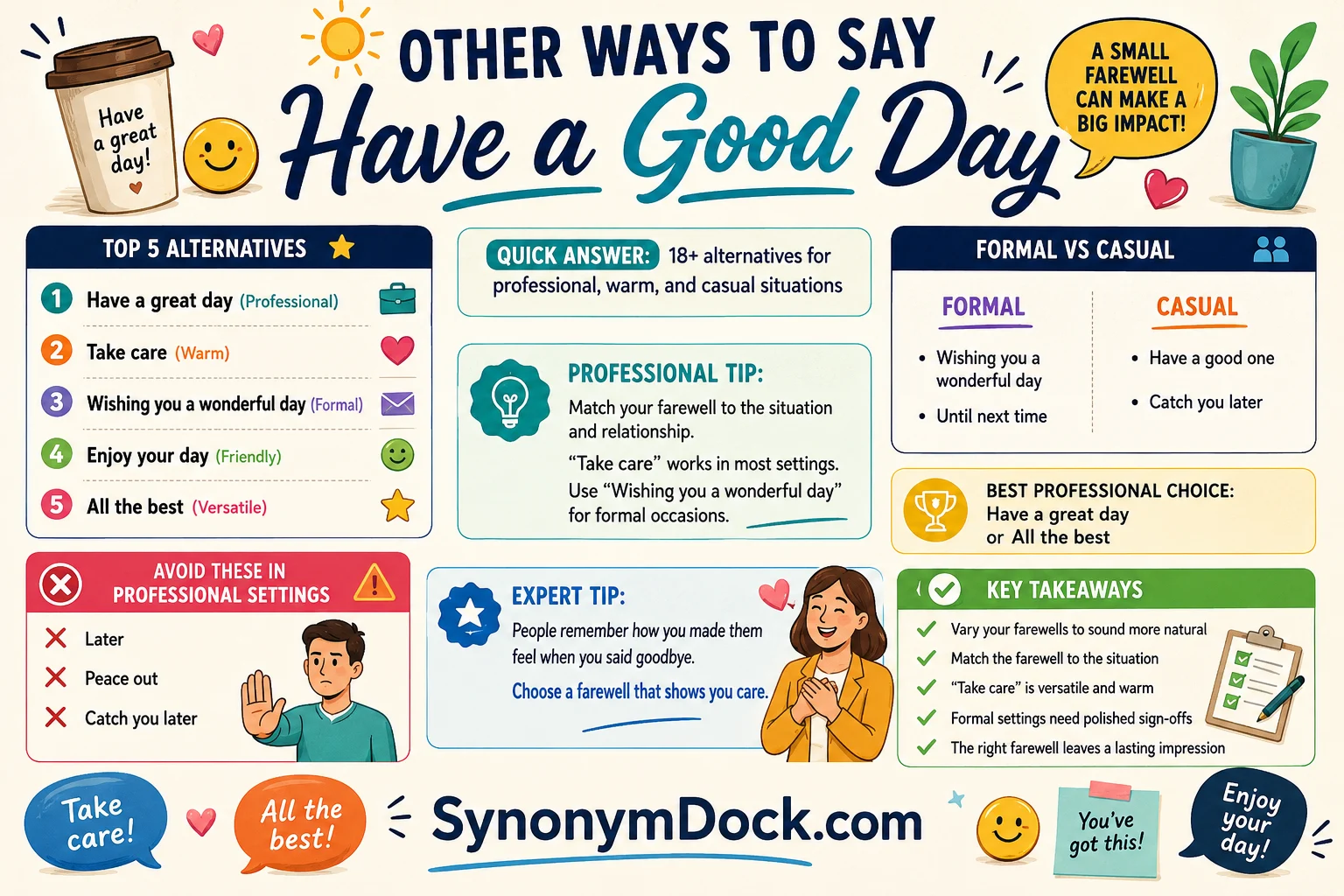
Looking for other ways to say have a good day? Try “Have a great day” for professional settings, “Take care” for warm farewells, “Wishing you a wonderful day” for formal emails, “Enjoy your day” for casual conversations, or “Have a lovely day” for warm interactions. The best alternatives include: Have a great day, Take care, Wishing you a wonderful day, Enjoy your day, Have a lovely day, All the best, See you later, Have a nice one, Take it easy, and Until next time.
“Have a good day” is one of the most common farewells in English. We say it to colleagues, customers, friends, and strangers alike. But using the same phrase repeatedly can make you sound unoriginal and mechanical.
Whether you’re ending a business email, saying goodbye to a client, or wishing a friend well, having other ways to say have a good day shows thoughtfulness and emotional intelligence. The right farewell leaves a lasting positive impression. This article explores 15+ powerful alternatives to “have a good day” organized by tone and situation, so you can choose the perfect sign-off with confidence.
Quick Categories
Formal Alternatives
- I wish you a pleasant day
- May your day be filled with success
- Wishing you a productive day
- Have a wonderful day
- I hope your day goes well
Pro Tip: Use formal alternatives in professional emails, business letters, and when addressing clients or senior colleagues. They show respect and professionalism.
Professional Alternatives
- Have a great day
- All the best
- Wishing you all the best
- Enjoy the rest of your day
- Take care
Pro Tip: Professional alternatives work well in workplace settings, client communications, and team interactions. They balance warmth with professionalism.
Business Email Alternatives
- I hope your day is productive
- Wishing you a successful day
- May your day go smoothly
- Best wishes for the rest of your day
- Have an excellent day
Pro Tip: Email sign-offs should match the company culture. These phrases are safe, professional, and leave a positive impression.
Academic Alternatives
- Have a good day, everyone
- I wish you all a pleasant afternoon
- Enjoy the rest of your day
- Have a wonderful weekend
- See you next time
Pro Tip: Academic farewells should be inclusive and respectful. They create a positive learning environment.
Casual Alternatives
- Have a good one
- Take it easy
- Enjoy your day
- See you later
- Catch you later
Pro Tip: Casual alternatives are perfect for friends, family, and informal settings. They feel warm and natural.
Informal Expressions
- Later
- Peace out
- Laters
- See ya
- Catch ya later
Pro Tip: Use informal expressions only with close friends or in very casual environments. Avoid them in any professional context.
The way you say goodbye matters as much as the way you say hello.”
What Does “Have a Good Day” Mean?
“Have a good day” is a polite expression used when parting from someone, wishing them a positive or pleasant day ahead. It expresses goodwill and positive intentions toward the other person.
Example: “Thanks for meeting with me. Have a good day!”
Grammar: “Have a good day” is an imperative sentence, though it functions as a wish rather than a command. It’s the standard polite farewell in English-speaking cultures.
Is It Professional or Polite?
“Have a good day” is both professional and polite in most situations. However, it can feel generic and unmemorable.
Polite? ✅ Yes
Professional? ✅ Yes, but can feel formulaic
Formal? ⚠️ Sometimes – can feel too casual in very formal writing
Natural? ✅ Yes
Example: “Have a good day, Mrs. Chen” works in most professional settings. For a formal letter, “I wish you a pleasant day” sounds more polished.
Common Mistakes
Mistake #1: Using “Have a Good Day” in Every Situation
Why it’s incorrect: Using the same phrase repeatedly sounds robotic and impersonal.
Correct version: Vary your farewells based on the situation and relationship.
Example: For a colleague, “Have a great meeting” is more specific. For a friend, “Enjoy your day” sounds warmer.
Mistake #2: Adding “Now” at the End
Why it’s incorrect: “Have a good day now” can sound dismissive or condescending.
Correct version: Use “Have a good day” or “Have a good one” without “now.”
Example: “Thanks, have a good day” is perfect. “Thanks, have a good day now” can feel abrupt.
Mistake #3: Using “Have a Good Day” When It’s Evening
Why it’s incorrect: It’s evening, so the day is almost over. “Have a good evening” is more appropriate.
Correct version: Match the time of day: morning, afternoon, evening, or night.
Example: “Have a good evening” for evening departures. “Have a good afternoon” for afternoon goodbyes.
Mistake #4: Using It With Someone You’ll See Later
Why it’s incorrect: “Goodbye” farewells are for longer separations. “See you later” is better for short separations.
Correct version: Use “See you later” or “See you soon” for short separations.
Example: “See you tomorrow” for colleagues you’ll see the next day.
Mistake #5: Using “Have a Good Day” in Text Messages
Why it’s incorrect: It can sound too formal and cold in casual texts.
Correct version: Use “Take care,” “Have a good one,” or “Later.”
Example: “Take care, talk soon” is warm and natural in texts.
When to Use “Have a Good Day”
Common Situations:
- Ending conversations
- Parting from colleagues
- Finishing customer service interactions
- Saying goodbye in stores and restaurants
- Ending phone calls
Business:
- Client meetings
- Customer service
- Team farewells
- Business emails
- Conference calls
Academic:
- End of class
- Meeting with professors
- Study groups
- Academic events
Daily Conversation:
- Shopping
- Social gatherings
- Friends and family
- Neighborly chats
Written English:
- Emails
- Letters
- Online messages
“The most memorable farewells are specific, warm, and personal.”
Pros and Cons of “Have a Good Day”
Pros
- Universally understood
- Safe and appropriate
- Polite and friendly
- Works in most situations
Cons
- Overused
- Generic and formulaic
- Lacks personality
- Not memorable
- Can feel robotic
15 Other Ways to Say Have a Good Day
[1]. Have a Great Day
Meaning: A warm, positive farewell wishing someone an excellent day.
Explanation: “Have a great day” is one of the most popular alternatives to “have a good day.” It sounds more enthusiastic and positive. Native speakers use it constantly in professional and casual settings. The word “great” adds energy and warmth that “good” lacks.
Example Sentence: “Thanks for your help today. Have a great day!”
Best Use: Professional Settings, Customer Service, Colleagues
Avoid Using In: Extremely Formal Legal Correspondence
Tone: Warm, Positive
Formality Level: ⭐⭐⭐ Neutral
Usage Frequency: Very Common
CEFR Level: A1
Common Collocations:
- have a great day ahead
- have a great day at work
- have a great day everyone
- have a great rest of your day
- I hope you have a great day
Context Variability:
- Spoken English: “Have a great day, see you tomorrow!”
- Professional English: “Thank you, have a great day.”
[2]. Take Care
Meaning: A warm, caring farewell expressing concern for someone’s wellbeing.
Explanation: “Take care” is a warm and affectionate farewell. Native speakers use it when they genuinely care about the other person. It works in both professional and casual contexts. It feels more personal than “have a good day” without being overly intimate.
Example Sentence: “It was great seeing you. Take care of yourself.”
Best Use: Friends, Family, Colleagues, Warm Professional Settings
Avoid Using In: Very Formal Business Letters
Tone: Warm, Caring
Formality Level: ⭐⭐⭐ Neutral
Usage Frequency: Very Common
CEFR Level: A2
Common Collocations:
- take care of yourself
- take care and stay safe
- take care, see you soon
- take care, talk later
- take care, have a good one
Context Variability:
- Spoken English: “Take care, I’ll call you tomorrow.”
- Professional English: “Take care, enjoy your weekend.”
[3]. Wishing You a Wonderful Day
Meaning: A formal, warm farewell expressing hope for someone’s wonderful day.
Explanation: “Wishing you a wonderful day” is a beautiful, polished farewell. It sounds elegant and thoughtful. Native speakers use it in formal emails, letters, and customer service interactions. It’s warmer than “have a good day” without being too informal.
Example Sentence: “Thank you for your time. Wishing you a wonderful day.”
Best Use: Formal Emails, Customer Service, Client Communications
Avoid Using In: Casual Text Messages
Tone: Warm, Formal
Formality Level: ⭐⭐⭐⭐ Formal
Usage Frequency: Common (Formal Contexts)
CEFR Level: B1
Common Collocations:
- wishing you a wonderful day ahead
- wishing you a wonderful week
- wishing you a wonderful weekend
- wishing you all the best
Context Variability:
- Written English: “Wishing you a wonderful day, best regards.”
- Professional English: “Thank you, wishing you a wonderful afternoon.”
[4]. Enjoy Your Day
Meaning: A friendly, encouraging farewell suggesting someone should savor their day.
Explanation: “Enjoy your day” is a positive and uplifting farewell. Native speakers use it when they want the other person to take time and appreciate their day. It’s more specific and thoughtful than “have a good day.” It’s perfect for both professional and casual settings.
Example Sentence: “The sun is shining – enjoy your day!”
Best Use: Casual Settings, Friendly Professional Environments, Customer Service
Avoid Using In: Highly Formal Legal Documents
Tone: Friendly, Encouraging
Formality Level: ⭐⭐⭐ Neutral
Usage Frequency: Very Common
CEFR Level: A2
Common Collocations:
- enjoy your day at work
- enjoy the rest of your day
- enjoy your day off
- enjoy your day with family
- enjoy your day, you deserve it
Context Variability:
- Spoken English: “Enjoy your day, I’ll see you later!”
- Professional English: “Enjoy your day, I look forward to our next meeting.”
[5]. Have a Lovely Day
Meaning: A warm, slightly formal farewell wishing someone a pleasant day.
Explanation: “Have a lovely day” is a beautiful, warm farewell. It’s common in British English and sounds charming. Native speakers use it to be kind and thoughtful. It works especially well in customer service and friendly professional settings.
Example Sentence: “Thank you for coming in today. Have a lovely day.”
Best Use: Customer Service, Friendly Professional Settings, Warm Farewells
Avoid Using In: Very Formal Legal Correspondence
Tone: Warm, Charming
Formality Level: ⭐⭐⭐ Neutral
Usage Frequency: Common (Especially in UK)
CEFR Level: A2
Common Collocations:
- have a lovely day ahead
- have a lovely weekend
- have a lovely afternoon
- have a lovely time
Context Variability:
- Spoken English: “Have a lovely day, dear.”
- Professional English: “Thank you, have a lovely day.”
“The perfect farewell leaves people feeling valued and remembered.”
[6]. All the Best
Meaning: A warm, versatile farewell wishing someone success and good fortune.
Explanation: “All the best” is an excellent alternative for both professional and casual settings. Native speakers use it when parting from someone, wishing them well in their future endeavors. It’s warm without being too intimate and professional without being cold.
Example Sentence: “Thanks for your contribution today. All the best.”
Best Use: Professional Farewells, Emails, General Use
Avoid Using In: Extremely Casual Text Messages (Though Still Acceptable)
Tone: Warm, Neutral
Formality Level: ⭐⭐⭐ Neutral
Usage Frequency: Very Common
CEFR Level: A2
Common Collocations:
- all the best to you
- all the best in your new role
- all the best for the future
- all the best and take care
- all the best, see you soon
Context Variability:
- Spoken English: “All the best, my friend.”
- Professional English: “All the best in your new position.”
[7]. Have a Good One
Meaning: A casual, friendly alternative to “have a good day.”
Explanation: “Have a good one” is a very common casual farewell. Native speakers use it constantly in everyday conversation. It’s versatile and can refer to a good day, evening, weekend, or whatever time period is relevant. It’s warm and approachable.
Example Sentence: “It was good seeing you. Have a good one!”
Best Use: Casual Settings, Friends, Informal Professional Environments
Avoid Using In: Formal Business Letters
Tone: Casual, Friendly
Formality Level: ⭐⭐ Casual
Usage Frequency: Very Common
CEFR Level: B1
Common Collocations:
- have a good one today
- have a good one everyone
- have a good one, man
- have a good one, see you
Context Variability:
- Spoken English: “Have a good one, I’ll catch you later.”
- Casual Professional: Works in laid-back workplaces.
[8]. Take It Easy
Meaning: A casual farewell encouraging someone to relax and not stress.
Explanation: “Take it easy” is a warm, casual farewell. Native speakers use it to tell someone to relax and enjoy themselves. It’s popular in both American and British English. It works well with friends and in casual professional settings.
Example Sentence: “You’ve been working hard. Take it easy this weekend.”
Best Use: Casual Settings, Friends, Colleagues
Avoid Using In: Formal Professional Environments
Tone: Casual, Relaxed
Formality Level: ⭐⭐ Casual
Usage Frequency: Common
CEFR Level: B1
Common Collocations:
- take it easy, man
- take it easy today
- take it easy, relax
- take it easy, see you later
Context Variability:
- Spoken English: “Take it easy, I’ll see you tomorrow.”
- Casual Professional: Acceptable in relaxed workplace cultures.
[9]. See You Later
Meaning: A casual, friendly farewell implying a future meeting.
Explanation: “See you later” is one of the most common casual farewells. Native speakers use it constantly with friends, family, and colleagues they’ll see again. It’s warm and implies connection. It’s perfect for short separations.
Example Sentence: “I’ve got to run. See you later!”
Best Use: Friends, Colleagues, Family, Social Settings
Avoid Using In: Formal Correspondence
Tone: Casual, Friendly
Formality Level: ⭐⭐ Casual
Usage Frequency: Very Common
CEFR Level: A1
Common Collocations:
- see you later, alligator
- see you later tonight
- see you later at the meeting
- see you later, take care
Context Variability:
- Spoken English: “See you later, I’m heading out.”
- Professional English: Works well with colleagues you know.
[10]. Until Next Time
Meaning: A formal, thoughtful farewell suggesting a future meeting.
Explanation: “Until next time” is a beautiful, formal farewell. Native speakers use it when they want to sound thoughtful and professional. It’s slightly poetic and leaves a positive impression. It works well in emails, letters, and formal settings.
Example Sentence: “Thank you for your time. Until next time.”
Best Use: Formal Emails, Professional Correspondence, Academic Settings
Avoid Using In: Casual Text Messages
Tone: Formal, Thoughtful
Formality Level: ⭐⭐⭐⭐ Formal
Usage Frequency: Occasional (Formal Contexts)
CEFR Level: B2
Common Collocations:
- until next time, take care
- until next time, my friend
- until next time, stay safe
- until next time, all the best
Context Variability:
- Written English: “Until next time, I remain yours sincerely.”
- Professional English: Perfect for ending meetings or conferences.
[11]. Have a Good Rest of Your Day
Meaning: A thoughtful farewell acknowledging the day hasn’t ended yet.
Explanation: “Have a good rest of your day” is a considerate farewell. Native speakers use it when it’s not morning but the day is still ongoing. It’s more specific and thoughtful than simply saying “have a good day.” It shows you’re aware of the time.
Example Sentence: “I’ll let you get back to work. Have a good rest of your day.”
Best Use: Professional Settings, Emails, Afternoon Farewells
Avoid Using In: Morning Exchanges
Tone: Thoughtful, Professional
Formality Level: ⭐⭐⭐ Neutral
Usage Frequency: Common
CEFR Level: A2
Common Collocations:
- have a good rest of your day and week
- have a good rest of your day, see you soon
- enjoy the rest of your day
- have a productive rest of your day
Context Variability:
- Spoken English: “Have a good rest of your day, it was nice chatting.”
- Professional English: Often used in afternoon meetings.
[12]. May Your Day Be Filled With Joy
Meaning: A beautiful, formal farewell expressing hope for someone’s joyful day.
Explanation: This is a poetic and formal farewell. Native speakers use it in special occasions or when they want to sound particularly warm and kind. It’s more personal and memorable than “have a good day.” Use it when you genuinely want to make someone feel special.
Example Sentence: “Thank you for your kindness. May your day be filled with joy.”
Best Use: Special Occasions, Warm Professional Settings, Formal Emails
Avoid Using In: Daily Casual Conversation
Tone: Beautiful, Formal
Formality Level: ⭐⭐⭐⭐ Formal
Usage Frequency: Occasional (Special Contexts)
CEFR Level: B2
Common Collocations:
- may your day be filled with joy and peace
- may your day be filled with happiness
- may your day be filled with blessings
Context Variability:
- Written English: Beautiful for formal letters or cards.
- Professional English: Works in warm, personal business contexts.
[13]. Catch You Later
Meaning: A very casual farewell similar to “see you later.”
Explanation: “Catch you later” is an informal alternative to “see you later.” Native speakers use it with friends and in casual contexts. It’s energetic and friendly. However, avoid it in any professional setting.
Example Sentence: “I’m heading out. Catch you later!”
Best Use: Friends, Family, Social Settings
Avoid Using In: Professional Settings
Tone: Very Casual, Friendly
Formality Level: ⭐⭐ Casual
Usage Frequency: Common
CEFR Level: B1
Common Collocations:
- catch you later, man
- catch you later tonight
- catch you later, alligator
- catch you later, take care
Context Variability:
- Spoken English: “Catch you later, I’ve got to go.”
- Text Message: “Catch you later, talk soon.”
[14]. Enjoy the Rest of Your Week
Meaning: A thoughtful farewell that looks ahead to the rest of the week.
Explanation: “Enjoy the rest of your week” is a considerate farewell, especially when said mid-week. Native speakers use it to show they care about the other person’s entire week, not just the current day. It’s especially common on Wednesdays and Thursdays.
Example Sentence: “We’ll talk again on Monday. Enjoy the rest of your week!”
Best Use: Mid-Week Farewells, Professional Settings, Emails
Avoid Using In: Mondays (Too Early) or Fridays (Weekend Coming)
Tone: Thoughtful, Professional
Formality Level: ⭐⭐⭐ Neutral
Usage Frequency: Common
CEFR Level: A2
Common Collocations:
- enjoy the rest of your week and weekend
- enjoy the rest of your week at work
- have a great rest of your week
- enjoy the rest of your week, we’ll catch up soon
Context Variability:
- Spoken English: “Enjoy the rest of your week, see you next Monday.”
- Professional English: Excellent for ending mid-week emails.
[15]. Take Care of Yourself
Meaning: A warm, caring farewell with a personal touch.
Explanation: “Take care of yourself” is a deeper, more personal version of “take care.” Native speakers use it when they genuinely care about the other person’s wellbeing. It’s warmer and more intimate. Use it with people you have a close relationship with.
Example Sentence: “Don’t work too hard. Take care of yourself.”
Best Use: Close Colleagues, Friends, Family, Warm Settings
Avoid Using In: Formal Business with Strangers
Tone: Warm, Caring
Formality Level: ⭐⭐⭐ Neutral
Usage Frequency: Common
CEFR Level: A2
Common Collocations:
- take care of yourself and stay safe
- take care of yourself, I’m thinking of you
- take care of yourself, see you soon
- please take care of yourself
Context Variability:
- Spoken English: “Take care of yourself, it was lovely to see you.”
- Professional English: Works well with close colleagues.
“The best farewells are specific, warm, and tailored to the person.”
Native Speaker Tip
Native speakers often choose their farewell based on how they feel about the person. “Take care” shows genuine concern. “Have a great day” shows positive energy. “All the best” shows professional warmth. “See you later” is for people you expect to see again. The key is matching the farewell to both the situation and the relationship.
Expert Insight
In workplace communication, your sign-off creates a lasting impression. “Have a great day” is safe and professional. “Take care” adds a personal touch. “All the best” works well for professional transitions. The most effective sign-offs balance professionalism with genuine warmth. Remember, people remember how you made them feel when you said goodbye.
Avoid These Expressions in Formal Situations
| Expression | Why to Avoid | Better Alternative |
|---|---|---|
| Later | Too casual | All the best |
| Peace out | Too informal | Have a great day |
| Catch you later | Too casual | See you later (for colleagues) |
| Have a good one | Too casual for formal | Have a wonderful day |
| Take it easy | Too casual | Take care |
Top 10 Alternatives Compared
| Phrase | Tone | Formality | Best Use | Frequency |
|---|---|---|---|---|
| Have a great day | Warm, Positive | ⭐⭐⭐ | Professional, Casual | Very Common |
| Take care | Warm, Caring | ⭐⭐⭐ | All contexts | Very Common |
| Wishing you a wonderful day | Warm, Formal | ⭐⭐⭐⭐ | Formal, Emails | Common |
| Enjoy your day | Friendly, Encouraging | ⭐⭐⭐ | Casual, Professional | Very Common |
| Have a lovely day | Warm, Charming | ⭐⭐⭐ | Customer Service | Common |
| All the best | Warm, Neutral | ⭐⭐⭐ | Professional, General | Very Common |
| Have a good one | Casual, Friendly | ⭐⭐ | Casual Settings | Very Common |
| Take it easy | Casual, Relaxed | ⭐⭐ | Friends, Casual | Common |
| See you later | Casual, Friendly | ⭐⭐ | Friends, Colleagues | Very Common |
| Until next time | Formal, Thoughtful | ⭐⭐⭐⭐ | Formal, Academic | Occasional |
Which One Should You Use?
Best Overall: Have a great day – positive and works in almost every situation
Best Professional: All the best – professional and warm
Best Business Email: Wishing you a wonderful day – polished and thoughtful
Best Everyday Conversation: Take care or Enjoy your day – natural and warm
Most Natural: Take care – native speakers use it constantly
Most Polite: Wishing you a wonderful day – shows exceptional thoughtfulness
Commonly Confused Phrases
“Have a good day” vs. “Have a good one”
“Have a good day” is slightly more formal. “Have a good one” is casual and versatile. Use “have a good day” professionally and “have a good one” with friends.
“Take care” vs. “Take care of yourself”
“Take care” is a standard warm farewell. “Take care of yourself” is more personal and caring. Use “take care of yourself” with people you know well.
“Enjoy your day” vs. “Enjoy the rest of your day”
“Enjoy your day” is for morning. “Enjoy the rest of your day” is for afternoon or evening. Matching the time shows attention.
Scenario Practice
Scenario 1: You’re ending a client meeting.
Which farewell would you choose?
Correct Answer: “Thank you for your time. Have a great day.”
Why: Professional, positive, and appropriate for client interactions.
Scenario 2: You’re saying goodbye to a friend at the grocery store.
Which farewell would you choose?
Correct Answer: “Good seeing you! Have a good one.”
Why: Casual, friendly, and natural for informal encounters.
Scenario 3: You’re sending a formal email to a potential employer.
Which farewell would you choose?
Correct Answer: “Thank you for your consideration. Wishing you a wonderful day.”
Why: Formal, polite, and leaves a positive impression.
Scenario 4: You’re saying goodbye to a colleague who’s been stressed.
Which farewell would you choose?
Correct Answer: “Don’t forget to rest. Take care of yourself.”
Why: Shows genuine concern and care for their wellbeing.
Scenario 5: You’re ending a mid-week meeting with your team.
Which farewell would you choose?
Correct Answer: “Thanks, everyone. Enjoy the rest of your week.”
Why: Thoughtful, inclusive, and appropriate for the timing.
Mini Quiz
1. Which farewell is most appropriate for a formal email?
- A) Have a good one
- B) Wishing you a wonderful day
- C) Catch you later
2. Which farewell is too casual for professional settings?
- A) Take care
- B) All the best
- C) Later
3. Which farewell shows the most concern for someone’s wellbeing?
- A) Have a good day
- B) Take care of yourself
- C) See you later
4. Which farewell is best for ending an afternoon meeting?
- A) Enjoy your day
- B) Enjoy the rest of your day
- C) Good morning
5. Which is the most versatile farewell for most situations?
- A) Take care
- B) Peace out
- C) Later
Answer Key
- B) Wishing you a wonderful day – Formal and polished for professional emails.
- C) Later – Too casual for any professional setting.
- B) Take care of yourself – Shows deeper care for wellbeing.
- B) Enjoy the rest of your day – Specifically acknowledges it’s afternoon.
- A) Take care – Works in almost every situation.
FAQs
What is the most formal way to say “have a good day”?
“Wishing you a wonderful day” is one of the most formal alternatives. “May your day be filled with joy” and “I wish you a pleasant day” are also excellent for formal contexts. Use these in professional emails, letters, and formal events.
Which phrase is best for professional emails?
“All the best” and “Wishing you a wonderful day” are excellent for professional emails. “Have a great day” is also widely accepted in workplace communication. Avoid casual alternatives like “Have a good one” in formal emails.
What is the difference between “Take care” and “Take care of yourself”?
“Take care” is a warm, standard farewell. “Take care of yourself” is more personal and shows deeper concern. Use “take care of yourself” with people you have a closer relationship with.
Which alternative sounds most natural to native speakers?
“Take care” and “Have a great day” sound very natural. “See you later” is also extremely common. The most natural choice depends on the situation and relationship.
Can I use these expressions in business meetings?
Yes, professional alternatives like “Have a great day,” “All the best,” and “Thank you, enjoy your day” are perfect for business meetings. Avoid “Later,” “Catch you later,” and “Take it easy” in formal business contexts.
Conclusion
Learning other ways to say have a good day transforms how you end conversations. Instead of using the same generic farewell, you now have powerful alternatives for every situation – from formal professional settings to casual conversations with friends.
The key is choosing the right farewell for the right context. “Have a great day” and “All the best” show professional warmth. “Take care” and “Enjoy your day” add a personal touch. “Wishing you a wonderful day” brings formal elegance. With practice, these alternatives will become natural, and your farewells will leave a lasting positive impression.
Start today – pick one new farewell and use it in your next conversation. You’ll sound more fluent, thoughtful, and professional.

11 thoughts on “Other Ways to Say “Have a Good Day” |18+ Warm Alternatives”