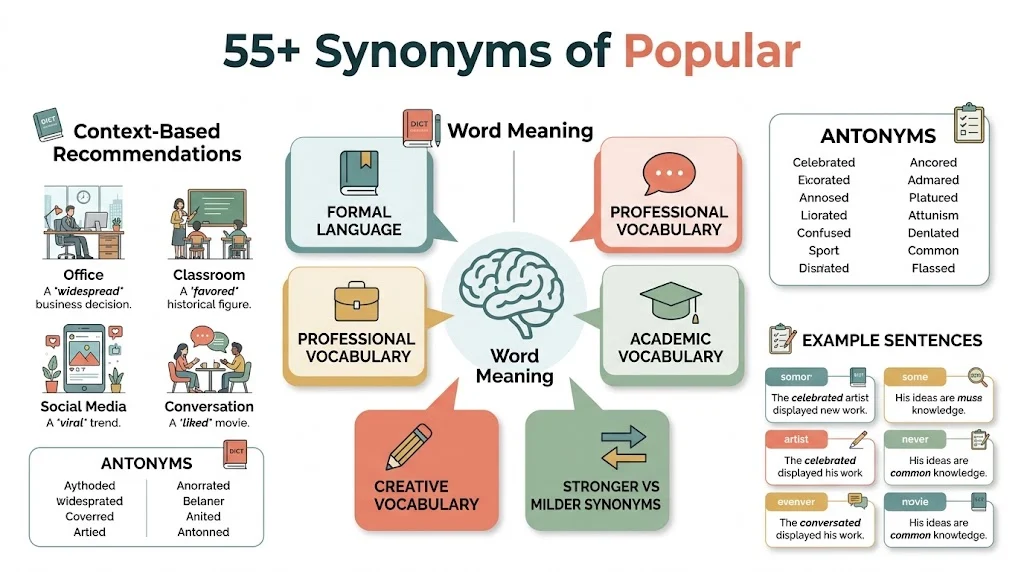
The word “popular” describes something or someone well-liked, widely admired, or currently in favor with many people. The best synonym depends on context: use well-liked for everyday situations, fashionable for trends, acclaimed for professional praise, prevailing for academic writing, and trending for social media.
Have you ever caught yourself using the word “popular” over and over while writing an essay, drafting a social media caption, or describing a trend at work? That feeling of repeating the same word is frustrating. It makes your writing feel dull and uninspired.
Choosing a fresh synonym of popular can instantly improve how your message lands. The right word adds precision, adjusts the tone, and shows off your vocabulary skills. Whether you are writing an email, a school assignment, or a professional report, knowing exactly which alternative to use makes all the difference.
Meaning, Tone, and Context
Simple Definition
Popular describes something that many people like, enjoy, or approve of.
Part of Speech
Adjective
Overall Tone
Neutral. The word itself carries neither positive nor negative weight, although it often implies positive regard.
Formality Level
Neutral. “Popular” works in formal writing, casual conversation, and everything in between.
Common Uses
Native English speakers use “popular” to describe:
- People who are liked by many friends or colleagues
- Products, movies, or songs with mass appeal
- Trends or fashions that many people follow
- Democratic concepts like “popular vote”
- Entertainment designed for a general audience
Word Forms
- Noun: popularity
- Adverb: popularly
- Verb: popularize
- Opposite form: unpopular
When and How to Use “Popular”
Use “popular” when you want to communicate broad appeal without adding extra emotional weight. It is a versatile word that fits almost any situation.
Professional:
“The new software update has proven popular among our remote teams.”
Academic:
“This theory remains popular among sociologists studying urban development.”
Workplace:
“Flexible scheduling options are increasingly popular with our staff.”
Personal:
“Hiking trails have become popular with my friends this summer.”
Email:
“Your presentation was very popular with the leadership team.”
Resume:
“Developed training programs that became popular across three departments.”
Social Media:
“This filter is incredibly popular with creators right now.”
Best Synonyms of “Popular”
No synonym perfectly matches “popular” in every situation. The best choice depends on what you are describing and who you are writing for.
Professional Writing
Acclaimed works best because it implies professional recognition and respect.
Academic Writing
Prevailing sounds precise and authoritative for research and scholarly work.
Business Communication
In demand communicates market appeal and practical value clearly.
Casual Conversation
Well-liked feels natural, warm, and conversational.
Emotional Writing
Beloved adds genuine emotional weight and personal affection.
Creative Writing
Celebrated gives a sense of honor and public appreciation.
Resume Writing
Sought-after highlights your value and marketability as a candidate.
Workplace Communication
Favored works well for discussing choices, options, and preferences.
Stronger Meaning
Ubiquitous means everywhere, which implies extreme popularity.
Softer Meaning
Fashionable is lighter and focuses more on trends than deep approval.
When Not to Use “Popular”
Too General
The word “popular” often fails to communicate why something is liked. It is a shortcut that leaves your reader wanting details.
Less Effective: “The restaurant is very popular.”
Better: “The restaurant is critically acclaimed for its innovative menu.”
Too Vague
“Popular” does not specify who likes something or for what reason.
Less Effective: “His ideas are popular.”
Better: “His ideas are widely accepted by industry experts.”
Too Weak
Sometimes you need a stronger word to emphasize genuine admiration.
Less Effective: “She is a popular speaker.”
Better: “She is a sought-after keynote speaker.”
Too Informal
In academic or legal writing, “popular” can sound too conversational.
Less Effective: “Popular opinion suggests…”
Better: “Prevailing public opinion suggests…”
Words Commonly Confused With “Popular”
Popular vs. Common
Difference: “Common” means frequent or ordinary. “Popular” means liked or approved. A common mistake is not necessarily popular.
When to Use It: Use “common” for frequency and “popular” for favor.
Example: “Colds are common in winter, but this new remedy has become popular.”
Popular vs. Famous
Difference: “Famous” means widely known. “Popular” means widely liked. Someone can be famous but unpopular, like a controversial celebrity.
When to Use It: Use “famous” for recognition and “popular” for approval.
Example: “The artist is famous worldwide but not popular with traditional critics.”
Popular vs. Trendy
Difference: “Trendy” implies being fashionable for a short period. “Popular” suggests broader and longer-lasting appeal.
When to Use It: Use “trendy” for short-term fashions and “popular” for lasting appeal.
Example: “The restaurant was trendy for a month but remains popular with locals.”
Popular vs. Prevailing
Difference: “Prevailing” means most common or influential at a particular time. It focuses on dominance rather than affection.
When to Use It: Use “prevailing” to describe what is most common or accepted in a specific context.
Example: “The prevailing view among scientists has shifted, though it was once popular.”
Popular vs. Well-liked
Difference: “Well-liked” is more personal and relational. “Popular” can describe things like products or songs, not just people.
When to Use It: Use “well-liked” for people and personal relationships.
Example: “The principal is well-liked by students and respected by teachers.”
Popular vs. Mainstream
Difference: “Mainstream” means conventional or accepted by the majority. “Popular” sometimes suggests mass appeal but can describe niche favorites too.
When to Use It: Use “mainstream” for what is ordinary and conventional.
Example: “The band is popular in indie circles but has not reached mainstream success.”
Best Synonyms of “Popular” by Context
| Context | Best Synonym | Why It Works | Example |
| Formal writing | Prevailing | Emphasizes widespread acceptance with authority | “The prevailing economic theory suggests…” |
| Academic writing | Prevalent | Common in scholarly work; precise | “This approach is prevalent in European universities” |
| Professional communication | Acclaimed | Implies respect and recognition | “The acclaimed author will speak at our conference” |
| Business emails | In demand | Suggests practical value and utility | “Our services are increasingly in demand” |
| Resume writing | Sought-after | Highlights desirability and competition | “Sought-after specialist in data analytics” |
| Workplace communication | Favored | Neutral and diplomatic | “The early morning schedule is favored by most staff” |
| Casual conversation | Well-liked | Warm and natural | “My neighbor is well-liked by everyone” |
| Everyday speaking | Liked | Simple and direct | “I liked the movie more than I expected” |
| Creative writing | Celebrated | Adds honor and artistic recognition | “The celebrated poet read her new work” |
| Storytelling | Beloved | Evokes genuine emotional attachment | “The beloved character returned in the sequel” |
| Emotional writing | Cherished | Implies deep affection and value | “The cherished tradition brings families together” |
| Strong emphasis | Ubiquitous | Suggests it is everywhere | “Smartphones are now ubiquitous” |
| Mild tone | Acceptable | Means okay but not strongly favored | “The solution was acceptable to both parties” |
| Social media captions | Trending | Current and relevant for digital content | “This song is trending on Spotify” |
| American English | Popular | Standard US usage | “Pop music is popular with teenagers” |
| British English | Popular | Same meaning, same usage | “The pub is popular with the locals” |
How to Choose the Best Synonym of “Popular”
Selecting the right synonym requires thinking about these five factors:
1. What exactly are you describing?
Are you talking about a person, a product, an idea, or a trend? Well-liked fits people, in demand fits products, and prevailing fits ideas.
2. What tone do you need?
Professional writing calls for acclaimed or sought-after. Casual conversation welcomes liked or trendy.
3. Who is your audience?
Resume readers expect sought-after. Social media followers respond to trending. Academic reviewers prefer prevalent.
4. How much emotional weight do you need?
Beloved and cherished carry strong feeling. Acceptable and common carry almost none.
5. Does the word sound natural?
Read your sentence aloud. If the synonym feels awkward or forced, try another.
The goal is not to sound fancy. The goal is to communicate clearly and effectively for your specific situation.
Real Life Examples of “Popular”
School:
The science fair project was well-liked by the judges.
College:
Professor Chen’s lectures are so popular that students line up early.
Workplace:
Our flexible work policy is favored by the entire team.
Business:
The product became so sought-after that we could not keep up with orders.
Email:
Your proposal is in demand among department heads.
Resume:
Consistently led initiatives that became company-wide best practices.
Conversation:
“Have you tried that place? It is really popular right now.”
Storytelling:
The celebrated author signed copies for hours at the bookshop.
Blogging:
These budget-friendly ideas are trending on Pinterest.
Social Media:
This filter is going viral. Everyone is using it.
18 Best Synonyms of “Popular”
| Synonym | Simple Meaning | Best Used For | Example Sentence |
| Well-liked | Liked by many people | Describing people or products informally | “The new manager is well-liked by her team” |
| Acclaimed | Publicly praised | Professional or artistic recognition | “The acclaimed documentary won three awards” |
| Sought-after | Wanted or desired by many | Resume and career writing | “She is a sought-after consultant in her field” |
| Prevailing | Dominant at a particular time | Academic writing and research | “The prevailing opinion supports this conclusion” |
| In demand | Wanted or needed by many | Business and product descriptions | “Our training sessions are in demand” |
| Favored | Preferred over others | Workplace and diplomatic contexts | “The blue option was favored by most voters” |
| Celebrated | Widely honored or praised | Creative and storytelling writing | “The celebrated musician performed to a full house” |
| Beloved | Deeply loved and cherished | Emotional and personal writing | “Her beloved grandmother inspired her career” |
| Trendy | Currently fashionable | Describing modern styles and fads | “Those sneakers are trendy right now” |
| Current | Happening or being used now | Describing up-to-date topics | “This issue is current in the news” |
| Widespread | Found over a large area or group | Describing ideas or practices | “The practice is widespread among schools” |
| Approved | Formally accepted or agreed to | Professional and institutional contexts | “The approved method is widely used” |
| Desired | Wanted or wished for | Describing goals or outcomes | “The desired outcome remains achievable” |
| Voguish | Fashionable in a sophisticated way | Creative and style writing | “Her voguish style impressed the audience” |
| Rife | Very common or widespread | Describing conditions or trends | “That opinion is rife among young voters” |
| Prominent | Well-known and important | Describing influential people | “A prominent researcher supported the theory” |
| Accepted | Generally agreed upon | Describing standards or norms | “The accepted view has shifted recently” |
| Usual | Common or normal | Everyday descriptions | “The usual approach worked well again” |
Synonyms of “Popular” by Usage
Professional vs Personal Synonyms
Professional synonyms like acclaimed, sought-after, and in demand highlight market value and recognition. They fit resumes, LinkedIn profiles, and business proposals.
Personal synonyms like well-liked, liked, and favored sound natural in conversations and informal writing about people and personal preferences.
Formal vs Conversational Synonyms
Formal: prevailing, prevalent, ubiquitous, prominent – Use these for research papers, reports, and formal presentations.
Conversational: trendy, hot, cool, liked – Use these in casual conversation, texts, and social media.
Academic Synonyms
Prevalent, prevailing, ubiquitous, and prominent sound precise and authoritative in academic writing. They signal that you understand formal scholarly language.
Professional and Business Synonyms
Sought-after, acclaimed, in demand, and favored demonstrate market awareness and professional polish. These words work well in business communication.
Creative and Literary Synonyms
Celebrated, beloved, voguish, and cherished add elegance and emotional depth to creative writing. They help paint vivid pictures for your readers.
Slang or Modern Synonyms
While popular has no established slang synonym, lit, fire, and viral are modern English terms for something that is popular or trending, especially on social media and among younger speakers. Avoid these in professional and academic writing.
Strongest to Mildest Synonyms
Mild: acceptable, usual, liked – These communicate basic approval without emphasis.
Moderate: well-liked, favored, in demand – These show clear positive regard.
Strong: acclaimed, celebrated, sought-after – These convey significant recognition.
Very Strong: beloved, cherished, ubiquitous – These express intense approval or dominance.
Emotional vs Neutral Synonyms
Emotional: beloved, cherished, celebrated – These words carry feeling and affection. Use them when you want your reader to feel something.
Neutral: prevailing, common, widespread, usual – These communicate information without added emotion. Use them when you need straightforward facts.
Antonyms of “Popular”
| Antonym | Meaning | Example Sentence |
| Unpopular | Not liked by many people | “The unpopular policy was quickly reversed” |
| Obscure | Not well-known or hidden | “He was an obscure artist before the exhibition” |
| Unfamiliar | Not known or recognized | “The concept is unfamiliar to most students” |
| Unknown | Not famous or recognized | “Her work remained unknown for decades” |
| Uncommon | Not frequently seen or happening | “That spelling is uncommon in American English” |
| Unfashionable | Not current or stylish | “The design now looks unfashionable” |
| Rejected | Not accepted or refused | “The rejected proposal was never revisited” |
| Disliked | Not liked by others | “The disliked executive was asked to leave” |
| Old-fashioned | Outdated or belonging to the past | “His views are old-fashioned and limiting” |
| Ignored | Not noticed or paid attention to | “Her warning was ignored by the team” |
| Unwanted | Not desired or requested | “The unwanted feedback caused tension” |
| Unusual | Rare or not common | “His unusual approach surprised everyone” |
| Unpretentious | Not trying to impress or be popular | “The unpretentious cafe became a quiet favorite” |
| Excluded | Kept out or not included | “The excluded group felt marginalized” |
| Unconventional | Not following traditional methods | “Her unconventional methods made her stand out” |
Comparison: “Popular” vs Similar Words
Popular vs Well-liked
Main Difference: “Well-liked” is more personal and relational. “Popular” can describe people, products, ideas, and trends.
Which Is Stronger? “Well-liked” actually sounds warmer and more genuine than “popular.”
Which Is More Formal? “Popular” is more versatile for formal contexts.
When to Use Each: Use “well-liked” for describing people and personal connections. Use “popular” for products, music, and general trends.
Examples:
- Popular: “The coffee shop is popular with tourists.”
- Well-liked: “The coffee shop owner is well-liked by regulars.”
Popular vs Famous
Main Difference: “Famous” means widely known. “Popular” means widely liked.
Which Is Stronger? “Famous” is stronger for recognition. “Popular” is stronger for approval.
Which Is More Formal? Both are neutral, though “famous” can sound slightly more informal.
When to Use Each: Use “famous” for celebrities and public figures. Use “popular” for things that many people enjoy.
Examples:
- Popular: “The song is popular on streaming platforms.”
- Famous: “The musician is famous around the world.”
Popular vs Trendy
Main Difference: “Trendy” implies temporary fashion. “Popular” suggests broader, often more lasting appeal.
Which Is Stronger? “Popular” usually suggests broader and deeper appeal.
Which Is More Formal? “Popular” is more formal than “trendy.”
When to Use Each: Use “trendy” for short-term styles. Use “popular” for lasting products or ideas.
Examples:
- Popular: “The restaurant has been popular for 20 years.”
- Trendy: “This new café is trendy with influencers right now.”
Popular vs Widespread
Main Difference: “Widespread” means physically or geographically common. “Popular” means well-liked regardless of location.
Which Is Stronger? “Widespread” emphasizes coverage. “Popular” emphasizes approval.
Which Is More Formal? “Widespread” is slightly more formal and academic.
When to Use Each: Use “widespread” for practices, customs, and physical distributions. Use “popular” for things people like.
Examples:
- Popular: “The app is popular in urban areas.”
- Widespread: “Internet access is widespread across the country.”
Popular vs Prevalent
Main Difference: “Prevalent” means common or widespread. “Popular” means liked or approved.
Which Is Stronger? “Prevalent” is stronger for dominance in number. “Popular” is stronger for favor.
Which Is More Formal? “Prevalent” is more formal and academic.
When to Use Each: Use “prevalent” in research and formal writing. Use “popular” for general communication.
Examples:
- Popular: “Spanish is popular among language learners.”
- Prevalent: “Spanish is prevalent in many American communities.”
Popular vs Sought-after
Main Difference: “Sought-after” means actively pursued or desired. “Popular” means generally liked.
Which Is Stronger? “Sought-after” is stronger and implies competition or scarcity.
Which Is More Formal? “Sought-after” is more professional.
When to Use Each: Use “sought-after” in resumes and professional recommendations. Use “popular” in everyday conversation.
Examples:
- Popular: “This website is popular with readers.”
- Sought-after: “She is a sought-after editor in the publishing industry.”
Common Phrases and Expressions with “Popular”
| Phrase | Meaning | Example Sentence |
| Popular culture | Mainstream entertainment and trends | “Popular culture has influenced fashion for decades” |
| Popular opinion | What most people think or believe | “Popular opinion has shifted on this issue” |
| Popular vote | Votes cast by the general public in an election | “The candidate won the popular vote but lost the election” |
| Popular music | Music with broad commercial appeal | “She started her career in popular music” |
| Popular science | Science explained for a general audience | “He writes popular science books for children” |
| Popular demand | Widespread public request for something | “The band returned by popular demand” |
| Make something popular | To cause something to become well-liked | “The review made the movie popular overnight” |
Common Mistakes to Avoid
Using a Vague Synonym
Incorrect: “The policy is common in schools.”
Better: “The policy is prevalent in schools.”
Why: “Common” means ordinary. “Prevalent” suggests widespread adoption.
Confusing “Popular” with “Common”
Incorrect: “The restaurant is very common in our area.”
Better: “The restaurant is very popular in our area.”
Why: “Common” suggests nothing special. “Popular” suggests people like it.
Using an Informal Synonym in Formal Writing
Incorrect: “This trend is hot in the industry.”
Better: “This trend is prevalent in the industry.”
Why: “Hot” sounds unprofessional. “Prevalent” sounds credible.
Selecting an Overly Dramatic Synonym
Incorrect: “The cafeteria is beloved by employees.”
Better: “The cafeteria is popular with employees.”
Why: “Beloved” is too emotional for describing a cafeteria.
Repeating “Popular” Too Often
Incorrect: “The popular restaurant became more popular after the popular review.”
Better: “The well-liked restaurant became more sought-after after the glowing review.”
Why: Variety makes writing more engaging.
Choosing a Synonym with the Wrong Emotional Tone
Incorrect: “The beloved coworker retired.”
Better: “The well-liked coworker retired.”
Why: “Beloved” sounds like a family member, not a coworker.
Using Slang in Professional Writing
Incorrect: “This feature is fire among users.”
Better: “This feature is in demand among users.”
Why: Slang undermines professional credibility.
Frequently Asked Questions
What are the best synonyms of “popular”?
The best synonyms depend on context: use well-liked for people, acclaimed for professional recognition, prevailing for academic writing, and sought-after for resumes and professional contexts.
What are the best formal synonyms of “popular”?
The best formal synonyms include prevailing, prevalent, ubiquitous, prominent, and accepted. These words sound authoritative in academic papers, reports, and professional documents.
What are common informal synonyms of “popular”?
Common informal synonyms include trendy, hot, cool, in, and liked. Use these in casual conversation, text messages, and social media posts where you want to sound natural and approachable.
What is another word for “popular” in professional writing?
Sought-after, in demand, acclaimed, and favored work well in professional writing. They sound polished and help you communicate market awareness in resumes, proposals, and business emails.
What is the difference between “popular” and “prevailing”?
“Popular” means well-liked by many people. “Prevailing” means most common or dominant at a particular time. Something prevailing is not necessarily popular, and something popular is not necessarily prevailing.
What is the opposite of “popular”?
The most direct opposite is unpopular. Other opposites include obscure, unfamiliar, unknown, uncommon, and old-fashioned, depending on whether you mean not liked, not known, or not current.
Conclusion
“Popular” is a versatile word that communicates broad appeal and general approval. It works well in almost any context, but the best communicators know when to reach for a more precise synonym.
Choose well-liked for personal connections, acclaimed for professional recognition, prevailing for academic authority, and sought-after for professional desirability. No single synonym works perfectly in every situation. Always consider your audience, tone, and purpose before making your choice.
A practical tip: before using “popular,” ask yourself whether you want to emphasize broad approval, personal warmth, professional recognition, or market demand. That question will guide you to the right synonym every time.
Definitions, meanings, and usage recommendations should be verified with trusted language references before publication. Recommended sources include Cambridge Dictionary, Oxford English Dictionary, Merriam-Webster, Collins Dictionary, and Britannica.

1 thought on “55+ Synonyms of Popular| Meanings and Best Alternatives”