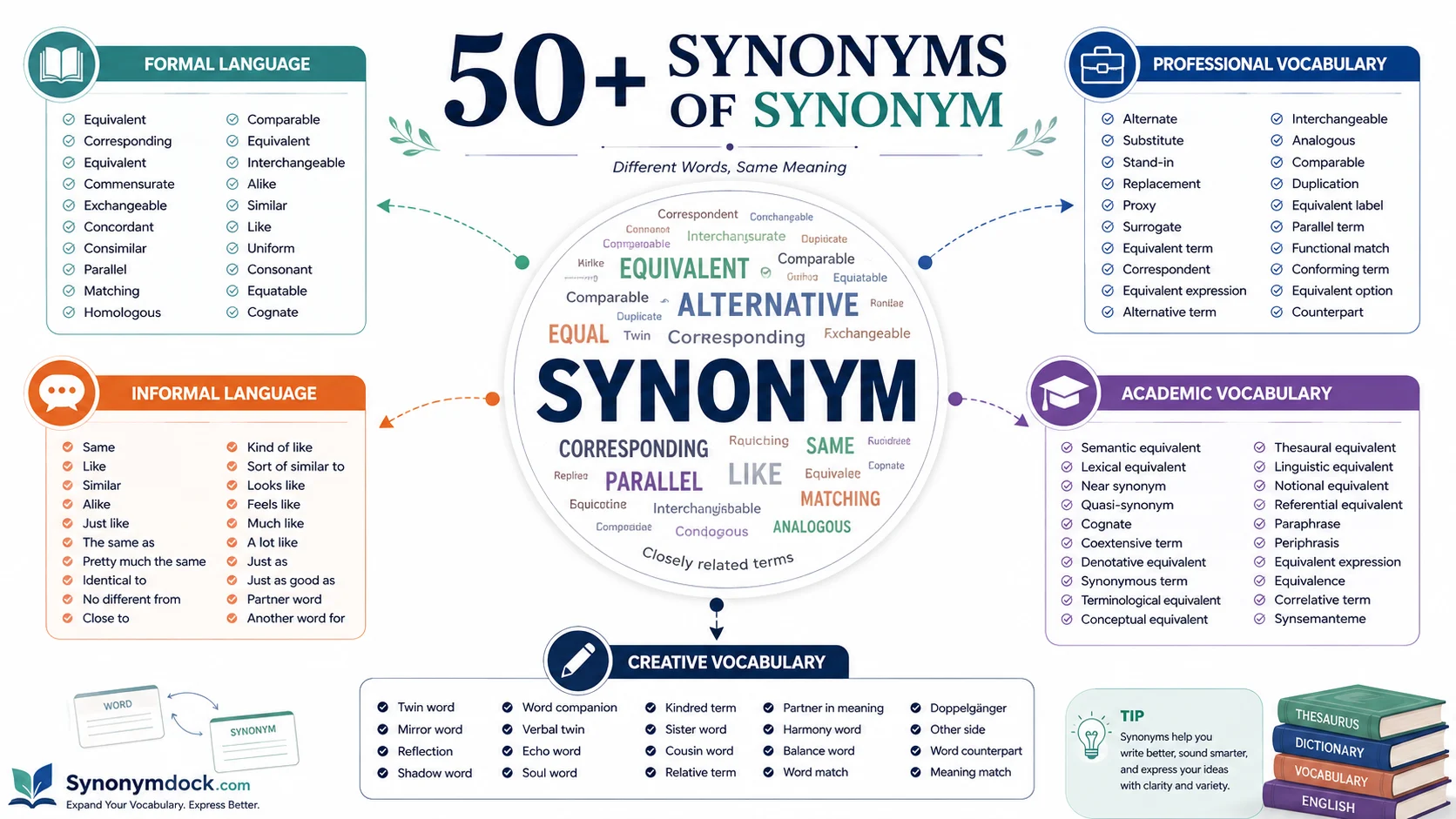
The word “synonym” means a word with the same or nearly the same meaning as another word . For formal writing, “equivalent” works best, while “alternative” fits professional contexts. In casual conversation, “similar word” or “like term” is more natural. For academic work, “corresponding term” or “analogue” are strong choices.
Have you ever found yourself writing an email, an essay, or a social media caption and realized you keep using the same word over and over? It happens to everyone. You know there must be a better way to say what you mean, but the right word just won’t come to mind. This is exactly where understanding the “synonyms of synonym” becomes incredibly useful. Choosing the right alternative word improves your clarity, sets the proper tone, and makes your communication more effective. This guide will help you move beyond basic vocabulary and choose the perfect word for every situation.
Meaning, Tone, and Context
Simple Definition
A synonym is a word, morpheme, or phrase that means precisely or nearly the same as another word, morpheme, or phrase in a given language . For instance, “car” and “automobile” are synonyms .
Part of Speech
Synonym is a noun.
Overall Tone
The word “synonym” is neutral. It simply describes a linguistic relationship without carrying positive or negative emotional weight.
Formality Level
The word “synonym” is standard English. It works in formal, neutral, and informal settings. However, its synonyms vary widely in formality.
Common Uses
Native English speakers use the word “synonym” when discussing vocabulary, teaching language, improving writing, or explaining word choices. You will hear it in classrooms, writing workshops, and everyday conversations about language.
Word Forms
- Noun: synonym
- Adjective: synonymous (meaning having the character of a synonym)
- Noun form for the state of being a synonym: synonymy
- Adverb: synonymously
When and How to Use “Synonym”
You should use the word “synonym” when you need to refer to words that share similar meanings. It is the most precise term for this concept. Here are examples in different contexts.
Professional
“In our client report, we should avoid using ‘synonym’ repeatedly and instead demonstrate variety in our vocabulary.”
Academic
“The researcher identified the synonym for each key term to ensure the study’s language was accessible.”
Workplace
“Can you think of a synonym for ‘improve’ that sounds more impactful in this performance review?”
Personal
“My friend always uses the same word in her texts, so I suggested a few synonyms to help her mix it up.”
“I included a list of synonyms for ‘help’ in my proposal to show the range of support we can offer.”
Resume
“Instead of saying ‘responsible for,’ I used synonyms like ‘managed’ and ‘directed’ to make my resume stronger.
Social Media
“This app suggests synonyms when you’re stuck writing the perfect caption.”
Best Synonyms of “Synonym”
No synonym is identical in every situation . The best choice depends on your audience, purpose, and tone . Here are the best synonyms for different contexts.
- Professional writing: Alternative. This word is direct and widely understood in business settings.
- Academic writing: Equivalent term. This phrase is precise and signals scholarly rigor.
- Business communication: Substitute. This word is practical and suggests a direct replacement.
- Casual conversation: Similar word. This is the most natural choice for everyday speech.
- Emotional writing: Analogue. This term suggests a deeper, more meaningful connection between words.
- Creative writing: Cognate. This word implies a shared origin or nature, which can add depth to your writing.
- Resume writing: Corresponding term. This sounds deliberate and thoughtful.
- Workplace communication: Like term. This is clear and unpretentious.
- Stronger meaning: Exact equivalent. This emphasizes precision.
- Softer meaning: Near-synonym. This acknowledges a close but not perfect match.
When Not to Use “Synonym”
Using the word “synonym” is not always the best choice. Here are situations where you should consider alternatives.
When the word sounds too technical
Instead of saying, “Find a synonym for ‘happy’,” you could say, “Find a similar word for ‘happy’.” This is more accessible.
When the word sounds too vague
If you need to be specific, “synonym” might not be enough. Say “exact equivalent” to be precise about a word that is a perfect match.
When the word sounds too formal
In casual conversation, “synonym” can sound academic. Using “similar word” or “like term” is more natural.
When the word sounds too weak
If you are emphasizing an exact match, “synonym” may not convey the strength you need. Use “direct equivalent” instead.
When the word sounds outdated
While “synonym” is not outdated, in some modern digital contexts, you might use “related term” or “keyword variant” instead.
Words Commonly Confused With “Synonym”
Here are words that people often confuse with “synonym.”
Synonym vs. Antonym
- Difference: A synonym has the same or similar meaning. An antonym has the opposite meaning .
- When to Use It: Use “antonym” when you want to express contrast or opposition.
- Example: “The antonym of ‘hot’ is ‘cold’.”
Synonym vs. Homonym
- Difference: A synonym is a word with a similar meaning. A homonym is a word that sounds the same as another but has a different meaning .
- When to Use It: Use “homonym” when discussing words that share pronunciation but not meaning.
- Example: “‘Rose’ the flower and ‘rose’ the past tense of ‘rise’ are homonyms.”
Synonym vs. Hypernym
- Difference: A synonym is a word with a similar meaning. A hypernym is a broader category word .
- When to Use It: Use “hypernym” when discussing categories and specific instances.
- Example: “‘Vehicle’ is a hypernym of ‘car’ and ‘truck’.”
Synonym vs. Metonym
- Difference: A synonym is a word with a similar meaning. A metonym is a word used as a substitute for something closely associated with it .
- When to Use It: Use “metonym” when discussing figurative language or symbolic substitutions.
- Example: “‘The White House’ is a metonym for the U.S. executive branch.”
Best Synonyms of “Synonym” by Context
Here is a table of the best synonyms for “synonym” organized by context.
| Context | Best Synonym | Why It Works | Example |
|---|---|---|---|
| Formal writing | Equivalent | It is precise and authoritative. | “The formal equivalent of ‘start’ is ‘commence’.” |
| Academic writing | Equivalent term | It sounds scholarly and precise. | “In this paper, we use the equivalent term for each key concept.” |
| Professional communication | Alternative | It is clear and widely understood. | We need a professional alternative for ‘help’ in our proposal. |
| Business emails | Substitute | It is direct and practical. | “Please use this substitute for the technical term in your email.” |
| Resume writing | Corresponding term | It is deliberate and thoughtful. | “Use the corresponding term to describe your leadership skills.” |
| Workplace communication | Like term | It is unpretentious and clear. | “Can you think of a like term for ‘project’?” |
| Casual conversation | Similar word | It sounds natural and friendly. | “I need a similar word for ‘great’.” |
| Everyday speaking | Like word | It is the most relaxed choice. | “Is there a like word for ‘good’?” |
| Creative writing | Cognate | It suggests shared nature and depth. | “The poet used a cognate to add layered meaning.” |
| Storytelling | Analogue | It implies a meaningful connection. | “The author found an analogue for every descriptive word.” |
| Emotional writing | Analogue | It suggests a deep, emotional connection. | “Her words were an analogue for her feelings.” |
| Strong emphasis | Exact equivalent | It emphasizes precision. | “This is the exact equivalent of the original term.” |
| Mild tone | Near-synonym | It acknowledges a close but not perfect match. | “We are looking for a near-synonym, not a perfect one.” |
| Social media captions | Alternative word | It is engaging and accessible. | “Here is an alternative word to use in your next caption.” |
| American English | Equivalent | This is the most common and versatile choice. | “In American English, the equivalent of ‘flat’ is ‘apartment’.” |
How to Choose the Best Synonym of “Synonym”
Choosing the best synonym involves considering a few key factors.
- Meaning: Are you looking for an exact match or a close one?
- Tone: Is your writing formal, informal, or neutral?
- Audience: Who will read your writing?
- Emotional strength: Do you want to emphasize precision or a general connection?
- Writing purpose: Are you writing an essay, an email, or a text message?
- Level of formality: Choose a synonym that matches the context.
Your goal is to communicate your message as clearly as possible. The right synonym helps you do that.
Real Life Examples of “Synonym”
Here are examples of how the word “synonym” is used in different situations.
School
“My English teacher asked us to find a synonym for every word on the list.”
College
“The professor emphasized using a thesaurus to find the best synonym for each term in our essays.”
Workplace
“During the meeting, I suggested a few synonyms for ‘efficiency’ to clarify our goals.”
Business
“Our marketing team brainstormed synonyms for ‘innovative’ to describe the new product.”
“In my email, I used a synonym for ‘problem’ to make the situation sound more positive.”
Resume
“My resume uses strong synonyms for common action verbs to stand out.”
Conversation
“I couldn’t think of a synonym for ‘fun,’ so I just said ‘enjoyable.'”
Storytelling
“The writer carefully chose a synonym for every word to create the right mood.”
Blogging
This blog post explains synonyms in a way that is easy to understand.”
Social Media
“Need a synonym for your favorite word? Check out this app!”
18 Best Synonyms of “Synonym”
Here is a table of the 18 best synonyms for “synonym,” with simple meanings and examples.
| Synonym | Simple Meaning | Best Used For | Example Sentence |
|---|---|---|---|
| Equivalent | A word with exactly the same meaning. | Formal and academic writing. | “The formal equivalent of ‘begin’ is ‘commence’.” |
| Alternative | Another possible word. | Professional and everyday use. | “We can use the alternative ‘assist’ for ‘help’.” |
| Substitute | A word used in place of another. | Business and practical contexts. | “Use ‘purchase’ as a substitute for ‘buy’.” |
| Analogue | A word that is comparable or similar. | Creative and descriptive writing. | “The poet found an analogue for every image.” |
| Cognate | A word with a shared origin or nature. | Linguistic and academic contexts. | “‘Night’ and ‘Nacht’ are cognates.” |
| Corresponding term | A term that matches another. | Academic and professional writing. | “Use the corresponding term in your essay.” |
| Like term | A term that is similar. | Informal conversation. | “I can’t think of a like term for that.” |
| Similar word | A word that is alike in meaning. | General use and casual speech. | “I need a similar word for ‘happy’.” |
| Near-synonym | A word with a similar but not identical meaning. | Linguistic precision. | “This is a near-synonym, not an exact one.” |
| Exact equivalent | A perfect match in meaning. | Emphasizing precision. | “This word is the exact equivalent of the original.” |
| Synonymous term | A term that is synonymous. | Formal and academic writing. | “Find a synonymous term for each key word.” |
| Direct equivalent | A straightforward match. | Professional and technical writing. | “This is the direct equivalent of the English word.” |
| Word variant | A variation of a word. | Linguistic and digital contexts. | “Use a word variant to improve your SEO.” |
| Related term | A term that is connected in meaning. | General and digital contexts. | “The thesaurus offers many related terms.” |
| Closely related word | A word that is very similar. | Academic and detailed writing. | “Choose a closely related word to avoid repetition.” |
| Poecilonym | An old, rare synonym for synonym . | Linguistic curiosity and rare usage. | “The professor used the archaism ‘poecilonym’.” |
| Equivalent word | A word that means the same . | Formal and professional contexts. | “This is the equivalent word in French.” |
| Alternative expression | A different way to say the same thing. | Creative and diverse contexts. | “The author used an alternative expression to add variety.” |
Synonyms of “Synonym” by Usage
Professional vs Personal Synonyms
In the workplace, you should use formal synonyms like “equivalent” or “alternative.” In personal conversations, “similar word” or “like term” sounds more natural.
Formal vs Conversational Synonyms
Use formal synonyms like “equivalent term” or “corresponding term” for reports, essays, and business presentations. Use “similar word” or “like word” for casual conversations and texting.
Academic Synonyms
Academic writing benefits from precise vocabulary like “equivalent term,” “corresponding term,” and “cognate.” These words sound more authoritative and scholarly.
Professional and Business Synonyms
For resumes, interviews, and client communication, choose strong synonyms like “alternative,” “substitute,” and “direct equivalent.” These words project professionalism and clarity.
Creative and Literary Synonyms
Storytelling and poetry often benefit from expressive alternatives like “analogue” and “cognate.” These words add emotion and imagery to your writing.
Slang or Modern Synonyms
There are no widely used slang terms for “synonym.” Using the standard term is your best choice in all situations.
Strongest to Mildest Synonyms
- Mild: similar word
- Moderate: alternative
- Strong: equivalent
- Very Strong: exact equivalent
Emotional vs Neutral Synonyms
- Emotional Synonyms: “analogue” can imply a deep connection.
- Neutral Synonyms: “equivalent,” “alternative,” and “substitute” simply communicate information.
Antonyms of “Synonym”
Here is a table of antonyms for “synonym.”
| Antonym | Meaning | Example Sentence |
|---|---|---|
| Antonym | A word with the opposite meaning . | “The antonym of ‘hot’ is ‘cold’.” |
| Opposite | A word with a contrary meaning. | “The opposite of ‘happy’ is ‘sad’.” |
| Contrary | A word expressing the opposite. | “His actions were the contrary of his words.” |
| Counterpart | A word that is an opposite. | “The counterpart to ‘yes’ is ‘no’.” |
| Reverse | A word that is the opposite in direction or effect. | “The reverse of ‘increase’ is ‘decrease’.” |
| Inverse | A word that is the opposite in order or relationship. | “The inverse of ‘multiply’ is ‘divide’.” |
| Converse | A word that is the opposite in proposition. | “The converse of ‘if it rains, it is wet’ is not always true.” |
| Obverse | A word that is the counterpart or opposite side. | “The obverse of the medal shows the king.” |
| Contradictory | A word that is mutually opposed. | “The two statements were contradictory.” |
| Contrastive | A word that shows a difference. | “Use a contrastive word to show the difference.” |
| Disagreement | A word expressing opposition. | “There was a clear disagreement between the two accounts.” |
| Opposition | A word expressing resistance. | “The opposition to the plan was strong.” |
| Reverse term | A term that is the opposite. | “In this context, it is the reverse term.” |
| Contrapositive | A logical opposite. | “The contrapositive of the statement is logically equivalent.” |
| Negation | A word that denies or refutes. | “The negation of ‘all’ is ‘none’.” |
Comparison: “Synonym” vs Similar Words
Synonym vs Equivalent
- Main Difference: A synonym is a word with a similar meaning. An equivalent is often a perfect match.
- Which Is Stronger?: Equivalent is stronger because it implies an exact correspondence.
- Which Is More Formal?: Equivalent is more formal.
- When to Use Each: Use “synonym” for general discussions. Use “equivalent” for precise matches.
- Examples:
- Synonym: “‘Big’ and ‘large’ are synonyms.”
- Equivalent: “‘Car’ is the British equivalent of ‘automobile’ in American English.”
Synonym vs Alternative
- Main Difference: A synonym is a word with a similar meaning. An alternative is another option or choice.
- Which Is Stronger?: Synonym is stronger in the context of word relationships.
- Which Is More Formal?: Both are versatile, but “alternative” is slightly more professional.
- When to Use Each: Use “synonym” when discussing meaning. Use “alternative” when discussing choices.
- Examples:
- Synonym: “‘Happy’ and ‘joyful’ are synonyms.”
- Alternative: “We need an alternative to the word ‘good’.”
Synonym vs Substitute
- Main Difference: A synonym is a word with a similar meaning. A substitute replaces another word.
- Which Is Stronger?: Substitute is stronger because it implies direct replacement.
- Which Is More Formal?: Substitute is more formal.
- When to Use Each: Use “synonym” for general meaning. Use “substitute” for a direct replacement.
- Examples:
- Synonym: “‘Car’ and ‘automobile’ are synonyms.”
- Substitute: “Use ‘purchase’ as a substitute for ‘buy’.”
Synonym vs Analogue
- Main Difference: A synonym is a word with a similar meaning. An analogue is something comparable in form or function.
- Which Is Stronger?: Analogue is stronger in a conceptual sense.
- Which Is More Formal?: Analogue is more formal and academic.
- When to Use Each: Use “synonym” for words. Use “analogue” for broader comparisons.
- Examples:
- Synonym: “‘Begin’ and ‘start’ are synonyms.”
- Analogue: “This story is an analogue of a classic myth.”
Synonym vs Cognate
- Main Difference: A synonym is a word with a similar meaning. A cognate is a word with a shared linguistic origin .
- Which Is Stronger?: Both are precise in their different domains.
- Which Is More Formal?: Cognate is more formal.
- When to Use Each: Use “synonym” for meaning. Use “cognate” for etymology.
- Examples:
- Synonym: “‘Happy’ and ‘content’ are synonyms.”
- Cognate: “‘Night’ and ‘nacht’ are cognates.”
Synonym vs Metonym
- Main Difference: A synonym is a word with a similar meaning. A metonym is a word substituted for something closely associated with it .
- Which Is Stronger?: Metonym is more specific and literary.
- Which Is More Formal?: Metonym is more formal.
- When to Use Each: Use “synonym” for words with similar meanings. Use “metonym” for symbolic associations.
- Examples:
- Synonym: “‘Car’ and ‘automobile’ are synonyms.”
- Metonym: “‘The Crown’ is a metonym for the monarchy.”
Common Phrases and Expressions with “Synonym”
Here are common phrases that include the word “synonym.”
Synonym for
- Meaning: A word that means the same as another.
- Example Sentence: “Find a synonym for ‘bad’ to make your feedback sound more constructive.”
Near-synonym
- Meaning: A word with a similar but not identical meaning .
- Example Sentence: “The term ‘near-synonym’ is used by linguists to describe words like ‘big’ and ‘large’.”
Synonymous with
- Meaning: So closely associated with something that the two terms are interchangeable .
- Example Sentence: “Her name has become synonymous with excellence.”
Direct synonym
- Meaning: A word that is a straight and exact equivalent.
- Example Sentence: “There is no direct synonym for this complex concept.”
Cognitive synonym
- Meaning: A word that shares the same denotational meaning .
- Example Sentence: “Cognitive synonyms are rare in the English language.”
Equivalent term
- Meaning: A term that is equal in meaning or value.
- Example Sentence: “Use the equivalent term in your report.”
Common Mistakes to Avoid
Here are common mistakes people make when using “synonym” or its alternatives.
1: Choosing a vague synonym
- Incorrect: “I need a word like that.”
- Better: “I need a synonym for that word.”
- Why: “Synonym” is the precise term.
2: Using an informal synonym in formal writing
- Incorrect: “Find a like word for this term.”
- Better: “Find an equivalent term for this concept.”
- Why: “Equivalent term” is more formal and academic.
3: Selecting an overly dramatic synonym
- Incorrect: “This word is the total analogue of that one.”
- Better: “This word is a synonym of that one.”
- Why: “Synonym” is neutral and precise.
4: Repeating the same word too often
- Incorrect: “Find a synonym. Use that synonym. The synonym will help.”
- Better: “Find a synonym. Use that alternative. The equivalent will help.”
- Why: Varying your language improves readability.
5: Choosing a synonym with the wrong emotional tone
- Incorrect: “This word is the exact cognate of that term.” (when you don’t mean etymologically)
- Better: “This word is the exact equivalent of that term.”
- Why: “Cognate” has a specific linguistic meaning that may not apply.
Frequently Asked Questions
1. What are the best synonyms of “synonym”?
The best synonyms of “synonym” include “equivalent,” “alternative,” “substitute,” “analogue,” and “cognate.” The best choice depends on your context and audience.
2. What are the best formal synonyms of “synonym”?
The best formal synonyms of “synonym” are “equivalent,” “equivalent term,” “corresponding term,” and “direct equivalent.” These words are appropriate for academic and professional writing.
3. What are common informal synonyms of “synonym”?
Common informal synonyms of “synonym” are “similar word,” “like word,” and “like term.” These choices are more natural in everyday conversation.
4. What is another word for “synonym” in professional writing?
Another word for “synonym” in professional writing is “alternative” or “substitute.” These terms are clear and practical in business contexts.
5. What is the difference between “synonym” and “equivalent”?
A “synonym” is a word with a similar meaning, while an “equivalent” often implies an exact match. “Equivalent” is generally stronger and more precise .
6. What is the opposite of “synonym”?
The opposite of “synonym” is “antonym.” An antonym is a word with the opposite meaning of another word .
Conclusion
Understanding the word “synonym” is more than just a grammar exercise. It is a key to better writing and clearer communication. The best synonyms like “equivalent,” “alternative,” and “substitute” each serve a unique purpose. No synonym works perfectly in every situation, so always consider your audience, tone, and purpose . Choosing the right word will make your writing stronger and more engaging. A final tip: keep a thesaurus handy to explore the rich variety of the English language.

13 thoughts on “Synonyms of Synonym| 50+ Alternatives & Word Choices For 2026”