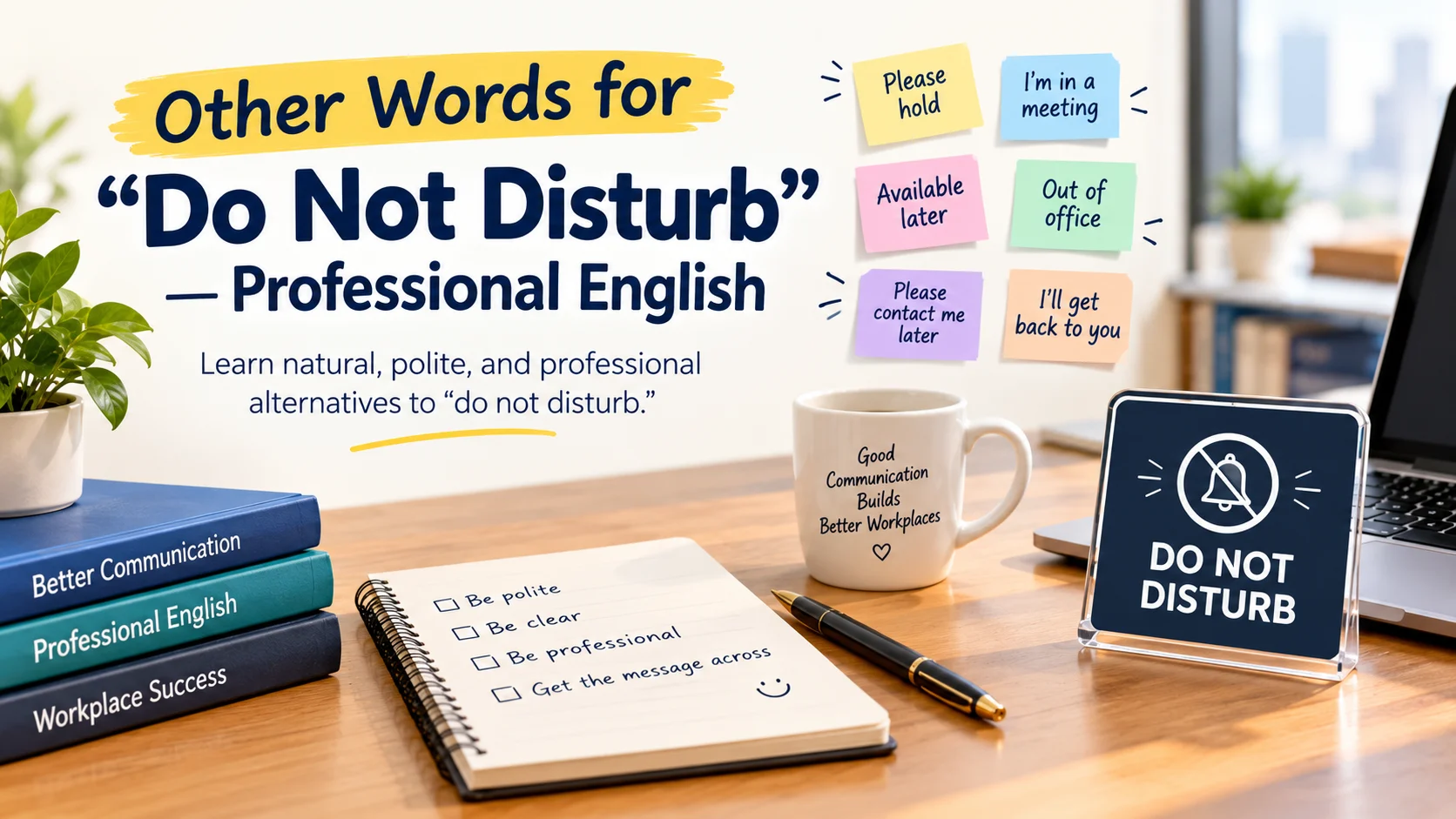
Other words for do not disturb include “please give me some privacy,” “I need some time alone,” “please don’t interrupt me,” “I’d appreciate some quiet time,” and “I’m unavailable right now.”
Best alternatives: Please give me some privacy, I need some time alone, please don’t interrupt me, I’d appreciate some quiet time, I’m unavailable right now.
The phrase “do not disturb” means that you do not want to be interrupted, contacted, or bothered for a period of time. It can sound neutral, but its tone changes depending on the situation and the words you choose.
Learning alternatives to “do not disturb” helps you communicate more naturally. Knowing other words for do not disturb is especially useful in workplace emails, meetings, academic settings, presentations, and everyday conversations.
Instead of repeating the same phrase, you can choose an expression that matches your relationship with the listener. A professional message may need a softer phrase, while a private conversation may allow something more direct.
“The best expression is not always the strongest one it is the one that fits the situation.”
Quick Categories
Formal Alternatives
- I would appreciate some privacy.
- I would prefer not to be disturbed.
- Please allow me some uninterrupted time.
- I kindly request some privacy.
Pro Tip
Formal expressions work well when you need to sound respectful and controlled. They are useful in professional correspondence, official settings, and formal requests.
Professional Alternatives
- I’m unavailable right now.
- I need some uninterrupted time.
- Please contact me later.
- I’m currently focusing on a task.
Pro Tip
In workplace English, explaining your availability is often more natural than simply telling someone not to disturb you.
Business Email Alternatives
- I’m currently unavailable.
- I’ll respond when I’m available.
- Please allow me some time to finish this.
- I’ll get back to you shortly.
Pro Tip
Business emails usually sound more cooperative when they tell the reader when or how communication can continue.
Academic Alternatives
- I need some uninterrupted study time.
- I’m concentrating on my work at the moment.
- Please give me some time to complete this.
- I need a quiet environment to focus.
Pro Tip
Academic English generally favors explanations about concentration, study, or completing work rather than blunt commands.
Casual Alternatives
- I need some time alone.
- I need a little quiet.
- Can you give me a minute?
- I need some space right now.
Pro Tip
These expressions sound natural among friends, family members, or people you know well.
Informal Expressions
- Give me a minute.
- Not right now, please.
- Can we talk later?
- I need a break.
Pro Tip
Informal expressions are useful in relaxed conversations, but they may sound too casual in a formal workplace or academic email.
“Tone matters as much as meaning when you want your English to sound natural.”
What Does “Other Words for Do Not Disturb” Mean?
“Other words for do not disturb” refers to alternative expressions used to communicate that someone does not want to be interrupted, contacted, or bothered.
The original phrase can describe a physical request, such as a “Do Not Disturb” sign on a hotel room, or a personal request, such as asking a colleague to let you work without interruptions.
For example:
“I’m working on a report right now, so I need some uninterrupted time.”
The meaning is similar to “Do not disturb me,” but the sentence sounds more natural and informative in a workplace.
When to Use “Do Not Disturb” and Its Alternatives
You may need these expressions in many situations:
- Business: when concentrating on an important task.
- Academic: when studying, reading, or writing.
- Emails: when explaining that you are temporarily unavailable.
- Meetings: when you need uninterrupted discussion time.
- Daily conversation: when you need privacy or quiet.
- Spoken English: when asking someone politely to wait.
- Written English: when setting expectations about communication.
- Formal situations: when making a respectful request.
- Informal situations: when speaking with friends or family.
The key is to match your wording with the relationship, setting, and urgency of the situation.
Is “Do Not Disturb” Professional or Polite?
Polite? ✔ Yes, depending on context.
Professional? ✔ Yes, but alternatives can sound more cooperative.
Formal? ✔ Sometimes.
Natural? ✔ Very natural in specific contexts.
“Do not disturb” is not automatically rude. However, “Do not disturb me” can sound quite direct when spoken to another person.
Compare:
Direct: “Do not disturb me. I’m working.”
More professional: “I’m focusing on a deadline right now. Could we talk later?”
The second version gives the listener a reason and a clear next step.
“Professional English often softens a boundary without weakening it.”
Pros and Cons
Pros
- Easy to understand.
- Short and direct.
- Common in English.
- Useful for signs and status messages.
- Clearly communicates a boundary.
Cons
- Can sound blunt when directed at a person.
- Does not explain when you will be available.
- May sound unfriendly in some workplace situations.
- Can be less useful when the listener needs guidance about what to do next.
Before You Choose an Alternative
The following alternatives give you more control over tone. Some are highly professional, while others sound better in casual conversations.
You will see how native speakers use them in emails, meetings, academic work, and everyday speech.
Expert Tip: Native English speakers often choose an expression based on the relationship between the speakers. A colleague may hear “I’m unavailable right now” more comfortably than “Do not disturb me.”
Other Words for “Do Not Disturb” With Examples
These 15 alternatives move from highly useful professional expressions to more casual choices.
1. Phrase: I’m Unavailable Right Now
Meaning:
You are not available to talk, respond, or interact at the moment.
Explanation:
This is one of the most useful professional alternatives to “do not disturb.” It communicates a temporary boundary without sounding aggressive.
It is neutral, professional, and polite.
Example Sentence:
“I’m unavailable right now, but I’ll check your message after the meeting.”
Best Use: Business Communication
Avoid Using In: Urgent Situations
Tone: Professional, Neutral
Formality Level: ⭐⭐⭐⭐ Formal
Usage Frequency: Very Common
CEFR Level: B1
Common Collocations:
- currently unavailable
- temporarily unavailable
- unavailable right now
- unavailable until later
Context Variability:
- Spoken: “I’m unavailable right now.”
- Professional: “I’m currently unavailable and will respond later.”
- Casual: “I’m unavailable right now can we talk later?”
2. Phrase: I Need Some Time Alone
Meaning:
You want to be by yourself for a while.
Explanation:
This expression focuses on personal space rather than work. It is natural and gentle in everyday English.
It sounds neutral, personal, and polite.
Example Sentence:
“I’ve had a busy morning, so I need some time alone.”
Best Use: Daily Conversation
Avoid Using In: Client Emails
Tone: Gentle, Personal
Formality Level: ⭐⭐⭐ Neutral
Usage Frequency: Very Common
CEFR Level: B1
Common Collocations:
- need some time alone
- need a little time alone
- spend time alone
- have some time alone
Context Variability:
- Spoken: “I need some time alone.”
- Professional: “I need some uninterrupted time to finish this.”
- Casual: “I just need some time alone.”
3. Phrase: Please Don’t Interrupt Me
Meaning:
You are asking someone not to stop or break your concentration.
Explanation:
This is direct but understandable. It works best when the need for uninterrupted attention is clear.
It is neutral to direct, rather than especially formal.
Example Sentence:
“Please don’t interrupt me while I’m presenting these results.”
Best Use: Focused Task
Avoid Using In: Formal Requests
Tone: Direct, Clear
Formality Level: ⭐⭐⭐ Neutral
Usage Frequency: Common
CEFR Level: B1
Common Collocations:
- interrupt me
- interrupt the meeting
- interrupt my work
- interrupt the presentation
Context Variability:
- Spoken: “Please don’t interrupt me.”
- Professional: “Please let me finish the presentation before we discuss questions.”
- Casual: “Please don’t interrupt me I’m almost done.”
4. Phrase: I’d Appreciate Some Quiet Time
Meaning:
You are politely asking for a period without noise or interruptions.
Explanation:
This is softer than “Do not disturb me.” It works particularly well when you need to concentrate.
It sounds polite, professional, and considerate.
Example Sentence:
“I’d appreciate some quiet time while I prepare for tomorrow’s presentation.”
Best Use: Workplace Focus
Avoid Using In: Emergency
Tone: Polite, Respectful
Formality Level: ⭐⭐⭐⭐ Formal
Usage Frequency: Common
CEFR Level: B2
Common Collocations:
- appreciate some quiet time
- quiet time to work
- quiet time to study
- quiet environment
Context Variability:
- Spoken: “I’d appreciate some quiet time.”
- Professional: “I’d appreciate some quiet time to complete this report.”
- Casual: “I’d really appreciate a little quiet.”
5. Phrase: Please Give Me Some Privacy
Meaning:
You are politely asking someone to leave you alone or respect your personal space.
Explanation:
This phrase is especially useful when the issue is personal rather than simply work-related.
It sounds polite, clear, and somewhat serious.
Example Sentence:
“Please give me some privacy while I make this personal phone call.”
Best Use: Personal Situation
Avoid Using In: Routine Emails
Tone: Respectful, Direct
Formality Level: ⭐⭐⭐ Neutral
Usage Frequency: Very Common
CEFR Level: B1
Common Collocations:
- give me some privacy
- respect my privacy
- personal privacy
- need privacy
Context Variability:
- Spoken: “Please give me some privacy.”
- Professional: “I’d appreciate some privacy for this discussion.”
- Casual: “Can you give me some privacy for a minute?”
Native Speaker Tip
“I’m unavailable right now” is usually more workplace-friendly than “Please don’t disturb me.” “I need some time alone” is more natural when the issue is personal space.
“A softer phrase can communicate the same boundary while keeping the conversation cooperative.”
6. Phrase: I Need Some Uninterrupted Time
Meaning:
You need a period in which nobody interrupts your work or concentration.
Explanation:
This is particularly useful in professional and academic English. It explains exactly what you need without sounding hostile.
Example Sentence:
“I need some uninterrupted time to complete the financial report.”
Best Use: Workplace Task
Avoid Using In: Casual Greeting
Tone: Professional, Focused
Formality Level: ⭐⭐⭐⭐ Formal
Usage Frequency: Common
CEFR Level: B2
Common Collocations:
- uninterrupted time
- uninterrupted work
- uninterrupted study
- uninterrupted concentration
Context Variability:
- Spoken: “I need some uninterrupted time.”
- Professional: “I need some uninterrupted time to meet this deadline.”
- Casual: “I need some uninterrupted time to finish this.”
7. Phrase: Please Allow Me Some Privacy
Meaning:
You are making a formal and respectful request for personal space.
Explanation:
This expression sounds more formal than “Please give me some privacy.” It can work in official or sensitive situations.
Example Sentence:
“Please allow me some privacy while I discuss this matter with my family.”
Best Use: Formal Request
Avoid Using In: Casual Chat
Tone: Formal, Respectful
Formality Level: ⭐⭐⭐⭐⭐ Very Formal
Usage Frequency: Occasional
CEFR Level: C1
Common Collocations:
- allow me some privacy
- allow privacy
- respect privacy
- personal privacy
Context Variability:
- Spoken: “Please allow me some privacy.”
- Professional: “Please allow me some privacy while I handle this matter.”
- Casual: Usually replaced with “Please give me some privacy.”
8. Phrase: I’m Focusing on Something Right Now
Meaning:
You are concentrating on a task and do not want to be distracted.
Explanation:
This is a natural way to explain your situation instead of giving a direct command.
Example Sentence:
“I’m focusing on something right now, so could we speak after lunch?”
Best Use: Workplace Conversation
Avoid Using In: Formal Notice
Tone: Natural, Polite
Formality Level: ⭐⭐⭐ Neutral
Usage Frequency: Very Common
CEFR Level: B1
Common Collocations:
- focusing on work
- focusing on a task
- focusing on something
- focus on the project
Context Variability:
- Spoken: “I’m focusing on something right now.”
- Professional: “I’m focusing on a deadline at the moment.”
- Casual: “I’m focusing on something can we talk later?”
9. Phrase: Could We Talk Later?
Meaning:
You are politely asking someone to postpone the conversation.
Explanation:
This is one of the most natural choices when you do not want to sound like you are rejecting the person.
Example Sentence:
“Could we talk later? I need to finish this before the meeting.”
Best Use: Everyday Conversation
Avoid Using In: Emergency
Tone: Friendly, Polite
Formality Level: ⭐⭐⭐ Neutral
Usage Frequency: Very Common
CEFR Level: B1
Common Collocations:
- talk later
- speak later
- discuss this later
- call later
Context Variability:
- Spoken: “Could we talk later?”
- Professional: “Could we discuss this after the meeting?”
- Casual: “Can we talk later?”
10. Phrase: I Would Prefer Not to Be Disturbed
Meaning:
You are politely expressing that you do not want interruptions.
Explanation:
This is a clear, formal alternative to “Do not disturb me.” It is suitable when you want to establish a firm but respectful boundary.
Example Sentence:
“I would prefer not to be disturbed while I’m conducting the interview.”
Best Use: Formal Workplace
Avoid Using In: Friendly Banter
Tone: Formal, Firm
Formality Level: ⭐⭐⭐⭐⭐ Very Formal
Usage Frequency: Common
CEFR Level: B2
Common Collocations:
- prefer not to be disturbed
- prefer not to discuss
- prefer not to interrupt
- prefer some privacy
Context Variability:
- Spoken: “I’d prefer not to be disturbed.”
- Professional: “I would prefer not to be disturbed during the interview.”
- Casual: “I’d rather have some quiet time.”
Expert Insight
In professional communication, it is often better to combine a boundary with a solution: “I’m unavailable right now; I’ll get back to you this afternoon.” This tells the listener both what is happening and what to expect.
11. Phrase: I Need a Little Quiet
Meaning:
You want a quieter environment so you can relax or concentrate.
Explanation:
This is natural in informal spoken English. It is softer than telling someone not to disturb you.
Example Sentence:
“I need a little quiet before I start studying.”
Best Use: Daily Conversation
Avoid Using In: Formal Email
Tone: Casual, Gentle
Formality Level: ⭐⭐ Casual
Usage Frequency: Common
CEFR Level: B1
Common Collocations:
- need a little quiet
- enjoy some quiet
- have some quiet
- find a quiet place
Context Variability:
- Spoken: “I need a little quiet.”
- Professional: “I need a quiet environment to concentrate.”
- Casual: “Can I have a little quiet, please?”
12. Phrase: I’m in the Middle of Something
Meaning:
You are already busy with another activity.
Explanation:
This common expression does not directly say “do not disturb,” but it naturally signals that the person should wait.
Example Sentence:
“I’m in the middle of something right now. Can I call you back?”
Best Use: Phone Conversation
Avoid Using In: Formal Letter
Tone: Natural, Friendly
Formality Level: ⭐⭐⭐ Neutral
Usage Frequency: Very Common
CEFR Level: B1
Common Collocations:
- in the middle of something
- in the middle of a meeting
- in the middle of work
- call back later
Context Variability:
- Spoken: “I’m in the middle of something.”
- Professional: “I’m in the middle of a meeting right now.”
- Casual: “I’m in the middle of something give me a few minutes.”
13. Phrase: Can You Give Me a Minute?
Meaning:
You are asking someone to wait briefly before continuing.
Explanation:
This is friendly and very common in spoken English. It usually suggests a short interruption rather than a long period of privacy.
Example Sentence:
“Can you give me a minute? I just need to finish this email.”
Best Use: Spoken English
Avoid Using In: Formal Email
Tone: Friendly, Casual
Formality Level: ⭐⭐ Casual
Usage Frequency: Very Common
CEFR Level: B1
Common Collocations:
- give me a minute
- give me a second
- give me a moment
- need a minute
Context Variability:
- Spoken: “Can you give me a minute?”
- Professional: “Could you give me a moment to finish this?”
- Casual: “Give me a minute.”
14. Phrase: Not Right Now, Please
Meaning:
You are politely saying that the present moment is not suitable.
Explanation:
This expression is short and useful when you need to postpone an interaction. Your tone of voice matters because it can sound abrupt if said harshly.
Example Sentence:
“Not right now, please. I’m trying to concentrate.”
Best Use: Immediate Situation
Avoid Using In: Formal Email
Tone: Direct, Polite
Formality Level: ⭐⭐ Casual
Usage Frequency: Common
CEFR Level: B1
Common Collocations:
- not right now
- not at the moment
- talk later
- come back later
Context Variability:
- Spoken: “Not right now, please.”
- Professional: “Not at the moment, please; I’m preparing for the presentation.”
- Casual: “Not right now, okay?”
15. Phrase: I Need Some Space Right Now
Meaning:
You need personal or emotional distance for a while.
Explanation:
This is common in personal conversations. It can sound stronger than “I need some time alone,” so use it when you genuinely need distance.
Example Sentence:
“I need some space right now, but we can talk about this later.”
Best Use: Personal Conversation
Avoid Using In: Client Communication
Tone: Direct, Personal
Formality Level: ⭐⭐⭐ Neutral
Usage Frequency: Common
CEFR Level: B2
Common Collocations:
- need some space
- give me some space
- personal space
- need space right now
Context Variability:
- Spoken: “I need some space right now.”
- Professional: Usually replace it with “I need some uninterrupted time.”
- Casual: “I just need some space for a while.”
Native Speaker Tip
Among these expressions, “I’m unavailable right now” is especially useful in modern professional communication. “I need some space” is more personal, while “Could we talk later?” is one of the most natural ways to postpone a conversation without sounding harsh.
Avoid These in Formal Situations
Some expressions may communicate the right basic idea but sound too blunt or casual in professional English.
1. “Leave me alone.”
This can sound irritated or hostile.
Better: “I need some uninterrupted time.”
2. “Don’t bother me.”
This sounds direct and may suggest annoyance.
Better: “I’m focusing on a task right now.”
3. “Go away.”
This is highly direct and unsuitable for professional communication.
Better: “Could we speak later?”
4. “Stop bothering me.”
This suggests that the other person has already caused a problem.
Better: “I’d appreciate some quiet time.”
5. “Get out of here.”
This is extremely direct and should not be used as a professional request.
Better: “Please give me a moment to finish this.”
“Being direct is useful; being unnecessarily harsh is not.”
Best Phrases by Situation
| Situation | Best Phrase |
| Business Email | I’m currently unavailable. |
| Client Meeting | Could we discuss this later? |
| Academic Essay | I need some uninterrupted time. |
| Presentation | Please don’t interrupt me until the end. |
| Workplace Discussion | I’m focusing on a task right now. |
| Job Interview | Please allow me a moment. |
| Team Collaboration | Could we talk after I finish this? |
| Everyday Conversation | Can you give me a minute? |
Top 10 Alternatives Compared
| Phrase | Tone | Formality | Best Use | Frequency |
| I’m unavailable right now | Professional | Formal | Business | Very Common |
| I need some time alone | Personal | Neutral | Daily life | Very Common |
| Please don’t interrupt me | Direct | Neutral | Focused tasks | Common |
| I’d appreciate some quiet time | Polite | Formal | Workplace | Common |
| Please give me some privacy | Respectful | Neutral | Personal situations | Very Common |
| I need some uninterrupted time | Professional | Formal | Work/study | Common |
| I’m focusing on something right now | Natural | Neutral | Workplace | Very Common |
| Could we talk later? | Friendly | Neutral | Conversation | Very Common |
| I would prefer not to be disturbed | Formal | Very Formal | Official settings | Common |
| I’m in the middle of something | Natural | Neutral | Spoken English | Very Common |
Which One Should You Use?
Best Overall
I’m unavailable right now is a flexible choice for professional and everyday situations.
Best Professional
I need some uninterrupted time clearly explains that you need to concentrate.
Best Academic
I’m focusing on my work at the moment sounds natural for studying, writing, and research.
Best Business Email
I’m currently unavailable and will respond later gives the reader useful information about what to expect.
Best Everyday Conversation
Could we talk later? is friendly, natural, and easy to understand.
Most Natural
I’m in the middle of something is extremely common in spoken English.
Most Polite
I’d appreciate some quiet time establishes a boundary without sounding unnecessarily harsh.
Commonly Confused Phrases
“I’m Unavailable” vs. “I Need Some Time Alone”
“I’m unavailable” focuses on availability. It works especially well in professional communication.
“I need some time alone” focuses on personal space and is more common in personal conversations.
“Please Don’t Interrupt Me” vs. “I Need Some Uninterrupted Time”
Both communicate a need for concentration, but the second focuses on the situation rather than blaming the listener.
“I Would Prefer Not to Be Disturbed” vs. “Please Give Me Some Privacy”
The first is more formal and can work in official situations. The second is more personal and focuses on privacy.
“Could We Talk Later?” vs. “I’m in the Middle of Something”
“Could we talk later?” directly postpones the conversation. “I’m in the middle of something” explains why you cannot engage immediately.
Scenario Practice
1. Business Meeting
Situation: A colleague approaches you while you are preparing figures for an important presentation.
Which phrase would you choose?
Answer: “I’m focusing on the presentation right now. Could we talk afterward?”
Why: It explains the situation and offers a clear alternative.
2. Job Interview
Situation: You need a moment to organize your thoughts before answering.
Which phrase would you choose?
Answer: “Could you give me a moment to think about that?”
Why: It is polite and professional.
3. Presentation
Situation: Someone keeps asking questions while you are speaking.
Which phrase would you choose?
Answer: “Please let me finish the presentation, and I’ll take questions afterward.”
Why: This sounds more professional than telling the person not to disturb you.
4. Class Discussion
Situation: You are writing an assignment and need concentration.
Which phrase would you choose?
Answer: “I need some uninterrupted time to finish this assignment.”
Why: It clearly explains your academic need.
5. Email Reply
Situation: You cannot respond immediately to a colleague.
Which phrase would you choose?
Answer: “I’m currently unavailable, but I’ll respond later today.”
Why: It establishes a professional boundary and gives a useful expectation.
Mini Quiz
1. Which phrase is most suitable for a professional email?
A. Go away.
B. Don’t bother me.
C. I’m currently unavailable.
D. Leave me alone.
2. Which expression is most natural for asking a friend to wait briefly?
A. I would prefer not to be disturbed.
B. Can you give me a minute?
C. Please allow me some privacy.
D. I am unavailable at this moment.
3. Which phrase focuses on personal privacy?
A. Please give me some privacy.
B. I’m in the middle of something.
C. Could we talk later?
D. I’m focusing on a task.
4. Which phrase is particularly formal?
A. Give me a minute.
B. Not right now.
C. I would prefer not to be disturbed.
D. Can we talk later?
5. Which expression gives the listener a future option?
A. Go away.
B. Could we talk later?
C. Don’t bother me.
D. Leave me alone.
Answer Key
- C It is professional and neutral.
- B It is natural in casual spoken English.
- A It directly refers to privacy.
- C It uses formal, respectful wording.
- B It postpones the conversation politely.
Frequently Asked Questions
What is the most formal way to say “do not disturb”?
“I would prefer not to be disturbed” is one of the more formal alternatives. It is respectful, clear, and appropriate when you need to establish a firm boundary. In everyday workplace communication, however, a slightly more natural phrase such as “I need some uninterrupted time” may sound less stiff.
Which phrase is best for professional emails?
“I’m currently unavailable” is an excellent professional choice because it sounds neutral and does not blame the reader. You can make it more helpful by adding what happens next, such as saying that you will respond later or suggesting another suitable time for communication.
What is the difference between “I’m unavailable” and “I need some time alone”?
“I’m unavailable” describes your availability and is especially useful in workplace communication. “I need some time alone” focuses on personal space. The first is professional and neutral, while the second is more personal and usually belongs in conversations with friends, family, or people you know well.
Which alternative sounds most natural?
There is no single phrase for every situation. “I’m in the middle of something,” “Could we talk later?” and “Can you give me a minute?” are highly natural in spoken English. For professional situations, “I’m unavailable right now” is particularly useful.
Can I use these expressions in business meetings?
Yes, but choose the expression carefully. Instead of saying “Do not disturb me,” explain what you need and, when possible, offer another time to talk. For example, “I’m focusing on this presentation right now. Could we discuss it afterward?” sounds cooperative and professional.
Conclusion
Knowing other words for do not disturb gives you more control over your English. You can choose a formal expression for an official situation, a professional phrase for workplace communication, or a natural alternative for everyday conversation. The goal is not simply to replace one phrase with another, but to understand the difference in tone, context, and level of formality.
Practice these alternatives in emails, meetings, presentations, academic work, and daily conversations. Start with flexible expressions such as “I’m unavailable right now” and “Could we talk later?”, then experiment with more specific choices. The more carefully you match your words to the situation, the more confident and natural your English will sound.

6 thoughts on “Other Words for Do Not Disturb|19 Alternatives For 2026”