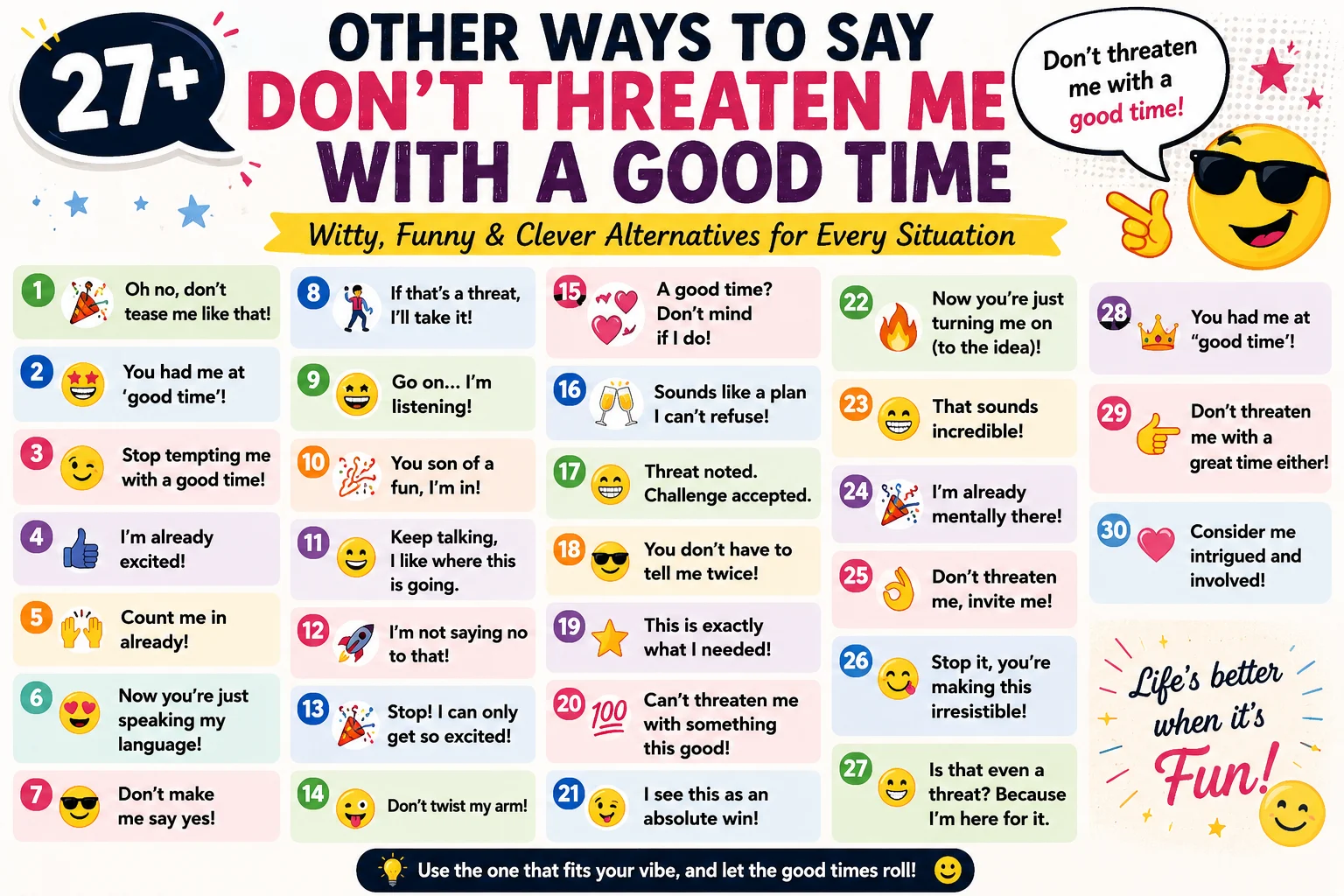
The phrase “don’t threaten me with a good time” is a witty, sarcastic response used when someone warns you about something but you actually find that thing exciting or appealing. It’s a playful way of saying, “Your warning sounds like an invitation to me, and I’m in!” .
Originally popularized by Panic! At The Disco’s 2015 song of the same name , this phrase has become a cultural staple for enthusiastic, ironic, and fearless comebacks. It perfectly captures the spirit of saying, “That sounds fun, not scary.”
However, repeating this exact phrase can lose its freshness. Whether you’re using it in social banter, a professional email, or a casual text, having a range of other ways to say “don’t threaten me with a good time” helps you sound more natural and engaging.
Top 5 alternatives: “I’m in!”, “That sounds like a challenge I’m ready for,” “Is that a promise?”, “Sounds good to me,” and “I wouldn’t miss it.”
Quick Categories
Sarcastic & Witty Alternatives
- Is that a promise?
- I’m shaking (in fear)
- That’s not a threat, that’s an invitation
- Sounds like my kind of problem
- That’s a risk I’m willing to take
Pro Tip: Use sarcastic alternatives when you want to emphasize the irony of the situation. They work best with friends or in laid-back settings.
Playful & Enthusiastic Alternatives
- I’m in!
- Sign me up
- I wouldn’t miss it
- What time and where?
- That sounds amazing
Pro Tip: Playful alternatives show genuine excitement. Use them when you really mean yes, and the tone is light and fun.
Confident & Bold Alternatives
- That sounds like a challenge I’m ready for
- Don’t tempt me
- You know I’m up for that
- That’s not a threat, it’s a selling point
- I’m always ready for a good time
Pro Tip: Bold alternatives work well when you want to show confidence and self-assurance. They’re great in both social and semi-professional settings.
Informal & Casual Alternatives
- Sounds good to me
- Works for me
- I’m game
- Can’t wait
- You bet
Pro Tip: Casual alternatives are perfect for texts, quick conversations, and relaxed social circles.
Professional & Polite Alternatives
- I’m looking forward to it
- That sounds like a great opportunity
- I’d be delighted to
- That’s an intriguing proposition
- I’m eager to participate
Pro Tip: Professional alternatives let you say yes enthusiastically while maintaining a polished tone. Use them in emails, meetings, and interviews.
What Does “Don’t Threaten Me With a Good Time” Mean?
Definition: A sarcastic expression used when someone warns you about something that you actually find appealing or exciting.
Grammar: It is an imperative sentence with a negative command (“don’t threaten”), followed by the phrase “me with a good time.” It functions as an ironic retort.
Simple Explanation: The speaker is telling the other person that their “threat” is not a threat at all it’s actually something they would enjoy. It’s a playful way to say, “That sounds fun, so I’m in! .
Example Sentence: “You’ll have to stay up past midnight at the party. Don’t threaten me with a good time!”
When to Use “Don’t Threaten Me With a Good Time”
This phrase is best used in casual, playful, or sarcastic contexts. It works well when:
- Someone presents a “warning” that sounds exciting
- You want to show you are not intimidated by a challenge
- You are teasing a friend
- You are accepting an invitation enthusiastically
- You want to make a lighthearted, confident remark
Example Scenario: A friend says, “This hike is going to be really tough.” You might reply, “Don’t threaten me with a good time!”
Is It Professional or Polite?
Polite? ✔ Yes, in casual contexts.
Professional? ❌ No, it is too informal and sarcastic for most professional settings.
Formal? ❌ No, it is very informal.
Natural? ✔ Yes, it sounds very natural among native speakers in casual conversations.
Business-style example: Instead of “Don’t threaten me with a good time,” use “I’m looking forward to the opportunity.”
Explanation: In professional settings, direct enthusiasm and appreciation are more appropriate than sarcasm. Save this phrase for friends and social settings.
Common Mistakes
Mistake 1: Using it in a serious conversation
Why it is incorrect: This phrase is sarcastic and playful. Using it when someone is genuinely concerned or warning you of a real danger can be insensitive.
Correct version: Acknowledge the seriousness and respond appropriately.
Example Sentence: Instead of “Don’t threaten me with a good time” to someone worried about a storm, say “Thank you for the warning. I’ll take precautions.”
Mistake 2: Misunderstanding the sarcasm
Why it is incorrect: If you or the listener does not understand the sarcasm, it can lead to confusion.
Correct version: Ensure the other person understands you are being ironic.
Example Sentence: “I’m being sarcastic, of course I actually think it sounds fun.”
Mistake 3: Overusing the phrase
Why it is incorrect: Like any phrase, overusing it can make it lose its charm and feel less fresh.
Correct version: Use a variety of alternatives to keep your language engaging.
Example Sentence: Instead of using the same phrase repeatedly, try “That sounds like an adventure” or “I’m in!”
Mistake 4: Using it in formal writing
Why it is incorrect: Formal writing (like business emails, academic papers, or official reports) requires a professional and straightforward tone.
Correct version: Use “I look forward to it” or “I’m eager to participate.”
Example Sentence: Instead of “Don’t threaten me with a good time” in an email, say “I’m excited about the upcoming project.
Mistake 5: Misreading the room
Why it is incorrect: Some people might not appreciate sarcasm or find it inappropriate in certain settings.
Correct version: Gauge the listener’s sense of humor and the context before using this phrase.
Example Sentence: If the person seems serious or stressed, choose a more straightforward alternative.
25+ Alternatives to Say “Don’t Threaten Me With a Good Time”
1. Phrase: Is That a Promise?
Meaning: A playful and flirty way to say “That sounds fun.
Explanation: This phrase turns a statement into an invitation. It’s a confident, sarcastic retort that often works well in a flirtatious or joking context.
Example Sentence: “You’ll have to stay up late to finish this? Is that a promise?”
Best Use: Friends, flirtatious moments, playful banter
Avoid Using In: Formal settings, professional emails
Tone: Playful, Confident
Formality Level: ⭐⭐ Casual
Usage Frequency: Common
CEFR Level: B1
Common Collocations:
- is that a promise
- is that a threat
- is that a joke
Context Variability:
- Spoken English: “Is that a promise?”
- Professional English: Avoid.
- Casual Conversation: Very common and playful.
2. Phrase: I’m In!
Meaning: A direct and enthusiastic way to say yes.
Explanation: This phrase is simple and effective. It shows immediate interest and willingness to participate.
Example Sentence: “There’s a karaoke night, and you’re singing? I’m in!”
Best Use: Friends, activities, social gatherings
Avoid Using In: Formal business proposals (unless you know the person well)
Tone: Enthusiastic, Direct
Formality Level: ⭐⭐⭐ Neutral
Usage Frequency: Very Common
CEFR Level: A2
Common Collocations:
- I’m in
- count me in
- I’m all in
Context Variability:
- Spoken English: “I’m in!”
- Professional English: Acceptable in casual work settings.
- Casual Conversation: Very common.
3. Phrase: That Sounds Like a Challenge I’m Ready For
Meaning: Expresses confidence and eagerness to tackle a difficult task.
Explanation: This phrase shows you are not intimidated but rather excited by the prospect of a challenge.
Example Sentence: “The project deadline is incredibly tight? That sounds like a challenge I’m ready for!”
Best Use: Professional settings, personal challenges
Avoid Using In: When the task is genuinely dangerous or unreasonable
Tone: Confident, Bold
Formality Level: ⭐⭐⭐⭐ Formal
Usage Frequency: Occasional
CEFR Level: B2
Common Collocations:
- ready for a challenge
- up for a challenge
- embrace a challenge
Context Variability:
- Spoken English: “That’s a challenge I’m ready for.”
- Professional English: Great for interviews and meetings.
- Casual Conversation: Shows a confident attitude.
4. Phrase: Is That a Threat or a Promise?
Meaning: A witty and sarcastic retort that questions the other person’s intentions.
Explanation: This is a classic sarcastic comeback. It asks if the statement is intended as a threat or an exciting proposition.
Example Sentence: “I’m going to make you work really hard on this project. Is that a threat or a promise?”
Best Use: Playful banter, close colleagues
Avoid Using In: Formal or sensitive contexts
Tone: Witty, Sarcastic
Formality Level: ⭐⭐ Casual
Usage Frequency: Common
CEFR Level: B1
Common Collocations:
- threat or a promise
- a threat or a challenge
Context Variability:
- Spoken English: “Is that a threat or a promise?”
- Professional English: Avoid in formal meetings.
- Casual Conversation: Very common.
5. Phrase: Sign Me Up
Meaning: An enthusiastic way to say you want to participate.
Explanation: This is a simple, excited way to commit to something. It shows you are fully onboard.
Example Sentence: “The team is going to the mountains for a weekend trip? Sign me up!”
Best Use: Friends, team activities, social events
Avoid Using In: Formal contracts or legal documents (use literally only)
Tone: Enthusiastic, Eager
Formality Level: ⭐⭐⭐ Neutral
Usage Frequency: Very Common
CEFR Level: B1
Common Collocations:
- sign me up
- count me in
- I’m on board
Context Variability:
- Spoken English: “Sign me up!”
- Professional English: “Count me in” is more common.
- Casual Conversation: Very common.
6. Phrase: That’s Not a Threat, That’s an Invitation
Meaning: Clarifies that you see the proposal as something positive.
Explanation: This phrase is a direct, witty way to flip a “threat” into a welcome suggestion.
Example Sentence: “You said you’d make me a great dinner. That’s not a threat, that’s an invitation.”
Best Use: Playful conversations, friends
Avoid Using In: Professional contexts
Tone: Witty, Playful
Formality Level: ⭐⭐ Casual
Usage Frequency: Occasional
CEFR Level: B2
Common Collocations:
- not a threat but an invitation
- sounds like an invitation
Context Variability:
- Spoken English: “That’s not a threat, it’s an invitation.”
- Professional English: Avoid.
- Casual Conversation: Very clever and natural.
7. Phrase: I Wouldn’t Miss It
Meaning: Shows high enthusiasm and commitment.
Explanation: This phrase indicates that the event or activity is important to you and you are excited to attend.
Example Sentence: “The team’s hosting a meeting? I wouldn’t miss it!”
Best Use: Friends, professional events, social gatherings
Avoid Using In: When you are not genuinely interested
Tone: Enthusiastic, Committed
Formality Level: ⭐⭐⭐ Neutral
Usage Frequency: Common
CEFR Level: B1
Common Collocations:
- wouldn’t miss it
- would not miss it for the world
Context Variability:
- Spoken English: “I wouldn’t miss it.”
- Professional English: Great for showing dedication.
- Casual Conversation: Very common.
8. Phrase: What Time and Where?
Meaning: A direct and eager way to accept an invitation.
Explanation: This phrase skips the pleasantries and gets straight to the logistics. It shows you are ready to go.
Example Sentence: “There’s a surprise party for John this Friday? What time and where?”
Best Use: Friends, social events, spontaneous plans
Avoid Using In: Formal settings
Tone: Eager, Direct
Formality Level: ⭐⭐ Casual
Usage Frequency: Common
CEFR Level: B1
Common Collocations:
- what time and where
- when and where
- where and when
Context Variability:
- Spoken English: “What time and where?”
- Professional English: Use when accepting a meeting invitation.
- Casual Conversation: Very common.
9. Phrase: Don’t Tempt Me
Meaning: A playful way to say you are very interested.
Explanation: This phrase suggests that the other person is testing your willpower. It’s a lighthearted retort.
Example Sentence: “I have extra tickets to a concert. Don’t tempt me to come!”
Best Use: Friends, playful interactions
Avoid Using In: Professional settings
Tone: Playful, Humorous
Formality Level: ⭐⭐ Casual
Usage Frequency: Common
CEFR Level: B1
Common Collocations:
- don’t tempt me
- don’t try me
- don’t make me
Context Variability:
- Spoken English: “Don’t tempt me!”
- Professional English: Avoid.
- Casual Conversation: Very common and playful.
10. Phrase: Sounds Like My Kind of Problem
Meaning: Expresses eagerness to take on a difficult task.
Explanation: This phrase turns a negative into a positive. It suggests that the challenge is something you actually welcome.
Example Sentence: “The project requires a lot of research? Sounds like my kind of problem.”
Best Use: Professional settings, problem-solving contexts
Avoid Using In: When the problem is actually serious
Tone: Confident, Bold
Formality Level: ⭐⭐⭐ Neutral
Usage Frequency: Occasional
CEFR Level: B2
Common Collocations:
- my kind of problem
- my kind of challenge
Context Variability:
- Spoken English: “Sounds like my kind of problem.”
- Professional English: Shows a proactive attitude.
- Casual Conversation: Very natural.
11. Phrase: I’m Game
Meaning: A casual way to say you are willing and ready.
Explanation: “I’m game” means you are up for the challenge. It’s a friendly and common informal response.
Example Sentence: “I’m going to try a new sport this weekend. I’m game if you are!”
Best Use: Friends, activities, casual settings
Avoid Using In: Formal emails, official requests
Tone: Casual, Friendly
Formality Level: ⭐⭐ Casual
Usage Frequency: Very Common
CEFR Level: B1
Common Collocations:
- I’m game
- game for anything
- game on
Context Variability:
- Spoken English: “I’m game!”
- Professional English: “I’m game” is acceptable but casual.
- Casual Conversation: Very common.
12. Phrase: You Know I’m Up for That
Meaning: Expresses enthusiastic agreement.
Explanation: This phrase is a friendly and direct way to say yes. It implies that the person knows you well.
Example Sentence: “There’s a late-night movie showing? You know I’m up for that!”
Best Use: Friends, familiar colleagues
Avoid Using In: Formal situations
Tone: Friendly, Enthusiastic
Formality Level: ⭐⭐ Casual
Usage Frequency: Common
CEFR Level: B1
Common Collocations:
- up for that
- down for that
- up for anything
Context Variability:
- Spoken English: “I’m up for that.”
- Professional English: “I’m up for the challenge” is acceptable.
- Casual Conversation: Very common.
13. Phrase: That’s a Risk I’m Willing to Take
Meaning: A bold way to accept a challenge.
Explanation: This phrase shows you have weighed the options and are intentionally making the choice. It sounds thoughtful and decisive.
Example Sentence: “The project has a high chance of failure? That’s a risk I’m willing to take.”
Best Use: Professional contexts, decision-making
Avoid Using In: Casually with friends
Tone: Bold, Decisive
Formality Level: ⭐⭐⭐⭐ Formal
Usage Frequency: Occasional
CEFR Level: B2
Common Collocations:
- willing to take
- ready to risk
- take a chance
Context Variability:
- Spoken English: “That’s a risk I’ll take.”
- Professional English: Great for interviews.
- Casual Conversation: Sounds serious.
14. Phrase: That’s Not a Threat, It’s a Selling Point
Meaning: A humorous way to say you are drawn to something.
Explanation: This is a playful and sarcastic way to say that the feature is a positive for you.
Example Sentence: “The hotel’s pool is freezing? That’s not a threat, it’s a selling point for me!”
Best Use: Friends, humorous interactions
Avoid Using In: Professional contexts
Tone: Humorous, Playful
Formality Level: ⭐⭐ Casual
Usage Frequency: Occasional
CEFR Level: B2
Common Collocations:
- selling point
- a feature, not a bug
- a positive, not a negative
Context Variability:
- Spoken English: “That’s a selling point!”
- Professional English: Use with caution.
- Casual Conversation: Very natural.
15. Phrase: I Can’t Wait
Meaning: A simple and effective way to express excitement.
Explanation: This phrase is direct and enthusiastic. It’s widely used in many contexts.
Example Sentence: “I just bought the tickets for the trip. I can’t wait!”
Best Use: Friends, family, professional events
Avoid Using In: When you are not genuinely excited
Tone: Enthusiastic, Eager
Formality Level: ⭐⭐⭐ Neutral
Usage Frequency: Very Common
CEFR Level: A2
Common Collocations:
- can’t wait
- can’t wait to
- can’t wait for
Context Variability:
- Spoken English: “I can’t wait!”
- Professional English: “I look forward to it” is more formal.
- Casual Conversation: Very common.
16. Phrase: Sounds Good to Me
Meaning: A quick and friendly way to agree.
Explanation: This is a common, relaxed phrase used to accept an offer or idea.
Example Sentence: “Let’s have a picnic on Saturday. Sounds good to me!”
Best Use: Friends, casual settings, family
Avoid Using In: Formal professional emails
Tone: Friendly, Relaxed
Formality Level: ⭐⭐⭐ Neutral
Usage Frequency: Very Common
CEFR Level: A2
Common Collocations:
- sounds good to me
- sounds good
- that works for me
Context Variability:
- Spoken English: “Sounds good!”
- Professional English: “That sounds good to me” is acceptable.
- Casual Conversation: Very common.
17. Phrase: I’m Looking Forward to It
Meaning: A polite and professional way to express anticipation.
Explanation: This phrase is a staple of professional and polite communication. It shows you are eager and respectful.
Example Sentence: “I’ve reviewed the conference schedule, and I’m looking forward to it.”
Best Use: Professional emails, interviews, meetings
Avoid Using In: Very casual texting (use “Can’t wait!” instead)
Tone: Professional, Polite
Formality Level: ⭐⭐⭐⭐ Formal
Usage Frequency: Very Common
CEFR Level: B1
Common Collocations:
- look forward to it
- looking forward to
- looking forward to it
Context Variability:
- Spoken English: “Looking forward to it!”
- Professional English: Standard and polite.
- Casual Conversation: Sounds slightly formal.
18. Phrase: You Bet
Meaning: A confident and informal way to say yes.
Explanation: “You bet” is a casual and emphatic affirmative. It’s common in American English.
Example Sentence: “Will you be at the game tonight? You bet!”
Best Use: Friends, casual conversations, family
Avoid Using In: Formal correspondence
Tone: Confident, Casual
Formality Level: ⭐⭐ Casual
Usage Frequency: Very Common
CEFR Level: B1
Common Collocations:
- you bet
- you betcha
- bet
Context Variability:
- Spoken English: “You bet!”
- Professional English: “You bet” is casual but acceptable.
- Casual Conversation: Very common.
19. Phrase: That Sounds Like a Great Opportunity
Meaning: A professional and positive way to accept.
Explanation: This is an excellent phrase for professional settings. It expresses enthusiasm while maintaining a polished tone.
Example Sentence: “The team is offering to mentor you. That sounds like a great opportunity.”
Best Use: Professional emails, career contexts, meetings
Avoid Using In: Casual personal chats
Tone: Professional, Positive
Formality Level: ⭐⭐⭐⭐ Formal
Usage Frequency: Very Common
CEFR Level: B2
Common Collocations:
- great opportunity
- fantastic opportunity
- wonderful opportunity
Context Variability:
- Spoken English: “That sounds great.”
- Professional English: Standard and respectful.
- Casual Conversation: Sounds formal.
20. Phrase: I’d Be Delighted To
Meaning: A very polite and formal expression of eagerness.
Explanation: “Delighted” is a stronger word than “happy.” It shows deep interest and willingness.
Example Sentence: “The board has invited you to speak. I’d be delighted to.”
Best Use: Formal invitations, professional events, official letters
Avoid Using In: Casual texts
Tone: Very Polite, Formal
Formality Level: ⭐⭐⭐⭐⭐ Very Formal
Usage Frequency: Occasional
CEFR Level: B2
Common Collocations:
- would be delighted
- delighted to
- would be honored to
Context Variability:
- Spoken English: “I’d be delighted to.”
- Professional English: Very polite and formal.
- Casual Conversation: Sounds overly formal.
21. Phrase: That’s an Intriguing Proposition
Meaning: A formal and thoughtful way to show interest.
Explanation: This phrase is used when someone makes an interesting offer or suggests an idea. It sounds analytical and engaged.
Example Sentence: “What if we tackled the project differently? That’s an intriguing proposition.”
Best Use: Business meetings, strategic discussions, formal contexts
Avoid Using In: Casual conversation
Tone: Analytical, Formal
Formality Level: ⭐⭐⭐⭐⭐ Very Formal
Usage Frequency: Rare
CEFR Level: C1
Common Collocations:
- intriguing proposition
- interesting proposal
- compelling proposition
Context Variability:
- Spoken English: Very rare.
- Professional English: Shows interest and analytical thinking.
- Casual Conversation: Sounds too formal.
22. Phrase: I’m Always Ready for a Good Time
Meaning: A bold statement showing consistent enthusiasm.
Explanation: This is a confident and playful phrase. It’s a versatile alternative to “Don’t threaten me with a good time.”
Example Sentence: “The party’s going to go on all night? I’m always ready for a good time.”
Best Use: Friends, playful conversations
Avoid Using In: Professional contexts
Tone: Bold, Playful
Formality Level: ⭐⭐ Casual
Usage Frequency: Common
CEFR Level: B1
Common Collocations:
- ready for a good time
- always ready
- ready for anything
Context Variability:
- Spoken English: “I’m always ready.”
- Professional English: Avoid.
- Casual Conversation: Very natural.
23. Phrase: Works for Me
Meaning: A casual way to say “I agree” or “I’m okay with that.
Explanation: “Works for me” is a relaxed and common phrase. It’s useful when you want to sound open and agreeable.
Example Sentence: “I suggest we meet at 5 pm. Works for me.”
Best Use: Friends, colleagues, casual interactions
Avoid Using In: Formal business proposals
Tone: Casual, Agreeable
Formality Level: ⭐⭐⭐ Neutral
Usage Frequency: Very Common
CEFR Level: B1
Common Collocations:
- works for me
- that works
- sounds good
Context Variability:
- Spoken English: “Works for me.”
- Professional English: “That works for me” is acceptable.
- Casual Conversation: Very common.
24. Phrase: I Wouldn’t Have It Any Other Way
Meaning: Expresses strong preference and agreement.
Explanation: This phrase shows that you are completely on board and wouldn’t want a different outcome.
Example Sentence: “We’re going camping in the rain? I wouldn’t have it any other way!”
Best Use: Friends, enthusiastic agreement
Avoid Using In: When you are unsure or neutral
Tone: Enthusiastic, Committed
Formality Level: ⭐⭐⭐ Neutral
Usage Frequency: Occasional
CEFR Level: B2
Common Collocations:
- wouldn’t have it any other way
- wouldn’t want it any other way
- no other way
Context Variability:
- Spoken English: “I wouldn’t have it any other way.”
- Professional English: Shows a strong opinion.
- Casual Conversation: Very expressive.
25. Phrase: That’s a Chance I’m Ready to Take
Meaning: A confident, professional way to accept a challenge.
Explanation: This is a more formal alternative to “That’s a risk I’m willing to take.” It shows you are proactive and prepared.
Example Sentence: “There might be some delays. That’s a chance I’m ready to take.”
Best Use: Professional contexts, decision-making
Avoid Using In: Very casual chats
Tone: Professional, Confident
Formality Level: ⭐⭐⭐⭐ Formal
Usage Frequency: Occasional
CEFR Level: B2
Common Collocations:
- ready to take a chance
- take a chance
- willing to risk
Context Variability:
- Spoken English: “I’m ready to take that chance.”
- Professional English: Great for interviews.
- Casual Conversation: Sounds serious.
Top 10 Alternatives Compared
| Phrase | Tone | Formality | Best Use | Frequency |
| I’m in! | Enthusiastic | Neutral | Friends, social | Very Common |
| Is that a promise? | Playful | Casual | Friends, flirting | Common |
| That sounds like a challenge I’m ready for | Confident | Formal | Professional | Occasional |
| Sign me up | Eager | Neutral | Activities, groups | Very Common |
| I wouldn’t miss it | Enthusiastic | Neutral | Events, gatherings | Common |
| That’s a risk I’m willing to take | Bold | Formal | Professional | Occasional |
| Sounds good to me | Friendly | Neutral | All contexts | Very Common |
| I’m looking forward to it | Polite | Formal | Professional | Very Common |
| That sounds like a great opportunity | Positive | Formal | Professional | Very Common |
| You bet | Casual | Casual | Friends, family | Very Common |
Which One Should You Use?
Best Overall
“Sounds good to me” This is a friendly, neutral, and versatile phrase that works in almost any setting. It is clear and effective.
Best Professional
“I’m looking forward to it” This is a respectful and professional way to show enthusiasm. Use it in emails, interviews, and meetings.
Best Casual
“I’m in!” This is direct, enthusiastic, and instantly understood. It is perfect for friends and social activities.
Best Bold
“That sounds like a challenge I’m ready for” This shows confidence and a proactive attitude. Great for professional situations.
Best Playful
“Is that a promise?” This is witty and flirty. It works well in playful banter.
Most Natural
“I’m game” This is a natural, relaxed response that sounds very authentic in informal conversations.
Avoid These in Formal Situations
“Is that a threat or a promise?” This is too sarcastic and confrontational for professional settings. Use “I’m looking forward to it” instead.
“Don’t tempt me” This sounds playful and even flirtatious. It is not suitable for formal contexts.
“That’s a risk I’m willing to take” While this is technically professional, it can sound dramatic. In many cases, “I’m ready for the challenge” is a better choice.
“I can’t wait” While acceptable in informal settings, “I look forward to it” is more polished in a professional context.
“You bet” This is too casual for formal business emails. Use “Certainly” or “Absolutely” instead.
Scenario Practice
Scenario 1: A friend invites you to a spontaneous road trip
You say: “A weekend road trip? I’m in! When do we leave?”
Explanation: “I’m in” shows instant enthusiasm and willingness to participate.
Scenario 2: A colleague suggests a challenging project
You say: “That sounds like a challenge I’m ready for. I’m excited to see what we can achieve.”
Explanation: This phrase is professional, confident, and shows readiness.
Scenario 3: Your boss says a meeting might run late
You say: “I’m looking forward to it. It’s an important discussion.”
Explanation: “Looking forward to it” is professional and polite, showing you value the meeting.
Scenario 4: A friend says they plan to pull an all-nighter
You say: “That’s not a threat, that’s an invitation! I’ll bring coffee.”
Explanation: This is a witty, playful way to say you want to join in.
Scenario 5: A partner suggests a very active vacation
You say: “An adventure trip? You know I’m up for that. I can’t wait!”
Explanation: “Up for that” and “can’t wait” are enthusiastic and friendly.
Mini Quiz
Question 1: Which phrase is most professional?
a) I’m in!
b) I’m looking forward to it
c) That sounds like a risk I’m willing to take
Question 2: Which phrase is best for a playful, flirty response?
a) Is that a promise?
b) You bet
c) Works for me
Question 3: Which phrase is a very natural, casual way to say yes?
a) I’m game
b) That’s a great opportunity
c) I’d be delighted to
Question 4: Which phrase is too sarcastic for a professional email?
a) Sign me up
b) That sounds like a challenge I’m ready for
c) Is that a threat or a promise?
Question 5: Which phrase shows confident decision-making?
a) Sounds good to me
b) That’s a risk I’m willing to take
c) Works for me
Answer Key
1. b) I’m looking forward to it This is polite, professional, and shows eagerness.
2. a) Is that a promise? This is playful, flirty, and sarcastic.
3. a) I’m game This is a natural, relaxed, and common way to say yes.
4. c) Is that a threat or a promise? This is too sarcastic and confrontational for formal writing.
5. b) That’s a risk I’m willing to take This shows you have thought carefully and are making a confident choice.
FAQs
What is the most professional way to say “don’t threaten me with a good time”?
The most professional way is to say “I’m looking forward to it” or “That sounds like a great opportunity.” These phrases express enthusiasm and willingness without the sarcasm. They are ideal for emails, meetings, and interviews.
Which alternative is best for casual conversations with friends?
“I’m in!” or “I’m game” are excellent choices for casual conversations. They are simple, enthusiastic, and sound very natural. You can also use “Works for me” or “Sounds good to me” in these settings.
What is the difference between “I’m in” and “Sign me up”?
“I’m in” is a simple statement of agreement, while “Sign me up” expresses stronger enthusiasm and a desire to participate. Both are common and effective.
Which alternative sounds most sarcastic?
“Is that a threat or a promise?” and “That’s not a threat, it’s an invitation” are very sarcastic and witty. They are best used when you want to emphasize the irony of the situation.
Can I use “don’t threaten me with a good time” in a business email?
No, you should avoid this phrase in business emails. It is too informal and sarcastic for professional communication. Use “I’m looking forward to the opportunity” or “That sounds like a great project” instead.
Conclusion
Finding the right other ways to say “Don’t threaten me with a good time” can make your conversations more playful, witty, and expressive. Whether you want to sound funny, sarcastic, enthusiastic, or clever, there are plenty of alternatives that capture the same lighthearted meaning. From casual replies like “Count me in” to playful expressions like “You had me at fun,” choose a phrase that matches your personality and the situation. The best alternative is one that keeps the humor while showing that you’re genuinely excited about what’s being offered.

8 thoughts on “Other Ways to Say “Don’t Threaten Me With a Good Time” |27+ Examples for 2026”