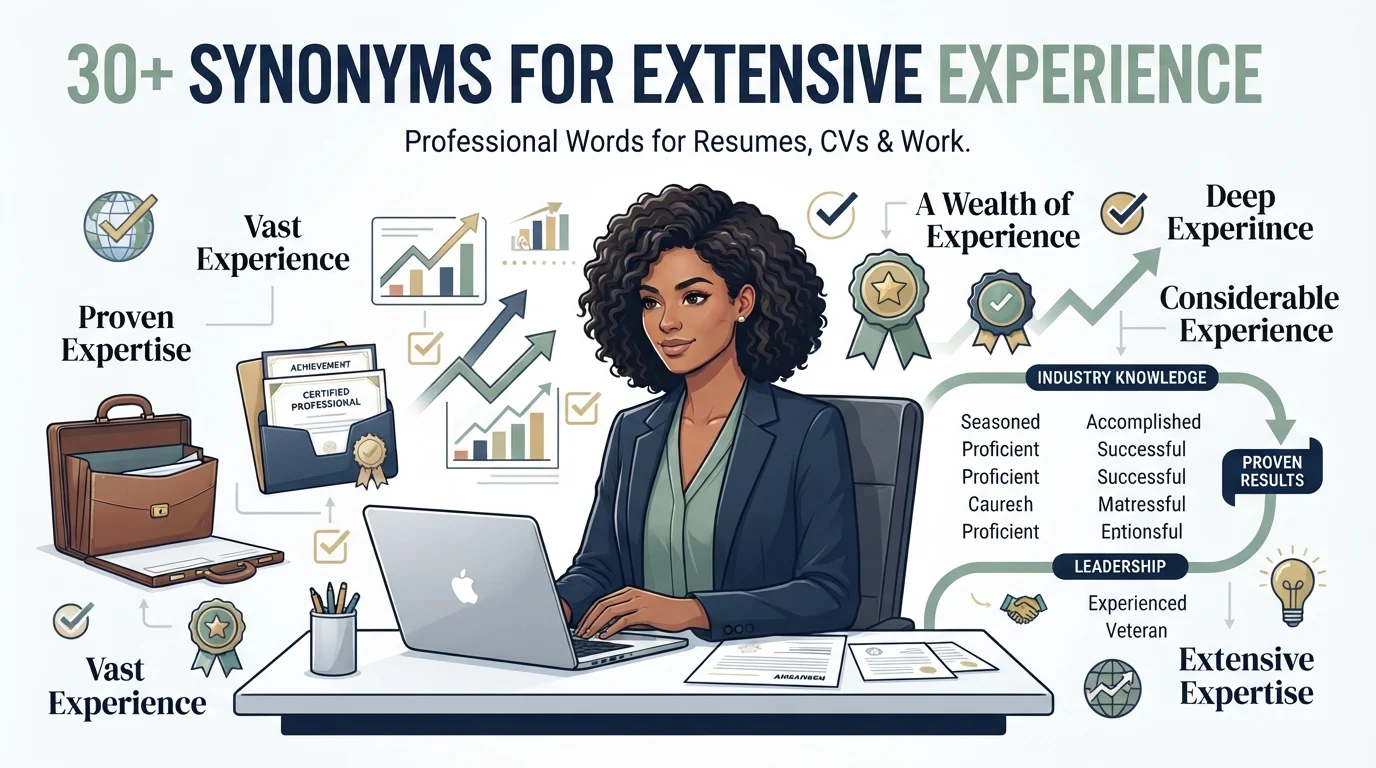
Extensive experience is one of the most overused phrases on resumes and professional profiles . When everyone claims to have it, the phrase loses its power to impress. Learning other ways to say extensive experience will make your professional communication more compelling and credible.
The key is choosing the right alternative for the right situation. Whether you are writing a resume, preparing for an interview, or networking with clients, the right phrase can significantly enhance your professional image. This guide offers 25+ practical alternatives to help you sound more credible and specific in your professional communication.
Top 5 alternatives: Proven track record, Considerable expertise, Seasoned professional, In-depth knowledge, Comprehensive background.
Quick Categories
Strong Resume Alternatives
- Proven track record
- Seasoned professional
- Accomplished expert
- Substantial background
- Well-versed professional
Pro Tip: Use these on resumes and LinkedIn profiles. Recruiters scan for specific, action-oriented language that demonstrates real-world impact.
Skill-Focused Alternatives
- In-depth knowledge
- Considerable expertise
- Specialized proficiency
- Advanced competency
- Mastery of
Pro Tip: These alternatives work best when you want to emphasize the depth of your knowledge in a particular area. They show you’re not just experienced but deeply skilled.
Academic & Formal Alternatives
- Comprehensive background
- Broad academic grounding
- Extensive scholarly engagement
- Deep theoretical understanding
- Rigorous practical training
Pro Tip: These are ideal for academic CVs, research proposals, or formal reports where precision and gravitas are valued.
Professional Email Alternatives
- I bring over [number] years of experience
- My background in [field] includes
- I have worked extensively in
- I have a strong foundation in
- I have developed expertise in
Pro Tip: Professional email alternatives help you sound confident and specific without being boastful. Use them when introducing yourself or pitching your services.
Neutral Alternatives
- A wealth of experience
- Broad range of experience
- Solid experience in
- Significant experience
- Vast experience
Pro Tip: Neutral alternatives are versatile and can be adapted to various professional contexts. However, be careful with “vast”it is often used in informal contexts.
Common Mistakes
Mistake 1: Using “extensive experience” repeatedly
Why it is incorrect: Repetition makes your writing sound dull and generic. It is the most overused buzzword on LinkedIn .
Correct version: Use a variety of alternatives to keep your writing engaging.
Example Sentence: Instead of “I have extensive experience in marketing and extensive experience in sales,” say “I have a proven track record in marketing and considerable expertise in sales.”
Mistake 2: Using “vast experience” when you mean “extensive experience”
Why it is incorrect: These two phrases are not fully interchangeable. “Extensive” emphasizes variety and breadth, whereas “vast” emphasizes sheer amount or scale .
Correct version: Use “extensive” when highlighting a wide range of skills across different areas. Use “vast” when pointing to a large amount of time in one area.
Example Sentence: “She has extensive experience managing diverse teams” (correct) vs. “She has vast experience managing diverse teams” (less precise) .
Mistake 3: Claiming “extensive experience” with only a few years in the field
Why it is incorrect: It is often better to be specific than to make a broad claim that could be challenged. “Extensive” implies years of work .
Correct version: Use “solid experience” or “considerable experience” for less time.
Example Sentence: Instead of “extensive experience” for a 3-year stint, say “I have considerable experience.”
Mistake 4: Using “extensive” without evidence
Why it is incorrect: In a resume, vague claims of experience are less persuasive than specific achievements .
Correct version: Back up your claim with quantifiable results.
Example Sentence: Instead of “extensive experience,” say “I have a proven track record of increasing sales by 300% over five years.
Mistake 5: Using “extensive experience” for a single specialized skill
Why it is incorrect: When discussing a specific skill without variation, “extensive” might not be the best fit .
Correct version: Use “in-depth knowledge” or “specialized proficiency.”
Example Sentence: Instead of “extensive experience in Python,” say “I have in-depth knowledge of Python.”
What Does “Extensive Experience” Mean?
Definition: A noun phrase describing wide-ranging, practical involvement across tasks, roles, or situations .
Simple Explanation: It means you have done a lot of different things in a particular field, over a significant period. It emphasizes range and breadth more than just duration.
Example Sentence: “She has extensive experience managing diverse teams, budgeting, and risk assessment.”
When to Use Alternatives to “Extensive Experience”
Using alternatives is often a better choice than the original phrase. Use alternatives when you are:
- Writing a resume or CV
- Updating a LinkedIn profile
- Drafting a cover letter
- Preparing for a job interview
- Writing a professional bio
- Composing a business proposal
- Networking with potential clients
“Clarity and specificity build more trust than generic claims of experience.”
Is It Professional?
Polite? ✔ Yes, it is polite.
Professional? ✔ Yes, but it is overused .
Formal? ✔ Yes, it is formal.
Natural? ⚠ Sometimes, but it has become a buzzword.
Business-style example: “I bring extensive experience in project management.”
Explanation: “Extensive experience” is a professional phrase, but it has been so overused that it can sound generic. To stand out, you need to be more specific.
Pros and Cons
Pros
- Widely understood
- Formal and professional
- Emphasizes breadth of knowledge
- Straightforward to use
Cons
- Overused and generic
- Lacks specific detail
- Can sound like a cliché
- May not be credible without supporting evidence
“The most effective way to demonstrate experience is through specific achievements, not just adjectives.”
25+ Alternatives to Say “Extensive Experience”
1. Phrase: Proven Track Record
Meaning: A history of demonstrated success.
Explanation: This is one of the most powerful alternatives. It shows you have tangible results, not just time spent. It emphasizes past achievements and reliability .
Example Sentence: “I have a proven track record of increasing revenue in competitive markets.”
Best Use: Resumes, cover letters, interviews
Avoid Using In: Casual conversations
Tone: Confident, Results-Oriented
Formality Level: ⭐⭐⭐⭐ Formal
Usage Frequency: Very Common
CEFR Level: B2
Common Collocations:
- proven track record of
- track record in
- track record of success
Context Variability:
- Spoken English: “I have a proven track record.”
- Professional English: Standard.
- Casual Conversation: Sounds formal.
2. Phrase: Considerable Expertise
Meaning: A substantial amount of skill and knowledge.
Explanation: This phrase emphasizes the depth of your skill rather than the time you have spent. It is a refined alternative for formal contexts .
Example Sentence: “She brings considerable expertise in financial modeling.”
Best Use: Formal settings, professional profiles
Avoid Using In: Casual conversations
Tone: Professional, Refined
Formality Level: ⭐⭐⭐⭐ Formal
Usage Frequency: Common
CEFR Level: B2
Common Collocations:
- considerable expertise in
- considerable experience
- considerable knowledge
Context Variability:
- Spoken English: “She has considerable expertise.”
- Professional English: Standard.
- Casual Conversation: Sounds formal.
3. Phrase: Seasoned Professional
Meaning: An experienced and skilled worker.
Explanation: This term implies you have not just experience but have been seasoned by it. It suggests maturity and wisdom gained over time .
Example Sentence: “As a seasoned professional, she knows how to handle difficult clients.”
Best Use: Resumes, professional bios
Avoid Using In: Entry-level contexts
Tone: Mature, Authoritative
Formality Level: ⭐⭐⭐⭐ Formal
Usage Frequency: Common
CEFR Level: B2
Common Collocations:
- seasoned professional
- seasoned expert
- seasoned veteran
Context Variability:
- Spoken English: “He is a seasoned professional.”
- Professional English: Standard.
- Casual Conversation: “She’s a seasoned pro.”
4. Phrase: In-Depth Knowledge
Meaning: Deep, comprehensive understanding.
Explanation: This is a solid alternative when you want to highlight the depth of your understanding, especially of specialized topics.
Example Sentence: “He has in-depth knowledge of international trade law.”
Best Use: Academic writing, specialized roles
Avoid Using In: When breadth is more important
Tone: Academic, Professional
Formality Level: ⭐⭐⭐⭐ Formal
Usage Frequency: Common
CEFR Level: B2
Common Collocations:
- in-depth knowledge
- in-depth understanding
- in-depth expertise
Context Variability:
- Spoken English: “He has in-depth knowledge.”
- Professional English: Standard.
- Casual Conversation: Sounds formal.
5. Phrase: Comprehensive Background
Meaning: A wide-ranging and thorough history.
Explanation: This phrase emphasizes the breadth and completeness of your professional history. It covers not just jobs but education and training.
Example Sentence: “She has a comprehensive background in healthcare management.”
Best Use: Professional bios, academic settings
Avoid Using In: Short, casual introductions
Tone: Formal, Thorough
Formality Level: ⭐⭐⭐⭐ Formal
Usage Frequency: Common
CEFR Level: B2
Common Collocations:
- comprehensive background
- comprehensive experience
- comprehensive knowledge
Context Variability:
- Spoken English: “She has a comprehensive background.”
- Professional English: Standard.
- Casual Conversation: Sounds formal.
6. Phrase: A Wealth of Experience
Meaning: A large, valuable amount of experience.
Explanation: This phrase is common and expressive. It indicates abundance and value .
Example Sentence: “He brings a wealth of experience in sales leadership.”
Best Use: Resumes, professional bios
Avoid Using In: Formal academic writing
Tone: Warm, Professional
Formality Level: ⭐⭐⭐ Neutral
Usage Frequency: Very Common
CEFR Level: B1
Common Collocations:
- wealth of experience
- wealth of knowledge
- wealth of information
Context Variability:
- Spoken English: “She brings a wealth of experience.”
- Professional English: Standard.
- Casual Conversation: Common.
7. Phrase: Accomplished Expert
Meaning: A highly skilled and successful professional.
Explanation: This term is powerful and confident. It suggests you have not only experience but a history of significant achievements .
Example Sentence: “She is an accomplished expert in the field of renewable energy.”
Best Use: Resumes, conference bios
Avoid Using In: Self-introductions in a new job
Tone: Confident, Authoritative
Formality Level: ⭐⭐⭐⭐ Formal
Usage Frequency: Common
CEFR Level: B2
Common Collocations:
- accomplished expert
- accomplished professional
- accomplished author
Context Variability:
- Spoken English: “She is an accomplished expert.”
- Professional English: Standard.
- Casual Conversation: “She is an accomplished expert.”
8. Phrase: I Bring Over [Number] Years of Experience
Meaning: A specific and quantifiable statement of experience.
Explanation: This is often more persuasive than a generic adjective because it provides a measurable fact . It gives the reader a clear sense of your experience level.
Example Sentence: “I bring over 15 years of experience in software development.”
Best Use: Resumes, interviews, LinkedIn summaries
Avoid Using In: When you have less than 3 years
Tone: Professional, Direct
Formality Level: ⭐⭐⭐ Neutral
Usage Frequency: Very Common
CEFR Level: B1
Common Collocations:
- over [number] years of experience
- more than [number] years
- X years of experience
Context Variability:
- Spoken English: “I have over 10 years of experience.”
- Professional English: Standard.
- Casual Conversation: Common.
9. Phrase: Substantial Background
Meaning: A significant and weighty history.
Explanation: This phrase conveys depth and substance. It is stronger than “solid” but not as assertive as “extensive.”
Example Sentence: “He has a substantial background in public policy.”
Best Use: Formal writing, academic contexts
Avoid Using In: Quick introductions
Tone: Formal, Weighty
Formality Level: ⭐⭐⭐⭐ Formal
Usage Frequency: Common
CEFR Level: B2
Common Collocations:
- substantial background
- substantial experience
- substantial knowledge
Context Variability:
- Spoken English: “She has a substantial background.”
- Professional English: Standard.
- Casual Conversation: Formal.
10. Phrase: Broad Range of Experience
Meaning: Experience across a wide variety of areas.
Explanation: This phrase emphasizes the diversity of your skills. It is perfect when you have worked in different sectors or roles .
Example Sentence: “She has a broad range of experience in both the public and private sectors.”
Best Use: Resumes, networking
Avoid Using In: When your experience is narrow
Tone: Professional, Versatile
Formality Level: ⭐⭐⭐ Neutral
Usage Frequency: Common
CEFR Level: B1
Common Collocations:
- broad range of experience
- wide range of experience
- diverse experience
Context Variability:
- Spoken English: “She has a broad range of experience.”
- Professional English: Standard.
- Casual Conversation: Common.
11. Phrase: Well-Versed Professional
Meaning: A professional with deep knowledge and familiarity.
Explanation: This term suggests you are not just experienced but fluent in the practices and language of your field .
Example Sentence: “She is a well-versed professional in the healthcare industry.”
Best Use: Resumes, professional bios
Avoid Using In: When you have minimal experience
Tone: Professional, Competent
Formality Level: ⭐⭐⭐⭐ Formal
Usage Frequency: Common
CEFR Level: B2
Common Collocations:
- well-versed in
- well-versed professional
- well-versed expert
Context Variability:
- Spoken English: “She is well-versed.”
- Professional English: Standard.
- Casual Conversation: “She’s really well-versed.”
12. Phrase: Advanced Competency
Meaning: A high level of skill.
Explanation: This is a strong, formal alternative. It emphasizes a high level of ability and is often used in HR contexts.
Example Sentence: “She has demonstrated advanced competency in data analysis.”
Best Use: Formal assessments, HR documents
Avoid Using In: Casual conversations
Tone: Formal, Analytical
Formality Level: ⭐⭐⭐⭐⭐ Very Formal
Usage Frequency: Occasional
CEFR Level: C1
Common Collocations:
- advanced competency in
- advanced skills
- advanced proficiency
Context Variability:
- Spoken English: Rare.
- Professional English: Used in formal documents.
- Casual Conversation: Not used.
13. Phrase: Mastery of
Meaning: Complete control and deep understanding.
Explanation: “Mastery” is the highest level of skill. Use it only when you have a true command of the subject .
Example Sentence: “He has mastery of six programming languages.”
Best Use: Highly specialized roles
Avoid Using In: When you have just basic knowledge
Tone: Authoritative, Expert
Formality Level: ⭐⭐⭐⭐ Formal
Usage Frequency: Occasional
CEFR Level: C1
Common Collocations:
- mastery of
- master of
- mastered
Context Variability:
- Spoken English: “She has mastery of the subject.”
- Professional English: Standard.
- Casual Conversation: “She’s a master at it.”
14. Phrase: Solid Experience
Meaning: Good, reliable experience.
Explanation: This is a safer alternative than “extensive” or “vast.” It is professional but doesn’t overstate your experience.
Example Sentence: “I have solid experience in customer service.”
Best Use: Resumes, interviews
Avoid Using In: Very senior roles
Tone: Professional, Reliable
Formality Level: ⭐⭐⭐ Neutral
Usage Frequency: Very Common
CEFR Level: B1
Common Collocations:
- solid experience in
- solid background
- solid knowledge
Context Variability:
- Spoken English: “She has solid experience.”
- Professional English: Standard.
- Casual Conversation: Common.
15. Phrase: Significant Experience
Meaning: A noteworthy amount of experience.
Explanation: “Significant” is a professional and balanced alternative. It indicates you have enough experience to be taken seriously.
Example Sentence: “He has significant experience in project management.”
Best Use: Resumes, professional bios
Avoid Using In: When you have minimal experience
Tone: Professional, Balanced
Formality Level: ⭐⭐⭐ Neutral
Usage Frequency: Very Common
CEFR Level: B1
Common Collocations:
- significant experience
- significant expertise
- significant background
Context Variability:
- Spoken English: “She has significant experience.”
- Professional English: Standard.
- Casual Conversation: Common.
16. Phrase: Vast Experience
Meaning: Experience on a large scale.
Explanation: This emphasizes sheer amount or scale. It is best used when pointing to a large amount of time in one area .
Example Sentence: “He brings vast experience from thirty years in aviation.”
Best Use: Speeches, executive summaries
Avoid Using In: When emphasizing diversity of tasks
Tone: Expressive, Large-Scale
Formality Level: ⭐⭐⭐ Neutral
Usage Frequency: Common
CEFR Level: B2
Common Collocations:
- vast experience
- vast knowledge
- vast network
Context Variability:
- Spoken English: “She has vast experience.”
- Professional English: Acceptable.
- Casual Conversation: Common.
17. Phrase: Broad Professional Background
Meaning: A wide and varied history.
Explanation: This is a comprehensive and formal alternative. It suggests you have experience across multiple disciplines.
Example Sentence: “He has a broad professional background in both engineering and finance.”
Best Use: Executive summaries, networking
Avoid Using In: Casual contexts
Tone: Formal, Comprehensive
Formality Level: ⭐⭐⭐⭐ Formal
Usage Frequency: Common
CEFR Level: B2
Common Collocations:
- broad professional background
- broad background
- diverse background
Context Variability:
- Spoken English: “She has a broad professional background.”
- Professional English: Standard.
- Casual Conversation: Formal.
18. Phrase: Deep Practical Knowledge
Meaning: Knowledge gained from doing, not just reading.
Explanation: This phrase emphasizes the practical, hands-on nature of your experience .
Example Sentence: “She brings deep practical knowledge of manufacturing processes.”
Best Use: Technical roles, hands-on professions
Avoid Using In: Theoretical roles
Tone: Professional, Hands-On
Formality Level: ⭐⭐⭐ Neutral
Usage Frequency: Common
CEFR Level: B2
Common Collocations:
- deep practical knowledge
- practical knowledge
- hands-on experience
Context Variability:
- Spoken English: “She has deep practical knowledge.”
- Professional English: Standard.
- Casual Conversation: Common.
19. Phrase: Seasoned Expertise
Meaning: Skill that has been refined over time.
Explanation: This is a combination of “seasoned” and “expertise.” It conveys maturity and skill refinement.
Example Sentence: “He has seasoned expertise in crisis management.”
Best Use: Resumes, professional bios
Avoid Using In: Casual conversation
Tone: Mature, Authoritative
Formality Level: ⭐⭐⭐⭐ Formal
Usage Frequency: Common
CEFR Level: B2
Common Collocations:
- seasoned expertise
- seasoned professional
- seasoned experience
Context Variability:
- Spoken English: “She has seasoned expertise.”
- Professional English: Standard.
- Casual Conversation: Formal.
20. Phrase: My Background Includes
Meaning: A versatile introduction to your experience.
Explanation: This is a practical and professional way to list your experience without using the word “experience” repeatedly.
Example Sentence: “My background includes sales, marketing, and business development.”
Best Use: Resumes, interviews, networking
Avoid Using In: Formal academic writing
Tone: Professional, Versatile
Formality Level: ⭐⭐⭐ Neutral
Usage Frequency: Very Common
CEFR Level: B1
Common Collocations:
- background includes
- experience includes
- skills include
Context Variability:
- Spoken English: “My background includes…”
- Professional English: Standard.
- Casual Conversation: Common.
21. Phrase: Extensive Work History
Meaning: A long and detailed employment record.
Explanation: This is a formal way to describe a long history of employment. It implies stability and experience.
Example Sentence: “She brings an extensive work history in the financial sector.”
Best Use: Resumes, formal profiles
Avoid Using In: Interviews
Tone: Formal, Professional
Formality Level: ⭐⭐⭐⭐ Formal
Usage Frequency: Occasional
CEFR Level: B2
Common Collocations:
- extensive work history
- work history
- employment history
Context Variability:
- Spoken English: “She has an extensive work history.”
- Professional English: Standard.
- Casual Conversation: Formal.
22. Phrase: I Have Worked Extensively In
Meaning: A statement of active, broad involvement.
Explanation: This is an active and engaging way to describe your experience. It shows you have been deeply involved.
Example Sentence: “I have worked extensively in the healthcare industry.”
Best Use: Interviews, resumes
Avoid Using In: Brief introductions
Tone: Active, Professional
Formality Level: ⭐⭐⭐ Neutral
Usage Frequency: Common
CEFR Level: B2
Common Collocations:
- worked extensively in
- worked in
- experience in
Context Variability:
- Spoken English: “I have worked extensively in…”
- Professional English: Standard.
- Casual Conversation: Common.
23. Phrase: Over [Number] Years of Hands-On Experience
Meaning: Specific and practical experience.
Explanation: This is a powerful phrase because it is specific and emphasizes practical, hands-on involvement.
Example Sentence: “I bring over a decade of hands-on experience in software engineering.”
Best Use: Resumes, interviews, cover letters
Avoid Using In: Academic writing
Tone: Professional, Practical
Formality Level: ⭐⭐⭐ Neutral
Usage Frequency: Very Common
CEFR Level: B1
Common Collocations:
- hands-on experience
- practical experience
- years of experience
Context Variability:
- Spoken English: “I have hands-on experience.”
- Professional English: Standard.
- Casual Conversation: Common.
24. Phrase: Practitioner with [Number] Years of Experience
Meaning: A professional who has actively practiced.
Explanation: This term focuses on active, on-the-job experience rather than academic knowledge.
Example Sentence: “She is a practitioner with 20 years of experience in law.”
Best Use: Professional bios, consulting profiles
Avoid Using In: Resumes
Tone: Professional, Practical
Formality Level: ⭐⭐⭐ Neutral
Usage Frequency: Common
CEFR Level: B2
Common Collocations:
- practitioner with experience
- practicing professional
- experienced practitioner
Context Variability:
- Spoken English: “She is a practitioner.”
- Professional English: Standard.
- Casual Conversation: Formal.
25. Phrase: Long-Standing Career in
Meaning: A career that has lasted a long time.
Explanation: This phrase emphasizes the length and stability of your career.
Example Sentence: “He has enjoyed a long-standing career in education.”
Best Use: Bios, profiles
Avoid Using In: Early career contexts
Tone: Professional, Stable
Formality Level: ⭐⭐⭐ Neutral
Usage Frequency: Common
CEFR Level: B2
Common Collocations:
- long-standing career
- long career
- career in
Context Variability:
- Spoken English: “She has a long-standing career.”
- Professional English: Standard.
- Casual Conversation: Common.
Top 10 Alternatives Compared
| Phrase | Tone | Formality | Best Use | Frequency |
| Proven track record | Confident, Results-Oriented | Formal | Resumes, cover letters | Very Common |
| Considerable expertise | Professional, Refined | Formal | Formal settings | Common |
| Seasoned professional | Mature, Authoritative | Formal | Resumes, professional bios | Common |
| In-depth knowledge | Academic, Professional | Formal | Academic writing | Common |
| Comprehensive background | Formal, Thorough | Formal | Professional bios | Common |
| A wealth of experience | Warm, Professional | Neutral | Resumes, bios | Very Common |
| Accomplished expert | Confident, Authoritative | Formal | Resumes, bios | Common |
| I bring over [X] years of experience | Professional, Direct | Neutral | Resumes, interviews | Very Common |
| Substantial background | Formal, Weighty | Formal | Formal writing | Common |
| Broad range of experience | Professional, Versatile | Neutral | Resumes, networking | Common |
Which One Should You Use?
Best Overall
Proven track record” This is one of the most powerful alternatives. It demonstrates results, not just time spent.
Best Professional
“Considerable expertise” This is refined and professional. It emphasizes depth of knowledge and skill.
Best Academic
“Comprehensive background” This is thorough and formal. It is perfect for academic settings.
Best Business Email
“I bring over [number] years of experience” This is specific and credible. It is ideal for professional introductions.
Best Everyday Conversation
“A wealth of experience” This is warm and professional. It sounds natural without being overly formal.
Most Natural
“I have worked extensively in” This sounds active and engaging. It shows deep involvement.
Most Polite
“My background includes” This is professional and versatile. It is a humble way to list your experience.
Avoid These in Formal Situations
“Vast experience” This is often used in informal contexts. Use it carefully when diversity of tasks is the focus .
“A lot of experience” This is too casual and vague. Use “significant experience” instead.
“Super experienced” This sounds like slang. Use “highly experienced” or “seasoned” instead.
“Mega experience” This is extremely informal. Use “extensive experience.”
“Wide experience” This is less common and sounds incomplete. Use “broad range of experience.”
FAQ Section
What is the most professional way to say “extensive experience”?
The most professional way is to be specificmention the number of years or provide quantifiable results. “I bring over 10 years of experience” or “I have a proven track record of increasing sales by 40%” are more persuasive than a generic adjective .
Which alternative is best for a resume?
“Proven track record” is an excellent choice because it emphasizes results and achievements rather than just time. “Seasoned professional” is also strong for more senior roles .
What is the difference between “extensive experience” and “vast experience”?
“Extensive experience” emphasizes breadth and diversity across tasks. “Vast experience” emphasizes large scale or sheer amount of time . Use “extensive” for variety and “vast” for duration.
Which phrase sounds most natural in a business email?
“I bring over [number] years of experience” sounds natural and professional. It is specific and credible. For a more formal setting, use “I have considerable expertise in.”
Can I use these alternatives in an interview?
Yes, but choose carefully. “I bring over 15 years of experience” is a powerful statement. “I have a proven track record of success” is also effective. Avoid overly informal or exaggerated terms.
Conclusion
Choosing the right synonym for “extensive experience” can make your resume, cover letter, LinkedIn profile, or professional communication more impressive and precise. Instead of repeating the same phrase, you can use alternatives such as “vast experience,” “considerable experience,” “proven expertise,” “a wealth of experience,” or “deep professional experience,” depending on your context.
The best choice should clearly communicate your level of knowledge while matching the tone of your industry and the position you are targeting. A strong, specific phrase can help present your professional background with greater confidence and impact.

2 thoughts on “Other Ways to Say “Extensive Experience” |28+ Examples for 2026”