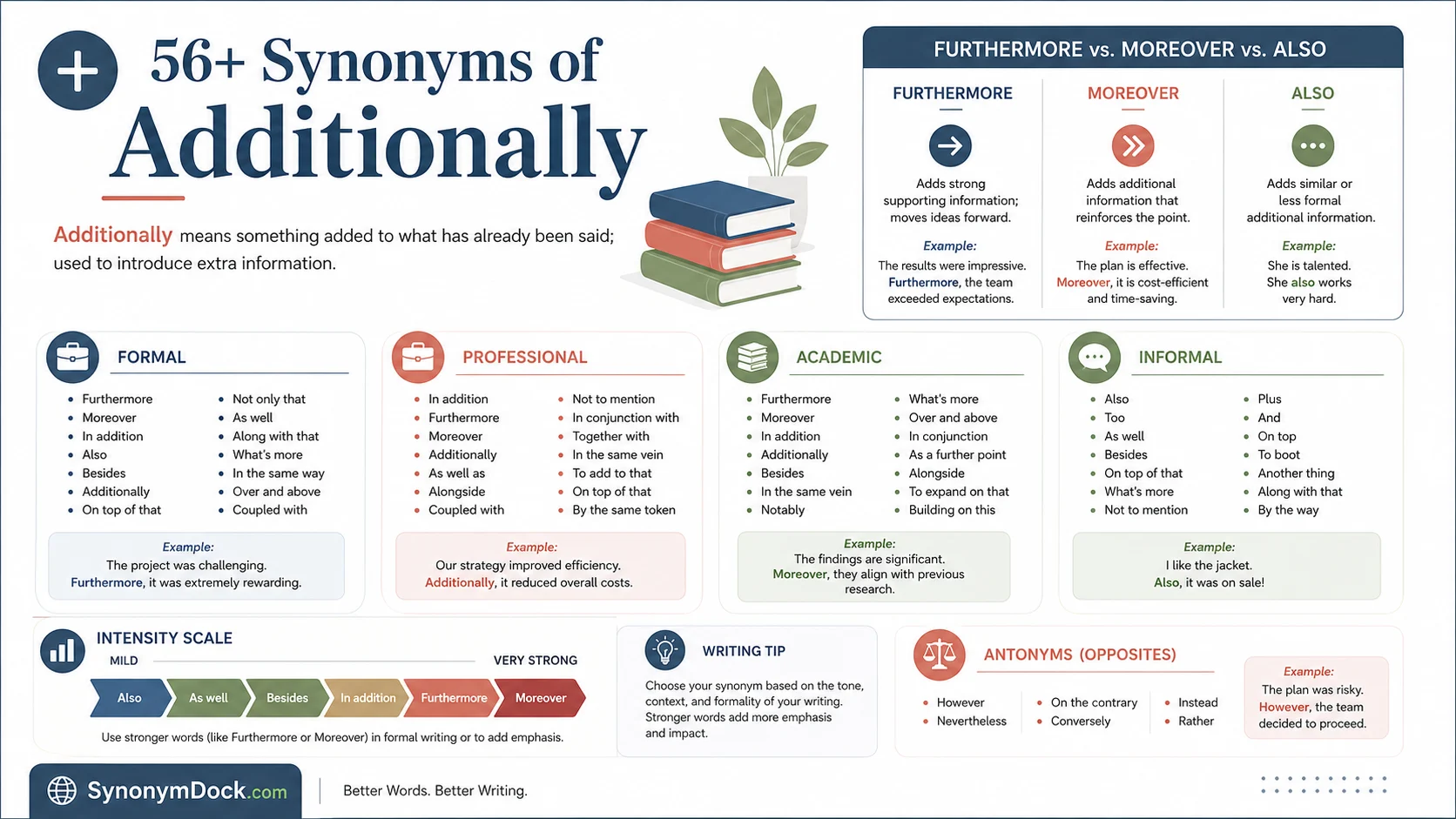
“Additionally” is an adverb that means “in addition” or “furthermore.” It is a formal connector used to add another point. For formal writing, the best synonyms are “furthermore,” “moreover,” and “in addition.” For casual conversation, try “also,” “plus,” or “on top of that.” Choose your synonym based on the formality of your writing and the message you want to convey.
Have you ever read an email or essay where the same word appears over and over? That overused word is often “additionally.” Many writers rely on this single adverb to connect every new point they make. The result often sounds repetitive and dull.
The good news is that English offers many fresh alternatives. You need a synonym of additionally that fits your exact meaning and tone. Choosing the right word can sharpen your writing and keep your readers engaged. Whether you are writing a business report, a college essay, or a simple email, varying your vocabulary makes a real difference. This guide will help you find the best alternative for any situation.
Meaning, Tone, and Context
Simple Definition
Additionally means “as a further point” or “in addition to what has been stated.” It is a linking word that signals to the reader that you are about to add another related idea, reason, or piece of information to your argument or description.
Part of Speech
Additionally is an adverb. Because it is an adverb, it modifies a verb, an adjective, or even an entire sentence to show how the new information relates to what was just said.
Overall Tone
The tone of “additionally” is neutral and formal. It does not carry a positive or negative emotional charge on its own. Instead, it is a functional tool for building an argument or a narrative.
Formality Level
This word is considered formal and is often used in reports, essays, and business writing. It is a staple of academic and professional English. The word is typically learned at an intermediate to advanced level (B2).
Common Uses
Native English speakers commonly use “additionally” in written text to:
- Introduce a new supporting point in an essay.
- List another reason in a business proposal.
- Add a final detail in a report.
- Provide extra information in an academic paper.
When and How to Use “Additionally”
You should choose “additionally” when you need a formal and clear way to introduce a new piece of supporting information. It is not the best word for casual chats, but it is an essential tool for professional and academic writing.
Here are realistic examples of how it is used in different contexts.
Professional
The new software will improve efficiency. Additionally, it will reduce operational costs.
Academic
The data supports the initial hypothesis. Additionally, the results indicate a trend that deserves further investigation.
Workplace
We will be restructuring the team. Additionally, we are implementing new communication protocols.
Personal (Formal Email)
Thank you for your application. Additionally, we have received your portfolio and will review it shortly.
Resume/Cover Letter
I have over five years of experience in project management. Additionally, I am certified in Agile methodology.
Social Media (Professional)
Our company is expanding to a new location. Additionally, we are hiring for several new positions.
Blog/Article
This recipe is simple to follow. Additionally, it uses ingredients you probably already have in your kitchen.
Best Synonyms of “Additionally”
No two synonyms are exactly the same. While many words mean “in addition,” their tone, formality, and usage can differ significantly. Here are the best choices for various contexts.
Professional Writing
Furthermore is a strong choice for professional writing. It adds a new and often more important point to the discussion. It sounds authoritative and helps build a solid argument. For example, “The proposal is cost-effective. Furthermore, it is easy to implement.”
Academic Writing
Moreover works best in academic settings. It adds information that reinforces the previous point, often with more weight or significance. For instance, “The study’s findings are consistent with the literature. Moreover, they offer new insights into the phenomenon.”
Business Communication
In addition is a versatile and safe choice for business communication. It is formal but straightforward. It is often used at the start of a sentence to introduce a new point. For example, “The quarterly report shows growth. In addition, our customer satisfaction scores are at an all-time high.”
Casual Conversation
Also is the most common and flexible alternative for everyday conversation. It can be placed in the middle or at the beginning of a sentence without sounding stiff. For instance, “I need to go to the store, and I also need to pick up my dry cleaning.”
Emotional Writing
What’s more can add a touch of emotion or emphasis to an argument. It suggests that the new point is so important that it almost invalidates the previous one. For example, “He was late to the meeting. What’s more, he forgot the presentation.”
Creative Writing
Besides can be useful in creative writing to add a point that is almost an afterthought or to shift to a slightly different, yet related topic. It sounds natural and conversational. For example, “She didn’t want to go to the party. Besides, she had nothing to wear.”
Resume Writing
In addition is a reliable and effective word for resumes. It presents your accomplishments as part of a larger narrative of success. For example, “Managed a team of 15 engineers. In addition, I oversaw the successful launch of three major products.”
Workplace Communication
Further is a concise and professional word for workplace communication. It is often used to introduce an additional detail in a memo or an email. For example, “Please complete the report by Friday. Further, ensure it is sent to all department heads.”
Stronger Meaning
Moreover and furthermore carry a stronger meaning than “additionally.” They imply that this next point is more important or adds a new dimension to the argument. They are more emphatic than a simple “also.”
Softer Meaning
As well and too offer a much softer and more gentle way to add a point. They are perfect for everyday speech and informal writing where you want to add a detail without making a grand announcement. For example, “I’m going to the movies as well.”
When Not to Use “Additionally”
Knowing when to avoid “additionally” is just as important as knowing when to use it. Here are some situations where it falls flat.
When the Word Sounds Too Formal
Using “additionally” in a text message or casual chat can sound stiff and pretentious. Imagine telling a friend, “I will be at the cafe at noon. Additionally, I will bring coffee.” It sounds unnatural.
Better: “I’ll be at the cafe at noon. Also, I’ll bring coffee.”
When the Word Sounds Too Vague
If you are listing a series of points in an essay, using “additionally” for each one can become repetitive and vague. It doesn’t tell the reader how the next point relates to the previous one. Does it support, contrast, or introduce a new idea?
Better: Use a more specific transition. For the next point, you could use “furthermore,” “however,” or “consequently.”
When the Word Is Too Weak
In a persuasive essay, “additionally” might not have enough weight to properly introduce a key piece of evidence. It sounds too casual for an important argument.
Better: “Moreover, the evidence strongly suggests a different conclusion.” This adds more impact.
When the Word Is Used Incorrectly
“Additionally” is a sentence adverb that connects two sentences or clauses. It should not be used to simply list items in a sequence.
Incorrect: “I went to the store. Additionally, I bought milk, eggs, and bread.” Using it to list items is redundant.
Correct: “I went to the store and bought milk, eggs, and bread.” Or, “I went to the store. In addition, I bought some milk for the recipe.”
Words Commonly Confused With “Additionally”
Several words are often confused with “additionally,” but they have distinct meanings.
Additionally vs Furthermore
Difference: Both add a point, but “furthermore” often introduces a point that is more important or strengthens the argument.
When to Use It: Use “furthermore” to build a stronger case.
Example: “The product is affordable. Furthermore, it is easy to use, making it the best option.”
Additionally vs Moreover
Difference: “Moreover” is similar to “furthermore” but often implies the new point is a significant addition to an already substantial list.
When to Use It: Use “moreover” to emphasize a key piece of evidence.
Example: “The experiment failed to produce results. Moreover, the equipment was damaged.”
Additionally vs Also
Difference: “Also” is much more informal and versatile. It can be placed in the middle of a sentence, whereas “additionally” almost always starts a sentence.
When to Use It: Use “also” in everyday conversation and less formal writing.
Example: “I can also help you with that project.”
Additionally vs In Addition
Difference: These two are very close in meaning. “In addition” is a prepositional phrase. It can be used on its own or followed by “to” before a noun. “Additionally” cannot be followed by “to.”
When to Use It: Use “in addition to” when you need to introduce a noun.
Example: “In addition to his salary, he receives a commission.”
Additionally vs Further
Difference: “Further” can mean “additionally” but also means “to a greater extent” or “more distant.” This can cause confusion.
When to Use It: Use “further” to add a point, but be aware of its other meanings.
Example: “This theory requires further testing. Further, it may not be applicable to all cases.”
Additionally vs Besides
Difference: “Besides” can mean “in addition,” but it can also mean “apart from” or “anyway.” It often has a slightly dismissive or conversational tone.
When to Use It: Use “besides” when adding an afterthought or a less formal point.
Example: “It’s too late to go to the store. Besides, it might be closed.”
Best Synonyms of “Additionally” by Context
The table below provides quick recommendations for the best synonym to use in specific situations.
| Context | Best Synonym | Why It Works | Example |
|---|---|---|---|
| Formal writing | Furthermore | It sounds authoritative and adds weight to an argument. | The policy is effective. Furthermore, it is popular with staff. |
| Academic writing | Moreover | It reinforces a point and adds significant supporting information. | The findings are unprecedented. Moreover, they challenge established theories. |
| Professional communication | In addition | It is clear, formal, and safe for any professional context. | The budget has been approved. In addition, the timeline has been extended. |
| Business emails | Also | It is more conversational than “additionally” but still professional. | We appreciate your feedback. We also have a few questions. |
| Resume writing | In addition | It presents accomplishments as part of a larger narrative. | Led sales team to record profits. In addition, I developed a new training program. |
| Workplace communication | Further | It is concise and signals a follow-up point. | Please review the document. Further, please share your feedback. |
| Casual conversation | Also | It is the most natural and common way to add a point. | I had a great time. Also, the food was amazing. |
| Everyday speaking | Plus | It is very informal and is often used to add a reason or benefit. | We should go to the new restaurant. Plus, it’s close by. |
| Creative writing | Besides | It sounds conversational and can add an afterthought. | She didn’t trust him. Besides, the story seemed suspicious. |
| Storytelling | On top of that | It adds a point in a way that sounds like a spoken anecdote. | It started raining. On top of that, we missed the bus. |
| Emotional writing | What’s more | It expresses frustration or emphasizes a bad/good thing. | He forgot our anniversary. What’s more, he didn’t even apologize. |
| Strong emphasis | Moreover | It signals that this new point is even more important than the last. | He was a genius. Moreover, he was a kind and humble person. |
| Mild tone | Too | It adds a point without any emphasis or formality. | I’d love to come too. |
| Social media captions | Also | It is simple, direct, and common on social media. | Loved this trip to the beach! Also, look at this adorable dog. |
How to Choose the Best Synonym of “Additionally”
Choosing the best synonym is about understanding the context of your message. Here is a practical decision guide to help you choose wisely.
- Consider Your Audience. Who are you writing for? If you are writing for a professor or a business executive, choose formal words like “furthermore” or “moreover.” If you are emailing a colleague or a friend, “also” or “plus” are more appropriate.
- Consider Your Purpose. What are you trying to achieve? If you are building a logical argument, “furthermore” and “in addition” are excellent. If you are simply adding an extra detail, “also” or “as well” work well.
- Consider Emotional Strength. How much emphasis do you want to add? “Moreover” and “what’s more” add stronger emphasis than “also” or “too.” Choose a word that matches the weight of your point.
- Vary Your Words. The primary reason to use synonyms is to avoid repetition. If you have already used “furthermore,” try “in addition” for your next point.
- Read Aloud. The best test for natural-sounding writing is to read it aloud. If a synonym sounds clunky or out of place in the sentence, choose a different one.
- Consider Formality. Always align your word choice with the document type. An academic paper requires different vocabulary than a text message. Using a formal synonym in a casual context, or vice versa, can make you sound out of touch.
Real Life Examples of “Additionally”
Here are examples of the word “additionally” used in a variety of real-world scenarios, including improved versions with stronger synonyms.
School
Original: The history textbook covers the American Revolution. Additionally, it has a chapter on the Constitution.
Improved: The history textbook covers the American Revolution. Moreover, it has an entire chapter dedicated to the Constitution.
College
Original: The student’s essay was well-structured. Additionally, it used excellent sources.
Improved: The student’s essay was well-structured. Furthermore, it used excellent and scholarly sources.
Workplace
Original: The project was completed on time. Additionally, it was under budget.
Improved: The project was completed on time and under budget.
Business
Original: Our sales increased last quarter. Additionally, we hired a new marketing director.
Improved: Our sales increased last quarter. In addition, we hired a new marketing director who is already driving results.
Original: I have attached the report. Additionally, I have included the spreadsheets.
Improved: I have attached the report along with the spreadsheets. [This removes the need for “additionally” entirely, making it more concise.]
Resume
Original: I managed the customer service team. Additionally, I was responsible for training new hires.
Improved: Managed the customer service team. In addition, I developed and implemented a comprehensive training program for new hires.
Conversation
Original: I wanted to go to the park. Additionally, I wanted to get ice cream.
Improved: I wanted to go to the park and get ice cream. [Again, combining is the best option.]
Storytelling
Original: The old house was full of dust and cobwebs. Additionally, the stairs creaked when you walked on them.
Improved: The old house was full of dust and cobwebs. On top of that, the stairs creaked ominously with every step.
Blogging
Original: This smoothie is great for breakfast. Additionally, it’s quick to make.
Improved: This smoothie is great for breakfast. Plus, it’s quick to make.
Social Media
Original: Enjoyed a sunny day at the beach! Additionally, I got a great tan!
Improved: Enjoyed a sunny day at the beach! Also, check out this amazing sunset!
18 Best Synonyms of “Additionally”
| Synonym | Simple Meaning | Best Used For | Example Sentence |
|---|---|---|---|
| Furthermore | Also, and more importantly | Formal writing and arguments | The proposal is sound. Furthermore, it is cost-effective. |
| Moreover | Also, and more significantly | Academic and persuasive writing | The theory is flawed. Moreover, the evidence is weak. |
| In addition | As an extra point or item | Professional and business writing | The company is growing. In addition, we are hiring. |
| Also | Too, in addition | Casual writing and conversation | I also need to buy some milk. |
| Further | To a greater extent, additionally | Workplace and formal communication | Further, we need to consider the long-term impact. |
| Plus | And, also, with the addition of | Casual conversation and informal writing | We should get pizza. Plus, it’s on sale. |
| As well | In addition, too | Everyday speaking | I’ll have a coffee as well. |
| Too | In addition, also | Casual conversation | I’d like to go too. |
| Besides | In addition, anyway, apart from | Conversational writing and creative writing | I wasn’t invited. Besides, I don’t like parties. |
| On top of that | In addition to something | Everyday speaking and storytelling | He lost his job. On top of that, his car broke down. |
| What’s more | Also, and more importantly | Emotional and emphatic writing | She is brilliant. What’s more, she is incredibly kind. |
| To boot | In addition, as well | Informal, often used in a list | The meal was delicious and cheap to boot. |
| Not only that | In addition to what was said | Informal emphasis | The hotel was great. Not only that, it was affordable. |
| Likewise | Similarly, also | Formal and professional contexts | The first study had limitations. Likewise, the second study had issues. |
| By the same token | For the same reason, similarly | Formal arguments and logic | He is good at math. By the same token, he excels in physics. |
| Again | Another, plus | Literary and formal writing | He was a great leader. Again, he was also a mentor. |
| Then | In that case, next, additionally | Sequential writing | We considered the budget. Then, we looked at the timeline. |
| In the same way | Similarly, also | Formal and academic comparisons | The first experiment failed. In the same way, the second produced no results. |
Synonyms of “Additionally” by Usage
Professional vs Personal Synonyms
Professional writing favors formal and precise synonyms like “furthermore,” “moreover,” and “in addition.” These words add authority to your argument.
Personal conversation calls for casual and simple words like “also,” “plus,” and “as well.” These sound natural and friendly.
Formal vs Conversational Synonyms
- Reports, Essays, and Business Writing: “Furthermore,” “moreover,” and “in addition.”
- Presentations: “Furthermore” and “in addition.”
- Emails and Memos: “Additionally,” “also,” and “in addition.”
- Casual Conversations and Texting: “Also,” “plus,” “too,” and “on top of that.”
Academic Synonyms
For research, essays, and reports, choose words that sound authoritative and precise.
- Moreover: Adds weight to a point.
- Furthermore: Adds a supporting point.
- In addition: A standard, safe choice.
- Likewise: Adds a similar point in a comparison.
These words demonstrate a strong command of academic language.
Professional and Business Synonyms
The strongest choices for resumes, meetings, and client communication are:
- In addition: For listing accomplishments.
- Furthermore: For making a persuasive case.
- Moreover: For adding an important detail to a report.
Using these words in a performance review or client meeting demonstrates professionalism.
Creative and Literary Synonyms
For storytelling, fiction, and poetry, you need expressive and often more vivid alternatives.
- Besides: For a conversational, almost dismissive tone.
- On top of that: For adding a point in a narrative.
- What’s more: For building dramatic effect in a story.
- To boot: For a playful, almost archaic addition to a list.
These words add color and personality to descriptive writing.
Slang or Modern Synonyms
There are very few slang synonyms for “additionally.” The informal synonyms below are acceptable in casual speech but should be avoided in professional writing.
- Plus: Very common in everyday speech.
- On top of that: Common and perfectly acceptable in casual contexts.
- To boot: Slightly old-fashioned but still used.
Strongest to Mildest Synonyms
This scale shows how the emotional intensity changes across different synonyms.
- Mild: Also, too, as well. These simply add a point without any emphasis.
- Moderate: In addition, further, plus. These are neutral and clear.
- Strong: Furthermore, besides. These add weight to a point and often introduce a more important idea.
- Very Strong: Moreover, what’s more, not only that. These introduce a point that is significantly more important or emphatic.
Emotional vs Neutral Synonyms
Emotional Synonyms
These words express stronger feelings or emphasis.
- What’s more: Can express frustration or excitement.
- On top of that: Often used to complain or to add to a dramatic story.
- Not only that: Adds a sense of pleasant or unpleasant surprise.
Neutral Synonyms
These words simply communicate information without adding emotion.
- Furthermore: Neutral, formal.
- In addition: Neutral, professional.
- Also: Neutral, informal.
Antonyms of “Additionally”
The concept of an antonym for “additionally” is a bit unusual. However, some words serve an opposite function by indicating an exception or a limitation.
| Antonym | Meaning | Example Sentence |
|---|---|---|
| However | Used to introduce a statement that contrasts with the previous one. | The project was successful. However, it was over budget. |
| Nevertheless | In spite of that. | The weather was terrible. Nevertheless, we had a great time. |
| Nonetheless | Despite what has just been said. | He was inexperienced. Nonetheless, he got the job. |
| Conversely | In an opposite way, on the other hand. | The first study supports the theory. Conversely, the second study contradicts it. |
| On the other hand | Used to introduce a contrasting point. | This plan is expensive. On the other hand, it is very effective. |
| Although | In spite of the fact that. | Although it was raining, we went for a walk. |
| Despite | Without being affected by. | Despite the challenges, the team succeeded. |
| In contrast | When compared to something else. | The first candidate was very aggressive. In contrast, the second was calm. |
| Yet | In spite of that. | He seemed happy, yet he was deeply troubled. |
| But | Used to introduce a contrast. | She is a good student, but she is not perfect. |
| Still | In spite of that. | He was innocent. Still, he was arrested. |
| Though | Despite the fact that. | She is rich, though not very happy. |
| Even so | In spite of that. | The offer was generous. Even so, he turned it down. |
| On the contrary | Used to show that the opposite is true. | It wasn’t a success. On the contrary, it was a complete failure. |
| Instead | As a substitute. | He didn’t go to the store. Instead, he went to the park. |
Comparison: “Additionally” vs Similar Words
Additionally vs Moreover
Main Difference: “Moreover” adds a point that is often more important or surprising than the previous one. “Additionally” is more neutral.
Which Is Stronger? “Moreover” is stronger.
Which Is More Formal? Both are formal, but “moreover” is slightly more academic.
When to Use Each: Use “additionally” to add any point. Use “moreover” when the new point is a significant addition.
Examples:
- Additionally: “The cafe has great coffee. Additionally, it has free Wi-Fi.”
- Moreover: “The cafe has great coffee. Moreover, it is the only place in town that roasts its own beans.”
Additionally vs Furthermore
Main Difference: “Furthermore” adds a new point that supports or extends the previous argument. “Additionally” is more general.
Which Is Stronger? “Furthermore” is stronger and more persuasive.
Which Is More Formal? Both are formal, but “furthermore” is a staple of persuasive writing.
When to Use Each: Use “additionally” to add extra information. Use “furthermore” to build a logical case.
Examples:
- Additionally: “The sales are up. Additionally, we hired a new manager.”
- Furthermore: “The sales are up. Furthermore, we have done this without increasing our marketing budget.”
Additionally vs Also
Main Difference: “Additionally” is formal and usually starts a sentence. “Also” is informal and can be placed almost anywhere in a sentence.
Which Is Stronger? Neither is stronger; they are different in tone.
Which Is More Formal? “Additionally” is formal. “Also” is informal.
When to Use Each: Use “additionally” in formal writing. Use “also” in conversation and informal writing.
Examples:
- Additionally: “Additionally, the project is on schedule.” (Formal)
- Also: “The project is also on schedule.” (Casual)
Additionally vs In addition
Main Difference: “In addition” is a prepositional phrase that can be followed by “to.” “Additionally” is an adverb that cannot be followed by “to.”
Which Is Stronger? They are similar in strength.
Which Is More Formal? Both are formal.
When to Use Each: Use “in addition to” when adding a noun phrase. Use “additionally” when starting a new sentence.
Examples:
- Additionally: “We need to hire a new developer. Additionally, we need to buy new computers.”
- In addition: “In addition to hiring a new developer, we need to buy new computers.”
Additionally vs Besides
Main Difference: “Additionally” adds a point logically. “Besides” adds a point that is often a separate or dismissive thought.
Which Is Stronger? “Additionally” is more direct. “Besides” is more conversational.
Which Is More Formal? “Additionally” is formal. “Besides” is informal.
When to Use Each: Use “additionally” to build a formal argument. Use “besides” to add an offhand comment.
Examples:
- Additionally: “He is a great leader. Additionally, he is a good listener.”
- Besides: “He is a great leader. Besides, he is a good listener.”
Additionally vs Further
Main Difference: “Further” can mean “additionally” or “to a greater degree,” while “additionally” only means “in addition.”
Which Is Stronger? “Further” can be stronger when it means “to a greater degree.”
Which Is More Formal? Both are formal.
When to Use Each: Use “additionally” to avoid ambiguity. Use “further” when you also want to imply “more.”
Examples:
- Additionally: “We need to investigate this issue. Additionally, we need a report.”
- Further: “We need to investigate this issue further. Further, we need a report.”
Common Phrases and Expressions with “Additionally”
Because “additionally” is a formal connector, there are very few set phrases or idioms that use it. It is mostly used as a straightforward linking word. However, there are a few common structural patterns.
In addition
Meaning: This is a synonym, but it is also a common phrase used in the same way.
Example Sentence: “I have finished the report. In addition, I have sent it to the team.”
Additionally
Meaning: This is the most common way to start a sentence with the word.
Example Sentence: “Additionally, the research shows a clear link between the two variables.”
and additionally
Meaning: Used to link a final point in a list.
Example Sentence: “The course covers grammar, vocabulary, and additionally, advanced writing skills.”
To boot
Meaning: An informal phrase meaning “in addition” or “as well.”
Example Sentence: “He was a good boss and a good friend to boot.”
Common Mistakes to Avoid
Mistake 1: Choosing a Vague Synonym
Using “additionally” repeatedly makes your writing vague.
- Incorrect: “The movie was good. Additionally, the actors were good. Additionally, the music was good.”
- Better: “The movie was excellent, with superb acting and a memorable score.”
Mistake 2: Confusing “Additionally” with “Addedly”
“Addedly” is an awkward, rarely used word. Avoid it.
- Incorrect: “Addedly, the plan has flaws.”
- Better: “Additionally, the plan has flaws.”
Mistake 3: Using an Informal Synonym in Formal Writing
Using “plus” in an academic paper is too casual.
- Incorrect: “The data supports the hypothesis. Plus, it’s consistent with previous studies.”
- Better: “The data supports the hypothesis. Furthermore, it is consistent with previous studies.”
Mistake 4: Selecting an Overly Dramatic Synonym
Using “moreover” for every single point sounds exaggerated.
- Incorrect: “The soup was hot. Moreover, it was served in a bowl.”
- Better: “The soup was hot and served in a bowl.”
Mistake 5: Repeating the Same Word Too Often
Saying “additionally” every few sentences is a sign of lazy writing.
- Incorrect: “We need to hire more staff. Additionally, we need a new office. Additionally, we need more computers.”
- Better: “We need to hire more staff, acquire a new office, and purchase more computers.”
Mistake 6: Using a Formal Synonym in a Casual Conversation
Using “furthermore” when chatting with friends sounds robotic.
- Incorrect: “I’m tired. Furthermore, I’m hungry.”
- Better: “I’m tired and hungry.”
Mistake 7: Using Slang in Professional Writing
Avoid “on top of that” in a formal business report.
- Incorrect: “Sales are up this quarter. On top of that, we have a new product.”
- Better: “Sales are up this quarter. In addition, we have launched a new product.”
Frequently Asked Questions
1. What are the best synonyms of “additionally”?
The best synonyms are “furthermore” and “moreover” for formal writing, and “also” or “plus” for casual conversation. “In addition” is a safe choice for most professional contexts.
2. What are the best formal synonyms of “additionally”?
The best formal synonyms are “furthermore,” “moreover,” and “in addition.” These words are appropriate for academic essays, business reports, and professional emails.
3. What are common informal synonyms of “additionally”?
Common informal synonyms include “also,” “plus,” “too,” “as well,” and “on top of that.” These are best for texting, social media, and everyday conversation.
4. What is another word for “additionally” in professional writing?
In professional writing, “in addition” and “furthermore” are excellent choices. They sound clear and authoritative without being overly academic. “Further” is also a good choice.
5. What is the difference between “additionally” and “moreover”?
The main difference is that “moreover” adds a point that is often more important or significant than the previous one, while “additionally” is a more neutral connector for adding any point.
6. What is the opposite of “additionally”?
Words like “however,” “nevertheless,” “conversely,” and “on the other hand” serve an opposite function by introducing a contrast or exception rather than adding a similar point.
Conclusion
“Additionally” is a valuable word for adding information, but its true power lies in its proper use. This guide has explained its meaning and offered a rich collection of the best synonym of additionally to use in any situation. You now know that “furthermore” and “moreover” are ideal for building formal arguments, while “also” and “plus” are perfect for everyday speech.
No single synonym is right for every context. The most effective writers choose their words based on their audience, purpose, and the message they want to convey. By varying your vocabulary and selecting the most precise term, you will make your writing clearer and more engaging.
Start by picking just one or two new synonyms from this list and practice using them in your next email or essay. Small changes in vocabulary can lead to a big improvement in your overall communication.

11 thoughts on “56+ Synonyms of Additionally| Meanings, Uses, and Examples”