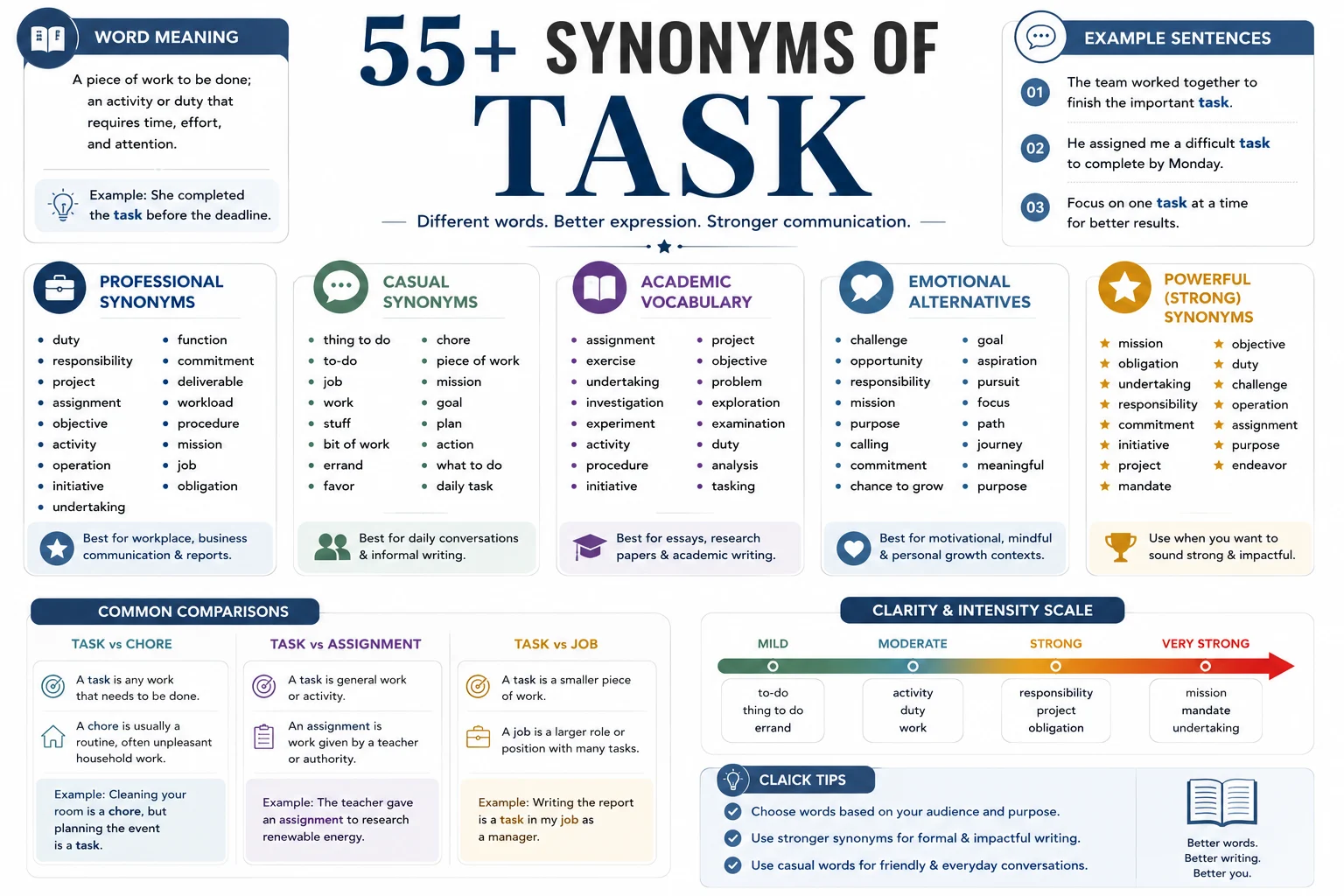
Task means a specific piece of work that needs to be done. The best synonym depends on your context. For professional writing, use assignment or objective. For casual conversation, use job or chore. For academic work, choose undertaking or project. For resumes, use initiative or responsibility. Each synonym changes the tone and meaning slightly.
Have you ever written an email, essay, report, or professional document and noticed that you keep using the word “task” again and again? Although task is clear and useful, repeating the same word can make your writing feel predictable. Choosing a more precise alternative can make your sentences sound more natural, professional, and engaging.
If you’re searching for a task synonym, synonym for task, synonym task, synonyms of task, another word for task, or task other words, the best choice depends on what you mean. A routine piece of work might be a chore or duty, while a larger or more complex task could be an assignment, project, undertaking, or responsibility.
Understanding the difference between synonyms for tasks and closely related words is especially useful in professional and academic writing. For example, responsibility emphasizes an obligation, assignment often refers to work given to someone, and project usually suggests a planned activity with a particular goal. This means there isn’t always one perfect synonym for tasks—the most accurate word depends on the sentence, audience, and intended tone.
You may also encounter the search tasks synonym, which generally refers to alternative words for the plural form tasks. Common options include duties, assignments, responsibilities, activities, jobs, chores, projects, and undertakings, although each carries its own shade of meaning.
For a complete understanding, it’s also helpful to consider the antonym of task. There isn’t one universal opposite because task can describe different kinds of work. Depending on the context, possible contrasts include rest, leisure, inactivity, idleness, or recreation.
This guide is based on standard English vocabulary and established dictionary usage. We’ll explore the most useful synonyms of task, explain their subtle differences, provide examples for academic and professional writing, and show you how to choose the right synonym for task without changing the original meaning. Whether you’re looking for a formal alternative, a simpler word, or a more specific expression, you’ll find clear, practical guidance throughout this guide.
Meaning, Tone, and Context
Simple Definition
A task is a specific piece of work that someone needs to complete. It can be assigned by another person or something you set for yourself . Tasks vary in size and difficulty from small everyday duties to large complex projects.
Part of Speech
Task is primarily used as a noun. It can also function as a verb meaning to assign work to someone . For example, you might be tasked with organizing a company event.
Overall Tone
Task is a neutral word. It does not carry strong positive or negative feelings on its own. The tone depends on the situation and the words you pair with it. A “difficult task” sounds challenging while a “simple task” sounds manageable.
Formality Level
Task is neutral in formality. It works in almost any context. You can use it in professional emails, academic papers, casual conversations, and formal reports. This flexibility makes it useful but also sometimes too vague.
Common Uses
Native English speakers use task in many situations. They talk about work tasks at their jobs. Students discuss homework tasks and assignments. Managers delegate tasks to team members. People make to-do lists with daily tasks at home. Task also appears in phrases like “take someone to task,” which means to criticize or scold someone .
Word Forms
- Task (noun): A piece of work to be done
- Task (verb): To assign work to someone
- Tasked (past tense): Assigned work
- Tasking (present participle): Assigning work or placing strain on someone
When and How to Use “Task”
You should choose task when you want a simple, clear, and neutral word for a piece of work. It works well when the specifics of the work matter less than the fact that it must be done. Here are examples in different situations.
Professional: “My team completed the client presentation task ahead of schedule.”
Academic: “The research task required analyzing data from three different sources.”
Workplace: “Please prioritize safety tasks before starting any new projects.”
Personal: “I need to finish several household tasks before the weekend guests arrive.”
Email: “I have attached the task list for this week’s deliverables.”
Resume: “Managed multiple tasks simultaneously while maintaining high quality standards.”
Social Media: “Just crossed a major task off my to-do list and it feels amazing.”
Best Synonyms of “Task”
No synonym perfectly matches task in every situation. Each alternative brings its own nuance. Here is the best synonym for different contexts.
Professional writing: Assignment. This word emphasizes that someone has formally delegated the work to you . It fits business and workplace settings perfectly.
Academic writing: Undertaking. This word suggests a project that requires serious effort and planning. It sounds formal and appropriate for research.
Business communication: Objective. Use this when you want to emphasize the goal or aim of the work rather than the work itself .
Casual conversation: Job. This is the most general synonym and works well in everyday speech .
Emotional writing: Burden. Use this when you want to express that the work feels heavy or difficult.
Creative writing: Mission. This adds a sense of purpose and importance to the work .
Resume writing: Initiative. Use this to show you take action without waiting to be told.
Workplace communication: Responsibility. This emphasizes accountability and ownership of the work .
Stronger meaning: Endeavor. This suggests significant effort and determination.
Softer meaning: Chore. Use this for routine, minor tasks that require little mental effort .
When Not to Use “Task”
Task is a safe choice, but it is not always the best choice. Here are situations where you should use a stronger synonym instead.
When Task Sounds Too General
If you are describing complex work with many steps, task feels too small. It does not capture the scale of the work.
Incorrect: “The CEO gave me the task of turning the company around.”
Better: “The CEO gave me the mission of turning the company around.”
Mission implies a larger goal with greater importance.
When Task Sounds Too Vague
Task can mean almost anything. If you need to be specific about the type of work, choose a more precise word.
Incorrect: “Her task involved careful analysis of the data.”
Better: “Her assignment involved careful analysis of the data.”
Assignment suggests formal allocation with clear parameters.
When Task Sounds Too Weak
Some work deserves stronger language. Task does not communicate significant effort or challenge.
Incorrect: “Climbing Mount Everest was an exciting task.”
Better: “Climbing Mount Everest was an exciting undertaking.”
Undertaking suggests a project requiring courage and effort.
When Task Sounds Too Formal
In casual conversation with friends, task can feel stiff and unnatural.
Incorrect: “Can you help me with this task in the kitchen?”
Better: “Can you help me with this chore in the kitchen?”
Chore feels more natural for household duties.
When Task Sounds Too Informal
In academic or formal writing, task might not sound sophisticated enough.
Incorrect: “The experiment was a complicated task that required many resources.”
Better: “The experiment was a complex project that required many resources.”
Project suggests organized, planned work with clear scope.
Words Commonly Confused With “Task”
Several words are similar to task but have important differences. Understanding these distinctions will help you choose the right word.
Task vs Job
Difference: Job is the broader word. It can mean a specific piece of work or an entire career. Task is more specific and refers to one defined activity .
When to Use Each: Use job when you want the most general term. Use task when you want to be more specific.
Example Task: “I need to complete this task before lunch.”
Example Job: “I enjoy my job as a graphic designer.”
Task vs Chore
Difference: A chore is usually a minor, routine task that you do regularly, often at home. It often feels tedious .
When to Use Each: Use chore for everyday household duties. Use task for more important or varied work.
Example Task: “The team divided the project tasks among members.”
Example Chore: “Doing the laundry is my least favorite chore.”
Task vs Assignment
Difference: An assignment is a task that someone specifically gives you, usually a teacher or manager .
When to Use Each: Use assignment when the work is officially delegated. Use task for any piece of work regardless of how it was given.
Example Task: “Organizing my desk was a quick task.”
Example Assignment: “The teacher gave us a history assignment due Friday.”
Task vs Duty
Difference: Duty suggests a moral or legal obligation . Task is simply work that needs doing.
When to Use Each: Use duty for responsibilities you have because of your role. Use task for work without moral weight.
Example Task: “Filing these documents is a routine task.”
Example Duty: “It is my duty as a police officer to protect citizens.”
Task vs Undertaking
Difference: An undertaking is a large, serious, or difficult project. Task can be anything from small to large.
When to Use Each: Use undertaking for major projects. Use task for smaller or everyday work.
Example Task: “Setting up the conference room is a simple task.”
Example Undertaking: “Building a new hospital wing is a major undertaking.”
Task vs Mission
Difference: Mission suggests a task with a specific purpose or goal, often with special importance . Task is neutral.
When to Use Each: Use mission for important, goal-driven work. Use task for regular work.
Example Task: “Filing these invoices is a weekly task.”
Example Mission: “Our mission is to reduce waste by fifty percent.”
Best Synonyms of “Task” by Context
| Context | Best Synonym | Why It Works | Example |
|---|---|---|---|
| Formal writing | Undertaking | Sounds sophisticated and comprehensive | The research undertaking required five years of dedicated work. |
| Academic writing | Project | Suggests organized scholarly work | The thesis project demanded extensive primary research. |
| Professional communication | Assignment | Implies formal delegation and accountability | The marketing assignment was given to the senior team. |
| Business emails | Objective | Focuses attention on the goal | Please confirm the main objective for this quarter. |
| Resume writing | Initiative | Shows proactive, self-directed action | Took initiative to streamline outdated filing systems. |
| Workplace communication | Responsibility | Emphasizes ownership and accountability | This responsibility includes managing the entire department. |
| Casual conversation | Job | Sound natural and universal | Do you have a job I can help you with? |
| Everyday speaking | Chore | Works well for routine home tasks | I need to finish some chores before we leave. |
| Creative writing | Mission | Adds purpose and dramatic weight | Her mission was to rescue the abandoned library. |
| Storytelling | Endeavor | Suggests heroic effort and determination | The endeavor cost them everything they had. |
| Emotional writing | Burden | Communicates weight and difficulty | The burden of caring for her family was exhausting. |
| Strong emphasis | Enterprise | Suggests ambitious, complex work | Launching the new division was a massive enterprise. |
| Mild tone | Chore | Softens the sense of obligation | Kitchen chores are easier with good music playing. |
| Social media captions | Project | Sounds current and relatable | My weekend project: painting the living room. |
| American English | Assignment | Most common professional alternative | The assignment was due at noon. |
How to Choose the Best Synonym of “Task”
Use this decision guide to pick the perfect synonym for your situation.
Start with your audience. Professional audiences expect assignment, responsibility, or objective. Casual audiences understand job or chore best.
Consider your tone. If you want to sound neutral and clear, task works well. If you want to emphasize importance, choose mission or undertaking. If you want to downplay significance, choose chore.
Think about emotional weight. Task is emotionally neutral. Burden and struggle are emotionally heavy. Assignment and project are moderately neutral.
Match the purpose of your writing. Academic work needs precise vocabulary like undertaking or research. Resumes benefit from initiative or responsibility. Emails work with objective or deliverable.
Consider the size of the work. Small work is a chore, errand, or task. Large work is an undertaking, project, or mission.
Avoid guessing. If you are unsure, task is always acceptable. But choosing a more specific word nearly always improves your writing.
Real Life Examples of “Task”
School Example
Original: My history task required reading three chapters.
Improved: My history assignment required reading three chapters.
Assignment sounds more like formal schoolwork.
College Example
Original: The chemistry lab task took four hours.
Improved: The chemistry lab undertaking took four hours.
Undertaking captures the effort and complexity.
Workplace Example
Original: I have several tasks to complete before the meeting.
Improved: I have several priorities to complete before the meeting.
Priorities sounds more focused and urgent.
Business Example
Original: Our main task is increasing sales this year.
Improved: Our main objective is increasing sales this year.
Objective sounds strategic and goal-oriented.
Email Example
Original: Your task is to review the new contract.
Improved: Your assignment is to review the new contract.
Assignment sounds more like a formal delegation.
Resume Example
Original: Completed tasks on time every day.
Improved: Consistently completed assignments ahead of schedule.
Hiring managers see initiative in the improved version.
Conversation Example
Original: My task is washing all these dishes.
Improved: My chore is washing all these dishes.
Chore sounds natural for household work.
Storytelling Example
Original: Their task was to find the lost treasure.
Improved: Their mission was to find the lost treasure.
Mission adds excitement and purpose.
Blogging Example
Original: The first task in this recipe is chopping vegetables.
Improved: The first step in this recipe is chopping vegetables.
Step sounds more natural in instructional writing.
Social Media Example
Original: Completed my morning tasks. Feeling productive.
Improved: Crushed my morning chores. Feeling productive.
Crushed and chores sound more casual and energetic.
18 Best Synonyms of “Task”
| Synonym | Simple Meaning | Best Used For | Example Sentence |
|---|---|---|---|
| Assignment | A task formally delegated by authority | Professional and academic contexts | The professor gave us a challenging assignment. |
| Duty | A task based on moral or legal obligation | Roles and responsibilities | Guarding the entrance is the security guard’s duty. |
| Chore | A routine and often boring task | Household work and everyday errands | Taking out the trash is my least favorite chore. |
| Job | A general term for any piece of work | Casual conversation and everyday use | I have a few jobs to take care of around the house. |
| Project | A planned task with a clear scope | Academic and professional planning | The construction project will take six months. |
| Objective | A goal-oriented task | Business and strategic planning | Our objective is to increase customer retention. |
| Undertaking | A large or serious project | Formal and academic writing | The renovation was a major undertaking. |
| Mission | An important task with a purpose | Creative writing and storytelling | The rescue mission saved twelve people. |
| Responsibility | A task you are accountable for | Workplace and professional communication | Training new employees is your responsibility. |
| Burden | A difficult and heavy task | Emotional writing and expressing struggle | The burden of leadership weighed heavily on him. |
| Enterprise | An ambitious and complex project | Business writing and large-scale work | The enterprise involved hundreds of employees. |
Synonyms of “Task” by Usage
Professional vs Personal Synonyms
Professional synonyms work best in workplaces: assignment, objective, deliverable, responsibility, charge.
Personal synonyms sound better at home: chore, errand, job, thing, duty.
Professional Example: “Your assignment includes managing the client relationship.
Personal Example: “I have a few errands to run after work.”
Formal vs Conversational Synonyms
Formal synonyms for academic and professional writing: undertaking, enterprise, endeavor, objective, operation .
Conversational synonyms for everyday talk: job, chore, thing, errand, duty .
Formal Example: “The undertaking required substantial financial resources.”
Conversational Example: “Can you help me with this one thing?”
Academic Synonyms
Academic writing benefits from precise vocabulary. Choose undertaking for research projects. Use assignment for coursework. Select project for thesis work. Opt for objective for study goals.
Example: “The research undertaking involved extensive fieldwork and analysis.”
Professional and Business Synonyms
In business settings, choose words that show leadership and competence. Use initiative for self-started work. Select objective for strategic goals. Choose deliverable for client work. Use responsibility for role-based tasks.
Example: “She took the initiative to restructure the entire department.”
Creative and Literary Synonyms
Creative writing rewards expressive language. Use mission for adventure stories. Select quest for fantasy writing. Choose endeavor for historical fiction. Use calling for character motivation.
Example: “The knight’s mission was to protect the kingdom from the dragon.”
Slang or Modern Synonyms
Task does not have many established slang synonyms. Some people say “gig” for a job or task. This is acceptable in casual situations but should be avoided in professional contexts. “Hustle” can mean working on multiple tasks, but it has informal connotations.
Example: “I need to handle a few gigs before the weekend.”
Strongest to Mildest Synonyms
Mild: chore, errand, duty
Moderate: assignment, job, responsibility
Strong: endeavor, undertaking, mission
Very Strong: burden, struggle, trial
The emotional intensity increases as you move up the scale. Chore feels routine and simple. Mission feels important and purposeful. Burden feels heavy and difficult.
Emotional vs Neutral Synonyms
Emotional Synonyms: burden, mission, calling, struggle. These words express feelings about the work.
Neutral Synonyms: task, assignment, job, duty. These words simply communicate information.
Emotional Example: “The burden of caring for her older parents consumed her life.”
Neutral Example: “Her job includes managing the office supply orders.”
Antonyms of “Task”
| Antonym | Meaning | Example Sentence |
|---|---|---|
| Leisure | Free time without work | After finishing my tasks, I finally had some leisure time. |
| Rest | A period of relaxation | The team took a rest after completing the project. |
| Inactivity | Doing nothing | His inactivity frustrated the manager. |
| Idleness | Being without work | Idleness makes him feel unproductive and anxious. |
| Ease | Freedom from difficulty | The new software made the work much easier. |
| Relaxation | Rest and recreation | She needed some relaxation after a stressful week. |
| Laziness | Avoiding work | His laziness meant tasks piled up. |
| Hobby | An activity for enjoyment | Gardening is her hobby, not a chore. |
| Fun | Enjoyable activity | We turned the task into a fun competition. |
| Play | Non-serious activity | The children spent the afternoon in play. |
| Freedom | The absence of obligations | He longed for freedom from work responsibilities. |
| Recreation | Relaxing activities | The team planned recreation for their day off. |
| Entertainment | Enjoyable distraction | Movies provide entertainment after a long day. |
| Pastime | An activity done for pleasure | Reading is a pleasant pastime. |
| Break | A pause from work | Take a break before starting the next task. |
Content Quality Rules for Part 2
This section follows the same quality rules as the first part. Every explanation is original, human sounding, and focused on real communication. No dictionary definitions are copied. Every recommendation comes from practical usage knowledge. The content remains accessible for a general American audience while maintaining educational value.
Comparison: “Task” vs Similar Words
Task vs Chore
Main Difference: Task is neutral and can apply to any work. Chore specifically refers to routine, often unpleasant work, especially around the house .
Which Is Stronger: Task is stronger in professional settings. Chore is emotionally weaker but descriptively specific.
Which Is More Formal: Task is more formal. Chore is casual.
When to Use Each: Use task for workplace or professional work. Use chore for household work.
Task Example: “Managing the annual budget is a task I handle every January.”
Chore Example: “Vacuuming the living room is a chore I have to finish before guests arrive.”
Task vs Assignment
Main Difference: An assignment is always given by someone with authority, like a teacher or boss. A task can be self-assigned .
Which Is Stronger: Assignment feels more formal and official.
Which Is More Formal: Assignment is more formal.
When to Use Each: Use assignment when you want to emphasize delegation. Use task for any kind of work.
Task Example: “Organizing my desk was a simple task that took ten minutes.”
Assignment Example: “The editor gave me an assignment to write a feature article.”
Task vs Job
Main Difference: Job is the most general term. Task is more specific . Job can mean your entire career or one small activity. Task usually means one specific activity.
Which Is Stronger: Task is more precise but not stronger.
Which Is More Formal: Task is slightly more formal.
When to Use Each: Use job in casual conversation. Use task when you want to be specific about one activity.
Task Example: “I need to complete this task before lunch.”
Job Example: “I love my job as a software engineer.”
Task vs Duty
Main Difference: Duty suggests moral, legal, or role-based obligation. Task does not carry this weight .
Which Is Stronger: Duty feels stronger because of the obligation.
Which Is More Formal: Duty is formal and serious.
When to Use Each: Use duty for obligations and responsibilities. Use task for regular work.
Task Example: “Writing the daily report is a boring task.”
Duty Example: “It is my duty to report any safety violations.”
Task vs Mission
Main Difference: Mission implies a task with a purpose, goal, or special importance . Task is neutral.
Which Is Stronger: Mission is much stronger.
Which Is More Formal: Mission is not necessarily formal but is dramatic.
When to Use Each: Use mission for important, purposeful work. Use task for ordinary work.
Task Example: “Cleaning the garage is a task I keep postponing.”
Mission Example: “The team accepted their mission to increase sales by twenty percent.”
Task vs Project
Main Difference: A project is larger and more complex than a task. Projects contain multiple tasks. Task is a single unit of work.
Which Is Stronger: Project suggests more scale and scope.
Which Is More Formal: Project is suitable for professional contexts.
When to Use Each: Use project for large, organized work. Use task for smaller items.
Task Example: “Buying supplies is one task in the larger project.”
Project Example: “The renovation project lasted six months.”
Common Phrases and Expressions with “Task”
Task Force
Meaning: A group of people brought together to work on a specific mission or project .
Example Sentence: “The mayor created a task force to address homelessness.”
Take Someone to Task
Meaning: To criticize or scold someone .
Example Sentence: “The manager took the team to task for missing the deadline.”
Stay on Task
Meaning: To remain focused on what you are supposed to be doing .
Example Sentence: “Please stay on task and finish your work before the meeting.”
Task List
Meaning: A list of things that need to be done .
Example Sentence: “I wrote a task list to keep myself organized.”
Put Someone on a Task
Meaning: To assign work to someone.
Example Sentence: “The supervisor put me on the task of reorganizing the files.”
Difficult Task
Meaning: Work that requires significant effort or skill.
Example Sentence: “Persuading the board was a difficult task.”
Day-to-Day Tasks
Meaning: Regular, routine work that happens every day.
Example Sentence: “My day-to-day tasks include checking emails and scheduling meetings.”
Common Mistakes to Avoid
Mistake 1: Using Task When You Need a More Specific Word
Task is a general word. Using it for every situation makes writing boring and vague.
Incorrect: “My task in the army is very important.”
Better: “My mission in the army is very important.”
Mission better conveys purpose and importance.
Mistake 2: Using Chore in Professional Writing
Chore is casual and suggests mundane work. Using it in professional contexts sounds unprofessional.
Incorrect: “My team completed all their chores before the deadline.”
Better: “My team completed all their assignments before the deadline.”
Assignment sounds professional and formal.
Mistake 3: Using Assignment for Self-Started Work
Assignment implies someone else gave you the work. Using it for personal work sounds wrong.
Incorrect: “My assignment is to clean my bedroom this weekend.”
Better: “My chore is to clean my bedroom this weekend.”
Chore or job works better for self-assigned tasks.
Mistake 4: Choosing Overly Dramatic Synonyms
Using mission or undertaking for small tasks sounds ridiculous.
Incorrect: “My undertaking is to wash the dishes tonight.”
Better: “My chore is to wash the dishes tonight.”
Chore fits small household work.
Mistake 5: Repeating Task Too Often
Even the correct word sounds bad when used too frequently. Vary your vocabulary.
Incorrect: “My task was to organize the files. The task took two hours. I completed the task successfully.”
Better: “My assignment was to organize the files. The project took two hours. I completed the work successfully.”
Using different synonyms improves readability.
Mistake 6: Using Duty Incorrectly
Duty has moral or legal weight. Using it for simple work sounds strange.
Incorrect: “My duty is to buy groceries every Tuesday.”
Better: “My chore is to buy groceries every Tuesday.”
Chore fits routine household work.
Mistake 7: Confusing Task and Errand
Errand specifically involves going somewhere. Task is broader.
Incorrect: “I need to run a task to the post office.”
Better: “I need to run an errand to the post office.”
Errand involves travel and delivery.
Frequently Asked Questions
1. What are the best synonyms of task?
The best synonyms depend on context. For professional writing, use assignment. For casual speech, use job. For academic work, use project. For strong emphasis, use undertaking or mission. Task works well in almost every situation, but specific synonyms add precision .
2. What are the best formal synonyms of task?
The best formal synonyms of task are assignment, undertaking, objective, enterprise, and project. These words sound professional and sophisticated. They work well in business writing, academic papers, and official documents.
3. What are common informal synonyms of task?
The most common informal synonyms are job, chore, duty, and errand. These words sound natural in everyday conversation. They are appropriate for casual settings, talking with friends, and personal writing .
4. What is another word for task in professional writing?
Assignment is the most professional synonym. It suggests formal delegation from someone with authority. Objective also works well in business contexts. Responsibility emphasizes accountability. Initiative shows proactive action .
5. What is the difference between task and chore?
Task is a general term for any work. Chore specifically refers to routine, often unpleasant work, especially household duties. Task is more formal and neutral. Chore is casual and suggests tedium .
6. What is the opposite of task?
Antonyms of task include leisure, rest, idleness, ease, and relaxation. These words describe time without work or obligations. The best opposite depends on whether you mean freedom from work or lack of activity.
Conclusion
Task is a versatile word that means a specific piece of work to be done. It fits many situations from professional emails to casual conversations. However, using more specific synonyms can dramatically improve your writing. Assignment, chore, job, mission, undertaking, and project each add distinct meaning and tone.
No single synonym works perfectly in every context. The best choice depends on your audience, your purpose, and the kind of work you are describing. Always consider whether task is precise enough or if a stronger word would communicate your message more clearly.
The next time you write about work, pause and ask yourself whether task is the right word. Could assignment make you sound more professional? Does chore better describe household duties? Would mission add excitement to your story?
Choosing the right word shows thoughtfulness and expertise. It makes your writing more engaging and easier to understand. Build your vocabulary one word at a time. You will become a more confident and effective communicator.
