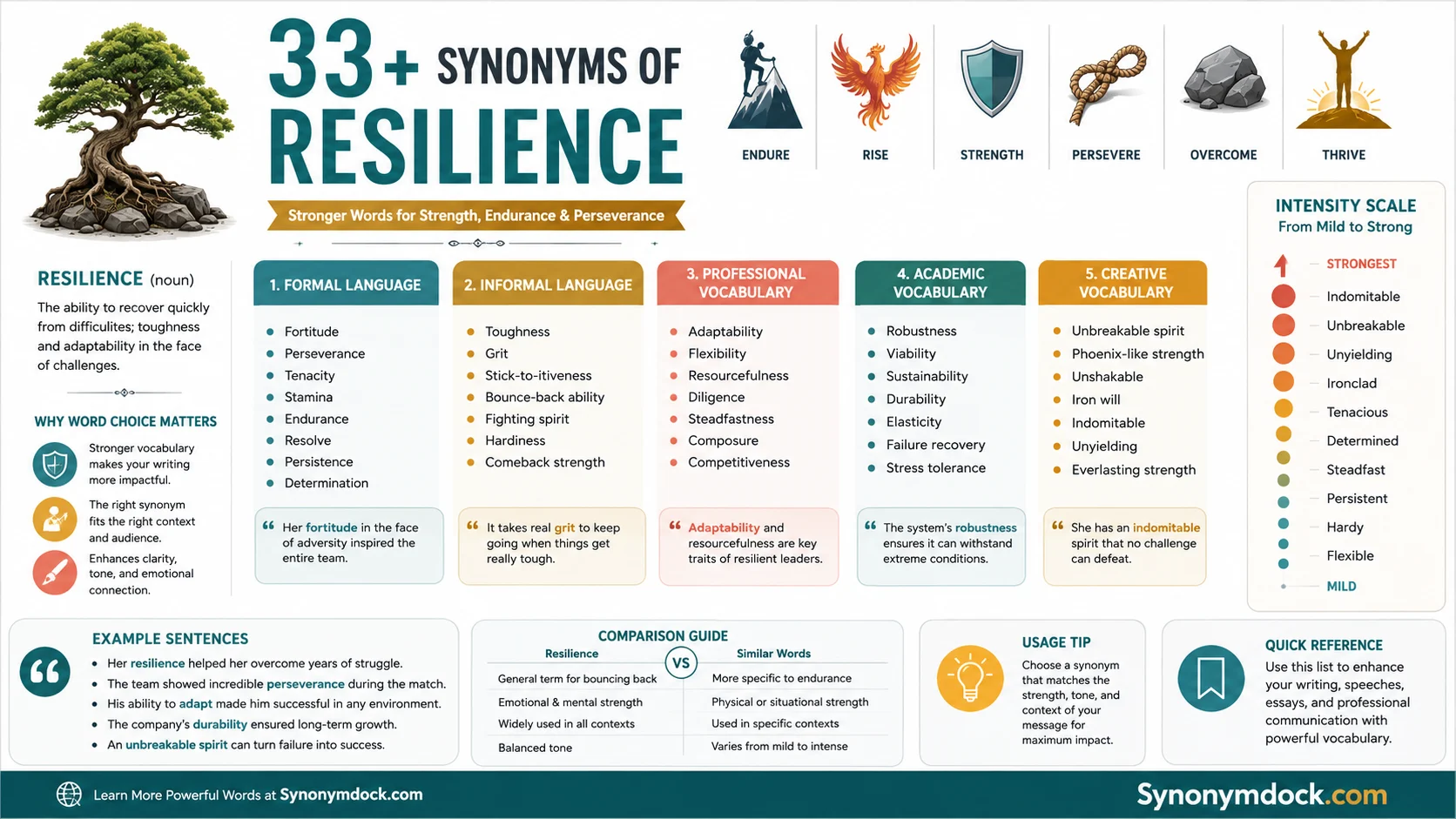
Resilience means the capacity to recover quickly from difficulties, setbacks, or change. Its overall tone is positive and empowering. For formal writing, use “fortitude” or “perseverance.” For casual conversation, use “toughness” or “grit.” For academic writing, use “adaptability” or “hardiness.” For professional communication, use “tenacity” or “determination.” For emotional writing, use “strength” or “endurance.”
You are writing a cover letter and want to describe your ability to handle challenges. You write “resilience” once, then again, and by the third time it feels repetitive. Finding the right synonym of resilience can transform your writing from ordinary to impressive. The right word shows strength, adaptability, and emotional intelligence. It helps you communicate exactly what you mean in job applications, essays, speeches, and everyday conversations. Choosing precise vocabulary makes your message clearer and more memorable.
Meaning, Tone, and Context
Simple Definition
Resilience is the ability to bounce back from adversity, stress, or change. It describes mental, emotional, or physical strength in the face of difficulty.
Part of Speech
Noun
Overall Tone
Positive and empowering. Resilience is almost always viewed as a desirable quality.
Formality Level
Neutral. Resilience works well in both formal and informal settings.
Common Uses
Native English speakers use “resilience” to describe people who overcome challenges. It appears in psychology, business, education, and personal development. You might talk about economic resilience, emotional resilience, or community resilience.
Word Forms
- Resilience (noun)
- Resilient (adjective)
- Resiliently (adverb)
- Resile (verb, rare)
When and How to Use “Resilience”
Choose “resilience” when you want to emphasize the ability to recover from hardship. It is a powerful word that conveys strength and optimism. Here are seven realistic examples.
Professional
“Her resilience during the company restructuring inspired the entire team to stay focused.”
Academic
“This study examines the psychological resilience of first-generation college students.”
Workplace
“We need to build resilience in our supply chain to handle future disruptions.”
Personal
“His resilience after losing his job was remarkable. He started a new career within months.”
“I admire your resilience throughout this difficult project. Your dedication made the difference.”
Resume
“Demonstrated resilience by leading the team through three major organizational changes.”
Social Media
“Some days are harder than others, but resilience keeps me moving forward.”
Best Synonyms of “Resilience”
No synonym is perfect for every situation. Here are the best synonyms grouped by context.
Professional writing → Tenacity
Why it works: “Tenacity” suggests determined persistence toward a goal. It sounds ambitious and focused.
Academic writing → Adaptability
Why it works: “Adaptability” highlights the ability to adjust to new conditions, which is central to resilience research.
Business communication → Fortitude
Why it works: “Fortitude” conveys quiet strength and courage under pressure. It sounds dignified and professional.
Casual conversation → Grit
Why it works: “Grit” is informal and vivid. It captures determination in a down-to-earth way.
Emotional writing → Strength
Why it works: “Strength” is simple and deeply human. It resonates with readers on an emotional level.
Creative writing → Indomitability
Why it works: “Indomitability” suggests an unconquerable spirit. It adds dramatic, literary flair.
Resume writing → Perseverance
Why it works: “Perseverance” shows sustained effort over time. Employers value this quality highly.
Workplace communication → Hardiness
Why it works: “Hardiness” is a specific term for mental and physical toughness. It fits professional contexts well.
Stronger meaning → Invincibility
Why it works: “Invincibility” suggests complete immunity to failure. It is the strongest possible form of resilience.
Softer meaning → Coping ability
Why it works: “Coping ability” sounds practical and manageable. It lowers the intensity while still being accurate.
When Not to Use “Resilience”
Sometimes “resilience” is not the best choice.
When it sounds too general
If you need to describe specific, sustained effort, “resilience” can feel vague. Use “perseverance” or “tenacity” instead.
Weak: “He showed resilience in completing the marathon.”
Better: “He showed perseverance in completing the marathon despite the injury.”
When it sounds too positive
“Resilience” assumes a positive outcome. In some contexts, you might need a more neutral word like “endurance.”
Weak: “She showed resilience during the tragic event.”
Better: “She showed endurance during the tragic event.”
When you need emotional depth
“Resilience” can sound clinical. Use “courage” or “bravery” for more emotional impact.
Weak: “His resilience was inspiring.”
Better: “His courage was inspiring.”
When you need to describe growth
“Resilience” is about recovery, not growth. Use “flourishing” or “thriving” to describe positive growth after adversity.
Weak: “She showed resilience and became stronger.”
Better: “She showed resilience and thrived as a result.”
Words Commonly Confused With “Resilience”
Resilience vs. Perseverance
- Difference: “Perseverance” focuses on continued effort toward a goal. “Resilience” focuses on recovering from setbacks.
- When to Use It: Use “perseverance” when you want to highlight sustained effort over time.
- Example: “His perseverance through years of training finally paid off.”
Resilience vs. Tenacity
- Difference: “Tenacity” implies stubborn determination. “Resilience” implies flexible recovery.
- When to Use It: Use “tenacity” when you want to emphasize determination and refusal to give up.
- Example: “She held on with tenacity long after others would have quit.”
Resilience vs. Fortitude
- Difference: “Fortitude” suggests inner strength and courage. “Resilience” suggests the ability to bounce back.
- When to Use It: Use “fortitude” in formal contexts that require dignity and moral strength.
- Example: “He faced the criticism with remarkable fortitude.”
Resilience vs. Grit
- Difference: “Grit” is informal and emphasizes passion and persistence. “Resilience” is more formal and emphasizes recovery.
- When to Use It: Use “grit” in casual conversation or motivational writing.
- Example: “It takes grit to succeed in this competitive industry.”
Resilience vs. Adaptability
- Difference: “Adaptability” focuses on adjusting to change. “Resilience” focuses on recovering from difficulty.
- When to Use It: Use “adaptability” in academic or business writing about change management.
- Example: “Her adaptability made her valuable during the company transition.”
Resilience vs. Hardiness
- Difference: “Hardiness” is a psychological term for resilience under stress. It is more specific.
- When to Use It: Use “hardiness” in psychology or health-related contexts.
- Example: “Hardiness is a key factor in managing workplace stress effectively.”
Best Synonyms of “Resilience” by Context
| Context | Best Synonym | Why It Works | Example |
|---|---|---|---|
| Formal writing | Fortitude | Conveys dignified inner strength | “The community showed remarkable fortitude during the crisis.” |
| Academic writing | Adaptability | Fits research and scholarly discussion | “Adaptability is a key measure of psychological resilience.” |
| Professional communication | Tenacity | Sounds determined and ambitious | “Her tenacity drove the project to completion.” |
| Business emails | Determination | Professional and straightforward | “Thank you for your determination in resolving this issue.” |
| Resume writing | Perseverance | Shows sustained effort and commitment | “Demonstrated perseverance in achieving all quarterly targets.” |
| Workplace communication | Hardiness | Specific and professional | “Hardiness in employees reduces burnout risk.” |
| Casual conversation | Grit | Vivid, relatable, and informal | “It takes grit to keep going when things get tough.” |
| Everyday speaking | Toughness | Simple and direct | “She has the toughness to handle any situation.” |
| Creative writing | Indomitability | Literary and dramatic | “Her indomitable spirit could not be broken.” |
| Storytelling | Endurance | Evokes physical and emotional stamina | “His endurance through the war became legendary.” |
| Emotional writing | Strength | Human and deeply resonant | “She found strength she never knew she had.” |
| Strong emphasis | Invincibility | Suggests unstoppable power | “He faced every challenge with a sense of invincibility.” |
| Mild tone | Coping ability | Gentle and practical | “Her coping ability improved with each challenge.” |
| Social media captions | Grit | Short, catchy, and motivational | “Keep your grit. The hard days build character.” |
| American English | Grit | Widely used in casual and motivational contexts | “American grit is celebrated in sports and business.” |
How to Choose the Best Synonym of “Resilience”
Choosing the right synonym does not need to be complicated. Follow this simple decision guide.
- What is your purpose?
To describe recovery from difficulty? Use “resilience.” To describe sustained effort? Use “perseverance.” - Who is your audience?
For an academic audience, use “adaptability.” For a business audience, use “tenacity.” For friends, use “grit.” - What tone do you want?
Formal? Use “fortitude.” Casual? Use “toughness.” Emotional? Use “strength.” - How strong do you want to sound?
For mild resilience, use “coping ability.” For very strong resilience, use “invincibility.” - Does it sound natural?
Read your sentence aloud. If the synonym feels forced, try a different one.
Real Life Examples of “Resilience”
School
“Learning a new language requires resilience. You make mistakes, you feel frustrated, and then you try again.”
College
“Graduate school tested her resilience. She faced rejection, difficult coursework, and doubt, but she never gave up.”
Workplace
“The team’s resilience turned a failing project into a success. They adapted their strategy and worked through every obstacle.”
Business
“Market downturns reveal a company’s resilience. The strongest businesses adjust and emerge stronger.”
“I want to acknowledge your resilience during this challenging quarter. Your efforts have not gone unnoticed.”
Resume
“Demonstrated resilience by successfully managing five concurrent high-priority projects with limited resources.”
Conversation
“I do not know how you stay so positive. Your resilience is honestly inspiring to everyone around you.”
Storytelling
“The village showed resilience after the flood. They rebuilt their homes and their lives with quiet determination.
Blogging
“Resilience is not about avoiding failure. It is about learning to get back up every single time you fall.”
Social Media
“Resilience looks like showing up even when you do not feel like it.”
25 Best Synonyms of “Resilience”
| Synonym | Simple Meaning | Best Used For | Example Sentence |
|---|---|---|---|
| Fortitude | Inner strength and courage in adversity | Formal and dignified writing | “She faced her illness with extraordinary fortitude.” |
| Perseverance | Continued effort despite difficulty | Resume and academic writing | “His perseverance through setbacks earned him respect.” |
| Tenacity | Persistent determination to achieve | Professional and business contexts | “Her tenacity secured the deal against all odds.” |
| Grit | Informal courage and persistence | Casual and motivational writing | “Grit matters more than talent in the long run.” |
| Adaptability | Ability to adjust to new conditions | Academic and business writing | “Adaptability is essential in a rapidly changing market.” |
| Hardiness | Psychological toughness under stress | Psychology and workplace contexts | “Hardiness protects employees from burnout.” |
| Determination | Firmness of purpose | Professional and personal writing | “His determination to succeed never wavered.” |
| Strength | Inner power to face challenges | Emotional and personal writing | “She drew strength from her family during hard times.” |
| Resistance | Ability to withstand pressure | Technical and defensive contexts | “The building showed resistance to earthquake damage.” |
| Pluck | Informal courage and spirit | Conversational and storytelling | “She showed real pluck when she stood up to the critics.” |
| Invincibility | Unable to be defeated | Strong, dramatic contexts | “The team played with a sense of invincibility.” |
Synonyms of “Resilience” by Usage
Professional vs Personal Synonyms
Professional: Tenacity, Perseverance, Determination, Fortitude
Personal: Grit, Strength, Toughness, Spunk
Formal vs Conversational Synonyms
Formal (Reports, Essays): Fortitude, Perseverance, Stoicism, Indomitability
Conversational (Texting, Speech): Grit, Toughness, Pluck, Spunk
Academic Synonyms
Use these for research papers and scholarly discussions: Adaptability, Hardiness, Resilience, Coping ability. These terms have specific meanings in psychology and social science research.
Professional and Business Synonyms
Use these in resumes, meetings, and client communication: Tenacity, Determination, Perseverance, Flexibility. They show valuable workplace qualities.
Creative and Literary Synonyms
Use these in fiction and descriptive writing: Indomitability, Mettle, Stoicism, Courage. They add dramatic depth and emotional resonance.
Slang or Modern Synonyms
- Grit: Widely used in motivational contexts. Acceptable in casual and professional writing.
- Pluck: Somewhat old-fashioned but still used in storytelling.
- Spunk: Informal. Use in casual conversation but avoid in formal writing.
Strongest to Mildest Synonyms
| Intensity | Synonym |
|---|---|
| Mild | Coping ability |
| Moderate | Resilience, Endurance |
| Strong | Tenacity, Fortitude |
| Very Strong | Invincibility, Indomitability |
Emotional vs Neutral Synonyms
Emotional: Courage, Strength, Mettle, Grit (these connect to feelings and human struggle)
Neutral: Adaptability, Hardiness, Tolerance, Resistance (these describe capacity without emotional coloring)
Antonyms of “Resilience”
| Antonym | Meaning | Example Sentence |
|---|---|---|
| Fragility | Easily broken or damaged | “The community’s fragility was exposed by the economic crisis.” |
| Vulnerability | Susceptible to harm or attack | “His vulnerability made him unable to cope with the stress.” |
| Weakness | Lack of strength or ability | “The team’s weakness was evident when they faced opposition.” |
| Helplessness | Unable to help oneself | “Her helplessness in the situation was heartbreaking.” |
| Frailty | Physical or moral weakness | “The frailty of the infrastructure became clear after the storm.” |
| Brittleness | Easily broken under pressure | “His brittleness under criticism made him difficult to work with.” |
| Delicacy | Fragile or easily damaged | “The delicacy of the ecosystem concerned the researchers.” |
| Sensitivity | Quick to react emotionally | “His sensitivity made it hard for him to handle feedback.” |
| Breakability | Tendency to break under stress | “The breakability of the material made it unsuitable.” |
| Inflexibility | Unable to adapt to change | “Her inflexibility caused problems during the transition.” |
| Rigidity | Stiff and unadaptable | “The rigidity of his thinking prevented innovation.” |
| Instability | Not steady or constant | “The instability of the economy worried investors.” |
| Conformity | Compliance without resistance | “His conformity meant he never challenged the system.” |
| Surrender | Giving up or yielding | “Her surrender to despair disappointed her supporters.” |
| Giving in | Yielding to pressure | “His giving in to demands revealed his lack of resolve.” |
Comparison: “Resilience” vs Similar Words
Resilience vs Perseverance
- Main Difference: “Resilience” is about bouncing back. “Perseverance” is about continuing forward.
- Which Is Stronger? Perseverance implies longer sustained effort.
- Which Is More Formal? Both are formal, but perseverance is slightly more academic.
- When to Use Each: Use “resilience” after a setback. Use “perseverance” for ongoing effort.
- Examples:
- Resilience: “Her resilience helped her recover from the failure.”
- Perseverance: “His perseverance finally led to success.”
Resilience vs Fortitude
- Main Difference: “Fortitude” emphasizes moral courage. “Resilience” emphasizes practical recovery.
- Which Is Stronger? Fortitude suggests deeper inner strength.
- Which Is More Formal? Fortitude is more formal and elevated.
- When to Use Each: Use “resilience” for general contexts. Use “fortitude” for dignified contexts.
- Examples:
- Resilience: “She showed resilience in rebuilding her life.”
- Fortitude: “He showed fortitude in the face of unjust criticism.”
Resilience vs Grit
- Main Difference: “Grit” is informal and passionate. “Resilience” is formal and clinical.
- Which Is Stronger? Grit suggests more intense passion.
- Which Is More Formal? Resilience is much more formal.
- When to Use Each: Use “grit” in casual or motivational writing. Use “resilience” in professional contexts.
- Examples:
- Resilience: “The study measured resilience in adolescents.”
- Grit: “It takes grit to succeed as an entrepreneur.”
Resilience vs Hardiness
- Main Difference: “Hardiness” is a specific psychological term. “Resilience” is broader.
- Which Is Stronger? Hardiness is more scientifically precise.
- Which Is More Formal? Hardiness is specialized.
- When to Use Each: Use “hardiness” in psychology or health writing. Use “resilience” for general use.
- Examples:
- Resilience: “The community’s resilience was inspiring.”
- Hardiness: “Hardiness training reduces stress in military personnel.”
Common Phrases and Expressions with “Resilience”
Show resilience
- Meaning: To demonstrate the ability to recover from difficulty.
- Example: “She showed resilience by bouncing back after the rejection.”
Build resilience
- Meaning: To develop the capacity to withstand stress.
- Example: “Exercise and mindfulness help build resilience against anxiety.”
Emotional resilience
- Meaning: The ability to cope with emotional challenges.
- Example: “Emotional resilience is important for maintaining mental health.”
Resilience in the face of
- Meaning: Maintaining strength when confronted with something difficult.
- Example: “His resilience in the face of adversity inspired everyone.”
Resilience and determination
- Meaning: A combination of bouncing back and staying focused.
- Example: “Her resilience and determination made her a natural leader.”
Test your resilience
- Meaning: To challenge someone’s ability to handle stress.
- Example: “The crisis truly tested our resilience as a team.”
Common Mistakes to Avoid
Mistake 1: Confusing Resilience with Perseverance
Incorrect: “His resilience to finish the race was impressive.” (Wrong focus)
Better: “His perseverance to finish the race was impressive.”
Why: “Perseverance” is about continuing effort. “Resilience” is about recovering from setbacks.
Mistake 2: Using Grit in Formal Writing
Incorrect: “The research measured grit in older populations.”
Better: “The research measured resilience in older populations.”
Why: “Grit” is informal and may not be appropriate for academic research.
Mistake 3: Choosing a Vague Synonym
Incorrect: “She showed strength by making dinner.” (Too vague)
Better: “She showed resilience by rebuilding her career after layoffs.”
Why: “Strength” is too general. “Resilience” is more specific.
Mistake 4: Using Resilience When You Mean Adaptability
Incorrect: “The software showed resilience to the new operating system.”
Better: “The software showed adaptability to the new operating system.”
Why: Software adjusts to change; it does not “recover” from it.
Mistake 5: Repeating the Same Word Too Often
Incorrect: “Resilience is key. The project requires resilience. We need resilience.”
Better: “Resilience is key. The project requires tenacity. We need determination.”
Why: Variation keeps writing fresh and engaging.
Mistake 6: Using Resilience for Physical Strength
Incorrect: “His resilience helped him lift 300 pounds.”
Better: “His strength helped him lift 300 pounds.”
Why: “Resilience” is emotional and mental. “Strength” is physical.
Frequently Asked Questions
What are the best synonyms of “resilience”?
The best synonyms depend on context. For professional settings, use “tenacity” or “fortitude.” For casual conversation, use “grit” or “toughness.” For academic writing, use “adaptability” or “hardiness.”
What are the best formal synonyms of “resilience”?
The best formal synonyms include “fortitude,” “perseverance,” “stoicism,” and “indomitability.” These words are appropriate for academic papers, legal documents, and professional reports.
What are common informal synonyms of “resilience”?
Common informal synonyms include “grit,” “toughness,” “pluck,” and “spunk.” These are perfect for conversations, text messages, and motivational content.
What is another word for “resilience” in professional writing?
In professional writing, use “tenacity,” “determination,” “perseverance,” or “flexibility.” These words demonstrate valuable workplace qualities and sound polished.
What is the difference between “resilience” and “perseverance”?
“Resilience” is about bouncing back from setbacks. “Perseverance” is about continuing effort toward a goal despite difficulties. Resilience focuses on recovery; perseverance focuses on sustained action.
What is the opposite of “resilience”?
The most direct opposite is “fragility.” Other antonyms include “vulnerability,” “weakness,” “helplessness,” and “frailty.” These describe a lack of strength or ability to withstand hardship.
Conclusion
Resilience is a powerful word that captures the human ability to recover, adapt, and grow through adversity. It describes emotional strength, mental toughness, and the capacity to keep going when things get hard. But language offers many alternatives to this one word. Choosing the right synonym of resilience can make your writing more precise and impactful.
No single synonym fits every situation. The best word depends on your audience, your tone, and your purpose. For formal writing, choose “fortitude.” For casual conversation, choose “grit.” For academic writing, choose “adaptability.” For professional writing, choose “tenacity” or “determination.”
A practical tip: before you write, ask yourself what aspect of resilience you are describing. Is it recovery? Persistence? Courage? Adaptability? The answer will guide your word choice. With practice, selecting the perfect word becomes second nature.

4 thoughts on “33+ Synonyms of Resilience| Meaningsand Best Alternatives 2026”