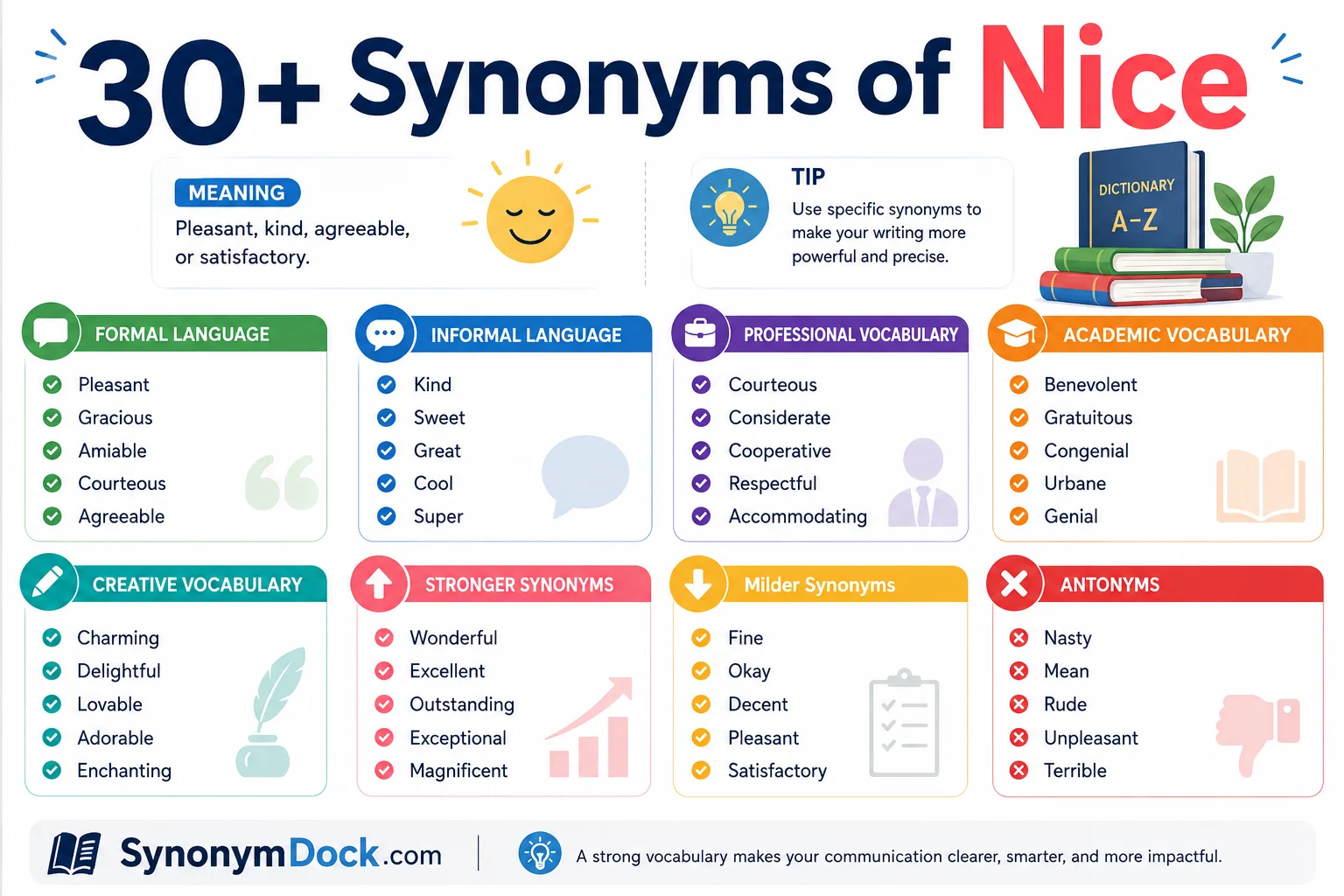
Nice means pleasant, agreeable, or kind. The best synonym depends on your context. For professional writing, use courteous or professional. For academic writing, use precise or meticulous. For casual conversation, use lovely or great. For describing people, use kind, friendly, or charming. For describing things, use pleasant, delightful, or enjoyable.
You are writing an email to a colleague. You want to compliment their work. You type “nice job.” Then you pause. It feels too ordinary. Too forgettable.
You write an essay for class. Your teacher asks you to avoid overused words. You see “nice” appearing three times in one paragraph. You know you need a stronger word.
Choosing the right synonym of nice can transform your writing. It helps you sound more professional. More precise. More confident.
This guide helps you find the perfect word for every situation. You will learn what nice really means. You will discover synonyms for professional writing, casual conversation, academic papers, and creative projects. You will understand the differences between similar words. You will avoid common mistakes.
Let us find the right word together.
Meaning, Tone, and Context
Simple Definition
Nice is an adjective that describes something pleasant, agreeable, or kind. It can describe a person, an experience, an object, or a situation.
Part of Speech
Adjective
Overall Tone
Positive. The word carries a generally favorable meaning.
Formality Level
Neutral to informal. Nice is widely used in everyday conversation. It is acceptable in most informal and semi-formal writing. In very formal or academic writing, more precise synonyms are preferred.
Common Uses
Native English speakers use nice in many situations. They use it to compliment people. They use it to describe enjoyable experiences. They use it to express approval.
- Complimenting someone: “She is a nice person.”
- Describing an experience: “We had a nice time at the park.”
- Expressing approval: “That is a nice dress.”
- Describing weather: “It is a nice day.”
Word Forms
- Adjective: nice (the standard form)
- Comparative: nicer
- Superlative: nicest
- Adverb: nicely
- Noun: niceness
When and How to Use “Nice”
Choose nice when you want a simple, positive word. It works well in everyday conversation and casual writing. However, it can become vague if overused.
Here are 7 examples showing how nice works in different contexts.
Professional Context
“Thank you for the nice introduction during the meeting.”
This is acceptable but could be stronger. More specific words like thoughtful or gracious might be better.
Academic Context
“The study produced nice results.”
In academic writing, this is too vague. Use more precise language like significant or positive.
Workplace Context
“She has a nice attitude toward her coworkers.”
This is okay but vague. Words like positive, friendly, or supportive are more effective.
Personal Context
“We had a nice dinner together.”
This is natural and common in casual conversation. It clearly communicates a pleasant experience.
Email Context
“It was nice to meet you at the conference.”
This is friendly and appropriate for follow-up emails.
Resume Context
“I have nice communication skills.”
This is too weak. Use excellent, strong, or effective communication skills instead.
Social Media Context
“Had a nice day at the beach.”
This is suitable for casual social media posts.
Best Synonyms of “Nice”
No synonym is identical in every situation. Each word carries its own tone and intensity. The best choice depends on your audience and purpose.
Best Synonym for Professional Writing
Courteous is the best choice. It means polite and respectful. It is formal enough for workplace communication.
Best Synonym for Academic Writing
Precise or meticulous are excellent choices. They describe attention to detail and careful accuracy.
Best Synonym for Business Communication
Professional or pleasing work well. They sound polished and competent.
Best Synonym for Casual Conversation
Great or lovely fit naturally. They are common and friendly.
Best Synonym for Emotional Writing
Kind or tender express warmth and care.
Best Synonym for Creative Writing
Delightful or enchanting add charm and personality.
Best Synonym for Resume Writing
Personable or amiable describe interpersonal skills effectively.
Best Synonym for Workplace Communication
Helpful or supportive clearly describe positive behavior at work.
Best Synonym for Stronger Meaning
Superb or excellent communicate a higher level of approval.
Best Synonym for Softer Meaning
Agreeable or pleasant are mild and gentle.
When Not to Use “Nice”
There are times when nice is not the best choice. It can sound too general, too vague, or too informal.
When It Sounds Too Vague
Situation: Describing a research finding in an academic paper.
Original: “The experiment produced nice results.”
Why It Is Weak: Nice does not communicate what made the results good. It lacks specificity.
Better Option: “The experiment produced promising results.”
When It Sounds Too Informal
Situation: Writing a formal business proposal.
Original: “We believe this is a nice opportunity for collaboration.”
Why It Is Weak: Nice does not sound serious or professional enough.
Better Option: “We believe this is a valuable opportunity for collaboration.”
When It Sounds Too Weak
Situation: Writing a letter of recommendation.
Original: “She did a nice job leading the team.”
Why It Is Weak: Nice does not convey the strength of her performance.
Better Option: “She did an outstanding job leading the team.”
When It Sounds Outdated
Situation: Using “nice” in the older sense of precise or exact.
Original: “He drew a nice distinction between the two concepts.”
Why It Is Old-Fashioned: This use is now rare and may sound odd to modern readers.
Better Option: “He drew a precise distinction between the two concepts.”
Words Commonly Confused With “Nice”
Nice vs Kind
Difference: Kind focuses on care and compassion for others. Nice focuses on general pleasantness.
When to Use It: Use kind when describing someone who genuinely cares about others. Use nice for general pleasantness.
Nice Example: “She is a nice person to talk to.”
Kind Example: “She is a kind person who always helps others.”
Nice vs Pleasant
Difference: Pleasant describes something that creates a sense of general satisfaction or enjoyment. Nice is more general.
When to Use It: Use pleasant when describing an experience. Use nice when describing a person or a quality.
Nice Example: “We met at a nice restaurant.”
Pleasant Example: “We had a pleasant conversation.”
Nice vs Agreeable
Difference: Agreeable suggests willingness to accept or agree with others. Nice suggests general pleasantness.
When to Use It: Use agreeable when describing someone who is easy to work with. Use nice for friendliness.
Nice Example: “He is a nice neighbor.”
Agreeable Example: “He is an agreeable colleague who rarely complains.”
Nice vs Courteous
Difference: Courteous specifically means polite and respectful. Nice is more general and informal.
When to Use It: Use courteous in professional settings. Use nice in casual conversation.
Nice Example: “The cashier was nice.”
Courteous Example: “The hotel staff was courteous.”
Nice vs Charming
Difference: Charming suggests an attractive and pleasing personality or appearance. Nice is more neutral.
When to Use It: Use charming when describing someone with magnetic appeal. Use nice for simple pleasantness.
Nice Example: “She is a nice host.”
Charming Example: “She is a charming host who makes everyone feel welcome.”
Nice vs Delightful
Difference: Delightful suggests something that brings great pleasure or joy. Nice is much milder.
When to Use It: Use delightful when you want to express strong enjoyment. Use nice for mild satisfaction.
Nice Example: “We had a nice afternoon.”
Delightful Example: “We had a delightful afternoon exploring the gardens.”
Best Synonyms of “Nice” by Context
| Context | Best Synonym | Why It Works | Example |
|---|---|---|---|
| Formal writing | Courteous | Shows politeness and professionalism | The staff were courteous throughout our visit. |
| Academic writing | Precise | Shows careful attention to detail | The researcher provided precise measurements. |
| Professional communication | Professional | Conveys competence and maturity | Her professional demeanor impressed the clients. |
| Business emails | Pleasing | Sounds positive and professional | Your proposal was pleasing to our team. |
| Resume writing | Personable | Describes good interpersonal skills | Personable and effective team leader. |
| Workplace communication | Helpful | Shows cooperation and support | She is always helpful to new employees. |
| Casual conversation | Great | Natural and commonly used | We had a great time at the party. |
| Everyday speaking | Lovely | Warm and friendly | It was a lovely evening. |
| Creative writing | Delightful | Adds charm and personality | The delightful garden was full of flowers. |
| Storytelling | Enchanting | Creates a magical or compelling feeling | The enchanting village captured their hearts. |
| Emotional writing | Kind | Expresses genuine warmth and care | Her kind words meant everything. |
| Strong emphasis | Excellent | Communicates high quality | The service was excellent. |
| Mild tone | Agreeable | Gentle and easygoing | He had an agreeable manner. |
| Social media captions | Amazing | Creates strong, positive engagement | Had an amazing day at the museum! |
| American English | Good | Universal and widely accepted | We had a good meal at the restaurant. |
How to Choose the Best Synonym of “Nice”
Choosing the right synonym is a decision-making process. Follow these steps.
Step 1: Identify your purpose. Are you writing a report or a text message?
Step 2: Consider your audience. Who will read this? A manager? A friend? A teacher?
Step 3: Determine the tone. Do you want formal, casual, or emotional language?
Step 4: Decide on intensity. Do you want a mild, moderate, or strong word?
Step 5: Choose a word that sounds natural. Read your sentence aloud. Does it flow?
Step 6: Test the word. Does it communicate your intended message clearly?
Quick Decision Guide
| If you want to… | Choose… |
|---|---|
| Sound professional | Courteous, professional |
| Sound academic | Precise, meticulous |
| Sound friendly | Kind, friendly, lovely |
| Describe an experience | Pleasant, enjoyable |
| Express strong approval | Excellent, wonderful |
| Keep it simple | Good, great |
| Add charm or creativity | Delightful, enchanting |
Real Life Examples of “Nice”
School Example
Sarah always says nice things about her classmates.
Better: “Sarah always says encouraging things about her classmates.”
College Example
“The professor gave us a nice overview of the topic.”
Better: “The professor gave us a comprehensive overview of the topic.”
Workplace Example
“He is a nice person to work with.”
Better: “He is a collaborative person to work with.”
Business Example
“We received a nice response from our customers.”
Better: “We received a positive response from our customers.”
Email Example
“It was nice to connect with you yesterday.”
Better: “It was wonderful to connect with you yesterday.”
Resume Example
“I have nice organizational skills.”
Better: “I have strong organizational skills.”
Conversation Example
“That is a nice idea.”
Better: “That is a great idea.”
Storytelling Example
“The nice old man gave the children sweets.”
Better: “The kind old man gave the children sweets.”
Blogging Example
“This is a nice product for beginners.”
Better: “This is an excellent product for beginners.”
Social Media Example
“Had a nice weekend away.”
Better: “Had an amazing weekend away.”
25 Best Synonyms of “Nice”
| Synonym | Simple Meaning | Best Used For | Example Sentence |
|---|---|---|---|
| Pleasant | Enjoyable and agreeable | Describing experiences and people | We had a pleasant walk through the park. |
| Kind | Caring and compassionate | Describing people’s character | She is a kind person who helps everyone. |
| Friendly | Warm and sociable | Describing people and interactions | The staff at the hotel were very friendly. |
| Delightful | Very pleasing and enjoyable | Creative and expressive writing | The garden was a delightful place to relax. |
| Enjoyable | Giving pleasure and satisfaction | Describing activities and events | The concert was truly enjoyable. |
| Courteous | Polite and respectful | Professional settings | The customer service was courteous and efficient. |
| Agreeable | Pleasant and easy to get along with | Describing personalities | He has an agreeable nature that makes him easy to work with. |
| Charming | Attractive and charismatic | Social and personal descriptions | She is a charming hostess who makes everyone feel at home. |
| Personable | Pleasant and outgoing in social settings | Resumes and professional profiles | Our personable agent answered all our questions. |
| Gracious | Elegant and courteous | Formal descriptions | She made a gracious speech at the awards ceremony. |
| Considerate | Thinking of others’ feelings | Describing thoughtful people | He is considerate of his colleagues’ schedules. |
| Helpful | Giving assistance and support | Professional environments | The tech support team was very helpful. |
| Refined | Elegant and cultured | Artistic or sophisticated contexts | The restaurant had a refined atmosphere. |
| Superb | Excellent and of high quality | Strong positive emphasis | The chef prepared a superb meal. |
| Fine | Of good quality | General approval | The company did fine work on the project. |
| Admirable | Deserving respect and approval | Formal praise | Her dedication to the cause is admirable. |
Synonyms of “Nice” by Usage
Professional vs Personal Synonyms
Professional Synonyms
- Courteous
- Professional
- Helpful
- Personable
- Gracious
These words are suitable for job interviews, performance reviews, and professional emails.
Personal Synonyms
- Kind
- Friendly
- Lovely
- Great
- Pleasant
These words are natural in everyday conversation with friends and family.
Formal vs Conversational Synonyms
Formal Synonyms
Use these in reports, essays, business writing, presentations, and official emails:
- Courteous
- Gracious
- Refined
- Elegant
- Considerate
Conversational Synonyms
Use these in casual conversations, texting, and informal writing:
- Great
- Lovely
- Good
- Nice
- Cool
Academic Synonyms
These precise words are suitable for research, essays, reports, and academic discussions:
- Meticulous (showing careful attention to detail)
- Precise (exact and accurate)
- Rigorous (thorough and accurate)
- Systematic (methodical and organized)
- Thorough (complete and careful)
These words sound more authoritative and demonstrate a higher level of analysis.
Professional and Business Synonyms
These are the strongest choices for resumes, interviews, meetings, presentations, performance reviews, client communication, and business emails:
- Personable (pleasant and easy to work with)
- Professional (showing competence and skill)
- Helpful (willing to assist)
- Courteous (polite and respectful)
- Efficient (productive and effective)
These words communicate competence and professionalism .
Creative and Literary Synonyms
These expressive alternatives are suitable for storytelling, fiction, poetry, descriptive writing, and speeches:
- Enchanting (captivating and delightful)
- Delightful (highly pleasing)
- Captivating (attracting and holding interest)
- Exquisite (extremely beautiful)
- Sublime (of outstanding spiritual beauty)
These words add emotion and imagery to creative writing.
Slang or Modern Synonyms
Some modern or casual synonyms include:
- Dope (meaning excellent, used in informal speech)
- Fire (meaning outstanding, used in modern slang)
- Legit (meaning genuine or good, used in casual speech)
Avoid these in professional or academic writing.
Strongest to Mildest Synonyms
This scale shows how emotional intensity changes.
Mild
- Acceptable
- Okay
- Fine
- Pleasant
- Agreeable
Moderate
- Nice
- Good
- Great
- Friendly
- Enjoyable
Strong
- Excellent
- Wonderful
- Delightful
- Kind
- Courteous
Very Strong
- Superb
- Outstanding
- Exceptional
- Magnificent
- Extraordinary
Emotional vs Neutral Synonyms
Emotional Synonyms
These words express stronger feelings and personal reactions:
- Wonderful (expresses strong delight)
- Lovely (expresses warm affection)
- Delightful (expresses great pleasure)
- Charming (expresses attraction and appeal)
Use emotional synonyms when you want to show your feelings.
Neutral Synonyms
These words simply communicate information without strong emotion:
- Pleasant (generally agreeable)
- Acceptable (satisfactory)
- Adequate (sufficient)
- Fine (of good quality)
Use neutral synonyms when you want to remain objective .
Antonyms of “Nice”
| Antonym | Meaning | Example Sentence |
|---|---|---|
| Mean | Unkind and unpleasant | The mean comment upset everyone. |
| Unpleasant | Not enjoyable or agreeable | The weather was unpleasant all weekend. |
| Rude | Impolite and disrespectful | The rude customer shouted at the waiter. |
| Cruel | Willfully causing pain or suffering | His cruel words hurt her deeply. |
| Nasty | Highly unpleasant and mean | The nasty review damaged his reputation. |
| Harsh | Severe and unkind | The harsh criticism made her cry. |
| Unkind | Lacking kindness | The unkind remark was unnecessary. |
| Disagreeable | Unpleasant and hard to get along with | The disagreeable manager made work difficult. |
| Hostile | Unfriendly and aggressive | The hostile audience booed the speaker. |
| Abrasive | Rough and harsh in manner | Her abrasive personality turned people away. |
| Offensive | Causing hurt or upset | His offensive joke was not appreciated. |
| Vile | Extremely unpleasant and bad | The vile behavior disgusted everyone. |
| Wicked | Evil and morally wrong | The wicked character in the story frightened the children. |
| Heartless | Lacking compassion and feeling | The heartless decision left employees without jobs. |
| Malicious | Intended to cause harm | The malicious gossip spread quickly. |
Comparison: “Nice” vs Similar Words
Nice vs Kind
Main Difference: Nice focuses on general pleasantness. Kind focuses on genuine care and compassion for others.
Which Is Stronger? Kind is stronger. It implies a deeper level of goodness.
Which Is More Formal? Kind is slightly more formal, though both are used informally.
When to Use Each: Use nice for casual compliments. Use kind when describing someone’s true character .
Examples:
- Nice: “She is a nice woman.”
- Kind: “She is a kind woman who volunteers at the shelter.”
Nice vs Pleasant
Main Difference: Pleasant describes an experience or feeling. Nice is broader and can describe people or objects.
Which Is Stronger? Pleasant suggests a more satisfying experience than nice.
Which Is More Formal? Pleasant is slightly more formal.
When to Use Each: Use pleasant to describe experiences. Use nice for general statements.
Examples:
- Nice: “We had a nice time.”
- Pleasant: “We had a pleasant time at the resort.”
Nice vs Agreeable
Main Difference: Agreeable means willing to accept or agree. Nice means generally pleasant.
Which Is Stronger? Agreeable is more specific and often stronger in describing ease.
Which Is More Formal? Agreeable is more formal.
When to Use Each: Use agreeable to describe cooperative people. Use nice for general praise.
Examples:
- Nice: “He is a nice person.”
- Agreeable: “He is an agreeable person who goes along with most plans.”
Nice vs Courteous
Main Difference: Courteous specifically describes politeness. Nice is more general.
Which Is Stronger? Courteous is stronger in describing good manners.
Which Is More Formal? Courteous is much more formal.
When to Use Each: Use courteous in professional settings. Use nice in casual conversation.
Examples:
- Nice: “The server was nice.”
- Courteous: “The airline staff were courteous throughout.”
Nice vs Charming
Main Difference: Charming suggests charisma and attractiveness. Nice is simple and neutral.
Which Is Stronger? Charming is much stronger and more specific.
Which Is More Formal? Charming can be used in both formal and informal contexts.
When to Use Each: Use charming when someone has magnetic appeal. Use nice for straightforward compliments.
Examples:
- Nice: “She is nice to talk to.”
- Charming: “She is a charming and engaging speaker.”
Nice vs Delightful
Main Difference: Delightful suggests great pleasure. Nice is much milder.
Which Is Stronger? Delightful is far stronger. It indicates more than simple satisfaction.
Which Is More Formal? Delightful is acceptable in formal and informal writing.
When to Use Each: Use delightful when you had a truly wonderful experience. Use nice for everyday satisfaction .
Examples:
- Nice: “We had a nice dinner.”
- Delightful: “We had a delightful dinner with excellent food and conversation.”
Common Phrases and Expressions with “Nice”
Nice to meet you
Meaning: A polite greeting when meeting someone for the first time.
Example Sentence: “It was nice to meet you at the conference.”
Have a nice day
Meaning: A polite farewell wishing someone a pleasant day.
Example Sentence: “Thank you for your help. Have a nice day.”
Nice try
Meaning: An expression acknowledging an attempt that was not successful, often used encouragingly or sarcastically.
Example Sentence: “You almost solved the problem. Nice try.”
Nice and…
Meaning: A phrase used to emphasize a positive quality, often with words like “warm” or “quiet.”
Example Sentence: “The soup is nice and warm.”
Nice going
Meaning: An expression used to praise a good job or, ironically, to point out a mistake.
Example Sentence: “You finished the project ahead of schedule. Nice going.”
Too nice
Meaning: Describes someone who is overly kind, often to their own disadvantage.
Example Sentence: “She is too nice and lets people take advantage of her.”
Nice work
Meaning: A phrase used to praise someone’s effort or results.
Example Sentence: “Nice work on the presentation. It was very clear.”
Common Mistakes to Avoid
Mistake 1: Choosing a Vague Synonym Instead of a Precise One
Incorrect: “We had nice results from the experiment.”
Better: “We had positive results from the experiment.”
Why Better: Positive is more specific and informative.
Mistake 2: Confusing “Nice” with “Kind”
Incorrect: “The manager was nice to approve my leave.”
Better: “The manager was kind to approve my leave.”
Why Better: Kind implies a personal consideration that nice does not fully convey.
Mistake 3: Using an Informal Synonym in Formal Writing
Incorrect: “The committee gave us a nice response.”
Better: “The committee gave us a favorable response.”
Why Better: Favorable is more appropriate in formal contexts.
Mistake 4: Selecting an Overly Dramatic Synonym
Incorrect: “I had a magnificent cup of coffee.”
Better: “I had a great cup of coffee.”
Why Better: Magnificent is too dramatic for describing a simple cup of coffee.
Mistake 5: Repeating the Same Word Too Often
Incorrect: “She is a nice woman. She has a nice smile. She lives in a nice house.”
Better: “She is a kind woman. She has a lovely smile. She lives in a charming house.”
Why Better: Using different synonyms adds variety and interest.
Mistake 6: Choosing a Synonym with the Wrong Emotional Tone
Incorrect: “The food was exquisite.”
Better: “The food was delicious.”
Why Better: Exquisite suggests extremely beautiful or refined food, which may be an overstatement.
Frequently Asked Questions
What are the best synonyms of “nice”?
The best synonyms depend on your context. For professional writing, choose courteous or professional. For academic writing, choose precise or meticulous. For casual conversation, choose lovely or great. For describing people, choose kind, friendly, or charming .
What are the best formal synonyms of “nice”?
The best formal synonyms of nice include courteous, gracious, refined, considerate, and professional. These words are suitable for business writing, academic papers, and professional communication. They demonstrate a higher level of language skill .
What are common informal synonyms of “nice”?
Common informal synonyms of nice include great, good, lovely, cool, and awesome. These words are used in everyday conversations and casual writing. They are not suitable for formal or professional communication.
What is another word for “nice” in professional writing?
Another word for nice in professional writing is courteous. It means polite and respectful. Other strong choices include professional, helpful, personable, and efficient. These words communicate competence and good manners.
What is the difference between “nice” and “kind”?
Nice describes general pleasantness. Kind describes genuine care and compassion for others. A kind person actively shows concern for others, while a nice person is simply pleasant to be around. Kind is a deeper and more meaningful description.
What is the opposite of “nice”?
The opposite of nice includes mean, unpleasant, rude, cruel, nasty, harsh, unkind, disagreeable, and hostile. These words describe people or situations that are negative or hurtful. Choose the specific antonym based on the context.
Conclusion
Nice is a useful word, but it often lacks precision. By choosing more specific synonyms, you can communicate more clearly and powerfully. You can sound more professional. You can add emotion. You can create more interesting writing.
There is no single synonym that works in every situation. The best word depends on your audience, your purpose, and your intended tone. Consider your context carefully. Choose words that sound natural and communicate exactly what you mean. With practice, selecting the right synonym becomes second nature.
Use the words in this guide to make your writing stronger and more effective.
Vocabulary improvement tip: The next time you write, review your work for the word nice. Replace it with a more precise synonym. You will immediately notice a difference in clarity and impact.
