Saying “no” can feel uncomfortable. Many people struggle with refusing requests, invitations, or offers. But learning other ways to say no helps you communicate boundaries clearly and politely.
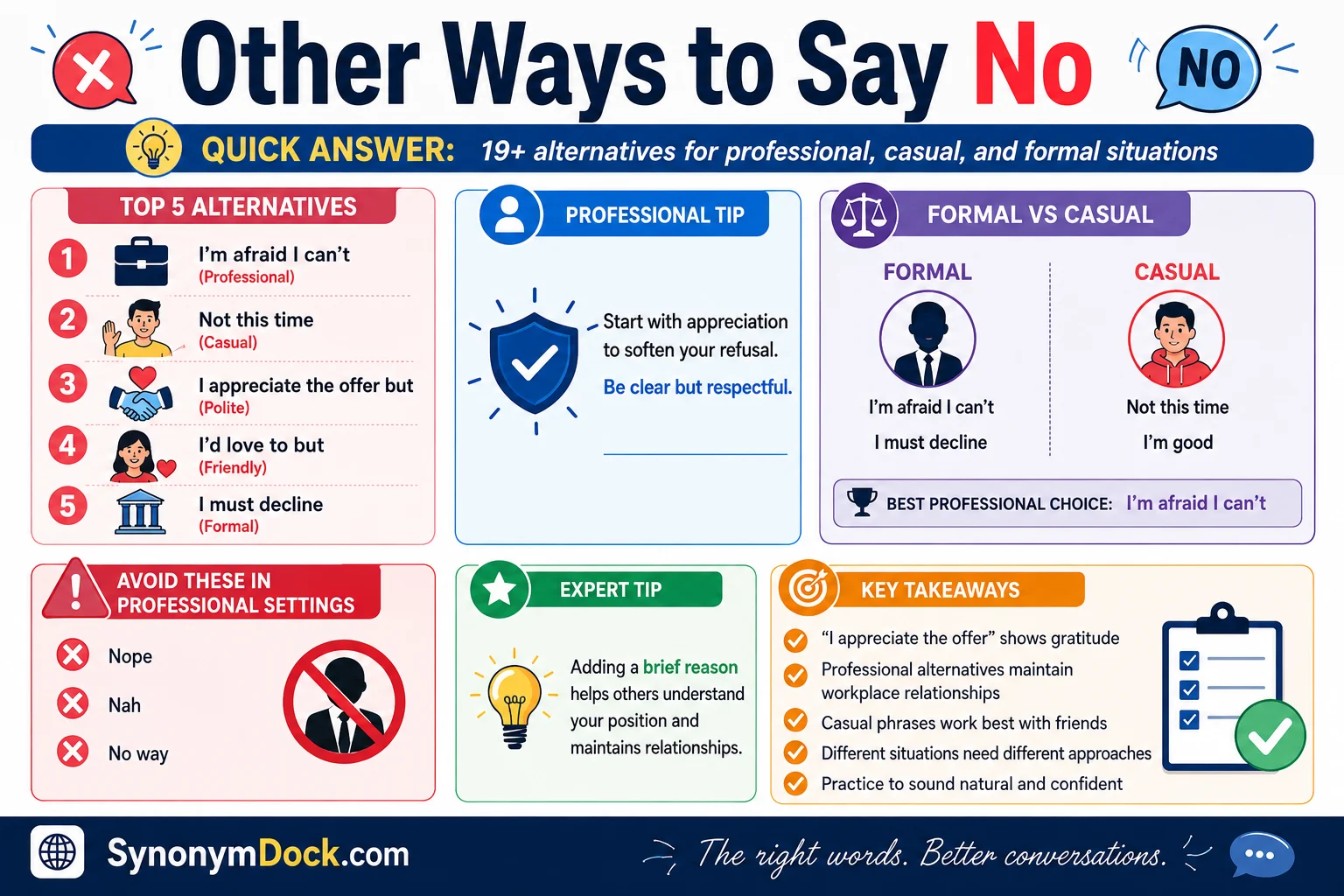
Looking for other ways to say no? Try “I’m afraid I can’t” for professional settings, “Thanks, but I’ll pass” for casual situations, “Unfortunately, I’m unable to” for formal contexts, “Not this time” for friendly conversations, or “I appreciate the offer, but” for polite refusals. The best alternatives include: I’m afraid I can’t, Thanks but I’ll pass, Unfortunately I’m unable, Not this time, I appreciate the offer but, I’d love to but, Maybe another time, I’m not available, That doesn’t work for me, and Count me out.
Whether you’re declining a meeting invitation, turning down a social offer, or setting professional boundaries, having alternatives to “no” makes you sound more polished and respectful. The right phrase can soften rejection while maintaining your position. This article explores 15+ powerful alternatives to “no” organized by tone and situation, so you can refuse gracefully in any context.
Quick Categories
Formal Alternatives
- I’m afraid I can’t
- Unfortunately, I’m unable to
- I regret to inform you
- It’s not possible at this time
- I must decline
Pro Tip: Use formal alternatives in professional emails, official correspondence, or when declining important requests. They sound respectful and maintain professionalism.
Professional Alternatives
- I’m not available
- That doesn’t work for me
- I can’t commit to that
- I’m unable to assist
- That’s not feasible
Pro Tip: Professional alternatives work well in workplace settings. They’re direct without being rude and show clear boundaries.
Business Email Alternatives
- I appreciate the offer, but
- Thank you for thinking of me
- Unfortunately, I’m unable to
- I’m afraid I can’t
- That won’t be possible
Pro Tip: Start business email refusals with appreciation. This softens the “no” and maintains positive relationships.
Academic Alternatives
- I’m unable to participate
- It’s not possible at this time
- I regret that I can’t
- I’m unavailable
- I’m afraid I can’t
Pro Tip: Academic alternatives work well when declining research invitations, speaking requests, or academic commitments. They sound thoughtful and respectful.
Casual Alternatives
- Not this time
- Maybe next time
- I’ll pass
- I’m good
- I don’t think so
Pro Tip: Casual alternatives are perfect for friends, family, and everyday conversations. They’re friendly without being formal.
Informal Expressions
- Nah
- Nope
- No way
- Hard pass
- Not happening
Pro Tip: Use informal expressions with close friends. They’re direct and casual but inappropriate in professional settings.
“Saying no gracefully is a skill that builds respect and maintains relationships.”
What Does “No” Mean?
“No” is a simple word used to refuse, decline, or disagree with something. It expresses a negative response or rejection.
Example: “No, I can’t come to the party.”
Grammar: “No” functions as an adverb, determiner, or interjection. It’s one of the first words English learners master.
Is It Professional or Polite?
“No” is direct and clear but can sometimes feel abrupt or rude depending on tone and context. Learning alternatives helps soften your refusal.
Polite? ⚠️ Depends on tone and context
Professional? ⚠️ Direct but can seem harsh
Formal? ❌ Too blunt for formal writing
Natural? ✅ Yes, especially with close friends
Example: “No, I’m not interested” is direct. “I appreciate the offer, but I’m not interested” sounds more polite and professional.
Common Mistakes
Mistake #1: Using “No” Without Explanation
Why it’s incorrect: A simple “no” can sound rude or dismissive.
Correct version: Add a brief reason or polite phrase.
Example: “I appreciate you asking, but I can’t this time.”
Mistake #2: Over-Apologizing When Saying No
Why it’s incorrect: Too many apologies make you seem insecure.
Correct version: Be clear and confident.
Example: “I’m not available, but thank you for inviting me.”
Mistake #3: Saying “Maybe” When You Mean “No”
Why it’s incorrect: This creates false hope and confusion.
Correct version: Be honest and clear.
Example: “I can’t, but thank you for thinking of me.”
Mistake #4: Using “Nope” in Professional Situations
Why it’s incorrect: Too casual and informal for work.
Correct version: Use “I’m unable to” or “I’m not available.”
Example: “I’m afraid I can’t make the meeting.”
Mistake #5: Saying “I’ll Try” When You Know You Can’t
Why it’s incorrect: This is dishonest and creates expectations.
Correct version: Be straightforward.
Example: “I’m not able to commit to that right now.”
When to Use “No”
Common Situations:
- Declining invitations
- Refusing requests
- Setting boundaries
- Expressing disagreement
- Rejecting offers
Business:
- Turning down projects
- Declining meetings
- Rejecting proposals
- Setting work boundaries
Academic:
- Declining research invitations
- Refusing speaking requests
- Setting study boundaries
- Disagreeing in discussions
Daily Conversation:
- Saying no to friends
- Declining social events
- Refusing food or drinks
- Disagreeing with opinions
“The best communicators know exactly when to use a soft ‘no’ instead of a hard one.”
Pros and Cons of “No”
Pros
- Clear and direct
- Easy to understand
- No ambiguity
- Quick and simple
Cons
- Can sound rude
- Too blunt sometimes
- Lacks nuance
- May damage relationships
- Not suitable for formal writing
15 Other Ways to Say No
[1]. I’m Afraid I Can’t
Meaning: A polite, slightly formal way to refuse while expressing regret.
Explanation: This phrase softens refusal by showing you wish you could help. Native speakers use it frequently in professional and formal situations. It sounds considerate and respectful without being overly apologetic.
Example Sentence: “I’m afraid I can’t attend the meeting on Friday.”
Best Use: Business Email, Professional Communication, Formal Refusals
Avoid Using In: Very Casual Conversations
Tone: Polite, Regretful
Formality Level: ⭐⭐⭐⭐ Formal
Usage Frequency: Very Common
CEFR Level: B1
Common Collocations:
- I’m afraid I can’t make it
- I’m afraid I’m unable to
- I’m afraid I have to decline
- I’m afraid that won’t work
Context Variability:
- Spoken English: “I’m afraid I can’t come tonight.”
- Professional English: “I’m afraid I can’t accept this project.”
[2]. Thanks, But I’ll Pass
Meaning: A friendly, casual way to decline an offer.
Explanation: This phrase is lighthearted and informal. It shows appreciation while declining. Native speakers often use it in social situations or with colleagues they know well. It’s friendly without being rude.
Example Sentence: “Thanks for the invite, but I’ll pass this time.
Best Use: Casual Conversation, Social Invitations, Friendly Refusals
Avoid Using In: Formal Correspondence
Tone: Friendly, Casual
Formality Level: ⭐⭐ Casual
Usage Frequency: Common
CEFR Level: B1
Common Collocations:
- thanks but I’ll pass
- I’ll pass on that
- going to pass on this one
Context Variability:
- Spoken English: “Thanks, but I’ll pass on dessert.”
- Casual Conversation: “Thanks for offering, but I’ll pass.”
[3]. Unfortunately, I’m Unable To
Meaning: A formal, professional phrase expressing regret about declining.
Explanation: This phrase is very professional and respectful. It acknowledges the request while clearly stating you can’t comply. Native speakers use it in emails, formal letters, and professional contexts. It sounds polished and considerate.
Example Sentence: “Unfortunately, I’m unable to join the conference call.”
Best Use: Business Emails, Formal Letters, Professional Declining
Avoid Using In: Casual Conversations
Tone: Formal, Respectful
Formality Level: ⭐⭐⭐⭐ Formal
Usage Frequency: Very Common (Professional Contexts)
CEFR Level: B1
Common Collocations:
- unfortunately I’m unable to attend
- unfortunately I’m unable to accept
- unfortunately I’m unable to assist
Context Variability:
- Professional English: “Unfortunately, I’m unable to attend the meeting.”
- Written English: “Unfortunately, I’m unable to approve the request.”
[4]. Not This Time
Meaning: A friendly, casual phrase suggesting a future possibility.
Explanation: This phrase leaves the door open for future opportunities. It’s a soft rejection that maintains goodwill. Native speakers use it in social situations and casual work environments. It’s positive despite being a “no.”
Example Sentence: “Not this time, but maybe next month!
Best Use: Social Invitations, Casual Refusals, Friendly Contexts
Avoid Using In: Formal Situations
Tone: Friendly, Hopeful
Formality Level: ⭐⭐ Casual
Usage Frequency: Very Common
CEFR Level: A2
Common Collocations:
- not this time
- not this time, maybe next time
- not this time around
Context Variability:
- Spoken English: “Not this time – I’m too busy.”
- Casual Conversation: “Not this time, but thanks for asking.”
[5]. I Appreciate the Offer, But
Meaning: A polite, professional phrase expressing gratitude while declining.
Explanation: This phrase starts with appreciation, which softens the refusal. Native speakers use it in both professional and personal contexts. It shows you value the gesture even though you can’t accept. This is one of the most polite alternatives.
Example Sentence: “I appreciate the offer, but I can’t accept it right now.
Best Use: Business Email, Professional Communication, Polite Refusals
Avoid Using In: Very Informal Situations
Tone: Polite, Appreciative
Formality Level: ⭐⭐⭐⭐ Formal
Usage Frequency: Very Common
CEFR Level: B1
Common Collocations:
- I appreciate the offer but
- I appreciate the invitation but
- I appreciate the opportunity but
Context Variability:
- Professional English: “I appreciate the offer, but I’m not available.”
- Spoken English: “I appreciate you asking, but I can’t.”
“The best ‘no’ includes appreciation and clarity.”
[6]. I’d Love To, But
Meaning: A friendly, enthusiastic phrase that shows interest while declining.
Explanation: This phrase expresses genuine interest, making the refusal easier to accept. Native speakers use it frequently in social and professional contexts. It shows you want to say yes, but circumstances prevent it. It maintains positive relationships.
Example Sentence: “I’d love to help, but I have a deadline tomorrow.”
Best Use: Friendly Refusals, Social Invitations, Professional Declining
Avoid Using In: Formal Legal Documents
Tone: Enthusiastic, Regretful
Formality Level: ⭐⭐⭐ Neutral
Usage Frequency: Very Common
CEFR Level: B1
Common Collocations:
- I’d love to but
- I’d love to help but
- I’d love to come but
Context Variability:
- Spoken English: “I’d love to go, but I’m busy.”
- Professional English: “I’d love to take this on, but I’m at capacity.”
[7]. Maybe Another Time
Meaning: A friendly, positive phrase suggesting future possibilities.
Explanation: This phrase keeps the door open while declining now. It’s optimistic and relationship-friendly. Native speakers use it for social invitations, casual work events, and friendly contexts. It softens the “no” with hope for the future.
Example Sentence: “Maybe another time – I’ve got plans tonight.
Best Use: Social Invitations, Casual Refusals, Friendly Contexts
Avoid Using In: Professional Commitments
Tone: Friendly, Hopeful
Formality Level: ⭐⭐⭐ Neutral
Usage Frequency: Very Common
CEFR Level: A2
Common Collocations:
- maybe another time
- maybe next time
- maybe later
Context Variability:
- Spoken English: “Maybe another time – I’m busy.”
- Casual Conversation: “Maybe another time. Thanks though!”
[8]. I’m Not Available
Meaning: A clear, professional phrase stating your unavailability.
Explanation: This phrase is direct without being rude. It focuses on your schedule rather than rejecting the person. Native speakers use it in professional contexts when they want to be clear but not harsh. It’s efficient and professional.
Example Sentence: “I’m not available for the meeting on Wednesday.”
Best Use: Professional Communication, Scheduling, Workplace Contexts
Avoid Using In: Very Casual Situations
Tone: Professional, Neutral
Formality Level: ⭐⭐⭐⭐ Formal
Usage Frequency: Very Common
CEFR Level: A2
Common Collocations:
- I’m not available at that time
- I’m not available on that date
- I’m not available to help
Context Variability:
- Professional English: “I’m not available for that project.”
- Spoken English: “Sorry, I’m not available tonight.”
[9]. That Doesn’t Work For Me
Meaning: A polite professional phrase focusing on the situation rather than the person.
Explanation: This phrase is non-confrontational and clear. It focuses on logistics rather than rejecting the person. Native speakers use it in scheduling, planning, and professional contexts. It’s direct but respectful.
Example Sentence: “That doesn’t work for me – can we reschedule?
Best Use: Scheduling, Professional Planning, Workplace Communication
Avoid Using In: Social Invitations
Tone: Professional, Direct
Formality Level: ⭐⭐⭐⭐ Formal
Usage Frequency: Common
CEFR Level: B1
Common Collocations:
- that doesn’t work for me
- that time doesn’t work
- that schedule doesn’t work
Context Variability:
- Professional English: “That time doesn’t work for me.”
- Spoken English: “That doesn’t work for me – I’m busy.”
[10]. Count Me Out
Meaning: A casual, direct phrase expressing disinterest or inability to participate.
Explanation: This phrase is informal and direct. It’s used among friends, family, and casual colleagues. Native speakers use it when they want to be clear without being formal. However, avoid it in professional settings.
Example Sentence: “Count me out for the trip – I can’t afford it.”
Best Use: Casual Conversations, Friends, Family
Avoid Using In: Professional Communication
Tone: Casual, Direct
Formality Level: ⭐⭐ Casual
Usage Frequency: Common (Informal Contexts)
CEFR Level: B1
Common Collocations:
- count me out
- count me in (opposite)
- count me out this time
Context Variability:
- Spoken English: “Count me out this weekend.”
- Casual Conversation: “Count me out – I’m not interested.”
[11]. I Must Decline
Meaning: A formal, definitive phrase indicating you cannot accept.
Explanation: This phrase is very formal and definitive. It’s often used in official correspondence or when declining invitations from high-level professionals. Native speakers use it sparingly as it sounds quite formal. It leaves no room for ambiguity.
Example Sentence: “I must decline your generous invitation.”
Best Use: Formal Events, Official Correspondence, Formal Invitations
Avoid Using In: Casual Conversation
Tone: Formal, Definitive
Formality Level: ⭐⭐⭐⭐⭐ Very Formal
Usage Frequency: Occasional (Formal Contexts)
CEFR Level: B2
Common Collocations:
- I must decline
- I regretfully decline
- I politely decline
Context Variability:
- Formal English: “I must decline the board position.”
- Written English: “I must decline your offer due to existing commitments.”
[12]. I’m Good, Thanks
Meaning: A friendly, casual phrase expressing you’re satisfied and don’t need anything.
Explanation: This phrase is very common in everyday conversation. It’s positive and friendly. Native speakers use it constantly when refusing offers, help, or extras. It sounds relaxed and natural. However, it’s too casual for professional contexts.
Example Sentence: “I’m good, thanks – I’ve already eaten.”
Best Use: Daily Conversation, Social Situations, Casual Offers
Avoid Using In: Professional Settings
Tone: Casual, Friendly
Formality Level: ⭐⭐ Casual
Usage Frequency: Very Common
CEFR Level: A2
Common Collocations:
- I’m good
- I’m good, thanks
- I’m all good
Context Variability:
- Spoken English: “I’m good, thanks. I don’t need anything.”
- Casual Conversation: “I’m good – I’ll pass.”
[13]. I Don’t Think So
Meaning: A mild, hesitant way to express disagreement or refusal.
Explanation: This phrase is softer and less direct than a firm “no.” It expresses doubt or hesitation. Native speakers use it to disagree gently or decline without being confrontational. It’s useful in sensitive conversations.
Example Sentence: “I don’t think so – I’ve got other plans.”
Best Use: Mild Disagreement, Gentle Refusals, Sensitive Conversations
Avoid Using In: Situations Requiring Clear Answers
Tone: Hesitant, Mild
Formality Level: ⭐⭐⭐ Neutral
Usage Frequency: Common
CEFR Level: A2
Common Collocations:
- I don’t think so
- I don’t think that works
- I don’t think I can
Context Variability:
- Spoken English: “I don’t think so – I’ll check my schedule.”
- Casual Conversation: “I don’t think so, but thanks.”
[14]. Not This Time Around
Meaning: A friendly phrase suggesting you’ll consider next time.
Explanation: This phrase is slightly more formal than “not this time.” It suggests you’re not rejecting permanently. Native speakers use it in social and casual professional contexts. It sounds thoughtful and leaves options open.
Example Sentence: “Not this time around – I’m focusing on other priorities.
Best Use: Social Invitations, Casual Refusals, Friendly Contexts
Avoid Using In: Formal Communication
Tone: Friendly, Open
Formality Level: ⭐⭐⭐ Neutral
Usage Frequency: Common
CEFR Level: B1
Common Collocations:
- not this time around
- maybe next time around
- this time around I can’t
Context Variability:
- Spoken English: “Not this time around – maybe next month.”
- Casual Conversation: “Not this time around, thanks.”
[15]. That’s Not Feasible
Meaning: A professional, business-focused phrase explaining something isn’t possible.
Explanation: This phrase focuses on practicality and logistics rather than desire. It sounds analytical and professional. Native speakers use it in business contexts when discussing projects, budgets, or plans. It’s objective and not personal.
Example Sentence: “That’s not feasible given our current resources.”
Best Use: Business Discussions, Project Planning, Professional Contexts
Avoid Using In: Social Invitations
Tone: Professional, Analytical
Formality Level: ⭐⭐⭐⭐ Formal
Usage Frequency: Common (Business Contexts)
CEFR Level: B2
Common Collocations:
- that’s not feasible
- that’s not financially feasible
- that’s not practically feasible
Context Variability:
- Professional English: “That’s not feasible with our current budget.”
- Business English: “The timeline isn’t feasible.”
“A direct ‘no’ is not always rude, but a polite ‘no’ is always professional.”
Native Speaker Tip
Native speakers rarely say a flat “no” in professional settings. Instead, they use phrases like “I’m afraid I can’t” or “Unfortunately, I’m unable to.” In casual conversation, “I’m good” and “Not this time” are much more common than a simple “no.” Learning these alternatives helps you sound more natural and polite in any situation.
Expert Insight
In workplace communication, how you say “no” can impact your professional relationships. Starting with appreciation (“I appreciate the offer, but”) softens the refusal and maintains goodwill. Being clear but respectful helps you set boundaries without damaging relationships. The key is to be honest while being considerate of the other person’s feelings.
Avoid These Expressions in Formal Situations
| Expression | Why to Avoid | Better Alternative |
|---|---|---|
| Nope | Too casual | I’m afraid I can’t |
| Nah | Too informal | I’m unable to |
| No way | Too blunt | That doesn’t work for me |
| Hard pass | Too casual | I’ll need to decline |
| I’m good | Too casual | I appreciate the offer |
Top 10 Alternatives Compared
| Phrase | Tone | Formality | Best Use | Frequency |
|---|---|---|---|---|
| I’m afraid I can’t | Polite | ⭐⭐⭐⭐ | Professional | Very Common |
| Thanks but I’ll pass | Friendly | ⭐⭐ | Social | Common |
| Unfortunately I’m unable | Formal | ⭐⭐⭐⭐ | Business | Very Common |
| Not this time | Friendly | ⭐⭐ | Casual | Very Common |
| I appreciate the offer but | Polite | ⭐⭐⭐⭐ | Professional | Very Common |
| I’d love to but | Enthusiastic | ⭐⭐⭐ | Social | Very Common |
| Maybe another time | Hopeful | ⭐⭐⭐ | Social | Common |
| I’m not available | Direct | ⭐⭐⭐⭐ | Professional | Common |
| That doesn’t work for me | Direct | ⭐⭐⭐⭐ | Scheduling | Common |
| Count me out | Casual | ⭐⭐ | Friends | Common |
Which One Should You Use?
Best Overall: I’d love to but – shows interest while declining
Best Professional: I’m afraid I can’t – polite and clear
Best Academic: I regret that I can’t – respectful and formal
Best Business Email: I appreciate the offer, but – maintains relationships
Best Everyday Conversation: Not this time – friendly and clear
Most Natural: I’m good, thanks – native speakers use it constantly
Most Polite: I appreciate the offer, but – shows gratitude
Commonly Confused Phrases
“I’m afraid I can’t” vs. “I’m sorry I can’t”
“I’m afraid” is more professional and polite. “I’m sorry” can sound overly apologetic. Use “I’m afraid” in professional settings.
“Not this time” vs. “Maybe another time”
“Not this time” is a clear refusal. “Maybe another time” leaves the possibility open. Use “not this time” when you want to be clear.
“I appreciate the offer, but” vs. “Thanks, but”
“I appreciate the offer” is more formal. “Thanks, but” is more casual. Choose based on context and relationship.
Scenario Practice
Scenario 1: A colleague invites you to a project you can’t commit to.
Which phrase would you choose?
Correct Answer: “I appreciate the offer, but I’m at capacity right now.”
Why: Professional, appreciative, and clearly states your situation.
Scenario 2: A friend asks you to go out, but you’re tired.
Which phrase would you choose?
Correct Answer: “Not tonight – I’m exhausted. Maybe this weekend?”
Why: Casual, honest, and leaves the door open.
Scenario 3: Your boss asks if you can take on extra work.
Which phrase would you choose?
Correct Answer: “I’m afraid I can’t right now – I’m focused on deadlines.”
Why: Professional, respectful, and explains your position.
Scenario 4: You’re offered food you don’t want at a dinner party.
Which phrase would you choose?*
Correct Answer: “I’m good, thanks – I’ve had enough.”
Why: Friendly, polite, and natural.
Scenario 5: A client requests a service you don’t provide.
Which phrase would you choose?
Correct Answer: “Unfortunately, I’m unable to assist with that.”
Why: Professional, clear, and maintains the client relationship.
Mini Quiz
1. Which phrase is best for professional email refusals?
- A) Nope
- B) I’m afraid I can’t
- C) No way
2. Which alternative suggests a future possibility?
- A) Count me out
- B) Not this time
- C) I’m good
3. Which phrase is too casual for business communication?
- A) I’m unable to
- B) I’m good, thanks
- C) That doesn’t work for me
4. Which phrase shows appreciation while declining?
- A) I appreciate the offer, but
- B) I must decline
- C) Count me out
5. Which alternative is most natural in casual conversation?
- A) I’m afraid I can’t
- B) I’m good, thanks
- C) I must decline
Answer Key
- B) I’m afraid I can’t – Professional and polite for email refusals
- B) Not this time – Leaves the door open for future opportunities
- B) I’m good, thanks – Too casual for professional communication
- A) I appreciate the offer, but – Shows gratitude while declining
- B) I’m good, thanks – Very common and natural in daily conversation
FAQs
What is the most polite way to say no?
“I appreciate the offer, but” is one of the most polite ways to decline. It starts with gratitude and shows you value the gesture. “I’d love to, but” also works well as it expresses genuine interest while refusing.
Which phrase is best for professional emails?
“I’m afraid I can’t” and “Unfortunately, I’m unable to” are excellent for professional emails. They’re polite, clear, and maintain professionalism. Start with appreciation for better results.
What is the difference between “Not this time” and “I’ll pass”?
Not this time” suggests you might say yes in the future. I’ll pass” is more definitive and often means you’re not interested at all. Choose based on whether you want to leave the door open.
Which alternative sounds most natural to native speakers?
“I’m good, thanks” is very natural in casual situations. “I’d love to, but” sounds natural in social contexts. “I’m afraid I can’t” sounds natural in professional settings. Choose based on context.
Can I use these expressions in business meetings?
Yes, phrases like “That doesn’t work for me” and “I’m afraid I can’t” are perfect for business meetings. Avoid overly casual alternatives like “nope” or “nah” in professional settings.
Conclusion
Learning other ways to say no transforms how you communicate. Instead of sounding abrupt or rude, you can now decline gracefully in any situation – from professional emails to casual conversations.
The key is choosing the right phrase for the right context. “I appreciate the offer, but” works perfectly for professional refusals. “Not this time” is friendly and leaves the door open. “I’d love to, but” shows genuine interest while declining.
Start today – choose one new alternative and use it in your next refusal. With practice, you’ll say no with confidence and maintain positive relationships.

10 thoughts on “Other Ways to Say No |19+ Professional & Polite Alternatives 2026”