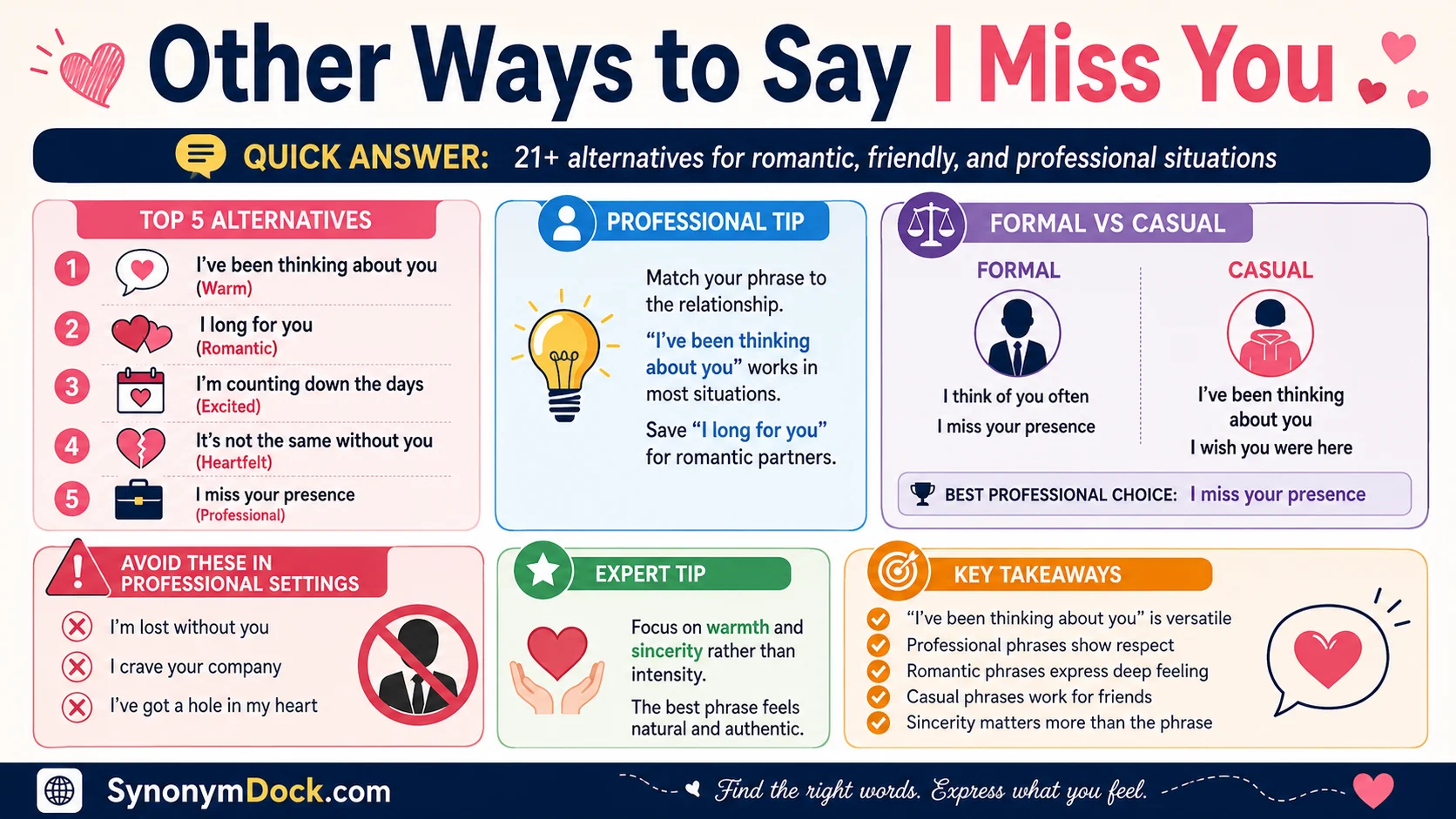
“I miss you” is a beautiful expression, but sometimes it feels repetitive or not quite strong enough. Whether you’re sending a romantic text, writing to a friend, or crafting a professional email, having other ways to say “I miss you” helps you express your feelings more precisely.
Looking for other ways to say “I miss you”? Try “I’ve been thinking about you” for casual situations, “I long for you” for romantic moments, “I’m counting down the days” for excitement, “It’s not the same without you” for heartfelt messages, or “I’ve been looking forward to seeing you” for professional contexts. The best alternatives include: I’ve been thinking about you, I long for you, I’m counting down the days, It’s not the same without you, I wish you were here, You’ve been on my mind, I crave your company, and I feel your absence.
The right phrase can convey everything from deep longing to casual fondness. This article explores 21+ powerful alternatives to “I miss you” organized by tone and situation, so you can choose the perfect expression with confidence. Your words will feel more genuine and heartfelt.
Quick Categories
Formal Alternatives
- I long for your company
- I feel your absence deeply
- I think of you often
- I eagerly await our reunion
- Your presence is greatly missed
Pro Tip: Use formal alternatives in professional correspondence, formal letters, or when addressing someone with whom you have a respectful relationship. These phrases sound polished and sincere.
Professional Alternatives
- I’ve been looking forward to seeing you
- I look forward to our next meeting
- I appreciate your contributions and miss your input
- It’s been a while since we connected
- I’m eager to reconnect
Pro Tip: Professional alternatives work well in workplace communication, business emails, and networking contexts. They maintain professionalism while acknowledging connection.
Romantic Alternatives
- I long for you
- I crave your presence
- You’re always in my thoughts
- My heart aches for you
- I can’t stop thinking about you
Pro Tip: Romantic alternatives are best for partners, spouses, or someone you’re dating. They express deep emotion and attachment.
Casual Alternatives
- I’ve been thinking about you
- I miss hanging out
- You’ve been on my mind
- It’s not the same without you
- I wish you were here
Pro Tip: Casual alternatives work perfectly for friends, family, and acquaintances. They feel warm and genuine without being overly intense.
Informal Expressions
- I’m lost without you
- I can’t wait to see you
- I’m counting down the days
- I’ve got a hole in my heart
- I need you here
Pro Tip: Informal expressions are great for close relationships and emotional moments. Reserve them for people you’re very close to.
Friendly Alternatives
- I wish we could hang out
- I miss our chats
- It’s quiet without you
- I miss your laugh
- I was just thinking of you
Pro Tip: Friendly alternatives are perfect for casual relationships with friends, classmates, and colleagues. They’re warm and easy to say.
“The right words can bridge any distance and warm any heart.”
What Does “I Miss You” Mean?
“I miss you” is an expression used to convey feelings of sadness, longing, or nostalgia when someone you care about is not with you. It expresses a desire for their presence and a sense of incompleteness without them.
Example: “I miss you so much since you moved away.”
Grammar: “I miss you” is a simple subject-verb-object structure. It can be modified with adverbs like “so much,” “really,” or “terribly” to express intensity.
Is It Professional or Polite?
“I miss you” is polite and appropriate for personal relationships but can feel too intimate for professional contexts.
Polite? ✅ Yes
Professional? ⚠️ Depends on the workplace culture and relationship
Formal? ❌ No – too personal and casual
Natural? ✅ Yes
Example: “I miss your expertise on this project” works in a more casual workplace. For a formal email, consider “I appreciate your contributions and look forward to reconnecting.”
Common Mistakes
Mistake #1: Using “I Miss You” Too Early in a Relationship
Why it’s incorrect: Saying “I miss you” too early can feel overwhelming or pushy.
Correct version: Use “I’ve been thinking about you” or “I look forward to seeing you again.”
Example: “I’ve been thinking about you since our last date” is more appropriate early on.
Mistake #2: Using “I Miss You” in Professional Emails
Why it’s incorrect: It’s too personal and informal for most professional contexts.
Correct version: “I look forward to reconnecting” or “I appreciate your contributions.”
Example: “I look forward to working with you again” sounds professional and warm.
Mistake #3: Overusing “I Miss You” in Text Messages
Why it’s incorrect: Repeating it constantly loses its meaning and can feel needy.
Correct version: Vary your expressions with alternatives.
Example: “I wish you were here” or “It’s not the same without you” adds variety.
Mistake #4: Using “I Long for You” Casually
Why it’s incorrect: “I long for you” is deeply romantic and intense.
Correct version: Use it only with romantic partners.
Example: “I long for you” is beautiful in a love letter but awkward for friends.
Mistake #5: Sending “I Miss You” After a Short Time Apart
Why it’s incorrect: It can seem over-dramatic if you’ve only been apart briefly.
Correct version: “I’m looking forward to seeing you again” is more balanced.
Example: “I enjoyed our time together and hope to see you again soon.”
“Expressing absence is an art – choose your words wisely.”
When to Use “I Miss You”
Romantic Situations:
- When your partner is away
- After a special date
- During a long-distance relationship
- When feeling lonely without them
Friend & Family:
- After a friend moves away
- When a family member travels
- During holiday seasons
- When reminiscing about good times
Professional Settings:
- When a colleague leaves
- After a team member is away
- When reconnecting with contacts
- During networking follow-ups
Written Communication:
- Text messages
- Personal emails
- Letters and cards
- Social media comments
Pros and Cons of “I Miss You”
Pros
- Simple and easy to say
- Universally understood
- Direct and honest
- Works in many relationships
Cons
- Often overused
- Can feel generic
- Too casual for professional settings
- Lacks emotional depth
- May not capture true feelings
15 Other Ways to Say “I Miss You”
[1]. I’ve Been Thinking About You
Meaning: A warm, casual phrase showing someone is on your mind.
Explanation: This is one of the most natural alternatives to “I miss you.” Native speakers use it constantly with friends, family, and even romantic interests. It’s warm without being overwhelming and works in almost any relationship.
Example Sentence: “I’ve been thinking about you all day – how are you?
Best Use: Casual Conversation, Text Messages, Social Media
Avoid Using In: Professional Emails
Tone: Warm, Thoughtful
Formality Level: ⭐⭐ Casual
Usage Frequency: Very Common
CEFR Level: A2
Common Collocations:
- been thinking about you
- thinking of you
- can’t stop thinking about you
- I was just thinking of you
- thinking about you today
Context Variability:
- Spoken English: “I’ve been thinking about you – let’s catch up soon!”
- Casual Conversation: “I was just thinking about you and smiled.”
[2]. I Long for You
Meaning: A deeply romantic phrase expressing strong desire and yearning.
Explanation: “I long for you” is powerful and intimate. Native speakers use it in romantic contexts, love letters, and poetry. It’s too intense for casual or professional situations, but perfect for expressing deep feelings.
Example Sentence: “Every moment we’re apart, I long for you more.”
Best Use: Romantic Relationships, Love Letters
Avoid Using In: Professional Settings, Casual Conversation
Tone: Intense, Romantic
Formality Level: ⭐⭐⭐⭐ Formal (Romantic)
Usage Frequency: Occasional (Romantic Contexts)
CEFR Level: B2
Common Collocations:
- long for your touch
- long for your presence
- long to be with you
- long for the day
- long for your company
Context Variability:
- Romantic: “I long for the day when we’re together again.”
- Written English: Commonly appears in love letters and poetry.
[3]. I’m Counting Down the Days
Meaning: A phrase expressing excitement and anticipation about seeing someone again.
Explanation: This phrase focuses on future reunion rather than present sadness. It’s positive and energetic. Native speakers use it when they’re eagerly looking forward to someone’s return.
Example Sentence: “I’m counting down the days until you’re back.”
Best Use: Romantic Partners, Long-Distance Relationships, Close Friends
Avoid Using In: Professional Contexts
Tone: Excited, Anticipatory
Formality Level: ⭐⭐ Casual
Usage Frequency: Common
CEFR Level: B1
Common Collocations:
- counting down the days
- counting the minutes
- counting the hours
- can’t wait for the day
- looking forward to
Context Variability:
- Spoken English: “I’m counting down the days until we’re together!”
- Text Message: “Only 5 days left – I’m counting down!”
[4]. It’s Not the Same Without You
Meaning: A heartfelt phrase acknowledging someone’s importance and presence.
Explanation: This phrase shows someone that their absence is felt. It’s personal and warm without being too emotional. Native speakers use it with friends, family, and close colleagues.
Example Sentence: “The team dinner was lovely, but it wasn’t the same without you.”
Best Use: Friends, Family, Close Colleagues
Avoid Using In: Very Formal Settings
Tone: Warm, Acknowledging
Formality Level: ⭐⭐⭐ Neutral
Usage Frequency: Common
CEFR Level: B1
Common Collocations:
- not the same without you
- doesn’t feel the same
- missing your presence
- everything feels different
- I notice your absence
Context Variability:
- Spoken English: “It’s so quiet without you – it’s not the same.”
- Professional English: “The meetings aren’t the same without your input.”
[5]. I Wish You Were Here
Meaning: A direct, heartfelt expression wishing someone was physically present.
Explanation: This is a classic alternative that’s both simple and sincere. Native speakers use it in personal and casual contexts. It’s versatile enough for friends, family, and romantic partners.
Example Sentence: “I wish you were here to see this sunset.
Best Use: Friends, Family, Romantic Partners
Avoid Using In: Professional Emails
Tone: Warm, Direct
Formality Level: ⭐⭐ Casual
Usage Frequency: Very Common
CEFR Level: A2
Common Collocations:
- wish you were here
- wish you were with me
- I wish you could see this
- if only you were here
- come be here with me
Context Variability:
- Spoken English: “I wish you were here – it’s beautiful!”
- Text Message: “Wish you were here ♥”
“Distance means so little when someone means so much.”
[6]. You’ve Been on My Mind
Meaning: A gentle way to say you’re thinking of someone.
Explanation: This is softer and less intense than “I miss you.” Native speakers use it when they want to acknowledge someone without the weight of “miss.” It’s perfect for acquaintances and new relationships.
Example Sentence: “You’ve been on my mind lately – how have you been?”
Best Use: New Relationships, Friends, Acquaintances
Avoid Using In: Professional Settings
Tone: Gentle, Thoughtful
Formality Level: ⭐⭐ Casual
Usage Frequency: Common
CEFR Level: B1
Common Collocations:
- been on my mind
- can’t get you off my mind
- I can’t stop thinking of you
- you’re in my thoughts
- thinking of you often
Context Variability:
- Casual Conversation: “You’ve been on my mind – hope you’re okay.”
- Text Message: “You’ve been on my mind all week.”
[7]. I Feel Your Absence
Meaning: A more formal phrase acknowledging someone’s absence.
Explanation: This phrase is respectful and sincere. It works well in professional and personal contexts where you want to acknowledge someone’s importance without being overly emotional.
Example Sentence: “I feel your absence in our meetings – your insights are missed.”
Best Use: Professional Contexts, Formal Correspondence
Avoid Using In: Very Casual Conversation
Tone: Respectful, Sincere
Formality Level: ⭐⭐⭐⭐ Formal
Usage Frequency: Occasional
CEFR Level: B2
Common Collocations:
- feel your absence
- sense your absence
- notice your absence
- your absence is felt
- keenly feel your absence
Context Variability:
- Professional English: “We feel your absence in the office.”
- Personal: “I feel your absence every day.”
[8]. I Crave Your Company
Meaning: A strong phrase expressing a deep desire to be with someone.
Explanation: This is more intense than “I miss you” and shows strong attachment. Native speakers use it in romantic relationships or with very close friends. It’s too strong for casual or professional use.
Example Sentence: “I crave your company – nothing feels right without you.”
Best Use: Romantic Partners, Close Friends
Avoid Using In: Professional Contexts
Tone: Intense, Passionate
Formality Level: ⭐⭐⭐ Neutral (Emotional)
Usage Frequency: Occasional
CEFR Level: B2
Common Collocations:
- crave your company
- crave your presence
- crave your touch
- crave your attention
- crave the time with you
Context Variability:
- Romantic: “I crave your company every moment we’re apart.”
- Close Relationships: Reserved for very intimate connections.
[9]. I Think of You Often
Meaning: A gentle, sincere phrase expressing frequent thoughts of someone.
Explanation: This is a warm and respectful alternative. It’s less intense than “I miss you” but still shows care. Native speakers use it in both personal and professional contexts.
Example Sentence: “I think of you often and hope you’re doing well.”
Best Use: Professional Correspondence, Personal Letters
Avoid Using In: Very Casual Texting
Tone: Warm, Respectful
Formality Level: ⭐⭐⭐⭐ Formal
Usage Frequency: Common
CEFR Level: B1
Common Collocations:
- think of you often
- think about you frequently
- think of you daily
- you cross my mind often
Context Variability:
- Professional English: “I think of you often and value our partnership.”
- Personal: “I think of you often – you’re always in my heart.”
[10]. I Can’t Wait to See You
Meaning: An energetic, excited phrase focused on reunion.
Explanation: This phrase shifts focus from absence to anticipation. It’s positive and forward-looking. Native speakers use it with friends, family, and romantic partners.
Example Sentence: “I can’t wait to see you at the airport!”
Best Use: Friends, Family, Romantic Partners
Avoid Using In: Professional Emails
Tone: Excited, Energetic
Formality Level: ⭐⭐ Casual
Usage Frequency: Very Common
CEFR Level: A2
Common Collocations:
- can’t wait to see you
- can’t wait to be with you
- can’t wait to hold you
- can’t wait for your visit
- counting down until I see you
Context Variability:
- Spoken English: “Can’t wait to see you – it’s been too long!”
- Text Message: “So excited! Can’t wait to see you! ❤️”
“Anticipation makes the heart grow fonder.”
[11]. I’m Lost Without You
Meaning: A strong phrase expressing dependency and deep attachment.
Explanation: This phrase is intense and should be used carefully. It suggests the other person is essential to your wellbeing. Native speakers reserve this for very close relationships.
Example Sentence: “I’m lost without you – I don’t know what to do with myself.”
Best Use: Romantic Partners, Very Close Relationships
Avoid Using In: Casual Friendships, Professional Contexts
Tone: Intense, Vulnerable
Formality Level: ⭐⭐ Casual
Usage Frequency: Common (Close Relationships)
CEFR Level: B1
Common Collocations:
- lost without you
- feel lost without you
- I’m incomplete without you
- I don’t know what to do without you
Context Variability:
- Romantic: “I’m lost without you in my life.”
- Emotional Moments: Best used during heartfelt conversations.
[12]. I Wish We Could Spend Time Together
Meaning: A gentle, polite way to express missing someone.
Explanation: This phrase is warm and respectful. It expresses a desire for connection without being overly emotional. Native speakers use it in casual and professional contexts.
Example Sentence: “I wish we could spend time together – it’s been too long.
Best Use: Friends, Family, Professional Acquaintances
Avoid Using In: Very Formal Writing
Tone: Warm, Respectful
Formality Level: ⭐⭐⭐ Neutral
Usage Frequency: Common
CEFR Level: B1
Common Collocations:
- wish we could spend time
- wish we could catch up
- wish we were together
- hope we can meet soon
Context Variability:
- Casual: “I wish we could spend time together like old times.”
- Professional: “I wish we had more time to connect.”
[13]. I’ve Got a Hole in My Heart Without You
Meaning: A poetic, emotional phrase expressing deep sadness.
Explanation: This is a very emotional and poetic expression. It conveys deep loss and emptiness. Native speakers use it in romantic contexts or when expressing profound feelings.
Example Sentence: “Ever since you left, I’ve got a hole in my heart.”
Best Use: Romantic Partners, Deep Emotional Moments
Avoid Using In: Professional Contexts
Tone: Deeply Emotional, Poetic
Formality Level: ⭐⭐ Casual
Usage Frequency: Occasional (Intimate Moments)
CEFR Level: B2
Common Collocations:
- hole in my heart
- emptiness in my heart
- missing you deeply
- aching heart
Context Variability:
- Romantic: “There’s a hole in my heart only you can fill.”
- Emotional: Reserved for very deep feelings.
[14]. I Miss Your Presence
Meaning: A formal, respectful way to say you miss someone.
Explanation: This phrase focuses on the person’s presence rather than them directly. It’s polished and sincere. Native speakers use it in professional and formal personal contexts.
Example Sentence: “I miss your presence in our team meetings.”
Best Use: Professional Settings, Formal Correspondence
Avoid Using In: Casual Text Messages
Tone: Respectful, Sincere
Formality Level: ⭐⭐⭐⭐ Formal
Usage Frequency: Occasional (Formal Contexts)
CEFR Level: B2
Common Collocations:
- miss your presence
- miss your energy
- miss your wisdom
- miss your guidance
Context Variability:
- Professional: “We miss your presence in the office.”
- Personal: “I miss your presence in my daily life.”
[15]. It Feels Like Something’s Missing
Meaning: A gentle way to express someone’s importance.
Explanation: This phrase acknowledges someone’s significance without being too direct. It’s warm and thoughtful. Native speakers use it with friends, family, and close colleagues.
Example Sentence: “It feels like something’s missing since you left.
Best Use: Friends, Family, Close Colleagues
Avoid Using In: Very Formal Contexts
Tone: Gentle, Thoughtful
Formality Level: ⭐⭐⭐ Neutral
Usage Frequency: Common
CEFR Level: B1
Common Collocations:
- something’s missing
- a part is missing
- everything feels incomplete
- I can sense your absence
Context Variability:
- Personal: “It feels like something’s missing when you’re not here.”
- Professional: “The team feels incomplete without your contribution.”
“Expressing absence shows someone they truly matter.”
Native Speaker Tip
Native speakers rarely use “I long for you” in everyday conversation – it sounds poetic and intense. For everyday situations, “I’ve been thinking about you” is much more natural. In professional contexts, “I appreciate your contributions” or “I look forward to reconnecting” works best. And for romantic partners, “I’m counting down the days” is a sweet and modern alternative.
Expert Insight
The phrase “I miss you” carries different weight in different contexts. In professional communication, it’s often better to acknowledge someone’s value rather than express personal longing. “We’ve missed your expertise” or “Your absence is felt in our team” sounds professional and sincere. In personal communication, matching the intensity of the phrase to the relationship is key.
Avoid These Expressions in Formal Situations
| Expression | Why to Avoid | Better Alternative |
|---|---|---|
| I’m lost without you | Too intense and emotional | I appreciate your contributions |
| I crave your company | Too personal and intense | I look forward to reconnecting |
| I’ve got a hole in my heart | Overly emotional | I value your presence |
| I can’t wait to see you | Too casual | I look forward to seeing you |
| I’m counting down the days | Too eager | I anticipate our next meeting |
Top 10 Alternatives Compared
| Phrase | Tone | Formality | Best Use | Frequency |
|---|---|---|---|---|
| I’ve been thinking about you | Warm | ⭐⭐ | Friends, Casual | Very Common |
| I long for you | Passionate | ⭐⭐⭐⭐ | Romantic | Occasional |
| I’m counting down the days | Excited | ⭐⭐ | Romantic, Friends | Common |
| It’s not the same without you | Warm | ⭐⭐⭐ | Friends, Family | Common |
| I wish you were here | Direct | ⭐⭐ | All Personal | Very Common |
| You’ve been on my mind | Gentle | ⭐⭐ | New Relationships | Common |
| I feel your absence | Respectful | ⭐⭐⭐⭐ | Professional | Occasional |
| I crave your company | Intense | ⭐⭐⭐ | Romantic | Occasional |
| I think of you often | Warm | ⭐⭐⭐⭐ | Professional, Personal | Common |
| I can’t wait to see you | Excited | ⭐⭐ | Friends, Family | Very Common |
Which One Should You Use?
Best Overall: I’ve been thinking about you – warm, natural, and versatile
Best Professional: I miss your presence – respectful and professional
Best Romantic: I long for you – passionate and poetic
Best Business Email: I think of you often – warm yet professional
Best Everyday Conversation: I’ve been thinking about you – natural and genuine
Most Natural: I’ve been thinking about you – native speakers use it constantly
Most Polite: I wish we could spend time together – gentle and respectful
Commonly Confused Phrases
“I miss you” vs. “I’ve been thinking about you”
“I miss you” expresses sadness and absence. “I’ve been thinking about you” is gentler and focuses on presence in thoughts rather than absence.
“I long for you” vs. “I crave your company”
“I long for you” is more romantic and poetic. “I crave your company” is more direct and intense, often implying a strong emotional or physical desire.
“I wish you were here” vs. “It’s not the same without you”
“I wish you were here” is simple and direct. “It’s not the same without you” acknowledges how the person’s absence affects a situation.
Scenario Practice
Scenario 1: You want to tell a new romantic partner you’re thinking of them.
Which phrase would you choose?
Correct Answer: “I’ve been thinking about you” or “I can’t wait to see you again”
Why: These are warm but not too intense for a new relationship.
Scenario 2: You’re writing a professional email to a colleague who left the company.
Which phrase would you choose?
Correct Answer: “I miss your expertise” or “I think of you often”
Why: Professional, respectful, and acknowledges their value.
Scenario 3: You’re in a long-distance relationship and feeling emotional.
Which phrase would you choose?
Correct Answer: “I long for you” or “I’m counting down the days”
Why: Expresses strong feelings and anticipation.
Scenario 4: A friend moved away and you want to reconnect.
Which phrase would you choose?
Correct Answer: “I’ve been thinking about you – let’s catch up!”
Why: Warm, casual, and invites connection.
Scenario 5: You’re sending a text to a friend you haven’t seen in months.
Which phrase would you choose?
Correct Answer: “I miss hanging out – we need to meet up!”
Why: Casual, friendly, and expresses a desire to reconnect.
Mini Quiz
1. Which phrase is best for a professional email?
- A) I’m lost without you
- B) I miss your presence
- C) I crave your company
2. Which alternative is too intense for casual friendships?
- A) I’ve been thinking about you
- B) I long for you
- C) I wish you were here
3. Which phrase expresses excitement about seeing someone again?
- A) I’m counting down the days
- B) I feel your absence
- C) I think of you often
4. Which phrase is most natural for everyday conversation?
- A) I’ve been thinking about you
- B) I crave your company
- C) I’ve got a hole in my heart
5. Which phrase acknowledges someone’s value in a professional context?
- A) I’m lost without you
- B) It’s not the same without you
- C) I long for you
Answer Key
- B) I miss your presence – Professional and respectful.
- B) I long for you – Too romantic and intense for casual friendships.
- A) I’m counting down the days – Expresses excited anticipation.
- A) I’ve been thinking about you – Natural and widely used.
- B) It’s not the same without you – Acknowledges value professionally.
FAQs
What is the most formal way to say “I miss you”?
I feel your absence” and “I think of you often” are among the most formal alternatives. “Your presence is missed” also works well in professional correspondence. These phrases are respectful and appropriate for professional or formal contexts.
Which phrase is best for professional emails?
“I think of you often” and “I miss your presence” are excellent for professional emails. I look forward to reconnecting” is also a professional way to express you’re thinking of someone. Avoid “I miss you” directly in professional communication.
What is the difference between “I long for you” and “I miss you”?
“I long for you” is much stronger and more romantic than “I miss you.” It suggests deep emotional and often physical yearning. “I miss you” is more general and can be used in many relationships. “I long for” is usually reserved for romantic partners.
Which alternative sounds most natural to native speakers?
“I’ve been thinking about you” is one of the most natural alternatives native speakers use. It’s warm, genuine, and appropriate for many situations. “I wish you were here” is also very common and natural in conversation.
Can I use these expressions in business meetings?
Professional alternatives like “I value your contribution” or “I look forward to reconnecting” can be used in business meetings. Avoid casual or romantic phrases. Always maintain professionalism while acknowledging the person’s importance.
Conclusion
Learning other ways to say “I miss you” transforms how you express your feelings. Instead of relying on the same phrase, you now have powerful alternatives for every relationship – from professional colleagues to romantic partners.
The key is choosing the right phrase for the right relationship. “I’ve been thinking about you” works almost everywhere. “I long for you” is reserved for deep romantic moments. “I miss your presence” suits professional contexts perfectly.
Start today – choose one new alternative and use it in your next message. Your words will feel more genuine, thoughtful, and impactful. The right phrase can bridge any distance and warm any heart.

4 thoughts on “Other Ways to Say “I Miss You” |21+ Heartfelt & Professional Alternatives 2026”