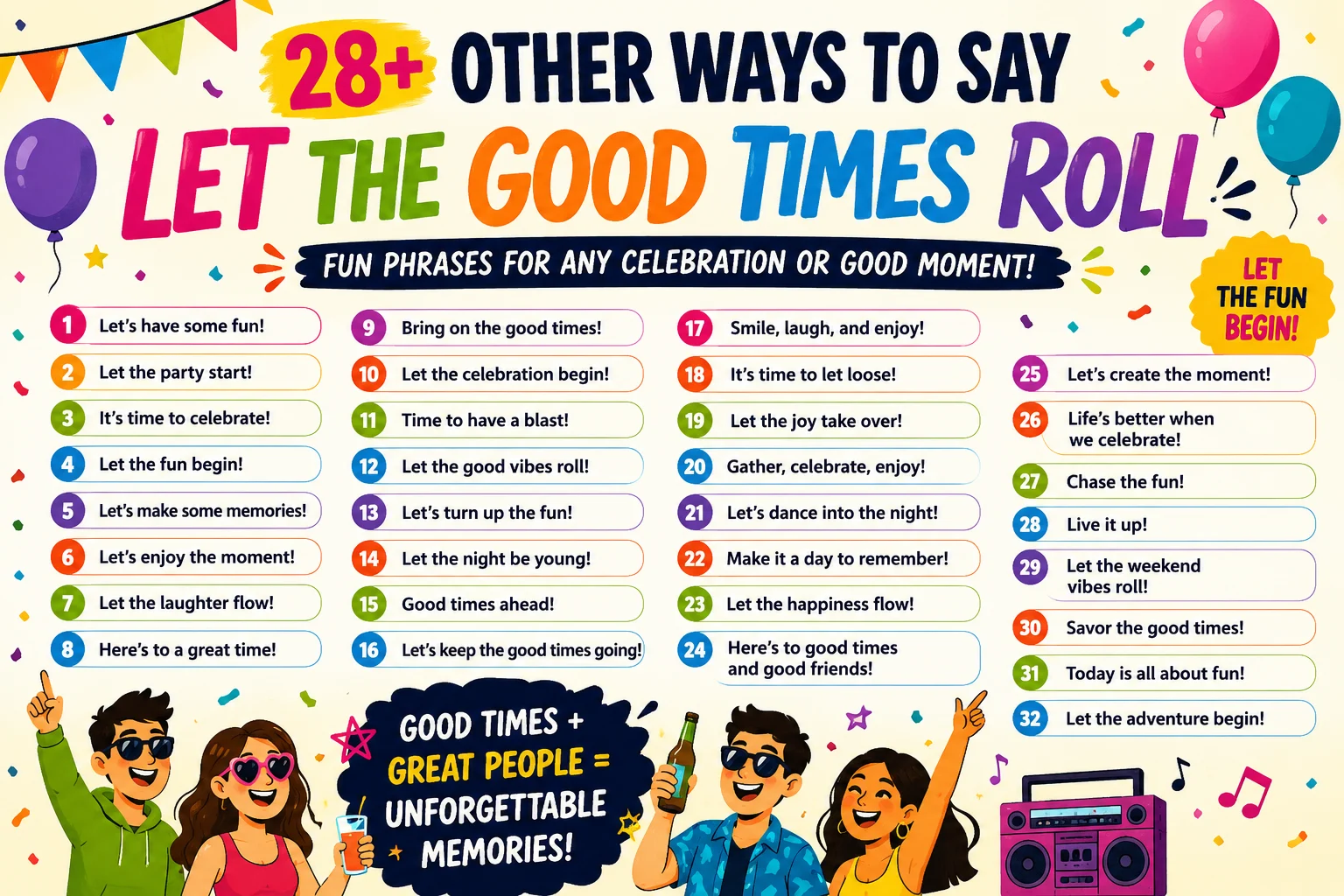
“Let the good times roll” is a classic expression that captures the joy of celebration and carefree enjoyment. But using this phrase in every festive situation can sound repetitive or out of touch. Having a variety of alternatives at your disposal helps you match the energy, setting, and cultural context of any gathering.
Knowing other ways to say “let the good times roll” allows you to sound more natural and spontaneous in social situations. Whether you’re at a party, a wedding, a casual get-together, or even a professional celebration, the right phrase can set the perfect tone. This guide provides 25+ alternatives to help you express enthusiasm for fun in any setting.
Top 5 alternatives: Let’s have some fun, Here’s to good times, Let’s make memories, Live it up, Enjoy the moment.
Quick Categories
Party & Celebration Alternatives
- Let’s get this party started
- Let’s have some fun
- Here’s to good times
- Let’s paint the town red
- Raise the roof
Pro Tip: These phrases work best in high-energy social settings like parties, weddings, and festivals. They express excitement and a desire for collective enjoyment.
Cheers & Toasts
- Here’s to good times
- Cheers to good times
- To happy times ahead
- Let’s raise a glass
- To the good times
Pro Tip: These phrases are ideal for toasts and celebrations where you want to honor the moment and the people sharing it with you.
Casual & Playful Alternatives
- Let’s have some fun
- Let’s make some memories
- Enjoy the moment
- Let’s live a little
- Let’s celebrate
Pro Tip: Casual alternatives are perfect for everyday social situations with friends, family, or close colleagues. They are warm and inviting.
Encouragement Alternatives
- Live it up
- Seize the day
- Make the most of it
- Carpe diem
- Enjoy it while it lasts
Pro Tip: Use encouraging phrases to motivate others to embrace the moment and enjoy themselves fully.
Philosophical Alternatives
- The party never stops
- Life is short
- Let’s enjoy the ride
- Life is for living
- Eat, drink, and be merry
Pro Tip: Philosophical alternatives add a reflective and appreciative tone, reminding everyone to cherish the good times.
Common Mistakes
Mistake 1: Using “Let’s get this party started” before everyone arrives
Why it is incorrect: This phrase is meant to launch a party. Using it when the room is half-empty can feel awkward or forced.
Correct version: Wait until the atmosphere is lively and most guests are present.
Example Sentence: Instead of yelling “Let’s get this party started!” at 7:00 PM with four people present, say “We’re all here now let’s get this party started!”
Mistake 2: Saying “Let’s paint the town red” in formal settings
Why it is incorrect: This phrase implies a night of wild partying, which is inappropriate for formal events or professional gatherings.
Correct version: Use “Let’s celebrate” or “Here’s to good times.”
Example Sentence: Instead of “Let’s paint the town red” at a company dinner, say “Let’s celebrate tonight’s success.”
Mistake 3: Using “Carpe diem” with people who don’t understand Latin
Why it is incorrect: “Carpe diem” may sound pretentious if the audience doesn’t know its meaning.
Correct version: Use the English translation: “Seize the day.”
Example Sentence: Instead of “Carpe diem!” say “Let’s seize the day and have some fun.
Mistake 4: Overusing “Live it up” in sentimental moments
Why it is incorrect: “Live it up” suggests wild, unrestrained enjoyment. In quieter, sentimental moments, it can feel inappropriate.
Correct version: Use “Enjoy the moment” or “Let’s make memories.”
Example Sentence: Instead of “Live it up!” at a quiet wedding dinner, say “Let’s enjoy this beautiful evening.
Mistake 5: Using “Life is short” in celebratory contexts
Why it is incorrect: This phrase can feel heavy or morbid, even when used with good intentions.
Correct version: Use “Life is for living” instead, which emphasizes life’s possibilities.
Example Sentence: Instead of “Life is short, let’s celebrate,” try “Life is for living let’s make the most of it.”
What Does “Let the Good Times Roll” Mean?
Definition: A phrase used to encourage enjoyment, celebration, and carefree fun.
Grammar: It is an imperative phrase, meaning it gives a command or suggestion. “The good times” is the object, and “roll” is the verb.
Simple Explanation: The phrase invites people to embrace happiness and enjoy themselves. It suggests that fun should happen naturally and abundantly.
Example Sentence: “The band is playing, the drinks are flowing let the good times roll!”
When to Use “Let the Good Times Roll”
This phrase is best used in social, celebratory, or carefree contexts. Use it when:
- The party or gathering is just getting started
- Friends are sharing a cheerful moment
- A celebration is in full swing
- You want to encourage others to relax and enjoy
“The right phrase can turn a good moment into a great memory.”
Is It Professional or Polite?
Polite? ✔ Yes, in social contexts.
Professional? ❌ No, it is far too casual for most professional settings.
Formal? ❌ No, it is informal and upbeat.
Natural? ✔ Yes, it sounds very natural in casual social situations.
Business-style example: “Let’s take this opportunity to celebrate our achievements.”
Explanation: “Let the good times roll” is a phrase you would use with friends, not colleagues. In professional settings, choose phrases that express celebration while maintaining a polished tone.
Pros and Cons
Pros
- Upbeat and positive
- Encourages enjoyment
- Easy to understand
- Creates a festive atmosphere
Cons
- Can feel clichéd
- Too informal for professional settings
- May sound old-fashioned to younger audiences
- Inappropriate for serious or sentimental moments
“The best celebrations combine enthusiasm with emotional intelligence.”
25+ Alternatives to Say “Let the Good Times Roll”
1. Phrase: Let’s Get This Party Started
Meaning: An energetic call to begin celebrating.
Explanation: This phrase is classic and energetic. It signals that the fun is about to begin. Native speakers use it to kick off events, particularly when music and dancing are involved.
Example Sentence: “The DJ is ready, and so are we let’s get this party started!”
Best Use: Parties, events, dance floors
Avoid Using In: Formal celebrations, quiet gatherings
Tone: Energetic, Exciting
Formality Level: ⭐⭐ Casual
Usage Frequency: Very Common
CEFR Level: B1
Common Collocations:
- get the party started
- let’s get this party started
- time to get this party started
Context Variability:
- Spoken English: “Let’s get this party started!”
- Professional English: Avoid.
- Casual Conversation: Very common at events.
2. Phrase: Let’s Have Some Fun
Meaning: A simple, direct invitation to enjoy yourselves.
Explanation: This phrase is versatile and universally understood. It works in a wide range of social settings where you want to encourage people to relax and enjoy.
Example Sentence: “The weekend is finally here let’s have some fun!”
Best Use: Friends, casual gatherings, social events
Avoid Using In: Formal professional contexts
Tone: Inviting, Simple
Formality Level: ⭐⭐⭐ Neutral
Usage Frequency: Very Common
CEFR Level: A1
Common Collocations:
- have some fun
- have a good time
- have a blast
Context Variability:
- Spoken English: “Let’s have some fun!”
- Professional English: “Let’s have some fun” is acceptable in casual workplaces.
- Casual Conversation: Very natural.
3. Phrase: Here’s to Good Times
Meaning: A toast celebrating happiness and joyful moments.
Explanation: This is a warm and classic toast phrase. It’s often used before drinking, but it can also be a heartfelt way to honor good experiences.
Example Sentence: “Here’s to good times with great friends!”
Best Use: Toasts, celebrations, social gatherings
Avoid Using In: Formal business dinners
Tone: Warm, Celebratory
Formality Level: ⭐⭐⭐ Neutral
Usage Frequency: Very Common
CEFR Level: B1
Common Collocations:
- here’s to
- here’s to good times
- here’s to memories
Context Variability:
- Spoken English: “Here’s to good times!”
- Professional English: “Here’s to our success.”
- Casual Conversation: Very common.
4. Phrase: Let’s Make Some Memories
Meaning: An invitation to create lasting experiences.
Explanation: This phrase is warm, sentimental, and encourages a focus on the moment. It’s perfect when you want to emphasize the importance of shared experiences.
Example Sentence: “We only have a few days together let’s make some memories!”
Best Use: Social gatherings, travel, special occasions
Avoid Using In: Professional contexts, casual parties
Tone: Sentimental, Warm
Formality Level: ⭐⭐⭐ Neutral
Usage Frequency: Common
CEFR Level: B1
Common Collocations:
- make memories
- create memories
- memorable moments
Context Variability:
- Spoken English: “Let’s make some memories.”
- Professional English: “Let’s make this a memorable experience.”
- Casual Conversation: Very common.
5. Phrase: Live It Up
Meaning: An enthusiastic encouragement to enjoy life to the fullest.
Explanation: This phrase conveys energetic enjoyment. It works well in active, spontaneous situations where there is an opportunity to indulge in fun.
Example Sentence: “We’re on vacation let’s live it up!”
Best Use: Travel, celebrations, energetic social situations
Avoid Using In: Quiet or sentimental moments
Tone: Energetic, Enthusiastic
Formality Level: ⭐⭐ Casual
Usage Frequency: Very Common
CEFR Level: B1
Common Collocations:
- live it up
- live a little
- live life to the fullest
Context Variability:
- Spoken English: “Let’s live it up!”
- Professional English: Avoid.
- Casual Conversation: Very common.
6. Phrase: Enjoy the Moment
Meaning: An invitation to be present and appreciate the present.
Explanation: This phrase is more mindful and intentional than “let the good times roll.” It works in both casual and semi-formal settings where you want to encourage people to appreciate what’s happening.
Example Sentence: “Don’t worry about tomorrow enjoy the moment!”
Best Use: All social settings, mindfulness practice
Avoid Using In: Formal professional contexts
Tone: Calm, Present
Formality Level: ⭐⭐⭐ Neutral
Usage Frequency: Very Common
CEFR Level: A2
Common Collocations:
- enjoy the moment
- enjoy the present
- be present
Context Variability:
- Spoken English: “Enjoy the moment.”
- Professional English: “Enjoy the moment” is acceptable.
- Casual Conversation: Very common.
7. Phrase: Let’s Celebrate
Meaning: An invitation to enjoy a happy occasion.
Explanation: This is a simple, direct, and universally understood phrase. It works in any situation where there is something positive to honor.
Example Sentence: “We got the promotion let’s celebrate!”
Best Use: Achievements, milestones, events
Avoid Using In: When there is no reason to celebrate
Tone: Excited, Warm
Formality Level: ⭐⭐⭐ Neutral
Usage Frequency: Very Common
CEFR Level: A1
Common Collocations:
- let’s celebrate
- celebrate together
- celebrate the moment
Context Variability:
- Spoken English: “Let’s celebrate!”
- Professional English: “Let’s celebrate this achievement.”
- Casual Conversation: Very common.
8. Phrase: Let’s Paint the Town Red
Meaning: A phrase meaning to go out and have a wild, fun night.
Explanation: This is a well-known idiom that implies a night of partying and excitement. It’s more common among older generations, but still understood by all.
Example Sentence: “We have the whole night ahead of us let’s paint the town red!”
Best Use: Nights out, parties, energetic social events
Avoid Using In: Formal settings, quiet evenings
Tone: Playful, Energetic
Formality Level: ⭐⭐ Casual
Usage Frequency: Common
CEFR Level: B2
Common Collocations:
- paint the town red
- paint the town
- out on the town
Context Variability:
- Spoken English: “Let’s paint the town red!”
- Professional English: Avoid.
- Casual Conversation: Common and playful.
9. Phrase: Seize the Day
Meaning: A call to make the most of the present moment.
Explanation: This phrase comes from the Latin “carpe diem.” It suggests taking action and enjoying life while you have the chance. It’s more about living life fully than just partying.
Example Sentence: “Tomorrow’s not guaranteed seize the day!”
Best Use: Encouragement, motivational moments
Avoid Using In: Lighthearted parties
Tone: Inspirational, Motivational
Formality Level: ⭐⭐⭐⭐ Formal
Usage Frequency: Common
CEFR Level: B2
Common Collocations:
- seize the day
- carpe diem
- make the most of today
Context Variability:
- Spoken English: “Seize the day!”
- Professional English: “Seize the day” is motivational.
- Casual Conversation: “Seize the day!” is common.
10. Phrase: Make the Most of It
Meaning: Encouraging someone to enjoy something fully.
Explanation: This phrase can be used both as encouragement before an experience and appreciation after one. It’s a practical and down-to-earth alternative.
Example Sentence: “We have one week in Paris make the most of it!”
Best Use: Travel, special occasions, opportunities
Avoid Using In: Formal contexts
Tone: Encouraging, Practical
Formality Level: ⭐⭐⭐ Neutral
Usage Frequency: Very Common
CEFR Level: B1
Common Collocations:
- make the most of it
- make the most of your time
- make the most of the opportunity
Context Variability:
- Spoken English: “Make the most of it!”
- Professional English: “Make the most of this opportunity.”
- Casual Conversation: Very common.
11. Phrase: Let’s Live a Little
Meaning: Encouraging someone to take a risk or do something fun.
Explanation: This phrase suggests that the other person is being too cautious. It’s a gentle, friendly nudge toward enjoyment and spontaneity.
Example Sentence: “Come on, have another dessert let’s live a little!”
Best Use: Social events, encouraging spontaneity
Avoid Using In: Professional settings
Tone: Playful, Encouraging
Formality Level: ⭐⭐⭐ Neutral
Usage Frequency: Common
CEFR Level: B1
Common Collocations:
- live a little
- take a chance
- let loose
Context Variability:
- Spoken English: “Let’s live a little!”
- Professional English: Avoid.
- Casual Conversation: Very natural.
12. Phrase: Raise the Roof
Meaning: An energetic call to have a great time, often with loud music or dancing.
Explanation: This is a lively, energetic phrase that suggests a party is going to be very loud and fun. It’s often used at concerts or dance parties.
Example Sentence: “The band is amazing let’s raise the roof!”
Best Use: Concerts, parties, energetic events
Avoid Using In: Formal events, quiet gatherings
Tone: Energetic, Loud
Formality Level: ⭐⭐ Casual
Usage Frequency: Common
CEFR Level: B2
Common Collocations:
- raise the roof
- rock the house
- tear the roof off
Context Variability:
- Spoken English: “Let’s raise the roof!”
- Professional English: Avoid.
- Casual Conversation: Used at energetic events.
13. Phrase: To Happy Times Ahead
Meaning: A toast to future happiness.
Explanation: This is a warm, forward-looking phrase. It’s often used as a toast to celebrate the present while looking forward to a bright future.
Example Sentence: “I’m excited for our new adventure together. To happy times ahead!”
Best Use: Toasts, celebrations, future plans
Avoid Using In: Very formal contexts
Tone: Optimistic, Forward-Looking
Formality Level: ⭐⭐⭐ Neutral
Usage Frequency: Common
CEFR Level: B1
Common Collocations:
- to happy times ahead
- to the future
- to better days
Context Variability:
- Spoken English: “To happy times ahead!”
- Professional English: “To our future success.”
- Casual Conversation: Very common.
14. Phrase: The Party Never Stops
Meaning: A declaration that the fun will continue indefinitely.
Explanation: This phrase is a playful way to express that the celebration is so good that you want it to last forever. It’s usually said with a smile.
Example Sentence: “We’ve been dancing for hours, and the party never stops!”
Best Use: Clubs, festivals, energetic parties
Avoid Using In: Formal contexts
Tone: Playful, Energetic
Formality Level: ⭐⭐ Casual
Usage Frequency: Common
CEFR Level: B2
Common Collocations:
- the party never stops
- the music never stops
- the fun never stops
Context Variability:
- Spoken English: “The party never stops!”
- Professional English: Avoid.
- Casual Conversation: Common.
15. Phrase: Let’s Enjoy the Ride
Meaning: An encouragement to embrace the journey.
Explanation: This phrase suggests that life is an experience, and you should enjoy it regardless of where it goes. It’s a calm, philosophical phrase.
Example Sentence: “We don’t know what’s coming next let’s enjoy the ride.”
Best Use: Travel, life transitions, social contexts
Avoid Using In: High-energy parties
Tone: Calm, Philosophical
Formality Level: ⭐⭐⭐ Neutral
Usage Frequency: Common
CEFR Level: B2
Common Collocations:
- enjoy the ride
- enjoy the journey
- life is a ride
Context Variability:
- Spoken English: “Let’s enjoy the ride.”
- Professional English: “Enjoy the ride” is acceptable.
- Casual Conversation: Very natural.
16. Phrase: Life Is for Living
Meaning: A reminder to embrace life and its opportunities.
Explanation: This is a straightforward, philosophical reminder that life is meant to be enjoyed. It’s a great alternative to “life is short.”
Example Sentence: “Stop worrying about work life is for living!”
Best Use: Encouragement, social contexts
Avoid Using In: Formal professional settings
Tone: Inspirational, Encouraging
Formality Level: ⭐⭐⭐ Neutral
Usage Frequency: Common
CEFR Level: B1
Common Collocations:
- life is for living
- live your life
- life is meant to be enjoyed
Context Variability:
- Spoken English: “Life is for living!”
- Professional English: “Life is for living” is acceptable.
- Casual Conversation: Very common.
17. Phrase: Eat, Drink, and Be Merry
Meaning: A classic phrase encouraging enjoyment of life’s pleasures.
Explanation: This famous phrase comes from the Bible and has become a standard expression for enjoying life. It can be used in a lighthearted, casual way or as a more meaningful reminder.
Example Sentence: “It’s the holidays let’s eat, drink, and be merry!”
Best Use: Gatherings, holidays, special occasions
Avoid Using In: Professional contexts
Tone: Classic, Festive
Formality Level: ⭐⭐⭐ Neutral
Usage Frequency: Common
CEFR Level: B2
Common Collocations:
- eat, drink, and be merry
- live, laugh, love
- good food, good drinks
Context Variability:
- Spoken English: “Eat, drink, and be merry!”
- Professional English: Avoid.
- Casual Conversation: Very common at festive events.
18. Phrase: Let’s Make It a Night to Remember
Meaning: A promise to create lasting memories.
Explanation: This phrase is often used when you want to ensure that the evening is special and unforgettable. It’s both romantic and friendly.
Example Sentence: “We’ve got the whole city ahead of us let’s make it a night to remember!”
Best Use: Dates, special events, celebrations
Avoid Using In: Very casual settings
Tone: Romantic, Memorable
Formality Level: ⭐⭐⭐ Neutral
Usage Frequency: Common
CEFR Level: B1
Common Collocations:
- a night to remember
- make it a night to remember
- unforgettable night
Context Variability:
- Spoken English: “Let’s make it a night to remember.”
- Professional English: “Let’s make this event memorable.”
- Casual Conversation: Very common.
19. Phrase: YOLO (You Only Live Once)
Meaning: An acronym for “You only live once,” used to justify taking risks.
Explanation: This modern expression encourages people to seize opportunities, especially fun or exciting ones. It is commonly used by younger people and on social media.
Example Sentence: “Let’s go skydiving tomorrow YOLO!”
Best Use: Social media, adventures, spontaneous decisions
Avoid Using In: Professional settings, serious conversations
Tone: Playful, Spontaneous
Formality Level: ⭐ Very Casual
Usage Frequency: Very Common
CEFR Level: B2
Common Collocations:
- YOLO
- you only live once
- YOLO
Context Variability:
- Spoken English: “YOLO!”
- Professional English: Avoid.
- Casual Conversation: Very common among young people.
20. Phrase: Let’s Have a Ball
Meaning: A fun phrase meaning to have a great time.
Explanation: This phrase is a bit old-fashioned but still understood. It expresses that you are going to enjoy yourself immensely.
Example Sentence: “We have the whole weekend for ourselves let’s have a ball!”
Best Use: Friends, casual social events
Avoid Using In: Formal contexts
Tone: Fun, Playful
Formality Level: ⭐⭐⭐ Neutral
Usage Frequency: Common
CEFR Level: B2
Common Collocations:
- have a ball
- have a blast
- have fun
Context Variability:
- Spoken English: “Let’s have a ball!”
- Professional English: Avoid.
- Casual Conversation: Very common.
21. Phrase: The Fun Is Just Beginning
Meaning: A phrase suggesting that the best part is yet to come.
Explanation: This is a great way to build anticipation and excitement. It encourages people to stay engaged and look forward to more enjoyment.
Example Sentence: “We’re just getting started the fun is just beginning!”
Best Use: Parties, events, ongoing celebrations
Avoid Using In: Calm or ending moments
Tone: Exciting, Anticipatory
Formality Level: ⭐⭐⭐ Neutral
Usage Frequency: Common
CEFR Level: B1
Common Collocations:
- the fun is just beginning
- the night is young
- we’re just getting started
Context Variability:
- Spoken English: “The fun is just beginning!”
- Professional English: “The best is yet to come.”
- Casual Conversation: Very common at events.
22. Phrase: Let’s Make It Count
Meaning: An encouragement to make the most of the moment.
Explanation: This phrase is more serious and motivational. It works when you want to emphasize that the moment is important and should be valued.
Example Sentence: “We have one shot at this let’s make it count.”
Best Use: Important moments, celebrations, competitions
Avoid Using In: Very lighthearted casual parties
Tone: Motivational, Serious
Formality Level: ⭐⭐⭐ Neutral
Usage Frequency: Common
CEFR Level: B1
Common Collocations:
- make it count
- make every moment count
- make this count
Context Variability:
- Spoken English: “Let’s make it count.”
- Professional English: “Let’s make this count.”
- Casual Conversation: Very common.
23. Phrase: Just Enjoy Yourself
Meaning: A simple reminder to have fun without stress.
Explanation: This is a warm, straightforward alternative. It works in a variety of social settings and is universally understood.
Example Sentence: “No need to worry about anything just enjoy yourself.”
Best Use: All social events
Avoid Using In: Professional performance contexts
Tone: Warm, Simple
Formality Level: ⭐⭐⭐ Neutral
Usage Frequency: Very Common
CEFR Level: A2
Common Collocations:
- enjoy yourself
- have fun
- enjoy the moment
Context Variability:
- Spoken English: “Just enjoy yourself.”
- Professional English: “Enjoy yourself” is acceptable.
- Casual Conversation: Very common.
24. Phrase: Let Loose
Meaning: A call to relax and have fun.
Explanation: This phrase encourages people to drop their inhibitions and enjoy themselves. It is often used at parties and social events.
Example Sentence: “The music is playing, so let loose and dance!”
Best Use: Parties, dancing, energetic social events
Avoid Using In: Professional contexts
Tone: Energetic, Encouraging
Formality Level: ⭐⭐ Casual
Usage Frequency: Common
CEFR Level: B1
Common Collocations:
- let loose
- let your hair down
- let go
Context Variability:
- Spoken English: “Let loose!”
- Professional English: “Let loose” is casual.
- Casual Conversation: Very common.
25. Phrase: The Good Times Are Here
Meaning: A statement that the present moment is joyful.
Explanation: This phrase is a more declarative version of “let the good times roll.” It states that the good times are happening now.
Example Sentence: “Look around you the good times are here!”
Best Use: Celebrations, social events, happy moments
Avoid Using In: Formal contexts
Tone: Joyful, Declarative
Formality Level: ⭐⭐⭐ Neutral
Usage Frequency: Common
CEFR Level: B1
Common Collocations:
- good times are here
- the good times
- good times
Context Variability:
- Spoken English: “The good times are here!”
- Professional English: Avoid.
- Casual Conversation: Very common.
Top 10 Alternatives Compared
| Phrase | Tone | Formality | Best Use | Frequency |
| Let’s get this party started | Energetic, Exciting | Casual | Parties, events | Very Common |
| Let’s have some fun | Inviting, Simple | Neutral | All social settings | Very Common |
| Here’s to good times | Warm, Celebratory | Neutral | Toasts, celebrations | Very Common |
| Let’s make some memories | Sentimental, Warm | Neutral | Special occasions | Common |
| Live it up | Energetic, Enthusiastic | Casual | Travel, parties | Very Common |
| Enjoy the moment | Calm, Present | Neutral | All settings | Very Common |
| Let’s celebrate | Excited, Warm | Neutral | Achievements, events | Very Common |
| Seize the day | Inspirational, Motivational | Formal | Encouragement | Common |
| Make the most of it | Encouraging, Practical | Neutral | Travel, opportunities | Very Common |
| Let’s paint the town red | Playful, Energetic | Casual | Nights out, parties | Common |
Which One Should You Use?
Best Overall
“Let’s have some fun” This is the most versatile and universally understood phrase. It works in almost any social setting and is warm and inviting.
Best for Parties
“Let’s get this party started” This is the perfect phrase to kick off any celebration. It builds energy and excitement.
Best for Toasts
“Here’s to good times” this is the ideal toast phrase. It’s warm, classic, and perfect for raising a glass.
Best for Sentimental Moments
“Let’s make some memories This is perfect when you want to emphasize the importance of shared experiences.
Best for Travel
“Make the most of it” This is practical and encouraging, ideal for trips and adventures.
Best for Encouragement
“Seize the day” This is inspirational and motivational. It encourages people to live life to the fullest.
Avoid These in Formal Situations
“Let’s paint the town red” This is too wild for professional celebrations. Use “Let’s celebrate” instead.
YOLO” This is too casual and juvenile for professional settings. Use “Seize the day” instead.
“Let’s raise the roof” This is too loud and informal. Use “Let’s enjoy this event.”
“The party never stops” This is too playful and casual. Use “Let’s make the most of this evening.”
“Live it up” This sounds unrestrained. Use “Let’s enjoy ourselves” instead.
FAQ Section
What is the most professional way to say “let the good times roll”?
The most professional way is to say “Let’s celebrate this achievement” or “Here’s to our success.” These phrases maintain a polished tone while expressing positive feelings. Avoid overly casual or playful alternatives in professional settings.
Which phrase is best for a wedding toast?
“Here’s to good times” is perfect for a wedding toast. It’s warm, celebratory, and appropriate for mixed company. “To happy times ahead” is also an excellent choice for a wedding.
What is the difference between “live it up” and “enjoy the moment”?
“Live it up” suggests energetic, active enjoyment and is often used for parties or travel. “Enjoy the moment” is more mindful and calm, encouraging presence rather than excess. Choose based on the energy of the event.
Which alternative sounds most natural in everyday conversation?
“Let’s have some fun” is the most natural and versatile. It works in almost any social setting and is universally understood. It’s simple, direct, and warm.
Can I use these expressions in professional settings?
Yes, but choose carefully. “Let’s celebrate,” “Enjoy the moment,” and “Here’s to good times” can all work in professional settings when used appropriately. Avoid “YOLO,” “Let’s paint the town red,” and “Live it up” in work contexts.
Conclusion
Whether you want to celebrate a special moment, set a cheerful mood, or simply encourage everyone to have fun, there are plenty of ways to say “Let the good times roll.” From casual phrases like “Let’s have some fun” to upbeat expressions like “Let the celebration begin,” the right alternative can make your message feel more lively and personal. Choose a phrase that matches the occasion and keeps the positive energy going.

14 thoughts on “Other Ways to Say “Let the Good Times Roll” |28+ Examples for 2026”