You are writing an email to a coworker who helped you meet a tight deadline. You type “thank you for your kindness” and pause. It feels right, but something is missing. You have used the same word three times this week. Your essay about community leaders relies on the same tired phrase, while your social media caption feels flat. This happens to everyone.
Finding the right synonym for kindness can transform repetitive writing into something more precise, natural, and memorable. English offers many synonyms for kindness, from compassion and generosity to thoughtfulness, benevolence, consideration, and warmth. However, these words are not always interchangeable. Each kindness synonym carries its own shade of meaning, emotional weight, level of formality, and appropriate use.
If you are searching for kindness synonyms, synonyms of kindness, another word for kindness, other words for kindness, or synonyms to kindness, understanding these distinctions can help you choose a word that accurately matches your intended message. A professional email may call for consideration or thoughtfulness, while a personal message might sound more natural with compassion, warmth, or generosity.
A reliable kindness thesaurus can provide a useful starting point, but simply replacing one word with another is not always the best approach. The strongest vocabulary choices consider context, tone, meaning, and audience. For example, charity emphasizes giving or helping, compassion focuses on concern for someone’s difficulties, and courtesy often describes polite and respectful behavior.
This guide is built around standard English usage and clear distinctions between related words. We’ll explore the most useful synonym kindness options, explain what each word means, provide example sentences, and show which alternatives work best in professional, academic, personal, and creative writing. Whether you’re looking for a single kindness synonym or a broader list of synonyms for kindness, you’ll find practical choices that make your writing more varied, precise, and expressive.
What Are the Best Synonyms of “Kindness”?
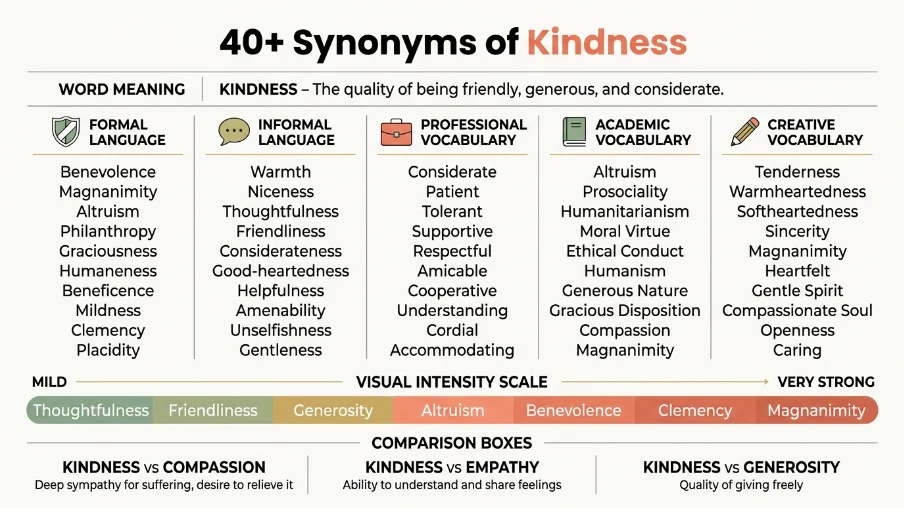
Kindness means the quality of being friendly, generous, and considerate toward others. For formal writing, choose benevolence or magnanimity. For casual conversation, use warmth or thoughtfulness. In professional settings, courtesy and consideration work best. Academic writing favors altruism and humanity. Emotional writing benefits from compassion and tenderness. Creative writing shines with graciousness and gentleness.
Meaning, Tone, and Context
Simple Definition: Kindness is the quality of being warmhearted, considerate, and humane toward others. It involves acting in ways that benefit other people, often without expecting anything in return.
Part of Speech: Noun
Overall Tone: Positive
Formality Level: Neutral. Kindness works in almost any context, from casual conversation to formal writing.
Common Uses: Native English speakers use kindness in everyday conversation, emails, workplace communication, academic writing, and creative work. The word appears frequently when describing someone’s character, acknowledging helpful actions, or discussing moral values.
Word Forms:
When and How to Use “Kindness”
Choose kindness when you want to describe a general quality of being good to others. The word works well in most situations because it is widely understood and carries a warm, positive tone. However, kindness can feel too general when you need a more specific or powerful word.
Professional: “Her kindness toward new employees made the onboarding process much smoother.”
Academic: “The study examined how kindness in the classroom affects student engagement and learning outcomes.”
Workplace: “I want to acknowledge your kindness in covering my shift last minute.”
Personal: “My grandmother’s kindness taught me more than any book ever could.”
Email: “Thank you for your kindness and patience during this challenging project.”
Resume: “Recognized for kindness and empathy in patient care, resulting in improved satisfaction scores.”
Social Media: “A small act of kindness can change someone’s entire day.”
Best Synonyms of “Kindness”
No synonym perfectly matches kindness in every situation. Each alternative carries its own nuance, emotional weight, and best use case. Here are the top recommendations for specific contexts.
Professional writing: Courtesy — sounds polished and businesslike without being overly emotional.
Academic writing: Altruism — carries scholarly weight and suggests selfless concern for others.
Business communication: Goodwill — implies positive relationships and mutual benefit.
Casual conversation: Warmth — feels natural and approachable in everyday speech.
Emotional writing: Compassion — conveys deep feeling and concern for others’ suffering.
Creative writing: Graciousness — adds elegance and charm to descriptive passages.
Resume writing: Empathy — demonstrates emotional intelligence and people skills.
Workplace communication: Consideration — shows respect for colleagues’ time and needs.
Stronger meaning: Magnanimity — suggests generosity of spirit, especially toward rivals.
Softer meaning: Gentleness — emphasizes a mild, tender approach.
When Not to Use “Kindness”
Kindness is a versatile word, but it is not always the best choice. Here are situations where you should consider alternatives.
When the word sounds too general: Kindness can feel vague when you need to describe a specific action or quality. It covers so much meaning that it sometimes says very little.
Better synonym: Specify what you mean. Use generosity for giving, compassion for suffering, or thoughtfulness for careful consideration of others.
Rewrite: Instead of “She showed kindness,” try “She showed remarkable generosity by donating her entire bonus.”
When the word sounds too weak: Kindness sometimes feels mild when you need to convey strong moral character or significant sacrifice.
Better synonym: Choose benevolence or magnanimity for a stronger, more impressive quality.
Rewrite: Instead of “His kindness was inspiring,” try “His magnanimity in victory earned everyone’s respect.”
When the word sounds too informal for the context: While kindness works in most settings, some formal documents benefit from more sophisticated vocabulary.
Better synonym: Use altruism in academic papers or philanthropy when discussing charitable giving.
Rewrite: Instead of “The foundation promotes kindness,” try “The foundation promotes philanthropy and community support.”
When the word sounds outdated: Kindness never really goes out of style, but some contexts call for more contemporary language.
Better synonym: Use empathy in modern workplace discussions about emotional intelligence.
Rewrite: Instead of “Managers should show kindness,” try “Managers should demonstrate empathy and understanding.”
Words Commonly Confused With “Kindness”
Kindness vs. Niceness
Difference: Niceness focuses on being pleasant and agreeable. Kindness involves acting in someone’s best interest, even when it is difficult.
When to use each: Use niceness for surface-level politeness. Use kindness for genuine care and moral goodness.
Example: “Her niceness made her popular, but her kindness made her trusted.
Kindness vs. Compassion
Difference: Compassion specifically involves awareness of and concern for others’ suffering. Kindness is broader and includes general friendliness and generosity.
When to use each: Use compassion when describing responses to pain or hardship. Use kindness for everyday warmth and consideration.
Example: “The nurse’s compassion for her patients went beyond ordinary kindness.”
Kindness vs. Empathy
Difference: Empathy is the ability to understand and share another person’s feelings. Kindness is the action or quality of being good to others.
When to use each: Use empathy when discussing understanding emotions. Use kindness when discussing actions and character.
Example: “Her empathy helped her understand his frustration, and her kindness led her to help.
Kindness vs. Generosity
Difference: Generosity specifically involves giving freely, often money or time. Kindness is a broader quality that includes generosity but also includes consideration, warmth, and helpfulness.
When to use each: Use generosity when the focus is on giving. Use kindness for a wider range of caring behaviors.
Example: “His generosity with money was impressive, but his kindness in listening was even more valuable.”
Kindness vs. Benevolence
Difference: Benevolence is an inclination to do good, often from a position of authority or power. Kindness is more personal and everyday.
When to use each: Use benevolence in formal contexts or when describing institutional goodwill. Use kindness for personal interactions.
Example: “The benevolence of the foundation changed countless lives through its grants.”
Kindness vs. Courtesy
Difference: Courtesy focuses on polite behavior and good manners. Kindness goes deeper and involves genuine care.
When to use each: Use courtesy for professional etiquette and politeness. Use kindness for warmer, more personal interactions.
Example: “His courtesy made meetings run smoothly, but his kindness made colleagues feel valued.”
Best Synonyms of “Kindness” by Context
How to Choose the Best Synonym of “Kindness”
Choosing the right synonym depends on several factors. Start by considering your audience. Formal audiences respond better to words like benevolence and courtesy. Casual audiences appreciate warmth and thoughtfulness.
Think about your purpose. Are you describing someone’s character? Use kindness or goodness. Are you acknowledging a specific action? Use consideration or helpfulness. Are you discussing moral philosophy? Use altruism or humanity.
Consider emotional intensity. Gentleness is mild. Compassion is stronger. Magnanimity is the strongest and most impressive.
Match the formality level. Academic and professional writing benefits from benevolence, altruism, and philanthropy. Casual writing works well with warmth, care, and thoughtfulness.
Above all, choose the word that communicates your intended message most clearly. If you are unsure, read your sentence aloud with each option. The right word will sound natural and feel right.
Real Life Examples of “Kindness”
School: The teacher’s kindness made every student feel safe enough to ask questions.
College: During finals week, small acts of kindness like sharing notes made a huge difference.
Workplace: Her kindness in mentoring new hires reduced turnover and improved team performance.
Business: The company’s kindness toward employees during the pandemic built lasting loyalty.
Email: “I am writing to express my gratitude for your kindness in reviewing my application.”
Resume: “Known for kindness and patience in high-stress customer service environments.”
Conversation: “You know, your kindness really helped me get through a rough week.”
Storytelling: “In a world that often felt cold, his kindness was a warm fire that drew people in.”
Blogging: “Kindness costs nothing but can change everything for someone who is struggling.”
Social media: “Never underestimate the power of a simple act of kindness. It might be exactly what someone needs today.”
25 Best Synonyms of “Kindness”
Synonyms of “Kindness” by Usage
Professional vs Personal Synonyms
In workplaces and professional settings, choose words that sound polished and businesslike. Courtesy, consideration, and goodwill work well in emails, meetings, and client communications. These words show respect without being overly emotional.
In personal conversations, warmth, thoughtfulness, and care sound natural and genuine. These words create connection and convey authentic feeling.
Formal vs Conversational Synonyms
Formal writing such as reports, essays, and business presentations benefits from benevolence, magnanimity, and altruism. These words carry authority and precision.
Conversational English prefers kindness itself, along with warmth, care, and thoughtfulness. These words feel natural in everyday speech and texting.
Academic Synonyms
Academic writing demands precision and authority. Altruism works well in psychology and social sciences. Benevolence fits philosophy and ethics. Humanity appears frequently in humanities and social commentary. Philanthropy suits economics and sociology discussions. These words sound scholarly and demonstrate vocabulary sophistication.
Professional and Business Synonyms
Resumes and interviews benefit from empathy, which shows emotional intelligence. Meetings and presentations call for courtesy and consideration. Performance reviews often use collegiality and cooperation. Client communication benefits from goodwill and responsiveness. Business emails work well with courtesy, understanding, and consideration.
Creative and Literary Synonyms
Storytelling and fiction benefit from tenderness, graciousness, and gentleness. These words add emotional depth and imagery. Poetry often uses compassion and humanity for their resonant sounds. Descriptive writing shines with warmth, kindliness, and fellow-feeling. Speeches use goodness and magnanimity for their inspirational quality.
Slang or Modern Synonyms
No widely used slang synonyms exist for kindness. The concept is too serious and positive to have developed casual slang alternatives. However, “good vibes” sometimes conveys a similar feeling in very casual contexts, but it is not a true synonym.
Strongest to Mildest Synonyms
Mild: Gentleness, thoughtfulness, courtesy
Moderate: Kindness, warmth, consideration, goodness
Strong: Compassion, generosity, benevolence, humanity
Very Strong: Magnanimity, altruism, philanthropy
Emotional vs Neutral Synonyms
Emotional Synonyms: Compassion, tenderness, warmth, sympathy, fellow-feeling. These words express stronger feelings and work well in personal writing, emotional contexts, and when you want to convey deep care.
Neutral Synonyms: Courtesy, consideration, decency, goodwill, helpfulness. These words communicate kindness without adding strong emotion. They work well in professional settings and when you want to be factual rather than sentimental.
Antonyms of “Kindness”
Comparison: “Kindness” vs Similar Words
Kindness vs Niceness
Main Difference: Niceness is about being pleasant and agreeable. Kindness is about acting in someone’s best interest, even when it is difficult.
Which Is Stronger? Kindness is stronger and more meaningful.
Which Is More Formal? Neither is particularly formal, but kindness appears more in serious writing.
When to Use Each: Use niceness for surface-level politeness. Use kindness for genuine care and moral goodness.
Examples:
- Niceness: “Her niceness made her easy to work with, but it sometimes felt superficial.”
- Kindness: “His kindness led him to tell her the truth, even though it was painful.”
Kindness vs Compassion
Main Difference: Compassion specifically involves awareness of others’ suffering and the desire to relieve it. Kindness is a broader quality that includes general friendliness, generosity, and consideration.
Which Is Stronger? Compassion is emotionally stronger and more specific.
Which Is More Formal? Both work in formal contexts, but compassion appears more in academic and medical writing.
When to Use Each: Use compassion when discussing responses to pain, hardship, or suffering. Use kindness for everyday warmth and consideration.
Examples:
- Kindness: “She showed kindness by bringing coffee to her tired colleague.”
- Compassion: “Her compassion for the grieving family was evident in every thoughtful gesture.”
Kindness vs Empathy
Main Difference: Empathy is the ability to understand and share another person’s feelings. Kindness is the action or quality of being good to others.
Which Is Stronger? Neither is stronger; they describe different things.
Which Is More Formal? Empathy is more technical and appears frequently in psychology and workplace contexts.
When to Use Each: Use empathy when discussing understanding emotions. Use kindness when discussing actions and character.
Examples:
- Kindness: “Her kindness made the new employee feel welcome from day one.”
- Empathy: “His empathy allowed him to sense her anxiety before she mentioned it.”
Kindness vs Generosity
Main Difference: Generosity specifically involves giving freely, often money or time. Kindness is a broader quality that includes generosity but also includes consideration, warmth, and helpfulness.
Which Is Stronger? Generosity is more specific and often more impressive when describing giving.
Which Is More Formal? Generosity works in all contexts.
When to Use Each: Use generosity when the focus is on giving resources. Use kindness for a wider range of caring behaviors.
Examples:
- Kindness: “His kindness included listening, helping, and always being patient.”
- Generosity: “His generosity funded scholarships for dozens of students.”
Kindness vs Benevolence
Main Difference: Benevolence is an inclination to do good, often from a position of authority or power. Kindness is more personal and everyday.
Which Is Stronger? Benevolence sounds more formal and impressive.
Which Is More Formal? Benevolence is significantly more formal.
When to Use Each: Use benevolence in formal contexts or when describing institutional goodwill. Use kindness for personal interactions.
Examples:
- Kindness: “My neighbor’s kindness in shoveling my driveway was deeply appreciated.”
- Benevolence: “The benevolence of the foundation changed countless lives through its grants.”
Kindness vs Courtesy
Main Difference: Courtesy focuses on polite behavior and good manners. Kindness goes deeper and involves genuine care and concern.
Which Is Stronger? Kindness is stronger and more meaningful.
Which Is More Formal? Courtesy is more formal and professional.
When to Use Each: Use courtesy for professional etiquette and politeness. Use kindness for warmer, more personal interactions.
Examples:
- Kindness: “Her kindness extended to remembering everyone’s birthday and favorite coffee order.”
- Courtesy: “His courtesy in holding the door and greeting clients professionally was noted.
Common Phrases and Expressions with “Kindness”
Act of kindness
Meaning: A specific kind or helpful action.
Example Sentence: “Buying coffee for the stranger behind you is a small act of kindness that can brighten someone’s day.
Kindness of strangers
Meaning: Help or care received from unknown people.
Example Sentence: “When her car broke down in the middle of nowhere, she relied on the kindness of strangers to get help.”
Random act of kindness
Meaning: An unplanned, spontaneous kind act.
Example Sentence: “The movement encourages people to perform random acts of kindness without expecting anything in return.”
Kill them with kindness
Meaning: Respond to unkindness with exaggerated kindness.
Example Sentence: “Instead of arguing with the rude customer, she decided to kill them with kindness.”
Out of the kindness of one’s heart
Meaning: Doing something purely out of generosity, not obligation.
Example Sentence: “He volunteered at the shelter out of the kindness of his heart, not for recognition or reward.”
Kindness begets kindness
Meaning: Kind acts inspire more kind acts.
Example Sentence: “She believes that kindness begets kindness, so she always tries to start the cycle.”
Tender loving kindness
Meaning: Gentle, caring attention and affection.
Example Sentence: “The injured puppy needed tender loving kindness to recover fully.”
Thank you for your kindness
Meaning: A common expression of gratitude.
Example Sentence: “Thank you for your kindness during such a difficult time. Your support meant everything.”
Common Mistakes to Avoid
Mistake 1: Choosing a vague synonym instead of a precise one
Incorrect: “Her good nature made her popular.” (Good nature is vague and does not convey specific kindness.)
Better: “Her kindness and generosity made her popular.” (Specify which qualities you mean.)
Mistake 2: Confusing kindness with niceness
Incorrect: “His niceness led him to donate his entire salary.” (Niceness is too superficial for such a significant action.)
Better: “His kindness and generosity led him to donate his entire salary.”
Mistake 3: Using an informal synonym in formal writing
Incorrect: “The foundation’s warm-fuzzies helped many families.” (Warm-fuzzies is too casual for formal writing.)
Better: “The foundation’s benevolence and philanthropy helped many families.”
Mistake 4: Selecting an overly dramatic synonym
Incorrect: “She showed magnanimity by bringing me soup when I was sick.” (Magnanimity is too grand for a small, kind act.)
Better: “She showed thoughtfulness by bringing me soup when I was sick.”
Mistake 5: Repeating the same word too often
Incorrect: “Her kindness was remarkable. Her kindness inspired others. Her kindness changed lives.” (Repetitive and dull.)
Better: “Her kindness was remarkable. Her compassion inspired others. Her generosity changed lives.”
Mistake 6: Choosing a synonym with the wrong emotional tone
Incorrect: “The manager’s compassion for the quarterly report impressed the team.” (Compassion is too emotional for a business document.)
Better: “The manager’s attention to detail and thoroughness impressed the team.”
Mistake 7: Using slang in academic or professional writing
Incorrect: “The study measured good vibes among participants.” (Good vibes is too casual for academic writing.)
Better: “The study measured prosocial attitudes and kindness among participants.”
Frequently Asked Questions
1. What are the best synonyms of kindness?
The best synonyms of kindness depend on your context. For formal writing, use benevolence or magnanimity. For casual conversation, use warmth or thoughtfulness. For professional settings, use courtesy or consideration.
2. What are the best formal synonyms of kindness?
The best formal synonyms include benevolence, magnanimity, altruism, philanthropy, and humanity. These words carry authority and work well in academic papers, business reports, and professional correspondence.
3. What are common informal synonyms of kindness?
Common informal synonyms include warmth, thoughtfulness, care, and goodness. These words feel natural in everyday conversation, personal emails, and social media posts.
4. What is another word for kindness in professional writing?
In professional writing, courtesy and consideration work well for workplace communication. For resumes and interviews, empathy and interpersonal skills are effective choices. For client communications, goodwill is excellent.
5. What is the difference between kindness and compassion?
Kindness is a broad quality that includes friendliness, generosity, and consideration. Compassion specifically involves awareness of and concern for others’ suffering. Compassion is a specific form of kindness directed toward those who are suffering.
6. What is the opposite of kindness?
The opposite of kindness includes cruelty, harshness, meanness, malevolence, and unkindness. These words describe behavior that causes harm, suffering, or distress to others.
Conclusion
Kindness is the quality of being friendly, generous, and considerate toward others. It is one of the most valuable traits a person can possess, and English offers dozens of ways to express it. The best synonym depends on your audience, purpose, and context. Formal writing benefits from benevolence and magnanimity. Casual conversation welcomes warmth and thoughtfulness. Professional settings call for courtesy and consideration. No single synonym works perfectly in every situation. The key is to choose the word that communicates your intended message most clearly and naturally. The next time you reach for “kindness,” pause and consider whether a more precise word might serve you better. Your writing will become clearer, stronger, and more engaging.

2 thoughts on “Synonyms of Kindness| 40+ Best Alternatives For 2026”