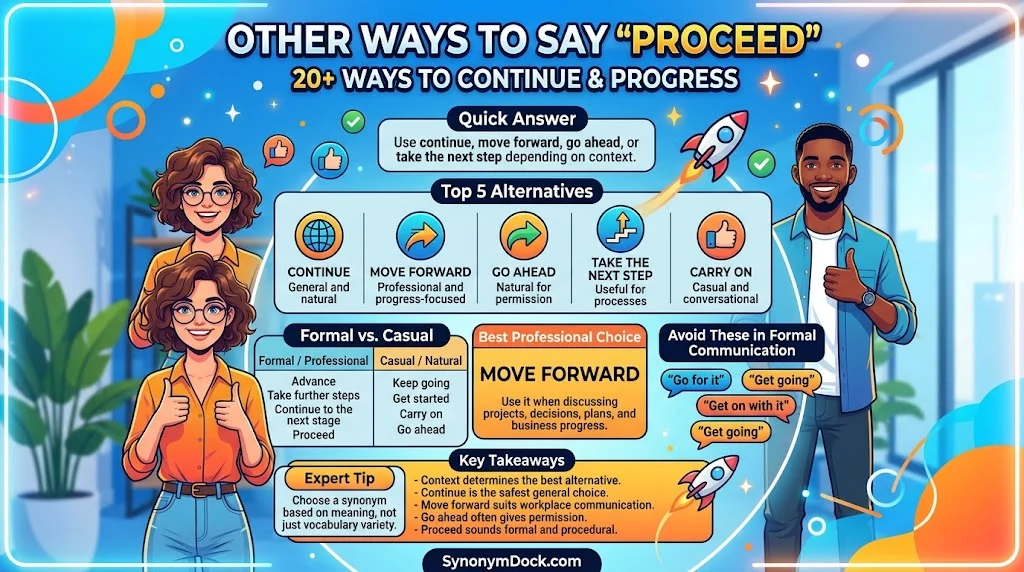
Other ways to say proceed include continue, move forward, go ahead, carry on, advance, take the next step, move ahead, and continue with the process. The best choice depends on formality and context.
5 best alternatives: continue, move forward, go ahead, carry on, take the next step
The verb proceed means to continue with an action, move forward, or begin the next stage of a process. It is common in professional, academic, legal, and formal English.
Learning other ways to say proceed helps you avoid repetition and choose language that matches your situation. The right alternative can make a business email sound more natural, a presentation more polished, or everyday speech more conversational.
Knowing several alternatives to proceed is especially useful when writing emails, giving instructions, participating in workplace meetings, preparing academic work, or speaking fluent English.
“Good vocabulary is not about using bigger words; it is about choosing the right word for the situation.”
Quick Categories
Formal Alternatives
- Continue
- Move forward
- Advance
- Continue with the matter
- Take the next step
Professional Alternatives
- Move forward
- Go ahead
- Continue with the process
- Take the next step
- Move ahead
Business Email Alternatives
- Please continue
- Please go ahead
- We can move forward
- You may continue
- Let’s move forward with this
Academic Alternatives
- Continue
- Develop further
- Advance
- Move to the next stage
- Continue with the analysis
Casual Alternatives
- Go ahead
- Keep going
- Carry on
- Move on
- Get started
Informal Expressions
- Go for it
- Keep going
- Carry on
- Move ahead
- Get on with it
Pro Tip
Use proceed when you want a formal or procedural tone. In everyday conversation, go ahead, keep going, or continue will usually sound more natural.
What Does “Proceed” Mean?
Proceed means to continue doing something, move forward to the next stage, or take action after a decision or instruction.
It is usually followed by with + noun when referring to a process:
- We can proceed with the project.
- Please proceed with the application.
- The team decided to proceed with the plan.
It can also describe moving forward:
- The speaker proceeded to explain the new policy.
In modern English, proceed is grammatically correct and widely understood, but it often sounds more formal than continue or go ahead.
Natural Example
Once everyone approved the proposal, the team proceeded with the next stage.
When to Use “Proceed”
You may see or hear proceed in:
- Business emails
- Workplace meetings
- Formal instructions
- Academic writing
- Presentations
- Official notices
- Customer communication
- Legal or administrative contexts
- Formal conversations
- Written English
For everyday spoken English, alternatives such as go ahead, continue, and keep going may sound more relaxed.
Is “Proceed” Professional or Polite?
Polite? ✔ Yes
Professional? ✔ Yes
Formal? ✔ Often
Natural? ✔ Yes, especially in procedural contexts
Business-style example
Please proceed with the revised proposal once the client confirms the details.
The sentence sounds professional because proceed focuses on moving to the next stage of an agreed process.
A more conversational version would be:
Please go ahead with the revised proposal once the client confirms the details.
The second version is still professional but feels less formal.
Pros and Cons
Pros
- Clear and widely understood
- Appropriate for professional communication
- Useful for describing processes
- Works well in formal writing
- Can clearly signal the next stage of an action
Cons
- Can sound formal in casual conversation
- May feel procedural or official
- Can be repetitive in business writing
- Sometimes continue or go ahead sounds more natural
“Formal English is useful when the situation calls for precision but natural English matters just as much.”
Other Ways to Say “Proceed” With Examples
There are many alternatives to proceed, but they are not interchangeable in every situation. Some describe continuing an activity, while others suggest permission, progress, or movement to a new stage.
The following expressions cover formal, professional, neutral, casual, and academic situations.
Expert Tip
Native speakers usually choose an alternative based on what kind of movement is involved. Use continue for an ongoing action, go ahead for permission or approval, and move forward when emphasizing progress.
1. Phrase: Continue
Meaning: To keep doing something without stopping.
Explanation:
Continue is the most straightforward alternative to proceed. It is neutral, natural, and suitable for both spoken and written English.
It works particularly well when an action is already underway.
Example Sentence:
The instructor asked the students to continue with the exercise.
Best Use:
Academic Work
Avoid Using In:
None broadly useful
Tone:
Neutral, Clear
Formality Level:
⭐⭐⭐ Neutral
Usage Frequency:
Very Common
CEFR Level:
B1
Common Collocations:
- continue working
- continue with the project
- continue the discussion
- continue the process
Context Variability:
- Spoken English: “You can continue when you’re ready.”
- Professional English: “We will continue with the implementation.”
- Casual Conversation: “Just continue what you were doing.”
2. Phrase: Move Forward
Meaning: To make progress or continue to the next stage.
Explanation:
Move forward is extremely useful in professional English. It often suggests progress after a decision, discussion, or problem.
It is especially common in workplace meetings and business communication.
Example Sentence:
After reviewing the proposal, the company decided to move forward with the partnership.
Best Use:
Business Meetings
Avoid Using In:
Simple Instructions
Tone:
Professional, Positive
Formality Level:
⭐⭐⭐⭐ Formal
Usage Frequency:
Very Common
CEFR Level:
B2
Common Collocations:
- move forward with
- move forward on
- move forward with the plan
- move forward together
Context Variability:
- Spoken English: “Let’s move forward with the idea.”
- Professional English: “We are ready to move forward with implementation.”
- Casual Conversation: “I’m ready to move forward.”
3. Phrase: Go Ahead
Meaning: To proceed after receiving permission or approval.
Explanation:
Go ahead is one of the most natural alternatives in spoken English. It often means that someone has permission to start or continue.
It is less formal than proceed, but it can still work in professional communication.
Example Sentence:
The manager gave us permission to go ahead with the presentation.
Best Use:
Daily Conversation
Avoid Using In:
Formal Academic Writing
Tone:
Friendly, Natural
Formality Level:
⭐⭐ Casual
Usage Frequency:
Very Common
CEFR Level:
B1
Common Collocations:
- go ahead with
- go ahead and start
- go ahead with the plan
- go ahead and submit
Context Variability:
- Spoken English: “Go ahead and start.”
- Professional English: “You can go ahead with the proposal.”
- Casual Conversation: “Go ahead. I’m listening.”
4. Phrase: Carry On
Meaning: To continue doing something.
Explanation:
Carry on is natural in conversation and common in British English. It can sound friendly and relaxed.
It is generally less suitable than continue for highly formal documents.
Example Sentence:
Despite the interruption, the presenter carried on with the discussion.
Best Use:
Spoken English
Avoid Using In:
Formal Reports
Tone:
Casual, Friendly
Formality Level:
⭐⭐ Casual
Usage Frequency:
Common
CEFR Level:
B1
Common Collocations:
- carry on working
- carry on talking
- carry on with
- carry on as usual
Context Variability:
- Spoken English: “Please carry on.”
- Professional English: “The meeting carried on after the break.”
- Casual Conversation: “Carry on; I won’t interrupt.”
5. Phrase: Take the Next Step
Meaning: To move to the next stage of a process.
Explanation:
This phrase is useful when proceed means moving from one stage to another. It is especially natural in business, career, project, and decision-making contexts.
Example Sentence:
Once the interview is complete, we can take the next step.
Best Use:
Business Communication
Avoid Using In:
Simple Instructions
Tone:
Professional, Encouraging
Formality Level:
⭐⭐⭐⭐ Formal
Usage Frequency:
Common
CEFR Level:
B2
Common Collocations:
- take the next step
- take further steps
- next step in the process
- take the appropriate step
Context Variability:
- Spoken English: “Let’s take the next step.”
- Professional English: “We are ready to take the next step.”
- Casual Conversation: “I think it’s time to take the next step.”
Native Speaker Tip
Continue is the safest general alternative, while go ahead is especially natural when permission is involved. Move forward is common in modern workplace English.
“If you mean permission, choose ‘go ahead.’ If you mean progress, ‘move forward’ often fits better.”
6. Phrase: Move Ahead
Meaning: To continue or make progress.
Explanation:
Move ahead is similar to move forward and works well when discussing plans, projects, or decisions.
It can sound slightly more action-oriented than continue.
Example Sentence:
The committee agreed to move ahead with the revised schedule.
Best Use:
Workplace Discussion
Avoid Using In:
Formal Definitions
Tone:
Professional, Direct
Formality Level:
⭐⭐⭐ Neutral
Usage Frequency:
Common
CEFR Level:
B2
Common Collocations:
- move ahead with
- move ahead as planned
- move ahead quickly
- move ahead with the project
Context Variability:
- Spoken English: “We can move ahead now.”
- Professional English: “The team will move ahead with implementation.”
- Casual Conversation: “Let’s move ahead with our plans.”
7. Phrase: Keep Going
Meaning: To continue without stopping.
Explanation:
Keep going is informal and encouraging. It is common in spoken English when someone is already doing something and should continue.
It is not normally the best choice for formal business writing.
Example Sentence:
The coach encouraged the students to keep going despite the difficult exercise.
Best Use:
Casual Conversation
Avoid Using In:
Formal Emails
Tone:
Friendly, Encouraging
Formality Level:
⭐⭐ Casual
Usage Frequency:
Very Common
CEFR Level:
B1
Common Collocations:
- keep going
- keep going with
- keep going until
- keep going forward
Context Variability:
- Spoken English: “Keep going; you’re almost finished.”
- Professional English: “The team should keep going with the current plan.”
- Casual Conversation: “Keep going! You’ve got this.”
8. Phrase: Continue With the Process
Meaning: To keep following an established procedure.
Explanation:
This expression is more specific than continue. It works particularly well when discussing applications, projects, procedures, or administrative tasks.
Example Sentence:
We can continue with the process once all documents have been reviewed.
Best Use:
Business Email
Avoid Using In:
Casual Conversation
Tone:
Professional, Precise
Formality Level:
⭐⭐⭐⭐ Formal
Usage Frequency:
Common
CEFR Level:
B2
Common Collocations:
- continue with the process
- continue with the application
- continue with the review
- continue with the procedure
Context Variability:
- Spoken English: “Can we continue with the process?”
- Professional English: “We will continue with the process after approval.”
- Casual Conversation: “Let’s continue with the plan.”
9. Phrase: Advance
Meaning: To move forward or make progress.
Explanation:
Advance is a formal alternative that works best when discussing progress, development, knowledge, technology, or a stage of work.
It does not always replace proceed naturally.
Example Sentence:
The research advanced significantly after the new data became available.
Best Use:
Academic Writing
Avoid Using In:
Casual Conversation
Tone:
Formal, Academic
Formality Level:
⭐⭐⭐⭐ Formal
Usage Frequency:
Common
CEFR Level:
C1
Common Collocations:
- advance the project
- advance research
- advance knowledge
- advance to the next stage
Context Variability:
- Spoken English: “The project is advancing well.”
- Professional English: “The initiative will advance our strategic goals.”
- Casual Conversation: Less common than “move forward.”
10. Phrase: Take Action
Meaning: To begin doing something rather than simply discussing it.
Explanation:
Take action is useful when proceed means moving from planning or discussion into actual activity.
It is common in professional, public, and organizational communication.
Example Sentence:
Once the risks were identified, the management team decided to take action.
Best Use:
Workplace Discussion
Avoid Using In:
Simple Continuation
Tone:
Confident, Direct
Formality Level:
⭐⭐⭐ Neutral
Usage Frequency:
Very Common
CEFR Level:
B2
Common Collocations:
- take immediate action
- take further action
- take appropriate action
- take action on
Context Variability:
- Spoken English: “We need to take action.”
- Professional English: “The company will take appropriate action.”
- Casual Conversation: “It’s time to take action.”
Expert Insight
In workplace communication, avoid replacing proceed with a synonym simply because it sounds more sophisticated. Choose the expression that communicates the exact relationship: continue means keep doing something, go ahead often signals permission, and move forward emphasizes progress.
11. Phrase: Move On
Meaning: To leave one stage or topic and begin another.
Explanation:
Move on is useful when proceed means progressing from one subject, task, or stage to another.
It is common in meetings and conversations.
Example Sentence:
After discussing the budget, the committee moved on to the staffing plan.
Best Use:
Meetings
Avoid Using In:
Formal Instructions
Tone:
Neutral, Natural
Formality Level:
⭐⭐⭐ Neutral
Usage Frequency:
Very Common
CEFR Level:
B1
Common Collocations:
- move on to
- move on from
- move on to the next topic
- move on with your life
Context Variability:
- Spoken English: “Let’s move on to the next question.”
- Professional English: “We can now move on to the final item.”
- Casual Conversation: “Let’s move on.”
12. Phrase: Get Started
Meaning: To begin an activity or process.
Explanation:
Use get started when proceed refers to beginning something. It is more conversational and energetic than proceed.
Example Sentence:
Once everyone is ready, we can get started.
Best Use:
Presentations
Avoid Using In:
Formal Notices
Tone:
Friendly, Direct
Formality Level:
⭐⭐ Casual
Usage Frequency:
Very Common
CEFR Level:
B1
Common Collocations:
- get started
- get started on
- get started with
- get started quickly
Context Variability:
- Spoken English: “Let’s get started.”
- Professional English: “We can get started once the client arrives.”
- Casual Conversation: “I’m ready to get started.”
13. Phrase: Go Forward
Meaning: To continue with a plan or decision.
Explanation:
Go forward can mean continuing with a course of action. It is understandable and sometimes useful, although move forward is generally more natural in modern professional English.
Example Sentence:
The organization decided to go forward with the proposed changes.
Best Use:
Formal Discussion
Avoid Using In:
Casual Chat
Tone:
Professional, Direct
Formality Level:
⭐⭐⭐⭐ Formal
Usage Frequency:
Occasional
CEFR Level:
B2
Common Collocations:
- go forward with
- go forward as planned
- go forward together
- decision to go forward
Context Variability:
- Spoken English: “Should we go forward with it?”
- Professional English: “The company will go forward with the initiative.”
- Casual Conversation: “Let’s just go forward with the plan.”
14. Phrase: Continue to the Next Stage
Meaning: To move from the current part of a process to the following stage.
Explanation:
This phrase is precise and useful when explaining procedures. It is particularly suitable for academic, technical, training, and professional contexts.
Example Sentence:
Candidates who meet the requirements will continue to the next stage.
Best Use:
Formal Process
Avoid Using In:
Casual Conversation
Tone:
Formal, Precise
Formality Level:
⭐⭐⭐⭐ Formal
Usage Frequency:
Occasional
CEFR Level:
B2
Common Collocations:
- next stage
- continue to the next stage
- reach the next stage
- move to the next stage
Context Variability:
- Spoken English: “We can continue to the next stage.”
- Professional English: “Successful applicants will continue to the next stage.”
- Casual Conversation: “Let’s move to the next part.”
15. Phrase: Take Further Steps
Meaning: To perform additional actions after an earlier decision or action.
Explanation:
Take further steps is a formal expression often used when a situation requires additional action. It is common in professional and official writing.
Example Sentence:
The department may take further steps if the issue is not resolved.
Best Use:
Formal Communication
Avoid Using In:
Friendly Conversation
Tone:
Formal, Serious
Formality Level:
⭐⭐⭐⭐ Formal
Usage Frequency:
Common
CEFR Level:
C1
Common Collocations:
- take further steps
- take appropriate steps
- take necessary steps
- further steps will be taken
Context Variability:
- Spoken English: “We may need to take further steps.”
- Professional English: “The company will take further steps if necessary.”
- Casual Conversation: Usually replace it with “do more” or “take action.”
Native Speaker Tip
Among these expressions, continue, go ahead, and move forward are especially useful in modern English. Proceed remains completely natural, but it sounds more formal when used in everyday conversation.
Avoid These in Formal Situations
Some expressions can communicate the basic idea of proceeding but sound too casual for formal writing.
- Keep going friendly and conversational; use continue in formal documents.
- Get going informal; use begin or proceed when a formal tone is needed.
- Go for it encouraging but casual; use go ahead in professional communication.
- Get on with it can sound impatient; use continue with the process instead.
- Let’s get moving conversational; use let’s move forward in a formal meeting.
“A synonym is only useful when its tone matches the situation.”
Best Phrases by Situation
| Situation | Best Phrase |
| Business Email | Move forward |
| Client Meeting | Move forward |
| Academic Essay | Continue |
| Presentation | Get started |
| Workplace Discussion | Move forward |
| Job Interview | Continue |
| Team Collaboration | Go ahead |
| Everyday Conversation | Go ahead |
Top 10 Alternatives Compared
| Phrase | Tone | Formality | Best Use | Frequency |
| Continue | Neutral | ⭐⭐⭐ | General use | Very Common |
| Move forward | Professional | ⭐⭐⭐⭐ | Business | Very Common |
| Go ahead | Friendly | ⭐⭐ | Permission | Very Common |
| Carry on | Casual | ⭐⭐ | Conversation | Common |
| Take the next step | Professional | ⭐⭐⭐⭐ | Processes | Common |
| Move ahead | Professional | ⭐⭐⭐ | Workplace | Common |
| Keep going | Casual | ⭐⭐ | Encouragement | Very Common |
| Advance | Formal | ⭐⭐⭐⭐ | Academic | Common |
| Take action | Direct | ⭐⭐⭐ | Decisions | Very Common |
| Move on | Neutral | ⭐⭐⭐ | Meetings | Very Common |
Which One Should You Use?
Best Overall
Continue is the safest general alternative because it works in formal, professional, academic, and everyday contexts.
Best Professional
Move forward works especially well when discussing projects, decisions, plans, or business relationships.
Best Academic
Continue is usually the most natural choice, while advance works when discussing progress or development.
Best Business Email
Move forward is useful when referring to an agreed plan or next stage.
Best Everyday Conversation
Go ahead sounds natural when giving or receiving permission.
Most Natural
Continue is broadly natural and rarely sounds out of place.
Most Polite
Go ahead can sound especially polite when giving someone permission to continue.
Commonly Confused Phrases
“Continue” vs. “Proceed”
Continue emphasizes keeping an existing action going. Proceed often emphasizes moving to the next step or following a procedure.
Please continue your presentation.
Please proceed to the next section.
“Go Ahead” vs. “Proceed”
Go ahead often communicates permission. Proceed sounds more formal and procedural.
You can go ahead and submit it.
You may proceed with the application.
“Move Forward” vs. “Proceed”
Move forward emphasizes progress. Proceed can simply mean continuing or taking the next procedural step.
We should move forward with the partnership.
Please proceed with the application.
“Move On” vs. “Move Forward”
Move on usually means leaving one topic or stage and beginning another. Move forward often suggests progress toward a goal.
Scenario Practice
1. Business Meeting
Situation: Your team has approved a new marketing plan.
Which phrase would you choose?
Answer: Move forward
“Now that we have approval, we can move forward with the campaign.”
It clearly communicates progress after a decision.
2. Job Interview
Situation: The interviewer asks you to continue explaining your experience.
Answer: Continue
“Certainly. I’ll continue with my previous example.”
It sounds professional without being unnecessarily formal.
3. Presentation
Situation: You have finished introducing your topic and want to begin the main section.
Answer: Move on
“Now, let’s move on to the main findings.”
This is natural presentation English.
4. Class Discussion
Situation: Your teacher asks students to continue the exercise.
Answer: Continue
“Please continue with question five.”
It is clear and appropriate for an academic setting.
5. Email Reply
Situation: A colleague asks whether they have permission to start the next stage.
Answer: Go ahead
“Yes, please go ahead with the next stage.”
It sounds polite, natural, and professional enough for most workplace emails.
Mini Quiz
1. Which phrase is most appropriate for a formal procedure?
A. Go for it
B. Proceed
C. Get going
D. Keep going
2. Which expression usually sounds most natural when giving permission?
A. Go ahead
B. Advance
C. Take further steps
D. Proceed to action
3. Which phrase best fits a business discussion about making progress?
A. Move forward
B. Get going
C. Carry on
D. Go for it
4. Which phrase is most conversational?
A. Advance
B. Take further steps
C. Keep going
D. Continue to the next stage
5. Which expression is useful for changing from one meeting topic to another?
A. Move on
B. Advance
C. Take action
D. Proceed with the contract
Answer Key
1. B Proceed: It has a formal, procedural tone.
2. A Go ahead: It commonly gives someone permission to act.
3. A Move forward: It emphasizes progress toward a goal.
4. C Keep going: It is common in informal spoken English.
5. A Move on: It naturally introduces the next topic or stage.
FAQs
What is the most formal way to say “proceed”?
Proceed itself is already a formal and professional word. Depending on the context, advance, continue to the next stage, or take further steps can also create a formal tone. However, they are not exact substitutes in every sentence, so choose based on whether you mean continuation, progress, or additional action.
Which phrase is best for professional emails?
Move forward and continue are strong choices for most professional emails. For example, “We can move forward with the proposal” emphasizes progress, while “We can continue with the proposal” emphasizes ongoing work. Go ahead is also suitable when you are giving someone permission to take action.
What is the difference between “proceed” and “move forward”?
Proceed generally means to continue or move to the next stage, often in a formal or procedural context. Move forward places more emphasis on progress. For example, an instruction may ask someone to “proceed with the application,” while a team may “move forward with the project.”
Which alternative to “proceed” sounds most natural?
Continue is usually the most flexible and natural general alternative. In everyday conversation, go ahead is particularly common when permission is involved. In workplace communication, move forward is widely useful when discussing plans, decisions, and projects.
Can I use these expressions in business meetings?
Yes. Expressions such as continue, move forward, go ahead, move on, and take the next step are all useful in business meetings. The best choice depends on the intended meaning. Use move on to change topics, go ahead to give permission, and move forward to discuss progress.
Conclusion
Learning other ways to say proceed gives you more control over tone, meaning, and style. Continue is a reliable general choice, while move forward works well in professional communication and go ahead sounds natural when giving permission. More formal options such as advance and take further steps fit specific academic or official contexts.
The key is not to replace proceed every time you see it. Instead, learn to recognize what the sentence actually means and choose the expression that fits. Practice these alternatives in everyday conversations, emails, meetings, presentations, and professional writing. With regular use, your English will become more precise, natural, and confident.

4 thoughts on “Other Ways to Say “Proceed” |17+ Examples For 2026”