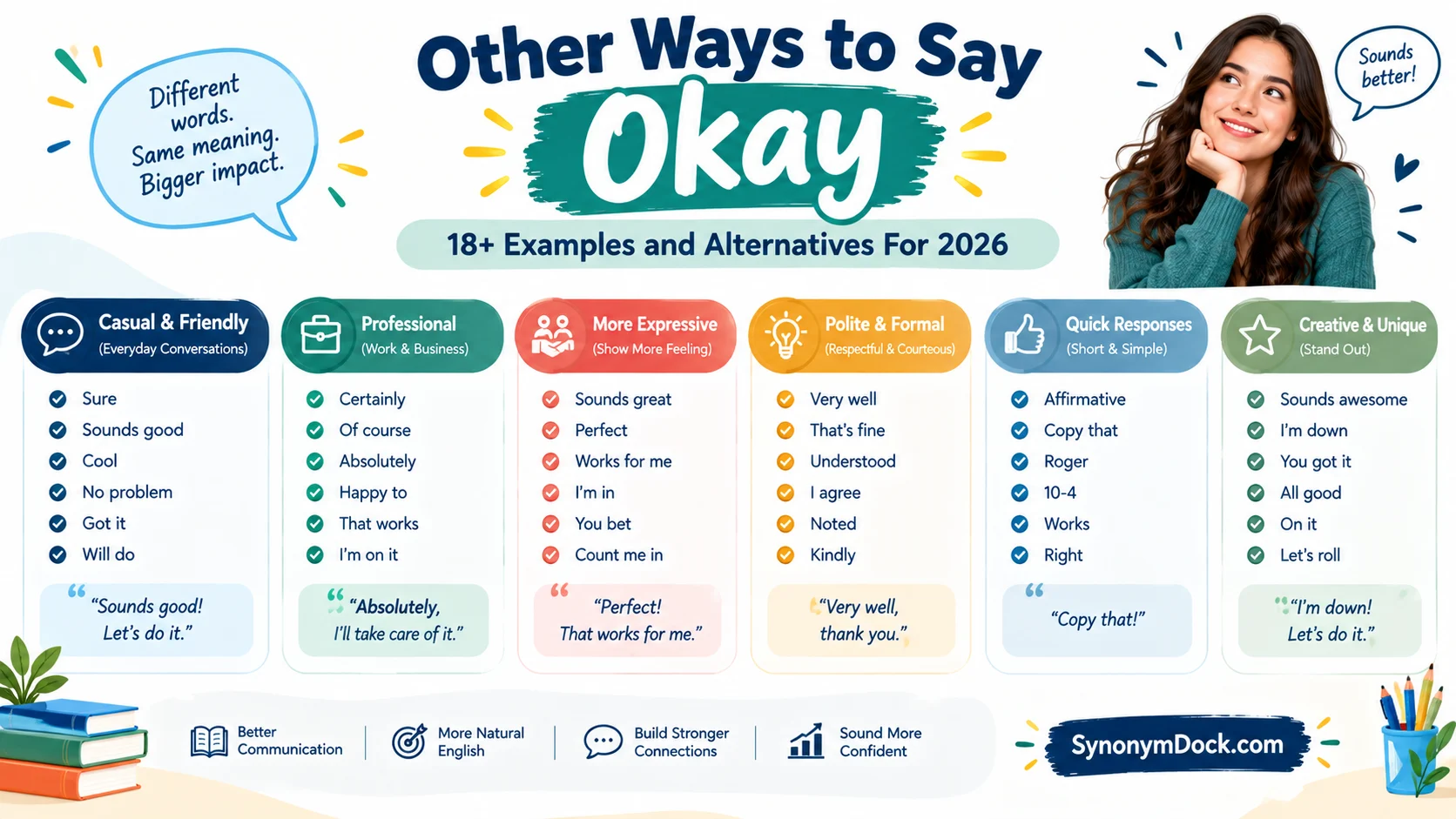
Other ways to say okay include all right, sounds good, that works, certainly, and understood. The best choice depends on whether you are speaking casually, writing professionally, or responding formally.
Top 5 alternatives: All right, Sounds good, That works, Certainly, Understood
Okay is one of the most useful words in English, but it can become repetitive. Learning other ways to say okay helps you sound more natural, precise, and confident.
There are many alternatives to okay, but they do not all mean exactly the same thing. Sounds good shows agreement, understood confirms comprehension, and certainly can express polite willingness.
Knowing other ways to say okay is especially useful in workplace meetings, business emails, academic discussions, interviews, presentations, and everyday conversation.
Formal Alternatives
- Certainly
- Absolutely
- Very well
- Agreed
- Understood
Pro Tip
Use formal alternatives when you want to sound respectful and controlled. In professional writing, choose a phrase that clearly communicates whether you are agreeing, confirming, or simply acknowledging information.
“The best alternative depends on what you mean by ‘okay.’”
Professional Alternatives
- That works for me
- Sounds good
- I understand
- That makes sense
- I’m happy to proceed
Pro Tip
In workplace communication, clarity matters more than sounding sophisticated. Choose an expression that tells the listener exactly what you accept or understand.
Business Email Alternatives
- That works for me.
- Understood.
- Certainly.
- I’ll proceed accordingly.
- That sounds good to me.
Pro Tip
For emails, avoid relying on a bare “Okay.” It can sometimes sound abrupt. A slightly fuller response often feels warmer and more professional.
Academic Alternatives
- I understand.
- That makes sense.
- I agree.
- Certainly.
- Understood.
Pro Tip
Academic English usually benefits from precision. If you agree with an argument, say “I agree” rather than simply “Okay.”
Casual Alternatives
- Sounds good
- Sure
- All right
- No problem
- Got it
Pro Tip
These expressions work naturally with friends, classmates, and familiar colleagues. Your relationship with the listener matters as much as the words themselves.
Informal Expressions
- Yep
- Sure thing
- Gotcha
- Okay, cool
- No worries
Pro Tip
Informal expressions are common in relaxed conversations and messages, but they may sound too casual in formal emails, interviews, or academic writing.
“Good English is not about using bigger words; it is about choosing the right words.”
What Does “Okay” Mean?
Okay can communicate several ideas depending on context. It may mean that you agree, understand, accept something, give permission, or simply acknowledge what someone has said.
For example:
“Okay, I’ll send the report before lunch.”
Here, okay indicates acceptance and willingness to act.
Grammatically, okay can function as an adjective, adverb, interjection, verb, or noun depending on the sentence. In everyday conversation, however, it is especially common as an interjection:
“Okay, I understand.”
Because it has so many uses, replacing it requires understanding the intended meaning.
When to Use “Okay”
You can use okay in many situations:
- Daily conversation: “Okay, see you tomorrow.”
- Workplace meetings: “Okay, let’s move to the next topic.”
- Business emails: “Okay, I’ll review the document.”
- Academic discussion: “Okay, I understand the argument.”
- Presentations: “Okay, let’s look at the next example.”
- Job interviews: “Okay, thank you for explaining that.”
- Text messages: “Okay, sounds good.”
- Spoken English: “Okay, I’ll keep that in mind.”
- Written English: “Okay” is acceptable, but more precise wording may be better in formal writing.
The important question is what you want “okay” to communicate: agreement, understanding, acceptance, permission, or acknowledgment.
Is “Okay” Professional or Polite?
Polite? ✔ Yes
Professional? ✔ Usually
Formal? Sometimes
Natural? ✔ Very
“Okay” is not inherently unprofessional. The problem is that a one-word “Okay” can sometimes feel vague or abrupt.
Compare:
Okay.
with:
Understood. I’ll update the document accordingly.
The second response gives the reader more useful information and sounds more deliberate.
In business communication, context determines whether okay feels appropriate. A quick spoken response between colleagues may be perfectly natural, while a client email may benefit from a more specific expression.
Pros and Cons
Pros
- Easy to understand
- Extremely common
- Flexible in conversation
- Natural for everyday English
- Works in many situations
Cons
- Can become repetitive
- May sound vague
- A short “Okay” can seem abrupt
- Does not always show your exact meaning
- May sound too casual in some formal writing
“Professional communication becomes clearer when your response says exactly what you mean.”
Better Alternatives to “Okay”
The following alternatives cover agreement, understanding, acceptance, permission, and acknowledgment. Choose based on meaning rather than simply replacing the word mechanically.
Expert Tip
Native speakers often change their response according to the relationship, setting, and purpose. “Sounds good” accepts a suggestion, while “Understood” confirms comprehension.
Other Ways to Say “Okay” With Examples
These 15 expressions are organized from highly useful everyday and professional choices to more context-specific expressions.
1. Phrase: All Right
Meaning:
A natural way to show acceptance, agreement, or acknowledgment.
Explanation:
All right is common in both spoken and written English. It can sound neutral and slightly more conversational than certainly or understood.
It is useful when accepting a suggestion or moving forward with a plan.
Example Sentence:
“All right, I’ll meet you outside the library at four.”
Best Use:
Daily Conversation
Avoid Using In:
Very Formal Writing
Tone:
Neutral, Friendly
Formality Level:
⭐⭐⭐ Neutral
Usage Frequency:
Very Common
CEFR Level:
B1
Common Collocations:
- all right, then
- all right with me
- all right, let’s go
- all right, I understand
Context Variability:
- Spoken English: “All right, let’s begin.”
- Professional English: “All right, I’ll review the figures.”
- Casual Conversation: “All right, see you later.”
2. Phrase: Sounds Good
Meaning:
A friendly way to show that you like or accept a proposed idea or plan.
Explanation:
Sounds good is extremely common in modern spoken English and informal professional communication. It responds particularly well to suggestions.
It does not simply mean that you understand something; it usually signals positive agreement.
Example Sentence:
“Sounds good. I’ll send you the updated schedule this afternoon.”
Best Use:
Workplace Discussion
Avoid Using In:
Formal Academic Writing
Tone:
Friendly, Positive
Formality Level:
⭐⭐⭐ Neutral
Usage Frequency:
Very Common
CEFR Level:
B1
Common Collocations:
- sounds good to me
- sounds good
- that sounds good
- sounds like a good plan
Context Variability:
- Spoken English: “Sounds good!”
- Professional English: “Sounds good. I’ll take care of it.”
- Casual Conversation: “Sounds good see you there.”
3. Phrase: That Works
Meaning:
A concise way to say that a proposed arrangement is acceptable.
Explanation:
That works is especially useful when discussing times, plans, schedules, or practical arrangements. It focuses on suitability rather than emotional agreement.
Example Sentence:
“Thursday afternoon works for me, so that works.”
Best Use:
Workplace Meeting
Avoid Using In:
Academic Essay
Tone:
Practical, Neutral
Formality Level:
⭐⭐⭐ Neutral
Usage Frequency:
Very Common
CEFR Level:
B1
Common Collocations:
- that works
- that works for me
- that should work
- this arrangement works
Context Variability:
- Spoken English: “Yes, that works.”
- Professional English: “That works for me; thank you.”
- Casual Conversation: “Friday? Yeah, that works.”
4. Phrase: Certainly
Meaning:
A polite and confident way to agree, confirm, or indicate willingness.
Explanation:
Certainly sounds more formal than sure or sounds good. It is particularly useful when responding to a request.
Example Sentence:
“Certainly, I can provide the revised document by tomorrow.”
Best Use:
Business Email
Avoid Using In:
Very Casual Chat
Tone:
Polite, Professional
Formality Level:
⭐⭐⭐⭐ Formal
Usage Frequency:
Common
CEFR Level:
B2
Common Collocations:
- certainly can
- certainly agree
- certainly possible
- certainly will
Context Variability:
- Spoken English: “Certainly, I can help.”
- Professional English: “Certainly. I’ll arrange the meeting.”
- Casual Conversation: Possible, but it may sound slightly formal.
5. Phrase: Understood
Meaning:
A direct way to confirm that you have understood information or instructions.
Explanation:
Understood is especially useful when someone has given you directions, requirements, or important information. It does not necessarily mean that you agree with the information.
Example Sentence:
“Understood. I’ll use the updated template for the report.”
Best Use:
Workplace Communication
Avoid Using In:
Friendly Social Chat
Tone:
Professional, Direct
Formality Level:
⭐⭐⭐⭐ Formal
Usage Frequency:
Common
CEFR Level:
B2
Common Collocations:
- understood clearly
- understood completely
- understood the instructions
- fully understood
Context Variability:
- Spoken English: “Understood. I’ll handle it.”
- Professional English: “Understood. We’ll follow the revised procedure.”
- Casual Conversation: “Understood!” can work, but may sound serious.
Native Speaker Tip
For everyday agreement, sounds good is usually more natural than certainly. For instructions, understood is more precise because it confirms comprehension rather than agreement.
6. Phrase: Sure
Meaning:
A common informal or neutral way to show agreement or willingness.
Explanation:
Sure is one of the easiest replacements for okay in conversation. It can mean “yes,” “of course,” or “I’m willing to do that,” depending on context.
Example Sentence:
“Sure, I can look over your presentation after class.”
Best Use:
Daily Conversation
Avoid Using In:
Formal Letter
Tone:
Friendly, Natural
Formality Level:
⭐⭐ Casual
Usage Frequency:
Very Common
CEFR Level:
A2
Common Collocations:
- sure, no problem
- sure thing
- sure, I can
- sure, why not
Context Variability:
- Spoken English: “Sure, I can help.”
- Professional English: “Sure, I can send that today.”
- Casual Conversation: “Sure! No problem.”
7. Phrase: No Problem
Meaning:
A friendly expression showing that you accept a request or do not consider something difficult or troublesome.
Explanation:
No problem is natural in conversation. However, in very formal customer or business communication, a more specific response can sound more polished.
Example Sentence:
“No problem. I’ll bring the extra copies tomorrow.”
Best Use:
Casual Workplace
Avoid Using In:
Formal Report
Tone:
Friendly, Relaxed
Formality Level:
⭐⭐ Casual
Usage Frequency:
Very Common
CEFR Level:
A2
Common Collocations:
- no problem at all
- no problem, I can
- no problem with that
- absolutely no problem
Context Variability:
- Spoken English: “No problem.”
- Professional English: “No problem; I’ll take care of it.”
- Casual Conversation: “No problem! See you later.”
8. Phrase: Got It
Meaning:
A conversational way to say that you understand something.
Explanation:
Got it is very common in modern spoken English. It focuses on understanding rather than agreement.
It is excellent for instructions, explanations, and quick conversations.
Example Sentence:
“Got it. I’ll include the references in the final version.”
Best Use:
Workplace Discussion
Avoid Using In:
Formal Academic Writing
Tone:
Natural, Informal
Formality Level:
⭐⭐ Casual
Usage Frequency:
Very Common
CEFR Level:
B1
Common Collocations:
- got it
- got it now
- got it, thanks
- got it completely
Context Variability:
- Spoken English: “Got it.”
- Professional English: “Got it. I’ll make those changes.”
- Casual Conversation: “Got it, thanks!”
9. Phrase: I Understand
Meaning:
A clear and polite way to confirm that you understand what someone has explained.
Explanation:
I understand is more explicit than okay. It is useful when you want to acknowledge someone’s explanation, concern, instructions, or position.
Example Sentence:
“I understand your concern, and I’ll review the issue carefully.”
Best Use:
Professional Conversation
Avoid Using In:
Quick Casual Text
Tone:
Respectful, Clear
Formality Level:
⭐⭐⭐⭐ Formal
Usage Frequency:
Common
CEFR Level:
B1
Common Collocations:
- I understand your point
- I understand your concern
- I understand completely
- I understand the situation
Context Variability:
- Spoken English: “I understand.”
- Professional English: “I understand your concern.”
- Casual Conversation: “Yeah, I understand.”
10. Phrase: I Agree
Meaning:
A direct way to say that you share the same opinion or view.
Explanation:
Use I agree when the intended meaning of okay is actually agreement. It is more precise than using okay when discussing an opinion or argument.
Example Sentence:
“I agree that clearer instructions would improve the process.”
Best Use:
Academic Discussion
Avoid Using In:
Simple Acknowledgment
Tone:
Clear, Neutral
Formality Level:
⭐⭐⭐ Neutral
Usage Frequency:
Very Common
CEFR Level:
B1
Common Collocations:
- I agree with you
- I agree completely
- I agree with that point
- I agree with your assessment
Context Variability:
- Spoken English: “I agree.”
- Professional English: “I agree with your assessment.”
- Casual Conversation: “Yeah, I agree.”
Expert Insight
In professional communication, do not automatically replace okay with another short phrase. First identify its function. If you mean “I understand,” say that. If you mean “I agree,” say “I agree.” Precision makes workplace English stronger.
11. Phrase: Absolutely
Meaning:
A strong and confident way to express complete agreement or enthusiastic acceptance.
Explanation:
Absolutely is stronger than a simple okay. It works well when you want to show clear agreement or enthusiasm.
Example Sentence:
“Absolutely. I agree that we should review the proposal before Friday.”
Best Use:
Professional Discussion
Avoid Using In:
Neutral Acknowledgment
Tone:
Confident, Positive
Formality Level:
⭐⭐⭐ Neutral
Usage Frequency:
Very Common
CEFR Level:
B1
Common Collocations:
- absolutely agree
- absolutely right
- absolutely fine
- absolutely yes
Context Variability:
- Spoken English: “Absolutely!”
- Professional English: “Absolutely. I support that approach.”
- Casual Conversation: “Absolutely!”
12. Phrase: Agreed
Meaning:
A concise way to confirm that you accept or share a decision, proposal, or viewpoint.
Explanation:
Agreed is useful when two people have reached the same conclusion. It can sound professional and decisive, especially in meetings or written exchanges.
Example Sentence:
“Agreed. We’ll use the revised deadline for the next project phase.”
Best Use:
Workplace Meeting
Avoid Using In:
Friendly Greeting
Tone:
Direct, Professional
Formality Level:
⭐⭐⭐⭐ Formal
Usage Frequency:
Common
CEFR Level:
B2
Common Collocations:
- agreed on
- agreed upon
- agreed to proceed
- mutually agreed
Context Variability:
- Spoken English: “Agreed. Let’s move ahead.”
- Professional English: “Agreed. I’ll update the project plan.”
- Casual Conversation: “Agreed!” can sound emphatic.
13. Phrase: That Makes Sense
Meaning:
A natural way to show that you understand and find an explanation logical.
Explanation:
This phrase is not simply another word for okay. It tells the other person that their reasoning is clear or logical.
Example Sentence:
“That makes sense, especially given the changes to the schedule.”
Best Use:
Class Discussion
Avoid Using In:
Formal Contract
Tone:
Natural, Thoughtful
Formality Level:
⭐⭐⭐ Neutral
Usage Frequency:
Very Common
CEFR Level:
B1
Common Collocations:
- that makes sense
- makes perfect sense
- makes sense to me
- logically makes sense
Context Variability:
- Spoken English: “That makes sense.”
- Professional English: “That makes sense given the current timeline.”
- Casual Conversation: “Yeah, that makes sense.”
14. Phrase: I’m Happy to Proceed
Meaning:
A professional way to show that you are willing to continue with an agreed plan.
Explanation:
This expression is more specific and formal than okay. It works especially well when responding to a proposal, decision, or next step.
Example Sentence:
“I’m happy to proceed with the revised proposal.”
Best Use:
Business Email
Avoid Using In:
Casual Text
Tone:
Professional, Positive
Formality Level:
⭐⭐⭐⭐ Formal
Usage Frequency:
Occasional
CEFR Level:
B2
Common Collocations:
- happy to proceed
- happy to help
- happy to continue
- happy to move forward
Context Variability:
- Spoken English: “I’m happy to proceed.”
- Professional English: “I’m happy to proceed with the recommended approach.”
- Casual Conversation: Usually sounds more formal than necessary.
15. Phrase: Very Well
Meaning:
A formal way to indicate acceptance or agreement with a decision or request.
Explanation:
Very well is grammatically correct but less common in everyday modern conversation. It can sound formal, deliberate, or somewhat old-fashioned depending on context.
Use it carefully rather than treating it as a universal replacement for okay.
Example Sentence:
“Very well, we’ll proceed with the revised schedule.”
Best Use:
Formal Conversation
Avoid Using In:
Casual Texting
Tone:
Formal, Deliberate
Formality Level:
⭐⭐⭐⭐ Formal
Usage Frequency:
Occasional
CEFR Level:
C1
Common Collocations:
- very well, then
- very well, I agree
- very well, let us proceed
- very well indeed
Context Variability:
- Spoken English: “Very well, let’s continue.”
- Professional English: Acceptable, but often more formal than necessary.
- Casual Conversation: Usually sounds unnatural or overly formal.
Native Speaker Tip
For modern everyday English, sounds good, that works, and got it are often more natural than very well. Very well is correct, but its formal tone makes it less common in relaxed conversations.
Avoid These in Formal Situations
Some expressions are perfectly normal among friends but can sound too casual in a formal workplace or academic setting.
- Yep Friendly and informal. Use certainly or understood when a more professional tone is needed.
- Yup Even more conversational in feel. It is better suited to casual messages.
- Okay, cool Natural among friends, but too relaxed for many business emails.
- Gotcha Common in casual speech, but I understand is safer professionally.
- No worries Friendly and widely used, but certainly or no problem may be preferable in formal communication.
Best Phrases by Situation
| Situation | Best Phrase |
| Business Email | Certainly |
| Client Meeting | That works for me |
| Academic Essay | I agree |
| Presentation | Absolutely |
| Workplace Discussion | That makes sense |
| Job Interview | I understand |
| Team Collaboration | Sounds good |
| Everyday Conversation | Sounds good |
Which One Should You Use?
Best Overall
Sounds good is versatile, natural, and useful when accepting a suggestion or plan.
Best Professional
That works for me clearly communicates that an arrangement is acceptable.
Best Academic
I agree is better when you are explicitly supporting an argument or viewpoint.
Best Business Email
Certainly works well when responding politely to a request.
Best Everyday Conversation
Sounds good feels natural in many everyday situations.
Most Natural
Sounds good is a highly common modern response to a suggestion.
Most Polite
Certainly gives a clear and respectful impression without sounding overly elaborate.
Commonly Confused Phrases
“I Agree” vs. “I Completely Agree”
I agree expresses agreement. I completely agree adds stronger emphasis.
“I agree with your suggestion.”
“I completely agree with your recommendation.”
“Okay” vs. “Understood”
Okay can express several meanings. Understood specifically confirms comprehension.
If your manager gives you an instruction, “Understood” is clearer than simply “Okay.”
“Sounds Good” vs. “That Works”
Sounds good often shows positive acceptance of an idea. That works focuses more on whether an arrangement is practical or suitable.
“Certainly” vs. “Sure”
Both can show willingness, but certainly is more formal while sure is more conversational.
“Sure, I can help.”
“Certainly, I can assist with that.”
Scenario Practice
1. Business Meeting
Your manager proposes moving the meeting to Thursday.
Which phrase would you choose?
Answer: “That works for me.”
It directly confirms that the proposed arrangement is suitable.
2. Job Interview
The interviewer explains the next stage of the hiring process.
Which phrase would you choose?
Answer: “I understand.”
It confirms comprehension and sounds respectful.
3. Presentation
A colleague suggests adding one more example to your presentation.
Which phrase would you choose?
Answer: “Sounds good.”
It shows positive acceptance without sounding overly formal.
4. Class Discussion
Another student makes an argument that you support.
Which phrase would you choose?
Answer: “I agree.”
This is more precise than simply saying okay because it clearly expresses agreement.
5. Email Reply
A client asks whether you can send the revised document tomorrow.
Which phrase would you choose?
Answer: “Certainly.”
It gives a polite, professional confirmation.
Mini Quiz
1. Your friend suggests meeting at 6 p.m. Which sounds most natural?
A. Very well
B. Sounds good
C. Agreed upon
D. Certainly, madam
Answer: B. Sounds good
2. Your manager gives you detailed instructions. Which response confirms understanding?
A. Gotcha
B. Yep
C. Understood
D. Cool
Answer: C. Understood
3. You want to express agreement with an academic argument. Which is clearest?
A. I agree
B. Okay cool
C. No worries
D. Gotcha
Answer: A. I agree
4. A client asks whether you can complete a requested task. Which sounds professional?
A. Yup
B. Sure thing
C. Certainly
D. Yep, cool
Answer: C. Certainly
5. Someone proposes a meeting time that suits you. Which phrase fits best?
A. That works for me
B. Gotcha
C. Very well indeed
D. Okay, cool
Answer: A. That works for me
Answer Key
- B Sounds good: Natural acceptance of a suggestion.
- C Understood: Specifically confirms comprehension.
- A I agree: Clearly communicates agreement with an opinion.
- C Certainly: Polite and professional.
- A That works for me: Shows that an arrangement is suitable.
Top 10 Alternatives Compared
| Phrase | Tone | Formality | Best Use | Frequency |
| Sounds good | Friendly | Neutral | Suggestions | Very Common |
| That works | Practical | Neutral | Arrangements | Very Common |
| All right | Neutral | Neutral | Daily conversation | Very Common |
| Understood | Direct | Formal | Instructions | Common |
| Certainly | Polite | Formal | Business requests | Common |
| Sure | Friendly | Casual | Daily conversation | Very Common |
| Got it | Conversational | Casual | Instructions | Very Common |
| I understand | Respectful | Formal | Professional discussion | Common |
| I agree | Clear | Neutral | Opinions | Very Common |
| That makes sense | Thoughtful | Neutral | Explanations | Very Common |
FAQs
What is the most formal way to say “okay”?
Certainly, understood, agreed, and very well can sound more formal than okay. The best choice depends on your intended meaning. Use certainly when accepting a request, understood when confirming information, and agreed when expressing agreement with a decision or viewpoint.
Which phrase is best for professional emails?
Certainly, that works for me, and understood are useful professional alternatives. Choose based on context. For a request, certainly is polite. For an arrangement, that works for me is clearer. For instructions or information, understood directly confirms comprehension.
What is the difference between “sounds good” and “that works”?
Sounds good usually shows positive acceptance of an idea or suggestion. That works focuses more on whether a plan, time, arrangement, or solution is suitable. For example, you might say “Sounds good” to a proposal and “That works for me” when accepting a meeting time.
Which alternative to “okay” sounds most natural?
For many everyday situations, sounds good, sure, all right, and got it sound natural. The right phrase depends on what you mean. Sounds good usually accepts a suggestion, while got it confirms understanding. There is no single replacement that fits every use of okay.
Can I use these expressions in business meetings?
Yes, but choose them according to the situation. That works, I understand, I agree, certainly, and understood can work well in professional meetings. Very casual expressions such as yup, gotcha, or okay, cool may be unsuitable when speaking with clients, senior colleagues, or formal audiences.
Conclusion
Learning different ways to say okay helps you communicate with greater precision. Instead of using one word for agreement, understanding, acceptance, and acknowledgment, you can choose expressions such as sounds good, that works, understood, I agree, or certainly according to the situation.
The goal is not to eliminate okay from your English. It is to expand your choices so you can sound natural in conversations, clear in emails, confident in meetings, and appropriate in academic or professional writing. Practice one or two alternatives at a time, and your vocabulary will become more flexible and expressive.
