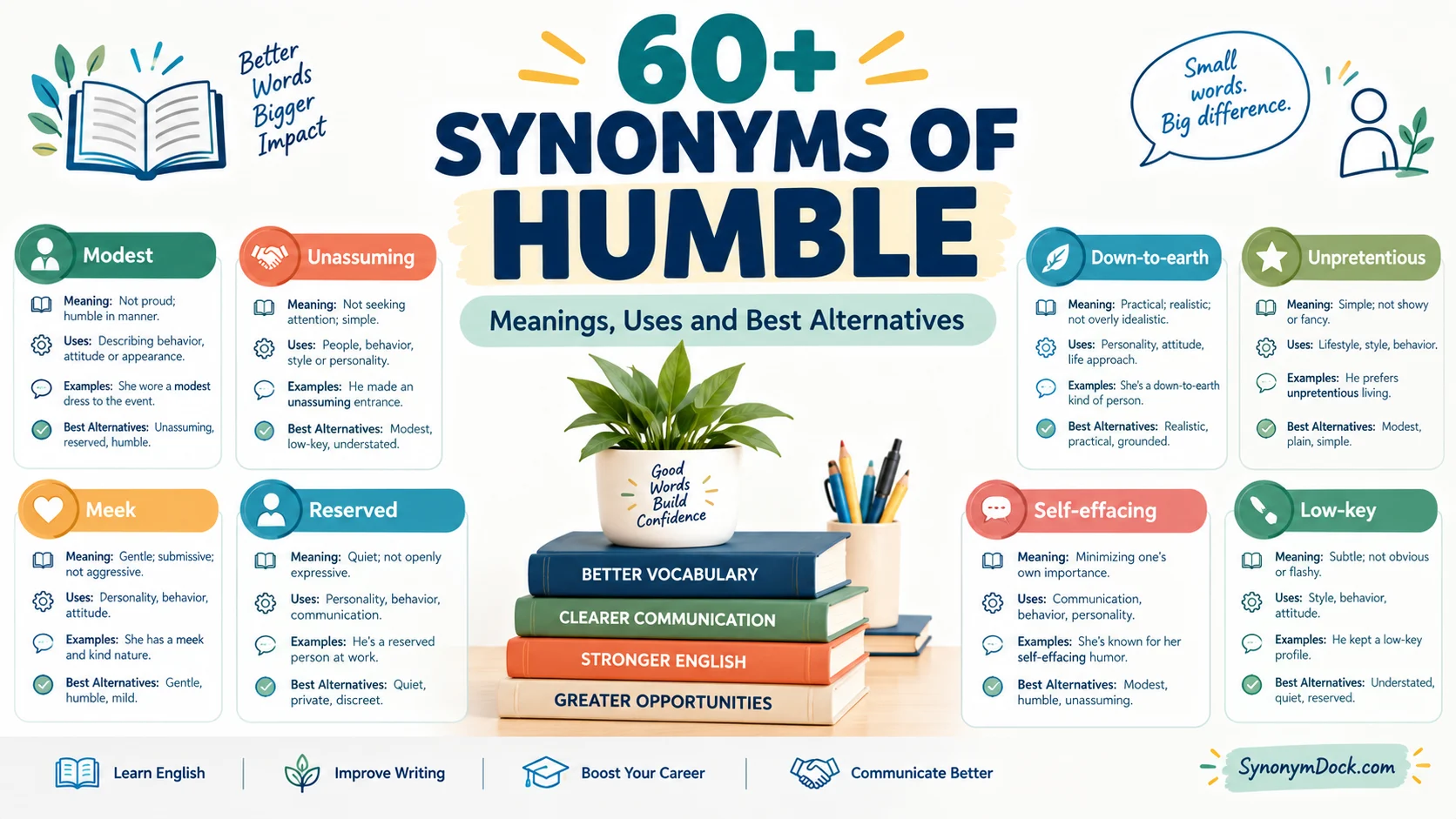
Humble means having a modest view of your own importance. Good synonyms include modest, unassuming, and down to earth for everyday use. For formal writing, try unpretentious or self effacing. For academic writing, consider unassuming or meek. Stronger options include lowly or submissive, depending on context.
You are writing an email to your manager, and you want to sound respectful without sounding weak. You type the word humble, delete it, type it again, and then wonder if there is a better choice. You are not alone. Writers, students, and professionals search for a synonym of humble every day because one word rarely fits every situation.
Humble is a small word with a wide range of meanings. It can describe a person who does not brag. It can describe a modest home. It can also describe a painful lesson that cuts you down to size. Because humble carries so many shades of meaning, choosing the right synonym depends on tone, audience, and purpose.
This guide breaks down the best synonyms of humble by context. You will learn which words fit formal writing, which ones work in casual conversation, and which ones to avoid. By the end, you will choose the right word with confidence instead of guessing.
Simple Definition
Humble describes someone who does not think they are better than other people. It also describes something simple or plain, like a humble home or a humble beginning. As a verb, it means to make someone feel less proud.
Part of Speech
Humble works as an adjective and a verb. The adjective form is the most common in daily writing.
Overall Tone
Humble is generally positive when describing people. It signals quiet confidence and respect for others. However, it can turn negative when it implies weakness or low status.
Formality Level
Humble sits in the neutral to semi formal range. It works in conversations, emails, essays, and professional writing.
Common Uses
Native English speakers use humble in resumes, cover letters, speeches, social media captions, and everyday conversation. It appears often in phrases like humble beginnings and in my humble opinion.
Word Forms
- Noun: humility
- Verb: humbled, humbling
- Adjective: humble, humbler, humblest
- Adverb: humbly
- Opposite form: arrogant, proud
When and How to Use “Humble”
Use humble when you want to show respect, modesty, or simplicity. Choose it when the tone should feel grounded rather than flashy.
- Professional: She accepted the award with a humble speech that thanked her entire team.
- Academic: The study began with a humble hypothesis that grew into a major discovery.
- Workplace: He stays humble even after leading three successful projects.
- Personal: I come from a humble family that values hard work over show.
- Email: Thank you for the kind words. I am humbled by your support.
- Resume: Delivered strong results while maintaining a humble and collaborative approach.
- Social Media: Grateful for this journey and staying humble through every win.
Best Synonyms of “Humble”
No synonym means exactly the same thing in every sentence. Each word carries its own tone, strength, and social weight. The list below matches the best synonym to the situation where it shines.
- Professional writing: Modest. It signals quiet confidence without sounding weak.
- Academic writing: Unassuming. It sounds precise and fits formal analysis.
- Business communication: Down to earth. It feels approachable and human.
- Casual conversation: Low key. It matches relaxed, modern speech.
- Emotional writing: Humble hearted. It adds warmth and sincerity.
- Creative writing: Unpretentious. It paints a clear picture of simple honesty.
- Resume writing: Grounded. It suggests maturity and steady judgment.
- Workplace communication: Approachable. It focuses on how others experience you.
- Stronger meaning: Lowly. It emphasizes a lower social or professional position.
- Softer meaning: Unpretentious. It removes ego without lowering status.
When Not to Use “Humble”
Humble is not always the right choice. In some sentences it sounds too vague, too weak, or too old fashioned.
Too general
Incorrect: She is a humble person.
Better: She is modest and quick to share credit.
Why it works: Modest adds a specific behavior instead of a broad label.
Too vague in business writing
Incorrect: We offer humble solutions.
Better: We offer practical, down to earth solutions.
Why it works: Down to earth sounds clearer and more customer friendly.
Too weak in a resume
Incorrect: I am a humble worker.
Better: I am a grounded professional who delivers results.
Why it works: Grounded sounds stronger and more confident.
Too formal for texting
Incorrect: I remain humbled by your invitation.
Better: Thanks so much. That means a lot.
Why it works: The casual version matches the message style.
Too strong for light praise
Incorrect: He is the most humble person alive.
Better: He is remarkably modest.
Why it works: Modest keeps the praise believable.
Outdated in some contexts
Incorrect: She is a humble servant of the company.
Better: She is a dedicated team player.
Why it works: Team player sounds modern and professional.
Words Commonly Confused With “Humble”
Modest
Difference: Modest focuses on not bragging about your talents or achievements.
When to Use It: Use modest when someone downplays their own success.
Example: She is modest about her award winning research.
Meek
Difference: Meek suggests quietness that can border on weakness.
When to Use It: Use meek when someone avoids conflict or stands back.
Example: He spoke in a meek voice during the meeting.
Humble vs Humble
Difference: As a verb, humble means to lower someone’s pride. As an adjective, it means modest.
When to Use It: Use the verb form when describing a humbling experience.
Example: The loss humbled the team and pushed them to improve.
Unassuming
Difference: Unassuming means not attracting attention, often despite real talent.
When to Use It: Use unassuming in formal or academic writing.
Example: The unassuming professor changed the field with one paper.
Down to Earth
Difference: Down to earth means friendly, practical, and free of pretension.
When to Use It: Use it in business and casual settings.
Example: Our new director is surprisingly down to earth.
Lowly
Difference: Lowly describes low rank or status, not personality.
When to Use It: Use lowly when discussing position or origin.
Example: He rose from a lowly clerk to company president.
Best Synonyms of “Humble” by Context
| Context | Best Synonym | Why It Works | Example |
| Formal writing | Unpretentious | Sounds polished and precise | Her unpretentious style won respect. |
| Academic writing | Unassuming | Fits analytical, neutral tone | The unassuming theory proved powerful. |
| Professional communication | Modest | Balanced and respectful | He gave a modest summary of his work. |
| Business emails | Down to earth | Feels human and clear | Thanks for the down to earth feedback. |
| Resume writing | Grounded | Signals maturity | Grounded leader with strong results. |
| Workplace communication | Approachable | Focuses on teamwork | She is approachable and fair. |
| Casual conversation | Low key | Modern and relaxed | He is low key about his success. |
| Everyday speaking | Modest | Natural and common | She is modest about her skills. |
| Creative writing | Unpretentious | Adds texture | The unpretentious cafe felt like home. |
| Storytelling | Humble hearted | Warm and sincere | A humble hearted hero saved the day. |
| Emotional writing | Humble hearted | Adds feeling | His humble hearted note moved us. |
| Strong emphasis | Lowly | Highlights low status | She started in a lowly role. |
| Mild tone | Unpretentious | Softens the message | A quiet, unpretentious victory. |
| Social media captions | Grounded | Short and shareable | Staying grounded through it all. |
| American English | Down to earth | Common in the US | He is down to earth and honest. |
| British English | Unassuming | Common in the UK | She is unassuming but brilliant. |
How to Choose the Best Synonym of “Humble”
Start with meaning. Ask what kind of humility you want to show. Is it about not bragging, about low status, or about a simple style?
Next, check tone. A resume needs grounded and modest. A text message needs low key. An academic paper needs unassuming or unpretentious.
Then think about your audience. A hiring manager reads differently than a friend. A professor reads differently than a social media follower.
Finally, test the sentence out loud. If the word feels forced or too dramatic, choose a softer option. If it feels flat, choose a stronger one. The best synonym is the one your reader understands without effort.
Real Life Examples of “Humble”
School: The student gave a modest answer even though she knew the topic well.
College: His unassuming presentation impressed the entire seminar.
Workplace: She stayed grounded after the promotion and helped new hires.
Business: The company shared a down to earth message about its humble origins.
Email: I am humbled by the trust you placed in me.
Resume: Grounded project lead with a record of steady delivery.
Conversation: He is low key about his marathon time.
Storytelling: The humble hearted farmer shared his last loaf of bread.
Blogging: A modest routine can produce remarkable results over time.
Social media: Grateful, focused, and staying grounded.
18 Best Synonyms of “Humble”
| Synonym | Simple Meaning | Best Used For | Example Sentence |
| Modest | Not bragging about yourself | Everyday and professional | She is modest about her talent. |
| Unassuming | Quiet and not attention seeking | Formal and academic | An unassuming expert solved the case. |
| Unpretentious | Simple and honest | Creative and formal | They loved his unpretentious style. |
| Down to earth | Practical and friendly | Business and casual | The CEO is down to earth. |
| Grounded | Stable and mature | Resumes and workplace | Grounded leaders build trust. |
| Low key | Relaxed and understated | Casual conversation | He is low key about his win. |
| Humble hearted | Warm and sincere | Emotional writing | A humble hearted volunteer stayed late. |
| Meek | Quiet and gentle | Literary and formal | She gave a meek reply. |
| Lowly | Of low rank | Storytelling and history | He began in a lowly position. |
| Approachable | Easy to talk to | Workplace | Managers should stay approachable. |
| Simple | Plain and not fancy | Everyday writing | They live a simple life. |
| Unostentatious | Not showy | Formal writing | Her unostentatious generosity helped many. |
| Demure | Shy and reserved | Literary | A demure smile crossed her face. |
| Unaffected | Natural and sincere | Professional | His unaffected charm won clients. |
| Self effacing | Downplays your own role | Academic and professional | A self effacing tone builds trust. |
| Unpresumptuous | Not overstepping | Formal writing | Her unpresumptuous request was granted. |
| Plain | Basic and honest | Everyday writing | He prefers plain talk. |
| Unarrogant | Free of pride | Formal writing | An unarrogant leader listens first. |
Synonyms of “Humble” by Usage
Professional vs Personal Synonyms
In professional settings, grounded, modest, and approachable work best. They signal maturity without weakness. In personal conversations, low key and down to earth feel more natural and warm.
Formal vs Conversational Synonyms
Formal writing favors unassuming, unpretentious, and self effacing. These words fit reports, essays, and presentations. Casual talk favors low key, modest, and down to earth. Use those in texts, chats, and friendly emails.
Academic Synonyms
Academic writing needs precise vocabulary. Unassuming and unpretentious sound authoritative without emotion. Self effacing also works when discussing how a researcher presents findings. These words keep the focus on ideas rather than ego.
Professional and Business Synonyms
Resumes and interviews reward grounded, modest, and approachable. Meetings and client emails benefit from down to earth and unpretentious. Performance reviews can use grounded to describe steady behavior. These words build trust with readers who value clarity.
Creative and Literary Synonyms
Storytelling thrives on humble hearted, meek, and demure. These words add texture and emotion. Unpretentious works well in descriptive writing. Plain can create a strong, spare style in fiction.
Slang or Modern Synonyms
Low key is the main modern option. It means quiet or understated. Use it in casual conversation and social media. Avoid it in academic papers, resumes, and formal emails.
Strongest to Mildest Synonyms
Mild: Unpretentious, plain, simple
Moderate: Modest, unassuming, down to earth
Strong: Grounded, self effacing, approachable
Very Strong: Lowly, meek, humble hearted
Emotional intensity rises as you move down the list. Mild words describe style. Strong words describe character. Very strong words can suggest low status or deep feeling, so use them with care.
Emotional vs Neutral Synonyms
Emotional Synonyms
Humble hearted, meek, and demure carry feeling. They work in stories, speeches, and personal notes. They help readers sense warmth or quiet strength.
Neutral Synonyms
Modest, unassuming, and unpretentious simply share information. They fit reports, articles, and professional messages. Use them when the tone should stay calm and clear.
Antonyms of “Humble”
| Antonym | Meaning | Example Sentence |
| Arrogant | Feeling superior to others | His arrogant tone annoyed the team. |
| Proud | Feeling deep satisfaction | She was proud of her work. |
| Conceited | Too proud of yourself | He sounded conceited during the call. |
| Haughty | Looking down on others | The haughty reply lost him the deal. |
| Vain | Focused on your own image | The vain speech bored the audience. |
| Boastful | Bragging often | His boastful posts turned people away. |
| Egotistical | Self centered | The egotistical manager ignored feedback. |
| Overconfident | Too sure of yourself | Her overconfident claim fell flat. |
| Pretentious | Trying to seem important | The pretentious email confused readers. |
| Snobbish | Acting above others | The snobbish comment hurt morale. |
| Superior | Acting better than others | His superior attitude caused friction. |
| Domineering | Controlling others | The domineering leader silenced ideas. |
| Immodest | Lacking humility | His immodest tone surprised everyone. |
| Unabashed | Not embarrassed by pride | She gave an unabashed brag. |
Comparison: “Humble” vs Similar Words
Humble vs Modest
Main Difference: Humble focuses on low self importance. Modest focuses on not bragging.
Which Is Stronger? Humble is slightly stronger.
Which Is More Formal? Both are neutral. Modest often fits professional writing better.
When to Use Each: Use humble for character and origin. Use modest for achievements and style.
Examples:
Humble: He came from a humble background.
Modest: She is modest about her awards.
Humble vs Meek
Main Difference: Meek suggests weakness or passivity. Humble suggests quiet strength.
Which Is Stronger? Meek feels stronger in a negative way.
Which Is More Formal? Meek is more literary.
When to Use Each: Use humble for respect. Use meek for shyness or submission.
Examples:
Humble: The humble leader listened first.
Meek: He gave a meek nod and said nothing.
Humble vs Unassuming
Main Difference: Unassuming means not seeking attention. Humble means not thinking you are superior.
Which Is Stronger? Humble carries more moral weight.
Which Is More Formal? Unassuming is more formal.
When to Use Each: Use unassuming in academic or formal writing. Use humble in everyday praise.
Examples:
Humble: She stayed humble after the promotion.
Unassuming: The unassuming scientist avoided the spotlight.
Humble vs Down to Earth
Main Difference: Down to earth describes a friendly, practical style. Humble describes modest self image.
Which Is Stronger? Humble is stronger in meaning.
Which Is More Formal? Down to earth is more casual.
When to Use Each: Use down to earth in business and conversation. Use humble in writing about character.
Examples:
Humble: His humble nature won trust.
Down to earth: Her down to earth advice helped the team.
Humble vs Lowly
Main Difference: Lowly refers to low rank or status. Humble refers to modest character.
Which Is Stronger? Lowly is stronger and can sound harsh.
Which Is More Formal? Lowly is more formal and historical.
When to Use Each: Use lowly for status or origin. Use humble for personality.
Examples:
Humble: He is humble about his success.
Lowly: She started in a lowly job and worked up.
Humble vs Self Effacing
Main Difference: Self effacing means downplaying your own role. Humble means having a modest view of yourself.
Which Is Stronger? Self effacing is more specific.
Which Is More Formal? Self effacing is more formal.
When to Use Each: Use self effacing in professional and academic writing. Use humble in general praise.
Examples:
Humble: He is humble and kind.
Self effacing: Her self effacing summary hid her huge contribution.
Common Phrases and Expressions with “Humble”
In my humble opinion
Meaning: A polite way to share your view.
Example: In my humble opinion, the simpler plan works better.
Humble beginnings
Meaning: A modest or low starting point.
Example: The company grew from humble beginnings in a garage.
Eat humble pie
Meaning: To admit you were wrong.
Example: After the failed launch, he had to eat humble pie.
Humble abode
Meaning: A modest home, often said with humor.
Example: Welcome to my humble abode.
Stay humble
Meaning: Remain modest despite success.
Example: Stay humble and keep learning.
Humble yourself
Meaning: To lower your pride.
Example: The loss humbled him and changed his approach.
Humbled and honored
Meaning: Grateful and deeply respectful.
Example: I am humbled and honored to receive this award.
Common Mistakes to Avoid
Mistake 1: Choosing a vague synonym
Incorrect: She is a nice person.
Better: She is modest and grounded.
Why it works: Modest and grounded describe real qualities.
Mistake 2: Confusing humble with meek
Incorrect: He is humble and never speaks up.
Better: He is humble but speaks with confidence.
Why it works: Humble does not mean weak.
Mistake 3: Using informal synonyms in formal writing
Incorrect: The report calls the founder low key.
Better: The report calls the founder unassuming.
Why it works: Unassuming fits a formal tone.
Mistake 4: Picking an overly dramatic synonym
Incorrect: She is the lowliest servant of the team.
Better: She is a modest team member.
Why it works: Modest keeps the message believable.
Mistake 5: Repeating the same word
Incorrect: He is humble. She is humble. They are humble.
Better: He is humble. She is modest. They are grounded.
Why it works: Variety keeps writing fresh.
Mistake 6: Wrong emotional tone
Incorrect: The humble hearted memo explained the budget.
Better: The clear memo explained the budget.
Why it works: Humble hearted adds emotion that budget writing does not need.
Mistake 7: Slang in academic writing
Incorrect: The theory is low key important.
Better: The theory is unassumingly important.
Why it works: Academic writing needs formal vocabulary.
Frequently Asked Questions
1. What are the best synonyms of humble?
The best synonyms of humble include modest, unassuming, unpretentious, down to earth, and grounded. Choose based on tone. Modest fits daily use. Unassuming fits formal writing. Down to earth fits business and casual talk.
2. What are the best formal synonyms of humble?
Formal synonyms of humble include unassuming, unpretentious, self effacing, and unostentatious. These words fit academic papers, reports, and professional emails. They sound precise without adding emotion.
3. What are common informal synonyms of humble?
Common informal synonyms of humble include low key, down to earth, and modest. Low key works best in texting and social media. Down to earth fits friendly conversation and casual business talk.
4. What is another word for humble in professional writing?
Grounded is a strong choice for professional writing. It signals maturity and steady judgment. Modest and approachable also work well in resumes, emails, and performance reviews.
5. What is the difference between humble and modest?
Humble describes a modest view of your own importance. Modest focuses on not bragging about achievements. Humble carries more moral weight. Modest often fits professional writing better.
6. What is the opposite of humble?
The opposite of humble is arrogant, proud, or conceited. Arrogant means feeling superior to others. Proud means feeling deep satisfaction. Conceited means being too proud of yourself.
Conclusion
Humble means having a modest view of your own importance. It also describes simple origins and quiet character. The best synonym of humble depends on your context. Use modest and grounded in professional writing. Use unassuming and unpretentious in formal or academic work. Use down to earth and low key in casual conversation.
No single synonym works in every sentence. Always think about your audience, your tone, and your purpose. A word that fits a text message may weaken a resume. A word that works in a speech may sound stiff in a blog post.
One practical tip: keep a short list of three synonyms for humble and rotate them as you write. This habit improves variety and helps you match the right word to the right moment. Mastering a synonym of humble is not about memorizing a list. It is about choosing the word that makes your meaning clear.

2 thoughts on “60+ Synonyms of Humble| Meanings, Uses and Best Alternatives”