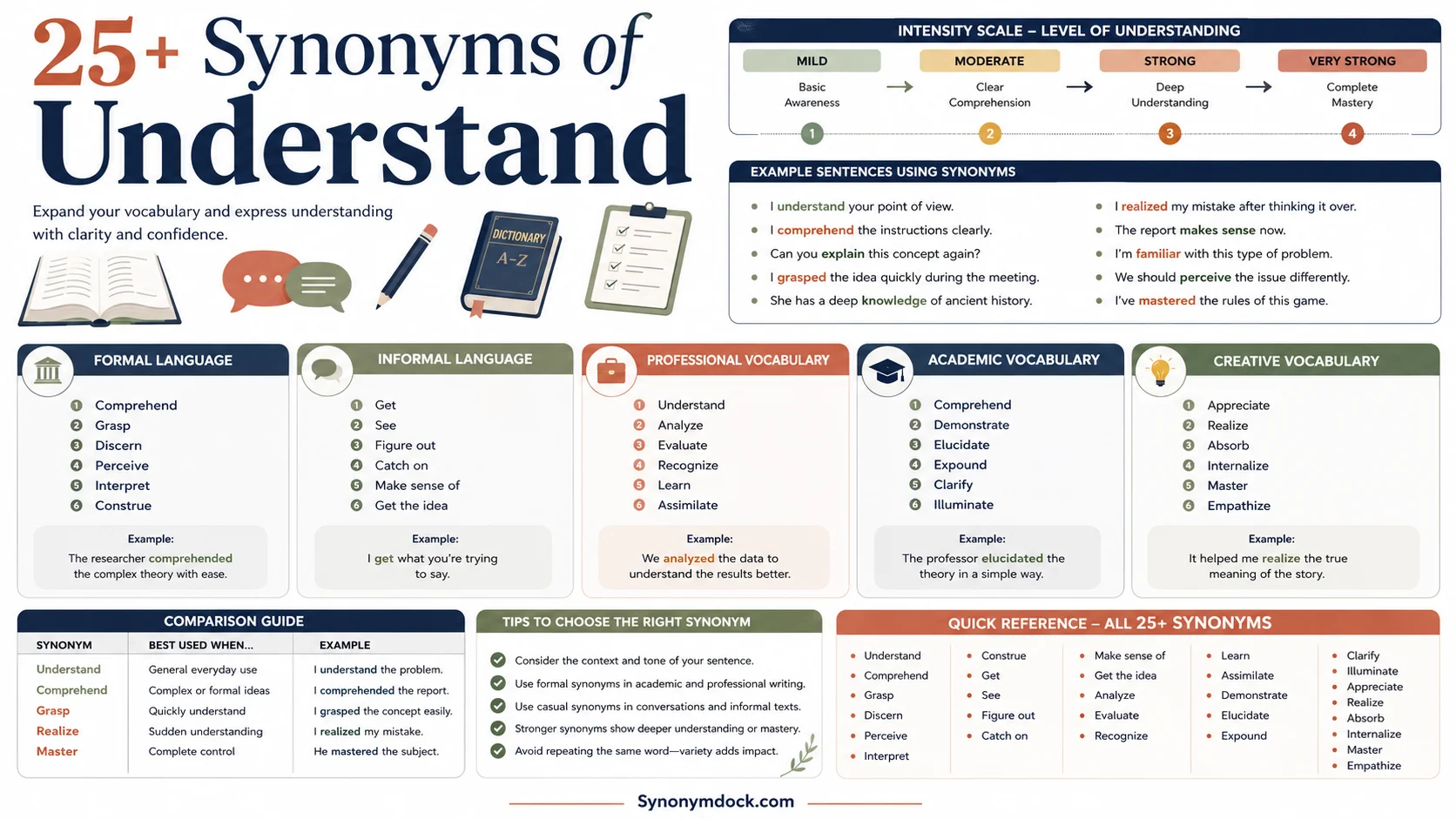
To understand something means to grasp its meaning, nature, or importance. The best synonym depends on your context. For formal writing, use “comprehend” or “apprehend.” For casual conversation, try “get” or “catch on.” For professional settings, “recognize” or “appreciate” work well. For emotional situations, “empathize” is the right choice.
Have you ever written an email, an essay, or a social media caption and realized you used the word “understand” three times in two sentences? It happens to the best of us. You know what you want to say, but repeating the same word makes your writing sound dull and uninspired. Finding the right synonym of understand can transform your communication. It adds precision, improves clarity, and helps you connect better with your audience. Whether you are writing a business report, a college essay, or a casual text, choosing the perfect word makes all the difference.
Meaning, Tone, and Context
Simple Definition
Understand means to perceive the meaning of something or to grasp the idea behind it. It can also mean to be sympathetically aware of another person’s feelings or situation.
Part of Speech
Verb (transitive and intransitive)
Overall Tone
Neutral. The word itself does not carry strong positive or negative emotional weight.
Formality Level
Neutral. “Understand” works in almost any situation, from casual conversation to formal writing.
Common Uses
Native English speakers use “understand” constantly. You might say you understand a concept, a person’s feelings, a set of instructions, or a complicated situation. It is one of the most common verbs in the English language.
Word Forms
- Understand (verb)
- Understanding (noun/adjective)
- Understood (past tense/past participle)
When and How to Use “Understand”
Choose “understand” when you need a clear, direct word that almost everyone will understand. It works in almost any situation. Here are seven realistic examples.
Professional
“I understand the project requirements and will have the draft ready by Friday.”
Academic
“To understand this theory, you must first review the foundational research.”
Workplace
“Do you understand how to use the new scheduling software?”
Personal
“I understand why you feel frustrated. That sounds like a difficult situation.”
“Thank you for your explanation. I now understand the policy changes.”
Resume
“Understood client needs and delivered customized solutions that exceeded expectations.”
Social Media
“It took me a while to understand this book, but now I absolutely love it.”
Best Synonyms of “Understand”
No synonym is perfect for every situation. Here are the best synonyms grouped by context.
Professional writing → Recognize
Why it works: “Recognize” implies you have identified and acknowledged the importance of something. It sounds polished and businesslike.
Academic writing → Comprehend
Why it works: “Comprehend” suggests deeper intellectual processing and grasping full meaning, making it ideal for scholarly work.
Business communication → Appreciate
Why it works: “Appreciate” shows you understand the value or significance of a situation, which sounds diplomatic.
Casual conversation → Get
Why it works: “Get” is short, direct, and natural. Native speakers use it constantly.
Emotional writing → Empathize
Why it works: “Empathize” specifically conveys understanding someone’s feelings, not just their words.
Creative writing → Fathom
Why it works: “Fathom” suggests deep, often difficult understanding, adding dramatic weight.
Resume writing → Discern
Why it works: “Discern” shows you can perceive subtle details, demonstrating sharp judgment.
Workplace communication → Grasp
Why it works: “Grasp” means you have firmly seized the idea, conveying confidence.
Stronger meaning → Penetrate
Why it works: “Penetrate” suggests understanding something complex or hidden.
Softer meaning → Appreciate
Why it works: “Appreciate” softens the statement while still showing awareness.
When Not to Use “Understand”
Sometimes “understand” is not the best choice.
When it sounds too general
If you need to show deep intellectual processing, “understand” can feel vague. Use “comprehend” or “fathom” instead.
Weak: “After years of study, I understand quantum mechanics.”
Better: “After years of study, I finally comprehend quantum mechanics.”
When it sounds too informal
In academic or legal writing, “understand” may lack authority.
Weak: “The court understands the defendant’s argument.”
Better: “The court acknowledges the defendant’s argument.”
When you need emotional depth
“Understand” does not convey compassion. Use “empathize” or “sympathize” in emotional contexts.
Weak: “I understand your grief.”
Better: “I empathize with your grief.”
When it is overused
Repeating “understand” in one piece of writing gets boring. Vary your vocabulary.
Words Commonly Confused With “Understand”
Understand vs. Comprehend
- Difference: “Comprehend” implies deeper, more complete mental processing.
- When to Use It: Use “comprehend” for complex academic or intellectual topics.
- Example: “She comprehended the advanced physics concept after months of study.”
Understand vs. Apprehend
- Difference: “Apprehend” often suggests understanding something with some difficulty or fear.
- When to Use It: Use “apprehend” when discussing difficult concepts or legal contexts.
- Example: “He could not apprehend the magnitude of the impending disaster.”
Understand vs. Grasp
- Difference: “Grasp” feels more immediate and physical, like seizing an idea firmly.
- When to Use It: Use “grasp” when you want to sound confident about a new idea.
- Example: “She quickly grasped the instructions and began the task.”
Understand vs. Perceive
- Difference: “Perceive” focuses on becoming aware of something through the senses.
- When to Use It: Use “perceive” when discussing observation or subtle awareness.
- Example: “He perceived a change in her tone and asked if everything was okay.”
Understand vs. Recognize
- Difference: “Recognize” means identifying something as already known or accepted.
- When to Use It: Use “recognize” to show awareness or acknowledgment.
- Example: “She recognized the flaws in the plan and suggested improvements.”
Understand vs. Fathom
- Difference: “Fathom” suggests understanding something mysterious or complex.
- When to Use It: Use “fathom” for dramatic or poetic contexts.
- Example: “He could not fathom why she made that decision.”
Best Synonyms of “Understand” by Context
| Context | Best Synonym | Why It Works | Example |
|---|---|---|---|
| Formal writing | Comprehend | Sounds more scholarly and complete | “The committee comprehends the complexity of this issue.” |
| Academic writing | Apprehend | Suggests deep intellectual effort | “Students must apprehend these core principles.” |
| Professional communication | Recognize | Shows polished acknowledgment | “We recognize the challenges in this project.” |
| Business emails | Appreciate | Diplomatically shows understanding of value | “I appreciate your concerns about the timeline.” |
| Resume writing | Discern | Demonstrates sharp judgment and insight | “Discerned market trends that increased sales by 15%.” |
| Workplace communication | Grasp | Conveys confident understanding | “I grasp what you are asking and can deliver.” |
| Casual conversation | Get | Natural, direct, and universal | “I get why you are upset.” |
| Everyday speaking | Follow | Good for tracking conversations or logic | “I follow your argument.” |
| Creative writing | Fathom | Adds depth and drama | “He fathomed the depths of her sorrow.” |
| Storytelling | Penetrate | Suggests uncovering hidden truth | “She penetrated the mystery of the old diary.” |
| Emotional writing | Empathize | Specifically addresses feelings | “I empathize with your fear.” |
| Strong emphasis | Perceive | Highlights awareness and insight | “She clearly perceives the danger.” |
| Mild tone | Appreciate | Keeps things gentle and polite | “I appreciate how hard this must be.” |
| Social media captions | Get | Short and engaging | “Can you get what she is saying?” |
| American English | Get | Most common casual choice | “I get the joke now.” |
How to Choose the Best Synonym of “Understand”
Choosing the right synonym does not need to be complicated. Follow this simple decision guide.
- Who is your audience?
For a boss or client, use “recognize” or “appreciate.” For a friend, use “get.” - What is your purpose?
To show deep thought? Use “comprehend.” To show emotional support? Use “empathize.” - What tone do you want?
Formal or academic? Use “apprehend.” Casual or conversational? Use “follow.” - How strong do you want to sound?
For mild understanding, use “appreciate.” For strong, confident understanding, use “grasp.” - Does it sound natural?
Read your sentence aloud. If the synonym feels forced, try a different one.
Real Life Examples of “Understand”
School
“After the teacher explained the problem twice, I finally understood how to solve it. I realized the steps were simpler than I had assumed.”
College
“To understand the political climate of the 1960s, you must study the cultural shifts that preceded it.”
Workplace
“I understand the urgency of this project. I will prioritize it and update you by noon.”
Business
“We understand the market is volatile, but our strategy accounts for that risk.”
“Thank you for the clarification. I now understand the next steps and will proceed accordingly.”
Resume
“Understood client requirements and delivered a solution that exceeded all benchmarks.”
Conversation
“I understand why you are hesitant. That is a big decision to make.”
Storytelling
“He understood her silence better than any words. It spoke of loss too deep for language.”
Blogging
“To understand this recipe, you need to master the basic sauce. Everything else builds on it.”
Social Media
“I finally understand the hype about this show. The writing is incredible.”
25 Best Synonyms of “Understand”
| Synonym | Simple Meaning | Best Used For | Example Sentence |
|---|---|---|---|
| Comprehend | Grasp fully in depth | Academic and formal writing | “I cannot comprehend the scale of this disaster.” |
| Grasp | Seize the meaning firmly | Professional and business settings | “She immediately grasped the concept and applied it.” |
| Apprehend | Understand with some difficulty | Legal or philosophical contexts | “He could not apprehend the true nature of the threat.” |
| Perceive | Become aware of through observation | When discussing subtle awareness | “He perceived her hesitation and asked why.” |
| Discern | Recognize with effort or difficulty | Resume writing and professional insight | “She discerned a pattern in the data that others missed.” |
| Fathom | Understand something deep or mysterious | Creative and dramatic writing | “I cannot fathom why he would do such a thing.” |
| Appreciate | Understand the value or significance | Diplomatic business communication | “I appreciate the complexity of this situation.” |
| Recognize | Identify as known or important | Professional acknowledgment | “We recognize the effort your team has made.” |
| Realize | Become fully aware | Moments of sudden understanding | “She suddenly realized the truth of his words.” |
| Get | Understand casually | Everyday conversation | “I get what you are saying.” |
| Follow | Track the logic or meaning | Following conversations or arguments | “I follow your reasoning.” |
| See | Understand in a sudden way | Casual, visual understanding | “Oh, I see the problem now.” |
| Absorb | Take in and understand fully | Deep learning contexts | “He absorbed the information quickly.” |
| Assimilate | Integrate understanding with existing knowledge | Academic and complex learning | “She assimilated the new data into her research framework.” |
| Penetrate | Understand something hidden or difficult | Dramatic, complex topics | “He penetrated the mystery with careful analysis.” |
| Sympathize | Share or understand feelings | Supportive contexts | “We sympathize with the family during this difficult time.” |
Synonyms of “Understand” by Usage
Professional vs Personal Synonyms
Professional: Recognize, Appreciate, Discern, Acknowledge
Personal: Get, Follow, See, Know
Formal vs Conversational Synonyms
Formal (Reports, Essays): Comprehend, Apprehend, Perceive, Discern
Conversational (Texting, Speech): Get, Follow, See, Catch on
Academic Synonyms
Use these for research papers and scholarly discussions: Comprehend, Apprehend, Perceive, Discern, Assimilate. They sound more authoritative because they imply rigorous mental processing.
Professional and Business Synonyms
Use these in resumes, meetings, and client communication: Recognize, Appreciate, Grasp, Discern. They show polished communication and professional judgment.
Creative and Literary Synonyms
Use these in fiction and descriptive writing: Fathom, Perceive, Penetrate, Sense. They add emotion and imagery by suggesting deep or subtle awareness.
Slang or Modern Synonyms
- Get: Used everywhere in casual speech. Acceptable in conversation but avoid in formal writing.
- Dig: Old-fashioned slang. Best avoided unless writing retro dialogue.
- Catch on: Acceptable in casual contexts. Avoid in professional writing.
Strongest to Mildest Synonyms
| Intensity | Synonym |
|---|---|
| Mild | Appreciate |
| Moderate | Understand, Recognize |
| Strong | Grasp, Comprehend |
| Very Strong | Fathom, Penetrate |
Emotional vs Neutral Synonyms
Emotional: Empathize, Sympathize, Sense, Fathom (these convey feelings or deep personal connection)
Neutral: Comprehend, Grasp, Know, Get (these simply communicate information without added emotion)
Antonyms of “Understand”
| Antonym | Meaning | Example Sentence |
|---|---|---|
| Misunderstand | Interpret incorrectly | “Please do not misunderstand my intentions.” |
| Misinterpret | Explain or understand wrongly | “She misinterpreted his silence as anger.” |
| Overlook | Fail to notice or understand | “He overlooked the importance of that detail.” |
| Ignore | Refuse to take notice | “They ignored the warning signs completely.” |
| Miss | Fail to understand | “I missed the point of the joke entirely.” |
| Confuse | Make unclear or uncertain | “The instructions confused her.” |
| Misconceive | Understand wrongly | “They misconceived the nature of the problem.” |
| Mistake | Incorrectly understand | “I mistook her meaning and apologized.” |
| Misread | Interpret wrongly | “He misread the situation and left early.” |
| Misapprehend | Understand wrongly | “The public misapprehends the scientist’s findings.” |
| Disbelieve | Refuse to accept as true | “She disbelieved the official explanation.” |
| Doubt | Feel uncertain about | “I doubt that he understood the assignment.” |
| Misconstrue | Interpret wrongly | “The media misconstrued his comments.” |
| Neglect | Fail to understand or care for | “He neglected the emotional needs of his team.” |
| Be ignorant | Lack knowledge | “She was ignorant of the company’s financial problems.” |
Comparison: “Understand” vs Similar Words
Understand vs Comprehend
- Main Difference: “Comprehend” suggests more complete mental mastery.
- Which Is Stronger? Comprehend
- Which Is More Formal? Comprehend
- When to Use Each: Use “comprehend” for serious intellectual topics. Use “understand” for general situations.
- Examples:
- Understand: “I understand the directions.”
- Comprehend: “I comprehend the ethical implications of this decision.”
Understand vs Apprehend
- Main Difference: “Apprehend” can imply understanding something with difficulty or unease.
- Which Is Stronger? Apprehend
- Which Is More Formal? Apprehend
- When to Use Each: Use “apprehend” for philosophical or legal discussions. Use “understand” for straightforward situations.
- Examples:
- Understand: “I understand the legal process.”
- Apprehend: “He finally apprehended the gravity of his mistake.”
Understand vs Grasp
- Main Difference: “Grasp” feels more immediate and secure.
- Which Is Stronger? Grasp is more confident
- Which Is More Formal? Understand is neutral; grasp is slightly more dynamic
- When to Use Each: Use “grasp” to show confident understanding. Use “understand” for simple acknowledgment.
- Examples:
- Understand: “I understand the assignment.”
- Grasp: “I grasp what you are asking and can deliver.”
Understand vs Perceive
- Main Difference: “Perceive” focuses on becoming aware through the senses or intuition.
- Which Is Stronger? Perceive suggests greater subtlety
- Which Is More Formal? Perceive
- When to Use Each: Use “perceive” for subtle observations. Use “understand” for clear comprehension.
- Examples:
- Understand: “I understand the rules.”
- Perceive: “She perceived a change in his behavior.”
Understand vs Recognize
- Main Difference: “Recognize” means to identify something as already known.
- Which Is Stronger? Recognize is more concrete
- Which Is More Formal? Recognize is professional but neutral
- When to Use Each: Use “recognize” for acknowledging known facts. Use “understand” for grasping new ideas.
- Examples:
- Understand: “I understand the new policy.”
- Recognize: “We recognize your contribution to this project.”
Understand vs Fathom
- Main Difference: “Fathom” suggests deep, almost mysterious understanding.
- Which Is Stronger? Fathom is much stronger
- Which Is More Formal? Fathom is literary, not informal
- When to Use Each: Use “fathom” for dramatic or poetic effect. Use “understand” for everyday situations.
- Examples:
- Understand: “I understand why you are upset.”
- Fathom: “He could not fathom the depths of her pain.”
Common Phrases and Expressions with “Understand”
Do you understand?
- Meaning: A direct question asking if someone has grasped the meaning.
- Example: “Do you understand the instructions I just gave?”
I understand what you mean
- Meaning: Acknowledging that you grasp someone’s point.
- Example: “I understand what you mean about the importance of deadlines.”
Give someone to understand
- Meaning: To make someone believe something is true.
- Example: “He gave me to understand that the project was cancelled.”
As I understand it
- Meaning: A phrase used to introduce your interpretation of a situation.
- Example: “As I understand it, the meeting has been moved to Thursday.”
I can’t understand why
- Meaning: Expressing confusion or disbelief about a situation.
- Example: “I cannot understand why he would do such a thing.”
Make yourself understood
- Meaning: To communicate clearly so others can grasp your meaning.
- Example: “To make yourself understood, use simple language.”
Common Mistakes to Avoid
Mistake 1: Choosing a Vague Synonym
Incorrect: “She perceived the recipe after reading it twice.” (Too vague)
Better: “She understood the recipe after reading it twice.”
Why: “Perceive” is about becoming aware through the senses, not simply comprehending a recipe.
Mistake 2: Confusing Understand with a Similar Word
Incorrect: “I apprehend your reasons for being late.” (Wrong context)
Better: “I understand your reasons for being late.”
Why: “Apprehend” is too strong and formal for explaining lateness.
Mistake 3: Using Informal Synonyms in Formal Writing
Incorrect: “The research team got the implications of the data.”
Better: “The research team comprehended the implications of the data.”
Why: “Got” is too casual for an academic paper.
Mistake 4: Selecting an Overly Dramatic Synonym
Incorrect: “I fathom what time the meeting starts.” (Overly dramatic)
Better: “I know what time the meeting starts.”
Why: “Fathom” suggests deep, mysterious understanding, not simple information.
Mistake 5: Repeating the Same Word Too Often
Incorrect: “I understand the problem. Do you understand the problem?”
Better: “I understand the problem. Do you grasp what I mean?”
Why: Variation keeps writing fresh and engaging.
Mistake 6: Choosing a Synonym with the Wrong Emotional Tone
Incorrect: “I empathize with your argument against the policy.” (Too emotional for a business discussion)
Better: “I appreciate your argument against the policy.”
Why: “Empathize” is about feelings; “appreciate” is about value.
Frequently Asked Questions
What are the best synonyms of “understand”?
The best synonyms depend on context. For professional settings, use “recognize” or “appreciate.” For casual conversation, use “get.” For academic writing, use “comprehend” or “apprehend.”
What are the best formal synonyms of “understand”?
The best formal synonyms include “comprehend,” “apprehend,” “perceive,” and “discern.” These words are appropriate for academic papers, legal documents, and professional reports.
What are common informal synonyms of “understand”?
Common informal synonyms include “get,” “follow,” “catch on,” and “see.” These are perfect for conversations, text messages, and social media.
What is another word for “understand” in professional writing?
In professional writing, use “recognize,” “appreciate,” “grasp,” or “acknowledge.” These words sound polished and demonstrate professional insight.
What is the difference between “understand” and “comprehend”?
“Comprehend” implies a deeper, more complete mental grasp of a subject. “Understand” is a general term for knowing the meaning of something. Comprehend suggests full intellectual processing.
What is the opposite of “understand”?
The most direct opposite is “misunderstand.” Other antonyms include “misinterpret,” “overlook,” “ignore,” “confuse,” and “misconceive.”
Conclusion
The word “understand” is one of the most versatile and commonly used verbs in the English language. It describes the process of grasping meaning, whether that meaning is intellectual, emotional, or practical. But language offers many alternatives to this one word. By choosing the right synonym of understand, you can communicate with greater precision and style.
No single synonym fits every situation. The best word depends on your audience, your tone, and your purpose. For formal writing, choose “comprehend.” For casual conversation, choose “get.” For emotional situations, choose “empathize.” For professional writing, choose “recognize” or “appreciate.”
A practical tip: before you write, ask yourself what kind of understanding you are describing. Is it intellectual? Emotional? Instant? Gradual? The answer will guide your word choice. With practice, selecting the perfect word becomes second nature.

15 thoughts on “25+ Synonyms of Understand| Meanings, Uses, and Examples”