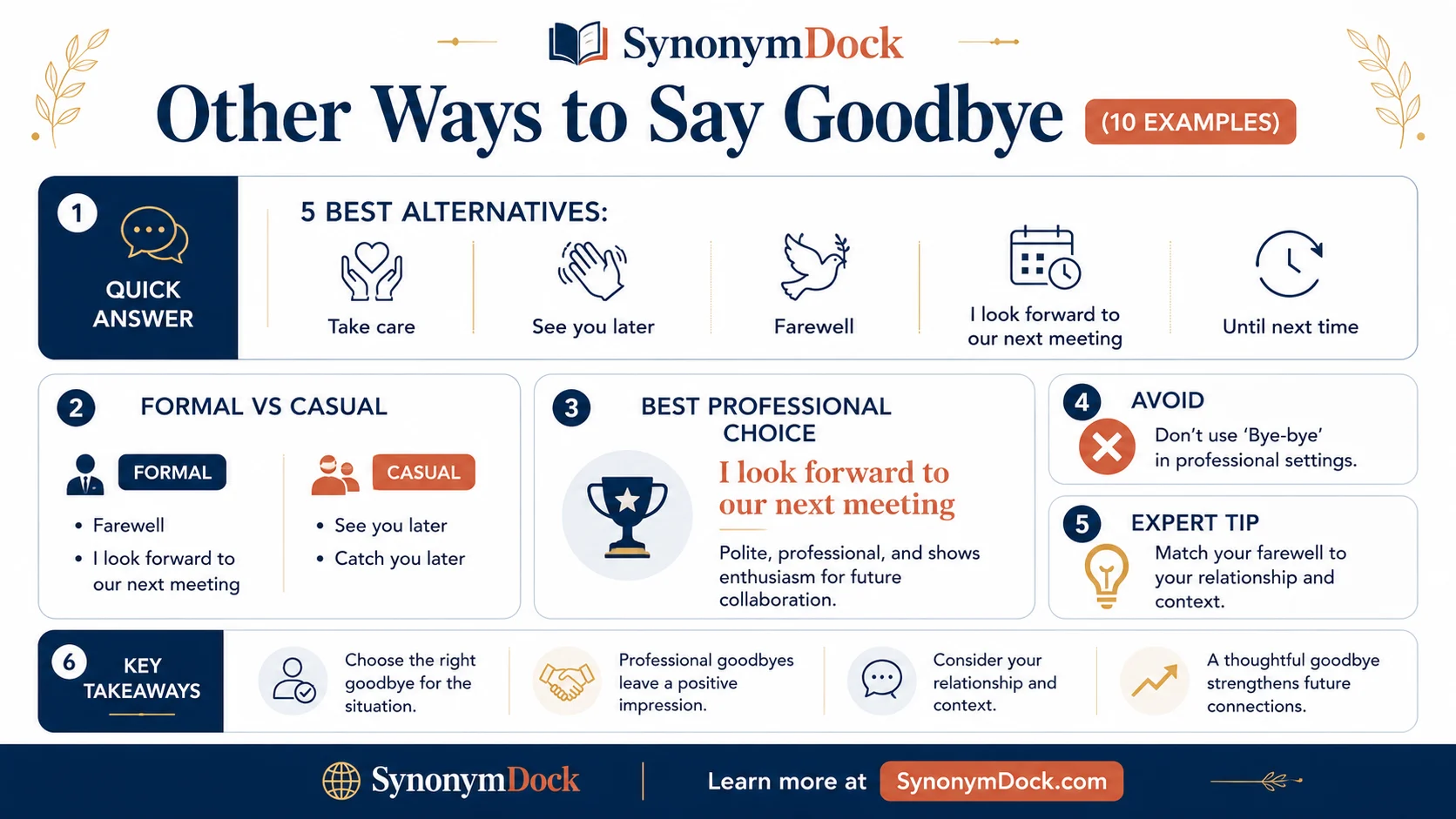
Looking for other ways to say goodbye? Try these natural alternatives: Take care, See you later, Farewell, I look forward to our next meeting, and Until next time. Each suits different situationsfrom casual chats to professional emails. Choose based on your relationship and context.
Saying goodbye is something we do every day. Yet most of us rely on the same few wordsbye, goodbye, or see you later. These work fine, but they don’t always fit every situation.
Using different farewells makes your English sound more natural and polished. It shows you understand tone, context, and relationship dynamics. Whether you’re writing a business email, ending a casual chat, or saying farewell to a colleague, the right phrase leaves a lasting impression.
This guide gives you ten practical alternatives to goodbye. You’ll learn exactly when and how to use each oneso you can speak and write with confidence in any setting.
Quick Category Section
Formal Alternatives
- Farewell – A dignified, somewhat old-fashioned send-off.
- I look forward to our next meeting – Professional and forward-looking.
- Until we meet again – Warm yet formal.
- Wishing you all the best – Polite and gracious.
Pro Tip: Use formal alternatives in job interviews, client meetings, and official correspondence. They convey respect and professionalism.
Professional & Business Email Alternatives
- Best regards – The gold standard for professional emails.
- Thank you for your time – Shows appreciation.
- Looking forward to hearing from you – Encourages a response.
- Warm regards – Friendly yet professional.
- Until next week – Casual but workplace-appropriate.
Pro Tip: Match your sign-off to your email’s tone. Best works for most situations. Save Warm regards for people you know well.
Casual & Informal Expressions
- Catch you later – Relaxed and friendly.
- See ya! – Very informal, common among friends.
- I’m off – Used when you’re leaving now.
- Take it easy – Laid-back and warm.
- Later! – Extremely casual, often used with close friends.
Pro Tip: Only use casual alternatives with people you know well. Avoid them in professional or formal settings.
Common Mistakes
1. Using “Bye-bye” in Professional Settings
Wrong: Ending a client email with Bye-bye!
Why it’s incorrect: Bye-bye sounds childish and informal. It’s fine for children but inappropriate for professional communication.
Correct: Best regards or Thank you for your time
Example: Thank you for your time, Mr. Chen. Best regards.
2. Saying “Farewell” Casually
Wrong: Farewell, see you tomorrow!
Why it’s incorrect: Farewell implies you won’t see the person againor at least not for a long time.
Correct: See you tomorrow or Until tomorrow
Example: See you tomorrow, Sarah. Have a good evening!
3. Overusing “Have a Good Day”
Wrong: Saying this to everyone, every time.
Why it’s incorrect: It becomes robotic and insincere. Native speakers vary their farewells based on time of day and context.
Correct: Match the timeHave a good afternoon, Have a great evening, or Good night.
Example: Have a great evening, everyone. See you on Monday!
4. Using “Take Care” Too Formally
Wrong: Take care, Your Honour.
Why it’s incorrect: While take care is polite, it’s somewhat informal. In very formal settings, it can sound too casual.
Correct: I look forward to our next meeting or It was a pleasure speaking with you
Example: It was a pleasure speaking with you, Judge Williams.
5. Confusing “See You Later” with “See You Soon”
Wrong: See you later when you won’t see the person again.
Why it’s incorrect: See you later implies you expect to see the person againusually the same day or soon. See you soon means you’ll meet again in the near future.
Correct: Use It was nice meeting you for a first-time encounter you won’t repeat soon.
Example: It was nice meeting you, Dr. Patel. I hope our paths cross again.
Meaning Section
What Does “Goodbye” Mean?
Goodbye is a farewell expression used when parting from someone. It comes from the phrase “God be with ye,” which was shortened over time. The first evidence dates back to around 1565–75.
Grammar note: Goodbye functions as an interjectiona word used to express emotion or to greet/part. It can also be a noun: She said her goodbyes and left.
Simple explanation: When you say goodbye, you’re wishing someone well as you leave. Today, it carries no religious meaningit’s simply a standard, neutral farewell.
Example sentence: Goodbye, everyone! Thanks for a wonderful evening.
When to Use
Business Communication
Use professional alternatives like Best regards, Thank you for your time, or I look forward to speaking again. These show respect and maintain a polished image.
Emails
Choose sign-offs that match your relationship with the recipient. Best and Regards work for most professional emails. Warm regards suits colleagues you know well.
Meetings & Presentations
End with Thank you for your attention or I look forward to our next discussion. These acknowledge your audience and leave a positive impression.
Academic Writing
In emails to professors or formal academic correspondence, use Sincerely, Respectfully, or Yours faithfully.
Interviews
Close with Thank you for your time and I look forward to hearing from you. These show professionalism and genuine interest.
Daily Conversations
Match your farewell to the situation. See you later works for friends. Take care suits acquaintances. Bye is fine for most casual encounters.
Professional vs Polite
Understanding the difference helps you choose the right phrase.
Polite: Shows good manners and consideration. Examples: Take care, Have a good day, It was nice meeting you.
Professional: Shows competence and maintains workplace boundaries. Examples: Best regards, Thank you for your time, I look forward to our next meeting.
Formal: Shows respect and distance. Used in official or ceremonial contexts. Examples: Farewell, Sincerely, Yours faithfully.
Natural: Sounds effortless and genuine. Native speakers vary their farewells based on context, relationship, and mood.
Pros and Cons
Pros of Using Different Goodbye Alternatives
- Sounds more natural – Native English speakers rarely say goodbye in casual conversation.
- Shows communication skill – Using varied phrases demonstrates language proficiency.
- Matches the situation – Different contexts call for different tones.
- Builds stronger relationships – The right farewell leaves a positive, lasting impression.
Cons of Using Different Goodbye Alternatives
- Risk of sounding awkward – Using an overly formal phrase in a casual setting feels stiff.
- Cultural misunderstandings – Some phrases are regional (e.g., Cheers in the UK).
- Overthinking – Worrying about the “perfect” farewell can make you hesitate.
- Misreading the relationship – Using casual phrases with someone you don’t know well can seem disrespectful.
Other Ways to Say “Goodbye” (With Examples)
1. Phrase: Take care
Meaning: A warm wish for someone’s well-being.
Explanation: This is one of the most versatile alternatives. It works in both casual and semi-formal settings. Take care shows you genuinely care about the other person’s safety and health. It’s warm without being overly familiar.
Tone: Warm, caring, polite
Formality Level: ⭐⭐⭐ (Neutral to Semi-formal)
Usage Frequency: Very Common
CEFR Level: B1
Common Collocations: take care of yourself, take care on your way, take care and stay safe
Context Examples:
- Spoken English: “Take care, Jenna. See you at the weekend.”
- Professional English: “Take care, and I’ll follow up with you next week.”
- Casual Conversation: “Alright, take care! Let’s catch up soon.”
Example Sentence: Take care on your drive homethe roads are icy tonight.
Best Use: Ending a conversation with acquaintances or colleagues.
Avoid Using In: Very formal business letters or legal correspondence.
2. Phrase: See you later
Meaning: A casual way to say you’ll see the person again.
Explanation: This is probably the most common alternative to goodbye in everyday English. It implies you expect to see the person againusually soon. You can shorten it to See ya or Later in very casual settings.
Tone: Friendly, casual, optimistic
Formality Level: ⭐⭐ (Casual)
Usage Frequency: Very Common
CEFR Level: A2
Common Collocations: see you soon, see you tomorrow, see you around, see you next week
Context Examples:
- Spoken English: “See you later, Mike. Thanks for the coffee.”
- Professional English: “See you later at the meeting.”
- Casual Conversation: “See ya! Text me when you get home.”
Example Sentence: See you laterI’ll pick you up at seven.
Best Use: Friends, family, and colleagues you see regularly.
Avoid Using In: Formal emails, first-time meetings, or when you won’t see the person again.
3. Phrase: I look forward to our next meeting
Meaning: A professional expression of anticipation for a future encounter.
Explanation: This is a polished, professional phrase used in business and formal contexts. It shows enthusiasm and respect. You can adapt it: I look forward to seeing you again or I look forward to speaking with you.
Tone: Professional, optimistic, respectful
Formality Level: ⭐⭐⭐⭐⭐ (Formal)
Usage Frequency: Common (in professional settings)
CEFR Level: B2
Common Collocations: look forward to hearing from you, look forward to working with you, look forward to our next discussion
Context Examples:
- Professional English: “I look forward to our next meeting, Mr. Tanaka.”
- Email Writing: “I look forward to hearing from you at your earliest convenience.”
- Spoken English: (less common in casual speech)
Example Sentence: I look forward to our next meeting and discussing the project’s progress.
Best Use: Business emails, client meetings, and professional correspondence.
Avoid Using In: Casual conversations with friends or family.
4. Phrase: Until next time
Meaning: A polished way to say you’ll meet again.
Explanation: This phrase is elegant and slightly formal. It’s perfect when you expect to see someone again but don’t know exactly when. You can also say Until then or Until we meet again.
Tone: Polished, warm, forward-looking
Formality Level: ⭐⭐⭐⭐ (Formal)
Usage Frequency: Occasional
CEFR Level: B2
Common Collocations: until then, until we meet again, until next week, until tomorrow
Context Examples:
- Professional English: “Until next time, everyone. Have a productive week.”
- Spoken English: “Until next time, my friend. Safe travels.”
- Email Writing: “Until next time, best wishes for your project.”
Example Sentence: Until next timeI hope your journey home is comfortable.
Best Use: Professional settings, formal letters, and when you expect to meet again.
Avoid Using In: Very casual conversations with close friends (it sounds too formal).
5. Phrase: It was a pleasure speaking with you
Meaning: A polite way to end a conversation, especially after a first meeting.
Explanation: This is a courteous, professional phrase used to close conversationsparticularly with people you’ve just met. You can shorten it to It was nice meeting you or It was great seeing you.
Tone: Polite, gracious, professional
Formality Level: ⭐⭐⭐⭐ (Formal)
Usage Frequency: Common (in professional contexts)
CEFR Level: B2
Common Collocations: pleasure meeting you, nice to meet you, great to see you, good to catch up
Context Examples:
- Professional English: “It was a pleasure speaking with you, Dr. Rivera.”
- Spoken English: “It was great seeing you at the conference.”
- Interview: “It was a pleasure speaking with you. I look forward to hearing from you.”
Example Sentence: It was a pleasure speaking with you about the new partnership opportunities.
Best Use: Networking events, interviews, first-time meetings, and professional gatherings.
Avoid Using In: Casual settings with close friends (it sounds too formal).
Native Speaker Tip (Alternatives 1–5)
Among these five, Take care is the most natural in daily lifeit’s warm, versatile, and works in almost any situation. For professional settings, I look forward to our next meeting is the strongest choice; it shows initiative and leaves a positive impression. The least common of these five is Until next timewhile elegant, native speakers use it less frequently than simpler options.
6. Phrase: Farewell
Meaning: A formal, somewhat old-fashioned way to say goodbye.
Explanation: Farewell comes from the Middle English fare wel, meaning “travel well” or “prosper.” It’s highly formal and often implies you won’t see the person againor at least not for a long time. Today, it’s more common in literature, speeches, and emotional farewells.
Tone: Dignified, emotional, final
Formality Level: ⭐⭐⭐⭐⭐ (Very Formal)
Usage Frequency: Rare (in daily conversation)
CEFR Level: B2
Common Collocations: bid farewell, say farewell, farewell party, farewell speech, fond farewell
Context Examples:
- Spoken English: (rare in casual speech)
- Professional English: “Farewell, and thank you for your years of service.”
- Ceremonial: “We bid farewell to our graduating students today.”
Example Sentence: Farewell, my friend. I wish you nothing but happiness in your new life.
Best Use: Emotional goodbyes, retirement speeches, formal ceremonies.
Avoid Using In: Daily conversation, casual emails, or when you’ll see the person soon.
7. Phrase: Have a good one
Meaning: A casual, friendly way to wish someone well.
Explanation: This is a very common American expression. It’s short, friendly, and works in many casual situations. Have a good one can mean have a good day, have a good evening, or even have a good weekendit’s intentionally vague.
Tone: Friendly, casual, upbeat
Formality Level: ⭐⭐ (Casual)
Usage Frequency: Very Common (especially in the US)
CEFR Level: B1
Common Collocations: have a good day, have a great one, have a nice one
Context Examples:
- Spoken English: “Alright, have a good one! Catch you later.”
- Professional English: (less common, but acceptable with close colleagues)
- Casual Conversation: “Thanks for coming. Have a good one!”
Example Sentence: Have a good one, mansee you at the game tomorrow.
Best Use: Casual conversations with friends, acquaintances, and service workers.
Avoid Using In: Formal business emails, academic writing, or when speaking to superiors.
8. Phrase: Keep in touch
Meaning: An invitation to maintain contact after parting.
Explanation: This is a warm, friendly way to say goodbye when you want to stay connected. It’s perfect for situations where you won’t see the person regularly but want to maintain the relationship. You can also say Stay in touch or Don’t be a stranger.
Tone: Warm, friendly, sincere
Formality Level: ⭐⭐⭐ (Neutral to Semi-formal)
Usage Frequency: Common
CEFR Level: B1
Common Collocations: stay in touch, keep in contact, let’s keep in touch, don’t be a stranger
Context Examples:
- Spoken English: “Keep in touch, okay? I’ll message you next week.”
- Professional English: “It was great working with you. Keep in touch!”
- Email Writing: “Keep in touch, and let me know if you need anything.”
Example Sentence: Keep in touch! I’d love to hear how your new job goes.
Best Use: Parting from friends, colleagues, or acquaintances you want to stay connected with.
Avoid Using In: Very formal business correspondence or with people you don’t want to maintain contact with.
9. Phrase: Catch you later
Meaning: A casual, friendly way to say you’ll see someone soon.
Explanation: This is an informal alternative to see you later. It’s common among friends and younger speakers. You’ll also hear Catch ya later or simply Catch you.
Tone: Casual, friendly, relaxed
Formality Level: ⭐ (Very Informal)
Usage Frequency: Common (among friends)
CEFR Level: B1
Common Collocations: catch you soon, catch ya later, catch you on the flip side
Context Examples:
- Spoken English: “Catch you later, bro. Thanks for the help.”
- Casual Conversation: “I’ve got to run. Catch you later!”
- Professional English: (avoidtoo informal)
Example Sentence: Catch you laterlet me know when you’re free for coffee.
Best Use: Friends, family, and people you know well.
Avoid Using In: Professional settings, formal emails, or with people you don’t know well.
10. Phrase: Wishing you all the best
Meaning: A warm, polite farewell that conveys goodwill.
Explanation: This is a gracious way to end a conversation or correspondenceespecially when you won’t see the person again soon. It works well in both professional and personal contexts. You can also say All the best or Best wishes.
Tone: Warm, gracious, sincere
Formality Level: ⭐⭐⭐⭐ (Formal)
Usage Frequency: Common
CEFR Level: B2
Common Collocations: all the best, best wishes, wishing you success, wishing you well
Context Examples:
- Professional English: “Wishing you all the best in your new role, Maria.”
- Email Writing: “Wishing you all the best for the future.”
- Spoken English: “Wishing you all the best, my friend. Stay in touch.”
Example Sentence: Wishing you all the best as you start your new chapter in London.
Best Use: Professional correspondence, farewell messages, and when someone is moving on.
Avoid Using In: Very casual conversations with close friends (it sounds too formal).
Native Speaker Tip (Alternatives 6–10)
Among the final five, Have a good one is the most natural in everyday American speechit’s casual, friendly, and universally understood. For professional communication, Wishing you all the best strikes the perfect balance between warmth and formality. The least common is Farewellwhile beautiful, it’s rarely used in daily conversation outside of formal ceremonies or emotional goodbyes.
Expert Insight
Workplace Communication: In professional settings, choose phrases that match your company culture. Best regards and Thank you for your time are always safe. Save Take care for colleagues you know well. Never use Catch you later in formal business correspondence.
Email Writing: Your sign-off sets the tone for your entire message. For external clients, use Best regards or Sincerely. For internal colleagues, Thanks or Best works well. Always include your name and title.
Academic English: In formal academic writing or emails to professors, use Sincerely, Respectfully, or Yours faithfully. Avoid casual phrases like See you or Take care.
Professional Tone: When in doubt, err on the side of formality. It’s easier to become more casual over time than to recover from being too informal.
Comparison Table
| Phrase | Tone | Formality | Best Use | Frequency |
| Take care | Warm, caring | ⭐⭐⭐ | Ending conversations with acquaintances | Very Common |
| See you later | Friendly, casual | ⭐⭐ | Friends, family, daily encounters | Very Common |
| I look forward to our next meeting | Professional, optimistic | ⭐⭐⭐⭐⭐ | Business emails, client meetings | Common |
| Until next time | Polished, warm | ⭐⭐⭐⭐ | Professional settings, formal letters | Occasional |
| It was a pleasure speaking with you | Polite, gracious | ⭐⭐⭐⭐ | Networking, interviews, first meetings | Common |
| Farewell | Dignified, emotional | ⭐⭐⭐⭐⭐ | Ceremonies, emotional goodbyes | Rare |
| Have a good one | Friendly, upbeat | ⭐⭐ | Casual conversations (US) | Very Common |
| Keep in touch | Warm, sincere | ⭐⭐⭐ | Maintaining relationships | Common |
| Catch you later | Casual, relaxed | ⭐ | Friends, family | Common |
| Wishing you all the best | Warm, gracious | ⭐⭐⭐⭐ | Professional correspondence, farewells | Common |
Best Choice Section
Best Overall: Take careit’s warm, versatile, and works in almost any situation from casual to semi-formal.
Best Professional: I look forward to our next meetingshows initiative, respect, and leaves a positive impression.
Best Academic: Sincerely or Yours faithfullystandard, respectful, and appropriate for formal academic correspondence.
Best Business Email: Best regardsprofessional, neutral, and widely accepted in business communication.
Best Everyday Conversation: See you laternatural, friendly, and used constantly by native speakers.
Most Natural: Byeshort, simple, and perfectly acceptable in most casual situations.
Most Polite: It was a pleasure speaking with youshows genuine appreciation and respect.
Commonly Confused Phrases
“See you later” vs. “See you soon”
- See you later – Implies you’ll see the person later the same day or soon. Very common.
- See you soon – Implies you’ll meet again in the near future, but not necessarily today.
- Don’t say “see you later” if you won’t see them again.
“Goodbye” vs. “Farewell”
- Goodbye – Neutral, standard, used daily.
- Farewell – Formal, emotional, often implies a final parting.
- Use “farewell” carefullyit sounds dramatic in casual conversation.
“Take care” vs. “Take it easy”
- Take care – Warm, caring, works in semi-formal settings.
- Take it easy – Casual, laid-back, only for friends.
- Don’t use “take it easy” with your boss or a client.
“Bye” vs. “Bye-bye”
- Bye – Neutral, standard, used by adults.
- Bye-bye – Childish, playful, usually used with children.
- Avoid “bye-bye” in professional settings.
Scenario Practice
Scenario 1: Business Meeting
You’ve just finished a productive meeting with a new client. You’re at the door, shaking hands.
Which phrase would you choose?
- A) “Catch you later!”
- B) “It was a pleasure speaking with you. I look forward to our next meeting.”
- C) “Have a good one!”
Answer: B. This is professional, respectful, and leaves a positive impression. A and C are too casual for a first meeting with a client.
Scenario 2: Job Interview
The interview is over. You want to leave a strong, professional impression.
Which phrase would you choose?
- A) “Take care, bye!”
- B) “Thank you for your time. I look forward to hearing from you.”
- C) “See you later!”
Answer: B. This shows appreciation and genuine interest in the position. A and C are too casual for an interview setting.
Scenario 3: Presentation
You’ve just finished presenting to a large audience. You want to close gracefully.
Which phrase would you choose?
- A) “That’s all, folks!”
- B) “Thank you for your attention. I look forward to your questions.”
- C) “Catch you on the flip side!”
Answer: B. It’s professional and acknowledges your audience’s time. A and C are too informal and could undermine your credibility.
Scenario 4: Classroom Discussion
You’re in an English class. The lesson is ending, and you’re saying goodbye to your classmates.
Which phrase would you choose?
- A) “Farewell, everyone!”
- B) “See you tomorrowhave a great evening!”
- C) “Wishing you all the best in your future endeavors.”
Answer: B. It’s friendly, natural, and matches the casual classroom setting. A sounds too dramatic; C is too formal for classmates.
Scenario 5: Email Reply
You’re replying to a colleague’s email. You’ve answered their questions and want to close professionally.
Which phrase would you choose?
- A) “Bye for now!”
- B) “Best regards, [Your Name]”
- C) “Later!”
Answer: B. Best regards is the standard professional email sign-off. A is slightly casual; C is far too informal for workplace email.
Mini Quiz
1. Which phrase is most appropriate for a formal business email?
- A) Catch you later
- B) Best regards
- C) See ya
2. What does “farewell” imply?
- A) You’ll see the person tomorrow
- B) You may not see the person again
- C) You’re going for lunch
3. Which phrase is the most natural in casual conversation?
- A) I look forward to our next meeting
- B) Farewell
- C) See you later
4. When should you avoid “bye-bye”?
- A) With children
- B) In professional settings
- C) With close friends
5. Which phrase shows you want to stay connected?
- A) Keep in touch
- B) Farewell
- C) Have a good one
Answer Key:
- B – Best regards is the standard professional email sign-off.
- B – Farewell often implies a final or long-term parting.
- C – See you later is one of the most common casual farewells.
- B – Bye-bye sounds childish and is inappropriate in professional settings.
- A – Keep in touch is an invitation to maintain contact.
FAQs
1. What is the most professional way to say goodbye in an email?
The most professional email sign-off is Best regards or Sincerely. For a slightly warmer tone, use Warm regards. Always match your sign-off to your relationship with the recipient.
2. Is “take care” a formal or informal goodbye?
Take care is neutralit works in both casual and semi-formal settings. It’s warm and caring without being overly familiar. Use it with acquaintances, colleagues, and people you know moderately well.
3. What is the difference between “see you later” and “see you soon”?
See you later implies you’ll meet again the same day or very soon. See you soon suggests a future meeting, but not necessarily today. Both are casual and friendly.
4. Can I use “farewell” in everyday conversation?
It’s best to avoid farewell in daily conversationit sounds overly formal and dramatic. Save it for emotional goodbyes, speeches, or formal ceremonies where a grander tone is appropriate.
5. What should I say instead of “goodbye” to sound more natural?
Try Take care, See you later, or Have a good one. These are among the most natural alternatives used by native English speakers in daily conversation.
Conclusion
Saying goodbye doesn’t have to be boring. With these ten alternatives, you can match your farewell to any situationfrom casual chats with friends to professional emails and formal presentations. The key is understanding the tone, context, and relationship behind each phrase.
Start by practicing one or two new alternatives each week. Soon, using varied farewells will feel completely natural. You’ll sound more confident, more polished, and more like a native English speaker. So go aheadtry Take care with a colleague tomorrow. Or end your next email with Best regards. Small changes make a big difference.

18 thoughts on “Other Ways to Say Goodbye |10 Best Examples and Alternatives For 2026”