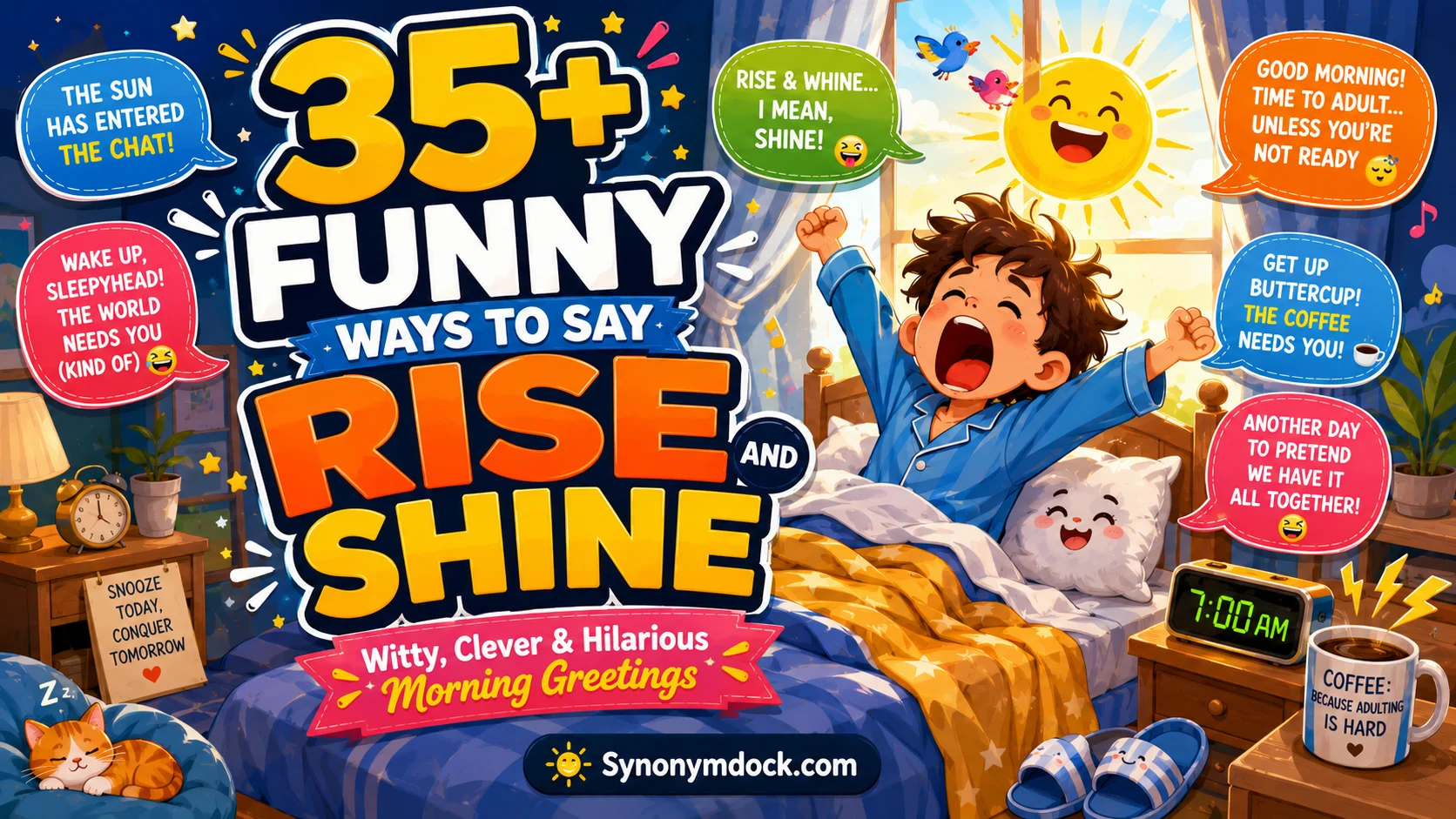
Rise and shine is one of those classic morning phrases that parents, teachers, and motivational speakers have been using for generations. But let’s be honestafter hearing it for the hundredth time, it starts to feel a bit stale.
Learning funny ways to say “rise and shine” can make your mornings more entertaining, help you connect with others through humor, and expand your English vocabulary with creative expressions. Whether you’re waking up a sleepy teenager, starting a team meeting, or just trying to make yourself laugh at 6 AM, these alternatives will add some sparkle to your morning routine.
Top 5 alternatives: Wakey wakey, eggs and bakey; Get your beauty sleepyou’ll need it; The sun is up and so should you be; Time to make the doughnuts; Good morning, sleepyhead.
Quick Categories
Playful & Rhyming Alternatives
- Wakey wakey, eggs and bakey
- Up and at ’em
- Rise and grind
- Wake up, buttercup
- Good morning, sunshine
Pro Tip: Rhyming phrases are memorable and fun. They work especially well with kids, close friends, or anyone who appreciates a little wordplay in the morning.
Silly & Exaggerated Alternatives
- The sun is up and so should you be
- It’s time to greet the day, whether you like it or not
- Time to make the doughnuts
- The bird is awakewhy aren’t you?
- I can hear your bed calling you, but it’s time to go
Pro Tip: Exaggerated phrases are perfect for dramatic friends or family members who appreciate a theatrical wake-up call.
Gentle & Encouraging Alternatives
- Time to welcome the day
- The morning is calling
- Let’s start the day with a smile
- Wake up, sleepyhead
- Good morning, beautiful
Pro Tip: These work well with partners, children, or anyone who needs a kind and gentle start to their day.
Humorous & Sarcastic Alternatives
- Another day, another opportunity to nap later
- You’ve slept enoughnow it’s time for coffee
- If you can read this, you’re awake
- Rise and grind (or just rise and hit snooze)
- Time to pretend you’re a morning person
Pro Tip: Sarcastic alternatives are great for friends who share your sense of humor and appreciate a funny spin on the morning struggle.
Professional & Office-Friendly Alternatives
- Good morning, team
- Welcome to a new day
- Let’s get started
- It’s a new day
- Here we go
Pro Tip: These are essential for workplace communication. They convey enthusiasm without sounding overly familiar or childish.
The best morning greeting matches the relationship, the moment, and the mood.
Common Mistakes
Mistake 1: Using overly familiar phrases with strangers or superiors
Why it is incorrect: Phrases like “wakey wakey, eggs and bakey” are too casual and can come across as unprofessional or disrespectful in formal settings.
Correct version: Use “Good morning” or “Let’s get started.”
Example Sentence: Instead of “Wakey wakey, eggs and bakey” to your boss, say “Good morning, I hope you’re well.”
Mistake 2: Using the same phrase every day
Why it is incorrect: Repetition makes the phrase lose its impact and can become annoying.
Correct version: Vary your greeting based on the day, mood, or situation.
Example Sentence: Try “Good morning, sleepyhead” one day and “Rise and grind” the next.
Mistake 3: Being too aggressive with your tone
Why it is incorrect: Some phrases like “Get up!” or “Wake up!” can sound angry or demanding.
Correct version: Use a gentle or playful tone to create a positive start to the day.
Example Sentence: Instead of “Get up right now,” try “Time to greet the day.”
Mistake 4: Using references that won’t be understood
Why it is incorrect: Pop culture references or regional expressions might confuse people.
Correct version: Use widely understood phrases or explain the reference if needed.
Example Sentence: Instead of “It’s time to make the doughnuts” to someone from another culture, say “Time to start the day.
Mistake 5: Overdoing the humor
Why it is incorrect: Too much humor in the morning can be overwhelming for people who aren’t morning people.
Correct version: Read the room and adjust your approach.
Example Sentence: Start with a warm “Good morning” and save the jokes for when they’ve had their coffee.
What Does “Rise and Shine” Mean?
Definition: A cheerful, encouraging phrase used to tell someone to wake up and get out of bed, often in a positive and energetic way.
Grammar: It is an imperative phrase consisting of two verbs: “rise” (get up) and “shine” (be bright and cheerful).
Simple Explanation: “Rise and shine” is a motivational way to start the day. It encourages someone to get up and be active, often with a cheerful tone.
Example Sentence: “Rise and shine, everyone! It’s a beautiful day.”
When to Use “Rise and Shine”
“Rise and shine” is a classic morning phrase. Use it when:
- Waking up family members
- Starting a morning meeting or team huddle
- Kicking off a group activity early in the day
- Encouraging someone to start their day
“A creative morning greeting can set the tone for the entire day.”
Is It Professional or Polite?
Polite? ✔ Yes, it’s a friendly and positive greeting.
Professional? ⚠ Sometimes, but it’s quite casual and may not be appropriate in very formal workplace settings.
Formal? ❌ No, it’s informal.
Natural? ✔ Yes, it’s very natural in casual and family contexts.
Business-style example: Instead of “Rise and shine,” try “Good morning, everyone. I hope you’re ready for today’s meeting.”
Explanation: “Rise and shine” is a classic, friendly phrase for family and close colleagues. In professional settings, a simple “Good morning” is usually more appropriate.
Pros and Cons
Pros
- Cheerful and positive
- Encouraging and motivating
- Easy to remember
- Works well with children
Cons
- Can become repetitive
- Too casual for formal settings
- Might feel forced or fake
- Not everyone appreciates morning enthusiasm
“The right morning phrase can start the day with a smile.”
35+ Funny Alternatives to Say “Rise and Shine”
1. Phrase: Wakey Wakey, Eggs and Bakey
Meaning: A playful, rhyming wake-up call.
Explanation: This is a classic, humorous phrase that’s become a staple of fun morning greetings. It’s silly, memorable, and guaranteed to get a smile.
Example Sentence: “Wakey wakey, eggs and bakey! Breakfast is almost ready.”
Best Use: Kids, partners, close friends, weekend mornings
Avoid Using In: Professional settings, formal events
Tone: Playful, Rhyming
Formality Level: ⭐ Very Casual
Usage Frequency: Very Common
CEFR Level: B1
Common Collocations:
- wakey wakey
- eggs and bakey
- time to wakey
Context Variability:
- Spoken English: “Wakey wakey, eggs and bakey!”
- Professional English: Avoid.
- Casual Conversation: Very fun and common.
2. Phrase: Good Morning, Sunshine
Meaning: A warm, affectionate morning greeting.
Explanation: This is a sweet and classic phrase. It’s often used to wake up a partner or child with a positive, loving tone.
Example Sentence: “Good morning, sunshine! Did you sleep well?”
Best Use: Partners, children, close friends
Avoid Using In: Professional contexts
Tone: Warm, Affectionate
Formality Level: ⭐⭐ Casual
Usage Frequency: Very Common
CEFR Level: A2
Common Collocations:
- good morning, sunshine
- good morning, sleepyhead
- good morning, beautiful
Context Variability:
- Spoken English: “Good morning, sunshine!”
- Professional English: Avoid.
- Casual Conversation: Very common.
3. Phrase: Rise and Grind
Meaning: A motivational phrase for starting a productive day.
Explanation: This is a modern, energetic twist on the classic. It’s often used in fitness, business, or self-improvement contexts. The “grind” means working hard.
Example Sentence: “Rise and grind! Time to crush today’s workout.”
Best Use: Fitness groups, business settings, motivational contexts
Avoid Using In: Relaxed weekend mornings
Tone: Energetic, Motivational
Formality Level: ⭐⭐ Casual
Usage Frequency: Very Common
CEFR Level: B1
Common Collocations:
- rise and grind
- time to grind
- let’s get this bread
Context Variability:
- Spoken English: “Rise and grind!”
- Professional English: Use with enthusiastic teams.
- Casual Conversation: Very common in fitness.
4. Phrase: The Sun Is Up and So Should You Be
Meaning: A gentle, logical reminder that it’s time to wake up.
Explanation: This is a slightly playful but gentle way to point out that the day has started. It’s less forceful than shouting “get up!”
Example Sentence: “The sun is up and so should you beit’s time for your morning run.”
Best Use: Partners, friends, gentle wake-ups
Avoid Using In: Professional settings
Tone: Gentle, Playful
Formality Level: ⭐⭐⭐ Neutral
Usage Frequency: Common
CEFR Level: B1
Common Collocations:
- sun is up
- it’s time
- the sun is shining
Context Variability:
- Spoken English: “The sun is up and so should you be.”
- Professional English: Acceptable.
- Casual Conversation: Very gentle.
5. Phrase: Time to Make the Doughnuts
Meaning: A humorous way to say it’s time to get to work.
Explanation: This phrase comes from an old commercial and has become a playful expression for starting work. It’s used to inject humor into the morning grind.
Example Sentence: “Time to make the doughnutslet’s get this project started.”
Best Use: Work contexts, with colleagues you know well
Avoid Using In: Formal client meetings
Tone: Playful, Old-School
Formality Level: ⭐⭐ Casual
Usage Frequency: Occasional
CEFR Level: B2
Common Collocations:
- make the doughnuts
- time to make the doughnuts
Context Variability:
- Spoken English: “Time to make the doughnuts!”
- Professional English: Fun with close colleagues.
- Casual Conversation: Playful and nostalgic.
6. Phrase: Get Your Beauty SleepYou’ll Need It
Meaning: A humorous way to tease someone about sleeping in.
Explanation: This is a teasing phrase that implies the person needed extra sleep to look good. It’s a lighthearted way to wake someone up.
Example Sentence: “Get your beauty sleepyou’ll need it if you want to look this good.”
Best Use: Friends, partners, playful teasing
Avoid Using In: Professional contexts
Tone: Teasing, Humorous
Formality Level: ⭐⭐ Casual
Usage Frequency: Common
CEFR Level: B2
Common Collocations:
- beauty sleep
- get your beauty sleep
- beauty rest
Context Variability:
- Spoken English: “Get your beauty sleep?”
- Professional English: Avoid.
- Casual Conversation: Very teasing.
7. Phrase: Up and At ‘Em
Meaning: An energetic, old-fashioned call to action.
Explanation: This phrase means “get up and get busy.” It’s a classic, slightly old-fashioned way to encourage someone to start their day.
Example Sentence: “Come on, everyoneup and at ’em! We’ve got a lot to do today.”
Best Use: Family mornings, sports teams, motivational contexts
Avoid Using In: Very formal settings
Tone: Energetic, Old-Fashioned
Formality Level: ⭐⭐⭐ Neutral
Usage Frequency: Common
CEFR Level: B1
Common Collocations:
- up and at ’em
- up and running
- up and about
Context Variability:
- Spoken English: “Up and at ’em, team!”
- Professional English: Acceptable but casual.
- Casual Conversation: Classic and energetic.
8. Phrase: Wake Up, Buttercup
Meaning: A playful, affectionate rhyming wake-up call.
Explanation: This is a sweet and silly phrase. The combination of “buttercup” with “wake up” makes it memorable and fun.
Example Sentence: “Wake up, buttercup! Your coffee is getting cold.”
Best Use: Partners, children, close friends
Avoid Using In: Professional settings
Tone: Playful, Affectionate
Formality Level: ⭐ Very Casual
Usage Frequency: Common
CEFR Level: B1
Common Collocations:
- wake up, buttercup
- wake up, sleepyhead
- wake up, sunshine
Context Variability:
- Spoken English: “Wake up, buttercup!”
- Professional English: Avoid.
- Casual Conversation: Very cute and fun.
9. Phrase: It’s Time to Greet the DayWhether You Like It or Not
Meaning: A humorous acknowledgment that mornings can be tough.
Explanation: This phrase is perfect for people who aren’t natural morning people. It acknowledges the struggle while encouraging them to start the day.
Example Sentence: “It’s time to greet the daywhether you like it or not. Your meeting starts in 20 minutes.”
Best Use: Friends, colleagues who appreciate honesty
Avoid Using In: Formal settings
Tone: Humorous, Honest
Formality Level: ⭐⭐⭐ Neutral
Usage Frequency: Common
CEFR Level: B2
Common Collocations:
- time to greet the day
- face the day
- welcome the day
Context Variability:
- Spoken English: “Time to greet the day!”
- Professional English: Acceptable.
- Casual Conversation: Very honest and funny.
10. Phrase: If You Can Read This, You’re Awake
Meaning: A humorous, sarcastic morning greeting.
Explanation: This phrase is a playful way to check if someone is actually awake. It works best as a text message or note.
Example Sentence: “If you can read this, you’re awakeand you’re late for breakfast!”
Best Use: Text messages, notes, playful contexts
Avoid Using In: Professional meetings
Tone: Sarcastic, Playful
Formality Level: ⭐⭐ Casual
Usage Frequency: Occasional
CEFR Level: B1
Common Collocations:
- if you can read this
- you’re awake
- you’re up
Context Variability:
- Spoken English: “If you can read this, you’re awake.”
- Professional English: Avoid.
- Casual Conversation: Very funny.
11. Phrase: Another Day, Another Opportunity to Nap Later
Meaning: A humorous acknowledgment that you’d rather be sleeping.
Explanation: This phrase is perfect for people who love sleep. It’s a funny way to start the day with honesty and humor.
Example Sentence: “Another day, another opportunity to nap later. But for now, let’s get started.”
Best Use: Friends, colleagues who share a sense of humor
Avoid Using In: Professional settings
Tone: Humorous, Relatable
Formality Level: ⭐⭐ Casual
Usage Frequency: Common
CEFR Level: B2
Common Collocations:
- another day
- opportunity to nap
- nap later
Context Variability:
- Spoken English: “Another day, another opportunity to nap later.”
- Professional English: Avoid.
- Casual Conversation: Very relatable.
12. Phrase: Time to Rise and Possibly Shine
Meaning: A realistic, humorous twist on the classic.
Explanation: This is a more honest version of “rise and shine.” It acknowledges that not every morning feels bright and shiny.
Example Sentence: “Time to rise and possibly shinemaybe after my second cup of coffee.”
Best Use: Friends, social media, casual contexts
Avoid Using In: Professional settings
Tone: Honest, Humorous
Formality Level: ⭐⭐ Casual
Usage Frequency: Common
CEFR Level: B2
Common Collocations:
- rise and shine
- maybe shine
- possibly shine
Context Variability:
- Spoken English: “Time to rise and possibly shine.”
- Professional English: Avoid.
- Casual Conversation: Very funny.
13. Phrase: The Bird Is AwakeWhy Aren’t You?
Meaning: A playful way to point out that nature is already active.
Explanation: This phrase uses the early-rising birds as a gentle example. It’s a cute and effective way to encourage someone to get up.
Example Sentence: “The bird is awakewhy aren’t you? It’s a beautiful morning out there.”
Best Use: Partners, children, gentle wake-ups
Avoid Using In: Professional contexts
Tone: Gentle, Playful
Formality Level: ⭐⭐⭐ Neutral
Usage Frequency: Common
CEFR Level: B1
Common Collocations:
- bird is awake
- early bird
- the birds are singing
Context Variability:
- Spoken English: “The bird is awake, why aren’t you?”
- Professional English: Acceptable.
- Casual Conversation: Very sweet.
14. Phrase: You’ve Slept EnoughNow It’s Time for Coffee
Meaning: A humorous acknowledgment that coffee is the real reason to get up.
Explanation: For many people, coffee is the primary motivation to start the day. This phrase captures that truth with humor.
Example Sentence: “You’ve slept enoughnow it’s time for coffee. And then we’ll talk about the day.”
Best Use: Friends, partners, coffee lovers
Avoid Using In: Professional settings
Tone: Humorous, Relatable
Formality Level: ⭐⭐ Casual
Usage Frequency: Very Common
CEFR Level: B1
Common Collocations:
- time for coffee
- coffee time
- caffeine time
Context Variability:
- Spoken English: “Time for coffee!”
- Professional English: Use with coffee-loving colleagues.
- Casual Conversation: Very relatable.
15. Phrase: Rise and Grind (or Just Rise and Hit Snooze)
Meaning: A funny, realistic twist that acknowledges the temptation to sleep more.
Explanation: This phrase is perfect for people who struggle to wake up. It gives them permission to laugh about their morning struggle.
Example Sentence: “Rise and grindor just rise and hit snooze. No judgment here.”
Best Use: Friends, social media, honest contexts
Avoid Using In: Professional settings
Tone: Honest, Humorous
Formality Level: ⭐⭐ Casual
Usage Frequency: Common
CEFR Level: B2
Common Collocations:
- rise and grind
- hit snooze
- snooze button
Context Variability:
- Spoken English: “Rise and grind or just hit snooze.”
- Professional English: Avoid.
- Casual Conversation: Very relatable.
16. Phrase: Let’s Get This Bread
Meaning: A modern, motivational phrase meaning let’s earn money/succeed.
Explanation: This is a popular internet and social media phrase. “Bread” is slang for money or success.
Example Sentence: “Let’s get this bread! Time to start the workday.”
Best Use: Young adults, social media, casual work contexts
Avoid Using In: Formal meetings
Tone: Motivational, Slang
Formality Level: ⭐⭐ Casual
Usage Frequency: Very Common
CEFR Level: B1
Common Collocations:
- get this bread
- get that bread
- bread and butter
Context Variability:
- Spoken English: “Let’s get this bread!”
- Professional English: Use with casual teams.
- Casual Conversation: Very common.
17. Phrase: Time to Put Your Game Face On
Meaning: A motivational call to get ready for the day’s challenges.
Explanation: This phrase is often used in competitive contexts. It’s a fun way to encourage someone to get in the right mindset.
Example Sentence: “Time to put your game face onwe’ve got a big meeting at 9 AM.”
Best Use: Work contexts, sports, motivational settings
Avoid Using In: Relaxed weekend mornings
Tone: Motivational, Energetic
Formality Level: ⭐⭐⭐ Neutral
Usage Frequency: Common
CEFR Level: B1
Common Collocations:
- game face
- put your game face on
- game time
Context Variability:
- Spoken English: “Time to put your game face on.”
- Professional English: Acceptable.
- Casual Conversation: Energetic and fun.
18. Phrase: The Day Isn’t Going to Start Itself
Meaning: A gentle, logical nudge to take action.
Explanation: This phrase points out that you need to actively start your day. It’s a reasonable reminder without being pushy.
Example Sentence: “The day isn’t going to start itselflet’s get moving.”
Best Use: Work contexts, friends, family
Avoid Using In: Very formal settings
Tone: Gentle, Logical
Formality Level: ⭐⭐⭐ Neutral
Usage Frequency: Common
CEFR Level: B1
Common Collocations:
- start itself
- get moving
- let’s get started
Context Variability:
- Spoken English: “The day isn’t going to start itself.”
- Professional English: Acceptable.
- Casual Conversation: Very natural.
19. Phrase: I Can Hear Your Bed Calling YouBut It’s Time to Go
Meaning: A humorous way to acknowledge the struggle.
Explanation: This phrase personifies the bed as something calling you to stay, but gently encourages you to leave it anyway.
Example Sentence: “I can hear your bed calling youbut it’s time to go to work.”
Best Use: Friends, partners, difficult mornings
Avoid Using In: Professional settings
Tone: Humorous, Gentle
Formality Level: ⭐⭐ Casual
Usage Frequency: Common
CEFR Level: B2
Common Collocations:
- bed calling you
- calling you back
- time to go
Context Variability:
- Spoken English: “Your bed is calling you!”
- Professional English: Avoid.
- Casual Conversation: Very funny.
20. Phrase: Good Morning! You Look Awake
Meaning: A slightly sarcastic, playful greeting.
Explanation: This is a fun way to greet someone in the morning, especially if they might not look fully awake.
Example Sentence: “Good morning! You look awakeor at least you’re pretending.”
Best Use: Friends, colleagues, playful contexts
Avoid Using In: Formal settings
Tone: Sarcastic, Playful
Formality Level: ⭐⭐ Casual
Usage Frequency: Common
CEFR Level: B2
Common Collocations:
- you look awake
- looking good
- morning
Context Variability:
- Spoken English: “You look awake!”
- Professional English: Avoid.
- Casual Conversation: Very playful.
21. Phrase: Rise and ShineIt’s Coffee O’Clock
Meaning: A humorous acknowledgment that coffee makes mornings bearable.
Explanation: This combines the classic phrase with the universal love of coffee. It’s perfect for any coffee enthusiast.
Example Sentence: “Rise and shineit’s coffee o’clock! I’ll meet you in the kitchen.”
Best Use: Friends, partners, coffee lovers
Avoid Using In: Professional settings
Tone: Humorous, Relatable
Formality Level: ⭐⭐ Casual
Usage Frequency: Very Common
CEFR Level: B1
Common Collocations:
- coffee o’clock
- coffee time
- time for coffee
Context Variability:
- Spoken English: “It’s coffee o’clock!”
- Professional English: Acceptable.
- Casual Conversation: Very relatable.
22. Phrase: The Alarm Clock Has Spoken
Meaning: A humorous way to acknowledge the authority of the alarm.
Explanation: This phrase personifies the alarm clock as having the final say. It’s a playful way to accept that it’s time to wake up.
Example Sentence: “The alarm clock has spokentime to get up and start the day.”
Best Use: Friends, humorous contexts
Avoid Using In: Professional settings
Tone: Playful, Humorous
Formality Level: ⭐⭐⭐ Neutral
Usage Frequency: Occasional
CEFR Level: B2
Common Collocations:
- alarm clock has spoken
- clock says
- it’s time
Context Variability:
- Spoken English: “The alarm clock has spoken.”
- Professional English: Acceptable.
- Casual Conversation: Very funny.
23. Phrase: Time to Show the World Your Face
Meaning: A gentle, encouraging morning greeting.
Explanation: This phrase uses a playful metaphor for getting up and being seen. It’s a sweet way to encourage someone.
Example Sentence: “Time to show the world your facelet’s go start the day!”
Best Use: Partners, children, gentle mornings
Avoid Using In: Professional settings
Tone: Gentle, Encouraging
Formality Level: ⭐⭐⭐ Neutral
Usage Frequency: Occasional
CEFR Level: B2
Common Collocations:
- show the world your face
- start the day
- get going
Context Variability:
- Spoken English: “Time to show the world your face.”
- Professional English: Avoid.
- Casual Conversation: Sweet and gentle.
24. Phrase: Wake UpThe World Needs You
Meaning: A motivational call to action.
Explanation: This phrase reminds someone that they matter and are needed. It’s a positive and encouraging morning greeting.
Example Sentence: “Wake upthe world needs you! Let’s make today amazing.”
Best Use: Partners, children, motivational contexts
Avoid Using In: Professional settings
Tone: Motivational, Encouraging
Formality Level: ⭐⭐⭐ Neutral
Usage Frequency: Common
CEFR Level: B1
Common Collocations:
- the world needs you
- you’re needed
- let’s make today
Context Variability:
- Spoken English: “Wake up, the world needs you.”
- Professional English: Avoid.
- Casual Conversation: Very encouraging.
25. Phrase: I Know You’re Not a Morning Person, But Here We Are
Meaning: A humorous acknowledgment of the struggle.
Explanation: This phrase is perfect for people who aren’t naturally morning people. It shows empathy while still encouraging them to start the day.
Example Sentence: “I know you’re not a morning person, but here we aretime to get up.”
Best Use: Friends, partners, honest mornings
Avoid Using In: Professional settings
Tone: Empathetic, Humorous
Formality Level: ⭐⭐⭐ Neutral
Usage Frequency: Common
CEFR Level: B2
Common Collocations:
- not a morning person
- here we are
- it’s morning
Context Variability:
- Spoken English: “I know you’re not a morning person.”
- Professional English: Avoid.
- Casual Conversation: Very relatable.
26. Phrase: Hello, Sleeping Beauty
Meaning: A gentle, fairy-tale-inspired wake-up call.
Explanation: This is a sweet, affectionate phrase. It’s often used to wake up a partner or child in a gentle way.
Example Sentence: “Hello, Sleeping Beautyit’s time to wake up.”
Best Use: Partners, children, gentle mornings
Avoid Using In: Professional settings
Tone: Gentle, Affectionate
Formality Level: ⭐⭐ Casual
Usage Frequency: Common
CEFR Level: B1
Common Collocations:
- sleeping beauty
- wake up, sleeping beauty
- beautiful
Context Variability:
- Spoken English: “Hello, Sleeping Beauty.”
- Professional English: Avoid.
- Casual Conversation: Very sweet.
27. Phrase: Let’s Get Ready to Rumble
Meaning: An energetic, boxing-inspired call to action.
Explanation: This phrase is used to start something exciting. It works well for energetic mornings or before a big event.
Example Sentence: “Let’s get ready to rumble! We’ve got a big day ahead.”
Best Use: Sports, energetic mornings, motivational contexts
Avoid Using In: Relaxed, quiet mornings
Tone: Energetic, Exciting
Formality Level: ⭐⭐ Casual
Usage Frequency: Common
CEFR Level: B2
Common Collocations:
- get ready to rumble
- ready to rumble
- let’s rumble
Context Variability:
- Spoken English: “Let’s get ready to rumble!”
- Professional English: Avoid.
- Casual Conversation: Very energetic.
28. Phrase: It’s Time to Start Your DayYou Know, the Thing You Have to Do
Meaning: A humorous, reluctant acknowledgment of the daily grind.
Explanation: This phrase is perfect for people who aren’t excited about the day. It acknowledges the reluctance while still encouraging action.
Example Sentence: “It’s time to start your dayyou know, the thing you have to do every single morning.”
Best Use: Friends, honest contexts
Avoid Using In: Professional settings
Tone: Humorous, Honest
Formality Level: ⭐⭐ Casual
Usage Frequency: Occasional
CEFR Level: B2
Common Collocations:
- start your day
- the thing you have to do
- every single morning
Context Variability:
- Spoken English: “Time to start your day.”
- Professional English: Avoid.
- Casual Conversation: Very honest.
29. Phrase: Rise and Shine, You Beautiful Human
Meaning: A warm, encouraging, and affectionate greeting.
Explanation: This phrase combines the classic with a modern, inclusive, and affirming touch. It’s perfect for making someone feel valued.
Example Sentence: “Rise and shine, you beautiful humanthe day is waiting for you!”
Best Use: Partners, children, anyone who needs encouragement
Avoid Using In: Professional settings
Tone: Warm, Affirming
Formality Level: ⭐⭐ Casual
Usage Frequency: Common
CEFR Level: B1
Common Collocations:
- beautiful human
- amazing human
- wonderful person
Context Variability:
- Spoken English: “Rise and shine, beautiful human.”
- Professional English: Avoid.
- Casual Conversation: Very affirming.
30. Phrase: Wake UpYour Dreams Aren’t That Interesting
Meaning: A teasing, slightly sarcastic wake-up call.
Explanation: This phrase assumes the person is having boring dreams. It’s a playful way to say that reality is better than whatever they’re dreaming.
Example Sentence: “Wake upyour dreams aren’t that interesting. The day is way more fun!”
Best Use: Friends, playful mornings
Avoid Using In: Professional settings
Tone: Teasing, Humorous
Formality Level: ⭐⭐ Casual
Usage Frequency: Occasional
CEFR Level: B2
Common Collocations:
- your dreams
- wake up
- time to wake up
Context Variability:
- Spoken English: “Your dreams aren’t that interesting.”
- Professional English: Avoid.
- Casual Conversation: Very teasing.
Top 10 Alternatives Compared
| Phrase | Tone | Formality | Best Use | Frequency |
| Wakey wakey, eggs and bakey | Playful, Rhyming | Very Casual | Kids, family | Very Common |
| Good morning, sunshine | Warm, Affectionate | Casual | Partners, children | Very Common |
| Rise and grind | Energetic, Motivational | Casual | Fitness, business | Very Common |
| Up and at ’em | Energetic, Old-Fashioned | Neutral | Family, teams | Common |
| Wake up, buttercup | Playful, Affectionate | Very Casual | Partners, kids | Common |
| It’s time to greet the day | Gentle, Encouraging | Neutral | Friends, family | Common |
| Another day, another opportunity to nap later | Humorous, Honest | Casual | Friends, social media | Common |
| Rise and grind or just hit snooze | Honest, Relatable | Casual | Friends, honest contexts | Common |
| Let’s get this bread | Motivational, Slang | Casual | Young adults, social media | Very Common |
| Time to make the doughnuts | Playful, Nostalgic | Casual | Work contexts | Occasional |
Which One Should You Use?
Best Overall
“Rise and grind” This is energetic, modern, and motivating. It works in many contexts from fitness to business.
Best for Family
“Wakey wakey, eggs and bakey” This is classic, playful, and guaranteed to bring a smile to kids and partners.
Best for Professional Settings
“Good morning, everyone” Keep it simple and professional. Save the funny phrases for coffee breaks.
Best for Partners
“Good morning, sunshine” or “Hello, Sleeping Beauty” These are warm, affectionate, and perfect for intimate morning moments.
Best for Friends
“Another day, another opportunity to nap later” This is relatable and funny for friends who share your sense of humor.
Best for Social Media
“Let’s get this bread” This is modern, catchy, and perfect for Instagram or TikTok.
Avoid These in Formal Situations
“Wakey wakey, eggs and bakey” This is too childish for professional settings. Use “Good morning” instead.
“Rise and grind” Unless you work in a very casual fitness or startup culture, avoid this in formal workplaces.
“Get your beauty sleepyou’ll need it” This can sound teasing and inappropriate in professional contexts.
“Another day, another opportunity to nap later” This might sound lazy or unmotivated in a work setting.
“Your dreams aren’t that interesting” This is too teasing and could be seen as disrespectful.
FAQ Section
What is the most professional way to say “rise and shine”?
The most professional way is to say “Good morning, everyone” or “Let’s get started on today’s agenda.” These phrases are respectful and appropriate for any workplace setting.
Which phrase is best for waking up kids?
“Wakey wakey, eggs and bakey” or “Wake up, buttercup” are excellent for kids. They’re playful, rhyming, and make morning fun.
What is the difference between “rise and shine” and “rise and grind”?
“Rise and shine” is about waking up cheerfully, while “rise and grind” means getting up to work hard. “Grind” refers to hard work and hustle culture.
Which alternative sounds most natural in British English?
“Up and at ’em” is common in British English. “Wakey wakey” is also used, though “eggs and bakey” is more of a rhyming addition.
Can I use these expressions in professional emails?
Generally no. For professional emails, stick to “Good morning,” “
Conclusion
Saying “rise and shine” doesn’t have to sound predictable. Whether you want to wake someone up with a laugh, tease a sleepy friend, or add some personality to your morning text, these funny alternatives give you plenty of ways to start the day with humor.
From “Wake up, sleepyhead!” to “The sun has entered the chat,” the right phrase can turn an ordinary good morning into something memorable. So the next time someone refuses to leave their cozy bed, skip the standard greeting and deliver a little morning comedy instead.
After all, mornings are easier when you can laugh your way into them! ☀️😂

6 thoughts on “Funny Ways to Say “Rise and Shine” |35+ Alternatives for 2026”