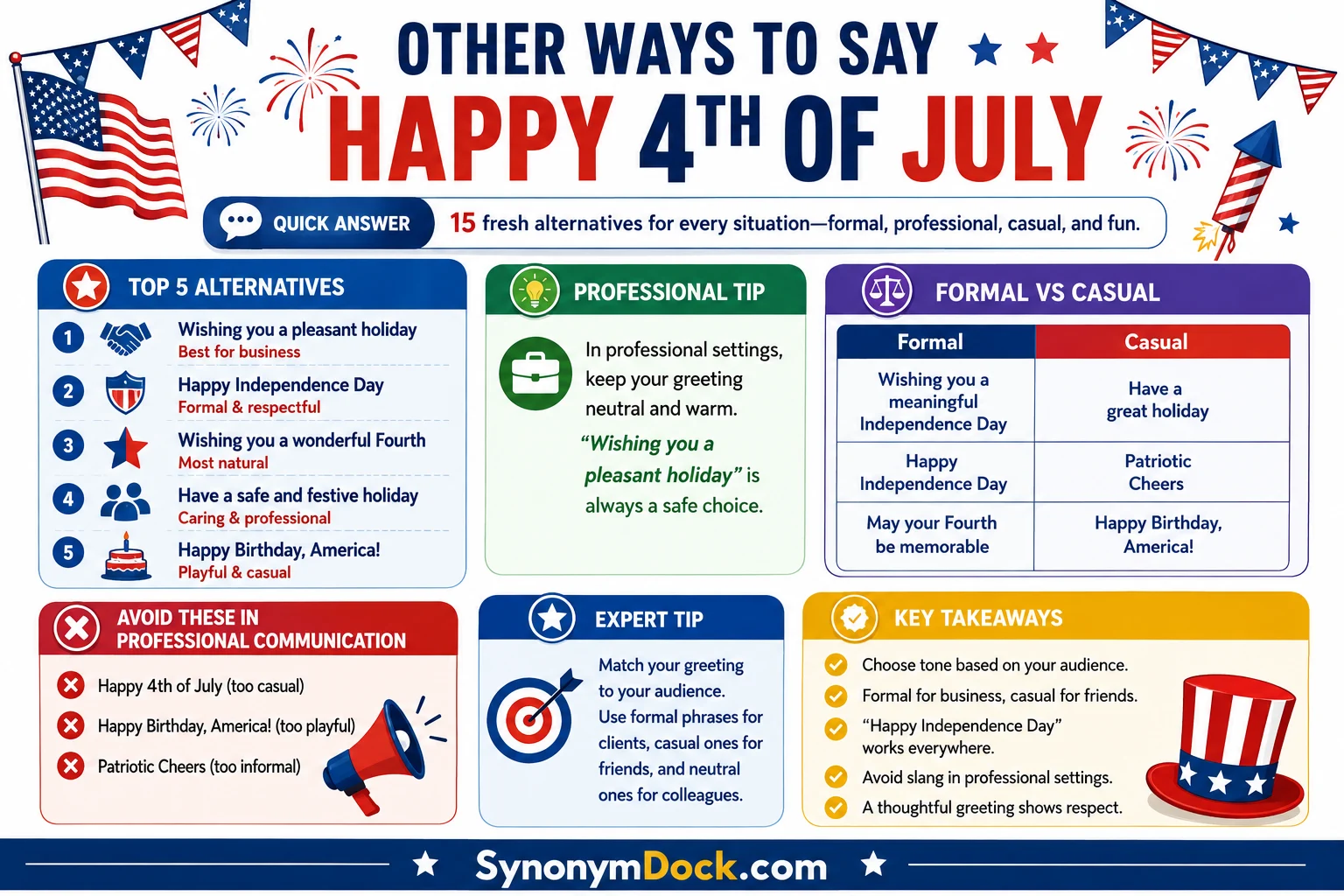
Wishing someone a joyful Independence Day, hoping they have a wonderful Fourth, or simply saying “Enjoy the celebrations today” are all excellent alternatives. Have a safe and festive holiday, cheers to freedom and unity, and Happy Independence Day are also great options.
“Happy 4th of July” is the go‑to greeting for America’s Independence Day. It’s friendly, warm, and instantly understood. But when you say it to everyonefriends, colleagues, clients, and even strangersit can start to feel a little repetitive or, in some situations, too casual.
That’s why having a few alternatives in your back pocket is so useful. Whether you’re writing a professional email, posting on social media, or chatting with friends, switching up your greeting shows thoughtfulness and cultural awareness. It also helps you sound more fluent and natural in English.
In this guide, you’ll discover 15 fresh ways to say “Happy 4th of July” organised by tone, formality, and context. You’ll learn exactly when to use each one, which to avoid in professional settings, and how native speakers really choose their words.
Quick Categories
Formal Alternatives
- Wishing you a meaningful Independence Day.
- Warm wishes on this Independence Day.
- May your Fourth of July be memorable.
- Best wishes as you celebrate today.
Pro Tip: Use full sentences and avoid slang when writing to colleagues, clients, or teachers.
Professional Alternatives
- Wishing you a pleasant holiday.
- Hope you enjoy the Independence Day celebrations.
- Sending best wishes for the Fourth.
- Have a safe and enjoyable holiday.
Pro Tip: In professional settings, keep your message friendly but neutral. A touch of warmth goes a long way, but save the fireworks metaphors for social media.
Business Email Alternatives
- Wishing you and your family a wonderful Fourth of July.
- Thank you for your continued trust and supportenjoy the holiday.
- Happy Independence Day from all of us.
- We hope you have a safe and restful holiday weekend.
Pro Tip: When writing to clients or partners, pair your greeting with genuine gratitude. A message that acknowledges the relationship feels more personal and less like a template.
Academic Alternatives
- On this day, we honour the founding of our nation.
- Independence Day offers a moment to reflect on liberty and democracy.
- Wishing you a thoughtful Fourth of July.
Pro Tip: In academic writing or speeches, focus on the historical and civic significance rather than just celebration.
Casual Alternatives
- Hope you have an awesome Fourth.
- Enjoy the fireworks tonight.
- Have a great holiday.
- Celebrate big today.
Pro Tip: Casual greetings are perfect for friends, texts, and social media posts. Keep them short and upbeat.
Informal Expressions
- Have a blast today.
- Party safe.
- Enjoy the long weekend.
- Make it a fun Fourth.
Pro Tip: Informal expressions are best for close friends, not workplace emails. Know your audience.
“The right holiday greeting can make your English sound warm, polished, and culturally aware.”
Common Mistakes
| Mistake | Why It’s Incorrect | Correct Version | Example Sentence |
| Using it in very formal writing | “Happy 4th of July” is too casual for official documents or formal letters. | “Wishing you a meaningful Independence Day.” | Incorrect: Happy 4th of July, Sir. Correct: Wishing you a meaningful Independence Day, Sir. |
| Forgetting capitalization | Holiday names and titles should be capitalised. | “Happy 4th of July” | Incorrect: happy 4th of july everyone Correct: Happy 4th of July, everyone! |
| Using it with non‑Americans who may not celebrate | The greeting assumes shared cultural context. | “Enjoy the long weekend” | Incorrect: Happy 4th of July to an international client. Correct: Enjoy the long weekend. |
| Overusing exclamation marks | Too many exclamation points feel unprofessional and exaggerated. | Use one, maximum. | Incorrect: Happy 4th of July!!!!! Correct: Happy 4th of July! |
| Using slang in professional messages | Slang undermines credibility in work contexts. | “Wishing you a pleasant holiday” | Incorrect: Have a lit Fourth, boss. Correct: Wishing you a pleasant holiday. |
What Does “Happy 4th of July” Mean?
“Happy 4th of July” is a standard greeting used to celebrate Independence Day in the United States. It expresses celebration, pride, and good wishes for the national holiday commemorating the adoption of the Declaration of Independence on July 4, 1776.
Grammatically, it follows the pattern “Happy + [holiday]” a fixed expression in English used for many celebrations (e.g., Happy New Year, Happy Birthday).
Example Sentence: I’m looking for things to say instead of “Happy 4th of July” in a work email.
When to Use “Happy 4th of July”
Common contexts:
- Greeting friends and family
- Social media posts
- Holiday parties
- Text messages
Spoken vs Written:
- Spoken: Very common and natural.
- Written: Fine for casual messages, but avoid in formal writing.
Formal vs Informal:
- Informal: Yes.
- Formal: Usually not.
Is It Professional or Polite?
Polite? ✔ Yes
Professional? ❌ No in most cases
Formal? ❌ Rarely
Natural? ✔ Yes
Business Example: Wishing you a pleasant Independence Day holiday.
“Professional English often replaces excitement with respectful, neutral wording.”
Pros and Cons
Pros
- Simple and easy to understand.
- Warm and friendly.
- Widely recognised and accepted.
- Works well in casual settings.
Cons
- Overused and can feel generic.
- Too casual for professional or formal contexts.
- Not appropriate for international audiences.
- Lacks depth or personalisation.
15 Alternatives to “Happy 4th of July”
Before we dive into the list, here’s what you’ll learn: when to use each phrase, what tone it carries, and which situations call for a more formal or casual approach. Choose based on your audience, the medium (email, text, speech), and the relationship you have with the person you’re addressing.
1. Wishing You a Joyful Independence Day
Meaning: A cheerful greeting that celebrates the nation’s independence with a focus on happiness and positivity.
Explanation: This phrase is warmer and more personal than the standard “Happy 4th of July.” Native speakers often use it when they want to sound thoughtful without being overly formal. It works well in both spoken and written English.
Example Sentence: Wishing you a joyful Independence Day full of fun and fireworks!
Best Use: Social media, cards, family messages
Avoid Using In: Business emails or legal documents
Tone: Warm, Cheerful
Formality Level: ⭐⭐⭐ Neutral
Usage Frequency: Common
CEFR Level: B1
Common Collocations: joyful celebration, joyful occasion, joyful holiday, joyful gathering
Context Variability:
- Spoken: “Wishing you a joyful Independence Day!”
- Professional: “We wish you a joyful Independence Day holiday.”
- Casual: “Joyful 4th to you and yours!”
2. Celebrate Freedom Day
Meaning: Encourages honouring the freedom and liberty that America stands for.
Explanation: This alternative emphasises the meaning behind the holiday rather than just the date. It sounds more purposeful and reflective. Native speakers use it when they want to acknowledge the deeper significance of July 4th.
Example Sentence: Let’s Celebrate Freedom Day with pride and gratitude.
Best Use: Community events, speeches, social media
Avoid Using In: Very casual texts
Tone: Inspiring, Purposeful
Formality Level: ⭐⭐⭐⭐ Formal
Usage Frequency: Occasional
CEFR Level: B2
Common Collocations: celebrate freedom, freedom and liberty, freedom fighters, freedom celebration
Context Variability:
- Spoken: “Let’s celebrate Freedom Day together.”
- Professional: “We invite you to celebrate Freedom Day with us.”
- Casual: “Happy Freedom Day, everyone!”
3. Patriotic Cheers
Definition: A fun and informal way to toast to America’s independence.
Explanation: This is a lively, upbeat greeting that works perfectly for social gatherings, barbecues, or Instagram captions. It’s not suitable for formal writing but adds a lot of personality in casual settings.
Example Sentence: Sending Patriotic Cheers to all my fellow Americans!
Best Use: Parties, toasts, captions
Avoid Using In: Professional emails
Tone: Playful, Festive
Formality Level: ⭐⭐ Casual
Usage Frequency: Occasional
CEFR Level: B1
Common Collocations: patriotic spirit, patriotic pride, patriotic celebration, patriotic display
Context Variability:
- Spoken: “Patriotic cheers to everyone at the cookout!”
- Professional: (Avoid)
- Casual: “Patriotic cheers from our family to yours!”
4. Stars and Stripes Greetings
Definition: References the American flag while sending greetings.
Explanation: This is a creative and visual way to say “Happy 4th of July.” It evokes the flag and all it represents. Native speakers use it in cards, social media posts, and festive messagesespecially when they want to be a little more imaginative.
Example Sentence: Sending Stars and Stripes Greetings to everyone near and far.
Best Use: Cards, social media, flag‑themed events
Avoid Using In: Formal business communication
Tone: Creative, Festive
Formality Level: ⭐⭐⭐ Neutral
Usage Frequency: Occasional
CEFR Level: B2
Common Collocations: stars and stripes, American flag, red white and blue, patriotic symbols
Context Variability:
- Spoken: “Stars and stripes greetings to you!”
- Professional: (Rare)
- Casual: “Sending stars and stripes greetings from our backyard!”
5. Freedom Fest Wishes
Definition: A festive alternative emphasising celebration and liberty.
Explanation: This phrase combines the ideas of freedom and festivity, making it ideal for party invitations or community event announcements. It sounds energetic and modern.
Example Sentence: Enjoy the fireworks and Freedom Fest Wishes to all!
Best Use: Event invitations, community posts
Avoid Using In: Academic writing
Tone: Energetic, Modern
Formality Level: ⭐⭐⭐ Neutral
Usage Frequency: Rare
CEFR Level: B2
Common Collocations: freedom fest, summer fest, community fest, celebration fest
Context Variability:
- Spoken: “Freedom Fest wishes to everyone at the parade!”
- Professional: “We extend Freedom Fest wishes to our partners.”
- Casual: “Happy Freedom Fest!”
“Fluency is not just vocabulary. It is choosing the right tone for the moment.”
6. Happy Independence Day
Definition: The most direct and widely recognised alternative to “Happy 4th of July.”
Explanation: This is the formal, full‑name version of the holiday. It’s appropriate for almost any contextfrom casual conversation to official statementsand is understood by all Americans. Native speakers often use it when they want to sound a bit more respectful or when addressing a larger audience.
Example Sentence: Happy Independence Day to everyone celebrating across the country.
Best Use: All contexts (except extremely casual texts)
Avoid Using In: Very informal group chats (where “Happy 4th” is fine)
Tone: Respectful, Clear
Formality Level: ⭐⭐⭐⭐ Formal
Usage Frequency: Very Common
CEFR Level: A2
Common Collocations: Independence Day celebration, Independence Day parade, Independence Day holiday, Independence Day weekend
Context Variability:
- Spoken: “Happy Independence Day, neighbour!”
- Professional: “Happy Independence Day from our team to yours.”
- Casual: “Happy Independence Day! Let’s grill!”
7. Wishing You a Wonderful Fourth
Definition: A warm, friendly greeting that keeps the focus on the person you’re addressing.
Explanation: This is one of the most natural alternatives in everyday conversation. It sounds personal without being overly emotional. Native speakers use it in emails, texts, and spoken greetings when they want to be kind but not overly formal.
Example Sentence: Wishing you a wonderful Fourth with your family and friends.
Best Use: Emails, texts, casual conversations
Avoid Using In: Official proclamations
Tone: Warm, Friendly
Formality Level: ⭐⭐⭐ Neutral
Usage Frequency: Common
CEFR Level: B1
Common Collocations: wonderful holiday, wonderful celebration, wonderful weekend, wonderful time
Context Variability:
- Spoken: “Wishing you a wonderful Fourth!”
- Professional: “Wishing you a wonderful Fourth of July holiday.”
- Casual: “Have a wonderful Fourth, see you soon!”
8. Enjoy the Celebrations Today
Definition: A simple, action‑oriented greeting that encourages the recipient to have a good time.
Explanation: Instead of just wishing someone happiness, this phrase invites them to actively participate in the day’s events. It’s friendly, neutral, and works well in both spoken and written English.
Example Sentence: Enjoy the celebrations todayyou deserve a great day off!
Best Use: Text messages, quick emails, casual greetings
Avoid Using In: Formal letters
Tone: Encouraging, Light
Formality Level: ⭐⭐⭐ Neutral
Usage Frequency: Common
CEFR Level: A2
Common Collocations: enjoy the day, enjoy the festivities, enjoy the holiday, enjoy the weekend
Context Variability:
- Spoken: “Enjoy the celebrations today!”
- Professional: “We hope you enjoy the celebrations today.”
- Casual: “Enjoy the celebrationsdon’t eat too many hot dogs!”
9. Have a Safe and Festive Holiday
Definition: A caring greeting that prioritises safety while still acknowledging the festive nature of the day.
Explanation: This is an excellent choice for professional or community messages. It shows you care about the person’s well‑being without sounding stiff. Native speakers often use it in workplace announcements or neighbourhood newsletters.
Example Sentence: Have a safe and festive holidaywe’ll see you back on Tuesday!
Best Use: Workplace emails, community announcements
Avoid Using In: Very casual texts
Tone: Caring, Professional
Formality Level: ⭐⭐⭐⭐ Formal
Usage Frequency: Common
CEFR Level: B1
Common Collocations: safe holiday, festive holiday, holiday weekend, holiday celebrations
Context Variability:
- Spoken: “Have a safe and festive holiday, everyone.”
- Professional: “We wish you a safe and festive holiday.”
- Casual: “Stay safe and have fun!”
10. Cheers to Freedom and Unity
Definition: A toast‑style greeting that celebrates both liberty and togetherness.
Explanation: This phrase adds a note of gratitude and community spirit. It’s a bit more poetic than the standard greeting and works well in toasts, speeches, or heartfelt messages.
Example Sentence: Cheers to freedom and unityhappy Fourth to all!
Best Use: Toasts, speeches, social media
Avoid Using In: Business emails
Tone: Heartfelt, Celebratory
Formality Level: ⭐⭐⭐ Neutral
Usage Frequency: Occasional
CEFR Level: B2
Common Collocations: cheers to freedom, cheers to unity, cheers to the holiday, cheers to America
Context Variability:
- Spoken: “Cheers to freedom and unity!”
- Professional: (Rare)
- Casual: “Cheers to freedom and unitylet’s eat!”
“The right greeting in the right moment makes people feel seen and valued.”
11. May Your Fourth of July Be Memorable
Definition: A warm wish that the day will leave a lasting positive impression.
Explanation: This is a slightly more formal and thoughtful alternative. It works well in cards, emails to older relatives, or when you want to express extra sincerity. Native speakers use it when they want to go beyond a simple “happy” wish.
Example Sentence: May your Fourth of July be memorable and filled with joy.
Best Use: Cards, emails, formal messages
Avoid Using In: Quick texts
Tone: Sincere, Thoughtful
Formality Level: ⭐⭐⭐⭐ Formal
Usage Frequency: Occasional
CEFR Level: B2
Common Collocations: memorable day, memorable holiday, memorable celebration, memorable experience
Context Variability:
- Spoken: “May your Fourth be memorable.”
- Professional: “May your Fourth of July be memorable and restful.”
- Casual: (Rare)
12. Wishing You a Pleasant Holiday
Definition: A neutral, polite greeting suitable for professional or formal contexts.
Explanation: This is the go‑to alternative for workplace emails, client messages, and any situation where you need to stay professional. It’s warm enough to be friendly but neutral enough to avoid overstepping.
Example Sentence: Wishing you a pleasant holidaywe appreciate your partnership.
Best Use: Business emails, client messages
Avoid Using In: Texts to friends
Tone: Professional, Neutral
Formality Level: ⭐⭐⭐⭐⭐ Very Formal
Usage Frequency: Common in business
CEFR Level: B1
Common Collocations: pleasant holiday, pleasant weekend, pleasant day, pleasant experience
Context Variability:
- Spoken: (Rare)
- Professional: “Wishing you a pleasant holiday.”
- Casual: (Avoid)
13. Here’s to the Red, White, and Blue
Definition: A patriotic toast that references the American flag.
Explanation: This phrase is cheerful and visual, perfect for toasts or social media captions. It’s not suitable for formal writing but adds a lot of colour to casual celebrations.
Example Sentence: Here’s to the red, white, and bluehappy Fourth of July!
Best Use: Toasts, captions, festive messages
Avoid Using In: Professional communication
Tone: Festive, Patriotic
Formality Level: ⭐⭐ Casual
Usage Frequency: Common around the holiday
CEFR Level: B1
Common Collocations: red white and blue, stars and stripes, American flag, patriotic colours
Context Variability:
- Spoken: “Here’s to the red, white, and blue!”
- Professional: (Avoid)
- Casual: “Here’s to the red, white, and bluelet’s celebrate!”
14. Wishing You Sunshine, Smiles, and Fireworks
Definition: A colourful, image‑filled greeting that paints a picture of a perfect Fourth.
Explanation: This is a creative and warm alternative, ideal for cards, social media, or messages to loved ones. It’s not for professional use but adds a lot of personality and warmth.
Example Sentence: Wishing you sunshine, smiles, and spectacular fireworks this Fourth of July.
Best Use: Cards, social media, family messages
Avoid Using In: Business emails
Tone: Creative, Warm
Formality Level: ⭐⭐ Casual
Usage Frequency: Occasional
CEFR Level: B2
Common Collocations: sunshine and smiles, fireworks and fun, summer celebrations, holiday cheer
Context Variability:
- Spoken: “Wishing you sunshine, smiles, and fireworks!”
- Professional: (Avoid)
- Casual: “Sunshine, smiles, and fireworks to you!”
15. Happy Birthday, America!
Definition: A playful, personified greeting that treats the nation as a living entity.
Explanation: This is a fun and endearing way to acknowledge the holiday. It’s very casual and works best in texts, captions, or among friends. Native speakers use it when they want to be light‑hearted and affectionate.
Example Sentence: Happy Birthday, America! Let’s celebrate with good food and great company.
Best Use: Texts, social media, casual conversations
Avoid Using In: Professional or formal settings
Tone: Playful, Affectionate
Formality Level: ⭐ Very Casual
Usage Frequency: Common
CEFR Level: A2
Common Collocations: birthday celebration, America’s birthday, Fourth of July birthday, patriotic birthday
Context Variability:
- Spoken: “Happy Birthday, America!”
- Professional: (Avoid)
- Casual: “Happy Birthday, Americalet’s party!”
“Native speakers often choose different expressions depending on formality, workplace culture, and the relationship with the listener.”
Native Speaker Tips
After every 5 alternatives, here’s what native speakers really think:
Tip 1 (after #5): Among the first five alternatives, “Happy Independence Day” is the most universally recognised. “Patriotic Cheers” and “Stars and Stripes Greetings” sound creative but are less common in everyday speechsave them for captions or cards.
Tip 2 (after #10): “Wishing you a wonderful Fourth” and “Have a safe and festive holiday” are the most natural choices for everyday use. Native speakers use them constantly in emails, texts, and casual conversation because they strike the right balance between warmth and neutrality.
Tip 3 (after #15): “Happy Birthday, America!” is playful and affectionate, but it can feel a little too casual for anyone outside your close circle. Use it with friends, not with your boss.
Expert Insights
After #10: In professional communication, the safest bet is always “Wishing you a pleasant holiday” or “Have a safe and festive holiday.” These phrases show you care without assuming the recipient’s political or cultural stance. They’re neutral, respectful, and universally appropriate.
Top 10 Alternatives Compared
| Phrase | Tone | Formality | Best Use | Frequency |
| Wishing you a pleasant holiday | Professional | ⭐⭐⭐⭐⭐ | Business emails | Common |
| Happy Independence Day | Respectful | ⭐⭐⭐⭐ | All formal contexts | Very Common |
| Wishing you a wonderful Fourth | Warm | ⭐⭐⭐ | Emails, texts | Common |
| Have a safe and festive holiday | Caring | ⭐⭐⭐⭐ | Workplace messages | Common |
| Celebrate Freedom Day | Inspiring | ⭐⭐⭐⭐ | Speeches, events | Occasional |
| Cheers to freedom and unity | Heartfelt | ⭐⭐⭐ | Toasts, social media | Occasional |
| May your Fourth be memorable | Thoughtful | ⭐⭐⭐⭐ | Cards, formal messages | Occasional |
| Enjoy the celebrations today | Encouraging | ⭐⭐⭐ | Texts, quick greetings | Common |
| Patriotic Cheers | Playful | ⭐⭐ | Parties, captions | Occasional |
| Happy Birthday, America! | Playful | ⭐ | Friends, social media | Common |
Which One Should You Use?
- Best Overall: Happy Independence Day – works in almost every context.
- Best Professional: Wishing you a pleasant holiday – neutral, respectful, and safe.
- Best Academic: On this day, we honour the founding of our nation – reflective and appropriate for formal writing.
- Best Business Email: Wishing you and your family a wonderful Fourth of July – warm yet professional.
- Best Everyday Conversation: Wishing you a wonderful Fourth – natural, friendly, and easy.
- Most Natural: Have a great holiday – simple, versatile, and used by native speakers daily.
- Most Polite: Have a safe and festive holiday – shows care without being overbearing.
Commonly Confused Phrases
| Phrase | Meaning | When to Use |
| Happy 4th of July | Standard casual greeting | Friends, family, social media |
| Happy Independence Day | Formal, full name of the holiday | Professional, official, or respectful contexts |
| Happy Fourth | Short, casual version | Texts, quick greetings |
| Wishing you a pleasant holiday | Professional, neutral | Business emails, client communication |
Subtle difference: “Happy Independence Day” sounds more official and respectful, while “Happy 4th of July” is more casual and everyday. “Happy Fourth” is the shortest and most informal.
Scenario Practice
Scenario 1: Business Email to a Client
Which phrase would you choose?
Answer: Wishing you a pleasant holiday – it’s professional, neutral, and shows respect without overstepping.
Scenario 2: Text to a Close Friend
Which phrase would you choose?
Answer: Happy Birthday, America! or Enjoy the fireworks tonight! – playful and casual.
Scenario 3: Community Newsletter
Which phrase would you choose?
Answer: Have a safe and festive holiday – caring, inclusive, and appropriate for a broad audience.
Scenario 4: Social Media Caption
Which phrase would you choose?
Answer: Patriotic Cheers or Here’s to the red, white, and blue – visual, fun, and shareable.
Scenario 5: Family Card
Which phrase would you choose?
Answer: Wishing you sunshine, smiles, and fireworks – warm, creative, and personal.
Mini Quiz
- Which phrase is best for a professional email to a client?
- A) Happy 4th of July!
- B) Wishing you a pleasant holiday.
- C) Patriotic Cheers!
- D) Happy Birthday, America!
- What is the most formal alternative?
- A) Have a great holiday.
- B) Enjoy the celebrations today.
- C) Wishing you a meaningful Independence Day.
- D) Cheers to freedom and unity.
- Which phrase is too casual for a workplace message?
- A) Have a safe and festive holiday.
- B) Happy Independence Day.
- C) Happy Birthday, America!
- D) Wishing you a wonderful Fourth.
- What does “Stars and Stripes Greetings” refer to?
- A) Fireworks
- B) The American flag
- C) Barbecues
- D) Parades
- Which phrase is most natural for everyday conversation?
- A) May your Fourth of July be memorable.
- B) Wishing you a wonderful Fourth.
- C) Celebrate Freedom Day.
- D) Freedom Fest Wishes.
Answer Key
- B – Wishing you a pleasant holiday is neutral and professional.
- C – Wishing you a meaningful Independence Day is the most formal.
- C – Happy Birthday, America! is very casual and playful.
- B – It references the American flag.
- B – Wishing you a wonderful Fourth is warm, natural, and widely used.
Avoid These in Formal Situations
| Phrase | Why to Avoid | Better Alternative |
| Happy 4th of July | Too casual for formal writing | Happy Independence Day |
| Happy Birthday, America! | Playful, not professional | Wishing you a pleasant holiday |
| Patriotic Cheers | Too informal for business | Have a safe and festive holiday |
| Let freedom bling! | Slang, unprofessional | Celebrate Freedom Day |
| Stay explosive, America! | Overly dramatic, inappropriate | Wishing you a joyful Independence Day |
Best Phrases by Situation
| Situation | Best Phrase |
| Business Email | Wishing you a pleasant holiday |
| Client Meeting | Happy Independence Day |
| Academic Essay | On this day, we honour the founding of our nation |
| Presentation | Independence Day offers a moment to reflect on liberty |
| Workplace Discussion | Have a safe and festive holiday |
| Job Interview | (Avoid holiday greetings unless the interviewer mentions it) |
| Team Collaboration | Wishing everyone a wonderful Fourth |
| Everyday Conversation | Have a great holiday |
FAQs
What is the most formal way to say “Happy 4th of July”?
Wishing you a meaningful Independence Day is the most formal option. It conveys respect and thoughtfulness, making it suitable for official letters, academic contexts, and formal speeches.
Which phrase is best for professional emails?
Wishing you a pleasant holiday is the safest and most professional choice. It’s neutral, respectful, and works well with clients, partners, and colleagues.
What is the difference between “Happy 4th of July” and “Happy Independence Day”?
“Happy 4th of July” is casual and conversational, while “Happy Independence Day” is the formal, full name of the holiday. Use the former with friends and the latter in professional or official settings.
Which alternative sounds most natural to native speakers?
Wishing you a wonderful Fourth and Have a great holiday are the most natural and frequently used alternatives in everyday conversation.
Can I use these expressions in business meetings?
Yes, but choose carefully. Happy Independence Day and Wishing you a pleasant holiday are appropriate. Avoid casual or playful phrases like Patriotic Cheers or Happy Birthday, America! in professional settings.
Conclusion
Learning different ways to say “Happy 4th of July” isn’t just about avoiding repetitionit’s about communicating with the right tone for the right audience. Whether you’re writing a formal email, posting on social media, or chatting with friends, the phrases in this guide give you the flexibility to sound natural, professional, and culturally aware.
Start using these alternatives in your everyday conversations, emails, and social media posts. The more you practise, the more confident you’ll become. And remember: the best greeting is the one that makes the other person feel seen and appreciated.

3 thoughts on “Other Ways to Say “Happy 4th of July” (15+ Examples)”