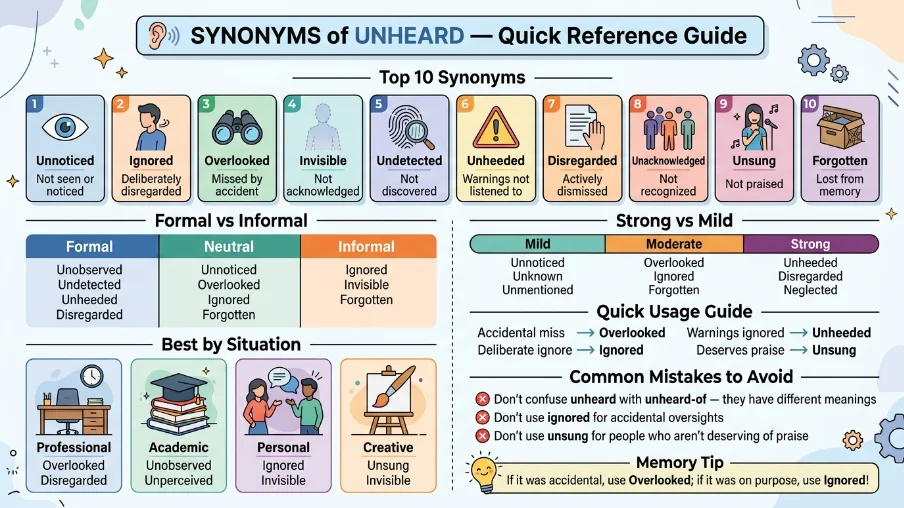
Unheard means not heard, unnoticed, or ignored. The best synonyms include unnoticed, ignored, overlooked, invisible, unobserved, unmarked, undetected, unheeded, unnoted, and unperceived. But each synonym has a slightly different meaning, tone, or context, so choosing the right one depends on your situation.
Have you ever felt like your voice wasn’t being heard? Or maybe you’re looking for a more precise word to describe something that went completely unnoticed. The word unheard is useful, but using it too often can make your writing feel repetitive.
That’s why learning synonyms for unheard matters. These alternative words help you describe situations more accurately whether someone’s opinion was ignored, a sound went undetected, or an achievement went unrecognized. In this guide, you’ll discover 25 powerful synonyms for unheard, complete with meanings, examples, and practical usage tips. By the end, you’ll know exactly which word to use in any context, from academic writing to everyday conversation.
What Does “Unheard” Mean?
Definition
Unheard means something that has not been heard or listened to. It can describe a sound that was too quiet to notice, a voice that was ignored, or an idea that never got attention. In everyday language, it often describes situations where someone or something was overlooked or dismissed. It’s a simple but powerful word that carries a sense of neglect or invisibility.
Pronunciation
| Feature | Value |
|---|---|
| US IPA | /ʌnˈhɜrd/ |
| UK IPA | /ʌnˈhɜːd/ |
| Syllables | 2 |
| Tip | Stress the second syllable: un-HERD |
Grammar
| Grammar Feature | Information |
|---|---|
| Part of Speech | Adjective |
| Common Position | Before a noun or after a linking verb |
| Typical Pattern | unheard + noun or remain/go unheard |
Example Sentences:
- Her voice went unheard in the crowded room.
- The unheard cries of the animals saddened everyone.
- Many important issues remain unheard in our society.
Grammar Note: Unheard is an adjective. It’s commonly used with verbs like go, remain, or fall to describe something that stays unnoticed. It can also be used as a compound adjective in unheard-of, which means something extremely unusual or unprecedented.
Word Family
| Word | Part of Speech | Meaning |
|---|---|---|
| Hear | Verb | To perceive sound with the ears |
| Heard | Verb/Adjective | Past tense of hear; perceived by ear |
| Unheard | Adjective | Not heard; ignored; unnoticed |
| Unheard-of | Adjective | Extremely unusual or unprecedented |
| Hearing | Noun/Adjective | The ability to perceive sound |
| Overhear | Verb | To hear something accidentally |
25 Synonyms of “Unheard”
1. Unnoticed
Meaning: Not seen, observed, or paid attention to.
Best Used For: Daily conversation, general writing, and describing things that escape attention.
Formality: Neutral
Tone: Neutral, matter-of-fact
Frequency: ⭐⭐⭐⭐⭐ Very Common
CEFR Level: B1
Example Sentence 1: His contributions went completely unnoticed by the team.
Example Sentence 2: The small detail remained unnoticed until the final review.
Usage Tip: Unnoticed is the most common and versatile synonym. Use it when something simply escaped attention, with no suggestion that it was intentional. It works in almost any context. Don’t confuse it with ignored, which suggests a deliberate choice.
2. Ignored
Meaning: Deliberately disregarded or paid no attention to.
Best Used For: Describing situations where someone or something was intentionally overlooked.
Formality: Neutral
Tone: Negative, dismissive
Frequency: ⭐⭐⭐⭐⭐ Very Common
CEFR Level: B1
Example Sentence 1: She felt ignored by her colleagues during the meeting.
Example Sentence 2: The warning signs were ignored, leading to a serious problem.
Usage Tip: Ignored implies intention. Use it when someone chose not to pay attention. It carries a negative tone, so use it carefully. If you mean something was simply not noticed without intent, use unnoticed or overlooked instead.
3. Overlooked
Meaning: Failed to notice or consider; not given attention.
Best Used For: Professional contexts, academic writing, and describing mistakes.
Formality: Neutral to formal
Tone: Neutral, sometimes regretful
Frequency: ⭐⭐⭐⭐⭐ Very Common
CEFR Level: B1
Example Sentence 1: One important detail was overlooked in the report.
Example Sentence 2: Many talented candidates are overlooked in the hiring process.
Usage Tip: Overlooked is slightly different from ignored. It often suggests a mistake or accident rather than a deliberate choice. It’s common in business and academic writing when describing errors or missed opportunities. Use it when you want to sound professional and neutral.
4. Invisible
Meaning: Not visible; not noticed or acknowledged.
Best Used For: Describing people who feel unseen or things that are hidden.
Formality: Neutral
Tone: Emotional, metaphorical
Frequency: ⭐⭐⭐⭐ Common
CEFR Level: B1
Example Sentence 1: Many homeless people feel invisible to society.
Example Sentence 2: The problem remained invisible until it became serious.
Usage Tip: Invisible is a powerful metaphorical word. It suggests that someone or something is completely ignored to the point of being unseen. It’s often used in social commentary and emotional contexts. It’s stronger than unnoticed and carries more emotional weight.
5. Unobserved
Meaning: Not seen, watched, or noticed.
Best Used For: Scientific, academic, and descriptive writing.
Formality: Formal
Tone: Neutral, analytical
Frequency: ⭐⭐ Rare
CEFR Level: B2
Example Sentence 1: The animal remained unobserved in its natural habitat.
Example Sentence 2: The changes went unobserved by most participants.
Usage Tip: Unobserved is more formal than unnoticed. It’s often used in scientific contexts to describe things that weren’t seen or measured. Use it in academic writing or professional reports when you need a precise, formal word.
6. Unmarked
Meaning: Not having any marks or signs; not noticed or indicated.
Best Used For: Describing physical objects, graves, or undesignated things.
Formality: Neutral
Tone: Neutral, factual
Frequency: ⭐⭐⭐ Moderate
CEFR Level: B1
Example Sentence 1: The grave remained unmarked for many years.
Example Sentence 2: The unmarked box sat in the corner, forgotten.
Usage Tip: Unmarked is most often used for physical things that don’t have labels or signs. It can also mean something that wasn’t noticed because there was no visible indication. It’s more literal than other synonyms.
7. Undetected
Meaning: Not discovered or noticed, especially when something is hidden or subtle.
Best Used For: Scientific, medical, security, and technical contexts.
Formality: Formal
Tone: Neutral, technical
Frequency: ⭐⭐⭐ Moderate
CEFR Level: B2
Example Sentence 1: The disease remained undetected for months.
Example Sentence 2: The intruder went undetected by the security system.
Usage Tip: Undetected suggests that something was actively hiding or that discovery was difficult. It’s common in medical, scientific, and security contexts. Use it when you want to emphasize that something wasn’t found despite efforts to detect it.
8. Unheeded
Meaning: Not listened to or paid attention to.
Best Used For: Describing warnings, advice, and requests that were ignored.
Formality: Formal
Tone: Serious, cautionary
Frequency: ⭐ Rare
CEFR Level: C1
Example Sentence 1: Her warnings went unheeded, and disaster followed.
Example Sentence 2: The doctor’s advice remained unheeded by the patient.
Usage Tip: Unheeded is a formal word specifically for things that were not listened to — especially warnings or advice. It’s a great word for storytelling and formal writing. It’s stronger than ignored and suggests that something important was dismissed. Avoid it in casual conversation.
9. Unnoted
Meaning: Not recorded or noticed; not given attention.
Best Used For: Formal writing, academic contexts, and descriptions.
Formality: Formal
Tone: Neutral, factual
Frequency: ⭐ Rare
CEFR Level: C1
Example Sentence 1: Many important details went unnoted in the report.
Example Sentence 2: The contributions of women were often unnoted in historical records.
Usage Tip: Unnoted is very similar to unnoticed but is more formal. It can mean either “not noticed” or “not recorded.” It’s common in academic writing when discussing omissions. Use it when you want a formal, precise word.
10. Unperceived
Meaning: Not perceived, noticed, or understood.
Best Used For: Philosophical, psychological, and academic contexts.
Formality: Formal
Tone: Analytical, intellectual
Frequency: ⭐ Rare
CEFR Level: C1
Example Sentence 1: The subtle shift in tone went unperceived by most listeners.
Example Sentence 2: Many social changes occur gradually and remain unperceived.
Usage Tip: Unperceived is a formal, intellectual word. It suggests that something wasn’t noticed on a deeper level — not just seen or heard, but understood. It’s excellent for academic writing but too formal for everyday conversation.
11. Disregarded
Meaning: Paid no attention to; ignored or treated as unimportant.
Best Used For: Professional contexts, legal writing, and formal discussions.
Formality: Formal
Tone: Negative, dismissive
Frequency: ⭐⭐⭐ Moderate
CEFR Level: B2
Example Sentence 1: The safety regulations were disregarded by the company.
Example Sentence 2: Her objections were disregarded without consideration.
Usage Tip: Disregarded is similar to ignored but often implies a more active rejection. It suggests that something was not just unnoticed but deliberately dismissed as unimportant. It’s common in legal and professional contexts.
12. Unsung
Meaning: Not celebrated, praised, or recognized.
Best Used For: Describing people who deserve recognition but haven’t received it.
Formality: Neutral to formal
Tone: Positive, respectful
Frequency: ⭐⭐ Rare
CEFR Level: B2
Example Sentence 1: Nurses are often the unsung heroes of the healthcare system.
Example Sentence 2: Many unsung artists contributed to the movement.
Usage Tip: Unsung is a beautiful, positive word. It specifically describes people who deserve praise but haven’t received it. It’s almost always used with hero or heroes. It’s not a direct synonym for unheard in all contexts — only when the “unheard” refers to lack of recognition.
13. Unacknowledged
Meaning: Not admitted, recognized, or accepted.
Best Used For: Professional, academic, and personal contexts about recognition.
Formality: Formal
Tone: Neutral to negative
Frequency: ⭐⭐⭐ Moderate
CEFR Level: B2
Example Sentence 1: Her contribution remained unacknowledged in the final report.
Example Sentence 2: There is an unacknowledged problem in the system.
Usage Tip: Unacknowledged suggests that something exists but hasn’t been formally recognized or admitted. It’s common in professional and academic writing. Use it when you want to emphasize that something was deliberately not recognized, often for political or social reasons.
14. Unappreciated
Meaning: Not valued, recognized, or appreciated.
Best Used For: Describing people or efforts that don’t receive gratitude.
Formality: Neutral
Tone: Emotional, negative
Frequency: ⭐⭐⭐ Moderate
CEFR Level: B2
Example Sentence 1: Many teachers feel unappreciated for their hard work.
Example Sentence 2: Her efforts went unappreciated by the team.
Usage Tip: Unappreciated focuses on lack of gratitude or value. It’s more emotional than unnoticed. Use it when you want to emphasize that someone’s work or presence wasn’t valued. It’s common in workplace and personal contexts.
15. Unrecognized
Meaning: Not identified, known, or acknowledged.
Best Used For: Describing talent, achievements, and people who deserve recognition.
Formality: Formal
Tone: Neutral to positive
Frequency: ⭐⭐⭐⭐ Common
CEFR Level: B2
Example Sentence 1: Many talented artists remain unrecognized during their lifetime.
Example Sentence 2: The condition often goes unrecognized by doctors.
Usage Tip: Unrecognized means something wasn’t identified or acknowledged. It’s less negative than ignored and more neutral. Use it when describing talent, health conditions, or achievements that simply haven’t been noticed yet.
16. Unremarked
Meaning: Not commented on or mentioned.
Best Used For: Formal writing and descriptions.
Formality: Formal
Tone: Neutral, factual
Frequency: ⭐ Rare
CEFR Level: C1
Example Sentence 1: His strange behavior went unremarked by the others.
Example Sentence 2: The achievement passed unremarked in the news.
Usage Tip: Unremarked is a formal word for something that wasn’t mentioned or commented on. It’s similar to unnoted but specifically about verbal or written comments. It’s a useful word for formal writing when you want to emphasize that nobody spoke about something.
17. Unmentioned
Meaning: Not spoken about or referred to.
Best Used For: Conversations, writing, and discussions.
Formality: Neutral
Tone: Neutral
Frequency: ⭐⭐⭐ Moderate
CEFR Level: B1
Example Sentence 1: His name was unmentioned throughout the ceremony.
Example Sentence 2: Many important topics remained unmentioned in the debate.
Usage Tip: Unmentioned is a clear, straightforward word. It simply means something wasn’t talked about. It’s less formal than unremarked but more formal than not mentioned. Use it when you want a simple, neutral alternative.
18. Inconspicuous
Meaning: Not noticeable or prominent; blending in.
Best Used For: Describing physical appearances and behaviors.
Formality: Neutral to formal
Tone: Neutral
Frequency: ⭐⭐⭐ Moderate
CEFR Level: B2
Example Sentence 1: She wore an inconspicuous outfit to avoid attention.
Example Sentence 2: The entrance was inconspicuous and easy to miss.
Usage Tip: Inconspicuous describes something that doesn’t stand out. It’s about blending in rather than being actively ignored. Use it for appearances, designs, or behaviors that are purposely subtle or accidentally hidden.
19. Secret
Meaning: Kept or meant to be kept unknown or unseen by others.
Best Used For: Describing hidden things, private information, or unknown events.
Formality: Neutral
Tone: Mysterious, private
Frequency: ⭐⭐⭐⭐⭐ Very Common
CEFR Level: A2
Example Sentence 1: The meeting was kept secret from most employees.
Example Sentence 2: She had a secret talent that surprised everyone.
Usage Tip: Secret is a common word that suggests something is hidden on purpose. It’s different from unheard because it implies intention and concealment. Use it when something was deliberately kept from being known or heard.
20. Confidential
Meaning: Intended to be kept secret or private.
Best Used For: Professional, legal, and personal contexts involving private information.
Formality: Formal
Tone: Professional, serious
Frequency: ⭐⭐⭐⭐ Common
CEFR Level: B2
Example Sentence 1: The information is strictly confidential.
Example Sentence 2: Please treat this document as confidential.
Usage Tip: Confidential is a formal word for information that should be kept private. It’s common in business, law, and medicine. Use it when you mean something is meant to be unheard by unauthorized people. It implies a responsibility to keep it that way.
21. Unknown
Meaning: Not known, familiar, or recognized.
Best Used For: Describing people, places, or things that aren’t famous or recognized.
Formality: Neutral
Tone: Neutral
Frequency: ⭐⭐⭐⭐⭐ Very Common
CEFR Level: A2
Example Sentence 1: The artist was relatively unknown until his exhibition.
Example Sentence 2: The cause of the problem remains unknown.
Usage Tip: Unknown is a broad, common word. It means something isn’t known. It’s different from unheard because it’s about knowledge, not hearing specifically. Use it when you want to emphasize that something lacks recognition or is a mystery.
22. Unfamiliar
Meaning: Not known or recognized; strange.
Best Used For: Describing new experiences, places, or people.
Formality: Neutral
Tone: Neutral, sometimes uneasy
Frequency: ⭐⭐⭐⭐ Common
CEFR Level: B1
Example Sentence 1: She felt unfamiliar with the new surroundings.
Example Sentence 2: The concept was completely unfamiliar to the students.
Usage Tip: Unfamiliar suggests something is new or strange to someone. It’s about lack of knowledge rather than being ignored. Use it when someone hasn’t encountered something before, not when something was deliberately ignored.
23. Forgotten
Meaning: Not remembered or no longer thought about.
Best Used For: Describing people, events, or things that have been left in the past.
Formality: Neutral
Tone: Emotional, nostalgic
Frequency: ⭐⭐⭐⭐⭐ Very Common
CEFR Level: A2
Example Sentence 1: His name has been forgotten by almost everyone.
Example Sentence 2: The forgotten village lay abandoned for decades.
Usage Tip: Forgotten means something was once known but is now not remembered. It’s different from unheard because it implies a loss of memory. Use it when you want to emphasize that something was known before but faded away.
24. Neglected
Meaning: Not given enough care or attention.
Best Used For: Describing people, places, or responsibilities that were abandoned.
Formality: Neutral to formal
Tone: Negative, regretful
Frequency: ⭐⭐⭐⭐ Common
CEFR Level: B1
Example Sentence 1: The old building has been neglected for years.
Example Sentence 2: She felt neglected by her busy parents.
Usage Tip: Neglected implies a failure to care for something or someone. It’s stronger than unnoticed because it suggests that attention was needed but not given. Use it when you want to emphasize that someone or something deserved attention but didn’t receive it.
25. Unheard-of
Meaning: Extremely unusual or unprecedented; not previously known.
Best Used For: Describing extraordinary events, shocking news, or unprecedented situations.
Formality: Neutral
Tone: Surprised, dramatic
Frequency: ⭐⭐⭐ Moderate
CEFR Level: B2
Example Sentence 1: A snowstorm in July is almost unheard-of in this region.
Example Sentence 2: The company’s growth was unheard-of in the industry.
Usage Tip: Unheard-of is a special case. It doesn’t mean “not heard” — it means something is so unusual that it’s like nothing ever heard before. It’s dramatic and emphatic. Use it when you want to emphasize extreme rarity or novelty. Don’t use it when you mean “ignored” or “unnoticed.”
Synonyms Comparison Table
| Synonym | Best Context | Formality | Tone | Frequency |
|---|---|---|---|---|
| Unnoticed | General, daily life | Neutral | Neutral | ⭐⭐⭐⭐⭐ |
| Ignored | Intentional disregard | Neutral | Negative | ⭐⭐⭐⭐⭐ |
| Overlooked | Mistakes, missed details | Neutral | Neutral | ⭐⭐⭐⭐⭐ |
| Invisible | Social commentary | Neutral | Emotional | ⭐⭐⭐⭐ |
| Unknown | Lack of knowledge | Neutral | Neutral | ⭐⭐⭐⭐⭐ |
| Forgotten | Memories, past | Neutral | Emotional | ⭐⭐⭐⭐⭐ |
| Neglected | Lack of care | Neutral | Negative | ⭐⭐⭐⭐ |
| Unrecognized | Talent, achievements | Formal | Neutral | ⭐⭐⭐⭐ |
| Unheeded | Warnings, advice | Formal | Serious | ⭐ |
| Undetected | Scientific, security | Formal | Technical | ⭐⭐⭐ |
Best Synonyms by Situation
| Situation | Best Synonym | Why It Works |
|---|---|---|
| Daily Conversation | Unnoticed or Ignored | Natural and easy to understand |
| Business Email | Overlooked or Disregarded | Professional and clear |
| Academic Writing | Unobserved or Unperceived | Precise and formal |
| School Assignment | Unnoticed or Overlooked | Simple and appropriate |
| Professional Meeting | Overlooked or Unrecognized | Professional and neutral |
| Presentation | Unnoticed or Invisible | Clear and impactful |
| Creative Writing | Unsung or Invisible | Imagery-rich and emotional |
| Social Media | Ignored or Invisible | Relatable and modern |
| Movie Review | Unnoticed or Forgotten | Describes themes naturally |
| Book Review | Unremarked or Unmentioned | Captures narrative details |
Formal vs Informal Synonyms
Formal Alternatives
| Synonym | Best Used For |
|---|---|
| Unobserved | Scientific observations |
| Undetected | Medical, security contexts |
| Unheeded | Warnings, important advice |
| Unnoted | Academic records |
| Unperceived | Psychological, philosophical |
| Disregarded | Legal, professional contexts |
| Unacknowledged | Formal recognition |
Neutral Alternatives
| Synonym | Best Used For |
|---|---|
| Unnoticed | General situations |
| Overlooked | Mistakes, details |
| Ignored | Intentional disregard |
| Invisible | Metaphorical use |
| Forgotten | Memories |
Informal Alternatives
| Synonym | Best Used For |
|---|---|
| Ignored | Conversations |
| Invisible | Social commentary |
| Forgotten | Casual discussions |
When to Choose Each Level of Formality: Use formal synonyms in academic papers, legal documents, and official reports. Use neutral synonyms in most writing, emails, and general conversation. Use informal synonyms with friends, in creative writing, and on social media.
Strong vs Mild Synonyms
Mild
- Unnoticed — Simply not seen or heard
- Unmentioned — Not talked about
- Unknown — Not known
- Unfamiliar — Not recognized
These words are gentle. They don’t suggest any deliberate act or strong emotion.
Moderate
- Overlooked — Missed by accident
- Ignored — Deliberately disregarded
- Invisible — Not noticed by others
- Forgotten — Lost from memory
These words have more weight and suggest a stronger sense of neglect or dismissal.
Strong
- Unheeded — Warnings or advice ignored
- Disregarded — Actively dismissed
- Neglected — Failed to care for
- Unappreciated — Not valued
These words carry serious emotional weight and should be used carefully. They imply significant neglect, rejection, or disrespect.
Real-Life Examples
In the Workplace:
- “Her suggestion was completely ignored during the meeting.”
- “An important safety detail was overlooked in the report.”
In Academic Writing:
- “The phenomenon remained unobserved in previous studies.”
- “Many historical contributions by women went unrecognized.”
In Everyday Conversation:
- “My phone was on silent, so your call went unheard.”
- “I felt invisible at the party — nobody talked to me.”
In Creative Writing:
- “The unsung hero quietly saved the day.”
- “His pleas went unheeded in the chaos of the night.”
In Social Commentary:
- “The people with low-income are often ignored by those in power.”
- “Mental health issues remain unacknowledged in many communities.”
In Business Emails:
- “I believe my previous email was overlooked.”
- “Please ensure no details are disregarded in the final version.”
Common Collocations
| Common Phrase | Better Alternative |
|---|---|
| Unheard voice | Ignored voice, silenced voice |
| Unheard cry | Ignored cry, unheeded plea |
| Unheard plea | Unheeded plea, disregarded request |
| Unheard opinion | Ignored opinion, dismissed view |
| Unheard warning | Unheeded warning, ignored caution |
| Unheard music | Unnoticed music, unheard-of music |
| Unheard story | Untold story, forgotten tale |
| Unheard-of event | Unprecedented event, extraordinary occurrence |
| Remain unheard | Go unnoticed, be ignored |
| Go unheard | Be overlooked, be disregarded |
Common Phrases
| Phrase | Meaning | Stronger Alternative |
|---|---|---|
| Go unheard | Not be listened to | Be dismissed |
| Fall on deaf ears | Be ignored | Be disregarded |
| Unheard-of | Extremely unusual | Unprecedented |
| Voice unheard | Opinion not considered | Voice silenced |
| Unheard cries | Pleas not listened to | Unheeded pleas |
| Unheard of before | Not previously known | Groundbreaking |
Context Guide
| Situation | Best Synonym | Reason |
|---|---|---|
| Essay | Unnoticed or Overlooked | Academic and neutral |
| Speech | Invisible or Ignored | Clear and impactful |
| Business Email | Overlooked or Disregarded | Professional and clear |
| Novel | Unsung or Invisible | Imagery-rich and emotional |
| Presentation | Unnoticed or Overlooked | Audience-friendly |
| Conversation | Ignored or Forgotten | Natural and easy |
| Academic Writing | Unobserved or Unperceived | Formal and precise |
| Marketing Copy | Unnoticed or Unknown | Engaging and relatable |
Related Words
Near Synonyms
- Unnoticed — Not seen or noticed
- Ignored — Deliberately disregarded
- Overlooked — Missed, often by accident
- Invisible — Not seen or acknowledged
Antonyms
- Heard — Perceived by the ear
- Noticed — Seen or observed
- Acknowledged — Recognized or accepted
- Celebrated — Publicly praised
- Recognized — Identified or appreciated
- Famous — Known by many people
Related Adjectives
- Deaf — Unable to hear
- Silent — Making no sound
- Inaudible — Cannot be heard
- Soundless — Without sound
- Obscure — Not well known
Related Nouns
- Silence — The absence of sound
- Neglect — Lack of attention
- Invisibility — State of being unseen
- Obscurity — Being unknown
Related Verbs
- Ignore — To pay no attention to
- Overlook — To fail to notice
- Neglect — To fail to care for
- Dismiss — To reject as unimportant
- Disregard — To ignore deliberately
- Overhear — To hear accidentally
Frequently Asked Questions
What is another word for unheard?
The most common synonyms are unnoticed, ignored, overlooked, and invisible. The best choice depends on whether the “unheard” was accidental (unnoticed, overlooked), deliberate (ignored), or metaphorical (invisible). Choose based on your specific context.
Which synonym sounds the most professional?
Overlooked, unacknowledged, and disregarded sound most professional. Use overlooked for mistakes, unacknowledged for lack of recognition, and disregarded for something deliberately dismissed. These words are common in business and academic writing.
What is the strongest synonym for unheard?
Unheeded and disregarded are the strongest synonyms. Unheeded specifically describes ignored warnings or advice, while disregarded suggests active dismissal. Both carry serious emotional weight and should be used carefully.
Which synonym is best for essays?
Unnoticed, overlooked, and unobserved work best in essays. They’re formal enough for academic writing but not overly technical. Unnoticed is versatile, overlooked is great for discussing mistakes, and unobserved works in scientific contexts.
What’s the difference between unheard and ignored?
Unheard means something was simply not heard — it could be accidental. Ignored means someone deliberately chose not to listen or pay attention. Ignored implies intention and is more negative.
Which synonym is most common in everyday English?
Unnoticed and ignored are most common. Native speakers use these words daily. Unnoticed for things that escaped attention, and ignored for things that were deliberately overlooked. Both are natural and easy to understand.
What is the opposite of unheard?
The main opposites are heard, noticed, acknowledged, recognized, and celebrated. Choose based on your context. Heard and noticed are simple opposites, while recognized and celebrated suggest public acknowledgment.
Is unheard-of the same as unheard?
No! Unheard-of means extremely unusual or unprecedented. Unheard means not heard or ignored. They’re different words with different meanings. Unheard-of is about rarity, while unheard is about being not listened to or noticed.
Conclusion
Unheard is a useful word that describes anything from a quiet sound to an ignored opinion. But using it too often can make your writing feel repetitive.
Now you have 25 powerful synonyms to choose from. Remember:
- Use unnoticed for things that escaped attention
- Use ignored for things deliberately dismissed
- Use overlooked for honest mistakes
- Use invisible for metaphorical neglect
- Use unheeded for ignored warnings
- Use unsung for unrecognized heroes
The key to choosing the right synonym is understanding your context. A word that works perfectly in a business email might sound odd in a poem about heroes. Practice using these synonyms in your daily writing and speaking, and soon they’ll feel completely natural.
Start small try replacing unheard with unnoticed or ignored in your next conversation. Then experiment with more advanced words like unheeded or unsung when the situation is right. Your vocabulary will grow, and your English will sound more fluent and natural.
