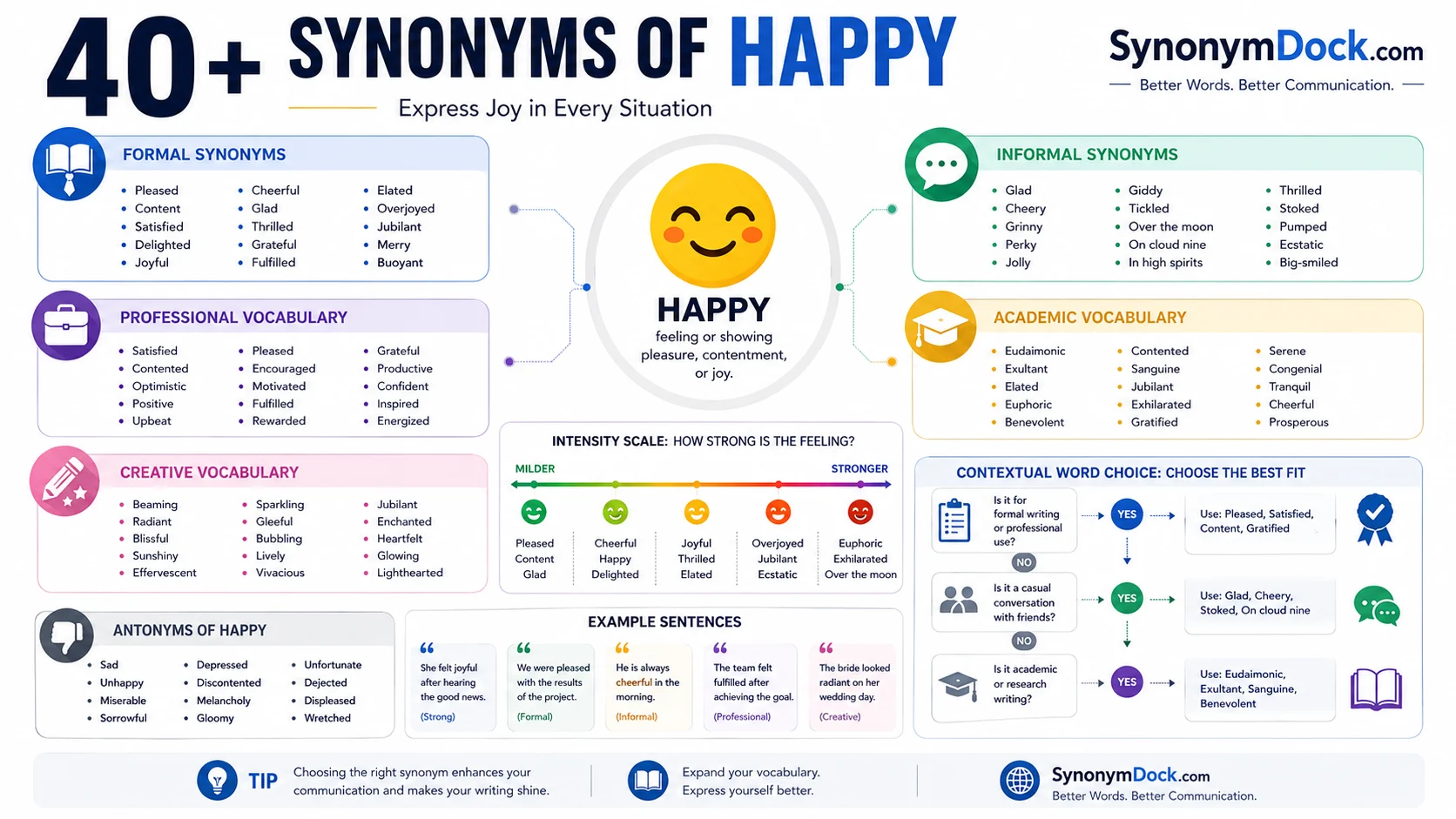
The word “happy” means feeling or showing pleasure, joy, or contentment. The best formal synonym is “delighted,” while for casual conversation, “glad” works well . In professional writing, use “pleased,” and for strong emotional writing, choose “ecstatic” or “elated.” “Content” fits perfectly for a peaceful state of satisfaction.
Imagine you are writing an email, a college essay, or a social media caption. You want to express a positive feeling, but you keep typing “happy” over and over. You know there are other words, but none come to mind quickly. This guide solves that problem. Finding the perfect synonym of happy is about more than avoiding repetition. It is about communicating the exact shade of joy, satisfaction, or contentment you truly mean.
Meaning, Tone, and Context
Simple Definition
“Happy” means feeling or showing pleasure, joy, or satisfaction. It is a general term for a positive emotional state.
Part of Speech
Adjective
Overall Tone
Positive
Formality Level
Neutral. “Happy” works in both formal and informal situations, which makes it versatile but sometimes too vague.
Common Uses
Native English speakers use “happy” in almost every context: describing personal feelings, greeting people, expressing satisfaction with work, and celebrating good news. It is a default adjective for anything positive.
Word Forms
- Adjective: happy
- Noun: happiness
- Adverb: happily
- Antonym: sad, unhappy
When and How to Use “Happy”
Choose “happy” when the emotion is general and no other word seems to fit perfectly. It is a safe, reliable choice. However, for more precise communication, consider using a specific synonym.
Here are 7 realistic examples:
- Professional: “I am happy to confirm our meeting for next Tuesday.”
- Academic: “Researchers were happy with the initial results of the study.”
- Workplace: “The team is happy with the progress we have made this quarter.”
- Personal: “I am so happy to see you!”
- Email: “I would be happy to help with that project.”
- Resume: “I was happy to take on additional responsibilities.” (Consider using “eager” or “pleased” instead.)
- Social Media: “Feeling happy on this beautiful day!”
Best Synonyms of “Happy”
No single synonym is identical to “happy” in every situation. The best choice depends on the context, your audience, and the intensity of the emotion.
Here are the best synonyms for specific contexts:
- Professional writing: Pleased – This conveys a formal, measured satisfaction. “The board was pleased with the results.”
- Academic writing: Content – This suggests a state of quiet, intellectual satisfaction. “The participants felt content with their performance.”
- Business communication: Delighted – This expresses strong, positive satisfaction. “We are delighted to announce a new partnership.”
- Casual conversation: Glad – This is a simple, friendly way to express happiness. “I’m so glad you could come.”
- Emotional writing: Ecstatic – This describes overwhelming joy. “He was ecstatic when he won the award.”
- Creative writing: Jubilant – This conveys triumphant, exultant happiness. “The crowd was jubilant after the victory.”
- Resume writing: Eager – This shows enthusiasm and a proactive attitude. “Eager to contribute to a dynamic team.”
- Workplace communication: Gratified – This shows satisfaction with a specific outcome. “I am gratified by the positive feedback.”
- Stronger meaning: Thrilled – This implies a powerful, exciting happiness. “She was thrilled with the surprise.”
- Softer meaning: Contented – This implies a calm, peaceful happiness. “The cat was contented in the sun.”
When Not to Use “Happy”
Sometimes, using “happy” is not the best choice. It can be too general, too vague, too formal, or too informal. Here are situations where a stronger word is better.
Situation: The Feeling is Too General
- Explanation: “Happy” is a catch-all term. It does not tell the reader if you are excited, satisfied, or overjoyed.
- Better Recommendation: Use a specific word like “delighted,” “thrilled,” or “ecstatic.”
- Rewrite: “I am happy you liked it.” -> “I am delighted you liked it.”
Situation: The Tone is Too Weak
- Explanation: “Happy” can sound flat, especially when you are describing major positive news or achievements.
- Better Recommendation: Use a stronger word like “jubilant” or “overjoyed.”
- Rewrite: “He was happy about the promotion.” -> “He was jubilant about the promotion.”
Situation: The Context is Professional and Formal
- Explanation: In business writing, “happy” can sound too casual or childish.
- Better Recommendation: Use “pleased,” “gratified,” or “delighted.”
- Rewrite: “We are happy with the proposal.” -> “We are pleased with the proposal.”
Situation: The Context is Casual and Friendly
- Explanation: In a casual text or chat, a formal synonym like “delighted” can sound stiff.
- Better Recommendation: Use a simple word like “glad” or “stoked.”
- Rewrite: “I am delighted to see you.” -> “I am so glad to see you!”
Words Commonly Confused With “Happy”
Happy vs. Glad
- Difference: “Happy” is a more general, long-lasting state. “Glad” is a temporary reaction to a specific event.
- When to Use It: Use “happy” for an overall feeling. Use “glad” for a quick, specific moment.
- Example: “I am happy in my new job.” “I am glad you called.”
Happy vs. Pleased
- Difference: “Happy” is a broad feeling of joy. “Pleased” is a formal, measured satisfaction with something.
- When to Use It: Use “happy” in personal conversations. Use “pleased” in professional communications.
- Example: “I am happy you are here.” “I am pleased with the team’s performance.”
Happy vs. Cheerful
- Difference: “Happy” is an internal feeling. “Cheerful” is an outward expression of happiness.
- When to Use It: Use “happy” to describe how someone feels. Use “cheerful” to describe how someone appears to others.
- Example: “She felt happy inside.” “She had a cheerful smile.”
Happy vs. Joyful
- Difference: “Happy” is a common, everyday word. “Joyful” is a more literary, profound word that suggests a deep, lasting joy.
- When to Use It: Use “happy” in everyday writing. Use “joyful” in creative writing or emotional storytelling.
- Example: “The children were happy with their new toy.” “The celebration was a joyful occasion.”
Happy vs. Content
- Difference: “Happy” is about feelings of joy or pleasure. “Content” is about a state of peace and satisfaction without wanting more.
- When to Use It: Use “happy” when there is excitement. Use “content” when there is calm satisfaction.
- Example: “I am happy with this delicious meal.” “I am content with my life as it is.”
Best Synonyms of “Happy” by Context
| Context | Best Synonym | Why It Works | Example |
|---|---|---|---|
| Formal writing | Pleased | It sounds professional and measured. | “We are pleased to confirm your admission.” |
| Academic writing | Content | It implies a state of quiet satisfaction. | “Participants reported feeling content with the results.” |
| Professional communication | Delighted | It expresses strong positive satisfaction. | “I am delighted to join your team.” |
| Business emails | Gratified | It shows satisfaction with a specific outcome. | “I am gratified by your quick response.” |
| Resume writing | Eager | It demonstrates a proactive and enthusiastic attitude. | “Eager to apply my skills in a new role.” |
| Workplace communication | Thrilled | It conveys a powerful, exciting happiness. | “The team is thrilled with the new contract.” |
| Casual conversation | Glad | It is simple, friendly, and natural. | “I’m glad you could make it.” |
| Everyday speaking | Happy | It is the default and works perfectly. | “I’m happy for you.” |
| Creative writing | Jubilant | It conveys a triumphant, exultant feeling. | “The crowd let out a jubilant roar.” |
| Storytelling | Joyous | It feels profound and significant. | “It was a joyous reunion.” |
| Emotional writing | Ecstatic | It describes overwhelming, intense joy. | “She was ecstatic when she found out.” |
| Strong emphasis | Overjoyed | It means extremely happy. | “He was overjoyed by the surprise.” |
| Mild tone | Contented | It implies a calm, peaceful happiness. | “The cat was contented in the sun.” |
| Social media captions | Blessed | It expresses gratitude and good fortune. | “Feeling so blessed today.” |
| American English | Stoked | It is modern slang for very excited. | “I am stoked about the concert.” |
How to Choose the Best Synonym of “Happy”
Choosing the best synonym requires considering your audience and your purpose.
- Consider Your Audience: For a business email, use pleased or delighted. For a text to a friend, use glad.
- Consider Your Purpose: If you want to announce good news, thrilled or ecstatic adds excitement. If you want to express a quiet satisfaction, content or contented is better.
- Consider the Emotional Strength: The intensity matters. Is the feeling mild, moderate, or overwhelming? Choose a word that matches the intensity.
Real Life Examples of “Happy”
School
“Sarah was delighted with her A+ on the history test.”
College
“The graduating student felt a sense of jubilant pride as she accepted her diploma.”
Workplace
“The manager was pleased with the team’s innovative proposal.”
Business
“We are thrilled to announce the launch of our new product.”
“I would be happy to provide more details.” (Using the original word is fine for a neutral offer.)
Resume
“Eager to leverage my skills in a challenging new position.”
Conversation
“I am so glad you could come to the party.”
Storytelling
“The family shared a joyous meal together after years apart.”
Blogging
“Here are five tips for a happier and more productive life.”
Social Media
“Feeling blessed and grateful for this beautiful day.”
18 Best Synonyms of “Happy”
| Synonym | Simple Meaning | Best Used For | Example Sentence |
|---|---|---|---|
| Pleased | A feeling of satisfaction or approval. | Formal writing, business communication. | “I am pleased to meet you.” |
| Delighted | A strong feeling of great pleasure or joy. | Professional communication, expressing enthusiasm. | “We are delighted to welcome you.” |
| Glad | A specific feeling of pleasure about something. | Casual conversations, everyday language. | “I am so glad you called.” |
| Content | A state of peaceful happiness and satisfaction. | Academic writing, describing quiet satisfaction. | “She felt content with her life.” |
| Cheerful | Showing happiness through being positive and lively. | Describing personality, everyday situations. | “He has a cheerful disposition.” |
| Jolly | Full of fun, happy, and good-natured. | Casual, friendly descriptions. | “He is a jolly old man.” |
| Merry | Cheerful and lively, often associated with festivities. | Holiday greetings, playful writing. | “Merry Christmas!” |
| Ecstatic | Feeling or expressing overwhelming happiness. | Emotional writing, creative expression. | “He was ecstatic about the news.” |
| Jubilant | Feeling or expressing great joy, especially after a success. | Storytelling, describing victories or celebrations. | “The fans were jubilant.” |
| Joyous | Feeling, expressing, or causing great joy. | Describing significant events, formal celebrations. | “It was a joyous occasion.” |
| Elated | Very happy and excited, often because of success. | Describing personal achievements. | “She was elated by her success.” |
| Overjoyed | Extremely happy. | Strong emotional writing. | “They were overjoyed to see her.” |
| Blissful | Extremely happy; full of joy. | Creative writing, describing perfect moments. | “They spent a blissful afternoon.” |
| Thrilled | Extremely pleased or excited. | Business communication, expressing strong positive emotion. | “I am thrilled to accept the position.” |
Synonyms of “Happy” by Usage
Professional vs Personal Synonyms
- Professional: Pleased, delighted, gratified. These sound formal and appropriate for work.
- Personal: Glad, happy, cheerful. These are better for friends and family.
Formal vs Conversational Synonyms
- Formal: Satisfied, pleased, content.
- Conversational: Glad, happy, jolly.
Academic Synonyms
- Precise Vocabulary: Content, satisfied, pleased.
- Why: These words are neutral and precise, avoiding the more emotional connotations of words like “ecstatic.”
Professional and Business Synonyms
- Strongest Choices: Delighted, thrilled, gratified, pleased.
- Why: They show a positive attitude without sounding overly dramatic. “Delighted” implies enthusiasm, while “gratified” shows appreciation for a specific outcome.
Creative and Literary Synonyms
- Expressive Alternatives: Ecstatic, jubilant, joyous, blissful, carefree.
- Why: These words add emotion and imagery, making writing more engaging and vivid.
Slang or Modern Synonyms
- Stoked: Very excited or happy. Appropriate for casual conversations and social media. Not for formal writing.
- Happy Camper: A phrase meaning a contented person. “He’s not a happy camper today.”
Strongest to Mildest Synonyms
This scale shows how the emotional intensity changes from mild to very strong.
Mild → Moderate → Strong → Very Strong
- Contented: A peaceful, calm happiness. (Mild)
- Glad: A specific, momentary pleasure. (Mild)
- Happy: The general term. (Moderate)
- Pleased: A formal sense of satisfaction. (Moderate)
- Cheerful: An outward, pleasant attitude. (Moderate)
- Delighted: A strong, enthusiastic pleasure. (Strong)
- Thrilled: A powerful, exciting joy. (Strong)
- Elated: Great happiness and excitement. (Strong)
- Overjoyed: An extremely intense happiness. (Very Strong)
- Jubilant: Triumphant, exultant joy. (Very Strong)
- Ecstatic: Overwhelming, rapturous delight. (Very Strong)
Emotional vs Neutral Synonyms
Emotional Synonyms
These words express stronger feelings and often create a more personal, vivid tone.
- Words: Ecstatic, jubilant, overjoyed, elated, thrilled.
- Use when: You want to express intense emotion, enthusiasm, or excitement.
Neutral Synonyms
These words simply communicate information without adding excessive emotion.
- Words: Content, pleased, satisfied, glad.
- Use when: You want to be formal, objective, or when the situation is not highly emotional.
Antonyms of “Happy”
| Antonym | Meaning | Example Sentence |
|---|---|---|
| Sad | Feeling or showing sorrow. | She was sad to say goodbye.” |
| Unhappy | Not happy; sad. | “He was unhappy with the result.” |
| Miserable | Very unhappy; wretched. | “The news left him feeling miserable.” |
| Depressed | Severely sad and hopeless. | “He has been depressed for weeks.” |
| Despondent | In low spirits from loss of hope. | “She became despondent after the failure.” |
| Displeased | Feeling annoyance or dissatisfaction. | “The teacher was displeased with the behavior.” |
| Dissatisfied | Not content or happy with something. | “The customer was dissatisfied with the service.” |
| Melancholy | A feeling of pensive sadness, often with no obvious cause. | “He was in a melancholy mood.” |
| Sorrowful | Feeling or showing grief. | “There was a sorrowful look on her face.” |
| Gloomy | Dark or poorly lit; also means feeling sad. | “A gloomy day.” |
| Dejected | Sad and depressed; dispirited. | “She looked dejected after the loss.” |
| Forlorn | Pitifully sad and abandoned or lonely. | “A forlorn figure sat alone.” |
| Somber | Dark or dull in color or tone; also means serious and sad. | “A somber mood filled the room.” |
| Joyless | Not giving or feeling any pleasure. | “It was a joyless existence.” |
| Cheerless | Gloomy; depressing. | “The room was cold and cheerless.” |
Comparison: “Happy” vs Similar Words
Happy vs. Content
- Main Difference: “Happy” is a general feeling of joy and pleasure. “Content” is a peaceful, quiet state of satisfaction without wanting more.
- Which Is Stronger? “Happy” can be stronger, describing active joy.
- Which Is More Formal? Both are neutral, but “content” is often used in more formal or reflective writing.
- When to Use Each: Use “happy” for active, positive events. Use “content” for a settled, peaceful state.
- Examples:
- Happy: “I am happy to see you.”
- Content: “I am content with my life.”
Happy vs. Glad
- Main Difference: “Happy” is a long-lasting state or a general feeling. “Glad” is a quick, specific reaction to a single event.
- Which Is Stronger? “Happy” is generally stronger and more profound.
- Which Is More Formal? Both are neutral, but “glad” is common in casual conversation.
- When to Use Each: Use “glad” when something just happened. Use “happy” for an overall feeling.
- Examples:
- Happy: “He is a happy child.”
- Glad: “I am glad it stopped raining.”
Happy vs. Cheerful
- Main Difference: “Happy” is an internal emotional state. “Cheerful” is an external display of happiness.
- Which Is Stronger? Neither is stronger. They describe different aspects of happiness.
- Which Is More Formal? Both are neutral.
- When to Use Each: Use “cheerful” to describe someone’s appearance, personality, or actions.
- Examples:
- Happy: “I am happy with my new job.”
- Cheerful: “He always has a cheerful greeting for everyone.”
Happy vs. Joyful
- Main Difference: “Happy” is common and everyday. “Joyful” is more profound and literary, suggesting a deep, lasting joy.
- Which Is Stronger? “Joyful” feels more profound and significant.
- Which Is More Formal? “Joyful” is more formal and expressive.
- When to Use Each: Use “joyful” in creative writing or to describe important, meaningful events.
- Examples:
- Happy: “The children were happy with their toys.”
- Joyful: “The birth of a child is a joyful occasion.”
Happy vs. Elated
- Main Difference: “Happy” is a general feeling. “Elated” is a feeling of great happiness and excitement, often from success.
- Which Is Stronger? “Elated” is much stronger.
- Which Is More Formal? “Elated” is more dramatic and less common in everyday speech.
- When to Use Each: Use “elated” when you have just won or achieved something big.
- Examples:
- Happy: “I am happy with my score.”
- Elated: “I am elated to have won the award.”
Common Phrases and Expressions with “Happy”
Phrase: Happy Birthday
- Meaning: A greeting used on someone’s birthday.
- Example: “Happy Birthday, Sarah! I hope you have a wonderful day.”
Phrase: Happy New Year
- Meaning: A greeting used at the beginning of the new year.
- Example: “We wish all our friends a very Happy New Year.”
Phrase: Happy to help
- Meaning: A phrase expressing willingness to assist someone.
- Example: “If you have any questions, I would be happy to help.”
Happy medium
- Meaning: A reasonable compromise or middle ground.
- Example: “We need to find a happy medium between cost and quality.”
Happy ending
- Meaning: A positive or pleasing conclusion to a story or event.
- Example: “Everyone loves a good movie with a happy ending.”
Common Mistakes to Avoid
1: Using “Happy” When a Stronger Word is Needed
- Incorrect: “I was happy to get the promotion.”
- Better: “I was elated to get the promotion.”
- Why: “Elated” shows the true strength of your emotion.
2: Choosing a Vague Synonym Instead of a Precise One
- Incorrect: “He is very content.” (If you mean excited, this is wrong.)
- Better: “He is very cheerful.”
- Why: “Content” is about peace, not excitement.
3: Using an Informal Synonym in Formal Writing
- Incorrect: “I am stoked to apply for this position.”
- Better: “I am pleased to apply for this position.”
- Why: “Stoked” is slang. “Pleased” is professional.
4: Selecting an Overly Dramatic Synonym
- Incorrect: “I am ecstatic to see you!” (For a casual meeting.)
- Better: “I am glad to see you!”
- Why: “Ecstatic” is too strong for a simple greeting.
5: Repeating the Same Word Too Often
- Incorrect: “I am happy. She is happy. We are all happy.”
- Better: “I am delighted. She is content. We are all joyful.”
- Why: Using varied vocabulary creates better writing.
Frequently Asked Questions
What are the best synonyms of “happy”?
The best synonyms depend on the context. For professional use, choose “pleased” or “delighted.” For casual use, “glad” is perfect. For strong emotions, use “ecstatic” or “elated.”
What are the best formal synonyms of “happy”?
The best formal synonyms are “pleased,” “delighted,” “gratified,” and “content.” These words sound professional and precise in a business or academic context.
What are common informal synonyms of “happy”?
Common informal synonyms are “glad,” “jolly,” “merry,” and “cheerful.” In modern slang, you might also hear “stoked.
What is another word for “happy” in professional writing?
In professional writing, “pleased,” “gratified,” and “delighted” are excellent choices. “Eager” is also good for showing enthusiasm in a resume.
What is the difference between “happy” and “content”?
“Happy” is a general feeling of joy and pleasure. “Content” is a state of peaceful satisfaction and not wanting more.
What is the opposite of “happy”?
The most common opposites are “sad” and “unhappy.” Other antonyms include “miserable,” “depressed,” “displeased,” and “dissatisfied.”
Conclusion
The word “happy” is a useful, versatile adjective for describing positive feelings. However, the English language is full of more precise and powerful synonyms that can improve your writing. The best synonym of happy for you depends on your audience, your purpose, and the emotional strength you want to convey.
Whether you choose “pleased” for a formal email, “elated” for great news, or “glad” for a simple greeting, the goal is clear communication. Remember that no synonym works perfectly in every situation. Consider your tone and context carefully. A good vocabulary tip is to learn one new synonym each week and practice using it in conversation. This will expand your vocabulary quickly and naturally.

2 thoughts on “40+ Synonyms of Happy| Meanings and Best Alternatives 2026”