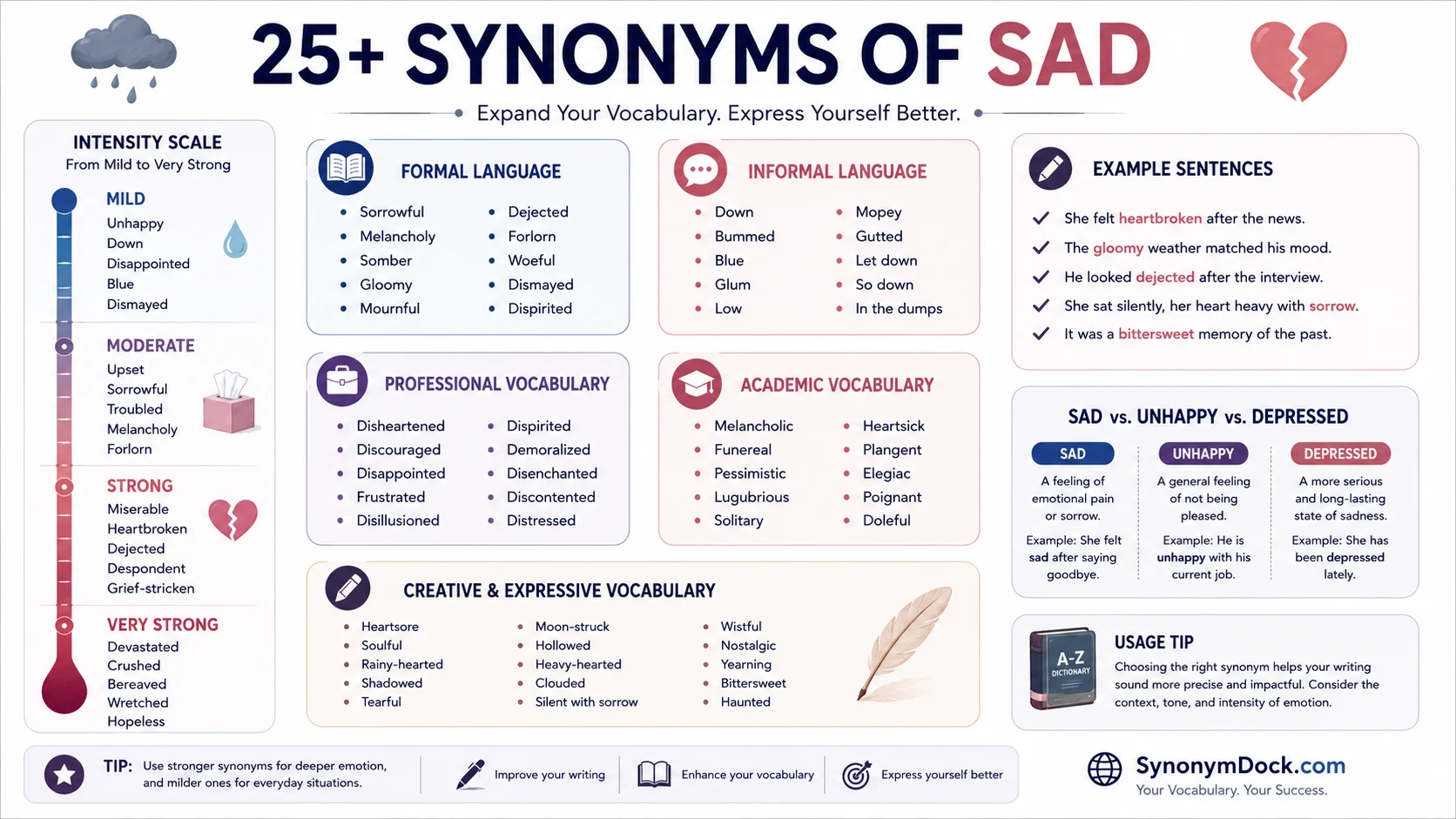
Sad means feeling or showing sorrow, unhappiness, or disappointment. The best synonym depends on your context. For formal writing, use “melancholy” or “somber.” For casual conversation, try “down” or “blue.” For professional settings, use “disheartened” or “discouraged.” For intense emotional writing, choose “heartbroken” or “devastated.”
Have you ever written a story, an email, or a social media post and used the word “sad” three times in one paragraph? It happens more often than you might think. You know exactly what you want to express, but repeating the same word makes your writing feel flat and uninspired. Finding the right synonym of sad can completely transform your message. It helps you capture the exact shade of emotion you intend to convey. Whether you are writing a heartfelt letter, a professional report, or a creative piece, choosing the perfect word makes your communication more powerful and precise.
Meaning, Tone, and Context
Simple Definition
Sad describes a state of unhappiness, sorrow, or emotional pain. It can refer to a temporary feeling or a deeper, longer lasting emotional condition.
Part of Speech
Adjective
Overall Tone
Negative. The word carries a clear emotional weight and indicates distress or disappointment.
Formality Level
Neutral. “Sad” works in almost any situation, from casual conversations to formal writing.
Common Uses
Native English speakers use “sad” constantly. You might say you feel sad about a loss, a disappointment, or a difficult situation. The word also describes things that cause unhappiness, like sad news or a sad movie. It is one of the most common emotion words in the English language.
Word Forms
- Sad (adjective)
- Sadly (adverb)
- Sadness (noun)
- Sadder (comparative)
- Saddest (superlative)
When and How to Use “Sad”
Choose “sad” when you need a clear, direct word that nearly everyone understands. It works in almost any situation. Here are seven realistic examples.
Professional
“We received the sad news about the budget cuts and will need to adjust our plans accordingly.”
Academic
“The study’s findings present a sad reality about the state of mental health services in rural areas.”
Workplace
“It was sad to see such a talented colleague leave the team.”
Personal
“I felt incredibly sad when I heard about your grandmother’s passing.”
“It is with a sad heart that I inform you of the project’s cancellation.”
Resume
“Left a position due to sad circumstances beyond my control.” (Use sparingly)
Social Media
“This movie made me so sad I cried for an hour.”
Best Synonyms of “Sad”
No synonym is perfect for every situation. Here are the best synonyms grouped by context.
Professional writing → Disheartened
Why it works: “Disheartened” conveys loss of hope or confidence in a dignified way that sounds appropriate for workplace discussions.
Academic writing → Melancholy
Why it works: “Melancholy” has a scholarly, literary quality that fits academic discussions of emotion, art, or literature.
Business communication → Discouraged
Why it works: “Discouraged” describes a professional setback without sounding overly emotional or dramatic.
Casual conversation → Down
Why it works: “Down” is short, simple, and natural in everyday speech. It softens the emotional weight while still conveying sadness.
Emotional writing → Heartbroken
Why it works: “Heartbroken” expresses deep emotional pain and works perfectly for personal narratives or dramatic scenes.
Creative writing → Despondent
Why it works: “Despondent” suggests a deep loss of hope, adding literary depth to character descriptions.
Resume writing → Regretful
Why it works: “Regretful” shows reflection without making you sound unprofessional or unstable.
Workplace communication → Dispirited
Why it works: “Dispirited” describes a loss of enthusiasm professionally without being overly personal.
Stronger meaning → Devastated
Why it works: “Devastated” conveys overwhelming emotional destruction, making it ideal for intense situations.
Softer meaning → Unhappy
Why it works: “Unhappy” is milder and more general, appropriate for everyday disappointments.
When Not to Use “Sad”
Sometimes “sad” is not the best choice.
When it sounds too vague
If you need to describe the specific quality of sadness, “sad” can feel too general. Use “melancholy” for a reflective sadness or “despondent” for hopelessness.
Weak: “She felt sad about the painting she destroyed.”
Better: “She felt melancholic about the painting she destroyed.”
When it sounds too informal
In academic or professional writing, “sad” may lack the nuance required. Use “somber” or “disheartened” instead.
Weak: “The sad economic forecast worried investors.”
Better: “The somber economic forecast worried investors.”
When you need more emotional depth
“Sad” does not convey the intensity of profound grief. Use “heartbroken” or “devastated.”
Weak: “She was sad after the divorce.”
Better: “She was heartbroken after the divorce.”
When it is overused
Repeating “sad” in a story or essay makes the writing feel repetitive. Vary your vocabulary.
When the situation calls for a specific type of sadness
Use “homesick” for missing home, “nostalgic” for bittersweet memories, or “mournful” for grief.
Words Commonly Confused With “Sad”
Sad vs. Depressed
- Difference: “Depressed” is a clinical term for a mental health condition, while “sad” is a normal emotional state.
- When to Use It: Use “sad” for everyday unhappiness. Use “depressed” only when referring to a diagnosed condition or severe, persistent feeling.
- Example: “After the breakup, he felt sad for a few weeks, but he was not clinically depressed.”
Sad vs. Melancholy
- Difference: “Melancholy” suggests a reflective, thoughtful sadness rather than sharp pain.
- When to Use It: Use “melancholy” for artistic or literary contexts.
- Example: “The autumn leaves inspired a sense of melancholy in her.”
Sad vs. Sorrowful
- Difference: “Sorrowful” is more formal and suggests deeper, more profound grief.
- When to Use It: Use “sorrowful” in religious, formal, or literary contexts.
- Example: “The mourners sang a sorrowful hymn at the funeral.”
Sad vs. Mournful
- Difference: “Mournful” specifically relates to grief for someone who has died.
- When to Use It: Use “mournful” when describing grief or loss.
- Example: “The mournful music reflected the family’s loss.”
Sad vs. Blue
- Difference: “Blue” is an informal, casual synonym for feeling down.
- When to Use It: Use “blue” in casual conversations, not formal writing.
- Example: “I have been feeling a bit blue lately.”
Sad vs. Downhearted
- Difference: “Downhearted” suggests a loss of hope or courage.
- When to Use It: Use “downhearted” when someone feels defeated or discouraged.
- Example: “The team felt downhearted after losing the championship.”
Best Synonyms of “Sad” by Context
| Context | Best Synonym | Why It Works | Example |
|---|---|---|---|
| Formal writing | Somber | Sounds serious and appropriate for official contexts | “The somber meeting addressed the company’s future.” |
| Academic writing | Melancholy | Has scholarly and literary quality | “The poet’s melancholy verse reflected the era’s despair.” |
| Professional communication | Disheartened | Conveys disappointment professionally | “We are disheartened by the project’s cancellation.” |
| Business emails | Discouraged | Shows professional concern without being dramatic | “I am discouraged by the lack of progress.” |
| Resume writing | Regretful | Shows reflection without sounding unstable | “Regretful that the position was eliminated.” |
| Workplace communication | Dispirited | Describes loss of enthusiasm professionally | “Employees felt dispirited after the announcement.” |
| Casual conversation | Down | Natural and softens the emotional weight | “I feel down today for no particular reason.” |
| Everyday speaking | Blue | Lighthearted and informal | “I have been feeling blue all week.” |
| Creative writing | Despondent | Adds literary depth and drama | “She stared out the window with despondent eyes.” |
| Storytelling | Forlorn | Suggests loneliness and abandonment | “The forlorn child waited alone on the steps.” |
| Emotional writing | Heartbroken | Expresses deep emotional pain | “She was heartbroken when he moved away.” |
| Strong emphasis | Devastated | Conveys overwhelming loss | “He was devastated by the news.” |
| Mild tone | Unhappy | General and unemotional | “I am unhappy with the situation.” |
| Social media captions | Feeling down | Relatable and conversational | “Feeling down today. Send good vibes.” |
| American English | Down | Most common casual choice | “I am down about the game last night.” |
How to Choose the Best Synonym of “Sad”
Choosing the right synonym does not need to be complicated. Follow this simple decision guide.
- How intense is the feeling?
For mild sadness, use “unhappy” or “down.” For deep grief, use “heartbroken” or “devastated.” - Who is your audience?
For a boss or client, use “disheartened” or “discouraged.” For a friend, use “blue” or “down.” - What is your purpose?
To show literary depth? Use “melancholy.” To show personal grief? Use “sorrowful.” - Is the situation temporary or lasting?
For temporary feelings, use “down.” For lasting states, use “despondent” or “melancholy.” - What tone do you want?
Formal or professional? Use “somber” or “disheartened.” Casual or personal? Use “blue” or “down.” - Does it sound natural?
Read your sentence aloud. If the synonym feels forced, choose a different one.
Real Life Examples of “Sad”
School
“The students were sad when their favorite teacher announced her retirement.”
College
“Many graduates felt melancholic as they walked across campus one final time.”
Workplace
“The team felt disheartened after learning the project was cancelled.”
Business
“We are discouraged by the quarterly results but remain optimistic about the future.”
“It is with a heavy heart that I share this sad news with you.”
Resume
“Regretful to leave a rewarding position due to company restructuring.”
Conversation
“I feel so down today. Nothing seems to be going right.”
Storytelling
“The forlorn house stood empty on the hill, its windows like sad eyes staring at nothing.”
Blogging
“Grief is not just a sad feeling. It is a complex emotional journey.”
Social Media
“This book made me feel things I cannot describe. So sad but so beautiful.”
25 Best Synonyms of “Sad”
| Synonym | Simple Meaning | Best Used For | Example Sentence |
|---|---|---|---|
| Unhappy | Not happy, generally sad | Everyday situations | “She felt unhappy with her current job.” |
| Melancholy | Reflective, thoughtful sadness | Literary and academic contexts | “He gazed out the window with a melancholy expression.” |
| Somber | Dark, serious, gloomy | Formal and professional settings | “The somber meeting addressed the crisis.” |
| Disheartened | Lost confidence or hope | Professional disappointments | “The team was disheartened by the layoffs.” |
| Gloomy | Dark, depressing, or pessimistic | Describing atmospheres or moods | “The rainy weather made everyone feel gloomy.” |
| Blue | Mildly sad or depressed | Casual conversation | “I have been feeling blue since the holidays.” |
| Down | Feeling low or depressed | Everyday speech | “I have been down all week.” |
| Mournful | Feeling or expressing grief | Related to death or loss | “The mournful music reflected the family’s loss.” |
| Woeful | Full of sorrow or misery | Dramatic or literary contexts | “He told a woeful tale of misfortune.” |
| Downcast | Feeling sad, looking downward | Describing appearance or mood | “Her downcast eyes revealed her sadness.” |
Synonyms of “Sad” by Usage
Professional vs Personal Synonyms
Professional: Disheartened, Discouraged, Dispirited, Somber
Personal: Down, Blue, Unhappy, Heartbroken
Formal vs Conversational Synonyms
Formal (Reports, Essays): Melancholy, Somber, Sorrowful, Doleful
Conversational (Texting, Speech): Down, Blue, Unhappy, Feeling low
Academic Synonyms
Use these in research and scholarly writing: Melancholy, Sorrowful, Somber, Disconsolate. They sound more authoritative because they carry literary and psychological weight.
Professional and Business Synonyms
Use these in resumes, meetings, and emails: Disheartened, Discouraged, Dispirited, Regretful. They show emotional awareness without sounding unprofessional.
Creative and Literary Synonyms
Use these in fiction and descriptive writing: Forlorn, Melancholy, Despondent, Mournful, Plaintive, Woeful. They add emotional depth and imagery.
Slang or Modern Synonyms
- Down: Used everywhere in casual speech. Acceptable in conversation but too informal for formal writing.
- Blue: Common in casual conversation. Works in semi-formal contexts but not academic writing.
- Bummed: Very informal. Use only with friends or in very casual writing.
- Bummed out: Similar to “bummed.” Avoid in professional settings.
Strongest to Mildest Synonyms
| Intensity | Synonym |
|---|---|
| Mild | Unhappy, Blue, Down |
| Moderate | Sad, Discouraged, Disheartened |
| Strong | Sorrowful, Despondent, Heartbroken |
| Very Strong | Devastated, Bereaved |
Emotional vs Neutral Synonyms
Emotional: Heartbroken, Devastated, Sorrowful, Mournful, Forlorn (these convey intense personal grief)
Neutral: Unhappy, Discouraged, Disheartened (these describe emotional states with less intensity)
Antonyms of “Sad”
| Antonym | Meaning | Example Sentence |
|---|---|---|
| Happy | Feeling joy or contentment | “She felt happy when she received the good news.” |
| Joyful | Full of great happiness | “The joyful crowd celebrated the victory.” |
| Cheerful | Noticeably happy and optimistic | “Despite the bad weather, she remained cheerful.” |
| Elated | Very happy and excited | “He was elated to receive the promotion.” |
| Delighted | Greatly pleased or happy | “I am delighted to accept your invitation.” |
| Content | Satisfied and peaceful | “She felt content with her simple life.” |
| Glad | Feeling pleasure or happiness | “I am glad you could join us today.” |
| Pleased | Happy or satisfied | “The teacher was pleased with the students’ work.” |
| Jubilant | Feeling great joy and triumph | “The jubilant fans celebrated the championship.” |
| Ecstatic | Overwhelmingly happy | “She was ecstatic about winning the award.” |
| Upbeat | Cheerful and optimistic | “His upbeat attitude brightened the room.” |
| Buoyant | Cheerful and optimistic | “She remained buoyant despite the setbacks.” |
| Jovial | Cheerful and friendly | “The jovial host made everyone feel welcome.” |
| Merry | Cheerful and lively | “The merry children played in the snow.” |
| Radiant | Beaming with joy or happiness | “The bride looked radiant on her wedding day.” |
Comparison: “Sad” vs Similar Words
Sad vs Depressed
- Main Difference: “Sad” is a normal emotional state. “Depressed” is a clinical condition or severe, persistent sadness.
- Which Is Stronger? Depressed
- Which Is More Formal? Depressed (when used clinically)
- When to Use Each: Use “sad” for everyday unhappiness. Use “depressed” only when referring to a diagnosed condition or extreme, prolonged sadness.
- Examples:
- Sad: “I feel sad about the cancelled trip.”
- Depressed: “She has been clinically depressed and is seeking treatment.”
Sad vs Melancholy
- Main Difference: “Melancholy” suggests a reflective, thoughtful sadness rather than sharp pain.
- Which Is Stronger? Melancholy is deeper and more lasting
- Which Is More Formal? Melancholy
- When to Use Each: Use “sad” for simple unhappiness. Use “melancholy” for literary or philosophical contexts.
- Examples:
- Sad: “He was sad about the lost opportunity.”
- Melancholy: “The novel captured a sense of melancholy that lingered.”
Sad vs Sorrowful
- Main Difference: “Sorrowful” implies deeper, more profound grief.
- Which Is Stronger? Sorrowful
- Which Is More Formal? Sorrowful
- When to Use Each: Use “sad” for general unhappiness. Use “sorrowful” for serious or formal contexts.
- Examples:
- Sad: “She felt sad when her friend moved away.”
- Sorrowful: “The sorrowful widow spoke of her late husband.”
Sad vs Heartbroken
- Main Difference: “Heartbroken” describes overwhelming emotional pain.
- Which Is Stronger? Heartbroken
- Which Is More Formal? Neither; heartbroken is emotional
- When to Use Each: Use “sad” for moderate feelings. Use “heartbroken” for intense grief.
- Examples:
- Sad: “He felt sad about the argument.”
- Heartbroken: “She was heartbroken when her marriage ended.”
Sad vs Down
- Main Difference: “Down” is informal and mild.
- Which Is Stronger? Sad is stronger
- Which Is More Formal? Sad
- When to Use Each: Use “down” for casual conversation. Use “sad” for more formal contexts.
- Examples:
- Sad: “I was sad to hear about the layoffs.”
- Down: “I have been down all day.”
Sad vs Devastated
- Main Difference: “Devastated” implies complete emotional destruction.
- Which Is Stronger? Devastated
- Which Is More Formal? Devastated is dramatic but not informal
- When to Use Each: Use “sad” for ordinary unhappiness. Use “devastated” for catastrophic loss.
- Examples:
- Sad: “She was sad to miss the concert.”
- Devastated: “He was devastated by the house fire.”
Common Phrases and Expressions with “Sad”
Sad to say
- Meaning: Used to express regret about an unpleasant fact.
- Example: “Sad to say, we have to cancel the event.”
Sad state of affairs
- Meaning: An unfortunate or regrettable situation.
- Example: “It is a sad state of affairs when people cannot afford basic healthcare.”
It’s a sad day when
- Meaning: Expressing disappointment about something that happens.
- Example: “It is a sad day when we cannot trust the news.”
Sad sack
- Meaning: An inept or pathetic person (slang).
- Example: “Stop being such a sad sack and try again.”
Sad ending
- Meaning: An unhappy or disappointing conclusion.
- Example: “The movie had a sad ending that left everyone crying.”
Sad story
- Meaning: A story that evokes sympathy or pity.
- Example: “He told me a sad story about growing up in poverty.”
Common Mistakes to Avoid
Mistake 1: Using “Sad” When You Mean “Depressed”
Incorrect: “I have been sad every day for months and cannot get out of bed.”
Better: “I have been depressed every day for months and cannot get out of bed.”
Why: “Depressed” accurately describes a clinical or severe condition, while “sad” describes a normal emotional state.
Mistake 2: Using “Heartbroken” for Minor Disappointments
Incorrect: “I was heartbroken when the store ran out of my favorite ice cream.”
Better: “I was disappointed when the store ran out of my favorite ice cream.”
Why: “Heartbroken” describes profound emotional pain, not minor inconveniences.
Mistake 3: Using Informal Synonyms in Formal Writing
Incorrect: “The board felt blue about the quarterly losses.”
Better: “The board felt discouraged about the quarterly losses.”
Why: “Blue” is too casual for professional communication.
Mistake 4: Confusing “Sad” with “Sorrowful”
Incorrect: “I felt sorrowful about the rain ruining my picnic.”
Better: “I felt sad about the rain ruining my picnic.”
Why: “Sorrowful” implies deeper grief and is too dramatic for a ruined picnic.
Mistake 5: Repeating “Sad” Too Often
Incorrect: “She was sad. Her friend was sad too. Everyone seemed sad.”
Better: “She was sad. Her friend felt melancholic too. Everyone seemed downhearted.”
Why: Variation keeps your writing engaging.
Mistake 6: Choosing a Synonym with the Wrong Emotional Intensity
Incorrect: “He was devastated that he missed the bus.”
Better: “He was frustrated that he missed the bus.”
Why: “Devastated” is far too intense for missing a bus.
Mistake 7: Using Slang in Academic or Professional Writing
Incorrect: “The research findings made the team feel down.”
Better: “The research findings disheartened the team.”
Why: “Down” is too informal for academic or professional contexts.
Frequently Asked Questions
What are the best synonyms of “sad”?
The best synonyms depend on your context. For formal writing, use “somber” or “melancholy.” For casual conversation, use “down” or “blue.” For intense emotions, use “heartbroken” or “devastated.”
What are the best formal synonyms of “sad”?
The best formal synonyms include “melancholy,” “somber,” “sorrowful,” and “disheartened.” These words are appropriate for academic papers, professional reports, and formal speeches.
What are common informal synonyms of “sad”?
Common informal synonyms include “down,” “blue,” “bummed,” and “low.” These are perfect for conversations, text messages, and social media posts.
What is another word for “sad” in professional writing?
In professional writing, use “disheartened,” “discouraged,” “dispirited,” or “somber.” These words demonstrate emotional intelligence without being overly personal.
What is the difference between “sad” and “depressed”?
“Sad” describes a normal, temporary emotional state. “Depressed” refers to a clinical condition or severe, persistent sadness. Use “sad” for everyday unhappiness and “depressed” only for serious conditions.
What is the opposite of “sad”?
The most direct opposite is “happy.” Other antonyms include “joyful,” “cheerful,” “delighted,” “elated,” “content,” and “glad.”
Conclusion
The word “sad” is one of the most common words in the English language for describing unhappiness. It is simple, direct, and effective. But English offers many alternatives that allow you to express the exact shade of sorrow you want to convey. By choosing the right synonym of sad, you can add precision and emotional depth to your writing.
No single synonym works perfectly in every situation. The best word depends on your audience, your tone, and the intensity of the emotion you want to express. For formal writing, choose “somber” or “melancholy.” For casual conversation, choose “down” or “blue.” For profound grief, choose “heartbroken” or “devastated.”
A practical tip: before you write, consider what specific quality of sadness you are describing. Is it reflective? Grieving? Hopeless? Temporary? The answer will guide your word choice. With practice, selecting the perfect synonym becomes second nature.

3 thoughts on “25+ Synonyms of Sad| Meanings, Uses, Examples, and Best Alternatives”