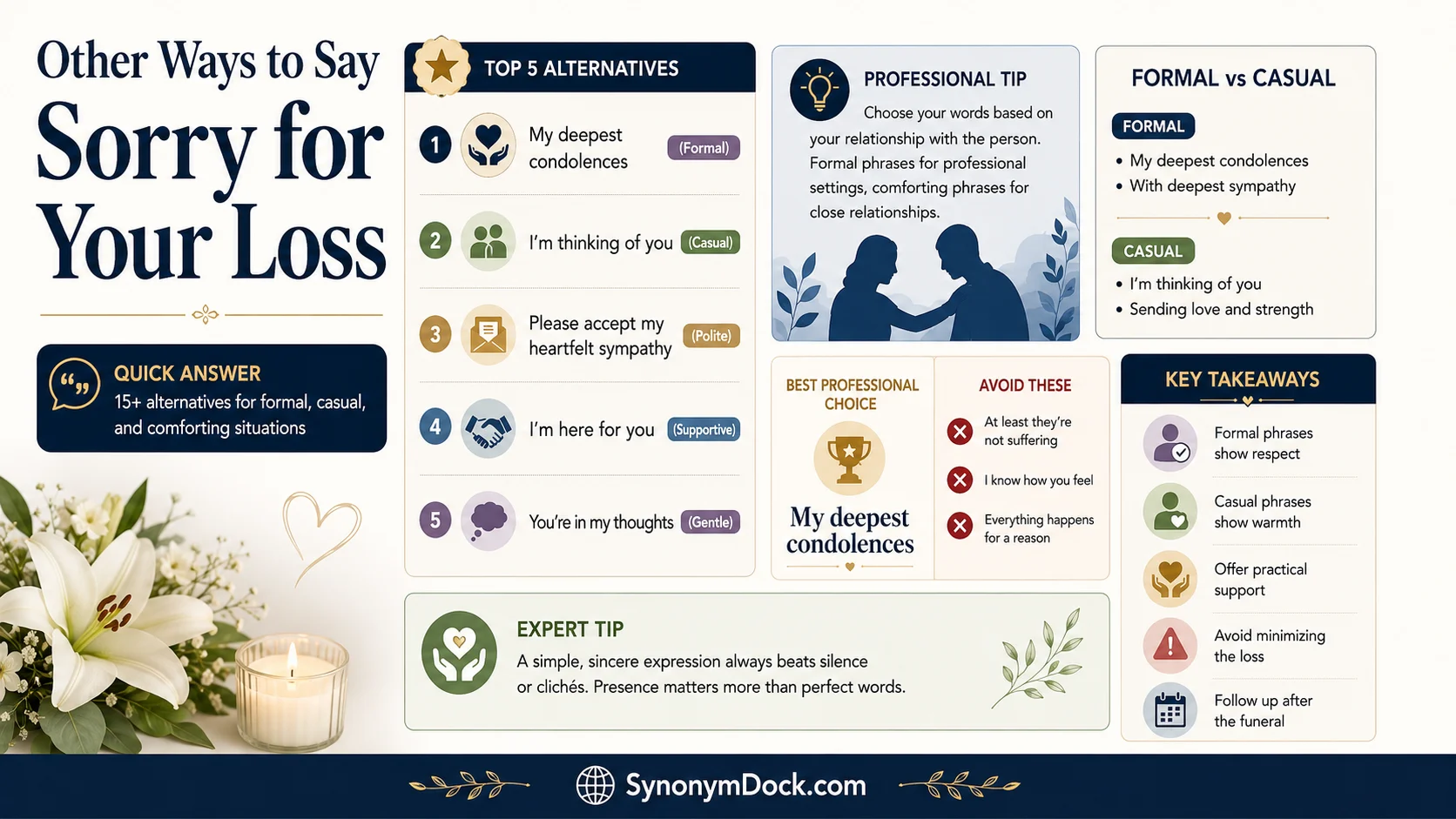
Looking for other ways to say sorry for your loss? Try “My deepest condolences” for formal settings, “I’m thinking of you” for casual comfort, “Please accept my heartfelt sympathy” for written messages, “I’m here for you” for personal support, or “You’re in my thoughts” for gentle acknowledgment. The best alternatives include: My deepest condolences, I’m thinking of you, Please accept my heartfelt sympathy, I’m here for you, You’re in my thoughts, My heart goes out to you, Sending you love and strength, and I’m so sorry to hear this news.
Losing someone we love is one of life’s most difficult experiences. Finding the right words to comfort someone grieving can feel overwhelming and awkward.
“Saying sorry for your loss” is the most common way to express sympathy. But sometimes, these words feel overused, impersonal, or simply not enough. Having other ways to say sorry for your loss helps you express genuine compassion, respect, and support. The right phrase can bring comfort when words matter most. This article explores 15+ powerful alternatives organized by tone and situation, so you can offer meaningful support with confidence.
Quick Categories
Formal Alternatives
- My deepest condolences
- Please accept my heartfelt sympathy
- I offer my sincere condolences
- Please know you’re in my thoughts
- With deepest sympathy
Pro Tip: Use formal alternatives for sympathy cards, formal letters, professional settings, and when you don’t know the person well. They show respect and dignity.
Professional Alternatives
- I was deeply saddened to hear
- Please accept my condolences
- Thinking of you during this difficult time
- My thoughts are with you and your family
- I’m so sorry for your loss
Pro Tip: Professional alternatives work well in workplace communication, emails to colleagues, and business relationships. They maintain professionalism while showing genuine care.
Comforting Alternatives
- My heart goes out to you
- I’m keeping you in my thoughts
- Sending you love and strength
- I’m here for you
- You’re in my prayers
Pro Tip: Comforting phrases are perfect for close relationships and personal messages. They offer emotional support and warmth.
Written Message Alternatives
- With heartfelt sympathy
- In loving memory
- Forever in our hearts
- Thinking of you and your family
- May you find comfort in cherished memories
Pro Tip: Written alternatives are ideal for sympathy cards, emails, and social media messages. They allow for more thoughtful expression.
Spiritual Alternatives
- May you find peace and comfort
- You’re in my prayers
- May God give you strength
- Rest in peace
- May their memory be a blessing
Pro Tip: Spiritual phrases offer comfort to those who share religious beliefs. Use them when you know the person’s faith background.
Close Relationship Alternatives
- I’m here for you, always
- You’re not alone
- I love you and I’m here
- My arms are open if you need me
- Whatever you need, I’m here
Pro Tip: Use these phrases with close friends, family, and loved ones. They offer practical and emotional support.
“In times of grief, presence often speaks louder than words.”
What Does “Sorry for Your Loss” Mean?
“Sorry for your loss” is a condolence expression used to express sympathy when someone has experienced a death. It acknowledges the person’s pain and offers comfort.
Example: “Sorry for your loss – your mother was a wonderful woman.”
Grammar: “Sorry for your loss” uses the structure “sorry” + “for” + “your loss.” The possessive “your” personalizes the expression.
Is It Professional or Polite?
“Sorry for your loss” is both polite and appropriate in most situations. However, it can feel overused and impersonal in some contexts.
Polite? ✅ Yes
Professional? ✅ Yes, but more formal alternatives exist
Formal? ⚠️ Sometimes – can feel informal in written sympathy
Natural? ✅ Yes
Example: “Sorry for your loss, Sarah” works in conversation. For a formal sympathy card, consider “Please accept my deepest condolences” instead.
Common Mistakes
Mistake #1: Saying “I Know How You Feel”
Why it’s incorrect: Everyone grieves differently. This can minimize the person’s unique pain.
Correct version: “I can’t imagine how you’re feeling, but I’m here for you.”
Example: “I can’t imagine what you’re going through” is more appropriate.
Mistake #2: Offering Unhelpful Advice
Why it’s incorrect: Statements like “They’re in a better place” can feel dismissive or hurtful.
Correct version: Focus on offering support, not advice.
Example: “I’m thinking of you” is safer than “It’s God’s plan.”
Mistake #3: Avoiding the Conversation Altogether
Why it’s incorrect: Silence can feel like indifference.
Correct version: Acknowledge the loss simply and kindly.
Example: “I was so sorry to hear about your loss” shows you care.
Mistake #4: Making the Conversation About Yourself
Why it’s incorrect: Grief isn’t about your experience or your own losses.
Correct version: Focus on the person grieving and their loved one.
Example: “Your mother was such a special person” acknowledges the person, not you.
Mistake #5: Saying “At Least” or “At Least They’re Not Suffering”
Why it’s incorrect: This minimizes the loss and can feel dismissive.
Correct version: “They will be deeply missed” acknowledges the loss.
Example: “Your father will be so missed” is kind; “At least he’s not suffering” is not.
When to Use “Sorry for Your Loss”
Common Situations:
- In person after a death
- During funeral or memorial services
- In sympathy cards
- Social media messages
- Workplace condolences
Business:
- Colleague’s family member passes
- Client loses a loved one
- Employee’s bereavement
- Professional networks
Academic:
- Student’s family member passes
- School community loss
- Professor’s bereavement
Written English:
- Sympathy cards
- Condolence emails
- Social media posts
- Letters of support
“The most powerful comfort often comes from the simplest words.”
Pros and Cons of “Sorry for Your Loss”
Pros
- Simple and clear
- Widely accepted
- Appropriate in most situations
- Shows basic concern
Cons
- Overused
- Can feel robotic
- Lacks personal touch
- May not convey genuine emotion
- Sometimes feels like a scripted response
15 Other Ways to Say Sorry for Your Loss
[1]. My Deepest Condolences
Meaning: A formal, respectful expression of sympathy.
Explanation: “My deepest condolences” is one of the most formal and respectful alternatives. Native speakers use it in formal sympathy messages, cards, and professional condolences. It conveys genuine sympathy and respect for the person grieving. The word “deepest” adds emotional weight.
Example Sentence: “My deepest condolences to you and your family during this difficult time.”
Best Use: Formal Cards, Professional Messages, Written Condolences
Avoid Using In: Casual Conversation
Tone: Formal, Respectful
Formality Level: ⭐⭐⭐⭐⭐ Very Formal
Usage Frequency: Common (Formal Contexts)
CEFR Level: B2
Common Collocations:
- my deepest condolences to you
- please accept my deepest condolences
- deepest condolences on your loss
- my heartfelt condolences
- sincere condolences
Context Variability:
- Written English: “My deepest condolences on the passing of your mother.”
- Formal Setting: “I offer my deepest condolences to your family.”
[2]. I’m Thinking of You
Meaning: A gentle, comforting expression showing someone they’re in your thoughts.
Explanation: “I’m thinking of you” is a kind, simple phrase that shows you care without being intrusive. Native speakers use it in many situations, including grief. It’s less formal than “condolences” but still appropriate. It’s comforting because it shows presence and care.
Example Sentence: “I’m thinking of you during this difficult time.”
Best Use: Casual Conversation, Text Messages, Close Relationships
Avoid Using In: Formal Sympathy Cards
Tone: Warm, Gentle
Formality Level: ⭐⭐⭐ Neutral
Usage Frequency: Very Common
CEFR Level: A2
Common Collocations:
- thinking of you and your family
- thinking of you during this time
- thinking of you always
- thinking of you and sending love
- thinking of you with sympathy
Context Variability:
- Spoken English: “I’m thinking of you, my friend.”
- Text Message: “Thinking of you today.”
[3]. Please Accept My Heartfelt Sympathy
Meaning: A formal, sincere expression of sympathy.
Explanation: “Please accept my heartfelt sympathy” is a very formal and sincere phrase. Native speakers use it in formal correspondence and sympathy cards. “Heartfelt” means genuine and deeply felt. It’s appropriate for people you don’t know well or formal relationships.
Example Sentence: “Please accept my heartfelt sympathy on the passing of your husband.”
Best Use: Formal Letters, Sympathy Cards, Professional Messages
Avoid Using In: Casual Conversation
Tone: Formal, Sincere
Formality Level: ⭐⭐⭐⭐⭐ Very Formal
Usage Frequency: Common (Written/Formal Contexts)
CEFR Level: B2
Common Collocations:
- please accept my heartfelt sympathy
- heartfelt condolences
- heartfelt sympathy to you
- heartfelt condolences on your loss
- with heartfelt sympathy
Context Variability:
- Written English: “Please accept my heartfelt sympathy for your great loss.”
- Formal Communication: Used in official condolence messages.
[4]. My Heart Goes Out to You
Meaning: A warm, emotional expression of shared sadness.
Explanation: “My heart goes out to you” is a compassionate, emotional phrase. Native speakers use it to express deep sympathy. It’s less formal than “condolences” but more emotional. It conveys that you feel their pain and care deeply. It’s excellent for close relationships and personal messages.
Example Sentence: “My heart goes out to you and your family in this difficult time.”
Best Use: Personal Messages, Close Relationships, Comforting Friends
Avoid Using In: Formal Business Communication
Tone: Warm, Compassionate
Formality Level: ⭐⭐⭐ Neutral
Usage Frequency: Common
CEFR Level: B1
Common Collocations:
- my heart goes out to you
- our hearts go out to you
- hearts go out to the family
- our thoughts and hearts are with you
Context Variability:
- Spoken English: “My heart goes out to you, I’m so sorry.”
- Written Message: “My heart goes out to you and your children.”
[5]. You’re in My Thoughts
Meaning: A gentle, comforting expression showing you’re thinking of someone.
Explanation: “You’re in my thoughts” is a kind, gentle phrase. Native speakers use it to offer comfort without being intrusive. It’s similar to “I’m thinking of you” but slightly more formal. It’s appropriate for many situations and shows the person is in your heart and mind.
Example Sentence: “You’re in my thoughts and prayers during this sorrowful time.”
Best Use: Sympathy Cards, Social Media, Casual Conversation
Avoid Using In: Extremely Formal Documents
Tone: Gentle, Comforting
Formality Level: ⭐⭐⭐ Neutral
Usage Frequency: Very Common
CEFR Level: A2
Common Collocations:
- you’re in my thoughts and prayers
- you’re in my thoughts today
- you’re in my thoughts and heart
- thinking of you and your family
- you’re in our thoughts
Context Variability:
- Spoken English: “You’re in my thoughts, my friend.”
- Social Media: “You’re in my thoughts during this difficult time.”
“Grief doesn’t need fixing. It needs witnessing.”
[6]. I’m Here for You
Meaning: A practical, supportive expression offering presence and help.
Explanation: “I’m here for you” is one of the most supportive phrases. Native speakers use it to offer practical and emotional support. It shows you’re available to help, listen, or just be present. This phrase is powerful because it offers something concrete: presence and support.
Example Sentence: “Whatever you need, I’m here for you. Call me anytime.”
Best Use: Close Relationships, Personal Support, Offering Help
Avoid Using In: Formal Business Communication
Tone: Supportive, Caring
Formality Level: ⭐⭐ Casual
Usage Frequency: Very Common
CEFR Level: A2
Common Collocations:
- I’m here for you always
- I’m here for you whatever you need
- I’m here for you if you need to talk
- I’m here for you and your family
- I’m here for you through this
Context Variability:
- Spoken English: “I’m here for you, just call me.”
- Text Message: “I’m here for you. What can I do?”
[7]. Sending You Love and Strength
Meaning: A warm, encouraging expression offering emotional support.
Explanation: “Sending you love and strength” is a positive, supportive phrase. Native speakers use it to offer comfort and encouragement. “Love” represents emotional support. “Strength” represents encouragement to get through difficult times. It’s warm without being intrusive.
Example Sentence: “Sending you love and strength as you navigate this difficult journey.”
Best Use: Personal Messages, Social Media, Close Relationships
Avoid Using In: Formal Business Letters
Tone: Warm, Encouraging
Formality Level: ⭐⭐ Casual
Usage Frequency: Common
CEFR Level: B1
Common Collocations:
- sending you love and strength
- sending you love and prayers
- sending you love at this time
- sending you love and comfort
- sending love your way
Context Variability:
- Spoken English: “Sending you love and strength, my dear.”
- Social Media: “Sending you love and strength during this time.”
[8]. I’m So Sorry to Hear This News
Meaning: A simple, sincere expression of sympathy about the loss.
Explanation: “I’m so sorry to hear this news” is a very natural, spoken alternative. Native speakers often use this in conversation when they hear about a loss. It’s less formal than “condolences” but more personal than a simple “sorry for your loss.” The word “news” acknowledges the specific information.
Example Sentence: “I’m so sorry to hear this news about your father.”
Best Use: Conversation, Phone Calls, Personal Messages
Avoid Using In: Formal Written Condolences
Tone: Sincere, Natural
Formality Level: ⭐⭐⭐ Neutral
Usage Frequency: Very Common
CEFR Level: A2
Common Collocations:
- I’m so sorry to hear this
- I’m so sorry to hear about your loss
- I’m so sorry to hear the news
- I’m so sorry to hear that
- sorry to hear about your loss
Context Variability:
- Spoken English: “I’m so sorry to hear this news, Sarah.”
- Phone Call: “I’m so sorry to hear about your mother.”
[9]. They Will Be Deeply Missed
Meaning: A respectful expression acknowledging the person’s significance.
Explanation: “They will be deeply missed” is a respectful, meaningful phrase. Native speakers use it to acknowledge the value of the person who passed away. It’s a beautiful way to show respect and honor their memory. It focuses on the person, not the grief.
Example Sentence: “Your grandmother was such a wonderful woman. She will be deeply missed.”
Best Use: Memorials, Eulogies, Sympathy Messages
Avoid Using In: Casual Text Messages
Tone: Respectful, Honoring
Formality Level: ⭐⭐⭐⭐ Formal
Usage Frequency: Common (Formal/Respectful Contexts)
CEFR Level: B1
Common Collocations:
- will be deeply missed
- will be greatly missed
- will be missed by all
- never forgotten, always missed
- missed beyond words
Context Variability:
- Written English: “Your father will be deeply missed by all who knew him.”
- Eulogy: “He will be deeply missed, but his memory lives on.”
[10]. May You Find Comfort in Cherished Memories
Meaning: A comforting, gentle phrase suggesting finding peace in remembering.
Explanation: “May you find comfort in cherished memories” is a beautiful, comforting phrase. Native speakers use it to gently suggest that memories can bring comfort. It’s not demanding or prescriptive, but offers a gentle suggestion. It’s appropriate for close relationships and formal messages.
Example Sentence: “May you find comfort in cherished memories of your mother.”
Best Use: Sympathy Cards, Personal Messages, Funeral Messages
Avoid Using In: Casual Conversation
Tone: Gentle, Comforting
Formality Level: ⭐⭐⭐⭐ Formal
Usage Frequency: Occasional (Formal Contexts)
CEFR Level: B2
Common Collocations:
- find comfort in cherished memories
- cherish the memories
- hold onto the memories
- memories bring comfort
- may memories bring you peace
Context Variability:
- Written English: “May you find comfort in cherished memories of your husband.”
- Sympathy Card: “May cherished memories bring you comfort.”
[11]. You’re Not Alone
Meaning: A warm, supportive expression reminding someone they have support.
Explanation: “You’re not alone” is a powerful, comforting phrase. Native speakers use it to show solidarity and support. Grief can feel incredibly isolating. This phrase reminds the person that they have people who care. It’s simple, direct, and deeply comforting.
Example Sentence: “You’re not alone. Your friends are all here for you.”
Best Use: Close Relationships, Personal Support, Comforting Friends
Avoid Using In: Formal Business Communication
Tone: Supportive, Warm
Formality Level: ⭐⭐ Casual
Usage Frequency: Very Common
CEFR Level: A2
Common Collocations:
- you’re not alone in this
- you’re not alone, we’re here
- you’re not alone, I’m here
- you don’t have to go through this alone
- you’re never alone
Context Variability:
- Spoken English: “You’re not alone, we’re all here for you.”
- Text Message: “You’re not alone. Call me anytime.”
[12]. With Deepest Sympathy
Meaning: A formal, respectful closing for sympathy messages.
Explanation: “With deepest sympathy” is a very formal phrase often used as a closing. Native speakers use it to end sympathy cards, letters, and formal messages. It’s similar to “my deepest condolences” but more concise. It’s appropriate for all formal condolences.
Example Sentence: “With deepest sympathy, [Your Name]”
Best Use: Sympathy Cards, Formal Letters, Condolence Messages
Avoid Using In: Conversation
Tone: Formal, Respectful
Formality Level: ⭐⭐⭐⭐⭐ Very Formal
Usage Frequency: Common (Written/Formal Contexts)
CEFR Level: B2
Common Collocations:
- with deepest sympathy
- with heartfelt sympathy
- with sincere sympathy
- with deepest condolences
- with sympathy and love
Context Variability:
- Written English: “With deepest sympathy for your family.”
- Sympathy Card: Used as a closing signature.
[13]. Sending You Comfort and Peace
Meaning: A warm expression offering emotional solace and calm.
Explanation: “Sending you comfort and peace” is a gentle, soothing phrase. Native speakers use it to offer emotional support and calm. “Comfort” addresses immediate pain. “Peace” offers hope for eventual acceptance. It’s a kind, non-intrusive phrase.
Example Sentence: “Sending you comfort and peace during this heartbreaking time.”
Best Use: Personal Messages, Sympathy Cards, Social Media
Avoid Using In: Business Communication
Tone: Gentle, Soothing
Formality Level: ⭐⭐⭐ Neutral
Usage Frequency: Common
CEFR Level: B1
Common Collocations:
- sending you comfort and peace
- sending you peace and love
- sending you comfort and strength
- wishing you peace
- comfort and peace to you
Context Variability:
- Spoken English: “Sending you comfort and peace, my friend.”
- Written Message: “Sending you comfort and peace during this time.”
[14]. May Their Memory Be a Blessing
Meaning: A beautiful, traditional expression honoring the deceased’s life.
Explanation: “May their memory be a blessing” is a traditional, beautiful phrase. Native speakers, particularly in some religious and cultural traditions, use this to honor the deceased. It acknowledges that the person’s life was a gift, and their memory continues to bring blessings. It’s respectful and meaningful.
Example Sentence: “May your father’s memory be a blessing to all who loved him.”
Best Use: Religious Settings, Personal Messages, Memorials
Avoid Using In: Secular Professional Contexts
Tone: Respectful, Sacred
Formality Level: ⭐⭐⭐⭐ Formal
Usage Frequency: Common (Traditional/Religious Contexts)
CEFR Level: B2
Common Collocations:
- may their memory be a blessing
- may their memory be eternal
- blessed memory
- may you be comforted
- may your memories bring you peace
Context Variability:
- Religious English: “May her memory be a blessing to all of us.”
- Traditional Settings: “May their memory be a blessing forever.”
[15]. I’m Holding You in My Heart
Meaning: A warm, personal expression of love and support.
Explanation: “I’m holding you in my heart” is a deeply personal, warm phrase. Native speakers use it with close relationships to show love and care. “Holding” suggests gentle support and presence. “In my heart” emphasizes deep, genuine feeling. It’s intimate and comforting.
Example Sentence: “I’m holding you in my heart and sending you all my love.”
Best Use: Close Relationships, Family, Personal Messages
Avoid Using In: Professional Communication
Tone: Warm, Personal
Formality Level: ⭐⭐ Casual
Usage Frequency: Common (Personal Contexts)
CEFR Level: B1
Common Collocations:
- holding you in my heart
- holding you in my thoughts and prayers
- holding you close in my heart
- keeping you in my heart
- you’re always in my heart
Context Variability:
- Spoken English: “I’m holding you in my heart, my dear friend.”
- Text Message: “Holding you in my heart today.”
“Sometimes the most comforting words are the ones that acknowledge the pain.”
Native Speaker Tip
Native speakers often combine “sorry for your loss” with a personal memory or offer of support. For example: “I’m so sorry for your loss. I’ll always remember your mother’s kindness and warmth.” This adds a personal touch and shows genuine care. Avoid overused phrases like “they’re in a better place” unless you know the person’s beliefs.
Expert Insight
In professional settings, expressing sympathy to colleagues requires careful balance. Too informal can seem insensitive. Too formal can feel cold. Phrases like “Please accept my sincere condolences” or “Thinking of you during this difficult time” strike the right balance. Always consider your relationship with the person and the workplace culture.
Avoid These Expressions in Formal Situations
| Expression | Why to Avoid | Better Alternative |
|---|---|---|
| They’re in a better place | May not match beliefs | They will be deeply missed |
| At least they’re not suffering | Minimizes loss | I’m thinking of you |
| I know how you feel | Everyone grieves differently | My heart goes out to you |
| Everything happens for a reason | Dismissive | I’m here for you |
| You’ll get over it | Insensitive | May you find comfort in memories |
Top 10 Alternatives Compared
| Phrase | Tone | Formality | Best Use | Frequency |
|---|---|---|---|---|
| My deepest condolences | Formal | ⭐⭐⭐⭐⭐ | Cards, Formal | Common |
| I’m thinking of you | Gentle | ⭐⭐⭐ | Conversation | Very Common |
| My heart goes out to you | Warm | ⭐⭐⭐ | Personal messages | Common |
| I’m here for you | Supportive | ⭐⭐ | Close relationships | Very Common |
| You’re in my thoughts | Gentle | ⭐⭐⭐ | Cards, Social media | Very Common |
| Please accept my sympathy | Formal | ⭐⭐⭐⭐⭐ | Formal letters | Common |
| Sending you love and strength | Warm | ⭐⭐ | Personal messages | Common |
| I’m so sorry to hear this | Natural | ⭐⭐⭐ | Conversation | Very Common |
| They will be deeply missed | Respectful | ⭐⭐⭐⭐ | Memorials | Common |
| May their memory be a blessing | Traditional | ⭐⭐⭐⭐ | Religious contexts | Common |
Which One Should You Use?
Best Overall: My deepest condolences – respectful and formal
Best Professional: Please accept my heartfelt sympathy
Best Casual: I’m thinking of you – gentle and kind
Best Close Relationship: I’m here for you – offers practical support
Most Natural: I’m so sorry to hear this news
Most Comforting: My heart goes out to you
Commonly Confused Phrases
“Condolences” vs. “Sympathy”
“Condolences” expresses sorrow for someone’s loss. “Sympathy” expresses understanding of someone’s feelings. They overlap, but “condolences” is more specific to death. “Sympathy” is broader.
“I’m sorry for your loss” vs. “I’m sorry to hear that”
“Sorry for your loss” is specific to death. “Sorry to hear that” can apply to many situations, including illness, job loss, or other difficulties.
“My thoughts are with you” vs. “My prayers are with you”
“My thoughts are with you” is secular and universal. “My prayers are with you” is religious. Use the one that matches the person’s beliefs.
Scenario Practice
Scenario 1: You’re sending a sympathy card to a colleague.
Which phrase would you choose?
Correct Answer: “Please accept my deepest condolences on the loss of your father.”
Why: Formal, respectful, appropriate for professional relationships.
Scenario 2: Your best friend just lost their mother.
Which phrase would you choose?
Correct Answer: “I’m here for you, my friend. Whatever you need.”
Why: Warm, personal, and offers practical support.
Scenario 3: You’ve just heard about a neighbor’s loss.
Which phrase would you choose?
Correct Answer: “I’m so sorry to hear this news. Thinking of you.”
Why: Natural, sincere, and appropriate for a neighbor you know.
Scenario 4: You’re writing a sympathy message on social media.
Which phrase would you choose?
Correct Answer: “Sending you love and strength during this difficult time.”
Why: Warm, public, and respectful of grief.
Scenario 5: A distant relative has passed away.
Which phrase would you choose?
Correct Answer: “With deepest sympathy for your loss.”
Why: Formal, appropriate for a distant relationship, respectful.
Mini Quiz
1. Which phrase is most appropriate for a formal sympathy card?
- A) Thinking of you
- B) My deepest condolences
- C) Sending love and strength
2. Which phrase offers practical support and presence?
- A) I’m here for you
- B) You’re in my thoughts
- C) They will be deeply missed
3. Which phrase should you avoid because it minimizes loss?
- A) My deepest condolences
- B) At least they’re not suffering
- C) I’m thinking of you
4. Which phrase is most natural for conversation?
- A) Please accept my heartfelt sympathy
- B) I’m so sorry to hear this news
- C) May their memory be a blessing
5. Which phrase is best for a close friend?
- A) With deepest sympathy
- B) My heart goes out to you
- C) Thinking of you
Answer Key
- B) My deepest condolences – Formal and appropriate for sympathy cards.
- A) I’m here for you – Offers practical, concrete support and presence.
- B) At least they’re not suffering – Minimizes the loss and can be hurtful.
- B) I’m so sorry to hear this news – Natural and sincere for conversation.
- B) My heart goes out to you – Warm, emotional, and appropriate for close relationships.
FAQ Section
What is the most formal way to say “sorry for your loss”?
My deepest condolences” and “Please accept my heartfelt sympathy” are among the most formal alternatives. “With deepest sympathy” is also very formal and often used in cards and letters. These phrases show respect and professionalism.
Which phrase is best for a professional setting?
“Please accept my sincere condolences” works well for professional settings. “Thinking of you during this difficult time” is also appropriate. Avoid casual phrases like “you’re not alone” in formal business communication.
What should I say instead of “sorry for your loss” to a close friend?
Try “I’m here for you,” “My heart goes out to you,” or “Sending you love and strength.” These phrases are warm, personal, and show you care. Adding a personal memory of the person who passed is also meaningful.
Which alternative sounds most natural to native speakers?
“I’m so sorry to hear this” or “I’m thinking of you” sound very natural. Native speakers use these phrases in conversation. They’re simple, sincere, and don’t feel scripted.
Is it okay to say “I know how you feel”?
No, avoid “I know how you feel.” Everyone grieves differently, and this phrase can minimize the person’s unique pain. Instead, say “I can’t imagine what you’re going through, but I’m here for you.”
Conclusion
Learning other ways to say sorry for your loss helps you offer genuine comfort during one of life’s most difficult moments. Instead of relying on the same phrase, you now have meaningful alternatives for every situation – from formal sympathy cards to warm conversations with close friends.
The key is choosing words that match your relationship with the person and the situation. “My deepest condolences” shows respect and professionalism. “I’m here for you” offers practical support and presence. “I’m thinking of you” is gentle and kind. With practice, these expressions will come naturally, and your words will bring comfort to those who need it most.
Start today – the next time someone experiences a loss, choose one of these alternatives and offer your support with confidence and compassion.
