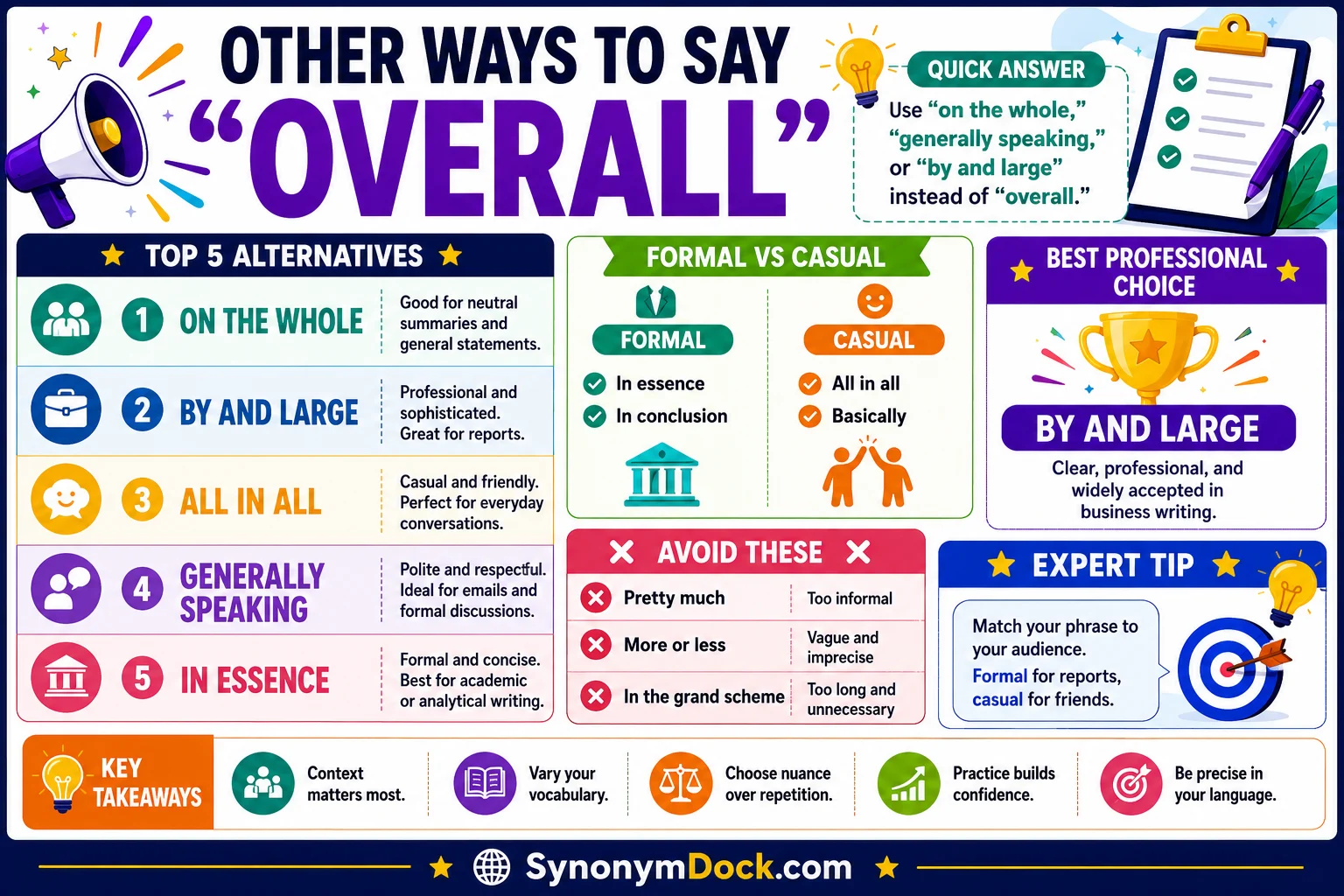
Looking for other ways to say “overall”? Use alternatives like “on the whole,” “generally speaking,” “all in all,” “by and large,” or “in essence” to vary your language in writing and conversation.
Do you find yourself using the word “overall” again and again? It’s a common habit, but overusing it can make your English sound repetitive.
“Overall” is a useful word. It means “in general” or “considering everything together.” But English is rich with alternatives that can make your speech and writing more precise. Learning different ways to express this idea is a simple way to sound more fluent and professional .
Whether you are drafting a business email, writing an academic essay, or just chatting with friends, knowing the right synonym for “overall” helps you communicate more effectively. This guide will help you choose the perfect phrase for every situation.
Quick Categories
Formal Alternatives
- In conclusion
- In essence
- On the whole
- In summary
- Taking everything into account
Pro Tip
Use these in academic papers, formal reports, and official documents. They sound authoritative and well-considered.
Professional Alternatives
- By and large
- Generally speaking
- For the most part
- In the main
- As a whole
Pro Tip
These are ideal for business emails, presentations, and meetings. They sound confident and professional without being stuffy.
Business Email Alternatives
- All things considered
- On balance
- In general
- To sum up
- In the long run
Pro Tip
In an email, choose these phrases to politely summarize a point or gently steer a conversation toward a conclusion.
Academic Alternatives
- In essence
- Ultimately
- Fundamentally
- In the grand scheme of things
- Holistically
Pro Tip
Academic writing values precision. “In essence” and “fundamentally” get to the heart of an idea, while “holistically” shows you’ve considered all aspects.
Casual Alternatives
- All in all
- At the end of the day
- Basically
- All told
- In short
Pro Tip
Use these in everyday conversations, friendly emails, or informal blog posts. They are natural and relatable .
Informal Expressions
- More or less
- Pretty much
- On average
- For the most part
Pro Tip
These are very common in spoken English. They’re great for casual chats but should be avoided in formal writing.
Common Mistakes
Mistake 1: Using a phrase that’s too formal.
Why it’s incorrect: It makes you sound stiff and unnatural in casual conversation.
Correct Version: In a casual chat, use “all in all” or “basically” instead of “in conclusion.”
Example Sentence: “All in all, it was a great party.”
Mistake 2: Using a phrase that’s too casual in a professional email.
Why it’s incorrect: It can sound unprofessional and damage your credibility.
Correct Version: In a business email, use “on balance” or “in general” instead of “pretty much.”
Example Sentence: “On balance, the new policy has been well-received.”
Mistake 3: Forgetting to use a comma after the phrase.
Why it’s incorrect: It’s a grammar mistake that can make your writing confusing.
Correct Version: Always put a comma after your transition word.
Example Sentence: “Generally speaking, our sales are up this quarter.
Mistake 4: Using a phrase that doesn’t fit the meaning.
Why it’s incorrect: It changes the meaning of your sentence and confuses the listener.
Correct Version: Use “on the whole” to mean considering everything, and “in general” to mean usually.
Example Sentence: “On the whole, the project was a success.”
Mistake 5: Repeating the same phrase multiple times.
Why it’s incorrect: It makes your writing or speech sound repetitive and uninteresting.
Correct Version: Use a variety of synonyms from this list to keep your language fresh.
Example Sentence: “By and large, I agree with the plan. All things considered, it’s the best option.”
What Does “Overall” Mean?
“Overall” is a word used to describe something when you are thinking about all its parts together or considering the general picture. It can be used as an adverb, as in “Overall, it was a good day,” or as an adjective, as in “The overall cost was high.”
It’s a versatile and neutral transition word that helps to conclude a thought or summarize a situation. Because it is so useful, it’s very common, which is why learning other ways to say “overall” can make your English stand out .
When To Use “Overall”
You can use the word “overall” in many situations, from daily life to professional settings. As you explore alternatives to “overall” on SynonymDock, think about the context you are writing or speaking in.
- Common situations: Summarizing an event, talking about a group, giving a general opinion.
- Business: Summarizing a report’s findings, giving a general update on a project.
- Academic: Concluding an essay, summarizing research, stating the main idea of a paper.
- Emails: Finishing a message, wrapping up a point, giving a general status update.
- Meetings: Concluding a discussion, giving a final assessment, stating an overall goal.
- Daily conversation: Talking about a movie, a vacation, or a friend.
- Spoken English: More common than in written English, but used in both.
- Written English: Used in formal and informal writing.
- Formal: Yes, it can be used formally.
- Informal: Yes, it can be used informally.
Is It Professional or Polite?
“Overall” is a neutral and versatile word that is appropriate in most situations. It is neither overly formal nor informal.
Polite? ✔ Yes
Professional? ✔ Yes, but variety is key
Formal? Depends on the context
Natural? ✔ Yes, but can be overused
Because it’s so common, relying on “overall” too much can make you sound like you have a limited vocabulary. In the professional world, using a range of words demonstrates strong communication skills.
Pros and Cons
Pros
- Easy to understand
- Friendly and neutral
- Common and universally recognized
- Works in almost any context
Cons
- Overused and can become a crutch
- Limited nuance; doesn’t show precision
- Can sound too casual for some formal writing
- Repetitive if used too often
Transition to the Main List
In the sections below, we’ve curated the best alternatives to “overall,” organized by context and tone.
You will learn:
- Better vocabulary for any situation.
- Professional communication skills.
- How to use formal and casual English correctly.
- The subtle differences in tone between similar words.
Remember, the key to great communication is choosing the right tool for the job. Understanding the nuance of each alternative is the first step.
Other Ways to Say “Overall” (With Examples)
The following list of alternatives to “overall” will help you sound more fluent, improve your professional English, and expand your vocabulary. We’ve included 15 powerful alternatives so you can communicate naturally in any situation. You can also scroll to the bottom for a quick quiz and a recap of the best phrases.
[1]. Phrase: On the Whole
Meaning: Considering everything; in general.
Explanation: This is a very natural, common, and direct synonym for “overall.” Native speakers use it frequently to give a general assessment of a situation or experience .
Example Sentence: “On the whole, the conference was a huge success, even if a few sessions were poorly attended.”
Best Use: Summary, General Assessment, Everyday Conversation.
Avoid Using In: Very formal academic papers.
Tone: Neutral, Natural.
Formality Level: ⭐⭐⭐ Neutral
Usage Frequency: Very Common
CEFR Level: B2
Common Collocations:
- On the whole, I think
- On the whole, it was
- On the whole, the project
- On the whole, people seem to
- On the whole, I would say
Context Variability
- Spoken English: “On the whole, I enjoyed the movie.”
- Professional English: “On the whole, our quarterly results are positive.”
[2]. Phrase: Generally Speaking
Meaning: In most cases or for most people.
Explanation: This is a very polite and formal way to introduce a general statement. It’s a great way to avoid saying “overall” in a presentation or business meeting, as it sounds more considered and authoritative .
Example Sentence: “Generally speaking, younger employees are more open to flexible work arrangements.”
Best Use: Presentations, Professional Meetings, Academic Writing.
Avoid Using In: Text messages, Casual conversation.
Tone: Formal, Respectful.
Formality Level: ⭐⭐⭐⭐ Formal
Usage Frequency: Very Common
CEFR Level: B2
Common Collocations:
- Generally speaking, it is
- Generally speaking, people
- Generally speaking, we find
- Generally speaking, this is
Context Variability
- Professional English: “Generally speaking, our clients prefer this approach.”
- Written English: “Generally speaking, the data supports our hypothesis.”
[3]. Phrase: All in All
Meaning: When you consider all the parts of something together.
Explanation: This is a friendly and idiomatic phrase that is perfect for everyday conversation and informal emails. While you can use it in some workplace settings, it’s slightly more casual than “on the whole” or “generally speaking” .
Example Sentence: “All in all, it was a fantastic vacation, even with the delayed flight.”
Best Use: Everyday Conversation, Friendly Emails, Personal Summaries.
Avoid Using In: Formal academic essays, legal contracts.
Tone: Friendly, Casual.
Formality Level: ⭐⭐ Casual
Usage Frequency: Very Common
CEFR Level: B2
Common Collocations:
- All in all, it was
- All in all, I’m happy with
- All in all, not a bad
Context Variability
- Spoken English: “All in all, I think we did a good job.”
- Casual Conversation: “All in all, it could have been worse.”
Native Speaker Tip
Native speakers often choose between “on the whole” and “generally speaking” based on how formal they need to be. “On the whole” is more common in everyday conversation, while “generally speaking” is preferred in professional settings.
[4]. Phrase: By and Large
Meaning: In general or mostly, with few exceptions.
Explanation: This is a classic and sophisticated English idiom that essentially means “overall.” It is a great choice for professional settings because it sounds thoughtful and polished, but it’s not so formal that it sounds stiff .
Example Sentence: “By and large, our customers are very satisfied with the new software update.”
Best Use: Business Emails, Presentations, Professional Meetings.
Avoid Using In: Very casual chats with close friends.
Tone: Professional, Sophisticated.
Formality Level: ⭐⭐⭐⭐ Formal
Usage Frequency: Occasional
CEFR Level: B2
Common Collocations:
- By and large, we have
- By and large, I agree
- By and large, the system
- By and large, the response
Context Variability
- Professional English: “By and large, the merger has been a success.”
- Written English: “By and large, the evidence points to a different conclusion.”
[5]. Phrase: For the Most Part
Meaning: Generally; mostly, but not entirely.
Explanation: This is a very useful phrase for when you want to say something is true in most cases, but you want to leave a little room for exceptions. It’s a natural way to avoid absolute statements .
Example Sentence: “For the most part, the training program was a success, though a few participants found it challenging.”
Best Use: Giving feedback, making general statements, reports.
Avoid Using In: Situations requiring absolute certainty.
Tone: Neutral, Honest.
Formality Level: ⭐⭐⭐ Neutral
Usage Frequency: Very Common
CEFR Level: B2
Common Collocations:
- For the most part, it was
- For the most part, they are
- For the most part, the data
- For the most part, we’ve
Context Variability
- Spoken English: “For the most part, I agree with you.”
- Business English: “For the most part, the team met its goals.”
[6]. Phrase: In Essence
Meaning: The most important or fundamental part of something.
Explanation: This is an excellent alternative to “overall” when you want to get to the core of an idea. “In essence” is a formal and powerful phrase that shows you can think critically and distill complex information into its key components .
Example Sentence: “In essence, the proposal aims to reduce costs while improving efficiency.”
Best Use: Academic Writing, Executive Summaries, Legal Documents.
Avoid Using In: Casual conversation, friendly texts.
Tone: Formal, Authoritative.
Formality Level: ⭐⭐⭐⭐⭐ Very Formal
Usage Frequency: Occasional
CEFR Level: C1
Common Collocations:
- In essence, it is
- In essence, the idea
- In essence, the problem
- In essence, the plan
Context Variability
- Academic English: “In essence, the theory suggests a fundamental shift.”
- Professional English: “In essence, we are restructuring to be more agile.”
[7]. Phrase: To Sum Up
Meaning: To give a brief and concise final statement.
Explanation: This is a very direct and clear phrase to use when you are finishing a presentation, an email, or a section of writing. It signals clearly that you are about to conclude and is a great alternative to “overall” .
Example Sentence: “To sum up, we recommend proceeding with the proposed marketing strategy.”
Best Use: Conclusion of a presentation, email, or report.
Avoid Using In: Casual conversation.
Tone: Direct, Professional.
Formality Level: ⭐⭐⭐⭐ Formal
Usage Frequency: Common
CEFR Level: B2
Common Collocations:
- To sum up, we need
- To sum up, I believe
- To sum up, the main points
- To sum up, the findings
Context Variability
- Professional English: “To sum up, we will need to hire more staff for this project.”
- Written English: “To sum up, the argument is flawed in several ways.”
Expert Insight
In business writing, avoiding filler words is crucial. Using alternatives to “overall” like “in essence” or “to sum up” demonstrates clear thinking and makes your writing more impactful. It signals that you are not just summarizing, but synthesizing information.
[8]. Phrase: All Things Considered
Meaning: Considering all the different aspects of a situation.
Explanation: This is a very polite and thoughtful phrase to use when you’ve weighed all the pros and cons. It shows that you have made a fair and balanced judgment. It’s a more formal and profound way to say “overall .
Example Sentence: “All things considered, it was a wise decision to invest in the new technology.”
Best Use: Making a final judgment, giving a balanced opinion, discussing decisions.
Avoid Using In: Quick, off-the-cuff remarks.
Tone: Measured, Thoughtful.
Formality Level: ⭐⭐⭐⭐ Formal
Usage Frequency: Common
CEFR Level: B2
Common Collocations:
- All things considered, I think
- All things considered, it was
- All things considered, the best option
- All things considered, we should
Context Variability
- Professional English: “All things considered, I think we should accept the client’s offer.”
- Written English: “All things considered, the experiment provided valuable data.”
[9]. Phrase: In Conclusion
Meaning: Used to introduce the final point in a discussion or text.
Explanation: This is one of the most well-known and formal ways to introduce your final thought. It is a classic alternative to “overall” that is often used in essays, speeches, and formal reports. It’s a signal that you are wrapping up .
Example Sentence: “In conclusion, I would like to thank everyone for their hard work and dedication.”
Best Use: Formal speeches, academic essays, presentations.
Avoid Using In: Everyday conversation, informal emails.
Tone: Very Formal.
Formality Level: ⭐⭐⭐⭐⭐ Very Formal
Usage Frequency: Common
CEFR Level: B2
Common Collocations:
- In conclusion, I would like to
- In conclusion, we can see
- In conclusion, it is clear
Context Variability
- Academic English: “In conclusion, this study has shown a clear link between the two variables.”
- Professional English: “In conclusion, we have met all our targets for this quarter.”
[10]. Phrase: On Balance
Meaning: After considering all the facts and weighing the advantages against the disadvantages.
Explanation: This phrase is similar to “all things considered” but is often used in a more business-like context. It’s the perfect way to say “overall” when you are making a decision or presenting a recommendation after analyzing a situation .
Example Sentence: “On balance, I believe the benefits of the proposal outweigh the risks.”
Best Use: Business decisions, analytical reports, strategic planning.
Avoid Using In: Casual conversation.
Tone: Analytical, Professional.
Formality Level: ⭐⭐⭐⭐ Formal
Usage Frequency: Occasional
CEFR Level: B1
Common Collocations:
- On balance, it seems
- On balance, I prefer
- On balance, the data suggests
- On balance, we should
Context Variability
- Professional English: “On balance, we decided to proceed with the smaller vendor.”
- Written English: “On balance, the evidence is inconclusive.”
Native Speaker Tip
“In conclusion” is a classic but can sound a bit like a textbook phrase. Native speakers, especially in the workplace, often prefer the more dynamic “to sum up” or “in summary.”
[11]. Phrase: In General
Meaning: Usually; in most cases.
Explanation: This is perhaps the simplest and most direct synonym for “overall.” It’s a staple of everyday English and is used to state common truths or widespread patterns. It is neutral and easy to understand, making it a reliable choice in any context .
Example Sentence: “In general, the new policy has been accepted with a lot of enthusiasm.”
Best Use: General statements, daily conversation, most forms of writing.
Avoid Using In: Legal writing or highly formal context.
Tone: Neutral, Straightforward.
Formality Level: ⭐⭐⭐ Neutral
Usage Frequency: Very Common
CEFR Level: B1
Common Collocations:
- In general, it is
- In general, people
- In general, the rules
Context Variability
- Spoken English: “In general, I prefer to eat at home.”
- Professional English: “In general, our customer satisfaction scores are high.”
[12]. Phrase: Ultimately
Meaning: Finally; in the end.
Explanation: “Ultimately” is a fantastic word to use when you want to show that you have arrived at the most important conclusion or the most significant point. It’s a powerful and more sophisticated way to say “overall” and emphasizes the end result .
Example Sentence: “Ultimately, the success of the project depends on strong teamwork.”
Best Use: Academic writing, strategic discussions, conclusions.
Avoid Using In: Simple, everyday summaries.
Tone: Strong, Decisive.
Formality Level: ⭐⭐⭐⭐ Formal
Usage Frequency: Common
CEFR Level: B2
Common Collocations:
- Ultimately, it is up to
- Ultimately, the goal is
- Ultimately, we must
- Ultimately, the decision
- Ultimately, the outcome
Context Variability
- Professional English: “Ultimately, we are responsible for our own success.”
- Academic English: “Ultimately, this theory challenges established ideas.”
Expert Insight
Choose “ultimately” when you want to emphasize the finality and importance of a conclusion. It’s stronger than “in general” and more impactful than “in conclusion.” For instance, when discussing the “overall goal” of a company, you might say “The ultimate goal of the company is to increase shareholder value” .
[13]. Phrase: As a Rule
Meaning: Usually; in most cases.
Explanation: This is a slightly more formal and less common way of saying “in general” or “overall.” It is used to describe a standard or typical behavior. It’s excellent for when you want to sound more articulate without being overly stuffy .
Example Sentence: “As a rule, I don’t work late on Fridays.”
Best Use: Explaining habits, setting expectations, workplace rules.
Avoid Using In: Very personal or emotional conversations.
Tone: Assertive, Business-like.
Formality Level: ⭐⭐⭐⭐ Formal
Usage Frequency: Occasional
CEFR Level: B2
Common Collocations:
- As a rule, I try to
- As a rule, we don’t
- As a rule, it is better to
- As a rule, the company
Context Variability
- Professional English: “As a rule, we check all deliverables before sending them to the client.”
- Spoken English: “As a rule, I like to be on time.”
[14]. Phrase: In the Long Run
Meaning: Over a long period of time; in the end.
Explanation: This is a great alternative to “overall” when you want to emphasize long-term results or consequences. It’s a very common idiom that is used in both business and personal conversations. It focuses on the “overall” outcome over time .
Example Sentence: “In the long run, investing in high-quality equipment will save us money.”
Best Use: Strategic decisions, financial planning, career advice.
Avoid Using In: Immediate, short-term discussions.
Tone: Wise, Strategic.
Formality Level: ⭐⭐ Neutral
Usage Frequency: Common
CEFR Level: B2
Common Collocations:
- In the long run, it’s better
- In the long run, we will
- In the long run, this will
Context Variability
- Professional English: “In the long run, we hope to expand into Asian markets.”
- Personal English: “In the long run, a good education pays for itself.”
[15]. Phrase: In Short
Meaning: In a few words; briefly.
Explanation: “In short” is a concise and effective way to provide a quick summary. It tells the listener that you are about to boil down a complex idea into its simplest form. It’s a very common and direct synonym .
Example Sentence: “In short, we need to increase our marketing efforts to meet our sales targets.”
Best Use: Giving quick summaries, wrapping up a point.
Avoid Using In: Academic writing or when you need to emphasize a significant conclusion.
Tone: Direct, Concise.
Formality Level: ⭐⭐⭐ Neutral
Usage Frequency: Very Common
CEFR Level: B2
Common Collocations:
- In short, we need
- In short, the answer is
- In short, I believe
Context Variability
- Spoken English: “In short, the party was a disaster.”
- Professional English: “In short, we are understaffed and overworked.”
Native Speaker Tip
When summarizing in an email, start a new paragraph with “In short” to grab attention. It signals to the reader that you are about to get to the main point.
Comparison Section
Top 10 Alternatives Compared
| Phrase | Tone | Formality | Best Use | Frequency |
|---|---|---|---|---|
| On the Whole | Neutral, Natural | ⭐⭐⭐ | Summary, General Assessment | Very Common |
| Generally Speaking | Formal, Polite | ⭐⭐⭐⭐ | Presentations, Professional Meetings | Very Common |
| All in All | Friendly, Casual | ⭐⭐ | Everyday Conversation, Friendly Emails | Very Common |
| By and Large | Professional, Sophisticated | ⭐⭐⭐⭐ | Business Emails, Presentations | Occasional |
| For the Most Part | Neutral, Honest | ⭐⭐⭐ | Giving feedback, general statements | Very Common |
| In Essence | Formal, Authoritative | ⭐⭐⭐⭐⭐ | Academic Writing, Executive Summaries | Occasional |
| To Sum Up | Direct, Professional | ⭐⭐⭐⭐ | Conclusion of a presentation, email | Common |
| All Things Considered | Measured, Thoughtful | ⭐⭐⭐⭐ | Making a final judgment | Common |
| In Conclusion | Very Formal | ⭐⭐⭐⭐⭐ | Formal speeches, academic essays | Common |
| On Balance | Analytical, Professional | ⭐⭐⭐⭐ | Business decisions, analytical reports | Occasional |
Which One Should You Use?
Best Overall
On the Whole. It is versatile, natural, and appropriate for almost any situation.
Best Professional
By and Large. It sounds smart, sophisticated, and confident.
Best Academic
In Essence. It helps you get to the core of an idea in a profound way.
Best Business Email
All Things Considered. It shows thoughtfulness and balanced judgment.
Best Everyday Conversation
All in All. It’s friendly, easy to say, and very common.
Most Natural
On the Whole. Native speakers use this phrase constantly.
Most Polite
Generally Speaking. It softens a statement and sounds very respectful.
Commonly Confused Phrases
“In General” is used to discuss a typical, normal state of affairs. “Overall” is used to summarize a specific situation. For example, “In general, he’s a good worker” means he’s usually good, whereas “Overall, his performance this year was good” is a specific conclusion.
“All in All” is a casual summary. “All Things Considered” is a more formal, thoughtful version. You’d use the former with a friend and the latter in an email to a boss.
“By and Large” and “For the Most Part” are very similar. “By and large” is slightly more formal and can sound a bit more authoritative.
Scenario Practice
Scenario 1: Business Meeting
You are wrapping up a quarterly review meeting. What do you say?
Correct Answer: “By and large, we’ve had a successful quarter.” or “On balance, our performance has been strong.” Both are professional and confident.
Scenario 2: Job Interview
The interviewer asks how you handle stress. What is a good summary?
Correct Answer: “In general, I stay calm under pressure.” This shows it’s a consistent trait.
Scenario 3: Giving a Presentation
You want to elegantly transition to your final point.
Correct Answer: “Ultimately, the goal is to increase customer satisfaction.” or “In essence, our strategy is simple.”
Scenario 4: Casual Chat
You are telling a friend about the movie you saw last night.
Correct Answer: “All in all, it was a great movie.” or “On the whole, I really enjoyed it.”
Scenario 5: Writing an Email
You want to give a positive summary to a client after a project.
Correct Answer: “All things considered, we are very pleased with the results.”
Mini Quiz
- Which phrase is best for a formal academic paper?
a) All in all
b) In essence
c) Pretty much - What is a friendly and casual way to say “overall?
a) All in all
b) On balance
c) In summary - You want to sound sophisticated in a business email. Which is best?
a) In conclusion
b) By and large
c) More or less - You are giving a balanced opinion after hearing both sides of an argument.
a) In general
b) All things considered
c) In short - You are telling a friend how you usually handle work.
a) For the most part
b) As a rule
c) In essence
Answer Key
- b) In essence. It is formal and gets to the core of an idea.
- a) All in all. It is a common, friendly phrase.
- b) By and large. It is sophisticated without being stuffy.
- b) All things considered. It implies you’ve heard both sides.
- b) As a rule. It is used for standard practices or habits.
FAQ Section
What is the most professional way to say “overall” in a business email?
The most professional way is to use phrases like “by and large,” “on balance,” or “all things considered.” These phrases sound considered and balanced, which is ideal for professional communication .
Which alternative to “overall” is best for an academic essay?
“In essence,” “ultimately,” and “on the whole” are excellent choices. “In conclusion” is also a classic, but “in essence” is particularly good for summing up a core argument .
What is the difference between “on the whole” and “in general”?
“On the whole” means considering everything about a specific situation, whereas “in general” means usually or in most cases. You’d use “on the whole” to talk about a specific movie, and “in general” to state a preference .
Which synonym for “overall” sounds most natural in everyday conversation?
“All in all,” “on the whole,” and “basically” are the most natural for everyday conversation. They are common, easy to say, and don’t sound overly formal .
Can I use “ultimately” instead of “overall” in a meeting?
Yes, “ultimately” is a powerful and professional word to use in a meeting. It emphasizes the final conclusion or the most important goal. For example, you could say, “Ultimately, we need to focus on profitability.”
Conclusion
Learning to use different words instead of “overall” is a simple but effective way to make your English more impressive and precise. By understanding the subtle differences between each alternative, you can tailor your language to any audience and situation. This will make you a more confident and skilled communicator, whether you’re writing an email, giving a speech, or having a conversation.
Don’t be afraid to start incorporating these alternatives into your daily language. With practice, they will become second nature. Choose the phrase that fits your context, and watch your English fluency and confidence grow. You can also use these tips for related phrases like “other ways to say I agree with you formally” to build your vocabulary further.

2 thoughts on “Other Ways to Say Overall | 17+ Professional Alternatives in 2026”