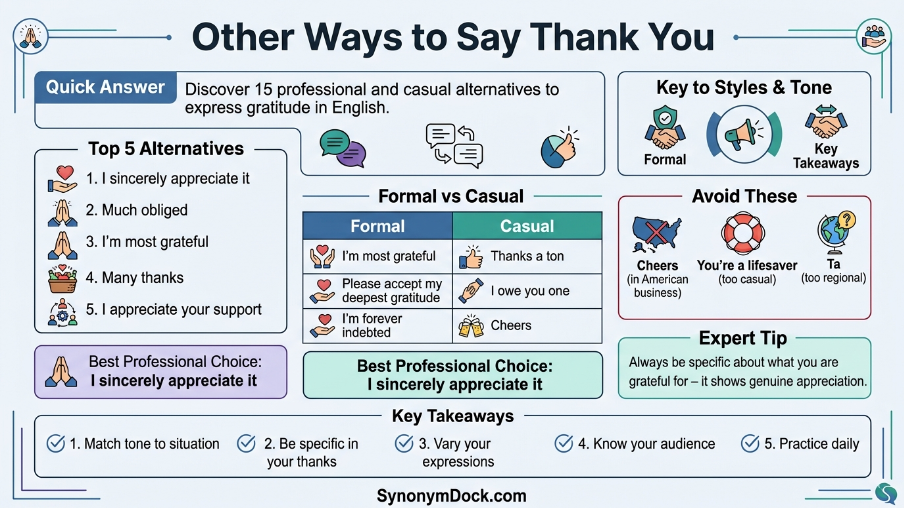
Looking for other ways to say thank you? The best alternatives include I sincerely appreciate it, Much obliged, I’m most grateful, Many thanks, and I appreciate your support. Each phrase works best in specific professional or casual settings.
Top 5 alternatives: I sincerely appreciate it, Much obliged, I’m most grateful, Many thanks, I appreciate your support.
“Thank you” is one of the first phrases English learners master. It is polite, simple, and universally understood. But using the same expression repeatedly can make your English sound limited and repetitive.
Native speakers use dozens of alternatives to express gratitude. The right phrase can make you sound more professional, more sincere, or more natural depending on the situation. Learning these alternatives will help you communicate with greater confidence and precision.
Whether you are writing a business email, speaking with colleagues, or thanking a friend, this guide will help you choose the perfect phrase for every occasion.
Quick Categories
Formal Alternatives
- I’m most grateful
- Please accept my deepest gratitude
- I’m forever indebted
- Much obliged
- I sincerely appreciate it
Professional Alternatives
- I appreciate your support
- Thank you for your time and consideration
- I value your contribution
- Your assistance has been invaluable
- I’m thankful for your guidance
Business Email Alternatives
- Many thanks
- With gratitude
- Thank you for your prompt attention
- I appreciate your feedback
- Grateful for your cooperation
Academic Alternatives
- I am deeply thankful
- I would like to express my gratitude
- I am grateful for your insights
- Your contribution is greatly appreciated
- I acknowledge your support
Casual Alternatives
- Thanks a ton
- I owe you one
- Cheers
- You’re a lifesaver
- Much appreciated
Informal Expressions
- Thanks a bunch
- You’re the best
- I can’t thank you enough
- Ta (UK)
- Appreciate it
Pro Tip: Match your phrase to your relationship with the listener. Using formal expressions with friends sounds unnatural. Using casual phrases with a boss can seem unprofessional.
“The right expression of gratitude can strengthen relationships and open doors.”
Common Mistakes
Mistake 1: Using “Thanks a lot” sarcastically
Why it is incorrect: In spoken English, “thanks a lot” is often used sarcastically to mean the opposite of gratitude. This can cause confusion.
Correct version: Use “Thanks so much” or “Thank you very much” to avoid sounding sarcastic.
Example: ❌ “Thanks a lot for forgetting my coffee.” ✅ “Thanks so much for picking up my coffee.”
Mistake 2: Overusing “I appreciate it”
Why it is incorrect: While “I appreciate it” is a great phrase, using it too frequently makes it lose its impact.
Correct version: Vary your expressions. Try “I’m grateful” or “That means a lot” instead.
Example: ❌ “I appreciate it. I appreciate your help. I appreciate your time.” ✅ “I appreciate your help. Your support has been invaluable.”
Mistake 3: Saying “Much obliged” in casual conversation
Why it is incorrect: “Much obliged” sounds old-fashioned to many native speakers. It can feel overly formal for everyday situations.
Correct version: Use “Thanks” or “Cheers” with friends and colleagues.
Example: ❌ “Much obliged for the coffee.” ✅ “Thanks for the coffee.”
Mistake 4: Using “Cheers” in American business emails
Why it is incorrect: In American English, “cheers” is rarely used to mean “thank you” and is more commonly a toast or sign-off.
Correct version: Use “Thanks” or “Many thanks” in professional emails.
Example: ❌ “Cheers for your help on this.” ✅ “Thanks for your help on this.”
Mistake 5: Forgetting to specify what you are thankful for
Why it is incorrect: A vague “thank you” can feel insincere or lazy. Specificity shows genuine appreciation.
Correct version: Always mention the specific action or help you are grateful for.
Example: ❌ “Thank you for everything.” ✅ “Thank you for staying late to help me finish the presentation.”
What Does “Thank You” Mean?
Definition: “Thank you” is an expression of gratitude used to acknowledge kindness, help, or a favor received from another person.
Grammar explanation: “Thank” is a verb, and “you” is the object. The phrase can be expanded with adverbs like “very much” or “so much” to emphasize gratitude.
Simple explanation: You say “thank you” when someone does something nice for you. It is one of the most common polite expressions in English.
Example: “Thank you for helping me with my resume.”
When to Use “Thank You”
Common situations:
- Receiving a gift
- Accepting help
- Acknowledging a favor
- Ending a conversation
- Responding to a compliment
Business:
- After a meeting
- Following up on a job interview
- Receiving feedback
- Closing an email
Academic:
- Thanking a professor
- Acknowledging research assistance
- After a presentation
Emails:
- Opening or closing correspondence
- Responding to requests
- Following up
Meetings:
- Acknowledging contributions
- Thanking attendees
- Closing discussions
Daily conversation:
- Holding doors
- Receiving service
- Accepting offers
Spoken English: Very common in all spoken interactions.
Written English: Essential in emails, letters, and notes.
Formal: Yes, “thank you” is always appropriate in formal settings.
Informal: Yes, “thank you” works well in casual situations too.
Is It Professional or Polite?
Polite? ✔ Yes – “Thank you” is one of the most polite phrases in English.
Professional? ✔ Yes – It is appropriate in all professional settings.
Formal? Sometimes – While always acceptable, more formal alternatives exist for high-stakes correspondence.
Natural? ✔ Yes – Native speakers use it constantly.
Business-style example: “Thank you for your time and consideration regarding my application.
Simple explanation: “Thank you” is universally polite and professional. However, varying your language shows greater fluency and emotional intelligence.
Pros and Cons
Pros
- Universally understood by all English speakers
- Appropriate in every setting – formal, casual, written, spoken
- Simple and easy to remember for English learners
- Always polite and never offensive
Cons
- Overused – can sound repetitive and unoriginal
- Limited emotional range – does not express deep gratitude
- Too casual for some high-stakes formal writing
- Lacks specificity – does not show what you are thankful for
15 Other Ways to Say Thank You
Ready to expand your vocabulary? Here are 15 powerful alternatives to “thank you.” Each one will help you sound more fluent, professional, and natural.
[1]. Phrase: I Sincerely Appreciate It
Meaning: A warm and professional way to express genuine gratitude.
Explanation: Native speakers use this phrase when they want to sound both professional and heartfelt. It works well in spoken and written English. The word “sincerely” adds emotional weight without sounding overly formal.
Example Sentence: “I sincerely appreciate it – your guidance on this project has been invaluable.
Best Use: Business Email, Workplace Meeting
Avoid Using In: Casual Text, Everyday Conversation
Tone: Professional, Warm
Formality Level: ⭐⭐⭐⭐ Formal
Usage Frequency: Common
CEFR Level: B2
Common Collocations:
- sincerely appreciate your help
- sincerely appreciate your time
- sincerely appreciate the opportunity
- sincerely appreciate your support
Context Variability:
- Spoken English: “I sincerely appreciate everything you’ve done.”
- Professional English: “I sincerely appreciate your willingness to mentor me.”
- Casual Conversation: (Less common – sounds too formal for friends)
[2]. Phrase: Much Obliged
Meaning: A formal and slightly old-fashioned way to say thank you.
Explanation: “Much obliged” is more common in British English and among older generations. It conveys a sense of duty and gratitude. While it sounds formal, it can also be used casually with a hint of humor.
Example Sentence: “Much obliged for your assistance with the quarterly report.”
Best Use: Formal Letters, Professional Emails
Avoid Using In: Casual Text, Modern Workplace Chat
Tone: Formal, Traditional
Formality Level: ⭐⭐⭐⭐⭐ Very Formal
Usage Frequency: Occasional
CEFR Level: C1
Common Collocations:
- much obliged for your help
- much obliged to you
- much obliged indeed
- much obliged for the information
Context Variability:
- Spoken English: “Much obliged, mate” (British, informal-friendly)
- Professional English: “I am much obliged for your consideration.”
- Casual Conversation: Can sound overly formal or humorous
[3]. Phrase: I’m Most Grateful
Meaning: A formal and sincere expression of deep gratitude.
Explanation: This phrase emphasizes a high level of thankfulness. It is commonly used in formal written correspondence and speeches. The word “most” intensifies the gratitude.
Example Sentence: “I’m most grateful for the opportunity to work with such a talented team.
Best Use: Formal Emails, Academic Settings, Speeches
Avoid Using In: Casual Conversation, Text Messages
Tone: Formal, Respectful
Formality Level: ⭐⭐⭐⭐⭐ Very Formal
Usage Frequency: Occasional
CEFR Level: C1
Common Collocations:
- most grateful for your support
- most grateful to you
- most grateful for the opportunity
- most grateful for your kindness
Context Variability:
- Spoken English: Rare in everyday speech
- Professional English: “I’m most grateful for the trust you have placed in me.”
- Casual Conversation: Sounds too formal
[4]. Phrase: Please Accept My Deepest Gratitude
Meaning: An extremely formal and heartfelt expression of thanks.
Explanation: This is one of the most formal ways to say thank you. It is reserved for very important occasions, such as thanking someone for a life-changing opportunity or extraordinary kindness.
Example Sentence: “Please accept my deepest gratitude for your unwavering support during this challenging time.”
Best Use: Formal Letters, Major Life Events, Award Speeches
Avoid Using In: Everyday Emails, Casual Conversation
Tone: Formal, Profound
Formality Level: ⭐⭐⭐⭐⭐ Very Formal
Usage Frequency: Rare
CEFR Level: C2
Common Collocations:
- accept my deepest gratitude
- deepest gratitude for your support
- gratitude for your kindness
- gratitude for your understanding
Context Variability:
- Spoken English: Almost never used in speech
- Professional English: Appropriate for major professional acknowledgments
- Casual Conversation: Too formal
[5]. Phrase: I’m Forever Indebted
Meaning: A formal way to say you will always be grateful to someone.
Explanation: This phrase suggests that you can never fully repay the person’s kindness. It is used for truly significant acts of help or support. It sounds very formal and sincere.
Example Sentence: “I’m forever indebted to you for the mentorship you provided early in my career.”
Best Use: Formal Letters, Major Acknowledgments
Avoid Using In: Business Emails, Casual Conversation
Tone: Formal, Sincere
Formality Level: ⭐⭐⭐⭐⭐ Very Formal
Usage Frequency: Rare
CEFR Level: C2
Common Collocations:
- forever indebted to you
- indebted for your kindness
- indebted for your support
- indebted for your generosity
Context Variability:
- Spoken English: Rare in speech
- Professional English: Used for significant professional debts of gratitude
- Casual Conversation: Sounds overly dramatic
Native Speaker Tip: “Much obliged,” “I’m most grateful,” and “I’m forever indebted” are increasingly rare in modern spoken English. Use them in formal writing, but in conversation, native speakers usually prefer simpler expressions like “I really appreciate it.”
[6]. Phrase: I Appreciate Your Support
Meaning: A professional and sincere way to acknowledge someone’s help.
Explanation: This phrase works well in workplace settings. It is specific (you name the support) and professional. It sounds natural in both spoken and written English.
Example Sentence: “I appreciate your support on the marketing campaign – your insights were invaluable.
Best Use: Business Email, Workplace Meeting, Team Communication
Avoid Using In: Very Formal Legal Documents
Tone: Professional, Warm
Formality Level: ⭐⭐⭐⭐ Formal
Usage Frequency: Very Common
CEFR Level: B2
Common Collocations:
- appreciate your support
- appreciate your help
- appreciate your time
- appreciate your feedback
- appreciate your patience
Context Variability:
- Spoken English: “I really appreciate your support on this.”
- Professional English: “We appreciate your continued support.”
- Casual Conversation: “Appreciate your support, mate.”
[7]. Phrase: Many Thanks
Meaning: A concise and professional way to express gratitude.
Explanation: “Many thanks” is a standard phrase in business emails and professional correspondence. It is slightly more formal than “thanks” but less formal than “I’m most grateful.” It works well as an email sign-off.
Example Sentence: “Many thanks for your prompt response to my inquiry.
Best Use: Business Email, Professional Correspondence, Email Sign-offs
Avoid Using In: Very Formal Letters, Casual Text Messages
Tone: Professional, Polite
Formality Level: ⭐⭐⭐⭐ Formal
Usage Frequency: Very Common
CEFR Level: B1
Common Collocations:
- many thanks for your help
- many thanks for your time
- many thanks for your consideration
- many thanks indeed
Context Variability:
- Spoken English: Less common in speech, but used
- Professional English: “Many thanks for your cooperation on this matter.
- Casual Conversation: “Many thanks!” (can sound slightly formal but acceptable)
[8]. Phrase: I Value Your Contribution
Meaning: A professional way to acknowledge someone’s specific input or work.
Explanation: This phrase is excellent for team settings, project work, and collaborative environments. It shows that you recognize and respect the person’s specific efforts.
Example Sentence: “I value your contribution to the research phase – your data analysis was exceptional.”
Best Use: Team Meetings, Project Acknowledgments, Performance Feedback
Avoid Using In: Casual Conversation, Personal Letters
Tone: Professional, Respectful
Formality Level: ⭐⭐⭐⭐ Formal
Usage Frequency: Common
CEFR Level: B2
Common Collocations:
- value your contribution
- value your input
- value your opinion
- value your feedback
- value your time
Context Variability:
- Spoken English: “I really value your contribution to this team.”
- Professional English: “We value your contribution to the company’s success.”
- Casual Conversation: Sounds too formal
[9]. Phrase: I’m Deeply Thankful
Meaning: A warm and sincere expression of profound gratitude.
Explanation: This phrase conveys strong emotional appreciation. It works well in both formal and personal contexts. The word “deeply” adds intensity without sounding overly formal.
Example Sentence: “I’m deeply thankful for the trust you have placed in me.
Best Use: Formal Letters, Personal Acknowledgments, Speeches
Avoid Using In: Casual Everyday Conversation
Tone: Sincere, Warm
Formality Level: ⭐⭐⭐⭐ Formal
Usage Frequency: Occasional
CEFR Level: B2
Common Collocations:
- deeply thankful for your support
- deeply thankful for your kindness
- deeply thankful for the opportunity
- deeply thankful to you
Context Variability:
- Spoken English: “I’m deeply thankful for everything you’ve done.”
- Professional English: “We are deeply thankful for your partnership.”
- Casual Conversation: Sounds slightly formal but heartfelt
[10]. Phrase: I Would Like to Express My Gratitude
Meaning: A polite and formal way to introduce a statement of thanks.
Explanation: This is a complete formal phrase often used in speeches, presentations, and formal letters. It is a way to begin a gratitude statement rather than a standalone expression.
Example Sentence: “I would like to express my gratitude to everyone who contributed to this project.”
Best Use: Formal Speeches, Presentations, Award Ceremonies
Avoid Using In: Casual Conversation, Short Emails
Tone: Formal, Polite
Formality Level: ⭐⭐⭐⭐⭐ Very Formal
Usage Frequency: Occasional
CEFR Level: C1
Common Collocations:
- express my gratitude
- express my thanks
- express my appreciation
- express my sincere gratitude
Context Variability:
- Spoken English: Used in formal speeches
- Professional English: “I would like to express my gratitude for your hospitality.”
- Casual Conversation: Too formal
Expert Insight: In professional emails, specificity matters. Instead of a generic “thank you,” mention exactly what you are grateful for. “Thank you for your detailed feedback on the proposal” sounds more sincere and professional than “Thank you for your help.” Specificity builds trust and shows genuine appreciation.
[11]. Phrase: Thanks a Ton
Meaning: An informal and enthusiastic way to say thank you.
Explanation: This is a casual, friendly expression used among friends, family, and close colleagues. It conveys strong gratitude in a lighthearted way.
Example Sentence: “Thanks a ton for covering my shift – you’re a lifesaver.”
Best Use: Casual Conversation, Friendly Emails, Close Colleagues
Avoid Using In: Business Emails, Formal Letters, Client Communication
Tone: Casual, Friendly
Formality Level: ⭐⭐ Casual
Usage Frequency: Very Common
CEFR Level: B1
Common Collocations:
- thanks a ton for your help
- thanks a ton for the support
- thanks a ton, mate
- thanks a ton for everything
Context Variability:
- Spoken English: “Thanks a ton for picking me up.”
- Professional English: Avoid in formal settings
- Casual Conversation: Very natural and common
[12]. Phrase: I Owe You One
Meaning: An informal way to say you will return the favor.
Explanation: This phrase implies that you are grateful and intend to help the person in return. It is commonly used among friends and close colleagues.
Example Sentence: “I owe you one for helping me with that presentation.”
Best Use: Casual Conversation, Friendly Workplace
Avoid Using In: Formal Business, Client Communication
Tone: Casual, Friendly
Formality Level: ⭐⭐ Casual
Usage Frequency: Very Common
CEFR Level: B1
Common Collocations:
- owe you one
- owe you big time
- owe you a favor
- owe you for this
Context Variability:
- Spoken English: “I owe you one – thanks!”
- Professional English: Can be used informally with close colleagues
- Casual Conversation: Very natural
[13]. Phrase: Cheers
Meaning: An informal British way to say thank you.
Explanation: “Cheers” is widely used in the UK, Australia, and New Zealand as a casual way to say thank you. In American English, it is less common and can sound unusual. It is also used as a toast when drinking.
Example Sentence: “Cheers for helping me with that – I really appreciate it.”
Best Use: Casual Conversation (UK/Australia/NZ)
Avoid Using In: American Business Emails, Formal Settings
Tone: Casual, Friendly
Formality Level: ⭐ Very Casual
Usage Frequency: Very Common (UK)
CEFR Level: B1
Common Collocations:
- cheers for your help
- cheers, mate
- cheers for that
- cheers for the support
Context Variability:
- Spoken English: “Cheers for the lift!”
- Professional English: Can be used informally in UK workplaces
- Casual Conversation: Very common in British English
[14]. Phrase: You’re a Lifesaver
Meaning: An informal way to thank someone who helped you in a difficult situation.
Explanation: This is a warm, appreciative phrase used when someone has helped you significantly. It is common among friends, family, and close colleagues.
Example Sentence: “You’re a lifesaver – I would have missed the deadline without your help.”
Best Use: Casual Conversation, Friendly Workplace
Avoid Using In: Formal Business, Client Communication
Tone: Warm, Appreciative
Formality Level: ⭐⭐ Casual
Usage Frequency: Very Common
CEFR Level: B1
Common Collocations:
- you’re a lifesaver
- you’re an absolute lifesaver
- you saved my life
- total lifesaver
Context Variability:
- Spoken English: “You’re a lifesaver, thanks!”
- Professional English: Can be used informally with close colleagues
- Casual Conversation: Very natural
[15]. Phrase: I Can’t Thank You Enough
Meaning: A heartfelt way to say your gratitude is beyond words.
Explanation: This phrase expresses deep appreciation. It suggests that words are insufficient to convey your thanks. It works in both formal and informal contexts.
Example Sentence: “I can’t thank you enough for your patience and guidance throughout this process.”
Best Use: Personal Letters, Heartfelt Emails, In-Person Thanks
Avoid Using In: Brief Casual Exchanges
Tone: Sincere, Warm
Formality Level: ⭐⭐⭐ Neutral
Usage Frequency: Very Common
CEFR Level: B2
Common Collocations:
- can’t thank you enough
- can’t thank you enough for your support
- can’t thank you enough for your kindness
- can’t thank you enough for everything
Context Variability:
- Spoken English: “I can’t thank you enough for this.”
- Professional English: “I can’t thank you enough for the opportunity.”
- Casual Conversation: “I can’t thank you enough, really.”
Quick Recap:
- Best Professional Choice: I sincerely appreciate it
- Best Casual Choice: Thanks a ton
- Best Formal Choice: I’m most grateful
- Most Natural Choice: Many thanks
- Most Polite Choice: Please accept my deepest gratitude
Top 10 Alternatives Compared
| Phrase | Tone | Formality | Best Use | Frequency |
|---|---|---|---|---|
| I sincerely appreciate it | Warm, Professional | ⭐⭐⭐⭐ | Business Email | Very Common |
| Much obliged | Traditional | ⭐⭐⭐⭐⭐ | Formal Letters | Occasional |
| I’m most grateful | Formal, Respectful | ⭐⭐⭐⭐⭐ | Academic Settings | Occasional |
| Please accept my deepest gratitude | Profound | ⭐⭐⭐⭐⭐ | Major Acknowledgments | Rare |
| I’m forever indebted | Sincere | ⭐⭐⭐⭐⭐ | Significant Acts | Rare |
| I appreciate your support | Professional | ⭐⭐⭐⭐ | Workplace | Very Common |
| Many thanks | Polite | ⭐⭐⭐⭐ | Email Sign-offs | Very Common |
| I value your contribution | Respectful | ⭐⭐⭐⭐ | Team Settings | Common |
| I’m deeply thankful | Warm | ⭐⭐⭐⭐ | Personal Acknowledgments | Occasional |
| I would like to express my gratitude | Formal | ⭐⭐⭐⭐⭐ | Speeches | Occasional |
Which One Should You Use?
Best Overall
I sincerely appreciate it – Works in almost every professional and personal context.
Best Professional
I appreciate your support – Specific, warm, and appropriate for workplace communication.
Best Academic
I’m most grateful – Formal enough for academic correspondence yet sincere.
Best Business Email
Many thanks – Concise, professional, and perfect for email sign-offs.
Best Everyday Conversation
Thanks a ton – Friendly, natural, and widely understood.
Most Natural
I can’t thank you enough – Expresses deep gratitude in a natural, conversational way.
Most Polite
Please accept my deepest gratitude – Ideal for truly significant expressions of thanks.
“Gratitude is not just the greatest of virtues but the parent of all others.” – Cicero
Commonly Confused Phrases
| Phrase | Meaning | When to Use |
|---|---|---|
| Thank you | Standard gratitude | Every situation |
| Thanks a lot | Casual gratitude | Can sound sarcastic – use carefully |
| Thanks a ton | Enthusiastic gratitude | Casual, friendly settings |
| Much obliged | Formal gratitude | Sounds old-fashioned – use sparingly |
| I appreciate it | Professional gratitude | Workplace and everyday use |
| I’m grateful | Sincere gratitude | Personal and professional contexts |
Subtle differences:
- “Thank you” is neutral and always safe.
- “Thanks a lot” can sound sarcastic depending on tone.
- “Much obliged” sounds traditional and is less common today.
- “I appreciate it” sounds professional and warm.
Scenario Practice
Scenario 1: Business Meeting
A colleague stayed late to help you finalize a presentation.
Which phrase would you choose?
“I sincerely appreciate your help with the presentation last night.”
Why: This phrase is professional, warm, and specific. It acknowledges the effort while maintaining a workplace-appropriate tone.
Scenario 2: Job Interview
The interviewer took extra time to answer your questions.
Which phrase would you choose?
“Thank you for your time and the thoughtful answers to my questions.”
Why: This is polite, professional, and shows you value the interviewer’s time.
Scenario 3: Friend’s Favor
Your friend drove you to the airport at 5 AM.
Which phrase would you choose?
“You’re a lifesaver – I owe you one!”
Why: This is warm, appreciative, and casual – perfect for friends.
Scenario 4: Academic Setting
Your professor provided extensive feedback on your thesis.
Which phrase would you choose?
“I’m deeply thankful for your detailed feedback on my thesis.”
Why: This is formal enough for academic correspondence while expressing genuine appreciation.
Scenario 5: Email Reply
A client sent you important documents promptly.
Which phrase would you choose?
“Many thanks for sending the documents so quickly.”
Why: This is concise, professional, and perfect for email correspondence.
Mini Quiz
1. Which phrase is most appropriate for a formal business letter?
- A) Thanks a ton
- B) I’m most grateful
- C) Cheers
- D) I owe you one
2. Which phrase is best for thanking a friend for a small favor?
- A) Please accept my deepest gratitude
- B) I’m forever indebted
- C) Thanks a bunch
- D) I would like to express my gratitude
3. Which phrase should you avoid in American business emails?
- A) Many thanks
- B) I appreciate your support
- C) Cheers
- D) I value your contribution
4. Which phrase sounds the most formal?
- A) I can’t thank you enough
- B) Much obliged
- C) Thanks
- D) Appreciate it
5. Which phrase is best for a workplace email to a manager?
- A) You’re a lifesaver
- B) I owe you one
- C) I appreciate your guidance
- D) Cheers
Answer Key
1. B – “I’m most grateful” is appropriately formal for business letters. “Thanks a ton” and “Cheers” are too casual.
2. C – “Thanks a bunch” is casual and friendly. The other options are too formal for a small favor.
3. C – “Cheers” is not commonly used in American business English to mean thank you.
4. B – “Much obliged” is very formal and somewhat old-fashioned. It is more formal than the others.
5. C – “I appreciate your guidance” is professional, respectful, and specific. It is appropriate for a manager.
Avoid These in Formal Situations
| Expression | Why to Avoid | Better Alternative |
|---|---|---|
| Cheers | Too casual; not used in American business English | Many thanks |
| Thanks a bunch | Too informal for professional settings | I appreciate your support |
| You’re a lifesaver | Too dramatic for professional correspondence | I’m grateful for your help |
| I owe you one | Implies a favor exchange; unprofessional | I appreciate your assistance |
| Ta | Very informal; regional (UK) | Thank you |
Best Phrases by Situation
| Situation | Best Phrase |
|---|---|
| Business Email | Many thanks |
| Client Meeting | I sincerely appreciate it |
| Academic Essay | I’m most grateful |
| Presentation | I would like to express my gratitude |
| Workplace Discussion | I appreciate your support |
| Job Interview | Thank you for your time and consideration |
| Team Collaboration | I value your contribution |
| Everyday Conversation | Thanks a ton |
FAQ
What is the most formal way to say thank you?
“Please accept my deepest gratitude” is one of the most formal expressions. “I’m forever indebted” and “I would like to express my gratitude” are also highly formal. These are best reserved for significant occasions such as award speeches, formal letters, or major life events.
Which phrase is best for professional emails?
“Many thanks” and “I sincerely appreciate it” are excellent choices for professional emails. They strike the right balance between formality and warmth. “I appreciate your support” also works well when you want to be specific about what you are grateful for.
What is the difference between “thanks” and “thank you”?
“Thanks” is more informal and casual, while “thank you” is neutral and appropriate in all situations. Use “thank you” in professional settings and “thanks” with friends and family. “Thanks” is also common in quick, everyday exchanges.
Which alternative sounds most natural to native speakers?
Native speakers frequently use “thanks,” “thank you,” “I appreciate it,” and “thanks a lot” in everyday conversation. “Many thanks” and “I sincerely appreciate it” are common in professional settings. The most natural choice depends on the context and relationship.
Can I use these expressions in business meetings?
Yes, phrases like “I appreciate your support,” “Many thanks,” and “I sincerely appreciate it” are perfectly appropriate for business meetings. Avoid overly casual expressions like “Cheers” or “You’re a lifesaver” in formal professional settings.
Conclusion
Learning different ways to say thank you will make your English sound more fluent, professional, and natural. The right phrase can strengthen relationships, show genuine appreciation, and help you communicate with greater confidence.
Start practicing these alternatives today. Use them in your emails, meetings, and everyday conversations. The more you vary your language, the more natural and engaging your English will become. Remember gratitude is a powerful tool. Use it wisely, and it will open doors for you.

14 thoughts on “15+ Other Ways to Say Thank You |Professional Examples For 2026”