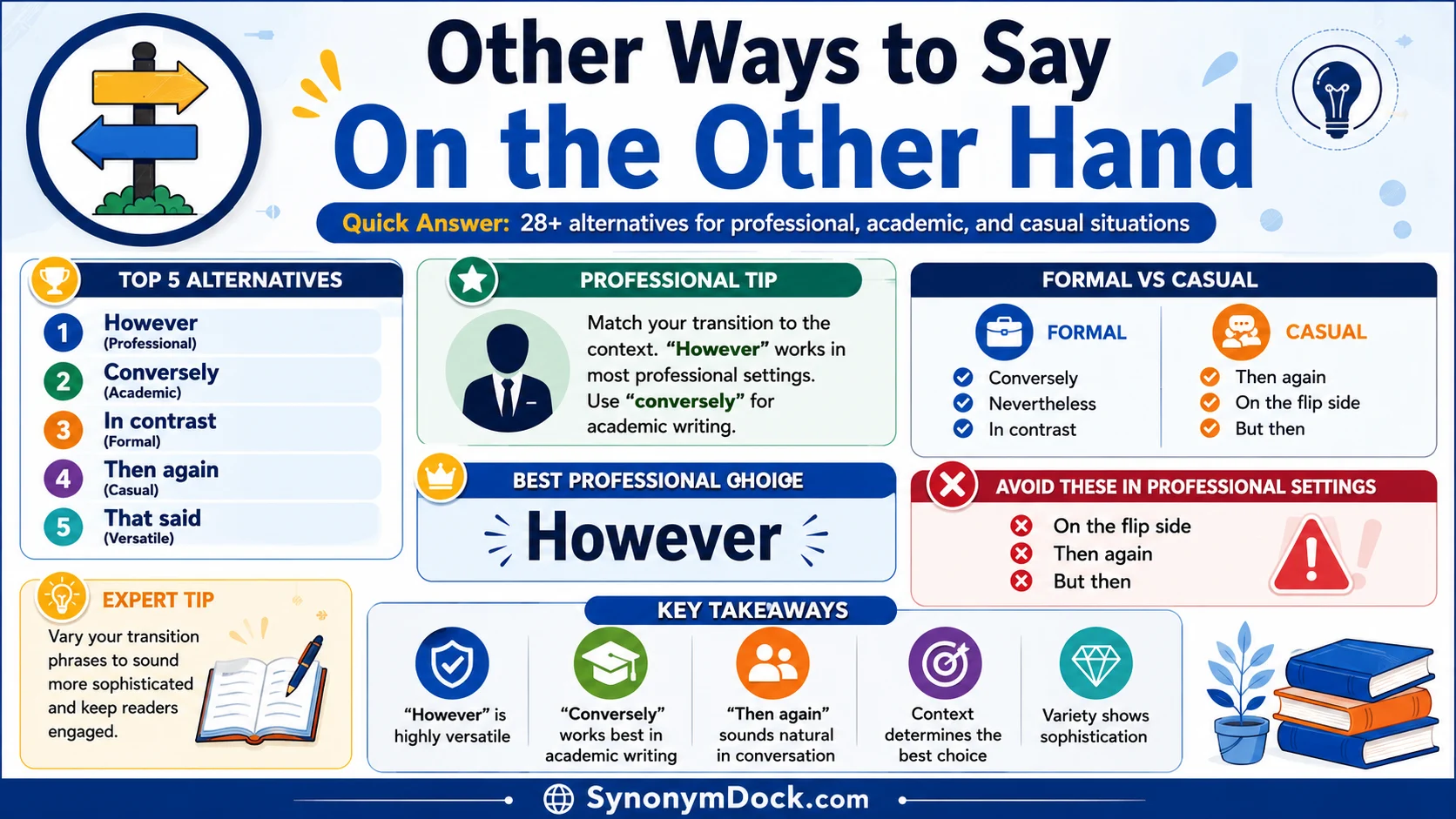
Looking for other ways to say on the other hand? Try “however” for professional writing, “conversely” for academic contexts, “in contrast” for essays, “then again” for casual conversation, or “alternatively” for presenting options. The best alternatives include: however, conversely, in contrast, then again, alternatively, on the contrary, by contrast, nevertheless, yet, and from another perspective.
“On the other hand” is a useful transitional phrase. It helps us contrast ideas, present alternatives, and show different perspectives. But using it too often makes your writing sound repetitive and amateurish.
Whether you’re writing an academic essay, a business report, or having a conversation, having other ways to say on the other hand helps you sound more sophisticated and fluent. The right alternative can elevate your writing from basic to impressive. This article explores 15+ powerful alternatives to “on the other hand” organized by tone and situation, so you can choose the perfect expression with confidence.
Quick Categories
Formal Alternatives
- Conversely
- In contrast
- On the contrary
- Nevertheless
- Yet
Pro Tip: Use formal alternatives in academic writing, legal documents, and official correspondence. They sound sophisticated and precise.
Professional Alternatives
- However
- Alternatively
- By contrast
- From another perspective
- That said
Pro Tip: Professional alternatives work well in business reports, emails, and workplace communication. They show your command of professional English.
Business Email Alternatives
- However
- That being said
- Having said that
- With that in mind
- On the flip side
Pro Tip: Business email alternatives help you present balanced arguments while maintaining a professional tone.
Academic Alternatives
- Conversely
- In contrast to
- On the contrary
- By way of contrast
- From a different angle
Pro Tip: Academic alternatives strengthen your essays and research papers by adding variety and sophistication to your arguments.
Casual Alternatives
- Then again
- But then
- On the flip side
- That said
- At the same time
Pro Tip: Casual alternatives work well in everyday conversation and informal writing. They sound natural and native-like.
Informal Expressions
- On the flip side
- Then again
- But then again
- On a different note
- Mind you
Pro Tip: Use informal expressions with friends, family, and in casual writing. Avoid them in professional or academic contexts.
“Variety in transition phrases shows you’re a confident, sophisticated writer.”
What Does “On the Other Hand” Mean?
“On the other hand” is a transitional phrase used to introduce a contrasting point, alternative perspective, or different side of an argument. It helps writers and speakers present balanced views.
Example: “The job pays well. On the other hand, the hours are very long.”
Grammar: “On the other hand” is a conjunctive adverb. It connects two independent clauses or ideas. It’s often used after a period or semicolon, followed by a comma.
Is It Professional or Polite?
“On the other hand” is both professional and polite when used appropriately. However, overusing it can make your writing feel repetitive and basic.
Polite? ✅ Yes
Professional? ✅ Yes, but variety matters
Formal? ⚠️ Sometimes – can feel too casual in formal writing
Natural? ✅ Yes
Example: “The proposal has merit. On the other hand, we must consider the costs.” This works professionally. For academic writing, consider “However” or “Conversely.”
Common Mistakes
Mistake #1: Confusing “On the Other Hand” with “On the Contrary”
Why it’s incorrect: “On the other hand” presents a different perspective. “On the contrary” contradicts or denies a previous statement.
Correct version: Use “on the contrary” only when contradicting, not when offering an alternative.
Example: “I don’t dislike it. On the contrary, I think it’s brilliant!” (Correct)
Incorrect: “I like the idea. On the contrary, it has some problems.” (Should be “On the other hand”)
Mistake #2: Overusing “On the Other Hand” in Essays
Why it’s incorrect: Repetitive use of any transition phrase weakens your writing.
Correct version: Vary your language with alternatives like “however,” “conversely,” and “in contrast.”
Example: “This theory has strengths. However, it also has significant limitations.”
Mistake #3: Using “On the Other Hand” Without a Previous Point
Why it’s incorrect: “On the other hand” requires a first point to contrast with.
Correct version: Always ensure you’ve presented one side before using this phrase.
Example: “The location is convenient. On the other hand, the rent is expensive.” (Has both sides)
Mistake #4: Using “Then Again” in Formal Writing
Why it’s incorrect: “Then again” is too casual for academic or professional writing.
Correct version: Use “however,” “nevertheless,” or “conversely” instead.
Example: “The data supports this view. However, there are alternative interpretations.”
Mistake #5: Not Using a Comma After Transition Phrases
Why it’s incorrect: Transition phrases should be followed by a comma for proper punctuation.
Correct version: Always use a comma after introductory transition phrases.
Example: “On the other hand, we need to consider the budget.” (Correct)
Incorrect: “On the other hand we need to consider the budget.”
When to Use “On the Other Hand”
Common Situations:
- Presenting contrasting ideas
- Showing different perspectives
- Balancing arguments
- Considering alternatives
- Academic writing
- Business reports
Business:
- Presenting pros and cons
- Evaluating options
- Balancing trade-offs
- Decision-making discussions
Academic:
- Presenting counterarguments
- Comparing theories
- Analyzing different viewpoints
- Balanced research writing
Daily Conversation:
- Sharing different perspectives
- Considering alternatives
- Casual decision-making
- Friendly debates
Written English:
- Academic essays
- Business reports
- Professional emails
- Opinion pieces
“Transition words are the invisible glue that holds your writing together.”
Pros and Cons of “On the Other Hand”
Pros
- Clear and easy to understand
- Widely used and accepted
- Works in many contexts
- Shows balanced thinking
Cons
- Overused
- Can feel repetitive
- Sometimes too wordy
- Lacks sophistication
- Not ideal for formal writing
15 Other Ways to Say On the Other Hand
[1]. However
Meaning: A versatile transition word meaning “on the other hand” or “but.”
Explanation: “However” is one of the most common and professional alternatives. It’s widely used in writing and speech. Native speakers use it constantly in both formal and casual contexts. It’s concise and effective.
Example Sentence: “The software is affordable. However, it lacks some advanced features.”
Best Use: Professional Writing, Academic Essays, Business Reports
Avoid Using In: Very Casual Text Messages
Tone: Professional, Neutral
Formality Level: ⭐⭐⭐⭐ Formal
Usage Frequency: Very Common
CEFR Level: B1
Common Collocations:
- however, it should be noted
- however, this is not always the case
- however, we must consider
- however, there are exceptions
- however, the evidence suggests
Context Variability:
- Spoken English: “I’d love to go. However, I’m busy that day.”
- Professional English: “We made good progress. However, there’s more work to do.”
[2]. Conversely
Meaning: A formal word meaning “on the other hand” or “in contrast.”
Explanation: “Conversely” is an academic and professional alternative. It’s perfect for formal writing and presentations. Native speakers use it in scholarly contexts and formal speeches. It sounds sophisticated and precise.
Example Sentence: “Some people enjoy working in teams. Conversely, others prefer working alone.”
Best Use: Academic Writing, Formal Speeches, Professional Reports
Avoid Using In: Casual Conversation
Tone: Formal, Sophisticated
Formality Level: ⭐⭐⭐⭐⭐ Very Formal
Usage Frequency: Occasional (Academic/Formal)
CEFR Level: C1
Common Collocations:
- conversely, it can be argued
- conversely, this approach suggests
- conversely, the opposite is true
- conversely, some might argue
- conversely, research shows
Context Variability:
- Academic English: “This theory predicts X. Conversely, an alternative theory predicts Y.”
- Professional English: “Online sales are increasing. Conversely, in-store sales are declining.”
[3]. In Contrast
Meaning: A formal phrase meaning “on the other hand” or “by comparison.”
Explanation: “In contrast” is an excellent academic and professional alternative. It’s used to highlight differences between two things. Native speakers use it in writing and formal speech. It’s clear and effective.
Example Sentence: “The first proposal is expensive. In contrast, the second is much more affordable.”
Best Use: Academic Essays, Business Reports, Professional Writing
Avoid Using In: Casual Conversation
Tone: Formal, Analytical
Formality Level: ⭐⭐⭐⭐ Formal
Usage Frequency: Common (Professional Contexts)
CEFR Level: B2
Common Collocations:
- in contrast, the data shows
- in contrast to previous findings
- in contrast, this approach
- in contrast with other studies
- in contrast, the results indicate
Context Variability:
- Academic English: “In contrast, the experimental group showed significant improvement.”
- Professional English: “In contrast, our competitors offer fewer features.”
[4]. Then Again
Meaning: A casual phrase meaning “on the other hand” or “however.”
Explanation: “Then again” is a very natural, casual alternative. Native speakers use it constantly in conversation and informal writing. It’s slightly hesitant and thoughtful. However, avoid it in professional or academic contexts.
Example Sentence: “I could go to the party. Then again, I’m really tired.”
Best Use: Casual Conversation, Friendly Discussions
Avoid Using In: Professional Writing, Academic Essays
Tone: Casual, Thoughtful
Formality Level: ⭐⭐ Casual
Usage Frequency: Very Common (Informal)
CEFR Level: B1
Common Collocations:
- then again, maybe
- then again, I’m not sure
- then again, it depends
- then again, who knows
- then again, that might not be true
Context Variability:
- Spoken English: “I could buy the red one. Then again, the blue is nicer.”
- Informal Writing: “We could leave now. Then again, we could wait.”
[5]. Alternatively
Meaning: A formal word meaning “as another option” or “on the other hand.”
Explanation: “Alternatively” is perfect for presenting options or choices. It’s professional and clear. Native speakers use it in business, academic, and formal contexts. It works well when offering alternatives.
Example Sentence: “We could hold the meeting in person. Alternatively, we could meet online.”
Best Use: Business Emails, Professional Reports, Academic Writing
Avoid Using In: Casual Conversation
Tone: Professional, Neutral
Formality Level: ⭐⭐⭐⭐ Formal
Usage Frequency: Common
CEFR Level: B2
Common Collocations:
- alternatively, we could
- alternatively, you might
- alternatively, consider this
- alternatively, there is another option
- alternatively, it’s possible
Context Variability:
- Professional English: “We could hire a full-time employee. Alternatively, we could use contractors.”
- Academic English: “This could be interpreted as X. Alternatively, it could be seen as Y.”
“Good writers use transition words to guide readers through their arguments.”
[6]. On the Contrary
Meaning: A formal phrase meaning “the opposite is true” or “in fact.”
Explanation: “On the contrary” is used to strongly contradict a previous statement. It’s different from “on the other hand.” Native speakers use it when they want to emphasize the opposite position. It’s powerful and definitive.
Example Sentence: “I don’t think the project is failing. On the contrary, it’s very successful.”
Best Use: Formal Writing, Debates, Academic Arguments
Avoid Using In: Casual Conversation (Unless Emphasizing)
Tone: Formal, Definite
Formality Level: ⭐⭐⭐⭐ Formal
Usage Frequency: Common
CEFR Level: B2
Common Collocations:
- on the contrary, I think
- on the contrary, this shows
- on the contrary, the evidence proves
- on the contrary, it’s clear
- on the contrary, that’s not true
Context Variability:
- Formal English: “He isn’t unhappy. On the contrary, he’s thrilled.”
- Academic English: “This doesn’t disprove the theory. On the contrary, it supports it.”
[7]. By Contrast
Meaning: A formal phrase meaning “on the other hand” or “in comparison.”
Explanation: “By contrast” is similar to “in contrast” but slightly more concise. It’s excellent for highlighting differences. Native speakers use it in academic and professional writing. It sounds precise and polished.
Example Sentence: “The first candidate has years of experience. By contrast, the second has fresh ideas.”
Best Use: Academic Essays, Business Reports, Professional Writing
Avoid Using In: Very Casual Conversation
Tone: Formal, Analytical
Formality Level: ⭐⭐⭐⭐ Formal
Usage Frequency: Common (Professional Contexts)
CEFR Level: B2
Common Collocations:
- by contrast, the other
- by contrast, this approach
- by contrast, the results
- by contrast, it’s clear
- by contrast, they argued
Context Variability:
- Academic English: “By contrast, Smith’s theory suggests something different.”
- Professional English: “By contrast, our competitors have struggled.”
[8]. Nevertheless
Meaning: A formal word meaning “despite that” or “on the other hand.”
Explanation: “Nevertheless” is a sophisticated formal alternative. It acknowledges a previous point but introduces a contrast. Native speakers use it in academic writing, formal speeches, and professional contexts. It sounds educated and measured.
Example Sentence: “The task was difficult. Nevertheless, we completed it on time.”
Best Use: Academic Writing, Formal Reports, Professional Speeches
Avoid Using In: Casual Conversation
Tone: Formal, Measured
Formality Level: ⭐⭐⭐⭐⭐ Very Formal
Usage Frequency: Common (Formal Contexts)
CEFR Level: C1
Common Collocations:
- nevertheless, it remains
- nevertheless, this is important
- nevertheless, we must
- nevertheless, the fact remains
- nevertheless, there is hope
Context Variability:
- Academic English: “The data is limited. Nevertheless, the findings are significant.”
- Professional English: “The project faced delays. Nevertheless, we met our deadline.”
[9]. Yet
Meaning: A formal transition meaning “but” or “on the other hand.”
Explanation: “Yet” is a concise, sophisticated alternative. It’s formal but not overly academic. Native speakers use it in writing and formal speech. It’s excellent for elegant, concise writing.
Example Sentence: “The solution is simple. Yet, its implementation is challenging.”
Best Use: Formal Writing, Academic Essays, Professional Reports
Avoid Using In: Casual Conversation (In This Context)
Tone: Formal, Elegant
Formality Level: ⭐⭐⭐⭐ Formal
Usage Frequency: Common
CEFR Level: B2
Common Collocations:
- yet, it’s clear that
- yet, there is more
- yet, the evidence suggests
- yet, we cannot ignore
- yet, this is not always
Context Variability:
- Formal English: “This solution is elegant. Yet, it has its challenges.”
- Academic English: “This theory is compelling. Yet, it faces criticism.”
[10]. From Another Perspective
Meaning: A formal phrase meaning “looking at this differently” or “on the other hand.”
Explanation: “From another perspective” is a sophisticated phrase. It suggests you’re considering a different viewpoint. Native speakers use it in discussions, presentations, and formal writing. It sounds thoughtful and balanced.
Example Sentence: “From one perspective, this seems risky. From another perspective, it’s a great opportunity.”
Best Use: Academic Discussions, Professional Presentations, Debate
Avoid Using In: Very Casual Conversation
Tone: Formal, Thoughtful
Formality Level: ⭐⭐⭐⭐ Formal
Usage Frequency: Occasional
CEFR Level: C1
Common Collocations:
- from another perspective, however
- from another perspective, this suggests
- from another perspective, the situation
- from another perspective, it’s clear
- from another perspective, we can see
Context Variability:
- Academic English: “From another perspective, the findings could be interpreted differently.”
- Professional English: “From another perspective, this risk is manageable.”
[11]. That Said
Meaning: A neutral, professional phrase meaning “however” or “on the other hand.”
Explanation: “That said” is a versatile and natural alternative. It acknowledges a previous point while introducing a contrast. Native speakers use it in both professional and casual contexts. It sounds conversational yet professional.
Example Sentence: “The new policy has many benefits. That said, it does have some drawbacks.”
Best Use: Professional Emails, Presentations, Casual Writing
Avoid Using In: Extremely Formal Documents
Tone: Neutral, Professional
Formality Level: ⭐⭐⭐ Neutral
Usage Frequency: Common
CEFR Level: B1
Common Collocations:
- that said, we should
- that said, it’s worth
- that said, there are
- that said, we must
- that said, it’s important
Context Variability:
- Professional English: “The proposal is strong. That said, we need to review the budget.”
- Spoken English: “I agree with you. That said, I see your point.”
[12]. On the Flip Side
Meaning: A casual, friendly phrase meaning “on the other hand.”
Explanation: “On the flip side” is a very casual and friendly alternative. Native speakers use it in conversations and informal writing. It’s engaging and easy to understand. However, avoid it in professional or academic contexts.
Example Sentence: “Living in the city is exciting. On the flip side, it’s very expensive.”
Best Use: Casual Conversation, Friendly Discussions
Avoid Using In: Professional Writing, Academic Essays
Tone: Casual, Friendly
Formality Level: ⭐⭐ Casual
Usage Frequency: Common (Informal)
CEFR Level: B1
Common Collocations:
- on the flip side, however
- on the flip side, it’s
- on the flip side, there’s
- on the flip side, you might
- on the flip side, consider
Context Variability:
- Spoken English: “Working from home is convenient. On the flip side, it’s lonely.”
- Informal Writing: “The car is fast. On the flip side, it uses a lot of gas.”
[13]. With That in Mind
Meaning: A professional phrase meaning “considering that” or “on the other hand.”
Explanation: “With that in mind” is a thoughtful, professional alternative. It suggests you’re considering context while introducing a new point. Native speakers use it in meetings, emails, and professional discussions.
Example Sentence: “The budget is tight. With that in mind, we need to prioritize carefully.”
Best Use: Business Meetings, Professional Emails, Planning Discussions
Avoid Using In: Casual Conversation
Tone: Professional, Strategic
Formality Level: ⭐⭐⭐⭐ Formal
Usage Frequency: Common (Business)
CEFR Level: B2
Common Collocations:
- with that in mind, we
- with that in mind, let’s
- with that in mind, it’s
- with that in mind, consider
- with that in mind, the decision
Context Variability:
- Professional English: “With that in mind, I suggest we proceed.”
- Business English: “With that in mind, let’s look at the options.”
[14]. But Then
Meaning: A casual phrase meaning “however” or “on the other hand.”
Explanation: “But then” is a very natural, conversational alternative. Native speakers use it to introduce a contrasting idea or new consideration. It’s common in speech but too informal for most writing contexts.
Example Sentence: “This phone is great. But then, it is expensive.”
Best Use: Casual Conversation, Friendly Discussions
Avoid Using In: Professional Writing, Academic Essays
Tone: Casual, Conversational
Formality Level: ⭐⭐ Casual
Usage Frequency: Common (Speech)
CEFR Level: B1
Common Collocations:
- but then again
- but then, there’s
- but then, you might
- but then, it’s also
- but then, what about
Context Variability:
- Spoken English: “I could stay home. But then, I’d miss the party.”
- Informal Writing: “The book is interesting. But then, it’s also very long.”
[15]. Mind You
Meaning: A casual, slightly British phrase meaning “on the other hand” or “however.”
Explanation: “Mind you” is a very casual, conversational phrase. It’s used to introduce a contrasting point or add important information. Native British speakers use it frequently. It’s not appropriate for formal or American professional writing.
Example Sentence: “I love London. Mind you, the weather is terrible.”
Best Use: Casual Conversation, British English
Avoid Using In: American Professional Writing
Tone: Casual, Conversational
Formality Level: ⭐⭐ Casual
Usage Frequency: Common (British, Informal)
CEFR Level: B2
Common Collocations:
- mind you, though
- mind you, it’s
- mind you, that’s
- mind you, I’m not
- mind you, it could
Context Variability:
- British English: “It’s a great idea. Mind you, it’s quite expensive.”
- Spoken English: “She’s very talented. Mind you, she works hard too.”
“The best writers use a variety of transition words to keep their readers engaged.”
Native Speaker Tip
Native speakers often choose “however” for professional writing because it’s versatile and concise. In conversation, “then again” and “on the flip side” sound most natural. British speakers frequently use “mind you” in casual contexts. American speakers prefer “that said” or “on the flip side.” Always consider your audience and context.
Expert Insight
In professional writing, varying your transition phrases shows sophistication. Academic essays benefit from “conversely” and “in contrast.” Business reports work well with “however” and “that said.” Presentations benefit from “from another perspective.” The key is matching your language to your context and audience.
Avoid These Expressions in Formal Situations
| Expression | Why to Avoid | Better Alternative |
|---|---|---|
| On the flip side | Too casual | However or Conversely |
| Then again | Too conversational | Nevertheless or However |
| But then | Too informal | In contrast or Yet |
| Mind you | Regional/casual | However |
| But then again | Too conversational | Alternatively |
Top 10 Alternatives Compared
| Phrase | Tone | Formality | Best Use | Frequency |
|---|---|---|---|---|
| However | Professional | ⭐⭐⭐⭐ | Writing, Speech | Very Common |
| Conversely | Academic | ⭐⭐⭐⭐⭐ | Essays, Formal | Common |
| In contrast | Analytical | ⭐⭐⭐⭐ | Academic, Business | Common |
| Then again | Casual | ⭐⭐ | Conversation | Very Common |
| Alternatively | Professional | ⭐⭐⭐⭐ | Options, Choices | Common |
| On the contrary | Formal | ⭐⭐⭐⭐ | Contradiction | Common |
| By contrast | Formal | ⭐⭐⭐⭐ | Comparison | Common |
| Nevertheless | Formal | ⭐⭐⭐⭐⭐ | Formal Writing | Common |
| Yet | Formal | ⭐⭐⭐⭐ | Elegant Writing | Common |
| That said | Neutral | ⭐⭐⭐ | All contexts | Very Common |
Which One Should You Use?
Best Overall: However – works in almost every context
Best Professional: However – concise and professional
Best Academic: Conversely or In contrast – sophisticated and precise
Best Business Email: However or That said – professional and clear
Best Everyday Conversation: Then again or On the flip side – natural and friendly
Most Natural: However – native speakers use it constantly
Most Polite: That said – acknowledges previous point respectfully
Commonly Confused Phrases
“On the other hand” vs. “On the contrary”
“On the other hand” presents an alternative perspective. “On the contrary” strongly contradicts a previous statement. They are not interchangeable.
“However” vs. “Nevertheless”
“However” is more common and versatile. “Nevertheless” is more formal and emphasizes persistence despite obstacles. Both work for contrast.
“In contrast” vs. “By contrast”
These are nearly identical. “In contrast” is slightly more common. Both highlight differences between two things.
Scenario Practice
Scenario 1: You’re writing an academic essay comparing two theories.
Which phrase would you choose?
Correct Answer: “Conversely, the second theory argues…” or “In contrast, this approach…”
Why: Academic and precise for scholarly writing.
Scenario 2: You’re having a casual conversation about weekend plans.
Which phrase would you choose?
Correct Answer: “I could go to the beach. Then again, it might rain.”
Why: Casual and natural for conversation.
Scenario 3: You’re writing a professional business report.
Which phrase would you choose?
Correct Answer: “However, we must consider…” or “That said, there are risks.”
Why: Professional and appropriate for business writing.
Scenario 4: You’re presenting two options in a meeting.
Which phrase would you choose?
Correct Answer: “Alternatively, we could…” or “From another perspective…”
Why: Shows balanced thinking and consideration of options.
Scenario 5: You’re writing a balanced opinion piece.
Which phrase would you choose?*
Correct Answer: “On the other hand” or “Nevertheless” or “However”
Why: Shows you’re considering different viewpoints.
Mini Quiz
1. Which phrase is best for academic writing?
- A) On the flip side
- B) Conversely
- C) Then again
2. Which alternative is too casual for professional writing?
- A) However
- B) Conversely
- C) On the flip side
3. Which phrase contradicts a previous statement?
- A) On the other hand
- B) On the contrary
- C) In contrast
4. Which is the most versatile alternative for most situations?
- A) Conversely
- B) However
- C) Nevertheless
5. Which phrase is commonly used in British casual conversation?
- A) Mind you
- B) Conversely
- C) In contrast
Answer Key
- B) Conversely – Academic and sophisticated.
- C) On the flip side – Too casual for professional writing.
- B) On the contrary – Used to contradict previous statements.
- B) However – Works in almost all contexts.
- A) Mind you – Common in British casual conversation.
FAQs
What is the most formal way to say “on the other hand”?
“Conversely,” “nevertheless,” and “on the contrary” are among the most formal alternatives. “In contrast” and “by contrast” are also excellent formal choices. Use these in academic writing, legal documents, and official correspondence.
Which phrase is best for professional emails?
“However” is the best choice for professional emails. It’s concise, professional, and widely understood. “That said” and “alternatively” are also excellent options for workplace communication.
What is the difference between “on the other hand” and “on the contrary”?
“On the other hand” presents a different perspective or alternative. “On the contrary” contradicts or denies a previous statement. They serve different purposes and are not interchangeable.
Which alternative sounds most natural to native speakers?
“However” sounds most natural to native speakers in both writing and speech. “Then again” and “that said” are also very natural in conversation. The most natural choice depends on the context.
Can I use these expressions in business meetings?
Yes, professional alternatives like “however,” “that said,” and “alternatively” are perfect for business meetings. Avoid casual options like “on the flip side” or “then again” in professional settings.
Conclusion
Learning other ways to say on the other hand transforms your writing and speaking. Instead of repeating the same transition phrase, you now have powerful alternatives for every situation – from academic essays to casual conversations.
The key is choosing the right phrase for the right context. “However” and “conversely” work perfectly in professional settings. “Then again” and “on the flip side” are natural choices for everyday conversation. With practice, these alternatives will become second nature, and your English will sound more sophisticated and confident.
Start today – choose one new alternative and use it in your next conversation, email, or essay. Your communication will improve dramatically.

1 thought on “Other Ways to Say On the Other Hand |28+ Professional Alternatives”