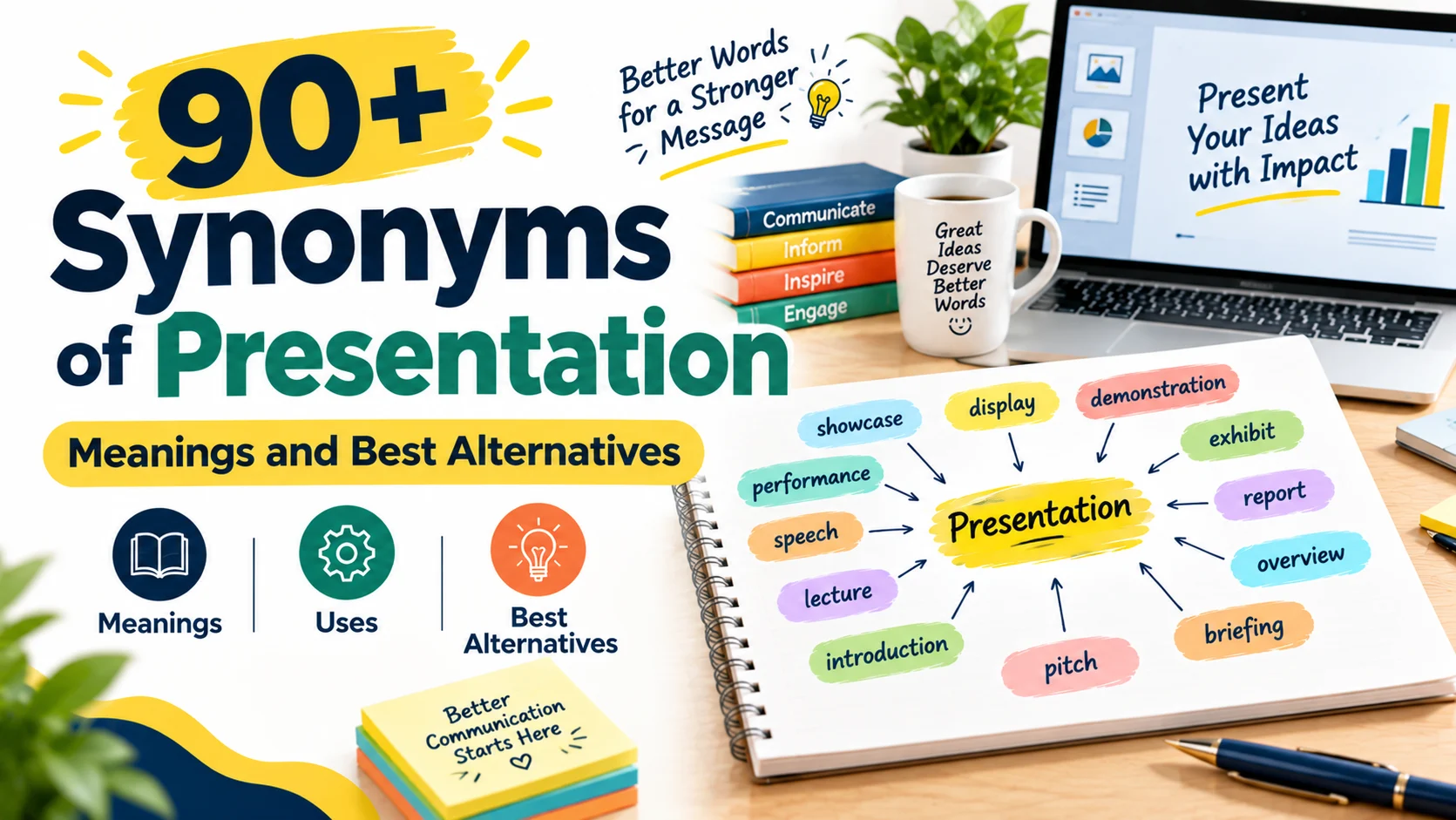
The word “presentation” refers to the act of showing, explaining, or delivering information to an audience. The best synonyms depend on your context. For formal writing, use “demonstration” or “exhibition.” For professional settings, “briefing” or “proposal” work well. For academic contexts, choose “lecture” or “dissertation.” For creative or emotional situations, “performance” or “display” are excellent choices.
Have you ever found yourself writing an email, preparing a speech, or drafting a report and using the word “presentation” over and over again? You know exactly what you want to say, but repeating the same word makes your writing feel dull and uninspired. Finding the right synonym of presentation can transform your communication from repetitive to refined. Whether you are a student, professional, or content creator, choosing the most accurate word helps you connect with your audience more effectively. This guide will help you understand the meaning of presentation, explore its best synonyms, and confidently select the perfect word for any situation.
Meaning, Tone, and Context
Simple Definition
A presentation is the act of showing or explaining something to others. It can involve visual aids, spoken words, written materials, or a combination of these elements. The purpose is typically to inform, persuade, or entertain an audience.
Part of Speech
Presentation is a noun.
Overall Tone
The tone of “presentation” is neutral. It simply describes an activity without adding emotional weight. This neutrality makes it useful across many contexts, but it also means the word can feel bland when stronger alternatives are available.
Formality Level
Presentation is neutral to semi-formal. It works in professional environments, academic settings, and everyday conversation. However, some synonyms carry more formality, while others are more casual.
Common Uses
Native English speakers use “presentation” in business meetings, academic lectures, sales pitches, conferences, and classroom settings. It also appears in everyday situations when someone shows pictures, explains an idea, or demonstrates a product.
Word Forms
- Noun: presentation
- Verb: present
- Adjective: presentational
- Adverb: presentationally (rarely used)
- Related noun: presenter
When and How to Use “Presentation”
Choose “presentation” when you need a general, neutral word that works in most situations. It is the safest choice when you are unsure which specific term fits best. However, for more precise communication, consider using one of the synonyms discussed later in this guide.
7 Realistic Examples
Professional Context
The marketing team delivered a presentation on the new product launch strategy.
Academic Context
Her presentation on climate change included detailed charts and research findings.
Workplace Context
I need to prepare a presentation for next week’s department meeting.
Personal Context
He gave a short presentation about his volunteer work in South America.
Email Context
Please review the presentation slides before our call tomorrow morning.
Resume Context
Created and delivered presentations to executive leadership teams.
Social Media Context
She shared a presentation-style carousel post with ten tips for better photography.
Best Synonyms of “Presentation”
No synonym is identical in every situation. The best choice depends on your audience, purpose, and tone. Here are the top recommendations for different contexts.
Professional Writing: Use “briefing” when sharing important updates with a team. It sounds focused and action-oriented.
Academic Writing: Use “lecture” for educational contexts or “dissertation” for formal research presentations.
Business Communication: Use “proposal” when offering a plan or suggestion. It implies thoughtfulness and strategic thinking.
Casual Conversation: Use “show” or “demo” for informal situations.
Emotional Writing: Use “performance” when the presentation involves artistic expression or personal storytelling.
Creative Writing: Use “exhibition” to describe a display of creative work.
Resume Writing: Use “demonstration” to highlight hands-on skills and practical expertise.
Workplace Communication: Use “debriefing” for post-project reviews or summary sessions.
Stronger Meaning: Use “manifestation” when the presentation reveals or embodies something significant.
Softer Meaning: Use “overview” when keeping things brief and surface-level.
When Not to Use “Presentation”
When the Word Sounds Too General
“Presentation” can feel vague when you need a more specific term.
Weak: I gave a presentation about our sales numbers.
Better: I briefed the team on our quarterly sales performance.
The improved version sounds more professional and precise.
When the Word Sounds Too Formal
In casual settings, “presentation” can feel stiff.
Too Formal: Let me give you a presentation about my vacation photos.
Better: Let me show you my vacation photos.
The informal alternative sounds more natural for personal situations.
When the Word Sounds Too Weak
Sometimes “presentation” lacks the impact your message needs.
Too Weak: His presentation of the research was adequate.
Stronger: His demonstration of the research findings was compelling.
The stronger word adds conviction and authority.
When the Word Sounds Outdated
“Presentation” remains widely used, but some contexts benefit from modern alternatives.
Outdated Feel: Please view my presentation on the company website.
Modern: Please check out my portfolio on the company website.
Words Commonly Confused With “Presentation”
Presentation vs Demonstration
Difference: A demonstration shows how something works. A presentation shares information or ideas.
When to Use It: Use “demonstration” when showing a process, product, or skill in action.
Example: The chef gave a demonstration of knife skills to the cooking class.
Presentation vs Lecture
Difference: A lecture is typically educational and one-way. A presentation can be more interactive.
When to Use It: Use “lecture” for academic or formal teaching situations.
Example: The professor’s lecture on economic theory lasted two hours.
Presentation vs Performance
Difference: A performance involves artistic expression. A presentation focuses on information delivery.
When to Use It: Use “performance” when creativity, emotion, or entertainment is central.
Example: The theater group’s performance received a standing ovation.
Presentation vs Exhibition
Difference: An exhibition displays items for public viewing. A presentation involves an active speaker.
When to Use It: Use “exhibition” when describing a show or display of works.
Example: The art exhibition featured works by emerging local painters.
Presentation vs Proposal
Difference: A proposal suggests a plan or recommendation. A presentation may simply share information.
When to Use It: Use “proposal” when you want to persuade or gain approval.
Example: The team submitted a proposal to expand operations into Asia.
Presentation vs Show
Difference: A show is informal and often entertaining. A presentation is more structured.
When to Use It: Use “show” for casual, everyday situations.
Example: She gave a show of her new dance routine to her friends.
Best Synonyms of “Presentation” by Context
| Context | Best Synonym | Why It Works | Example |
| Formal writing | Exhibition | Adds sophistication and suggests careful curation | The museum’s exhibition of ancient artifacts drew international attention |
| Academic writing | Lecture | Indicates educational purpose and scholarly authority | The lecture on neuroscience covered the latest research developments |
| Professional communication | Briefing | Sounds efficient and action-oriented | The morning briefing covered all critical operational updates |
| Business emails | Proposal | Implies thoughtful planning and strategic thinking | I have attached the proposal for the new client onboarding process |
| Resume writing | Demonstration | Highlights practical skills and hands-on experience | Led product demonstrations for major corporate clients |
| Workplace communication | Debriefing | Suggests thorough review and knowledge sharing | The project debriefing helped us identify improvement opportunities |
| Casual conversation | Show | Feels natural and friendly | Let me show you how this app works |
| Everyday speaking | Talk | Simple and widely understood | She gave a talk at the community center |
| Creative writing | Performance | Adds emotional and artistic depth | The performance of the dance troupe captivated the audience |
| Storytelling | Portrayal | Emphasizes descriptive representation | The portrayal of village life in the novel felt authentic |
| Emotional writing | Revelation | Suggests discovery and emotional impact | The revelation of his past experiences moved everyone |
| Strong emphasis | Manifestation | Conveys power and significance | The manifestation of community support was overwhelming |
| Mild tone | Overview | Keeps things brief and accessible | She provided an overview of the company’s history |
| Social media captions | Reel | Modern and platform-specific | Check out my new reel showing the process |
| American English | Presentation | Standard across all contexts | She prepared her presentation for the conference |
How to Choose the Best Synonym of “Presentation”
Choosing the right synonym starts with understanding your purpose. Ask yourself what you are actually doing. Are you teaching, persuading, showing, or entertaining? Your answer will guide your word choice.
Consider your audience next. A formal business meeting requires different language than a conversation with friends. Think about the emotional tone you want to create. Some synonyms add warmth and energy. Others keep things neutral and professional.
Also think about the medium. A spoken presentation might use different words than a written one. A slide deck might be called a “deck” in business contexts, while a live talk might be called a “performance” in creative settings.
The goal is always to communicate your message as clearly as possible. Choose the word that matches your meaning, fits your audience, and sounds natural in context.
Real Life Examples of “Presentation”
School Context
The student’s presentation on renewable energy earned the highest grade in the class.
Improved: The student’s lecture on renewable energy captivated everyone, including the teacher.
College Context
For her thesis, she had to give a presentation to the faculty committee.
Improved: She delivered a compelling dissertation defense to the faculty committee.
Workplace Context
The team prepared a presentation for the quarterly review meeting.
Improved: The team prepared a comprehensive briefing for the quarterly review meeting.
Business Context
His presentation convinced the investors to fund the startup.
Improved: His persuasive proposal convinced the investors to fund the startup.
Email Context
Please find attached the presentation for tomorrow’s client call.
Improved: Please find attached the proposal for tomorrow’s client call.
Resume Context
Developed and delivered presentations to cross-functional teams.
Improved: Developed and delivered strategic briefings to cross-functional teams.
Conversation Context
I have to do a presentation at work next week.
Improved: I have to give a talk at work next week.
Storytelling Context
The old man’s presentation of his memories brought tears to his grandchildren’s eyes.
Improved: The old man’s portrayal of his memories brought tears to his grandchildren’s eyes.
Blogging Context
My blog post presentation of the recipe included step-by-step photos.
Improved: My blog post demonstration of the recipe included step-by-step photos.
Social Media Context
Her presentation about mental health went viral on TikTok.
Improved: Her honest talk about mental health went viral on TikTok.
18 Best Synonyms of “Presentation”
| Synonym | Simple Meaning | Best Used For | Example Sentence |
| Demonstration | Showing how something works or is done | Hands-on teaching, product launches, skill sharing | The instructor’s demonstration of the software saved everyone hours of confusion |
| Lecture | Educational speech given to an audience | Academic settings, classrooms, conferences | The lecture on ancient history lasted three hours but felt like thirty minutes |
| Exhibition | Public display of works or items | Art shows, museums, trade fairs | The exhibition of modern sculpture attracted visitors from all over the country |
| Briefing | Short, focused update or instruction | Business meetings, military contexts, team updates | The morning briefing prepared the team for the challenging day ahead |
| Proposal | Formal suggestion or plan for consideration | Business pitches, project planning, grant applications | Their proposal for the community garden won unanimous approval |
| Performance | Act of presenting art, music, or entertainment | Theater, music, dance, storytelling | The performance of the jazz quartet received a standing ovation |
| Display | Arrangement of items for viewing | Retail, museums, exhibitions, personal sharing | The display of vintage cameras in the shop window caught every passerby’s attention |
| Talk | Informal speech on a topic | Conferences, community events, casual settings | She gave an inspiring talk about overcoming obstacles |
| Portfolio | Collection of work samples | Job applications, creative professions, academic review | His portfolio demonstrated years of design experience and creative growth |
| Show | Informal display or performance | Social situations, casual conversations, entertainment | The magician’s show amazed children and adults alike |
| Overview | General summary of a topic | Introductions, executive summaries, preliminary discussions | The overview of the project helped everyone understand the scope |
| Revelation | Revealing something surprising or important | Emotional moments, discoveries, dramatic storytelling | The revelation of the company’s new direction surprised the entire industry |
Synonyms of “Presentation” by Usage
Professional vs Personal Synonyms
In professional environments, words like “briefing,” “proposal,” and “demonstration” show seriousness and preparation. They suggest you have done your homework and respect your audience’s time. Use “debriefing” for project reviews and “portfolio” for showcasing your work.
In personal contexts, “show,” “talk,” and “display” sound more relaxed and friendly. They work well when you want to share something without the pressure of a formal event. Choose based on your relationship with the listener and the setting.
Formal vs Conversational Synonyms
For reports, essays, and business writing, choose “exhibition,” “lecture,” or “discourse.” These words add weight and authority to your writing. They are appropriate for academic papers, executive summaries, and formal proposals.
For casual conversations and texting, “show,” “demo,” and “overview” keep things easy and approachable. They help you sound natural and relatable.
Academic Synonyms
“Lecture,” “dissertation,” “thesis defense,” and “seminar” are the most appropriate for academic contexts. These words signal intellectual rigor and scholarly purpose. Use “exposition” for detailed explanations and “discourse” for formal academic discussions. These terms sound authoritative and help your writing meet academic standards.
Professional and Business Synonyms
“Briefing,” “proposal,” “pitch,” and “deck” are the strongest choices for business settings. “Briefing” suggests efficiency and focus. “Proposal” implies strategic thinking. “Pitch” works well for sales contexts. “Deck” is the preferred term for slide presentations. These words fit resumes, interviews, meetings, and client communications perfectly.
Creative and Literary Synonyms
“Performance,” “portrayal,” “exhibition,” and “revelation” add emotional and artistic depth to writing. These words are ideal for storytelling, fiction, and descriptive pieces. They help paint vivid pictures and evoke feelings. Use “portrayal” to describe character descriptions. Use “manifestation” to convey deeper meaning. Use “exposition” for detailed narrative sections.
Slang or Modern Synonyms
“Deck” is widely used in business to refer to a slide presentation. “Reel” works for short video presentations on social media. “Ted Talk style” describes a specific presentation format. “Pitch” is common in startup and sales environments. Use these terms in appropriate contexts, but avoid them in formal academic writing or official documents.
Strongest to Mildest Synonyms
Mild
- Overview
- Talk
- Show
Moderate
- Presentation
- Display
- Exhibition
Strong
- Demonstration
- Briefing
- Performance
Very Strong
- Manifestation
- Revelation
- Discourse
The emotional intensity changes as you move up the scale. Mild synonyms keep things simple and safe. Moderate synonyms add some weight but remain neutral. Strong synonyms convey confidence and purpose. Very strong synonyms carry emotional depth and significance.
Emotional vs Neutral Synonyms
Emotional Synonyms
These words express stronger feelings and create a deeper connection with your audience:
- Revelation
- Manifestation
- Performance
- Portrayal
- Debut
Use these when you want to move your audience or convey importance. They work well in storytelling, personal writing, and creative contexts.
Neutral Synonyms
These words simply communicate information without adding emotion:
- Presentation
- Display
- Exhibition
- Overview
- Talk
Use these when you want to share facts without emotional coloring. They are appropriate for reports, news, and straightforward communication.
Antonyms of “Presentation”
| Antonym | Meaning | Example Sentence |
| Concealment | Act of hiding or keeping secret | The concealment of the evidence raised serious questions |
| Suppression | Forcibly preventing information from being shared | The suppression of the report angered many employees |
| Secrecy | State of being secret or hidden | The secrecy surrounding the project made everyone suspicious |
| Omission | Leaving something out or excluding | The omission of key data weakened their argument |
| Withholding | Refusing to give information | The withholding of documents delayed the investigation |
| Silence | Complete absence of speech or information | The silence on the issue was deafening |
| Ignorance | Lack of knowledge or awareness | Their ignorance of the situation led to poor decisions |
| Censorship | Suppression of speech or information | The censorship of the article violated free speech principles |
| Redaction | Editing out sensitive information | The redaction of the report left many questions unanswered |
| Deletion | Removing information completely | The deletion of the files caused significant data loss |
| Inhibition | Restraint that prevents expression | His inhibition prevented him from sharing his ideas |
| Obscurity | State of being unclear or unknown | The obscurity of the details confused the audience |
| Disappearance | Act of being lost or not seen | The disappearance of the evidence hurt their case |
| Neglect | Failing to give proper attention | The neglect of safety procedures caused the incident |
| Oversight | Unintentional failure to consider something | The oversight in the report was minor but noticeable |
Comparison: “Presentation” vs Similar Words
Presentation vs Demonstration
Main Difference: A presentation shares information. A demonstration actively shows how something works.
Which Is Stronger? Demonstration feels more active and hands-on.
Which Is More Formal? Both are neutral, but demonstration often appears in technical contexts.
When to Use Each: Use “presentation” when sharing ideas. Use “demonstration” when showing processes or products in action.
Examples
Presentation: The presentation covered the company’s five-year plan.
Demonstration: The demonstration showed exactly how the software operates.
Presentation vs Lecture
Main Difference: A lecture is typically educational and one-way. A presentation can include interaction.
Which Is Stronger? Lecture sounds more authoritative in academic contexts.
Which Is More Formal? Lecture is more formal.
When to Use Each: Use “presentation” for diverse settings. Use “lecture” for academic teaching.
Examples
Presentation: The team’s presentation included audience questions.
Lecture: The professor’s lecture was well organized and informative.
Presentation vs Performance
Main Difference: Performance emphasizes artistry and expression. Presentation focuses on information delivery.
Which Is Stronger? Performance carries more emotional weight.
Which Is More Formal? Performance can be formal or informal depending on context.
When to Use Each: Use “presentation” for work and school. Use “performance” for entertainment and creative expression.
Examples
Presentation: The investor presentation convinced the board.
Performance: The actress’s performance received critical acclaim.
Presentation vs Exhibition
Main Difference: An exhibition involves displaying items. A presentation often includes a speaker.
Which Is Stronger? Exhibition suggests a curated, formal display.
Which Is More Formal? Exhibition is generally more formal.
When to Use Each: Use “presentation” when speaking. Use “exhibition” when showing objects.
Examples
Presentation: She delivered a presentation on modern architecture.
Exhibition: The exhibition featured works by twenty contemporary artists.
Presentation vs Proposal
Main Difference: A presentation may share information without a specific ask. A proposal recommends action.
Which Is Stronger? Proposal implies a persuasive goal.
Which Is More Formal? Both are formal, but proposal is often used in business contexts.
When to Use Each: Use “presentation” to inform. Use “proposal” to persuade.
Examples
Presentation: He gave a presentation on market trends.
Proposal: The proposal outlined a complete restructuring plan.
Presentation vs Show
Main Difference: Show is informal and casual. Presentation is more structured.
Which Is Stronger? Presentation has more weight in professional settings.
Which Is More Formal? Presentation is more formal.
When to Use Each: Use “presentation” for business and school. Use “show” for social situations.
Examples
Presentation: The board requested a presentation of the findings.
Show: She put on a show of her new art collection for friends.
Common Phrases and Expressions with “Presentation”
Give a Presentation
Meaning: To deliver information to an audience.
Example Sentence: I need to give a presentation to the entire department on Friday.
Make a Presentation
Meaning: To prepare and deliver a presentation.
Example Sentence: She made a presentation that impressed all the senior executives.
Presentation Skills
Meaning: The ability to effectively communicate information to an audience.
Example Sentence: His presentation skills improved significantly after taking a public speaking course.
Presentation Style
Meaning: The approach or method used in a presentation.
Example Sentence: Her presentation style was engaging and visually dynamic.
Formal Presentation
Meaning: A structured, professional delivery of information.
Example Sentence: The formal presentation to the board lasted over an hour.
Visual Presentation
Meaning: A presentation that emphasizes visual elements.
Example Sentence: The visual presentation included detailed infographics and charts.
Business Presentation
Meaning: A presentation delivered in a professional setting.
Example Sentence: The business presentation won the company several new clients.
Common Mistakes to Avoid
Mistake 1: Choosing a Vague Synonym
Using “show” when you need a more professional word can make you sound less credible.
Incorrect: The team did a show of their findings.
Better: The team delivered a presentation of their findings.
Explanation: “Show” sounds too casual for professional contexts. “Presentation” adds the formality needed.
Mistake 2: Confusing Presentation with Demonstration
Using these words interchangeably can create confusion.
Incorrect: The teacher gave a presentation of how to solve the equation.
Better: The teacher gave a demonstration of how to solve the equation.
Explanation: “Demonstration” shows the process in action. “Presentation” shares information.
Mistake 3: Using an Informal Synonym in Formal Writing
“Show” or “talk” might not work in academic papers.
Incorrect: This paper will show the research findings.
Better: This paper will present the research findings.
Explanation: Academic writing requires more formal vocabulary choices.
Mistake 4: Selecting an Overly Dramatic Synonym
Using “revelation” for routine information sounds exaggerated.
Incorrect: I have a revelation about our weekly meeting schedule.
Better: I have an update about our weekly meeting schedule.
Explanation: “Revelation” suggests something surprising or important. Routine updates need simpler words.
Mistake 5: Repeating the Same Word Too Often
Repeating “presentation” makes your writing monotonous.
Incorrect: The presentation covered the budget. The presentation included charts. The presentation ended with questions.
Better: The briefing covered the budget. The presentation included charts. The discussion ended with questions.
Explanation: Varying your vocabulary keeps writing interesting and engaging.
Mistake 6: Choosing a Synonym with the Wrong Emotional Tone
Using “performance” for a serious business meeting adds an inappropriate tone.
Incorrect: The CEO’s performance at the meeting impressed everyone.
Better: The CEO’s presentation at the meeting impressed everyone.
Explanation: “Performance” suggests entertainment. Business meetings need words that sound professional.
Mistake 7: Using Slang in Academic or Professional Writing
“Deck” might work in a startup but not in an academic paper.
Incorrect: The deck included all the necessary information.
Better: The presentation included all the necessary information.
Explanation: Academic and formal writing require standard vocabulary, not industry slang.
Frequently Asked Questions
1. What are the best synonyms of presentation?
The best synonyms of presentation include demonstration, lecture, exhibition, briefing, proposal, performance, and display. Your choice depends on the context, audience, and purpose of your communication.
2. What are the best formal synonyms of presentation?
The best formal synonyms of presentation are lecture, exhibition, exposition, and discourse. These words work well in academic and professional settings where formality matters.
3. What are common informal synonyms of presentation?
Common informal synonyms of presentation include show, talk, overview, and demo. These words are perfect for casual conversations, social media, and everyday situations.
4. What is another word for presentation in professional writing?
In professional writing, another word for presentation is briefing, proposal, or demonstration. These terms sound more strategic and action-oriented than the neutral word presentation.
5. What is the difference between presentation and demonstration?
A presentation focuses on sharing ideas or information. A demonstration actively shows how something works. Demonstrations are often more hands-on and interactive.
6. What is the opposite of presentation?
The opposite of presentation includes concealment, suppression, secrecy, and omission. These words describe situations where information is hidden, withheld, or not shared.
Conclusion
The word “presentation” serves as a useful neutral term for sharing information with an audience. However, the best synonyms of presentation can transform your communication by adding precision, emotional weight, or professional authority. Remember that no synonym works perfectly in every situation. Consider your audience, purpose, and tone before choosing your words. Whether you need a formal lecture, a creative performance, or a casual show, the right word makes all the difference. The next time you prepare to share something with others, choose a synonym of presentation that truly fits your message

2 thoughts on “90+ Synonyms of Presentation| Meanings and Best Alternatives”