Have you ever caught yourself using the word “show” over and over again in an email, essay, or presentation?
You are not alone. Most writers and speakers default to this common verb without realizing how many precise alternatives exist.
Choosing the right synonym can transform your writing from repetitive and vague to clear and impactful. Whether you are crafting a professional report, sending a casual text, or writing a college essay, the word you select shapes how your message lands.
This guide will help you master every shade of meaning for “show” so you can communicate with confidence and precision.
What Does “Show” Mean?
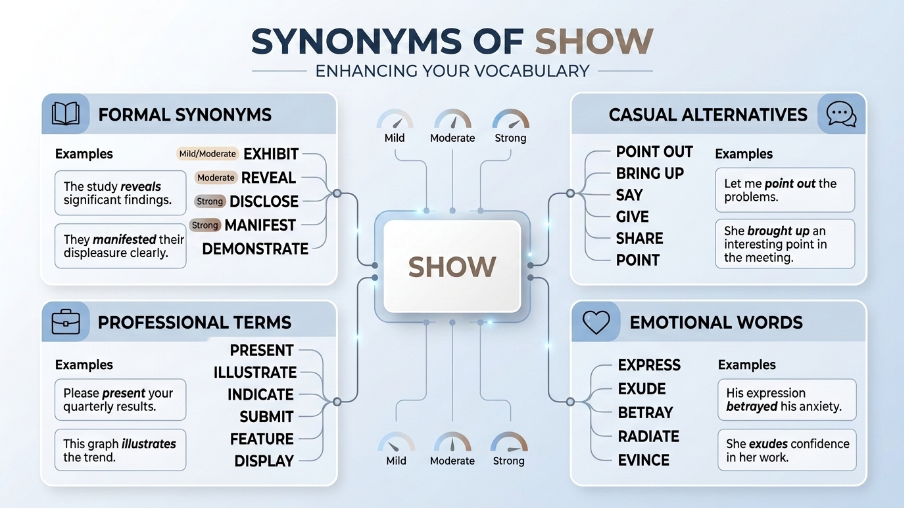
“Show” means to make something visible, demonstrate, or explain. The best synonyms depend on context. Use “demonstrate” for professional writing, “reveal” for emotional impact, “display” for visual contexts, and “indicate” for factual communication.
Meaning, Tone and Context
Simple Definition
To show something means to cause it to be seen, understood, or known by others.
Part of Speech
Show is primarily a verb. It can also function as a noun meaning a performance or exhibition.
Tone
The tone of “show” is neutral. This makes it useful but sometimes too vague for precise communication.
Formality Level
Show is standard English. It works in both casual and formal situations but may lack the sophistication needed for professional or academic writing.
Common Use Cases
- Describing visual demonstrations
- Explaining evidence or proof
- Presenting information
- Displaying emotions or qualities
- Performing or exhibiting
Important Word Forms
- Show (verb and noun)
- Shows (third person singular)
- Showing (present participle)
- Showed (past tense)
- Shown (past participle)
- Showy (adjective, often negative)
- Showman (noun)
When and How to Use “Show”
You should use “show” when you need a straightforward, neutral word that everyone understands. It works well when you do not need special emphasis or emotional weight.
Here are realistic examples across different contexts:
1. Professional Context
The quarterly report shows a fifteen percent increase in revenue.
2. Academic Context
The experiment shows that temperature affects the reaction rate.
3. Personal Context
Please show me your vacation photos when you have a moment.
4. Emotional Context
She finally showed her true feelings during the conversation.
5. Creative Context
The sunset showed colors we had never seen before.
6. Social Media Context
My recent post shows how I styled this outfit for spring.
7. Email Context
The attached document shows the complete project timeline.
Another Word for “Show”
The best single replacement for “show” depends entirely on your context and purpose.
Professional Writing
Use “demonstrate.” This word carries authority and suggests clear evidence or proof. The data demonstrates our success rate.
Academic Writing
Use “indicate.” This word suggests evidence or signs without making absolute claims. The results indicate a correlation.
Casual Conversation
Use “let me see” or “look at.” These phrases feel natural and friendly. Let me see that new phone you bought.
Emotional Writing
Use “reveal.” This word suggests vulnerability and truth coming to light. He revealed his deepest fears.
Creative Writing
Use “depict.” This word works beautifully for visual description and imagery. The painting depicts a rural landscape.
Resume or Workplace Use
Use “present.” This word suggests professionalism and competence. I presented my findings to the executive team.
Social Media Captions
Use “feature.” This word works well for highlighting products, outfits, or moments. This photo features my favorite corner of the city.
Stronger Meaning
Use “expose.” This word suggests revealing something hidden, often with significant impact. The investigation exposed the truth.
Softer Meaning
Use “suggest.” This word implies evidence without full certainty. The evidence suggests a different conclusion.
When Not to Use “Show”
Avoid using “show” when you need to convey a specific tone or precise meaning.
When the Word Sounds Too Vague
Compare these sentences:
Weak: His actions show he cares.
Strong: His actions demonstrate his commitment.
The second sentence is more powerful and specific.
When You Need Professional Impact
Avoid “show” in resumes, proposals, and executive summaries. Replace it with stronger action verbs like “demonstrate,” “present,” or “exhibit.”
When You Want Emotional Depth
Using “show” for emotional content feels flat. Choose “reveal,” “betray,” or “express” instead.
When You Describe Visual Art
“Show” does not capture artistic description well. Use “depict,” “portray,” or “illustrate.”
When Writing Formal Academic Papers
Academic readers expect precise language. Use “indicate,” “suggest,” or “demonstrate” based on your level of certainty.
Words Commonly Confused With “Show”
Several words overlap with “show” but have distinct meanings. Understanding these differences will help you choose the right word every time.
Show vs. Demonstrate
“Show” is general. “Demonstrate” implies deliberate proof or explanation.
Show: The photo shows my family.
Demonstrate: The expert demonstrated the technique step by step.
Show vs. Reveal
“Show” is neutral. “Reveal” suggests making something hidden known.
Show: The report shows the numbers.
Reveal: The report revealed a major error.
Show vs. Display
“Show” is active. “Display” emphasizes visual arrangement.
Show: She showed her artwork.
Display: She displayed her artwork in the gallery.
Show vs. Indicate
“Show” is direct. “Indicate” suggests evidence without absolute certainty.
Show: The sign shows the exit.
Indicate: The sign indicates the exit is nearby.
Show vs. Exhibit
“Show” is common. “Exhibit” is more formal and often relates to public display.
Show: He showed his collection.
Exhibit: He exhibited his collection at the museum.
Show vs. Portray
“Show” is literal. “Portray” suggests artistic representation or characterization.
Show: The movie shows a detective.
Portray: The movie portrays the detective as a flawed hero.
Best Synonym by Context for “Show”
| Context | Best Synonym | Why It Works | Example |
|---|---|---|---|
| Formal Writing | Demonstrate | Suggests proof and evidence with authority | The study demonstrates the effectiveness of the treatment |
| Academic Writing | Indicate | Implies evidence without overclaiming | The findings indicate a need for further research |
| Professional or Business | Present | Sounds polished and competent | I will present the quarterly results at the meeting |
| Resume Use | Exemplify | Highlights your skills through concrete examples | My leadership style exemplifies collaboration |
| Casual Conversation | Let me see | Feels natural and friendly | Let me see what you are talking about |
| Creative Writing | Depict | Creates vivid visual imagery | The novel depicts life in rural America |
| Emotional Tone | Reveal | Suggests vulnerability and hidden truth | She revealed her childhood memories |
| Strong Intensity | Expose | Implies uncovering something important | The article exposed the corruption |
| Soft or Moderate Tone | Suggest | Indicates possibility without certainty | His expression suggested confusion |
| Social Media Captions | Feature | Highlights products, outfits, or moments | This video features our new product line |
| US English | Show | Standard American English usage | The guide shows you how to cook the dish |
| UK English | Demonstrate | More common in British academic and professional contexts | The research demonstrates a clear pattern |
Which Synonym Should You Choose?
Choosing the right synonym for “show” is easier when you ask yourself a few simple questions.
Consider Your Meaning
Are you proving something, displaying something, or revealing something hidden?
Use “demonstrate” for proof, “display” for visual presentation, and “reveal” for hidden information.
Consider Your Formality Level
Are you writing an email to a colleague or an academic paper?
Use “present” or “demonstrate” for professional situations. Use “show” or “let me see” for casual conversations.
Consider Your Emotional Intensity
Do you want to sound neutral or emotional?
Use “indicate” or “show” for neutral statements. Use “reveal” or “expose” for emotional impact.
Consider Your Professional Value
Are you describing your achievements or skills?
Use “exemplify” or “demonstrate” to sound more impressive than “show.”
Consider Your Sentence Context
Does your sentence need a strong action verb or a softer suggestion?
Choose “expose” for strong impact. Choose “suggest” for softer, less certain statements.
Real Life Examples of “Show” in Sentences
These examples demonstrate how “show” and its synonyms work in different real world situations.
School
The science fair project showed how plants respond to light.
Better: The science fair project demonstrated how plants respond to light.
Workplace
My manager showed appreciation for my hard work.
Better: My manager expressed appreciation for my hard work.
Writing
The article shows three ways to improve productivity.
Better: The article outlines three ways to improve productivity.
Conversation
Can you show me how to fix this?
Better: Can you walk me through fixing this?
Social Media
This post shows my morning routine.
Better: This post highlights my morning routine.
Resume
I showed leadership skills in my previous role.
Better: I demonstrated leadership skills in my previous role.
The chart shows our progress this quarter.
Better: The chart illustrates our progress this quarter.
Storytelling
His smile showed he was happy.
Better: His smile revealed his happiness.
25 Synonyms for “Show”
| Synonym | Simple Meaning | Best Used For | Example Sentence |
|---|---|---|---|
| Demonstrate | To prove or explain clearly | Professional and academic writing | The experiment demonstrates the theory perfectly |
| Reveal | To make something hidden known | Emotional or dramatic contexts | The diary revealed her true feelings |
| Display | To put something in plain view | Visual or public presentations | The museum displays ancient artifacts |
| Indicate | To point out or suggest | Academic and scientific writing | The data indicates a positive trend |
| Present | To formally introduce or offer | Business and professional settings | I will present the budget proposal tomorrow |
| Exhibit | To display publicly | Art, science, and formal exhibitions | The gallery exhibits contemporary paintings |
| Illustrate | To explain with examples or pictures | Educational and explanatory writing | The diagram illustrates the process clearly |
| Expose | To uncover something hidden | Investigative or emotional contexts | The report exposed the company’s mistakes |
| Portray | To represent in art or literature | Creative and descriptive writing | The film portrays life in the 1920s |
| Depict | To show in a picture or describe | Artistic and visual descriptions | The mural depicts a historical battle |
| Express | To convey thoughts or feelings | Emotional and personal communication | She expressed her concerns honestly |
| Convey | To communicate or transmit | Formal and professional writing | The email conveys the urgency of the situation |
| Manifest | To make clear or evident | Formal and abstract contexts | His behavior manifested his true intentions |
| Unveil | To reveal for the first time | Product launches and major announcements | The company unveiled its new smartphone |
| Highlight | To emphasize or draw attention | Presentations and social media | The report highlights key achievements |
| Emphasize | To give special importance | Professional and academic writing | The speaker emphasized the need for change |
| Proclaim | To announce officially | Formal declarations and speeches | The president proclaimed a national holiday |
| Disclose | To make information known | Legal, financial, and formal contexts | The company disclosed its financial records |
| Suggest | To imply or hint | Academic and cautious statements | The evidence suggests a different conclusion |
| Point out | To direct attention to | Casual and instructional contexts | She pointed out the error in the report |
| Set forth | To present or explain | Legal and formal documents | The contract sets forth the terms clearly |
| Advertise | To promote publicly | Marketing and business contexts | The campaign advertises the product’s benefits |
| Broadcast | To make widely known | Media and communication | The news broadcast the election results |
| Betray | To reveal unintentionally | Emotional and psychological contexts | His voice betrayed his nervousness |
| Mirror | To reflect or imitate | Descriptive and comparative writing | The results mirror previous findings |
Synonym Groups and Usage Differences
Professional vs. Personal Synonyms
Professional synonyms like “demonstrate,” “present,” and “exhibit” suggest competence and formal communication. Personal synonyms like “reveal,” “express,” and “let me see” work better in casual or emotional contexts.
Professional: The study demonstrates the effectiveness of the new method.
Personal: Her smile revealed her happiness.
Formal vs. Conversational Synonyms
Formal synonyms include “demonstrate,” “indicate,” “exhibit,” and “manifest.” These words appear in reports, essays, and speeches. Conversational synonyms include “point out,” “let me see,” and “show.” These words work well in texts, emails to friends, and casual speaking.
Formal: The data indicates a significant correlation.
Conversational: Let me show you what I mean.
Academic Synonyms
Academic writing benefits from precise words like “indicate,” “demonstrate,” “suggest,” and “illustrate.” These words convey different levels of certainty and evidence.
The results indicate a possible connection.
The experiment demonstrates a clear cause and effect.
The evidence suggests further investigation is needed.
Professional and Business Synonyms
Business professionals should use “present,” “demonstrate,” “highlight,” and “exemplify.” These words sound confident and competent in emails, resumes, presentations, and meetings.
I will present the quarterly results.
The report highlights our key achievements.
My previous experience exemplifies leadership.
Creative or Literary Synonyms
Creative writers can enrich their work with “depict,” “portray,” “unveil,” and “mirror.” These words add imagery, emotion, and descriptive depth.
The novel depicts the struggles of immigrant families.
The poem portrays love as a transformative force.
The landscape mirrored her melancholy mood.
Slang or Modern Synonyms
Slang synonyms for “show” are limited. “Flex” is a modern slang term meaning to show off. It is acceptable in casual social media contexts but never appropriate in professional or academic writing.
He flexed his new car on Instagram.
Strongest vs. Weaker Synonyms
Mild
Suggest
Point out
Indicate
Moderate
Show
Display
Present
Strong
Demonstrate
Expose
Reveal
Very Strong
Proclaim
Unveil
Manifest
Emotional vs. Neutral Synonyms
Neutral
Show
Indicate
Display
Present
Emotional
Reveal
Express
Expose
Betray
Antonyms of “Show”
| Antonym | Meaning | Example Sentence |
|---|---|---|
| Hide | To keep out of sight | She tried to hide her disappointment |
| Conceal | To keep secret or hidden | He concealed the documents in his drawer |
| Cover | To place something over | The clouds covered the sun |
| Mask | To hide or disguise | Her smile masked her true feelings |
| Disguise | To change appearance to hide | The spy disguised his identity |
| Suppress | To prevent from being revealed | He suppressed his anger during the meeting |
| Obscure | To make unclear or hidden | The fog obscured the mountain view |
| Veil | To cover or conceal | The truth remained veiled for years |
| Bury | To hide from view | The report buried the most important findings |
| Withhold | To refuse to give or show | The company withheld important information |
| Deny | To refuse to acknowledge | He denied any knowledge of the event |
| Contradict | To state the opposite | The evidence contradicts his claims |
| Refute | To prove false | The study refutes earlier assumptions |
| Disprove | To show something is false | The experiment disproved the hypothesis |
| Omit | To leave out | The report omitted critical details |
Comparison: Show vs. Similar Words
Show vs. Demonstrate
Main Difference: “Show” is general. “Demonstrate” implies deliberate proof or teaching.
Which One Is Stronger: Demonstrate is stronger and more authoritative.
Which One Is More Formal: Demonstrate is more formal.
Example: The photo shows my family. The instructor demonstrated the proper technique.
Show vs. Reveal
Main Difference: “Show” is neutral. “Reveal” suggests making hidden information known.
Which One Is Stronger: Reveal is emotionally stronger.
Which One Is More Formal: Both are acceptable in formal contexts.
Example: The clock shows the time. The investigation revealed the truth.
Show vs. Display
Main Difference: “Show” is active. “Display” emphasizes visual arrangement.
Which One Is Stronger: Neither is stronger; they serve different purposes.
Which One Is More Formal: Display is slightly more formal.
Example: She showed her artwork. She displayed her artwork in the gallery.
Show vs. Indicate
Main Difference: “Show” is direct. “Indicate” suggests evidence without certainty.
Which One Is Stronger: Show is more direct and certain.
Which One Is More Formal: Indicate is more academic.
Example: The sign shows the exit. The signs indicate a change in weather.
Show vs. Illustrate
Main Difference: “Show” is general. Illustrate” means to explain using examples or images.
Which One Is Stronger: Illustrate is more precise for explanations.
Which One Is More Formal: Illustrate is more academic.
Example: The book shows different techniques. The diagram illustrates the process.
Show vs. Portray
Main Difference: “Show” is literal. “Portray” suggests artistic representation.
Which One Is Stronger: Portray is more descriptive and vivid.
Which One Is More Formal: Both are acceptable in formal contexts.
Example: The movie shows a detective. The movie portrays the detective as a hero.
Common Phrases and Expressions with “Show”
1. Show off
Meaning: To display one’s abilities or possessions proudly, often excessively.
Example: He always shows off his new gadgets at parties.
2. Show up
Meaning: To arrive or appear.
Example: She showed up late to the meeting.
3. Show someone around
Meaning: To guide someone through a place.
Example: I will show you around the office on your first day.
4. Show your hand
Meaning: To reveal your intentions or plans.
Example: The negotiator refused to show his hand too early.
5. Show the way
Meaning: To lead or guide.
Example: The experienced hiker showed the way through the forest.
6. Show compassion
Meaning: To demonstrate kindness or sympathy.
Example: The nurse showed compassion to all her patients.
7. Show signs of
Meaning: To indicate the presence of something.
Example: The patient is showing signs of recovery.
8. Show a preference for
Meaning: To indicate a liking for one thing over another.
Example: Children often show a preference for sweet foods.
Common Mistakes to Avoid
1. Using “Show” When a More Precise Synonym Is Better
Vague: The report shows improvements.
Precise: The report demonstrates significant improvements.
2. Confusing “Show” with “Reveal”
Incorrect: The manual reveals how to operate the machine.
Correct: The manual shows how to operate the machine.
3. Using a Casual Synonym in Formal Writing
Incorrect: The study lets us see the connection.
Correct: The study demonstrates the connection.
4. Using an Overly Dramatic Synonym for a Simple Situation
Incorrect: The menu exposes the daily specials.
Correct: The menu shows the daily specials.
5. Repeating the Same Word Too Often
Poor: The graph shows sales. The table shows expenses. The report shows profits.
Improved: The graph shows sales. The table displays expenses. The report indicates profits.
6. Choosing a Synonym with the Wrong Emotional Tone
Incorrect: The teacher betrayed the answer.
Correct: The teacher revealed the answer.
7. Using Slang in Academic or Professional Writing
Incorrect: The study flexes the importance of education.
Correct: The study highlights the importance of education.
FAQs
What is the best synonym for show?
The best synonym depends on context. Use “demonstrate” for professional writing, “reveal” for emotional impact, and “indicate” for academic work.
What is a formal synonym for show?
Demonstrate” and “exhibit” are excellent formal synonyms for show. They work well in academic papers, business reports, and professional presentations.
What is an informal synonym for show?
“Let me see” and “point out” are informal alternatives. They work well in casual conversations and friendly emails.
What is another word for show in professional writing?
Present,” “demonstrate,” and “highlight” are the best professional synonyms. They sound confident and competent in business settings.
What is the difference between show and demonstrate?
“Show” is general and neutral. “Demonstrate” implies deliberate proof, explanation, or teaching. It sounds more authoritative and professional.
What is the opposite of show?
The main antonyms include hide, conceal, cover, mask, and obscure. Each suggests keeping something out of sight or keeping information secret.
Conclusion
The word “show” is useful, but it cannot do everything. Relying on this single word makes your writing feel repetitive and vague.
By learning the precise alternatives, you gain control over your message. You can demonstrate competence in professional settings, reveal emotions in personal writing, and indicate findings in academic work.
The best vocabulary tip is simple. Ask yourself what you really mean before you write. Are you displaying something visually, proving something logically, or uncovering something hidden? Choose the synonym that matches your true intention.
Your readers will notice the difference. Your writing will become clearer, more engaging, and more professional.

7 thoughts on “50+ Synonyms of Show| Meanings, Examples and Best Alternatives For 2026”