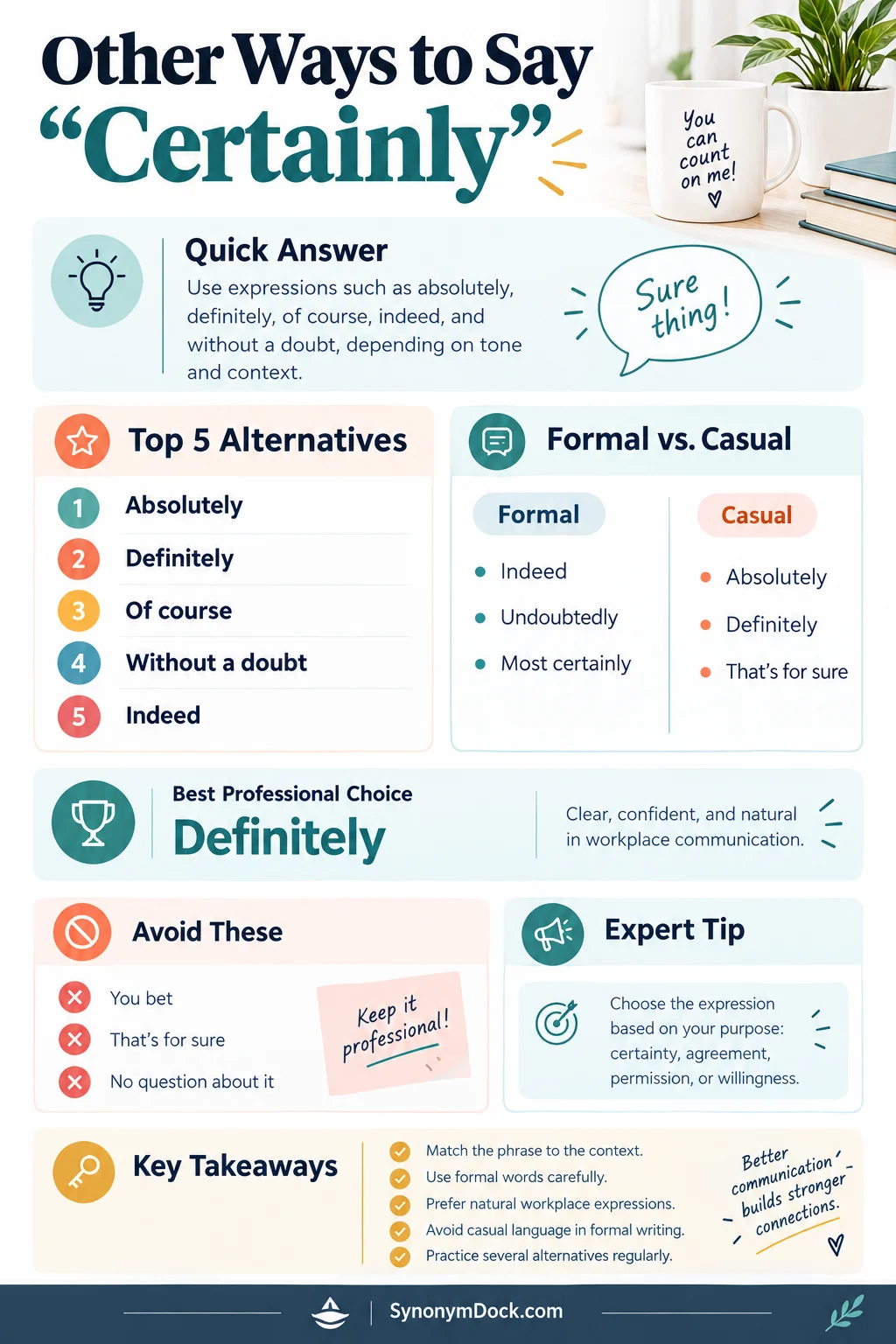
Other ways to say certainly include absolutely, definitely, of course, without a doubt, indeed, undoubtedly, and most certainly. The best choice depends on whether you want to sound formal, professional, confident, polite, or casual.
Top 5 alternatives: Absolutely, Definitely, Of course, Without a doubt, Indeed.
“Certainly” is a useful English word for showing strong agreement, confidence, willingness, or polite acceptance. However, using the same expression repeatedly can make your English sound less flexible.
Learning alternatives to certainly helps you choose language that fits the situation. You may need a formal expression for academic writing, a professional phrase for a business email, or a natural response in everyday conversation.
These other ways to say certainly also help you sound more fluent because native English speakers change their wording according to tone, context, and the strength of their certainty.
“Fluent English is not just knowing more words; it is knowing when each word fits.”
Quick Categories
Formal Alternatives
- Indeed
- Undoubtedly
- Assuredly
- Without a doubt
- Most certainly
Pro Tip
Use formal expressions carefully. Words such as undoubtedly and assuredly can sound polished in writing but may feel stiff in relaxed conversation.
Professional Alternatives
- Definitely
- Absolutely
- Certainly
- Of course
- You can count on it
Pro Tip
In workplace communication, choose a phrase that matches the level of confidence you actually want to express. Definitely and absolutely are confident without sounding excessively formal.
Business Email Alternatives
- Absolutely
- Of course
- I’d be happy to
- By all means
- You can count on it
Pro Tip
For business emails, phrases such as I’d be happy to can sound warmer than a simple “Certainly,” especially when responding to a request.
Academic Alternatives
- Indeed
- Undoubtedly
- Without a doubt
- Certainly
- Most certainly
Pro Tip
Academic writing generally benefits from precise language. Use undoubtedly only when the evidence genuinely supports a very strong claim.
Casual Alternatives
- Absolutely
- Definitely
- That’s for sure
- No question about it
- Surely
Pro Tip
Casual expressions work well with friends and familiar colleagues, but phrases such as that’s for sure are usually better in conversation than formal writing.
Informal Expressions
- Absolutely
- That’s for sure
- No question about it
- Definitely
- You bet
Pro Tip
Informal expressions can make conversations warmer and more natural, but they should not automatically be transferred into formal emails, reports, or academic essays.
Common Mistakes
1. Treating every alternative as an exact synonym
Why it is a problem: Some expressions show certainty, while others show agreement, permission, or willingness.
Correct approach: Choose the phrase according to its function.
Example:
“Certainly, I can help” can become “I’d be happy to help,” but “I’d be happy to” expresses willingness rather than certainty alone.
2. Using very formal words in casual conversation
Why it can sound awkward: “Assuredly” is grammatically correct, but it is uncommon in everyday speech.
Better: Use definitely, absolutely, or of course.
Example:
“Absolutely, I’ll come with you.”
3. Using “of course” without considering tone
Why it matters: “Of course” can sound friendly, but in some situations it may imply that something should have been obvious.
Better: Use it when the context clearly supports a warm or natural response.
Example:
“Of course, I can send you the document.”
4. Overusing “undoubtedly”
Why it can weaken your writing: Repeatedly making absolute claims can sound exaggerated.
Better: Reserve undoubtedly for situations where strong evidence supports certainty.
Example:
“Her research has undoubtedly influenced the field.”
5. Using casual phrases in formal writing
Why it is inappropriate: Expressions such as “You bet” and “That’s for sure” are conversational.
Better: Use indeed, certainly, or undoubtedly when the context requires formal English.
What Does “Certainly” Mean?
Certainly is an adverb used to express strong agreement, confidence, or willingness. It can also be used to give a polite affirmative response.
In simple English, certainly often means “yes,” “definitely,” “without doubt,” or “of course,” depending on the sentence.
Grammar
“Certainly” commonly appears:
- At the beginning: Certainly, I can help.
- Before the main verb: She certainly understands the issue.
- After an auxiliary verb: We can certainly discuss it.
Natural Example
“Certainly, I’ll send the updated report this afternoon.”
The word sounds polite and professional, which is why it appears frequently in workplace conversations and customer-service communication.
“A strong synonym should preserve the meaning not just replace the word.”
When to Use “Certainly”
You can use certainly in many situations, but its tone changes slightly with context.
- Business emails: “Certainly, I’ll forward the information.”
- Workplace meetings: “We can certainly consider that option.”
- Client communication: “Certainly, we can arrange another meeting.”
- Academic writing: “This certainly supports the argument.”
- Presentations: “This is certainly an important consideration.”
- Job interviews: “I would certainly welcome the opportunity.”
- Daily conversation: “Certainly, you can borrow it.”
- Spoken English: Often polite and confident.
- Written English: Suitable for professional and formal contexts.
- Formal situations: A strong, polite choice.
- Informal situations: Correct, although sure, definitely, or absolutely may sound more relaxed.
Is “Certainly” Professional or Polite?
Polite? ✔ Yes
Professional? ✔ Yes
Formal? ✔ Often
Natural? ✔ Yes
“Certainly” is especially useful when you want to give a positive answer without sounding overly casual.
Business example:
“Certainly. I’ll have the revised proposal ready by Friday.”
The phrase sounds respectful and capable. However, it does not necessarily sound warmer than alternatives such as I’d be happy to.
Pros and Cons
Pros
- Easy to understand
- Polite and respectful
- Suitable for professional communication
- Works in both speech and writing
- Shows confidence clearly
Cons
- Can sound slightly formal in casual conversation
- May become repetitive when overused
- Does not always express warmth
- Some alternatives communicate a more specific meaning
Before You Choose an Alternative
The best alternative depends on what you mean by “certainly.” Are you showing agreement, confirming information, accepting a request, or expressing confidence?
The following alternatives help you make that distinction more clearly while improving your professional English, spoken English, and vocabulary range.
“Choose the expression that matches your intention, not simply the closest dictionary synonym.”
Expert Tip
Native speakers often change expressions according to the relationship, setting, and purpose of the conversation. Absolutely can sound enthusiastic, indeed can sound formal, and I’d be happy to can sound especially helpful.
Other Ways to Say “Certainly” (With Examples)
These 15 alternatives cover professional communication, academic English, everyday conversation, and informal speech. Some are direct replacements, while others work when certainly is being used to express a related idea such as agreement or willingness.
1. Phrase: Absolutely
Meaning:
A strong way to say “yes” or show complete agreement or certainty.
Explanation:
“Absolutely” is one of the most natural modern alternatives to “certainly.” It is confident, enthusiastic, and common in spoken English. It works well with colleagues and in everyday conversation, although it can be slightly less formal than “certainly.”
Example Sentence:
“Absolutely, we can review the proposal before the meeting.”
Best Use: Business Conversation
Avoid Using In: Highly Formal Reports
Tone: Confident, Positive
Formality Level: ⭐⭐⭐ Neutral
Usage Frequency: Very Common
CEFR Level: B1
Common Collocations:
- absolutely agree
- absolutely certain
- absolutely right
- absolutely necessary
Context Variability:
- Spoken: “Absolutely, I agree.”
- Professional: “Absolutely, we can make that adjustment.”
- Casual: “Absolutely! Let’s do it.”
2. Phrase: Definitely
Meaning:
A common way to express strong certainty.
Explanation:
“Definitely” is natural in both spoken and written English. It is confident without being particularly formal, making it useful for workplace discussions, interviews, and everyday conversations.
Example Sentence:
“I’ll definitely review the figures before tomorrow’s presentation.”
Best Use: Workplace Discussion
Avoid Using In: Legal Statements
Tone: Confident, Direct
Formality Level: ⭐⭐⭐ Neutral
Usage Frequency: Very Common
CEFR Level: B1
Common Collocations:
- definitely agree
- definitely worth
- definitely possible
- definitely consider
Context Variability:
- Spoken: “Definitely. I’ll join you.”
- Professional: “We should definitely examine the proposal.”
- Casual: “I’ll definitely be there.”
3. Phrase: Of Course
Meaning:
A natural way to express agreement, permission, or willingness.
Explanation:
“Of course” is extremely common and versatile. It can sound warm and helpful, particularly when responding to a request. However, tone matters because it can occasionally sound dismissive if the listener feels their question was treated as obvious.
Example Sentence:
“Of course, I can send you a copy of the presentation.”
Best Use: Business Email
Avoid Using In: Sensitive Disagreement
Tone: Polite, Friendly
Formality Level: ⭐⭐⭐ Neutral
Usage Frequency: Very Common
CEFR Level: A2
Common Collocations:
- of course I can
- of course you can
- of course not
- of course we can
Context Variability:
- Spoken: “Of course, I can help.”
- Professional: “Of course, we can arrange another call.”
- Casual: “Of course! No problem.”
4. Phrase: Without a Doubt
Meaning:
A strong expression showing complete confidence.
Explanation:
“Without a doubt” emphasizes certainty more strongly than ordinary agreement. It is natural in conversation and writing but should not be used for claims that genuinely involve uncertainty.
Example Sentence:
“Without a doubt, clear communication improves teamwork.”
Best Use: Strong Assertion
Avoid Using In: Uncertain Claims
Tone: Confident, Emphatic
Formality Level: ⭐⭐⭐⭐ Formal
Usage Frequency: Common
CEFR Level: B2
Common Collocations:
- without a doubt
- without a doubt the best
- without a doubt important
- without a doubt successful
Context Variability:
- Spoken: “Without a doubt, she’s the right person.”
- Professional: “Without a doubt, this deserves further attention.”
- Casual: “He’s without a doubt the funniest person here.”
5. Phrase: Indeed
Meaning:
A formal or polished way to confirm, emphasize, or agree with a statement.
Explanation:
“Indeed” is especially useful in formal writing, academic English, presentations, and thoughtful professional communication. It sounds more formal than “absolutely” or “definitely.”
Example Sentence:
“Indeed, the findings provide useful evidence for the proposed approach.”
Best Use: Academic Writing
Avoid Using In: Casual Texting
Tone: Formal, Affirming
Formality Level: ⭐⭐⭐⭐ Formal
Usage Frequency: Common
CEFR Level: B2
Common Collocations:
- indeed true
- indeed important
- indeed the case
- yes, indeed
Context Variability:
- Spoken: “Indeed, that is a fair point.”
- Professional: “Indeed, the results support our conclusion.”
- Casual: “Indeed! I hadn’t thought of it that way.”
Native Speaker Tip
Absolutely and definitely are usually more natural in everyday conversation. Indeed is more polished and often appears in formal or written contexts. Assuredly and similar literary expressions are much less common today.
6. Phrase: Most Certainly
Meaning:
A stronger, more emphatic form of “certainly.”
Explanation:
“Most certainly” emphasizes complete confidence or agreement. It sounds polite and formal, and it is useful when you deliberately want a stronger tone.
Example Sentence:
“We will most certainly take your feedback into account.”
Best Use: Formal Response
Avoid Using In: Casual Chat
Tone: Formal, Confident
Formality Level: ⭐⭐⭐⭐ Formal
Usage Frequency: Occasional
CEFR Level: B2
Common Collocations:
- most certainly agree
- most certainly will
- most certainly true
- most certainly possible
Context Variability:
- Spoken: “Most certainly, I understand.”
- Professional: “We will most certainly review your concerns.”
- Casual: Possible, but often unnecessarily formal.
7. Phrase: Undoubtedly
Meaning:
An expression meaning that something is accepted as certain or beyond reasonable doubt.
Explanation:
“Undoubtedly” is particularly useful for formal writing and strong analytical statements. It should be used carefully because it presents a claim with a high degree of confidence.
Example Sentence:
“Her experience has undoubtedly contributed to the project’s success.”
Best Use: Academic Writing
Avoid Using In: Casual Conversation
Tone: Formal, Assertive
Formality Level: ⭐⭐⭐⭐⭐ Very Formal
Usage Frequency: Common
CEFR Level: C1
Common Collocations:
- undoubtedly important
- undoubtedly successful
- undoubtedly one of
- undoubtedly true
Context Variability:
- Spoken: “She is undoubtedly talented.”
- Professional: “This is undoubtedly an important consideration.”
- Casual: Correct, but can sound serious.
8. Phrase: Assuredly
Meaning:
A formal expression meaning certainly or confidently.
Explanation:
“Assuredly” is grammatically correct but considerably less common in modern everyday English. It can sound literary, old-fashioned, or deliberately formal.
Example Sentence:
“Assuredly, the decision requires careful consideration.”
Best Use: Formal Prose
Avoid Using In: Casual Conversation
Tone: Literary, Formal
Formality Level: ⭐⭐⭐⭐⭐ Very Formal
Usage Frequency: Rare
CEFR Level: C2
Common Collocations:
- assuredly true
- assuredly correct
- assuredly important
- assuredly the case
Context Variability:
- Spoken: Uncommon.
- Professional: Possible, but usually unnecessarily formal.
- Casual: Avoid.
9. Phrase: By All Means
Meaning:
A polite expression giving permission or enthusiastic agreement to a request.
Explanation:
“By all means” is not a universal synonym for “certainly.” It works best when someone asks for permission or suggests doing something and you want to encourage it.
Example Sentence:
“By all means, feel free to contact me if you need further information.”
Best Use: Giving Permission
Avoid Using In: Academic Claims
Tone: Helpful, Polite
Formality Level: ⭐⭐⭐⭐ Formal
Usage Frequency: Common
CEFR Level: B2
Common Collocations:
- by all means, go ahead
- by all means, ask
- by all means, continue
- by all means, feel free
Context Variability:
- Spoken: “By all means, come in.”
- Professional: “By all means, please share your suggestions.”
- Casual: “By all means, take the last piece.”
10. Phrase: I’d Be Happy To
Meaning:
A polite way to show willingness to do something.
Explanation:
This phrase is especially useful when “certainly” means “yes, I am willing to help.” It is warmer and more personal than a simple “certainly,” making it excellent for customer service, business emails, and workplace communication.
Example Sentence:
“I’d be happy to discuss the details with you tomorrow.”
Best Use: Professional Email
Avoid Using In: Academic Claims
Tone: Warm, Professional
Formality Level: ⭐⭐⭐⭐ Formal
Usage Frequency: Very Common
CEFR Level: B1
Common Collocations:
- happy to help
- happy to discuss
- happy to assist
- happy to provide
Context Variability:
- Spoken: “I’d be happy to help.”
- Professional: “I’d be happy to arrange a follow-up meeting.”
- Casual: “I’d be happy to come along.”
Native Speaker Tip
For workplace requests, I’d be happy to often sounds warmer than certainly. Definitely is more direct, while indeed is more formal. Choose based on whether you want warmth, confidence, or formality.
11. Phrase: You Can Count on It
Meaning:
A confident way to promise that something will happen or be reliable.
Explanation:
This expression communicates assurance rather than simple certainty. It is natural in spoken English and can work professionally when the relationship is familiar, but it is less suitable for highly formal documents.
Example Sentence:
“You can count on it; I’ll have the figures ready before the meeting.”
Best Use: Verbal Commitment
Avoid Using In: Academic Essay
Tone: Confident, Reassuring
Formality Level: ⭐⭐⭐ Neutral
Usage Frequency: Common
CEFR Level: B2
Common Collocations:
- count on it
- count on me
- count on our support
- count on your team
Context Variability:
- Spoken: “You can count on it.”
- Professional: “You can count on our team to support the rollout.”
- Casual: “You can count on me.”
12. Phrase: That’s for Sure
Meaning:
A casual expression used to strongly confirm something.
Explanation:
“That’s for sure” is conversational and emphatic. It is useful in friendly discussions but usually does not belong in academic writing or highly formal business communication.
Example Sentence:
“The new schedule is demanding, that’s for sure.”
Best Use: Daily Conversation
Avoid Using In: Formal Report
Tone: Casual, Emphatic
Formality Level: ⭐⭐ Casual
Usage Frequency: Common
CEFR Level: B1
Common Collocations:
- that’s for sure
- one thing’s for sure
- that much is for sure
- it’s difficult, that’s for sure
Context Variability:
- Spoken: “That’s for sure.”
- Professional: Use sparingly with familiar colleagues.
- Casual: “He’s busy, that’s for sure.”
13. Phrase: No Question About It
Meaning:
A strong informal expression showing complete confidence.
Explanation:
“No question about it” emphasizes that the speaker sees something as certain. It is natural in conversation and can add emphasis, but it is generally too conversational for academic or highly formal writing.
Example Sentence:
“No question about it, the team handled the challenge well.”
Best Use: Informal Discussion
Avoid Using In: Academic Paper
Tone: Strong, Casual
Formality Level: ⭐⭐ Casual
Usage Frequency: Common
CEFR Level: B2
Common Collocations:
- no question about it
- no question that
- there’s no question
- no question whatsoever
Context Variability:
- Spoken: “There’s no question about it.”
- Professional: Acceptable in relaxed meetings.
- Casual: “No question about it she earned the promotion.”
14. Phrase: Surely
Meaning:
An expression used to indicate strong expectation or belief.
Explanation:
“Surely” is tricky because it does not always mean exactly “certainly.” It can suggest that the speaker believes something must be true, and it may sometimes sound doubtful or rhetorical.
Example Sentence:
“Surely, there must be another way to solve the problem.”
Best Use: Rhetorical Statement
Avoid Using In: Direct Confirmation
Tone: Emphatic, Contextual
Formality Level: ⭐⭐⭐ Neutral
Usage Frequency: Common
CEFR Level: B2
Common Collocations:
- surely true
- surely possible
- surely understand
- surely enough
Context Variability:
- Spoken: “Surely you remember her.”
- Professional: “Surely we can find a practical solution.”
- Casual: “Surely that can’t be right.”
15. Phrase: Absolutely No Doubt
Meaning:
A strong expression emphasizing complete certainty.
Explanation:
This phrase is useful when you want to emphasize that there is no uncertainty. In natural English, without a doubt or there’s absolutely no doubt often sounds smoother than using “absolutely no doubt” alone.
Example Sentence:
“There’s absolutely no doubt that preparation improved her presentation.”
Best Use: Strong Emphasis
Avoid Using In: Tentative Analysis
Tone: Strong, Confident
Formality Level: ⭐⭐⭐ Neutral
Usage Frequency: Common
CEFR Level: B2
Common Collocations:
- absolutely no doubt
- absolutely no question
- no doubt whatsoever
- there is no doubt
Context Variability:
- Spoken: “There’s absolutely no doubt about it.”
- Professional: “There is absolutely no doubt that the change was necessary.”
- Casual: “No doubt about it he’s ready.”
Expert Insight
In professional English, the safest replacement depends on the purpose of the sentence. Use definitely for direct certainty, I’d be happy to for willingness, indeed for formal confirmation, and absolutely for strong agreement.
Avoid These in Formal Situations
Some alternatives are correct English but may sound too conversational for formal writing.
- You bet friendly and informal; use “certainly” or “absolutely” instead.
- That’s for sure natural speech, but too casual for formal reports.
- No question about it emphatic and conversational; use “undoubtedly” in formal contexts.
- You can count on it suitable for promises, but less appropriate for academic claims.
- Surely can imply doubt or rhetorical questioning, so it may not express certainty precisely.
“Correct English is not always appropriate English; register matters.”
Best Phrases by Situation
| Situation | Best Phrase |
| Business Email | I’d be happy to |
| Client Meeting | Absolutely |
| Academic Essay | Undoubtedly |
| Presentation | Certainly |
| Workplace Discussion | Definitely |
| Job Interview | Absolutely |
| Team Collaboration | You can count on it |
| Everyday Conversation | Of course |
See Also
- Other Ways to Say “I Agree” Learn natural, formal, and professional agreement expressions.
- Professional English Guide Improve your workplace vocabulary, emails, meetings, and formal communication.
Top 10 Alternatives Compared
| Phrase | Tone | Formality | Best Use | Frequency |
| Absolutely | Confident, positive | Neutral | Conversation | Very Common |
| Definitely | Direct, confident | Neutral | Workplace | Very Common |
| Of course | Friendly, polite | Neutral | Requests | Very Common |
| Without a doubt | Emphatic | Formal | Strong claims | Common |
| Indeed | Formal, affirming | Formal | Academic writing | Common |
| Most certainly | Formal, confident | Formal | Formal responses | Occasional |
| Undoubtedly | Assertive | Very Formal | Academic writing | Common |
| By all means | Helpful, polite | Formal | Permission | Common |
| I’d be happy to | Warm, professional | Formal | Business email | Very Common |
| You can count on it | Reassuring | Neutral | Commitments | Common |
Which One Should You Use?
Best Overall
Absolutely is a highly natural choice when you want to express strong agreement or confirmation.
Best Professional
Definitely sounds confident and clear in most workplace conversations.
Best Academic
Undoubtedly works well when evidence supports a strong statement.
Best Business Email
I’d be happy to adds warmth when accepting or responding to a request.
Best Everyday Conversation
Of course is natural, familiar, and flexible.
Most Natural
Absolutely is especially common in modern spoken English.
Most Polite
Certainly or I’d be happy to works well when you want a respectful professional tone.
Commonly Confused Phrases
“Certainly” vs. “Absolutely”
Certainly is often polite and professional. Absolutely is usually more enthusiastic and emphatic.
- “Certainly, I can help.” → polite confirmation
- “Absolutely, I agree.” → strong agreement
“Certainly” vs. “Definitely”
Both express confidence, but definitely is generally more conversational.
- “Certainly, we can discuss this.” → polite
- “We can definitely discuss this.” → direct and natural
“Certainly” vs. “Indeed”
Indeed is more formal and often appears in academic or written English.
- “Certainly, this is important.” → confident
- “Indeed, this supports the argument.” → formal confirmation
“Certainly” vs. “I’d Be Happy To”
These expressions serve different purposes.
- “Certainly” → confirms or agrees.
- “I’d be happy to” → shows willingness to help.
Understanding this difference prevents awkward substitutions.
Scenario Practice
1. Business Meeting
Situation: A colleague suggests reviewing the proposal before sending it to the client.
Which phrase would you choose?
Answer: “Absolutely. Let’s review it together.”
Why: It sounds confident, cooperative, and natural in workplace conversation.
2. Job Interview
Situation: The interviewer asks whether you would be willing to relocate.
Which phrase would you choose?
Answer: “Absolutely. I would be open to relocating for the right opportunity.”
Why: “Absolutely” communicates confidence without sounding excessively formal.
3. Presentation
Situation: You want to emphasize that preparation matters.
Which phrase would you choose?
Answer: “Certainly, preparation plays an important role.”
Why: “Certainly” fits a professional presentation and sounds measured.
4. Class Discussion
Situation: You strongly agree with another student’s interpretation.
Which phrase would you choose?
Answer: “I absolutely agree with that interpretation.”
Why: It sounds natural while clearly showing strong agreement.
5. Email Reply
Situation: A client asks whether you can provide additional information.
Which phrase would you choose?
Answer: “I’d be happy to provide the additional information.”
Why: It is professional, warm, and more helpful than a bare “certainly.”
Mini Quiz
1. Which phrase is most suitable for an academic essay?
A. You bet
B. That’s for sure
C. Undoubtedly
D. Absolutely
Answer: C
2. A colleague asks whether you can help with a report. Which sounds warm and professional?
A. I’d be happy to
B. You bet
C. No question about it
D. Surely
Answer: A
3. Which expression is most natural for strong agreement in conversation?
A. Assuredly
B. Absolutely
C. Indeed
D. Undoubtedly
Answer: B
4. Which phrase can sound rhetorical rather than simply certain?
A. Surely
B. Definitely
C. Absolutely
D. Certainly
Answer: A
5. Which expression is more casual?
A. Indeed
B. Undoubtedly
C. That’s for sure
D. Most certainly
Answer: C
Answer Key
- 1. C Undoubtedly: Appropriate for strong, evidence-based formal statements.
- 2. A I’d be happy to: Expresses willingness in a warm professional way.
- 3. B Absolutely: Very common for enthusiastic agreement.
- 4. A Surely: Can imply expectation, doubt, or a rhetorical point.
- 5. C That’s for sure: Primarily conversational and informal.
Frequently Asked Questions
What is the most formal way to say “certainly”?
Undoubtedly, indeed, and most certainly can sound more formal than everyday alternatives. Among them, undoubtedly is especially useful in formal or academic writing when the evidence supports a strong claim. Assuredly is also formal, but it is relatively rare and can sound literary or old-fashioned.
Which phrase is best for professional emails?
I’d be happy to is an excellent choice when responding positively to a request because it sounds helpful and professional. Certainly and absolutely also work well, depending on context. For example, “I’d be happy to send the revised document” sounds warmer than simply writing “Certainly.”
What is the difference between “certainly” and “definitely”?
Both communicate confidence, but their tone can differ. Certainly often sounds more polite or formal, especially when answering a request. Definitely is usually more conversational and direct. For example, “Certainly, I can assist” sounds polished, while “I’ll definitely help” sounds more conversational.
Which alternative to “certainly” sounds most natural?
Absolutely, definitely, and of course are among the most natural choices in modern everyday English. The best option depends on meaning. Use absolutely for strong agreement, definitely for certainty, and of course for a friendly confirmation or response to a request.
Can I use these expressions in business meetings?
Yes, but choose according to tone and purpose. Certainly, absolutely, and definitely work naturally in many workplace meetings. Indeed and undoubtedly sound more formal, while that’s for sure is more conversational. In professional communication, clarity and appropriate confidence matter more than choosing the most sophisticated expression.
Conclusion
Learning different ways to say certainly gives you more control over your English. Some expressions communicate strong certainty, while others show agreement, permission, or willingness. Understanding these differences helps you avoid repetitive language and choose expressions that fit professional emails, academic writing, meetings, presentations, interviews, and everyday conversations.
Start by practicing three flexible choices: absolutely for strong agreement, definitely for confident confirmation, and I’d be happy to for polite professional responses. Then add more formal options such as indeed and undoubtedly as your vocabulary grows. The more you practice matching words to context, the more natural and confident your English will sound.

1 thought on “Other Ways to Say Certainly |23+ Examples For 2026”