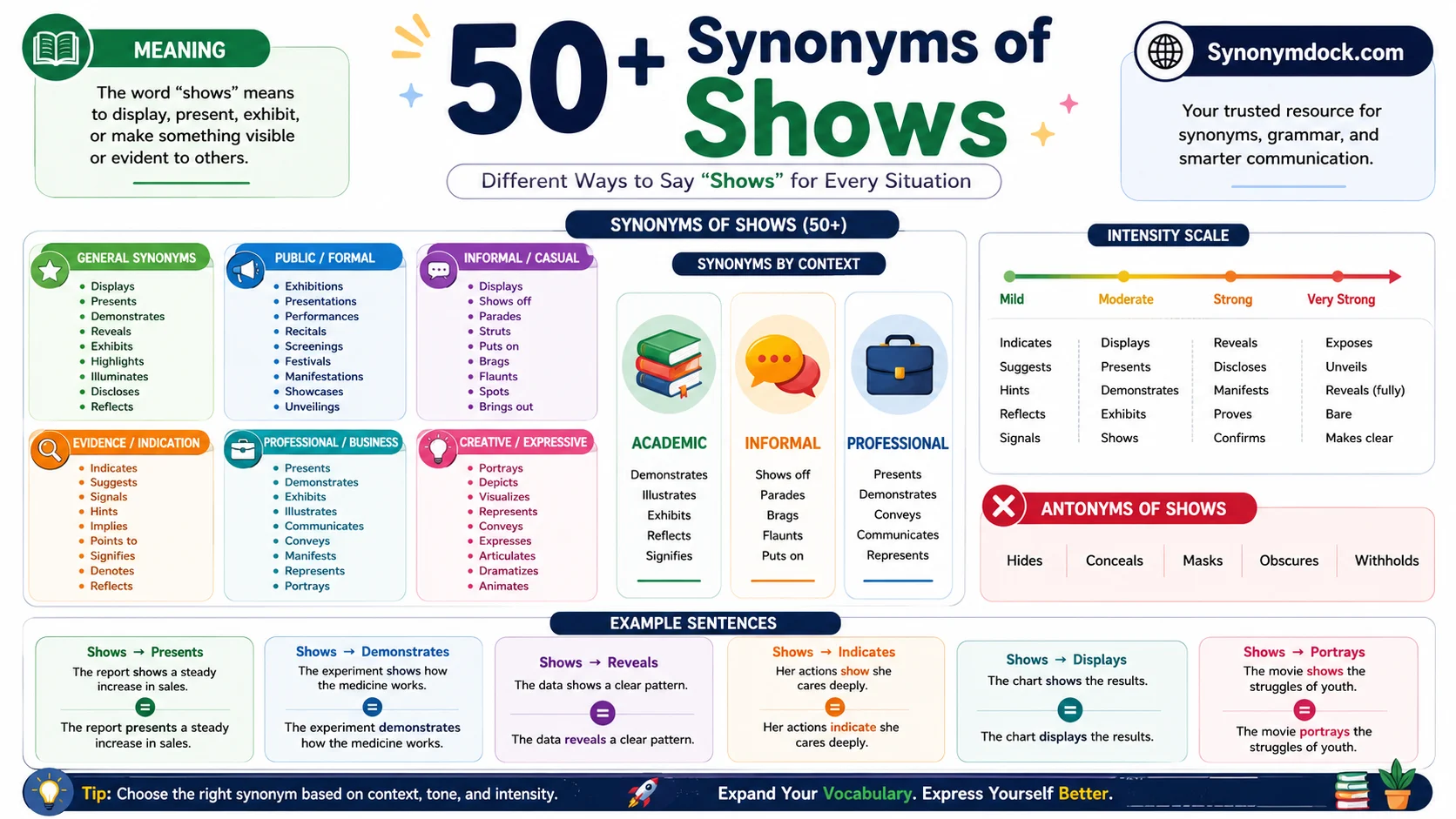
“Shows” is a verb meaning to display, demonstrate, or make something visible. The best synonym depends on your context. For formal writing, use “demonstrates” or “indicates.” For professional settings, use “displays,” “presents,” or “showcases.” For casual conversation, simpler words like “reveals” work well .
Have you ever noticed yourself using the word “shows” over and over in a report, an email, or a social media caption? It is a common habit that can make writing feel repetitive and a bit dull. The word is versatile, but relying on it too much can weaken your message. Choosing the right synonym of shows helps you communicate with more precision. It is not just about avoiding repetition; it is about choosing a word that truly fits the situation.
Whether you are writing a college essay, preparing a business presentation, or simply trying to express yourself more clearly, the words you choose matter. This guide will help you understand the many ways to say “shows” effectively.
Meaning, Tone, and Context
Understanding the core meaning of “shows” is the first step to using it and its synonyms effectively.
Simple Definition
To cause or allow something to be seen; to display. It can also mean to demonstrate, prove, or explain something. Additionally, it refers to a public performance or exhibition .
Part of Speech
“Shows” is most commonly used as a verb (the third-person singular present of “show”). It is also used as a plural noun meaning performances or exhibitions .
Overall Tone
“Shows” is a neutral word. It simply communicates an action without adding strong positive or negative emotion.
Formality Level
The word “shows” is neutral. It works in most everyday writing, but in academic or professional reports, more specific synonyms are often preferred.
Common Uses
Native English speakers use “shows” in many situations:
- To present visual information: “The map shows the route.”
- To explain or prove: “The data shows a clear trend.”
- To talk about entertainment: “We watch our favorite shows on TV.”
Word Forms
- Verb: show (base), showed (past), shown (past participle), showing (present participle)
- Noun: show (singular), shows (plural)
When and How to Use “Shows”
Use “shows” when you need a clear, general word to describe presenting something to others. It is the default choice in many contexts but can be replaced with more specific words.
7 Realistic Examples
- Professional: The report shows a 15% increase in sales this quarter.
- Academic: The research shows a clear link between diet and overall health.
- Workplace: The new employee shows great potential and enthusiasm.
- Personal: She shows her affection by baking cookies for her friends.
- Email: The attached document shows the proposed budget.
- Resume: My experience shows my ability to manage complex projects.
- Social Media: Her post shows her fun weekend trip to the beach.
Best Synonyms of “Shows”
No two synonyms are perfectly identical. The best choice depends on the specific context and what you want to emphasize. Here are some top recommendations for different situations.
- Professional writing: Use “demonstrates” to show evidence logically .
- Academic writing: Use “indicates” to present findings subtly.
- Business communication: Use “presents” to formally introduce information.
- Casual conversation: Use “shows” or “lets you see” for simplicity.
- Emotional writing: Use “reveals” to uncover feelings or secrets .
- Creative writing: Use “showcases” to highlight something impressive.
- Resume writing: Use “achieved” or “managed” instead of “shows” for stronger impact.
- Workplace communication: Use “illustrates” when using examples to explain a point.
- Stronger meaning: Use “proves” when you want to say it is certain.
- Softer meaning: Use “suggests” when the conclusion is not definitive.
When Not to Use “Shows”
While “shows” is versatile, there are times when it falls short. Using it too much can make your writing feel vague or repetitive. Here are situations where you should choose a more precise word.
When the Word Sounds Too General
- Why it is less effective: It does not provide any detail about how something is being shown.
- Recommend a better synonym: Use “demonstrates” for proof or “displays” for visual presentation.
- Rewrite the sentence: “The chart shows a decline.” becomes “The chart clearly demonstrates a consistent decline in sales over the past year.”
Sounds Too Vague
- Why it is less effective: It does not distinguish between a casual mention and a formal exhibition.
- Recommend a better synonym: Use “presents” for formal introductions or “unveils” for new ideas .
- Rewrite the sentence: “She shows the plan to the team.” becomes “She presents the plan to the team.”
It Is Too Weak
- Why it is less effective: It does not express conviction.
- Recommend a better synonym: Use “proves” or “confirms.”
- Rewrite the sentence: “The evidence shows he is guilty.” becomes “The evidence proves he is guilty beyond a reasonable doubt.”
Words Commonly Confused With “Shows”
Some words are often used interchangeably with “shows,” but they have distinct meanings. This can lead to miscommunication.
Shows vs Displays
- Difference: “Shows” is a general term, while “displays” implies a deliberate and often prominent arrangement.
- When to Use It: Use “displays” when something is intentionally placed for optimal viewing .
- Example: “The museum displays the ancient artifacts in a special glass case.”
Shows vs Demonstrates
- Difference: “Demonstrates” involves showing how something works or proving a point with logic and evidence.
- When to Use It: Use “demonstrates” to emphasize logic, proof, or instruction .
- Example: “The experiment demonstrates the effect of temperature on gas pressure.”
Shows vs Indicates
- Difference: “Indicates” is more subtle, pointing to a fact or conclusion indirectly.
- When to Use It: Use “indicates” when data or signs point toward a conclusion .
- Example: “The test results indicate a possible allergic reaction.”
Shows vs Reveals
- Difference: “Reveals” brings something hidden or secret into view.
- When to Use It: Use “reveals” when uncovering information that was previously unknown .
- Example: “The investigation revealed a shocking twist in the case.”
Shows vs Exhibits
- Difference: “Exhibits” often implies displaying something for public viewing, like in a gallery or a court of law.
- When to Use It: Use “exhibits” when an object is formally on display.
- Example: “The artist exhibits her sculptures at the city gallery.”
Shows vs Broadcasts
- Difference: “Broadcasts” specifically means transmitting a program via radio, television, or online.
- When to Use It: Use “broadcasts” for TV, radio, and internet streaming .
- Example: “The local station broadcasts the football game live.”
Best Synonyms of “Shows” by Context
| Context | Best Synonym | Why It Works | Example |
|---|---|---|---|
| Formal writing | Demonstrates | Shows proof and logic clearly. | “The study demonstrates the need for reform.” |
| Academic writing | Indicates | Points to findings without overclaiming. | “The data indicates a strong correlation.” |
| Professional communication | Presents | Formally introduces information. | “She presents the annual budget review.” |
| Business emails | Outlines | Gives a clear structure to the main points. | “This email outlines our plan for the week.” |
| Resume writing | Managed | Shows leadership and responsibility. | “Managed a team of five people on the project.” |
| Workplace communication | Illustrates | Uses examples to explain an idea. | “The graph illustrates the drop in expenses.” |
| Casual conversation | Reveals | Used to share personal or surprising info. | “He revealed his plan to move to Texas.” |
| Everyday speaking | Shows | The simplest and most common choice. | “My watch shows the time.” |
| Creative writing | Showcases | Highlights something in an impressive way. | “The new design showcases the artist’s talent.” |
| Storytelling | Unveils | Dramatically presents something new. | “The final chapter unveils the killer’s identity.” |
| Emotional writing | Betrays | Unintentionally reveals a hidden feeling. | “His voice betrayed his nervousness.” |
| Strong emphasis | Proves | Confirms with certainty. | “The facts prove he is innocent.” |
| Mild tone | Suggests | Offers a possibility rather than a certainty. | “The data suggests we should be cautious.” |
| Social media captions | Highlights | Draws attention to a key point of a post. | “This video highlights the main event.” |
How to Choose the Best Synonym of “Shows”
Choosing the right word is about more than just avoiding repetition. It is about communicating your message with clarity and precision.
- Identify the main idea: Are you trying to prove a fact, display an object, or express a feeling?
- Consider your audience: Is the reader a professor, a boss, or a friend? This determines how formal you need to be.
- Determine the tone: Do you want to sound certain, neutral, or dramatic? Choose a synonym that matches the emotional level you need.
- Think about the purpose: Are you presenting data, giving an instruction, or telling a story?
- Ask yourself: Does the synonym make the sentence clearer? The best word is one that your reader will instantly understand.
Real Life Examples of “Shows”
These examples show how “shows” and its synonyms can be used in different real-world situations.
- School: “The presentation shows what we learned in class.”
- College: “The thesis argues that the economic model is flawed.”
- Workplace: “The employee displays a positive attitude.”
- Business: “The CEO reveals the company’s new vision.”
- Email: “The summary outlines our next steps.”
- Resume: “Increased sales by 20% in the first quarter.”
- Conversation: “She showed me a picture of her new house.”
- Storytelling: “The author depicts life in the 1920s.”
- Blogging: “The article explains the benefits of meditation.”
- Social media: “The photo captures the perfect summer moment.”
25 Best Synonyms of “Shows”
| Synonym | Simple Meaning | Best Used For | Example Sentence |
|---|---|---|---|
| Demonstrates | Proves or explains with evidence. | Formal reports and academic writing. | “The new data demonstrates the effectiveness of the treatment.” |
| Indicates | Points out a fact indirectly. | Research, data analysis. | “Cloudy skies indicate that it will rain soon.” |
| Reveals | Uncovers something hidden. | Storytelling, personal writing. | “The diary reveals her true feelings.” |
| Displays | Puts something in view prominently. | Retail, galleries, workplace. | “The shelves display a wide range of products.” |
| Presents | Formally introduces something. | Business meetings, speeches. | “I will present the new proposal to the board.” |
| Exhibits | Shows something for the public. | Museums, courtrooms. | “The artist exhibits her work at the gallery.” |
| Showcases | Highlights something positive. | Creative writing, marketing. | “The show showcases the designer’s best dresses.” |
| Outlines | Gives a main idea without details. | Emails, meeting agendas. | “The document outlines the project timeline.” |
| Proves | Establishes that something is true. | Legal arguments, scientific proofs. | “The evidence proves his innocence.” |
| Evinces | Shows clearly; makes evident. | Formal, literary writing. | “His work evinces a great talent for design.” |
| Conveys | Communicates an idea or feeling. | Creative and emotional writing. | “Her tone conveys a sense of urgency.” |
| Betrays | Unintentionally reveals a feeling. | Literary, emotional writing. | “He smiled, but his eyes betrayed his sadness.” |
| Unveils | Makes a secret or plan public. | Product launches, dramatic reveals. | “The company unveils its latest smartphone.” |
| Exposes | Reveals something harmful or hidden. | Investigative, risky situations. | “The article exposes the corruption at the highest levels.” |
| Attests | Provides evidence or proof of something. | Formal writing. | “Her skills attest to her excellent training.” |
Synonyms of “Shows” by Usage
Professional vs Personal Synonyms
- Professional: Use demonstrates, indicates, highlights, and summarizes to create a formal and trustworthy tone.
- Personal: Use reveals or shows in casual conversation and storytelling.
Formal vs Conversational Synonyms
- Formal: Demonstrates and indicates are ideal for reports, essays, and business writing.
- Conversational: Shows is direct and works well in daily conversations.
Academic Synonyms
For research papers and essays, choose precise vocabulary like indicates for patterns, demonstrates for proof, confirms for validation, and illustrates for examples. These words carry an authoritative tone.
Professional and Business Synonyms
For resumes and meetings, use action-oriented synonyms like presented, managed, increased, outlined, and achieved. In meetings, present your ideas and highlight key points.
Creative and Literary Synonyms
- Reveals: For uncovering dramatic secrets.
- Depicts: For describing scenes and characters.
- Showcases: For highlighting impressive qualities.
- Conveys: For communicating complex emotions.
Slang or Modern Synonyms
“Show” doesn’t have widespread modern slang equivalents. The best approach is to use precise synonyms that match the context.
Strongest to Mildest Synonyms
- Mild: Suggests, indicates, outlines.
- Moderate: Shows, displays, presents, reveals.
- Strong: Demonstrates, proves, confirms, attests.
- Very Strong: Evinces, exposes, manifests.
Emotional vs Neutral Synonyms
- Emotional synonyms (Express feelings): Reveals, betrays, conveys.
- Neutral synonyms (Communicate facts): Indicates, displays, shows.
Antonyms of “Shows”
| Antonym | Meaning | Example Sentence |
|---|---|---|
| Hides | Keeps something out of sight. | “The villain hides the treasure in a secret cave.” |
| Conceals | Prevents something from being seen. | “The long curtains conceal the beautiful stained glass.” |
| Obscures | Makes something difficult to see. | “The fog obscures the mountain peaks.” |
| Veils | Covers or disguises something. | “The thin cloth veils the painting from the audience.” |
| Camouflages | Disguises something to blend in. | “The chameleon camouflages itself to avoid predators.” |
| Masks | Hides a true feeling or reality. | “His cheerful voice masks his true sadness.” |
| Covers | Places something over another thing. | “The tablecloth covers the old wooden table.” |
| Buries | Puts something deep underground. | “The dog buries its bone in the backyard.” |
| Shrouds | Envelops something and makes it dark. | “The dark clouds shroud the city in darkness.” |
| Cloaks | Covers or hides something effectively. | “The spy cloaks his movements under the cover of night.” |
| Denies | Refuses to admit the truth. | “The company denies the allegations.” |
| Contradicts | Says the opposite of a statement. | “The new evidence contradicts his story.” |
| Disproves | Shows that something is false. | “The scientist disproves the outdated theory.” |
| Invalidates | Makes something legally or logically void. | “This new finding invalidates the old research.” |
| Refutes | Proves something is wrong. | “The lawyer refutes the witness’s testimony.” |
Comparison: “Shows” vs Similar Words
Shows vs Demonstrates
- Main Difference: “Shows” is general, while “demonstrates” is about proof or explanation.
- Which Is Stronger? Demonstrates is stronger as it implies supporting evidence .
- Which Is More Formal? Demonstrates is much more formal.
- When to Use Each: Use “shows” for anything; use “demonstrates” in formal writing to prove a point.
- Examples:
- Shows: “The clock shows the time.”
- Demonstrates: “The expert demonstrates the correct technique.”
Shows vs Indicates
- Main Difference: “Indicates” is a clue, while “shows” is more direct proof.
- Which Is Stronger? Shows is generally stronger and more direct.
- Which Is More Formal? Indicates is common in formal and academic writing.
- When to Use Each: Use “shows” for direct facts; use “indicates” for patterns or signs .
- Examples:
- Shows: “The video shows the crime happening.”
- Indicates: “This behavior indicates a deeper problem.”
Shows vs Reveals
- Main Difference: “Reveals” means making something previously secret known.
- Which Is Stronger? Reveals has a more dramatic and powerful emotional weight.
- Which Is More Formal? Reveals works in various contexts, including dramatic formal ones.
- When to Use Each: Use “shows” for the ordinary; use “reveals” for secrets or emotions .
- Examples:
- Shows: “The map shows the location.”
- Reveals: “The investigation reveals a conspiracy.”
Common Phrases and Expressions with “Shows”
Shows Off
- Meaning: To display something boastfully or to demonstrate a skill .
- Example: “She always shows off her new clothes.”
Shows Up
- Meaning: To arrive at a place, often after being expected .
- Example: “I was worried he wouldn’t show up for the meeting.”
Shows Promise
- Meaning: To demonstrate potential for future success.
- Example: “The young singer shows promise.”
Shows Its Hand
- Meaning: To reveal one’s true intentions or plans .
- Example: “The company showed its hand by buying the competitor.”
Shows the Way
- Meaning: To act as a guide or an example for others.
- Example: “The leader shows the way with his integrity.”
Shows Signs
- Meaning: To display a particular characteristic that suggests a condition.
- Example: “The patient shows signs of improvement.”
Common Mistakes to Avoid
1. Choosing a Vague Synonym Instead of a Precise One
- Incorrect: The report tells about the problem.
- Better: The report highlights the main problems.
- Explanation: A precise word like “highlights” focuses attention.
2. Confusing “Shows” With “Tells”
- Incorrect: The data tells a clear story.
- Better: The data tells a clear story (if telling a story).
- Better: The data shows a clear trend.
- Explanation: “Tells” is for narratives; “shows” is for evidence.
3. Using an Informal Synonym in Formal Writing
- Incorrect: The results show off the effectiveness of the drug.
- Better: The results demonstrate the effectiveness of the drug.
- Explanation: “Show off” is too casual and boastful for professional writing.
4. Selecting an Overly Dramatic Synonym
- Incorrect: The weather forecast reveals rain.
- Better: The weather forecast indicates rain.
- Explanation: “Reveals” is too dramatic for everyday weather.
5. Repeating the Same Word Too Often
- Incorrect: The graph shows sales. It also shows customer satisfaction.
- Better: The graph shows sales. It also indicates customer satisfaction.
- Explanation: Variation makes the writing more engaging.
6. Choosing a Synonym With the Wrong Emotional Tone
- Incorrect: She revealed a positive attitude.
- Better: She displayed a positive attitude.
- Explanation: “Reveal” implies a secret. “Display” is more accurate for an observable attitude.
7. Using Slang in Academic Writing
- Incorrect: The results freak out the researchers.
- Better: The results surprised the researchers.
- Explanation: Avoid slang in formal writing.
Frequently Asked Questions
What are the best synonyms of “shows”?
The best synonyms for “shows” depend on the context. For formal situations, use demonstrates or indicates. For creative writing, use reveals or showcases. For professional settings, use presents or highlights .
What are the best formal synonyms of “shows”?
Excellent formal synonyms for “shows” include demonstrates, indicates, illustrates, confirms, and evidences. These words are suitable for academic papers, business reports, and official documents.
What are common informal synonyms of “shows”?
While “shows” works for casual conversation, words like reveals are also common and work well in both personal and professional writing .
What is another word for “shows” in professional writing?
In professional writing, you can use presents, demonstrates, outlines, or highlights. The best choice depends on whether you are introducing a plan, proving a point, or summarizing data.
What is the difference between “shows” and “demonstrates”?
The main difference is in the method of presentation. “Shows” is a general term for making something visible. “Demonstrates” specifically means proving or explaining something through evidence, logic, or action .
What is the opposite of “shows”?
Common antonyms for “shows” include hides, conceals, obscures, camouflages, and masks. These words all refer to the act of preventing something from being seen .
Conclusion
The word “shows” is a versatile and essential part of the English language. However, a rich vocabulary allows you to choose the perfect word for every situation. Synonyms like demonstrate, reveal, indicate, and showcase each bring a unique nuance to your writing. Remember that no synonym works perfectly in every situation. The key to mastering these words is to consider your audience, your tone, and your purpose. Start by practicing with one or two new synonyms this week. Replacing a vague word with a precise one is an easy way to instantly make your writing more clear and compelling.
