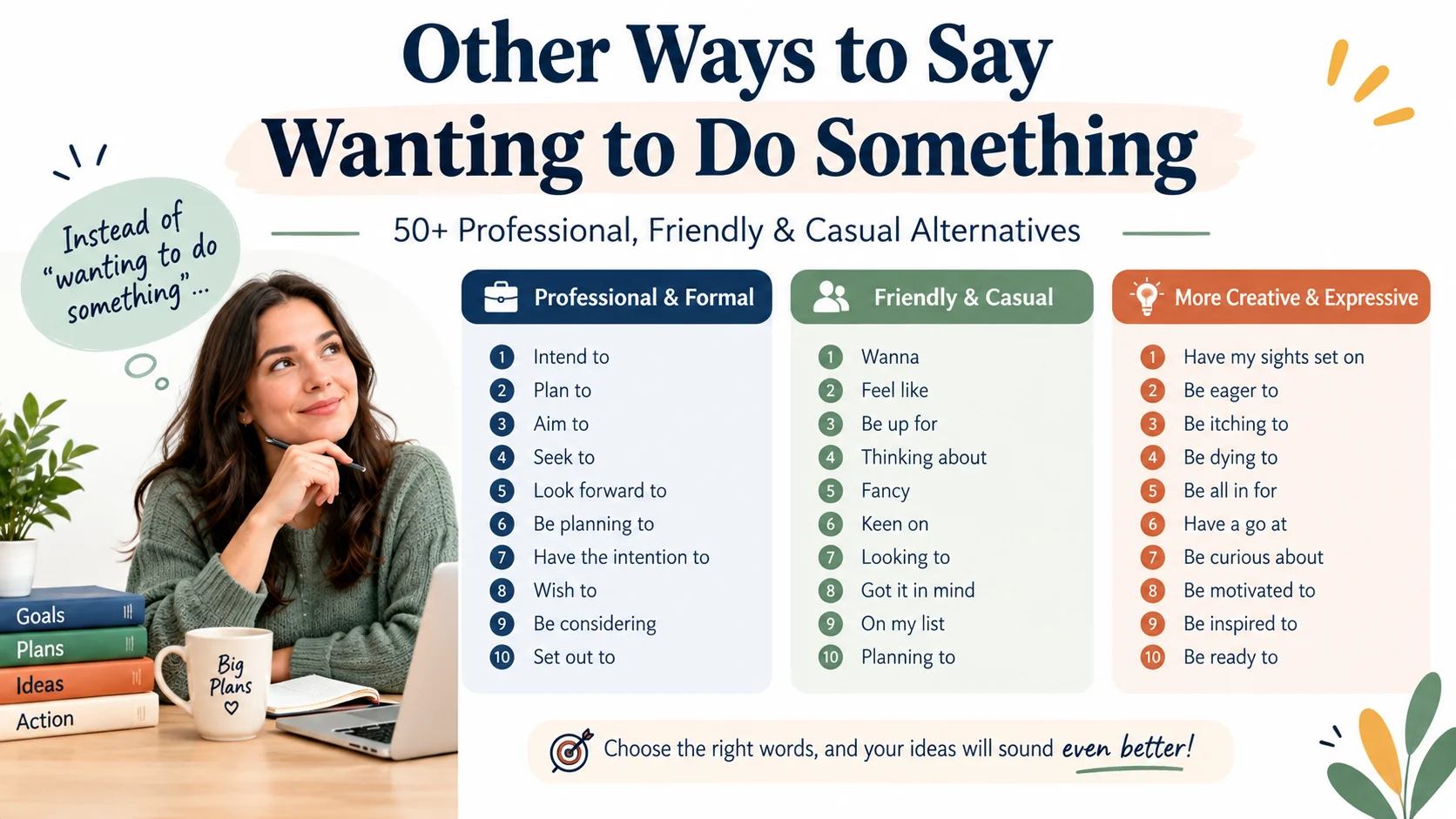
Other words for wanting to do something include intend to, plan to, hope to, aim to, would like to, wish to, be keen to, feel like, be eager to, and be interested in. The best choice depends on meaning and tone.
Best alternatives: intend to, plan to, hope to, aim to, would like to
If you keep using want to do something, your English can start to sound repetitive. Learning alternatives to “wanting to do something” helps you express intention, plans, hopes, preferences, and enthusiasm more precisely.
The best other ways to say “wanting to do something” depend on your meaning. For example, intend to shows a clear intention, while hope to suggests something you would like to happen but are not certain about.
These expressions are useful in everyday conversations, workplace meetings, business emails, presentations, job interviews, academic writing, and professional communication.
“Better vocabulary is not about using bigger words; it is about choosing the right word for the meaning.”
Formal Alternatives
- Intend to
- Wish to
- Aim to
- Be keen to
Pro Tip
Use these expressions when you need a respectful or polished tone. Intend to is especially useful when you want to communicate a clear intention.
Professional Alternatives
- Plan to
- Intend to
- Aim to
- Be interested in
- Be eager to
Pro Tip
In workplace communication, choose the expression that reflects your actual level of commitment. Plan to usually sounds more definite than hope to.
Business Email Alternatives
- I intend to…
- I plan to…
- I would like to…
- I am interested in…
- I hope to…
Pro Tip
I would like to… is particularly useful when making a polite request or expressing a professional preference.
Academic Alternatives
- Aim to
- Intend to
- Seek to
- Plan to
- Hope to
Pro Tip
Academic writing usually benefits from precise verbs. Use aim to for a research objective and seek to when describing an attempt to achieve a particular purpose.
Casual Alternatives
- Feel like
- Want to
- Be up for
- Be keen to
Pro Tip
These expressions work well in friendly conversations. Avoid very casual phrases such as wanna in formal writing.
Informal Expressions
- Feel like doing something
- Be up for doing something
- Be really into doing something
- Be eager to do something
Pro Tip
Informal expressions can make spoken English sound natural, but they are not always appropriate for professional emails or academic essays.
What Does “Wanting to Do Something” Mean?
Wanting to do something means having a desire, wish, intention, or preference to perform an action.
For example:
I want to learn Spanish.
This sentence tells us that the speaker has a desire to learn Spanish.
However, want does not always explain why the person wants to act. Different alternatives provide more information:
- I intend to learn Spanish. → I have made an intention.
- I plan to learn Spanish. → I have a plan.
- I hope to learn Spanish. → I desire it, but it may not happen.
- I aim to learn Spanish. → I have a goal.
- I would like to learn Spanish. → I express the desire politely.
Grammar
The most common structure is:
want + to + base verb
I want to improve my English.
Many alternatives also use to + base verb:
I intend to improve my English.
I plan to improve my English.
Some expressions use a gerund (-ing):
I feel like improving my English.
I am interested in improving my English.
When to Use “Wanting to Do Something”
You can use these expressions in many situations, but the best choice changes with context.
- Business: State intentions, plans, or professional goals.
- Academic writing: Describe aims, objectives, or research purposes.
- Emails: Express requests, plans, and preferences politely.
- Meetings: Explain what you intend or plan to do.
- Presentations: Describe goals and future actions.
- Job interviews: Explain professional interests and ambitions.
- Daily conversation: Talk naturally about activities you desire.
- Spoken English: Use shorter, familiar expressions.
- Written English: Choose expressions that match the level of formality.
- Formal situations: Prefer intend to, wish to, or aim to when appropriate.
- Informal situations: Feel like and be up for can sound more natural.
Is “Wanting to Do Something” Professional or Polite?
The phrase want to is not incorrect or unprofessional. It is simply broad and neutral.
| Question | Answer |
| Polite? | ✔ Yes, depending on context |
| Professional? | ✔ Yes, in many situations |
| Formal? | Sometimes |
| Natural? | ✔ Very natural |
Compare:
Neutral:
I want to discuss the proposal.
More polite:
I would like to discuss the proposal.
More formal:
I wish to discuss the proposal.
Clear intention:
I intend to discuss the proposal.
The difference is not correctness. It is tone and meaning.
Pros and Cons
Pros
- Easy to understand
- Extremely common
- Natural in spoken English
- Suitable for many everyday situations
- Easy for English learners to use
Cons
- Can become repetitive
- Does not always show the speaker’s exact intention
- May sound less polished in some formal contexts
- Does not distinguish between plans, hopes, goals, and preferences
“A synonym is useful only when it preserves the meaning you actually intend.”
Other Ways to Say “Wanting to Do Something”
These 15 alternatives cover the most useful formal, professional, academic, neutral, and casual situations.
1. Phrase: Intend to
Meaning: To have a clear intention to do something.
Explanation:
Intend to is stronger and more deliberate than want to. It suggests that you have decided or are committed to taking an action. It is common in professional, formal, and written English.
Example Sentence:
We intend to review the policy before the next meeting.
Best Use: Business Communication
Avoid Using In: Very Casual Chat
Tone: Formal, Clear
Formality Level: ⭐⭐⭐⭐ Formal
Usage Frequency: Common
CEFR Level: B2
Common Collocations:
- intend to improve
- intend to apply
- intend to continue
- intend to introduce
- intend to pursue
Context Variability:
- Spoken: I intend to speak with her tomorrow.
- Professional: We intend to expand the service next year.
- Casual: I intend to finish the book tonight.
2. Phrase: Plan to
Meaning: To have decided what you are going to do.
Explanation:
Plan to focuses on an arrangement or decision rather than simple desire. It is one of the most useful alternatives because it works in both professional and everyday English.
Example Sentence:
I plan to submit the application on Friday.
Best Use: Daily Communication
Avoid Using In: None Generally
Tone: Neutral, Practical
Formality Level: ⭐⭐⭐ Neutral
Usage Frequency: Very Common
CEFR Level: B1
Common Collocations:
- plan to attend
- plan to visit
- plan to launch
- plan to study
- plan to discuss
Context Variability:
- Spoken: I plan to visit my cousin this weekend.
- Professional: The company plans to update its website.
- Casual: We plan to watch a movie tonight.
3. Phrase: Hope to
Meaning: To want something to happen while accepting that it may not happen.
Explanation:
Hope to is different from intend to. It expresses a desired future outcome without promising that it will happen.
Example Sentence:
I hope to complete the course by December.
Best Use: Future Goals
Avoid Using In: Certain Commitments
Tone: Positive, Cautious
Formality Level: ⭐⭐⭐ Neutral
Usage Frequency: Very Common
CEFR Level: B1
Common Collocations:
- hope to achieve
- hope to hear
- hope to meet
- hope to improve
- hope to become
Context Variability:
- Spoken: I hope to see you soon.
- Professional: We hope to resolve the issue shortly.
- Casual: I hope to travel this summer.
4. Phrase: Aim to
Meaning: To have something as a goal.
Explanation:
Aim to emphasizes an objective. It is especially common in business, academic writing, presentations, and professional discussions.
Example Sentence:
The project aims to reduce processing time.
Best Use: Professional Goals
Avoid Using In: Casual Requests
Tone: Professional, Focused
Formality Level: ⭐⭐⭐⭐ Formal
Usage Frequency: Common
CEFR Level: B2
Common Collocations:
- aim to achieve
- aim to reduce
- aim to improve
- aim to provide
- aim to increase
Context Variability:
- Spoken: I aim to improve my presentation skills.
- Professional: We aim to provide faster customer support.
- Casual: I aim to finish this today.
5. Phrase: Would like to
Meaning: A polite way to express a desire or preference.
Explanation:
Would like to is one of the safest choices when you want to sound polite. It is particularly useful in requests, business emails, customer communication, and professional conversations.
Example Sentence:
I would like to discuss the revised schedule.
Best Use: Professional Emails
Avoid Using In: Very Casual Speech
Tone: Polite, Professional
Formality Level: ⭐⭐⭐⭐ Formal
Usage Frequency: Very Common
CEFR Level: B1
Common Collocations:
- would like to ask
- would like to discuss
- would like to know
- would like to request
- would like to arrange
Context Variability:
- Spoken: I would like to order a coffee.
- Professional: I would like to request a meeting.
- Casual: I would like to try that restaurant.
Native Speaker Tip
Would like to is extremely natural when you want to sound polite without sounding excessively formal. It is usually safer in professional situations than I want to.
6. Phrase: Wish to
Meaning: To want something, usually in a formal or polite way.
Explanation:
Wish to is more formal than want to. It appears in official communication, formal notices, customer-service language, and some professional writing.
Example Sentence:
If you wish to participate, please complete the registration form.
Best Use: Formal Writing
Avoid Using In: Friendly Chat
Tone: Formal, Respectful
Formality Level: ⭐⭐⭐⭐ Formal
Usage Frequency: Common
CEFR Level: B2
Common Collocations:
- wish to apply
- wish to inform
- wish to discuss
- wish to express
- wish to confirm
Context Variability:
- Spoken: I wish to speak with the manager.
- Professional: We wish to inform you of the change.
- Casual: I wish to learn another language.
7. Phrase: Be keen to
Meaning: To be very interested or enthusiastic about doing something.
Explanation:
Be keen to communicates enthusiasm rather than a simple desire. It is common in British English and is also understood widely elsewhere.
Example Sentence:
Our team is keen to explore new opportunities.
Best Use: Workplace Conversation
Avoid Using In: Strictly Formal Legal Writing
Tone: Positive, Enthusiastic
Formality Level: ⭐⭐⭐ Neutral
Usage Frequency: Common
CEFR Level: B2
Common Collocations:
- keen to learn
- keen to help
- keen to participate
- keen to explore
- keen to develop
Context Variability:
- Spoken: I’m keen to try it.
- Professional: She is keen to develop new skills.
- Casual: We’re keen to see the new place.
8. Phrase: Be eager to
Meaning: To strongly want to do something because you are excited or enthusiastic.
Explanation:
Eager to is stronger than want to. It can work in professional English, especially when discussing motivation, learning, collaboration, or career goals.
Example Sentence:
The new employees are eager to contribute to the project.
Best Use: Job Interviews
Avoid Using In: Neutral Reports
Tone: Enthusiastic, Positive
Formality Level: ⭐⭐⭐ Neutral
Usage Frequency: Common
CEFR Level: B2
Common Collocations:
- eager to learn
- eager to help
- eager to contribute
- eager to participate
- eager to improve
Context Variability:
- Spoken: I’m eager to learn more.
- Professional: We are eager to work with your team.
- Casual: I’m eager to see what happens.
9. Phrase: Be interested in
Meaning: To have an interest in doing or exploring something.
Explanation:
This phrase is useful when your desire comes from curiosity or interest. Remember that it is followed by a noun or -ing form, not normally to + verb.
Example Sentence:
She is interested in joining the research group.
Best Use: Professional Discussion
Avoid Using In: Immediate Decisions
Tone: Neutral, Professional
Formality Level: ⭐⭐⭐ Neutral
Usage Frequency: Very Common
CEFR Level: B1
Common Collocations:
- interested in learning
- interested in joining
- interested in working
- interested in exploring
- interested in discussing
Context Variability:
- Spoken: I’m interested in learning French.
- Professional: We are interested in discussing a partnership.
- Casual: He’s interested in trying something new.
10. Phrase: Seek to
Meaning: To try or aim to achieve something.
Explanation:
Seek to is formal and common in academic, institutional, business, and policy-related writing. It should not replace want to in every situation.
Example Sentence:
The study seeks to identify the main causes of the problem.
Best Use: Academic Writing
Avoid Using In: Casual Conversation
Tone: Formal, Academic
Formality Level: ⭐⭐⭐⭐⭐ Very Formal
Usage Frequency: Occasional
CEFR Level: C1
Common Collocations:
- seek to understand
- seek to improve
- seek to identify
- seek to establish
- seek to address
Context Variability:
- Spoken: We seek to improve the service.
- Professional: The organization seeks to expand access.
- Casual: Rare in relaxed conversation.
Native Speaker Tip
Seek to is grammatically natural but can sound unnecessarily formal in ordinary conversation. In daily speech, plan to, want to, or hope to will usually sound more natural.
11. Phrase: Feel like
Meaning: To have a desire or mood to do something.
Explanation:
Feel like is conversational and normally takes an -ing form. It describes what you are in the mood for rather than a long-term plan.
Example Sentence:
I feel like taking a walk after dinner.
Best Use: Daily Conversation
Avoid Using In: Formal Email
Tone: Casual, Natural
Formality Level: ⭐⭐ Casual
Usage Frequency: Very Common
CEFR Level: B1
Common Collocations:
- feel like going
- feel like eating
- feel like talking
- feel like trying
- feel like staying
Context Variability:
- Spoken: I feel like watching a film.
- Professional: Usually avoid it in formal business writing.
- Casual: Do you feel like getting some coffee?
12. Phrase: Be up for
Meaning: To be willing or interested in doing something.
Explanation:
Be up for is informal and friendly. It is useful when suggesting an activity or asking whether someone wants to participate.
Example Sentence:
Are you up for joining us after class?
Best Use: Friendly Conversation
Avoid Using In: Formal Email
Tone: Friendly, Informal
Formality Level: ⭐⭐ Casual
Usage Frequency: Common
CEFR Level: B2
Common Collocations:
- up for trying
- up for going
- up for meeting
- up for joining
- up for doing
Context Variability:
- Spoken: Are you up for dinner?
- Professional: Generally avoid it in formal correspondence.
- Casual: I’m up for trying something different.
13. Phrase: Be willing to
Meaning: To be ready or prepared to do something.
Explanation:
Be willing to focuses more on readiness than desire. Someone may not strongly want to do something, but they are prepared to do it.
Example Sentence:
I am willing to consider another approach.
Best Use: Workplace Discussion
Avoid Using In: Strong Personal Desire
Tone: Cooperative, Professional
Formality Level: ⭐⭐⭐ Neutral
Usage Frequency: Very Common
CEFR Level: B2
Common Collocations:
- willing to help
- willing to consider
- willing to discuss
- willing to cooperate
- willing to learn
Context Variability:
- Spoken: I’m willing to help.
- Professional: We are willing to consider your proposal.
- Casual: I’m willing to give it a try.
14. Phrase: Have an interest in
Meaning: To have a particular interest or desire related to something.
Explanation:
This phrase is more formal than simply saying be interested in. It can work well in professional profiles, reports, and formal descriptions.
Example Sentence:
The organization has an interest in developing sustainable solutions.
Best Use: Formal Writing
Avoid Using In: Casual Chat
Tone: Formal, Neutral
Formality Level: ⭐⭐⭐⭐ Formal
Usage Frequency: Occasional
CEFR Level: C1
Common Collocations:
- have an interest in learning
- have an interest in research
- have an interest in developing
- have an interest in technology
- have an interest in education
Context Variability:
- Spoken: I have an interest in photography.
- Professional: The company has an interest in expanding internationally.
- Casual: More natural alternatives are usually preferred.
15. Phrase: Be determined to
Meaning: To strongly decide that you will do something.
Explanation:
Be determined to is much stronger than want to. It communicates commitment and persistence, so use it when the speaker is serious about achieving a goal.
Example Sentence:
She is determined to improve her public-speaking skills.
Best Use: Personal Goals
Avoid Using In: Simple Preferences
Tone: Strong, Confident
Formality Level: ⭐⭐⭐ Neutral
Usage Frequency: Common
CEFR Level: B2
Common Collocations:
- determined to succeed
- determined to improve
- determined to achieve
- determined to continue
- determined to overcome
Context Variability:
- Spoken: I’m determined to finish this course.
- Professional: The team is determined to meet its objectives.
- Casual: He’s determined to learn how to cook.
“The strongest phrase is not always the best phrase. Choose the expression that matches your actual level of intention.”
Native Speaker Tip
For modern everyday English, plan to, hope to, want to, would like to, and feel like are especially useful.
For professional contexts, intend to, aim to, plan to, would like to, and be willing to often communicate your meaning clearly without sounding unnatural.
Very formal choices such as seek to and wish to have their place, but native speakers do not automatically use them just because a situation is professional.
Expert Insight
In workplace communication, avoid changing want to into a complicated phrase simply to sound intelligent. Precision matters more than formality.
For example, “We plan to launch the service in June” is usually clearer than an unnecessarily elaborate alternative.
Best Phrases by Situation
| Situation | Best Phrase |
| Business Email | I would like to… |
| Client Meeting | I intend to… |
| Academic Essay | aim to / seek to |
| Presentation | aim to… |
| Workplace Discussion | plan to… |
| Job Interview | I am eager to… |
| Team Collaboration | I am willing to… |
| Everyday Conversation | I want to / feel like… |
See Also
- Other Ways to Say “I Want” Professionally
- Professional English Phrases for Workplace Communication
Top 10 Alternatives Compared
| Phrase | Tone | Formality | Best Use | Frequency |
| Plan to | Neutral | ⭐⭐⭐ | Everyday & work | Very Common |
| Intend to | Professional | ⭐⭐⭐⭐ | Business | Common |
| Hope to | Positive | ⭐⭐⭐ | Goals | Very Common |
| Would like to | Polite | ⭐⭐⭐⭐ | Emails | Very Common |
| Aim to | Focused | ⭐⭐⭐⭐ | Academic/work | Common |
| Be willing to | Cooperative | ⭐⭐⭐ | Workplace | Very Common |
| Be eager to | Enthusiastic | ⭐⭐⭐ | Interviews | Common |
| Be interested in | Neutral | ⭐⭐⭐ | Discussions | Very Common |
| Wish to | Formal | ⭐⭐⭐⭐ | Official writing | Common |
| Seek to | Academic | ⭐⭐⭐⭐⭐ | Academic writing | Occasional |
Which One Should You Use?
Best Overall
Plan to is a versatile choice when you are describing a definite future action.
Best Professional
Intend to works well when you want to communicate a clear intention.
Best Academic
Aim to or seek to works well when describing an objective or research purpose.
Best Business Email
Would like to is useful for polite requests, preferences, and professional communication.
Best Everyday Conversation
Want to remains completely natural in ordinary speech.
Most Natural
Plan to is a strong alternative when you have already decided to do something.
Most Polite
Would like to is generally a natural way to soften a desire or request.
Commonly Confused Phrases
“I want to” vs. “I completely intend to”
These are not interchangeable. Want to expresses desire, while intend to suggests a stronger decision.
“I plan to” vs. “I hope to”
Plan to suggests a decided course of action. Hope to expresses a desired result that is less certain.
I plan to apply next week.
I hope to get the position.
“I intend to” vs. “I aim to”
Intend to focuses on what you have decided to do. Aim to focuses on a goal you are trying to achieve.
“I would like to” vs. “I want to”
Both express desire, but would like to is more polite and often better for requests.
“I feel like” vs. “I want to”
Feel like often describes a temporary mood or desire.
I feel like going for a walk.
Want to can describe a general or specific desire.
I want to learn French.
Scenario Practice
1. Business Meeting
Situation: You are explaining a clear company objective.
Which phrase would you choose?
Answer: We aim to improve customer satisfaction.
Why?
Aims to clearly communicates an organizational goal.
2. Job Interview
Situation: You want to show enthusiasm about learning.
Which phrase would you choose?
Answer: I am eager to learn and contribute to the team.
Why?
Eager to communicates enthusiasm without sounding overly casual.
3. Presentation
Situation: You are introducing the purpose of your presentation.
Which phrase would you choose?
Answer: This presentation aims to explain the main challenges.
Why?
Aims to is concise and appropriate for formal presentations.
4. Class Discussion
Situation: You are explaining your future study plan.
Which phrase would you choose?
Answer: I plan to study environmental science next year.
Why?
Plan to clearly describes a future decision.
5. Email Reply
Situation: You want to make a polite request.
Which phrase would you choose?
Answer: I would like to request a meeting next week.
Why?
Would like to keeps the request polite and professional.
Mini Quiz
1. Which phrase best shows a clear intention?
A. Feel like
B. Intend to
C. Be up for
D. Want to
2. Which phrase is most suitable for a polite business request?
A. I wanna
B. I feel like
C. I would like to
D. I’m up for
3. Which phrase best describes a goal?
A. Aim to
B. Feel like
C. Be up for
D. Wanna
4. Which phrase suggests uncertainty about a future result?
A. Hope to
B. Intend to
C. Determine to
D. Plan to
5. Which phrase is most casual?
A. Seek to
B. Wish to
C. Feel like
D. Intend to
Answer Key
- B Intend to: It communicates a clear intention.
- C I would like to: It is polite and professional.
- A Aim to: It focuses on a goal or objective.
- A Hope to: It expresses a desired outcome without certainty.
- C Feel like: It is common in relaxed, conversational English.
FAQs
What is the most formal way to say “want to do something”?
There is no single formal replacement for every situation. Wish to, intend to, aim to, and seek to can sound formal, but they have different meanings. Wish to expresses desire, intend to shows intention, aim to describes a goal, and seek to often describes an attempt or objective.
Which phrase is best for professional emails?
Would like to, intend to, and plan to are especially useful in professional emails. Use would like to for polite requests, intend to for clear intentions, and plan to for scheduled or decided actions. The best choice depends on whether you are expressing a request, intention, or future plan.
What is the difference between “I want to” and “I intend to”?
I want to expresses a desire, while I intend to communicates a stronger intention or decision. For example, “I want to apply” means applying is something you desire. “I intend to apply” suggests that you have made a clearer decision to do so.
Which alternative sounds most natural in everyday English?
Want to, plan to, hope to, and feel like are highly natural in everyday conversation. The choice depends on the meaning. Use feel like for a temporary mood, plan to for a decided action, and hope to when the outcome is desired but uncertain.
Can I use these expressions in business meetings?
Yes. Plan to, intend to, aim to, hope to, would like to, and be willing to can all work well in business meetings. Avoid choosing a phrase merely because it sounds formal. Clear, natural English is usually more effective than unnecessarily complicated vocabulary.
Conclusion
Learning other words for wanting to do something gives you more control over your English. Instead of using want to for every situation, you can show whether you have a plan, intention, goal, hope, preference, interest, or strong enthusiasm. That small difference can make your spoken and written English more precise.
Practice these expressions in everyday conversations, business emails, meetings, presentations, interviews, and academic writing. Start with common choices such as plan to, hope to, intend to, aim to, and would like to, then add more specific expressions as your confidence grows. The right phrase can make your English sound clearer, more natural, and more professional.

16 thoughts on “Other Ways to Say “Wanting to Do Something” |25 Examples”