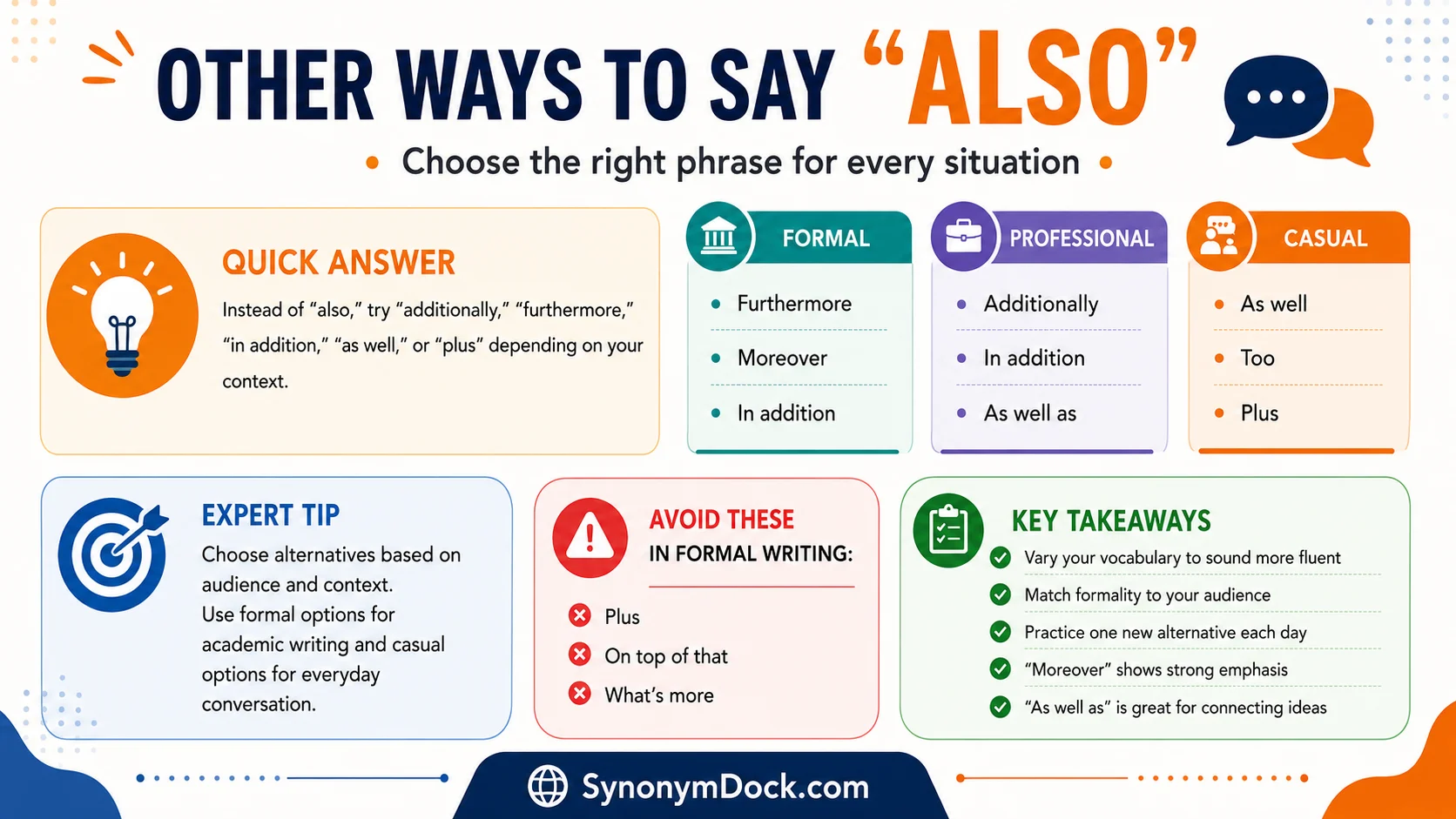
What are other ways to say “also”? Instead of repeating “also” in your writing or speech, use alternatives like additionally, furthermore, moreover, in addition, and as well. The best choice depends on your context formal writing, business emails, academic essays, or everyday conversation .
The word “also” helps us add information, but using it repeatedly can make your English sound repetitive. If you’ve ever read a sentence like “I also like coffee. I also enjoy tea. I also love hot chocolate,” you know exactly what I mean.
Learning alternatives to “also” will help you sound more fluent, professional, and natural whether you’re writing a business email, preparing for a job interview, or studying for an English exam. Native speakers rarely rely on just one word to connect ideas. They vary their vocabulary depending on the situation, the audience, and the tone they want to create .
This guide gives you 15+ powerful alternatives to “also,” with clear explanations, example sentences, and practical advice on when to use each one. You’ll learn to choose the right phrase for the right situation every time.
Quick Categories
Formal Alternatives
- Furthermore
- Moreover
- Additionally
- In addition
- Not only but also
Pro Tip: Use these in academic writing, professional reports, and formal presentations. They add weight to your arguments and show strong command of the language.
Professional & Business Alternatives
- Additionally
- Furthermore
- As well as
- Along with
- In addition to
Pro Tip: These expressions work well in business emails, client communication, and workplace meetings. They sound polished without being overly stiff.
Business Email Alternatives
- In addition
- Additionally
- Furthermore
- As well as
- Along with
Pro Tip: Short, clear alternatives work best in emails. Busy professionals appreciate concise, direct language that gets straight to the point.
Academic Alternatives
- Moreover
- Furthermore
- Additionally
- In addition
- As well as
Pro Tip: Academic writing rewards variety. Using different linking words throughout your essay demonstrates strong lexical range important for IELTS and academic success.
Casual & Everyday Alternatives
- As well
- Too
- Plus
- Besides
- What’s more
Pro Tip: These sound natural in conversation, friendly emails, and social media. They help you sound relaxed and approachable rather than overly formal.
Informal Expressions
- Plus
- On top of that
- What’s more
- Besides
- Not only that
Pro Tip: Save these for casual conversations and informal writing. Avoid them in professional or academic contexts where they might seem too casual.
“The right alternative makes your English sound more fluent and confident not just different.”
What Does “Also” Mean?
Definition: “Also” is an adverb that adds information to a previous idea. It means “in addition,” “too,” or “besides” .
Simple Explanation: You use “also” when you want to give extra information about something you’ve already mentioned.
Example:
“She works full-time. She also volunteers at the local shelter.”
When to Use “Also”
Common Situations:
- Adding information to a statement
- Connecting related ideas
- Emphasizing an additional point
- Listing multiple examples
In Professional English:
- Business emails
- Client communication
- Workplace meetings
- Presentations
In Academic English:
- Essays
- Research papers
- Reports
- Academic discussions
In Everyday Conversation:
- Casual chats
- Social media
- Friendly emails
- Text messages
Important: While “also” is always acceptable, using the same word repeatedly can make your English feel basic. Mixing in alternatives shows advanced language skills .
“Variety in your vocabulary is a sign of fluency and it’s easier to achieve than you think.”
Is “Also” Professional or Polite?
Polite? ✔ Yes it’s neutral and inoffensive.
Professional? ✔ Yes, but overusing it sounds basic.
Formal? Sometimes it works in most contexts but isn’t as formal as “furthermore” or “moreover.”
Natural? ✔ Yes, native speakers use it constantly.
Example (Professional Email):
“We received your proposal. We also need the budget breakdown by Friday.”
Alternative for a More Professional Tone:
“We received your proposal. Additionally, we need the budget breakdown by Friday.”
Pros and Cons
Pros
- Easy to understand
- Works in almost every context
- Neutral tone
- Widely used by native speakers
- Grammatically straightforward
Cons
- Overused can sound repetitive
- Limited in tone variety
- Not distinctive or impressive
- Can feel basic in professional writing
- Lacks emphasis compared to stronger alternatives
Transition to the Main List
Now let’s explore the best alternatives to “also” organized by tone and formality. Each option includes meaning, explanation, example sentences, and practical advice on when to use it and when to avoid it.
By the end of this guide, you’ll confidently choose the perfect phrase for any situation. Whether you’re writing a formal report, sending a business email, or having a casual conversation, you’ll have the right words at your fingertips.
Expert Tip: Native speakers choose different expressions based on formality, workplace culture, and their relationship with the listener. The same phrase that works in a team meeting might sound out of place in an academic essay .
15+ Powerful Alternatives to “Also”
[1]. Additionally
Meaning: In addition; as an extra point or piece of information .
Explanation: This is one of the most useful alternatives to “also” because it fits almost any formal or neutral context. Native speakers use it in business emails, academic writing, and professional reports. It’s clear, professional, and doesn’t sound forced.
Example Sentence:
“The marketing team delivered excellent results. Additionally, they managed to stay under budget.”
Best Use: Business emails, academic writing, professional reports, workplace meetings
Avoid Using In: Casual texts or very informal conversation
Tone: Professional, Neutral
Formality Level: ⭐⭐⭐⭐ Formal
Usage Frequency: Very Common
CEFR Level: B2
Common Collocations:
- Additionally, we need
- Additionally, the report shows
- Additionally, it’s important to
- Additionally, you should
Context Variability:
- Spoken: “Additionally, I think we should consider the budget.” (slightly formal)
- Professional: “Additionally, we’ll need to update the timeline.”
- Casual Conversation: Less common in casual speech use “plus” or “as well” instead.
[2]. Furthermore
Meaning: In addition; used to introduce a point that strengthens or adds to the previous argument .
Explanation: “Furthermore” is more formal than “additionally” and carries a stronger sense of logical progression. It suggests that the point you’re adding makes the previous one even more important or compelling. This makes it excellent for persuasive writing and structured arguments .
Example Sentence:
“The proposal is both cost-effective and practical. Furthermore, it aligns perfectly with our long-term strategy.”
Best Use: Academic essays, persuasive writing, formal reports, presentations
Avoid Using In: Casual conversations, friendly emails, texting
Tone: Formal, Logical, Persuasive
Formality Level: ⭐⭐⭐⭐⭐ Very Formal
Usage Frequency: Common (especially in writing)
CEFR Level: C1
Common Collocations:
- Furthermore, the evidence
- Furthermore, it should be noted
- Furthermore, this demonstrates
- Furthermore, the results indicate
Context Variability:
- Spoken: Rare in casual speech
- Professional: “Furthermore, we need to consider the long-term implications.”
- Academic: “Furthermore, the study reveals a significant correlation.”
Native Speaker Tip: “Furthermore” and “moreover” are formal and often used in writing, but you’ll rarely hear them in everyday conversation. Native speakers use them mostly in speeches, presentations, and formal writing .
[3]. Moreover
Meaning: In addition to what has been said; used to add a point that is even more important or significant .
Explanation: “Moreover” is very similar to “furthermore,” but it often carries a slightly stronger sense of emphasis. When you use “moreover,” you’re telling the reader that the new point is not just additional it’s actually more important than the previous one. This makes it particularly useful in academic writing and persuasive arguments .
Example Sentence:
“The research methodology was sound. Moreover, the sample size was large enough to draw meaningful conclusions.”
Best Use: Academic writing, persuasive essays, formal arguments
Avoid Using In: Casual writing, friendly emails, everyday conversation
Tone: Formal, Emphatic, Confident
Formality Level: ⭐⭐⭐⭐⭐ Very Formal
Usage Frequency: Common (academic writing)
CEFR Level: C1
Common Collocations:
- Moreover, the study
- Moreover, it’s clear that
- Moreover, the evidence suggests
- Moreover, the analysis shows
Context Variability:
- Spoken: Rare
- Professional: “Moreover, our competitors have not matched this innovation.”
- Academic: “Moreover, this finding challenges previous assumptions.”
[4]. In Addition
Meaning: As an extra item or piece of information; also .
Explanation: “In addition” is a versatile alternative that works in both formal and neutral contexts. It’s slightly more formal than “also” but less formal than “furthermore.” Native speakers use it frequently in business writing, and it sits comfortably in most professional contexts .
Example Sentence:
“Our team completed the project on time. In addition, we delivered it under budget.”
Best Use: Business emails, professional writing, presentations, neutral contexts
Avoid Using In: Very casual conversation (use “as well” or “plus” instead)
Tone: Neutral, Professional, Clear
Formality Level: ⭐⭐⭐⭐ Formal
Usage Frequency: Very Common
CEFR Level: B2
Common Collocations:
- In addition, we need
- In addition, the data
- In addition to this
- In addition, please note
Context Variability:
- Spoken: “In addition, I’d like to thank everyone for their hard work.” (formal speech)
- Professional: “In addition, we’ve updated the security protocols.”
- Casual Conversation: Less common
[5]. As Well
Meaning: In addition; also. Used to add information at the end of a sentence .
Explanation: “As well” is a natural, common alternative that native speakers use regularly. It’s less formal than “additionally” or “furthermore” but fits perfectly in both spoken and written English. The key difference: “as well” usually goes at the end of a sentence, while “also” can go in multiple positions.
Example Sentence:
“I bought groceries. I picked up some cleaning supplies as well.”
Best Use: Everyday conversation, friendly emails, informal writing, semi-professional contexts
Avoid Using In: Very formal academic writing (use “additionally” or “furthermore” instead)
Tone: Neutral, Friendly, Natural
Formality Level: ⭐⭐⭐ Neutral
Usage Frequency: Very Common
CEFR Level: A2
Common Collocations:
- and as well
- as well as
- included as well
Context Variability:
- Spoken: “I’ll have coffee, and a sandwich as well.”
- Professional: “We’re considering the proposal, and the budget implications as well.”
- Casual: Very common
Native Speaker Tip: In everyday conversation, native speakers rarely use “furthermore” or “moreover.” Instead, they choose “as well,” “too,” or “plus” for a natural, relaxed tone .
[6]. Too
Meaning: Also; in addition. Usually placed at the end of a sentence .
Explanation: “Too” is one of the simplest and most common alternatives to “also.” It’s informal and friendly perfect for everyday conversation. However, avoid it in formal writing where it can sound too casual.
Example Sentence:
“I’m excited about the trip. My sister is coming too.”
Best Use: Casual conversations, friendly emails, texts, social media
Avoid Using In: Formal essays, business reports, academic writing
Tone: Friendly, Casual, Warm
Formality Level: ⭐⭐ Casual
Usage Frequency: Very Common
CEFR Level: A1
Common Collocations:
- me too
- too
- too much (different meaning!)
Context Variability:
- Spoken: “I’d like to go too.”
- Professional: Rare in formal professional writing
- Casual: Very common
[7]. Plus
Meaning: In addition; also. Used in a casual, conversational way .
Explanation: “Plus” is informal and modern excellent for everyday conversation, marketing copy, and casual writing. It’s a quick, easy way to add information without sounding stiff. Avoid it in professional or academic writing .
Example Sentence:
“The restaurant has great food. Plus, the service is fantastic.”
Best Use: Everyday conversation, marketing, creative writing, casual emails
Avoid Using In: Academic writing, formal business reports, professional emails
Tone: Casual, Friendly, Modern
Formality Level: ⭐ Very Casual
Usage Frequency: Very Common (spoken)
CEFR Level: B1
Common Collocations:
- Plus, it’s
- Plus, you get
- Plus, I think
Context Variability:
- Spoken: “I love that movie. Plus, the soundtrack is amazing.”
- Marketing: “It’s affordable. Plus, shipping is free.”
- Professional: Not recommended
[8]. Besides
Meaning: In addition; used to add a reason or point that reinforces an argument .
Explanation: “Besides” works differently from most other alternatives. It’s often used to add a point that makes an argument stronger especially when the first point might not be enough. Native speakers use it in both spoken and written English, though it’s more common in conversation.
Example Sentence:
“I don’t think we need a new laptop. Besides, we don’t have the budget for it.”
Best Use: Everyday conversation, emails, informal writing, adding reasons
Avoid Using In: Very formal academic writing
Tone: Neutral, Conversational
Formality Level: ⭐⭐ Casual
Usage Frequency: Common
CEFR Level: A2
Common Collocations:
- Besides, I think
- Besides, we should
- Besides, it’s
Context Variability:
- Spoken: “Let’s stay home. Besides, it’s raining.”
- Professional: “We’ll keep the current system. Besides, we don’t have time for training.”
- Casual: Very common
[9]. What’s More
Meaning: In addition to something important; used to emphasize an extra point .
Explanation: “What’s more” is an expressive, conversational phrase that adds emphasis. It signals that the new point is not just additional it’s remarkable. Native speakers use it to create emotional engagement and highlight surprising or impressive information .
Example Sentence:
“The hotel has a beautiful view. What’s more, it’s surprisingly affordable.”
Best Use: Persuasive writing, storytelling, creative writing, informal conversations
Avoid Using In: Formal academic writing, very professional emails
Tone: Expressive, Enthusiastic, Engaging
Formality Level: ⭐⭐ Casual
Usage Frequency: Common
CEFR Level: B2
Common Collocations:
- What’s more, it’s
- What’s more, the
- What’s more, they
Context Variability:
- Spoken: “I love living here. What’s more, the community is so friendly.”
- Creative: “She’s an incredible artist. What’s more, she’s completely self-taught.”
- Professional: Occasional use in informal presentations
[10]. Not Only But Also
Meaning: A paired expression showing two things are both true, with special emphasis on the second point .
Explanation: This is a powerful, formal structure that creates emphasis and dramatic effect. After “Not only,” you should use an inverted word order (a question-like structure). Native speakers use this when they want to highlight two qualities, especially when the second one is particularly impressive .
Example Sentence:
“Not only does she speak fluent Spanish, but she also learned it in just two years.”
Best Use: Formal writing, persuasive speeches, emphasizing impressive qualities
Avoid Using In: Casual conversation (can sound too dramatic), very short sentences
Tone: Formal, Emphatic, Impressive
Formality Level: ⭐⭐⭐⭐ Formal
Usage Frequency: Common
CEFR Level: C1
Common Collocations:
- Not only but also
- Not only is but also
- Not only does but also
Context Variability:
- Spoken: “Not only is it cheaper, but it’s also better quality.” (formal speech)
- Professional: “Not only does he have experience, but he also has excellent references.”
- Academic: “Not only does the study confirm earlier findings, but it also provides new insights.”
Native Speaker Tip: “Not only but also” is very common in professional English because it shows confidence and makes a strong impression. Just remember to invert the word order after “Not only” .
[11]. Along With
Meaning: Together with; in addition to .
Explanation: “Along with” is a natural way to add information, especially when you’re combining people, items, or ideas. It suggests partnership or inclusion and works in both professional and casual contexts.
Example Sentence:
“Along with his experience, he brings incredible enthusiasm to the role.”
Best Use: Combining multiple items/people, professional writing, job descriptions
Avoid Using In: Academic writing where “as well as” might be more appropriate
Tone: Neutral, Cooperative, Professional
Formality Level: ⭐⭐⭐ Neutral
Usage Frequency: Common
CEFR Level: B2
Common Collocations:
- Along with his/her/their
- Along with the
- Along with this
Context Variability:
- Spoken: “Bring your passport, along with your flight confirmation.”
- Professional: “Along with the proposal, we’ve attached supporting documents.”
- Academic: “Along with economic factors, social influences must be considered.”
[12]. As Well As
Meaning: In addition to; and also .
Explanation: This is a versatile linking phrase that’s more formal than “and” but less formal than “furthermore.” Use it to connect two items or ideas within a sentence. Be careful unlike “also,” you usually follow it with a noun or gerund (-ing form), not a full clause .
Example Sentence:
“The course teaches grammar as well as conversation skills.”
Best Use: Linking nouns or -ing forms, professional writing, academic English
Avoid Using In: Starting a sentence (use “in addition” instead)
Tone: Neutral, Professional, Clear
Formality Level: ⭐⭐⭐ Neutral
Usage Frequency: Very Common
CEFR Level: B1
Common Collocations:
- As well as his/her/their
- As well as the
- As well as being
Context Variability:
- Spoken: “We need milk as well as eggs.”
- Professional: “She’s a project manager as well as a team leader.”
- Academic: “The study examined social as well as environmental factors.”
[13]. Likewise
Meaning: In the same way; similarly .
Explanation: “Likewise” is a wonderful alternative when you want to connect two similar ideas. It shows that the new point mirrors or reinforces the previous one. Native speakers use it in both written and spoken English, though it’s more common in writing.
Example Sentence:
“She values honesty in her employees. Likewise, she expects loyalty from them.”
Best Use: Making comparisons, showing similarity, professional and academic writing
Avoid Using In: Very casual conversation (use “same here” instead)
Tone: Formal, Balanced, Thoughtful
Formality Level: ⭐⭐⭐ Neutral
Usage Frequency: Common
CEFR Level: B2
Common Collocations:
- Likewise, the
- Likewise, we should
- Likewise, it’s important to
Context Variability:
- Spoken: “I loved the book.” “Likewise!” (response showing agreement)
- Professional: “We invested in training. Likewise, we upgraded our equipment.”
- Academic: “Likewise, the findings from the second experiment support this conclusion.”
[14]. On Top of That
Meaning: In addition to something already mentioned; furthermore .
Explanation: This is a conversational, expressive alternative that emphasizes the added point. Native speakers use it to highlight impressive or surprising additional information like “not only that, but also.” It adds a sense of accumulation .
Example Sentence:
“We had a busy week at work. On top of that, I had to finish my course assignments.”
Best Use: Everyday conversation, storytelling, casual emails
Avoid Using In: Formal academic writing, very professional reports
Tone: Conversational, Emphatic, Expressive
Formality Level: ⭐⭐ Casual
Usage Frequency: Common (spoken)
CEFR Level: B2
Common Collocations:
- And on top of that
- On top of that, I/we
- On top of that, it’s
Context Variability:
- Spoken: “The car broke down. On top of that, I missed my meeting.”
- Professional: Occasional use in informal workplace conversations
- Casual: Very common
[15]. In the Same Way
Meaning: Similarly; showing that two things are comparable .
Explanation: This phrase connects ideas by highlighting similarity rather than simply adding information. It’s particularly useful when you want to show that something applies in exactly the same way to a new example or situation.
Example Sentence:
“She handles stressful situations calmly. In the same way, she approaches every challenge with patience.”
Best Use: Making comparisons, explaining similarities, professional writing
Avoid Using In: Very casual conversation (use “likewise” or “same”)
Tone: Formal, Logical, Reflective
Formality Level: ⭐⭐⭐ Neutral
Usage Frequency: Occasional
CEFR Level: B2
Common Collocations:
- In the same way, we
- In the same way, the
- In the same way that
Context Variability:
- Spoken: Rare; may sound overly formal
- Professional: “In the same way, our customers expect reliability.”
- Academic: “In the same way, the theory applies to social dynamics.”
Expert Insight: The best alternative depends entirely on your audience and context. In academic writing, “furthermore” and “moreover” signal sophistication. In business emails, “additionally” and “in addition” sound professional without being overly formal. In casual conversation, “as well,” “too,” and “plus” sound natural and friendly.
Common Mistakes
Mistake 1: Using “As Well As” Instead of “And”
Why it’s incorrect: “As well as” should be followed by a noun or gerund, not a full verb phrase.
Incorrect: ❌ “She runs as well as she swims.”
Correct: ✔ “She runs as well as swims.” (if you mean in addition)
Better: “She runs, and she swims as well.”
Mistake 2: Overusing “Furthermore” and “Moreover”
Why it’s incorrect: Using these formal words in every paragraph sounds mechanical and unnatural.
Better: Vary your language. Use “additionally,” “in addition,” “also,” and other alternatives.
Mistake 3: Using “Plus” in Formal Writing
Why it’s incorrect: “Plus” is casual and doesn’t belong in academic essays or formal business reports.
Instead use: “Additionally,” “furthermore,” or “in addition.”
Mistake 4: Incorrect Sentence Position
Why it’s incorrect: Some alternatives must go in specific positions.
Incorrect: ❌ “He plays the guitar too and sings.”
Correct: ✔ “He plays the guitar and sings too.”
Mistake 5: Using Complex Words Without Purpose
Why it’s incorrect: Advanced vocabulary should enhance clarity, not confuse readers.
Better: Choose the simplest word that fits your context. Don’t force “moreover” into a casual conversation.
Avoid These in Formal Situations
| Expression | Why to Avoid | Better Alternative |
|---|---|---|
| Plus | Too casual for professional writing | Additionally / In addition |
| Too | Sounds too informal | As well / Additionally |
| Besides | Can sound dismissive | In addition / Furthermore |
| On top of that | Too conversational | Additionally / Furthermore |
| What’s more | Too expressive for formal writing | Moreover / Furthermore |
Best Phrases by Situation
| Situation | Best Phrase | Why It Works |
|---|---|---|
| Business Email | Additionally | Professional, clear, and concise |
| Client Meeting | In addition | Neutral and professional |
| Academic Essay | Furthermore | Shows logical progression |
| Presentation | In addition | Clear and easy to follow |
| Workplace Discussion | As well | Natural and professional |
| Job Interview | Not only but also | Demonstrates confidence |
| Team Collaboration | Along with | Emphasizes teamwork |
| Everyday Conversation | As well / Too | Natural and friendly |
Comparison Table: Top 10 Alternatives Compared
| Phrase | Tone | Formality | Best Use | Frequency |
|---|---|---|---|---|
| Additionally | Professional | Formal | Writing, emails | Very Common |
| Furthermore | Formal | Very Formal | Academic essays | Common |
| Moreover | Formal | Very Formal | Persuasive writing | Common |
| In Addition | Neutral | Formal | Business writing | Very Common |
| As Well | Natural | Neutral | Most contexts | Very Common |
| Too | Friendly | Casual | Conversation | Very Common |
| Plus | Friendly | Very Casual | Casual contexts | Very Common |
| Besides | Neutral | Casual | Adding reasons | Common |
| What’s More | Expressive | Casual | Storytelling | Common |
| Not only but also | Emphatic | Formal | Emphasis | Common |
Which One Should You Use?
Best Overall: In addition works in almost every context.
Best Professional: Additionally clear, professional, and never out of place.
Best Academic: Furthermore shows strong logical progression.
Best Business Email: Additionally or In addition professional without being pretentious.
Best Everyday Conversation: As well natural, friendly, and common.
Most Natural: As well native speakers use it constantly.
Most Polite: In addition adds information without demanding attention.
Commonly Confused Phrases
| Phrase | Meaning | Best Used For |
|---|---|---|
| Also | In addition | General use |
| Additionally | In addition | Formal/professional |
| As well | In addition | Neutral/casual |
| Moreover | In addition (with emphasis) | Formal/persuasive |
| Furthermore | In addition (logical progression) | Academic/professional |
| Plus | In addition (casual) | Informal conversations |
Key Difference: “Moreover” and “furthermore” suggest the new point strengthens the previous argument. “Additionally” and “in addition” simply add information without that implication .
Scenario Practice
Scenario 1: Writing a Business Proposal
You’re drafting a proposal and need to add important information about costs.
Which phrase would you choose?
“The project fits our timeline. _, it’s well within our budget.”
Correct Answer: “Additionally” or “In addition”
Why: These are professional and suitable for business writing.
Scenario 2: Casual Conversation with Friends
You’re telling your friends about a movie you loved.
Which phrase would you choose?
“The acting was fantastic, the cinematography was stunning.”
Correct Answer: “What’s more” or “Plus”
Why: These are expressive and casual perfect for friendly conversation.
Scenario 3: Academic Essay
You’re writing an essay and need to add evidence that strengthens your argument.
Which phrase would you choose?
“The data supports this interpretation, it aligns with previous research.”
Correct Answer: “Furthermore” or “Moreover”
Why: These show logical progression and work well in academic writing.
Scenario 4: Job Interview
You’re describing your skills and want to emphasize two strengths.
Which phrase would you choose?
“_ do I have technical expertise, I bring strong leadership skills.”
Correct Answer: “Not only but also”
Why: This structure creates emphasis and confidence perfect for interviews.
Scenario 5: Friendly Email
You’re inviting a colleague to lunch and mentioning another person.
Which phrase would you choose?
“I’m meeting Sarah for lunch. You should come.”
Correct Answer: “too” or “as well”
Why: These are natural and friendly for informal invitations.
Mini Quiz
Question 1:
Which phrase is best for an academic essay?
- A) Plus
- B) Furthermore
- C) On top of that
Question 2:
Which phrase is most natural in everyday conversation?
- A) Moreover
- B) As well
- C) In addition
Question 3:
Which phrase should you avoid in formal writing?
- A) Additionally
- B) Furthermore
- C) Plus
Question 4:
Which structure creates strong emphasis in professional English?
- A) Not only but also
- B) As well as
- C) Besides
Question 5:
Which phrase emphasizes the new point is even more important than the previous one?
- A) Additionally
- B) Moreover
- C) In addition
Answer Key
- B) Furthermore Best for academic writing.
- B) As well Most natural in conversation.
- C) Plus Too casual for formal writing.
- A) Not only but also Creates emphasis and confidence.
- B) Moreover Suggests the new point is more significant.
FAQs
What is the most formal way to say “also”?
“Moreover” and “furthermore” are the most formal alternatives. They are used in academic writing, formal reports, and persuasive arguments to add information that strengthens a point .
Which phrase is best for professional emails?
“Additionally” and “in addition” are the best choices for professional emails. They sound polished without being overly formal and work well in most business writing contexts .
What is the difference between “moreover” and “furthermore”?
They are very similar, but “moreover” often carries stronger emphasis suggesting the new point is more important. “Furthermore” focuses more on logical progression. Both are formal and used in academic writing .
Which alternative sounds most natural to native speakers?
“As well” and “too” are the most natural alternatives in everyday conversation. Native speakers use them constantly. In professional contexts, “additionally” and “in addition” are very common .
Can I use these expressions in business meetings?
Yes, but choose carefully. “Additionally,” “in addition,” and “as well” work well in business meetings. Avoid “plus,” “on top of that,” and “what’s more” unless the meeting is very informal .
Conclusion
Learning alternatives to “also” is a simple but powerful way to improve your English. Whether you’re writing a business email, preparing a presentation, studying for an exam, or having a casual conversation, the right word can make a huge difference in how you sound.
Try using one new alternative each day. Start with “additionally” in your emails, use “as well” in conversation, and challenge yourself with “not only but also” when you want to make a strong impression. With consistent practice, these alternatives will become natural, and your English will sound more fluent, professional, and confident.

17 thoughts on “Other Ways to Say “Also” |18+ Powerful Alternatives For 2026”