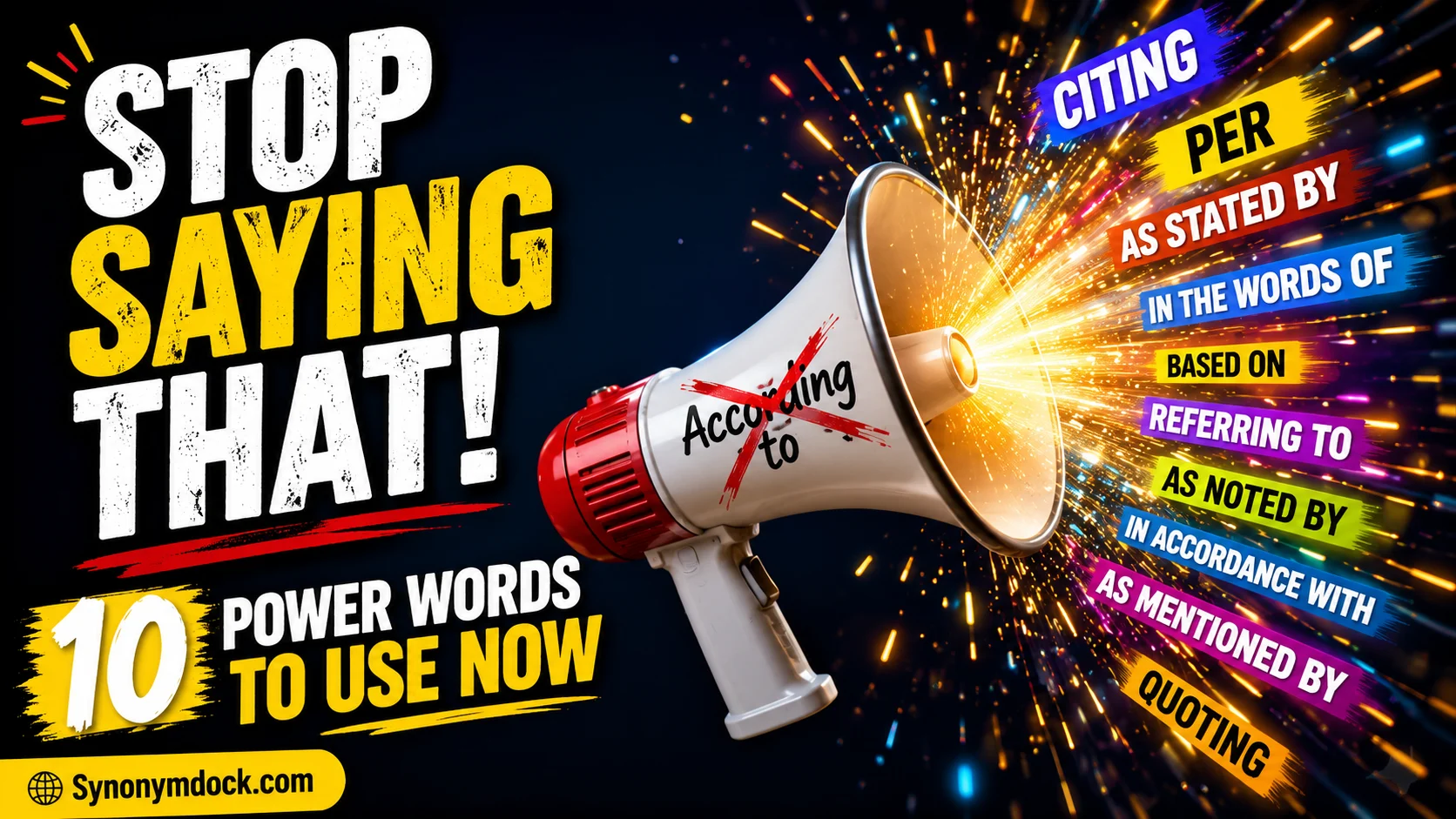
The best alternatives to “according to” depend on your context. For professional settings, try “as stated by” or “based on.” For formal writing, use “in accordance with” or “as per.” For casual conversations, “from what I’ve heard” works well.
“According to” is a phrase we often use on autopilot. While it serves its purpose, relying on it too much can make our English sound repetitive or overly formal.
This article explores 15 practical alternatives to help you cite sources more naturally and professionally.
QUICK CATEGORIES
Formal Alternatives
- In accordance with
- As per
- On the authority of
- In line with
- Pursuant to
Pro Tip: Use these in legal documents, official policies, and academic writing where precision matters.
Professional & Business Email Alternatives
- As stated by
- As reported by
- Based on
- Per
- Following
Pro Tip: “Per” is concise and commonly used in office communication; “as stated by” works well when attributing information to a colleague or supervisor.
Academic Alternatives
- Citing
- Referencing
- As indicated by
- As demonstrated by
- As evidenced by
Pro Tip: These phrases signal that your argument is grounded in established research, which strengthens academic credibility.
Casual & Informal Expressions
- From what I’ve heard
- In the words of
- From
- As mentioned by
- Based on
Pro Tip: “Based on” is the most versatile option it works in almost any context, from casual chats to business emails.
The right alternative to ‘according to’ not only varies your language but also clarifies your relationship to the source.
WHAT DOES “ACCORDING TO” MEAN?
The phrase “according to” is used to attribute information, opinions, or rules to a specific source. It signals that what follows comes from another person, group, or authority not from your own view.
Example:
According to the latest weather forecast, we can expect heavy rain throughout the week.
WHEN TO USE “ACCORDING TO”
- Business reports and professional documents
- Academic papers and research
- News articles and journalism
- Workplace meetings and presentations
- Emails referencing policies or guidelines
- Formal conversations
- Daily conversation (though alternatives can sound more natural)
IS IT PROFESSIONAL OR POLITE?
Polite? ✔ Yes
Professional? ✔ Yes, but overuse can sound repetitive
Formal? Sometimes
Natural? Yes, but variety improves your communication
Using “according to” is professional and widely accepted, but in business communication, overusing it might sound overly rigid. Learning alternatives helps keep your tone fresh and suitable.
“In a professional context, your conversation is more likely to have a specific focus. The way you speak should reflect that focus.”
PROS AND CONS
Pros
- Clear and universally understood
- Works well in formal documents, reports, and academic writing
- Neutral in tone
- Widely accepted across all English-speaking contexts
Cons
- Overuse can make writing repetitive and monotonous
- Lacks warmth compared to more natural expressions
- Can sound overly formal in casual conversations
- May create distance between you and the reader or listener
TRANSITION TO THE MAIN LIST
Now let’s explore 15 practical alternatives to “according to.” Each option includes a clear explanation, example sentence, and guidance on when to use it so you can choose the right phrase for every situation.
“Finding the right words in communication makes a huge difference.”
15 OTHER WAYS TO SAY “ACCORDING TO”
[1]. Phrase: As Stated By
Meaning: Used to directly quote or attribute a statement to a specific source.
Explanation: This phrase emphasizes that the information comes directly from a person, document, or authority. It conveys credibility and precision, making it ideal for professional or academic contexts.
Example Sentence:
As stated by the manager, the deadline will be extended to next Friday.
Best Use: Business emails, academic papers, reports
Avoid Using In: Casual conversation, friendly texts
Tone: Formal, Respectful
Formality Level: ⭐⭐⭐⭐ Formal
Usage Frequency: Common
CEFR Level: B2
Common Collocations:
- as stated by the report
- as stated by the CEO
- as stated by the guidelines
- as stated by the expert
Context Variability:
- Spoken: “As stated by the director, we’ll begin the project next month.”
- Professional: “As stated by the client, revisions must be completed by Thursday.”
- Casual: Less common in casual speech
[2]. Phrase: Based On
Meaning: Indicates that something is derived from specific information, evidence, or data.
Explanation: This versatile phrase works in both formal and informal contexts. It’s particularly useful when discussing conclusions, decisions, or opinions that stem from particular observations or data.
Example Sentence:
Based on the survey results, customer satisfaction has improved by 20%.
Best Use: Reports, presentations, daily conversation
Avoid Using In: Legal contracts, highly formal academic writing
Tone: Neutral, Professional
Formality Level: ⭐⭐⭐ Neutral
Usage Frequency: Very Common
CEFR Level: B1
Common Collocations:
- based on the data
- based on the evidence
- based on research
- based on your recommendation
- based on the findings
Context Variability:
- Spoken: “Based on what I’ve seen, this restaurant is excellent.”
- Professional: “Based on our analysis, we recommend this approach.”
- Casual: “I chose this route based on your advice.”
Native Speaker Tip: “Based on” is one of the most natural and versatile alternatives. Native speakers use it daily in both professional and casual settings. It’s almost always a safe choice.
[3]. Phrase: As Per
Meaning: A formal expression used to reference something that has been previously stated or agreed upon.
Explanation: This phrase implies adherence to a particular source or instruction. It’s commonly used in professional, legal, and business contexts to reference guidelines, documents, or prior agreements.
Example Sentence:
As per our last meeting, we will proceed with the project next Monday.
Best Use: Business emails, contracts, professional communication
Avoid Using In: Casual conversation, creative writing
Tone: Businesslike, Formal
Formality Level: ⭐⭐⭐⭐ Formal
Usage Frequency: Common
CEFR Level: B2
Common Collocations:
- as per the agreement
- as per the instructions
- as per the schedule
- as per the policy
- as per our conversation
Context Variability:
- Spoken: “As per the manager, the meeting starts at 10 AM.”
- Professional: “As per company policy, all employees must complete training.”
- Casual: Rarely used in casual contexts
Native Speaker Tip: “As per” and “per” are often used interchangeably in office settings. “Per” is slightly more concise and modern. Both sound professional but can feel stiff in very casual conversations.
[4]. Phrase: In Accordance With
Meaning: A formal way to indicate that something is compliant with a rule, law, or request.
Explanation: This phrase suggests strict adherence to a specified standard or directive. It’s particularly useful in legal, academic, or official documents where precision and formality are required.
Example Sentence:
All employees must act in accordance with the company’s code of conduct.
Best Use: Legal documents, policy manuals, official statements
Avoid Using In: Casual conversation, informal emails
Tone: Official, Authoritative
Formality Level: ⭐⭐⭐⭐⭐ Very Formal
Usage Frequency: Occasional
CEFR Level: C1
Common Collocations:
- in accordance with the law
- in accordance with the policy
- in accordance with the guidelines
- in accordance with the regulations
- in accordance with the agreement
Context Variability:
- Spoken: Rare in spoken English
- Professional: “In accordance with our policy, refunds are issued within 30 days.”
- Casual: Almost never used casually
[5]. Phrase: As Reported By
Meaning: Used to attribute information to a news outlet, journalist, or media source.
Explanation: This phrase is journalistic and objective, conveying a sense of verified information. It’s commonly used in news articles, research papers, or reports where transparency about sources matters.
Example Sentence:
As reported by the local newspaper, the festival attracted over 10,000 visitors.
Best Use: News articles, research papers, presentations
Avoid Using In: Personal conversation, informal writing
Tone: Factual, Credible
Formality Level: ⭐⭐⭐⭐ Formal
Usage Frequency: Common
CEFR Level: B2
Common Collocations:
- as reported by the news
- as reported by the authorities
- as reported by the study
- as reported by several sources
- as reported by the media
Context Variability:
- Spoken: “As reported by the evening news, the storm is approaching.”
- Professional: “As reported by industry analysts, market growth is expected to double.”
- Casual: Less common
“Proper attribution is essential in contexts where sourcing information accurately is important.”
[6]. Phrase: In Line With
Meaning: In agreement or accordance with something, suggesting harmony or consistency.
Explanation: This expression shows alignment with policies, opinions, or established standards. It’s suitable for professional and formal contexts, especially when connecting statements to guidelines or recommendations.
Example Sentence:
In line with the new policy, we will update our procedures immediately.
Best Use: Policy documents, formal discussions, business reports
Avoid Using In: Casual conversation, friendly emails
Tone: Professional, Polite
Formality Level: ⭐⭐⭐⭐ Formal
Usage Frequency: Common
CEFR Level: B2
Common Collocations:
- in line with the guidelines
- in line with the policy
- in line with expectations
- in line with the recommendations
- in line with the findings
Context Variability:
- Spoken: “In line with what we discussed, I’ve prepared the draft.”
- Professional: “Our strategy is in line with current market trends.”
- Casual: Occasionally used in semi-formal contexts
[7]. Phrase: In the Words Of
Meaning: Used to directly quote or paraphrase someone’s exact statement.
Explanation: This phrase is expressive and slightly formal, often adding a narrative or conversational tone. It draws attention to the source’s phrasing, making it ideal for emphasizing eloquence or authority.
Example Sentence:
In the words of Nelson Mandela, “Education is the most powerful weapon which you can use to change the world.”
Best Use: Speeches, presentations, essays
Avoid Using In: Legal documents, business reports
Tone: Thoughtful, Human
Formality Level: ⭐⭐⭐ Neutral
Usage Frequency: Occasional
CEFR Level: B2
Common Collocations:
- in the words of the author
- in the words of the CEO
- in the words of the expert
- in the words of the founder
- in the words of the mentor
Context Variability:
- Spoken: “In the words of my grandmother, ‘Patience is a virtue.'”
- Professional: “In the words of our CEO, ‘Innovation is the key to our success.'”
- Casual: Used in storytelling
[8]. Phrase: Per
Meaning: A concise, formal way to reference rules, instructions, or guidelines.
Explanation: “Per” is a short, efficient way to attribute information to a specific source or rule. It’s commonly seen in professional or legal contexts and is often interchangeable with “as per.”
Example Sentence:
Per company policy, all employees must complete the safety training.
Best Use: Business communication, office memos, guidelines
Avoid Using In: Academic essays, casual conversation
Tone: Concise, Businesslike
Formality Level: ⭐⭐⭐⭐ Formal
Usage Frequency: Common
CEFR Level: B2
Common Collocations:
- per the instructions
- per the agreement
- per the policy
- per the schedule
- per your request
Context Variability:
- Spoken: “Per the doctor’s orders, I need to rest.”
- Professional: “Per our agreement, the project deadline is fixed.”
- Casual: Rarely used
Native Speaker Tip: “Per” is widely used in American business English. It’s direct and professional, making it a favorite for short, clear communication. However, it can sound abrupt in very polite contexts consider “as per” for a slightly softer tone.
[9]. Phrase: Following
Meaning: Indicates that something comes after or as a result of guidance or instructions.
Explanation: This concise phrase suggests that the subsequent information or action is derived from a particular source. It’s suitable for both formal and informal contexts.
Example Sentence:
Following the guidelines, we implemented the new policy successfully.
Best Use: Instructions, reports, conversations
Avoid Using In: Legal documents, academic citations
Tone: Neutral, Informative
Formality Level: ⭐⭐⭐ Neutral
Usage Frequency: Common
CEFR Level: B1
Common Collocations:
- following the instructions
- following the guidelines
- following the advice
- following the recommendations
- following the data
Context Variability:
- Spoken: “Following your advice, I updated my resume.”
- Professional: “Following the data collected, we made several improvements.”
- Casual: “Following the recipe, I added the spices.”
[10]. Phrase: On the Authority Of
Meaning: A formal way to attribute information to someone with expertise or official power.
Explanation: This phrase emphasizes the credibility and reliability of the source. It’s effective when the authority of the source strengthens your statement, such as citing experts, officials, or authoritative texts.
Example Sentence:
On the authority of the chief engineer, the structure is completely safe.
Best Use: Formal reports, expert testimony, official statements
Avoid Using In: Casual conversation, everyday emails
Tone: Authoritative, Formal
Formality Level: ⭐⭐⭐⭐⭐ Very Formal
Usage Frequency: Rare
CEFR Level: C1
Common Collocations:
- on the authority of the expert
- on the authority of the court
- on the authority of the official
- on the authority of the professor
- on the authority of the study
Context Variability:
- Spoken: Very rare in spoken English
- Professional: “On the authority of the Supreme Court, the law was deemed unconstitutional.”
- Casual: Not used
[11]. Phrase: As Mentioned By
Meaning: Refers to a point previously brought up by someone else.
Explanation: This phrase is used to reinforce or build upon previous points. It’s appropriate in discussions, presentations, and writings where acknowledging others’ contributions adds depth to your message.
Example Sentence:
As mentioned by Sarah during the meeting, we need to adjust our timeline.
Best Use: Meetings, emails, team discussions
Avoid Using In: Academic citations, legal documents
Tone: Conversational, Polite
Formality Level: ⭐⭐⭐ Neutral
Usage Frequency: Very Common
CEFR Level: B1
Common Collocations:
- as mentioned by the speaker
- as mentioned by the manager
- as mentioned by the report
- as mentioned by the team
- as mentioned by the client
Context Variability:
- Spoken: “As mentioned by our guide, this site has historical significance.”
- Professional: “As mentioned by the client, we need to reconsider the budget.”
- Casual: “As mentioned by my friend, this movie is amazing.”
[12]. Phrase: Citing
Meaning: References or quotes a source, especially in academic or formal writing.
Explanation: This phrase indicates that you are drawing upon someone else’s work or statements. It’s essential in contexts where proper attribution is necessary to avoid plagiarism and to support your points with credible sources.
Example Sentence:
Citing Johnson’s 2019 study, the report highlights the importance of social dynamics.
Best Use: Academic papers, research articles, scholarly writing
Avoid Using In: Casual conversation, business emails
Tone: Academic, Authoritative
Formality Level: ⭐⭐⭐⭐ Formal
Usage Frequency: Occasional
CEFR Level: C1
Common Collocations:
- citing the research
- citing the study
- citing the author
- citing the data
- citing the source
Context Variability:
- Spoken: Rare in spoken English
- Professional: “Citing customer feedback, we made significant improvements.”
- Casual: Not used
[13]. Phrase: As Indicated By
Meaning: Refers to signs, data, or previous statements that suggest a particular conclusion.
Explanation: This phrase points to evidence or information that supports your statement. It’s neutral, factual, and informative making it suitable for reports and data-driven communication.
Example Sentence:
As indicated by the survey, customer satisfaction is at an all-time high.
Best Use: Reports, research, presentations
Avoid Using In: Casual conversation, personal writing
Tone: Neutral, Factual
Formality Level: ⭐⭐⭐⭐ Formal
Usage Frequency: Occasional
CEFR Level: B2
Common Collocations:
- as indicated by the data
- as indicated by the results
- as indicated by the study
- as indicated by the evidence
- as indicated by the findings
Context Variability:
- Spoken: Occasionally used in presentations
- Professional: “As indicated by the report, profits have increased.”
- Casual: Rarely used
[14]. Phrase: From What I’ve Heard
Meaning: An informal way to share information received from others.
Explanation: This phrase suggests secondhand knowledge and is often used in casual conversations. It’s useful when you want to share information without asserting it as an absolute fact, acknowledging that it’s based on hearsay.
Example Sentence:
From what I’ve heard, the new restaurant downtown is excellent.
Best Use: Casual conversation, friendly discussions
Avoid Using In: Business reports, academic writing
Tone: Casual, Friendly
Formality Level: ⭐ Very Casual
Usage Frequency: Very Common
CEFR Level: B1
Common Collocations:
- from what I’ve heard about
- from what I’ve heard from
- from what I’ve heard regarding
- from what I’ve heard recently
Context Variability:
- Spoken: Very common in daily conversation
- Professional: Avoid too casual for workplace communication
- Casual: “From what I’ve heard, the policy will change soon.”
[15]. Phrase: As Expressed By
Meaning: Refers to someone’s opinion, viewpoint, or stated position.
Explanation: This phrase highlights someone’s feelings, opinions, or perspective respectfully. It’s thoughtful and reflective, making it suitable for personal or professional communication where you want to honor the source’s viewpoint.
Example Sentence:
As expressed by the author, honesty is crucial in effective leadership.
Best Use: Discussions, essays, professional communication
Avoid Using In: Legal documents, highly formal writing
Tone: Thoughtful, Reflective
Formality Level: ⭐⭐⭐ Neutral
Usage Frequency: Occasional
CEFR Level: B2
Common Collocations:
- as expressed by the author
- as expressed by the manager
- as expressed by the team
- as expressed by the participants
- as expressed by the expert
Context Variability:
- Spoken: “As expressed by the coach, teamwork is our priority.”
- Professional: “As expressed by the survey participants, flexibility is valued at work.”
- Casual: Occasional use in friendly conversation
Expert Insight: The key to choosing the right alternative lies in understanding your audience and context. Professional settings demand precision and respect phrases like “as stated by” and “based on” signal credibility. Academic writing values proper attribution “citing” and “as indicated by” demonstrate scholarly rigor. Casual conversations allow more warmth “from what I’ve heard” and “as mentioned by” sound natural and approachable.
COMPARISON TABLE: TOP 10 ALTERNATIVES
| Phrase | Tone | Formality | Best Use | Frequency |
|---|---|---|---|---|
| As Stated By | Formal, Respectful | ⭐⭐⭐⭐ | Business, Academic | Common |
| Based On | Neutral, Professional | ⭐⭐⭐ | All contexts | Very Common |
| As Per | Formal, Businesslike | ⭐⭐⭐⭐ | Office, Contracts | Common |
| In Accordance With | Official, Authoritative | ⭐⭐⭐⭐⭐ | Legal, Policy | Occasional |
| As Reported By | Factual, Credible | ⭐⭐⭐⭐ | Journalism, Research | Common |
| In Line With | Professional, Polite | ⭐⭐⭐⭐ | Policy, Reports | Common |
| Per | Concise, Formal | ⭐⭐⭐⭐ | Business Memos | Common |
| Following | Neutral, Informative | ⭐⭐⭐ | Instructions | Common |
| As Mentioned By | Conversational, Polite | ⭐⭐⭐ | Meetings, Teams | Very Common |
| Citing | Academic, Authoritative | ⭐⭐⭐⭐ | Research Papers | Occasional |
WHICH ONE SHOULD YOU USE?
Best Overall: Based on versatile, natural, and works in almost any context.
Best Professional: As stated by credible and respectful for workplace communication.
Best Academic: Citing proper attribution that demonstrates scholarly rigor.
Best Business Email: As per concise and professional for office correspondence.
Best Everyday Conversation: From what I’ve heard natural and approachable.
Most Natural: Based on sounds effortless in both spoken and written English.
Most Polite: In line with respectful and diplomatic.
COMMON MISTAKES
Mistake 1: Overusing “According To” in Every Sentence
Why it’s incorrect: Repetitive use makes writing sound monotonous and unpolished.
Correct Version: Vary your language with alternatives like “based on,” “as stated by,” or “as reported by.”
Example:
❌ According to the report, sales are up. According to the manager, we should celebrate. According to the data, this is our best quarter.
✅ The report indicates that sales are up. As stated by the manager, we should celebrate. Based on the data, this is our best quarter.
Mistake 2: Using “As Per” in Casual Conversations
Why it’s incorrect: “As per” sounds overly formal and stilted in relaxed settings.
Correct Version: Use “based on” or “from what I’ve heard” in casual contexts.
Example:
❌ As per my friend, this restaurant is great.
✅ Based on what my friend said, this restaurant is great.
Mistake 3: Using “In Accordance With” Incorrectly
Why it’s incorrect: This phrase implies strict compliance with rules or laws not simply citing information.
Correct Version: Use it only when referring to regulations, policies, or legal requirements.
Example:
❌ In accordance with the teacher, we should study harder.
✅ The teacher said we should study harder. (Or use “as stated by the teacher”)
Mistake 4: Confusing “Citing” with “Siting”
Why it’s incorrect: These are different words with different meanings.
Correct Version: “Citing” means referencing a source. “Siting” means placing something in a location.
Example:
❌ Siting the research, the study found significant results.
✅ Citing the research, the study found significant results.
Mistake 5: Using “On the Authority Of” for Casual Sources
Why it’s incorrect: This very formal phrase should be reserved for experts, officials, or highly authoritative sources.
Correct Version: Use more neutral phrases like “according to” or “as stated by.”
Example:
❌ On the authority of my friend, the concert was amazing.
✅ According to my friend, the concert was amazing.
AVOID THESE EXPRESSIONS IN FORMAL SITUATIONS
| Expression | Why to Avoid | Better Alternative |
|---|---|---|
| “From what I’ve heard” | Too casual, implies hearsay | “Based on available information” |
| “Somebody said” | Vague, lacks credibility | “As reported by [source]” |
| “They say” | Unclear attribution, informal | “As indicated by research” |
| “Apparently” | Suggests uncertainty, informal | “Based on the evidence” |
| “I heard” | Too personal, lacks authority | “As mentioned by [source]” |
SCENARIO PRACTICE
Scenario 1: Business Meeting
You need to reference a client’s request during a team meeting.
Which phrase would you choose?
Answer: “As mentioned by the client” or “Based on the client’s feedback.” Both are professional and show you’re paying attention to client input.
Scenario 2: Academic Paper
You’re citing a study by Smith (2020) to support your argument.
Which phrase would you choose?
Answer: “Citing Smith (2020)” or “As indicated by Smith’s (2020) research.” These demonstrate proper academic attribution.
Scenario 3: Job Interview
You want to explain your approach to project management based on a mentor’s advice.
Which phrase would you choose?
Answer: “Based on my mentor’s guidance” or “As expressed by my mentor.” These sound professional while showing you’ve learned from others.
Scenario 4: Casual Conversation
You’re sharing information about a new movie you heard about.
Which phrase would you choose?
Answer: “From what I’ve heard” or “As mentioned by a friend.” These are natural and appropriate for casual settings.
Scenario 5: Email to Colleagues
You need to reference company policy in an email about deadlines.
Which phrase would you choose?
Answer: “Per company policy” or “In accordance with the policy.” These are concise, professional, and show you’re following guidelines.
MINI QUIZ
1. Which alternative is most appropriate for a business email referencing company policy?
A. From what I’ve heard
B. Per company policy
C. As mentioned by my friend
D. In the words of my colleague
2. Which phrase signals that information comes from an expert or authority?
A. Based on
B. On the authority of
C. As mentioned by
D. From what I’ve heard
3. “In accordance with” is BEST used for:
A. Casual conversation
B. Legal or regulatory compliance
C. Friendly emails
D. Creative writing
4. Which alternative is most natural for everyday conversation?
A. Citing
B. In accordance with
C. From what I’ve heard
D. Per
5. “As reported by” is commonly used in:
A. Casual text messages
B. Journalism and news articles
C. Personal diaries
D. Friendly emails
Answer Key
- B. Per company policy “Per” is concise and professional for business communication.
- B. On the authority of This phrase emphasizes the credibility and reliability of an expert source.
- B. Legal or regulatory compliance “In accordance with” suggests strict adherence to rules or laws.
- C. From what I’ve heard This is the most natural and casual option for everyday conversation.
- B. Journalism and news articles “As reported by” is commonly used to attribute information to news outlets or media sources.
FAQs
What is the most formal way to say “according to”?
“In accordance with” is the most formal alternative, followed by “on the authority of” and “as per.” These phrases are best suited for legal documents, official policies, and highly formal academic writing where precision and authority are essential.
Which phrase is best for professional emails?
“As per” and “per” are excellent choices for professional emails, as they are concise and direct. “As stated by” also works well when referencing a specific person or document. For a slightly softer tone, consider “based on” or “in line with.”
What is the difference between “as per” and “per”?
“As per” and “per” are often used interchangeably, but “as per” is slightly more formal and is typically used to reference a specific document, conversation, or agreement (e.g., “as per our meeting”). “Per” is more concise and is often used with rules, policies, or instructions (e.g., “per company policy”).
Which alternative sounds most natural to native speakers?
Based on” sounds the most natural in both professional and casual contexts. Native speakers also frequently use “as mentioned by” in conversations and meetings. “From what I’ve heard” is very common in everyday speech. These phrases feel effortless and don’t sound overly formal.
Can I use these expressions in business meetings?
Yes all these expressions can be used in business meetings, but choose based on the situation. “As mentioned by,” “based on,” and “in line with” work well in collaborative discussions. “Per” and “as per” are good for referencing policies or prior agreements. From what I’ve heard” is generally too casual for professional meetings.
CONCLUSION
Mastering alternatives to “according to” is a simple yet powerful way to elevate your English communication. Whether you’re writing a professional email, delivering a presentation, or having a casual conversation, choosing the right phrase helps you sound more fluent, confident, and credible.
The key is understanding your context and audience. Use “based on” for versatility, “as stated by” for professional credibility, “in accordance with” for formal compliance, and “from what I’ve heard” for casual conversations. With practice, these alternatives will become second nature and your English will sound more natural and polished.
Start using these phrases today, and watch your communication skills transform!

2 thoughts on “Other Ways to Say According To |22+ Examples”