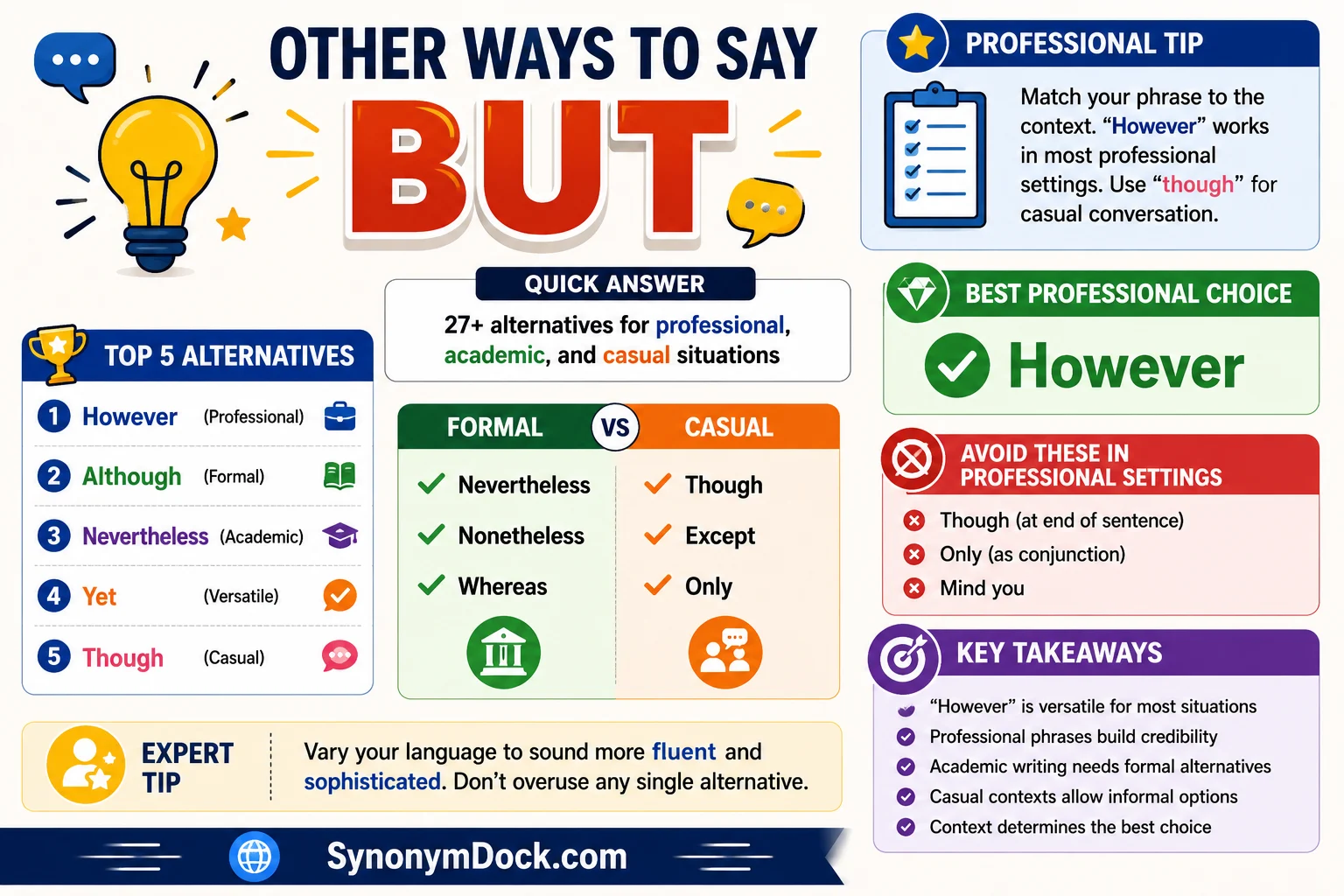
Looking for other ways to say but? Try “however” for professional writing, “although” for formal contexts, “yet” for casual conversation, “nevertheless” for academic work, or “though” for everyday speech. The best alternatives include: however, although, yet, nevertheless, though, on the other hand, whereas, while, nonetheless, and except.
“But” is one of the most common words in English. We use it constantly to show contrast, introduce exceptions, and express opposing ideas. But relying on this single word makes your writing repetitive and your speech predictable.
Whether you’re writing a business report, an academic essay, or having a casual conversation, having other ways to say but helps you sound more sophisticated and fluent. The right alternative can transform your English from basic to impressive. This article explores 15+ powerful alternatives to “but” organized by tone and situation, so you can choose the perfect expression with confidence.
Quick Categories
Formal Alternatives
- However
- Nevertheless
- Notwithstanding
- On the contrary
- Conversely
Pro Tip: Formal alternatives are perfect for academic writing, legal documents, and official correspondence. They add sophistication and precision to your writing.
Professional Alternatives
- Although
- Whereas
- While
- Though
- Yet
Pro Tip: Professional alternatives work well in business reports, emails, and workplace communication. They show your command of professional English.
Business Email Alternatives
- However
- On the other hand
- Although
- While
- Despite this
Pro Tip: These phrases are excellent for explaining contrasting viewpoints, presenting alternatives, and acknowledging objections in professional correspondence.
Academic Alternatives
- Nevertheless
- Nonetheless
- Notwithstanding
- On the contrary
- Conversely
Pro Tip: Academic alternatives strengthen your essays and research papers by adding variety and sophistication to your arguments.
Casual Alternatives
- Though
- Yet
- Still
- Except
- But then
Pro Tip: Casual alternatives work well in everyday conversation and informal writing. They sound natural and native-like.
Informal Expressions
- Only
- Except that
- Still though
- Having said that
- Mind you
Pro Tip: Use informal expressions with friends, family, and in text messages. Avoid them in professional or academic writing.
“Varying your language shows you’re a confident, fluent English speaker.”
What Does “But” Mean?
“But” is a conjunction used to introduce a contrast, exception, or opposing idea. It connects two clauses where the second clause contradicts, qualifies, or limits the first.
Example: “I wanted to go, but I was too tired.”
Grammar: “But” is a coordinating conjunction. It connects two independent clauses. The structure is: first clause + comma + but + second clause.
Is It Professional or Polite?
“But” is both professional and polite when used appropriately. However, overusing it can make your writing feel choppy and unsophisticated.
Polite? ✅ Yes
Professional? ✅ Yes, but variety matters
Formal? ⚠️ Sometimes – can feel too casual in formal writing
Natural? ✅ Yes
Example: “We wanted to proceed, but we lacked funding” works professionally. For a formal report, consider “We wanted to proceed; however, we lacked funding.”
Common Mistakes
Mistake #1: Starting Sentences with “But” Incorrectly
Why it’s incorrect: Starting a sentence with “but” is grammatically acceptable in modern English, but overusing it can make your writing feel choppy.
Correct version: Use “but” sparingly at the start of sentences, or use alternatives like “however” for variety.
Example: “But we decided to continue anyway.” (Acceptable but casual)
Better: “However, we decided to continue anyway.”
Mistake #2: Confusing “However” and “But”
Why it’s incorrect: “However” is more formal and can be used in different sentence positions. “But” is always a conjunction between clauses.
Correct version: “However” can start a sentence, appear in the middle with semicolons, or appear after a comma.
Example: “We wanted to go. However, we were too tired.” (Correct)
Mistake #3: Overusing “But” in Professional Writing
Why it’s incorrect: Repetitive use of “but” makes your writing sound basic and unsophisticated.
Correct version: Vary your language with alternatives like “although,” “whereas,” and “nevertheless.”
Example: “We wanted to proceed, but lacked funds. However, we found a solution.” (Varied and professional)
Mistake #4: Using “Despite” Incorrectly
Why it’s incorrect: “Despite” is a preposition, not a conjunction. It doesn’t take a clause.
Correct version: Use “despite” with a noun or gerund. Use “although” for clauses.
Example: “Despite the rain, we went out.” (Correct)
Incorrect: “Despite it rained, we went out.”
Mistake #5: Using “Yet” Incorrectly
Why it’s incorrect: “Yet” can mean “but” or “up to now.” This can cause confusion.
Correct version: Use “yet” for contrast or time, but clarify meaning through context.
Example: “The work was difficult, yet we succeeded.” (Contrast)
Example: “We haven’t finished yet.” (Time)
When to Use “But”
Common Situations:
- Showing contrast
- Introducing exceptions
- Expressing opposing viewpoints
- Qualifying statements
- Connecting contrasting ideas
Business:
- Presenting alternatives
- Acknowledging objections
- Showing trade-offs
- Balancing pros and cons
Academic:
- Presenting counterarguments
- Showing limitations
- Acknowledging exceptions
- Contrasting theories
Daily Conversation:
- Expressing preferences
- Making excuses
- Offering alternatives
- Showing unexpected outcomes
Written English:
- Academic essays
- Business reports
- Professional emails
- Creative writing
The best English speakers know exactly when to use formal versus casual alternatives.”
Pros and Cons of “But”
Pros
- Simple and direct
- Widely understood
- Works in any situation
- Clear and straightforward
Cons
- Overused and predictable
- Sounds repetitive
- Can feel too casual in formal writing
- Lacks sophistication
- Limited tone options
15 Other Ways to Say But
[1]. However
Meaning: A formal, sophisticated alternative introducing a contrasting idea.
Explanation: “However” is one of the most common and respected alternatives to “but.” Native speakers use it constantly in business writing, academic essays, and formal speech. It sounds polished and professional. It can appear in several positions within a sentence.
Example Sentence: “The proposal was excellent. However, we lacked the budget to implement it.”
Best Use: Business Reports, Academic Writing, Professional Emails
Avoid Using In: Very Casual Conversation
Tone: Formal, Professional
Formality Level: ⭐⭐⭐⭐ Formal
Usage Frequency: Very Common
CEFR Level: B1
Common Collocations:
- however, on the other hand
- however, we must consider
- however, this does not mean
- however, the fact remains
- however, there are exceptions
Context Variability:
- Spoken English: “The project went well. However, we need more staff.”
- Professional English: “We’ve made progress. However, challenges remain.”
[2]. Although
Meaning: A conjunction meaning “in spite of the fact that” or “but.”
Explanation: “Although” is a very common alternative to “but” that introduces a subordinate clause. Native speakers use it frequently in both writing and speaking. It’s slightly more formal than “but” but still works in casual contexts. It emphasizes the contrast more strongly.
Example Sentence: “Although we arrived late, we still managed to catch the train.”
Best Use: Professional Writing, Academic Essays, Business Communication
Avoid Using In: Text Messages (unless you want to sound formal)
Tone: Professional, Slightly Formal
Formality Level: ⭐⭐⭐⭐ Formal
Usage Frequency: Very Common
CEFR Level: B1
Common Collocations:
- although it may seem
- although we tried
- although the evidence suggests
- although this is true
- although not ideal
Context Variability:
- Spoken English: “Although I was tired, I kept working.”
- Professional English: “Although sales have declined, we remain optimistic.”
[3]. Yet
Meaning: A formal conjunction meaning “but” or “nevertheless.”
Explanation: “Yet” is a versatile alternative. Native speakers use it in both formal and casual contexts. It sounds slightly more sophisticated than “but” and works particularly well in written English. It can also mean “up to now,” so context is important.
Example Sentence: “The project was difficult, yet we managed to finish on time.”
Best Use: Professional Writing, Academic Essays, Formal Speech
Avoid Using In: Very Casual Conversation
Tone: Slightly Formal, Professional
Formality Level: ⭐⭐⭐⭐ Formal
Usage Frequency: Common
CEFR Level: B1
Common Collocations:
- yet we must remember
- yet the question remains
- yet despite this
- yet there is hope
- yet not without challenges
Context Variability:
- Spoken English: “It was raining, yet we went out.”
- Professional English: “The results are promising, yet we need more data.”
[4]. Nevertheless
Meaning: A formal adverb meaning “in spite of that” or “however.”
Explanation: “Nevertheless” is a very formal alternative to “but.” Native speakers use it in academic writing, formal reports, and official speeches. It sounds sophisticated and precise. It’s excellent for showing that a fact remains true despite what was just said.
Example Sentence: “The evidence was limited. Nevertheless, we proceeded with the research.”
Best Use: Academic Writing, Formal Reports, Legal Documents
Avoid Using In: Casual Conversation
Tone: Very Formal, Sophisticated
Formality Level: ⭐⭐⭐⭐⭐ Very Formal
Usage Frequency: Occasional (Formal Contexts)
CEFR Level: B2
Common Collocations:
- nevertheless, we must
- nevertheless, the fact remains
- nevertheless, this shows
- nevertheless, it is important
- nevertheless, we cannot ignore
Context Variability:
- Written English: “The experiment had limitations. Nevertheless, the results were significant.”
- Academic English: “Nevertheless, these findings challenge previous assumptions.”
[5]. Though
Meaning: A casual, versatile conjunction meaning “but” or “however.”
Explanation: “Though” is a very common and natural alternative. Native speakers use it constantly in everyday conversation and informal writing. It’s less formal than “although” but means the same thing. It can appear at the beginning, middle, or end of a sentence.
Example Sentence: “I didn’t get the job. I’m not sad, though.”
Best Use: Daily Conversation, Casual Writing, Text Messages
Avoid Using In: Formal Documents
Tone: Casual, Friendly
Formality Level: ⭐⭐ Casual
Usage Frequency: Very Common
CEFR Level: A2
Common Collocations:
- though, I have to say
- though, not everyone agrees
- it was worth it though
- I didn’t mind though
- not though I wanted to
Context Variability:
- Spoken English: “I was late, though I didn’t mean to be.”
- Text Message: “I’m busy. I’ll try to come though.”
“Good writers don’t just use one word – they choose the right word for the right moment.”
[6]. On the Other Hand
Meaning: A phrase used to introduce a contrasting point or alternative perspective.
Explanation: “On the other hand” is a very useful phrase for presenting alternatives. Native speakers use it in both professional and casual contexts when comparing options or viewpoints. It’s particularly common in business writing and academic essays.
Example Sentence: “The first option is cheaper. On the other hand, it takes much longer.”
Best Use: Business Reports, Presentations, Academic Essays
Avoid Using In: Very Short Casual Conversations
Tone: Neutral, Analytical
Formality Level: ⭐⭐⭐ Neutral
Usage Frequency: Very Common
CEFR Level: B1
Common Collocations:
- on the other hand, however
- on the other hand, this means
- on the other hand, we must consider
- on the other hand, there is
- on the other hand, but
Context Variability:
- Spoken English: “I like living in the city. On the other hand, it’s expensive.”
- Professional English: “We could expand now. On the other hand, we could wait.”
[7]. Whereas
Meaning: A formal conjunction used to show a contrast between two facts or situations.
Explanation: “Whereas” is a formal alternative that’s particularly useful for comparing two things. Native speakers use it in legal documents, academic writing, and formal reports. It’s perfect when you need to contrast two clearly different situations or facts.
Example Sentence: “The first group performed well, whereas the second group struggled.”
Best Use: Academic Writing, Legal Documents, Formal Reports
Avoid Using In: Casual Conversation
Tone: Very Formal, Comparative
Formality Level: ⭐⭐⭐⭐⭐ Very Formal
Usage Frequency: Occasional (Formal Contexts)
CEFR Level: B2
Common Collocations:
- whereas in contrast
- whereas, on the other hand
- whereas, however
- whereas it is true that
- whereas this suggests
Context Variability:
- Written English: “The North region saw growth, whereas the South experienced decline.”
- Academic English: “Whereas previous studies focused on adults, this research examines children.”
[8]. While
Meaning: A conjunction meaning “although” or “whereas.”
Explanation: “While” is a versatile alternative that’s widely used in both professional and casual contexts. Native speakers use it frequently in writing and speaking. It can mean “at the same time” or “although,” so context is important. It’s slightly more formal than “but” but less formal than “whereas.”
Example Sentence: “While we appreciate the offer, we cannot accept it.
Best Use: Professional Writing, Business Communication, Academic Essays
Avoid Using In: Formal Legal Documents (use “whereas” instead)
Tone: Professional, Neutral
Formality Level: ⭐⭐⭐⭐ Formal
Usage Frequency: Very Common
CEFR Level: B1
Common Collocations:
- while this is true
- while there are challenges
- while we understand
- while it may seem
- while not perfect
Context Variability:
- Spoken English: “While I agree with you, I have some concerns.”
- Professional English: “While sales are up, profits have declined.”
[9]. Nonetheless
Meaning: A formal adverb meaning “nevertheless” or “despite that.”
Explanation: “Nonetheless” is very similar to “nevertheless.” Native speakers use it in formal writing to show that something remains true despite other factors. It sounds sophisticated and precise. It’s excellent for academic and professional writing.
Example Sentence: “The weather was terrible. Nonetheless, the event was a success.”
Best Use: Academic Writing, Formal Reports, Business Communication
Avoid Using In: Casual Conversation
Tone: Very Formal, Precise
Formality Level: ⭐⭐⭐⭐⭐ Very Formal
Usage Frequency: Occasional (Formal Contexts)
CEFR Level: B2
Common Collocations:
- nonetheless, we must continue
- nonetheless, the data suggests
- nonetheless, this remains true
- nonetheless, it is important
- nonetheless, we cannot ignore
Context Variability:
- Written English: “The research had limitations. Nonetheless, the findings were significant.”
- Academic English: “Nonetheless, these results challenge existing theories.”
[10]. Except
Meaning: A preposition or conjunction meaning “apart from” or “but.”
Explanation: “Except” is a useful alternative when you want to indicate a single exception. Native speakers use it frequently in both writing and speaking. It’s more specific than “but” and clearly identifies the exception. It works in professional and casual contexts.
Example Sentence: “I agree with everything except your final point.”
Best Use: Professional Writing, Daily Conversation, Emails
Avoid Using In: Formal Legal Documents (unless appropriate)
Tone: Neutral, Specific
Formality Level: ⭐⭐⭐ Neutral
Usage Frequency: Very Common
CEFR Level: A2
Common Collocations:
- except for
- except when
- except that
- except perhaps
- except in cases
Context Variability:
- Spoken English: “I like all fruits except bananas.”
- Professional English: “All departments met their targets except marketing.”
[11]. Yet (as conjunction)
Meaning: A formal conjunction meaning “but” or “nevertheless.”
Explanation: “Yet” as a conjunction works similarly to “but” but sounds slightly more formal. Native speakers use it in both writing and speaking. It emphasizes a surprising or unexpected contrast. It’s particularly common in literary and professional writing.
Example Sentence: “The task was challenging, yet we accomplished it.”
Best Use: Professional Writing, Academic Essays, Formal Speech
Avoid Using In: Very Casual Conversation
Tone: Formal, Literary
Formality Level: ⭐⭐⭐⭐ Formal
Usage Frequency: Common
CEFR Level: B1
Common Collocations:
- yet we must remember
- yet the question remains
- yet despite this
- yet there is hope
- yet not without challenges
Context Variability:
- Spoken English: “It was raining, yet we went out.”
- Professional English: “The results are promising, yet we need more data.”
[12]. Still
Meaning: An adverb meaning “nevertheless” or “despite that.”
Explanation: “Still” is a versatile alternative that works in many contexts. Native speakers use it frequently in both professional and casual situations. It shows that something remains true despite what was just said. It’s less formal than “nevertheless” but more formal than “though.”
Example Sentence: “The system was old. Still, it worked perfectly.”
Best Use: Business Communication, Professional Writing, Daily Conversation
Avoid Using In: Very Formal Legal Documents
Tone: Neutral, Pragmatic
Formality Level: ⭐⭐⭐ Neutral
Usage Frequency: Very Common
CEFR Level: A2
Common Collocations:
- still, we must consider
- still, the fact remains
- still, there is hope
- still, it’s worth trying
- still, not everyone agrees
Context Variability:
- Spoken English: “It was a tough day. Still, I’m grateful.”
- Professional English: “The project is behind schedule. Still, we can catch up.”
[13]. On the Contrary
Meaning: A formal phrase used to contradict or show the opposite of what was just stated.
Explanation: “On the contrary” is a very formal phrase that strongly contradicts a previous statement. Native speakers use it in academic writing, formal debates, and official speeches. It’s stronger than “but” and definitively rejects the previous point.
Example Sentence: “This isn’t a weakness. On the contrary, it’s a strength.”
Best Use: Academic Writing, Formal Debates, Legal Arguments
Avoid Using In: Casual Conversation
Tone: Very Formal, Strong
Formality Level: ⭐⭐⭐⭐⭐ Very Formal
Usage Frequency: Occasional (Formal Contexts)
CEFR Level: B2
Common Collocations:
- on the contrary, this shows
- on the contrary, it is clear
- on the contrary, the evidence suggests
- on the contrary, we believe
- on the contrary, the data indicates
Context Variability:
- Written English: “This doesn’t contradict our theory. On the contrary, it supports it.”
- Academic English: “On the contrary, these findings reinforce our hypothesis.”
[14]. Despite This
Meaning: A phrase meaning “in spite of this” or “nevertheless.”
Explanation: “Despite this” is a professional phrase that acknowledges a point but shows it doesn’t change the outcome. Native speakers use it in business writing, reports, and professional communication. It’s less formal than “nevertheless” but more professional than “but.”
Example Sentence: “We faced many obstacles. Despite this, we succeeded.”
Best Use: Business Reports, Professional Emails, Presentations
Avoid Using In: Very Formal Academic Writing
Tone: Professional, Resilient
Formality Level: ⭐⭐⭐⭐ Formal
Usage Frequency: Common
CEFR Level: B1
Common Collocations:
- despite this, we
- despite this, the fact remains
- despite this, however
- despite this, there is
- despite this, we believe
Context Variability:
- Spoken English: “There were many problems. Despite this, we finished on time.”
- Professional English: “Despite this, we remain optimistic about the outcome.”
[15]. Only (as conjunction)
Meaning: A conjunction meaning “but” or “except,” often used to introduce a limitation.
Explanation: “Only” as a conjunction means “except” or “but.” It’s somewhat informal and common in everyday speech. Native speakers use it when they want to introduce a single limitation or exception. It’s less common in professional writing.
Example Sentence: “I’d like to help, only I’m busy today.”
Best Use: Casual Conversation, Friendly Emails, Text Messages
Avoid Using In: Professional Business Writing
Tone: Casual, Friendly
Formality Level: ⭐⭐ Casual
Usage Frequency: Common (Informal Contexts)
CEFR Level: B1
Common Collocations:
- only I’m not sure
- only we can’t
- only there’s one problem
- only if
- only that
Context Variability:
- Spoken English: “I’d come, only I have to work.”
- Text Message: “Can’t go, only I’m sick.”
“Every situation demands a different alternative – learn them all.”
Native Speaker Tip
Native speakers often choose “though” or “yet” over “but” in casual conversation to sound more natural. In professional emails, “however” and “although” are preferred. “Whereas” is used for direct comparisons, and “nevertheless” is reserved for formal writing. “On the contrary” is used to strongly contradict someone.
Expert Insight
In workplace communication, choosing the right alternative to “but” can affect how your message is received. “However” sounds analytical and balanced. “Although” and “while” acknowledge limitations without being confrontational. “Nevertheless” shows resilience. The key is matching your language to the context and your relationship with the reader.
Avoid These Expressions in Formal Situations
| Expression | Why to Avoid | Better Alternative |
|---|---|---|
| Though (at end) | Too casual | However or nevertheless |
| Only (as conjunction) | Informal | But or except |
| But then | Too casual | However or on the other hand |
| Mind you | Too informal | However or nevertheless |
| Still though | Too casual | Nevertheless or nonetheless |
Top 10 Alternatives Compared
| Phrase | Tone | Formality | Best Use | Frequency |
|---|---|---|---|---|
| However | Professional | ⭐⭐⭐⭐ | Business, Writing | Very Common |
| Although | Slightly Formal | ⭐⭐⭐⭐ | Essays, Speech | Very Common |
| Yet | Formal | ⭐⭐⭐⭐ | Writing, Formal | Common |
| Nevertheless | Very Formal | ⭐⭐⭐⭐⭐ | Academic, Legal | Occasional |
| Though | Casual | ⭐⭐ | Conversation | Very Common |
| On the other hand | Neutral | ⭐⭐⭐ | Comparisons | Very Common |
| Whereas | Very Formal | ⭐⭐⭐⭐⭐ | Comparisons | Occasional |
| While | Professional | ⭐⭐⭐⭐ | Writing | Very Common |
| Nonetheless | Very Formal | ⭐⭐⭐⭐⭐ | Academic | Occasional |
| Except | Neutral | ⭐⭐⭐ | Exceptions | Common |
Which One Should You Use?
Best Overall: However – works in almost any situation
Best Professional: However – polished and widely accepted
Best Academic: Nevertheless – sophisticated for essays
Best Business Email: However or although – professional and clear
Best Everyday Conversation: Though – natural and native-like
Best Natural: Though – native speakers use it constantly
Best Polite: However – diplomatic and respectful
Commonly Confused Phrases
“However” vs. “But”
“However” is more formal and can appear in different sentence positions. “But” is a conjunction that connects two clauses. Use “however” for more formal writing and “but” for casual writing.
“Although” vs. “While”
Both can mean “but.” “Although” emphasizes the contrast more strongly. “While” can also mean “at the same time.” Context usually clarifies meaning.
“Nevertheless” vs. “Nonetheless”
These are almost identical in meaning. “Nevertheless” is slightly more common. Both are formal and mean “despite that.”
Scenario Practice
Scenario 1: You’re writing a business report showing contrasting results.
Which phrase would you choose?
Correct Answer: “Sales increased in the North. However, the South saw a decline.”
Why: Professional, clear, and appropriate for business writing.
Scenario 2: You’re telling a friend about a difficult but successful experience.
Which phrase would you choose?
Correct Answer: “It was tough, though we managed somehow.”
Why: Casual and natural for conversation.
Scenario 3: You’re writing an academic essay presenting counterarguments.
Which phrase would you choose?
Correct Answer: “The theory is compelling. Nevertheless, it has limitations.”
Why: Formal and sophisticated for academic writing.
Scenario 4: You’re comparing two job candidates in a professional email.
Which phrase would you choose?*
Correct Answer: “Candidate A has more experience, whereas Candidate B has better skills.”
Why: Formal and clear for direct comparison.
Scenario 5: You’re in a meeting presenting alternatives.
Which phrase would you choose?*
Correct Answer: “The first option is cheaper. On the other hand, it takes longer.”
Why: Professional and helpful for decision-making.
Mini Quiz
1. Which alternative is most appropriate for academic writing?
- A) Though
- B) Nevertheless
- C) Only
2. Which phrase is best for comparing two things?
- A) Although
- B) Wherever
- C) Whereas
3. Which alternative is too casual for a business report?
- A) However
- B) Nevertheless
- C) Though
4. Which word can mean “but” or “up to now”?
- A) Yet
- B) Still
- C) Except
5. What’s the most versatile alternative for most situations?
- A) However
- B) Nonetheless
- C) Only
Answer Key
- B) Nevertheless – Formal and appropriate for academic contexts.
- C) Whereas – Specifically used for direct comparisons.
- C) Though – Too casual for formal business writing.
- A) Yet – Can mean “but” or “up to now.”
- A) However – Works in most professional and formal contexts.
FAQs
What is the most formal way to say “but”?
“Nevertheless” and “nonetheless” are among the most formal alternatives. “Whereas” is also very formal, especially for comparisons. “On the contrary” is formal and used for strong contradiction.
Which phrase is best for professional emails?
“However” is the best choice for professional emails. It’s formal enough for business contexts but not overly stiff. “Although” and “while” are also excellent options.
What is the difference between “although” and “though”?
“Although” is more formal than “though.” “Though” is more casual and can appear at the end of a sentence. Both mean the same thing. Choose “although” for formal writing and “though” for conversation.
Which alternative sounds most natural to native speakers?
“Though” sounds the most natural in casual conversation. “However” sounds natural in professional contexts. “Yet” is also very natural in both writing and speaking.
Can I use these expressions in business meetings?
Yes, professional alternatives like “however,” “although,” “while,” and “on the other hand” are perfect for business meetings. Avoid “though” (when at the end of a sentence) and “only” in professional settings.
Conclusion
Learning other ways to say but transforms your English communication. Instead of repeating the same word, you now have powerful alternatives for every situation – from professional emails to casual conversations.
The key is choosing the right phrase for the right context. “However” and “although” work perfectly in professional settings. “Though” is a natural choice for everyday conversation. “Nevertheless” and “nonetheless” add sophistication to academic writing.
Start today – choose one new alternative and use it in your next conversation or email. With practice, these alternatives will become second nature, and your English will sound more fluent, professional, and impressive.

10 thoughts on “Other Ways to Say But |27+ Professional & Casual Alternatives”