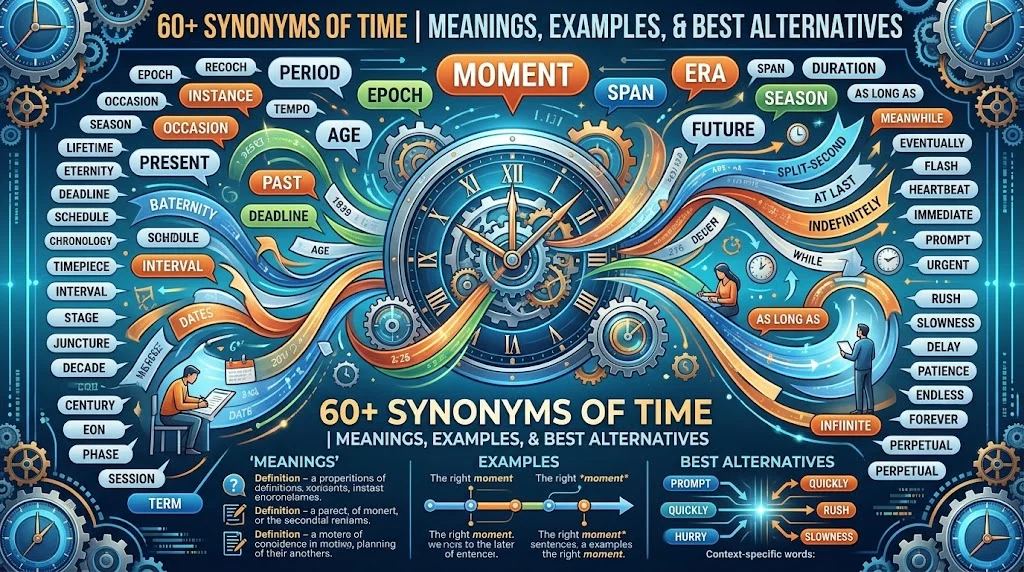
The best synonyms of time depend entirely on your context. For formal writing, choose “duration” or “period.” For casual conversation, try “while” or “spell.” In academic work, “temporal extent” or “chronological span” work well. For professional communication, “timeframe” and “schedule” are excellent choices. Creative writers often prefer “era,” “age,” or “moment.”
Have you ever found yourself writing an email, an essay, or a social media caption and realized you’ve used the word “time” over and over again? It happens to almost everyone. You want to sound polished and varied, but the right word just won’t come to mind. The word “time” is so common that we often forget it has many precise alternatives. Choosing the right synonym of time can transform your writing from repetitive to engaging. It can make your meaning clearer and your tone more appropriate for your audience.
Meaning, Tone, and Context
Simple Definition
Time refers to the indefinite continued progress of existence and events in the past, present, and future. It is the measurable period during which actions, processes, or conditions exist or continue.
Part of Speech
Time functions primarily as a noun. It can also be used as a verb meaning to schedule or measure.
Overall Tone
Time is a neutral word. It does not carry inherent positive or negative emotional weight. Its tone shifts based on how you use it and which words surround it.
Formality Level
Time is neutral in formality. You can use it in any setting from casual conversation to the most formal academic paper. However, its synonyms often carry specific formality levels that make them better suited for particular contexts.
Common Uses
Native English speakers use time constantly. They use it to discuss schedules, history, personal experiences, scientific concepts, and everyday activities. It appears in idioms, expressions, and nearly every type of communication.
Word Forms
Time (noun), times (plural noun), timely (adjective), timeless (adjective), timing (noun), timed (verb).
When and How to Use “Time”
You should choose the word “time” when you need a neutral, widely understood term that works in almost any context. It serves as a safe default for most communication. Here are realistic examples across different contexts.
Professional: We need to allocate more time to the Q3 marketing campaign.
Academic: The study examined how time affects memory retention in older adults.
Workplace: Please submit your timesheet by the end of the workday.
Personal: I wish I had more time to spend with my family.
Email: Thank you for taking the time to review my proposal.
Resume: Managed multiple projects simultaneously while meeting tight time constraints.
Social Media: Time flies when you are doing what you love.
Best Synonyms of “Time”
No synonym of time is identical in every situation. Each alternative carries subtle differences in meaning, tone, and formality. Here are the best synonyms for specific contexts.
Professional writing: Use “timeframe” because it suggests structure and planning.
Academic writing: Use “duration” because it conveys precision and measurability.
Business communication: Use “schedule” when discussing plans and deadlines.
Casual conversation: Use “while” for short, informal periods.
Emotional writing: Use “moment” to emphasize significance or feeling.
Creative writing: Use “era” to suggest a distinct historical or cultural period.
Resume writing: Use “tenure” to describe your length of service.
Workplace communication: Use “deadline” when referring to completion dates.
Stronger meaning: Use “eternity” to express endless time.
Softer meaning: Use “instant” to suggest a brief, gentle moment.
When Not to Use “Time”
Too General
Using “time” when you need precision can make your writing vague. Saying “a long time” lacks impact compared to more specific alternatives.
Better: Instead of “a long time,” say “a decade” or “an extended period.
Too Vague in Professional Settings
In business writing, “time” often fails to communicate urgency or structure.
Better: Use “deadline” or “schedule” to provide clear expectations.
Too Informal in Academic Writing
Academic papers require precise vocabulary. Repeated use of “time” can appear unsophisticated.
Better: Use “temporal dimension” or “chronological sequence” for research papers.
Too Weak for Emotional Impact
When describing meaningful experiences, “time” feels flat.
Better: Use “moment” or “milestone” to convey emotional weight.
Outdated in Certain Contexts
Some uses of “time” sound old-fashioned in modern business communication.
Better: Use “timeline” instead of “time frame” in project management contexts.
Words Commonly Confused With “Time”
Time vs Age
Difference: Age refers specifically to how long a person or thing has existed. Time is a broader concept.
When to Use Age: Use “age” when discussing human life spans or historical periods of specific entities.
Example: The age of the building is over one hundred years.
Time vs Era
Difference: Era describes a distinct historical or cultural period. Time is a more general measure.
When to Use Era: Use “era” when discussing significant periods marked by particular characteristics.
Example: The Victorian era transformed British society.
Time vs Period
Difference: Period suggests a defined interval with clear boundaries. Time is more abstract.
When to Use Period: Use “period” when referring to specific, measurable intervals.
Example: The study covers a five-year period.
Time vs Moment
Difference: Moment refers to a very brief, often significant point in time. Time is continuous.
When to Use Moment: Use “moment” for short, meaningful instances.
Example: She paused for a moment before answering.
Time vs Duration
Difference: Duration specifically refers to how long something continues. Time is more general.
When to Use Duration: Use “duration” when measuring the length of an event or state.
Example: The duration of the meeting was two hours.
Time vs Schedule
Difference: Schedule refers to a planned sequence of events. Time is the abstract measure.
When to Use Schedule: Use “schedule” when discussing planned activities and timing.
Example: The project schedule includes weekly milestones.
Best Synonyms of “Time” by Context
| Context | Best Synonym | Why It Works | Example |
| Formal writing | Duration | Provides precision and measurable clarity | The duration of the experiment lasted six months. |
| Academic writing | Chronological | Emphasizes sequence and order in research | The chronological sequence of events is crucial. |
| Professional communication | Timeframe | Conveys structure and planning | We will establish a clear timeframe for deliverables. |
| Business emails | Deadline | Creates urgency and accountability | Please meet the deadline for the quarterly report. |
| Resume writing | Tenure | Demonstrates commitment and experience | My tenure at the company spans five years. |
| Workplace communication | Milestone | Highlights achievements and progress | We reached every milestone on schedule. |
| Casual conversation | While | Feels natural and conversational | We chatted for a while about the weekend. |
| Everyday speaking | Spell | Adds personality to informal talk | We had a cold spell last week. |
| Creative writing | Era | Conveys historical or cultural significance | The era of exploration changed the world. |
| Storytelling | Moment | Creates emotional impact and drama | In that moment, everything changed. |
| Emotional writing | Season | Suggests natural cycles and personal growth | She entered a new season of her life. |
| Strong emphasis | Eternity | Conveys endlessness and permanence | The memory felt like an eternity. |
| Mild tone | Instant | Suggests briefness without drama | For an instant, he hesitated. |
| Social media captions | Now | Creates urgency and relevance | Start living in the now. |
| American English | Time | Standard and universally understood | We have plenty of time to decide. |
How to Choose the Best Synonym of “Time”
Choosing the right synonym of time starts with understanding your specific situation. Begin by asking yourself what you actually mean. Are you discussing a specific measurable period or an abstract concept? Consider your audience. A formal report demands different language than a text message. Think about the emotional weight you want to convey. Some synonyms carry strong feelings while others remain neutral. The level of formality matters too. Match your word choice to the context. Finally, read your sentence aloud with each option. The synonym that sounds most natural and clear is usually the correct choice.
Real Life Examples of “Time”
School Assignment
The teacher gave us limited time to complete the test. The students felt pressured by the clock.
College Research Paper
The study explored how sleep patterns change over time in young adults. Researchers tracked participants for six months.
Workplace Meeting
We need to discuss how much time each team member can commit to the project. Everyone should bring their calendars.
Business Proposal
Our proposal outlines the time required for each phase of implementation. Clients appreciate transparency about scheduling.
Email Reply
Thank you for finding the time to meet with me next week. I look forward to discussing our partnership.
Resume Description
Managed a team of fifteen people for a period of three years. Exceeded performance targets every quarter.
Conversation with a Friend
I can’t believe how much time has passed since we last saw each other. We need to meet up more often.
Storytelling Scene
The old clock measured time as it had for generations. Each tick echoed through the empty house.
Blogging about Productivity
Time management is the most important skill for entrepreneurs. Protect your time like your most valuable asset.
Social Media Inspiration
Make the most of the time you have today. Start something new and see where it takes you.
18 Best Synonyms of “Time”
| Synonym | Simple Meaning | Best Used For | Example Sentence |
| Duration | The length of time something continues | Academic writing and reports | The duration of the course is twelve weeks. |
| Period | A specific interval with defined boundaries | Professional and formal contexts | The company performed well during that period. |
| Era | A long and distinct historical or cultural period | Creative and historical writing | The digital era transformed how we communicate. |
| Age | A long period marked by particular features | Historical and generational contexts | We are living in the age of artificial intelligence. |
| Moment | A very brief, meaningful point in time | Emotional and conversational use | The moment of truth had finally arrived. |
| Instant | An extremely short period of time | Casual and dramatic descriptions | For an instant, the crowd fell silent. |
| While | A relatively short period | Everyday conversation and informal writing | I waited for a while at the coffee shop. |
| Spell | A short period with particular conditions | Casual and descriptive contexts | The country experienced a dry spell this summer. |
| Season | A period characterized by particular activities | Literary and metaphorical writing | She entered a season of personal growth. |
| Chronology | The arrangement of events in time order | Academic and technical writing | The chronology of the documents was unclear. |
| Eternity | Infinite or endless time | Emotional and philosophical writing | The wait felt like an eternity. |
| Interval | The gap or pause between events | Scientific and technical contexts | There was a long interval between phone calls. |
| Span | The full extent of something from start to finish | Project management and timelines | The project covers a span of two years. |
| Tenure | The period of holding a position or office | Resume and professional contexts | Her tenure as director was highly successful. |
| Timetable | A schedule showing planned times | Educational and business planning | Check the timetable for class changes. |
| Schedule | A planned sequence of activities | Professional and everyday use | My schedule is full for the rest of the week. |
| Timeframe | A specific period allocated for something | Business and project management | We need a realistic timeframe for completion. |
| Milestone | A significant point in a timeline | Professional achievements and planning | We celebrated every milestone along the way. |
Synonyms of “Time” by Usage
Professional vs Personal Synonyms
In professional settings, choose synonyms that convey structure, accountability, and precision. Words like “timeframe,” “schedule,” and “deadline” work well in business contexts. For personal conversations, simpler words like “while,” “spell,” and “period” sound more natural. Professional synonyms emphasize planning and results. Personal synonyms focus on experience and feeling. Match your choice to the relationship with your audience.
Formal vs Conversational Synonyms
Formal contexts like reports, essays, and presentations demand specific vocabulary. “Duration,” “chronology,” and “temporal extent” signal academic or professional sophistication. Conversational settings welcome shorter, more familiar words. “Time,” “while,” and “moment” feel comfortable in everyday speech. Business emails can bridge both worlds. They require professionalism but should not sound overly formal or robotic. “Timeframe” and “schedule” strike the right balance.
Academic Synonyms
Academic writing benefits from precise language. “Chronological sequence” emphasizes order and progression. “Temporal dimension” adds theoretical weight. “Duration” measures exact intervals. “Periodization” helps organize historical analysis. These terms demonstrate subject mastery. They also help readers understand complex relationships. Use academic synonyms when you need to communicate with scholars, researchers, or students.
Professional and Business Synonyms
The strongest professional synonyms of time include “timeframe,” “deadline,” “schedule,” “timetable,” “milestone,” “tenure,” and “timeline.” These words appear frequently in resumes, interviews, meetings, presentations, performance reviews, client communication, and business emails. They create clarity and establish accountability. They also demonstrate your ability to manage projects and people effectively. Use them to position yourself as organized and results oriented.
Creative and Literary Synonyms
Creative writers reach for expressive alternatives. “Era” suggests historical sweep. “Age” evokes cultural movements. “Season” implies natural cycles and personal transformation. “Moment” creates dramatic tension. “Eternity” adds philosophical weight. These words add emotion and imagery to fiction, poetry, speeches, and descriptive writing. They invite readers to feel the passage of time rather than simply measure it.
Slang or Modern Synonyms
English does not have many slang alternatives for “time.” The word is too fundamental to require casual substitutes. However, expressions like “a hot minute” can mean a long time. “Instant” sometimes appears as “insta” in very casual digital communication. These slang terms should be avoided in professional, academic, or formal writing. Use them only with close friends or in extremely informal settings.
Strongest to Mildest Synonyms
Mild: instant, moment, while, spell, period
Moderate: time, timeframe, interval, duration, schedule
Strong: era, age, season, span, tenure, chronology
Very Strong: eternity, timeless, endless, perpetual, infinite
Emotional intensity increases as you move from mild to very strong. A mild word like “instant” suggests something brief and passing. A very strong word like “eternity” conveys permanence and endlessness. Choose the intensity level that matches the weight you want to give your message. Overusing strong words diminishes their impact. Underusing them makes important moments feel ordinary.
Emotional vs Neutral Synonyms
Emotional Synonyms
Some synonyms of time carry distinct emotional weight. “Moment” often feels significant or meaningful. “Eternity” suggests intensity or permanence. “Season” implies personal growth and change. “Era” evokes nostalgia or historical importance. These words add feeling to your writing. Use them when you want your audience to connect emotionally with your message. They work well in storytelling, personal writing, and persuasive communication.
Neutral Synonyms
Neutral synonyms simply communicate information. “Duration” measures length without added feeling. “Period” defines an interval objectively. “Schedule” organizes activities. “Timeframe” structures planning. These words serve practical purposes. They fit professional, academic, and business contexts perfectly. Use them when clarity and precision matter more than emotional engagement.
Antonyms of “Time”
| Antonym | Meaning | Example Sentence |
| Eternity | Endless or infinite time, the opposite of a limited period | The concept of eternity contrasts sharply with human time. |
| Instant | A very brief moment, less than a measurable period | The decision happened in an instant, not over time. |
| Now | The present moment, focusing on immediacy | Stop worrying about time and just live in the now. |
| Forever | Without end, the complete opposite of temporary time | The contract seemed to last forever. |
| Never | At no time, expressing absence of time or occurrence | He will never forget that experience. |
| Momentary | Lasting for only a brief period | The pain was momentary and quickly faded. |
| Fleeting | Passing quickly, suggesting movement away from time | She caught a fleeting glimpse of the future. |
| Temporary | Lasting for a limited time only | This arrangement is only temporary. |
| Brief | Short in duration, opposite of extended time | The meeting was brief but productive. |
| Short | Limited in length or duration | The speech was surprisingly short. |
| Rare | Infrequent, occurring only occasionally | Such opportunities are rare. |
| Seldom | Not often, indicating low frequency | He seldom arrives on time. |
| Infrequent | Not occurring often | Her visits became infrequent. |
| Ephemeral | Lasting for a very short time | The beauty of the sunset was ephemeral. |
| Transitory | Not permanent, suggesting change over time | The feeling of happiness was transitory. |
Comparison: “Time” vs Similar Words
Time vs Duration
Main Difference: Time is the abstract concept of existence and events. Duration specifically measures how long an event continues.
Which Is Stronger?: Duration is more precise and suggests measurable length.
Which Is More Formal?: Duration is more formal and academic.
When to Use Each: Use “time” for general discussion. Use “duration” for specific measurement.
Examples
Time: I need more time to finish this project.
Duration: The duration of the training is six weeks.
Time vs Era
Main Difference: Time is a continuous measure. Era refers to a distinct period with specific cultural or historical characteristics.
Which Is Stronger?: Era carries more historical and cultural weight.
Which Is More Formal?: Era is more formal and literary.
When to Use Each: Use “time” for everyday contexts. Use “era” for historical or cultural discussions.
Examples
Time: Time passes quickly when you are busy.
Era: The Renaissance era produced remarkable art.
Time vs Moment
Main Difference: Time is a continuous flow. Moment is a brief, specific point often with emotional significance.
Which Is Stronger?: Moment is stronger in emotional impact.
Which Is More Formal?: Time is more formal and neutral.
When to Use Each: Use “time” for general references. Use “moment” for brief, meaningful instances.
Examples
Time: We have enough time to catch the train.
Moment: She savored every moment of the performance.
Time vs Period
Main Difference: Time is abstract and continuous. Period is a defined interval with clear boundaries.
Which Is Stronger?: Period is more specific and defined.
Which Is More Formal?: Period is more formal and structured.
When to Use Each: Use “time” for casual conversation. Use “period” for academic and professional contexts.
Examples
Time: I need more time to practice.
Period: The school operates on a semester period.
Time vs Age
Main Difference: Time is a universal measure. Age specifically refers to the length of existence of a person or thing.
Which Is Stronger?: Age is more personal and specific.
Which Is More Formal?: Age is formal when discussing demographics and historical contexts.
When to Use Each: Use “time” for general measures. Use “age” for life spans and historical designations.
Examples
Time: Time has taught me patience.
Age: The age of the building is over one hundred years.
Time vs Schedule
Main Difference: Time is the abstract measure. Schedule is the planned use of time for activities.
Which Is Stronger?: Schedule is more action oriented and practical.
Which Is More Formal?: Schedule is appropriate for professional and business contexts.
When to Use Each: Use “time” for general discussion. Use “schedule” for planning and coordination.
Examples
Time: We should manage our time wisely.
Schedule: Let me check my schedule for next week.
Common Phrases and Expressions with “Time”
Time Flies
Meaning: Time passes very quickly, often when you are enjoying something.
Example Sentence: It feels like we just started this project yesterday. Time flies when you are busy.
In the Nick of Time
Meaning: Just before it is too late or at the last possible moment.
Example Sentence: The repair was completed in the nick of time before the deadline.
Time to Kill
Meaning: Free time that needs to be filled or occupied.
Example Sentence: We had some time to kill before our flight departed.
At the Same Time
Meaning: Simultaneously or occurring together.
Example Sentence: You need to be both supportive and honest at the same time.
Time After Time
Meaning: Repeatedly or again and again.
Example Sentence: She has proven her reliability time after time.
Make Up for Lost Time
Meaning: To compensate for time wasted or missed.
Example Sentence: We worked extra hours to make up for lost time.
Bide Your Time
Meaning: To wait patiently for the right opportunity.
Example Sentence: He decided to bide his time until the perfect moment arrived.
Time and Again
Meaning: Repeatedly, over and over.
Example Sentence: Time and again, the research confirmed the same results.
Common Mistakes to Avoid
Choosing a Vague Synonym Instead of a Precise One
Incorrect: We need to finish this within a reasonable time.
Better: We need to finish this within a two-week timeframe.
Why: The vague “reasonable time” does not help anyone. A specific timeframe creates accountability.
Confusing Time with a Similar Word
Incorrect: Her schedule at the company was five years.
Better: Her tenure at the company was five years.
Why: “Tenure” specifically describes the duration of employment, while “schedule” refers to planned activities.
Using an Informal Synonym in Formal Writing
Incorrect: The experiment took a good long while to complete.
Better: The experiment required an extended duration to complete.
Why: “While” sounds conversational. “Duration” is the proper academic choice.
Selecting an Overly Dramatic Synonym
Incorrect: My commute to work takes an eternity every day.
Better: My commute to work takes a long period every day.
Why: “Eternity” exaggerates unnecessarily and loses credibility.
Repeating the Same Word Too Often
Incorrect: Time is precious. We should not waste time. Time management is essential.
Better: Time is precious. We should not waste it. Good schedule management is essential.
Why: Varying your vocabulary keeps writing interesting and professional.
Choosing a Synonym with the Wrong Emotional Tone
Incorrect: We are entering an era of quarterly financial planning.
Better: We are entering a period of quarterly financial planning.
Why: “Era” suggests historical significance. “Period” fits routine business planning.
Using Slang in Academic or Professional Writing
Incorrect: We have a hot minute to complete the research.
Better: We have a limited period to complete the research.
Why: Slang like “hot minute” ruins credibility in academic or professional contexts.
Frequently Asked Questions
1. What are the best synonyms of time?
The best synonyms of time depend on your context. For formal writing, use “duration” or “period.” For casual settings, choose “while” or “spell.” Academic work benefits from “chronological” or “temporal.” Business contexts prefer “timeframe” or “schedule.”
2. What are the best formal synonyms of time?
Formal synonyms of time include “duration,” “period,” “chronology,” “temporal extent,” and “interval.” These words appear in academic papers, professional reports, and formal business communication. They sound more precise and authoritative than the simple word “time.”
3. What are common informal synonyms of time?
Common informal synonyms of time include “while,” “spell,” “bit,” and “moment.” These words appear in everyday conversation, casual emails, text messages, and social media. They feel natural and relaxed. They do not carry the weight of their formal alternatives.
4. What is another word for time in professional writing?
In professional writing, use “timeframe,” “schedule,” “deadline,” “milestone,” or “tenure.” These words add precision and accountability to business communication. They show that you understand professional vocabulary and can communicate with clarity and purpose.
5. What is the difference between time and era?
Time is a continuous measure of existence and events. Era refers to a distinct historical or cultural period with specific characteristics. “Era” carries more weight and significance. Use “time” for general references. Use “era” when discussing important historical or cultural phases.
6. What is the opposite of time?
The opposite of time depends on how you define it. “Eternity” represents endless time. “Instant” represents a brief moment. “Never” suggests the absence of time. “Now” focuses on the present. All these words contrast with the concept of measured chronological time.
Conclusion
Time is one of the most common and versatile words in the English language. But using it repeatedly can make your writing feel dull and imprecise. The right synonym of time can transform your communication. It adds clarity, emotional weight, and professional polish. No single synonym works perfectly in every situation. The best choice depends on your audience, tone, and purpose. Formal writing demands words like “duration” and “period.” Professional contexts prefer “timeframe” and “schedule.” Creative writing thrives with “era,” “moment,” and “season.” Casual conversation flows naturally with “while” and “spell.” Take a moment to consider your specific context before choosing your words. This simple habit will dramatically improve your vocabulary and communication skills. The word time itself is powerful, but its synonyms are even more powerful when used wisely.

9 thoughts on “60+ Synonyms of Time| Meanings, Examples, and Best Alternatives”