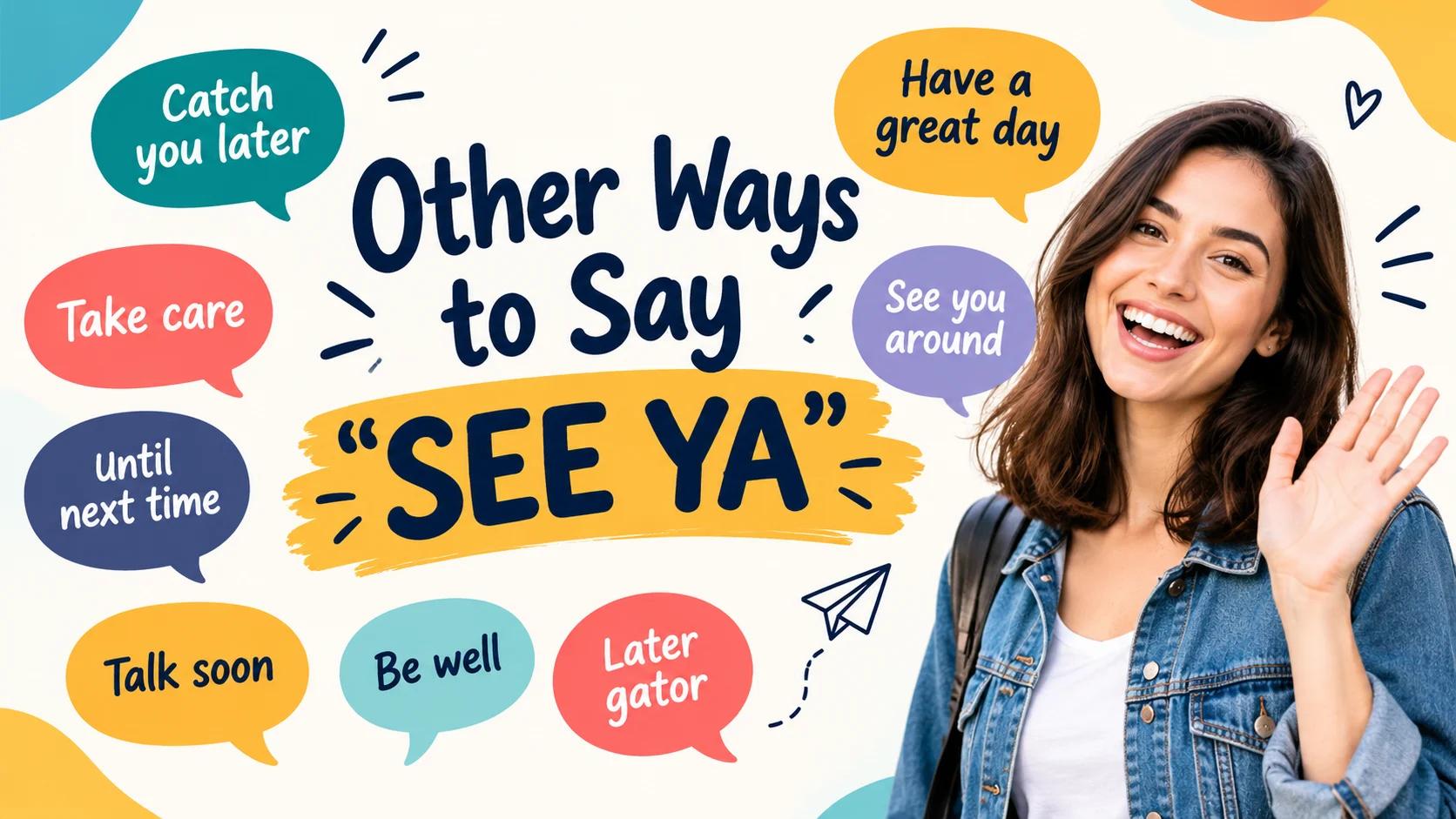
Other ways to say see ya include see you, see you later, catch you later, take care, goodbye, farewell, talk to you soon, until next time, have a good one, see you around, see you soon, bye for now, later, take it easy, and have a great day. The best choice depends on how casual, friendly, or formal the situation is.
Top 5 alternatives: See you, See you later, Take care, Catch you later, Talk to you soon
“See ya” is a friendly, informal way to say goodbye. It is common in spoken English, casual messages, and conversations between people who know each other well.
If you want to sound more natural or choose wording that fits a particular situation, learning other ways to say see ya can make your English more flexible. The right expression can sound warmer, more professional, more relaxed, or more polite.
These alternatives are useful in daily conversations, texts, workplace communication, emails, meetings, and social situations. Understanding the difference between them helps you avoid sounding either too casual or unnecessarily formal.
Formal Alternatives
- Goodbye
- Farewell
- Until next time
- Take care
- Have a good day
Pro Tip
Use goodbye when you need a neutral, universally understood option. Farewell is more formal and can sound dramatic or final in everyday conversation.
“A natural goodbye depends on both the relationship and the setting.”
Professional Alternatives
- Take care
- Have a good day
- Talk to you soon
- Until next time
- See you soon
Pro Tip
In professional conversations, choose an expression that matches the relationship. Have a good day is safe and polite, while talk to you soon works well when another conversation is expected.
Business Email Alternatives
- Best regards
- Have a great day
- Talk to you soon
- Take care
- Until next time
Pro Tip
A business email usually needs a closing rather than a spoken goodbye. Best regards is more appropriate in formal writing than see ya.
Academic Alternatives
- Goodbye
- Until next time
- See you soon
- Take care
- Have a good day
Pro Tip
Academic communication often benefits from neutral wording. Avoid highly casual expressions when writing to instructors, administrators, or unfamiliar classmates.
Casual Alternatives
- See you
- See you later
- Catch you later
- Later
- See you around
Pro Tip
These expressions are natural among friends, classmates, teammates, and familiar coworkers. Later is especially casual and works best when the relationship is already relaxed.
Informal Expressions
- Bye for now
- Take it easy
- Catch you later
- Later
- See you around
Pro Tip
Informal expressions create a relaxed tone. They are usually better for speech, texting, and friendly messages than formal emails or academic writing.
“The more familiar the relationship, the more freedom you have with casual goodbyes.”
What Does “See Ya” Mean?
“See ya” means goodbye or see you later. It is an informal pronunciation and spelling of “see you.”
The expression suggests that the speakers may meet or communicate again, but it does not always specify when.
Example:
“Thanks for hanging out. See ya tomorrow!”
Grammatically, see ya is mainly used as a conversational expression rather than formal written English. The spelling ya deliberately represents casual speech.
When to Use “See Ya”
You can use see ya in:
- Casual conversations with friends
- Text messages
- Informal chats
- Conversations with classmates
- Friendly social situations
- Relaxed conversations with familiar coworkers
- Informal spoken English
Avoid it in:
- Formal business emails
- Academic essays
- Job applications
- Official letters
- Formal presentations
- Communication with someone you do not know well
Is “See Ya” Professional or Polite?
Polite? ✔ Usually, in casual situations
Professional? Depends on the workplace and relationship
Formal? ✘ No
Natural? ✔ Very natural in informal spoken English
“See ya” is not rude by itself. Its main limitation is register. It sounds relaxed and familiar, so it may be inappropriate when a more professional closing is expected.
For a client email, Best regards or Have a great day is generally a better fit.
Pros and Cons
Pros
- Friendly and relaxed
- Very common in spoken English
- Easy to understand
- Natural among familiar people
- Creates an informal tone
Cons
- Too casual for formal writing
- Not ideal for professional correspondence
- Can sound overly familiar with strangers
- The spelling ya is informal
- Gives little information about future contact
“Casual English is effective when the context supports it.”
Other Ways to Say “See Ya” (With Examples)
These 15 alternatives give you more control over tone, context, and formality. Instead of memorizing one replacement, choose the expression that matches your relationship with the listener and the situation.
Expert Tip
Native speakers do not choose goodbye expressions only by meaning. They also consider formality, familiarity, workplace culture, and whether they expect to meet again.
1. Phrase: See You
Meaning: A simple, natural way to say goodbye while suggesting future contact.
Explanation: See you is one of the closest replacements for see ya. It is neutral and conversational rather than strongly formal or casual.
Example Sentence:
“I need to get home now. See you tomorrow!”
Best Use: Daily conversation
Avoid Using In: Formal documents
Tone: Friendly, Neutral
Formality Level: ⭐⭐⭐ Neutral
Usage Frequency: Very Common
CEFR Level: A2–B1
Common Collocations:
- see you tomorrow
- see you soon
- see you later
- see you next week
Context Variability:
- Spoken: “See you!”
- Professional: “See you at the meeting.”
- Casual: “See you later!”
2. Phrase: See You Later
Meaning: A friendly goodbye suggesting that you expect to see the person again.
Explanation: This is one of the most natural alternatives to see ya. It works particularly well in everyday conversations and informal messages.
Example Sentence:
“I’ve got class now, so I’ll see you later.”
Best Use: Informal conversation
Avoid Using In: Formal letters
Tone: Friendly, Natural
Formality Level: ⭐⭐ Casual
Usage Frequency: Very Common
CEFR Level: B1
Common Collocations:
- see you later
- see you later today
- see you later tonight
- I’ll see you later
Context Variability:
- Spoken: “See you later.”
- Professional: “I’ll see you later at the office.”
- Casual: “Okay, see you later!”
3. Phrase: Take Care
Meaning: A warm goodbye that expresses good wishes for the other person.
Explanation: Take care is slightly warmer than a simple goodbye. It is common in conversation, texts, and friendly professional communication.
Example Sentence:
“Thanks for your help today. Take care!”
Best Use: Friendly farewell
Avoid Using In: Very formal documents
Tone: Warm, Polite
Formality Level: ⭐⭐⭐ Neutral
Usage Frequency: Very Common
CEFR Level: B1
Common Collocations:
- take care
- take good care
- take care of yourself
- take care on your way home
Context Variability:
- Spoken: “Take care!”
- Professional: “Thanks again. Take care.”
- Casual: “Take care, everyone!”
4. Phrase: Catch You Later
Meaning: A very informal way to say you will see or speak to someone later.
Explanation: Catch you later sounds relaxed and conversational. It is common among friends and familiar coworkers but is not suitable for formal communication.
Example Sentence:
“I’m heading out now. Catch you later!”
Best Use: Friendly conversation
Avoid Using In: Formal emails
Tone: Casual, Friendly
Formality Level: ⭐⭐ Casual
Usage Frequency: Common
CEFR Level: B2
Common Collocations:
- catch you later
- catch you soon
- catch you tomorrow
Context Variability:
- Spoken: “Catch you later.”
- Professional: Only in relaxed workplaces
- Casual: “Catch you later, Sam!”
5. Phrase: Talk to You Soon
Meaning: A goodbye that indicates you expect to communicate again soon.
Explanation: This phrase works especially well when the next contact may be a phone call, message, meeting, or online conversation rather than an in-person meeting.
Example Sentence:
“I’ll send the details this evening. Talk to you soon.”
Best Use: Future communication
Avoid Using In: Formal applications
Tone: Friendly, Professional
Formality Level: ⭐⭐⭐ Neutral
Usage Frequency: Common
CEFR Level: B1
Common Collocations:
- talk to you soon
- talk to you tomorrow
- talk to you later
- I’ll talk to you soon
Context Variability:
- Spoken: “Talk to you soon.”
- Professional: “Thanks for your time. Talk to you soon.”
- Casual: “Okay, talk to you soon!”
Native Speaker Tip
See you and see you later are among the most natural everyday choices. Catch you later is more casual, while take care adds a warmer feeling.
“Small changes in a goodbye can change the relationship tone.”
6. Phrase: Goodbye
Meaning: A standard and neutral expression used when leaving or ending a conversation.
Explanation: Goodbye is more neutral than see ya and works across many situations. It can sound slightly more deliberate than the shorter bye.
Example Sentence:
“Thank you for meeting with me. Goodbye, and have a safe trip home.”
Best Use: Neutral farewell
Avoid Using In: Extremely casual banter
Tone: Neutral, Polite
Formality Level: ⭐⭐⭐⭐ Formal
Usage Frequency: Very Common
CEFR Level: A1–B1
Common Collocations:
- say goodbye
- goodbye for now
- a final goodbye
- wave goodbye
Context Variability:
- Spoken: “Goodbye.”
- Professional: “Thank you for coming. Goodbye.”
- Casual: “Okay, goodbye!”
7. Phrase: Have a Good Day
Meaning: A polite goodbye that wishes someone a pleasant day.
Explanation: This is particularly useful in customer service, workplaces, shops, offices, and other polite interactions. It sounds professional without being stiff.
Example Sentence:
“Thank you for calling. Have a good day.”
Best Use: Professional farewell
Avoid Using In: Late-night situations
Tone: Polite, Professional
Formality Level: ⭐⭐⭐⭐ Formal
Usage Frequency: Very Common
CEFR Level: A2–B1
Common Collocations:
- have a good day
- have a great day
- have a wonderful day
- hope you have a good day
Context Variability:
- Spoken: “Have a good day!”
- Professional: “Thank you for your time. Have a good day.”
- Casual: “Have a good day!”
8. Phrase: See You Soon
Meaning: A goodbye used when you expect to see someone again in the near future.
Explanation: See you soon is warmer and more specific than a simple goodbye. It works in both friendly and moderately professional situations.
Example Sentence:
“Enjoy your weekend. See you soon!”
Best Use: Future meeting
Avoid Using In: Uncertain relationships
Tone: Warm, Friendly
Formality Level: ⭐⭐⭐ Neutral
Usage Frequency: Common
CEFR Level: B1
Common Collocations:
- see you soon
- hopefully see you soon
- see you again soon
Context Variability:
- Spoken: “See you soon.”
- Professional: “I look forward to seeing you soon.”
- Casual: “See you soon!”
9. Phrase: See You Around
Meaning: An informal goodbye suggesting that you may meet again sometime.
Explanation: This phrase is relaxed and less specific than see you soon. It is useful when you expect future contact but do not have a definite plan.
Example Sentence:
“I’m moving to another department, but I’m sure I’ll see you around.”
Best Use: Casual farewell
Avoid Using In: Formal correspondence
Tone: Casual, Friendly
Formality Level: ⭐⭐ Casual
Usage Frequency: Common
CEFR Level: B2
Common Collocations:
- see you around
- I’ll see you around
- hope to see you around
Context Variability:
- Spoken: “See you around.”
- Professional: Possible among familiar coworkers
- Casual: Very natural
10. Phrase: Until Next Time
Meaning: A farewell meaning that you expect another meeting or interaction.
Explanation: Until next time sounds polished and slightly more formal than see ya. It can work well at the end of presentations, events, classes, or organized activities.
Example Sentence:
“Thank you all for joining the workshop. Until next time!”
Best Use: Events and meetings
Avoid Using In: Very casual texting
Tone: Polished, Warm
Formality Level: ⭐⭐⭐⭐ Formal
Usage Frequency: Common
CEFR Level: B2
Common Collocations:
- until next time
- until next week
- until we meet again
Context Variability:
- Spoken: “Until next time.”
- Professional: “Thank you for attending. Until next time.”
- Casual: Works when used playfully
Expert Insight
In workplace communication, the safest alternative is not always the most formal one. A short phrase such as have a good day can sound more natural than an elaborate farewell, especially in everyday professional interactions.
11. Phrase: Farewell
Meaning: A formal or literary way to say goodbye.
Explanation: Farewell is grammatically correct but less common in ordinary modern conversation. It can sound ceremonial, dramatic, literary, or final.
Example Sentence:
“After five years with the organization, she gave her colleagues a heartfelt farewell.”
Best Use: Ceremonial situations
Avoid Using In: Casual conversation
Tone: Formal, Literary
Formality Level: ⭐⭐⭐⭐⭐ Very Formal
Usage Frequency: Occasional
CEFR Level: B2
Common Collocations:
- farewell speech
- farewell party
- farewell message
- say farewell
Context Variability:
- Spoken: Formal or ceremonial
- Professional: Farewell event
- Casual: Usually sounds too formal
12. Phrase: Bye for Now
Meaning: A friendly goodbye indicating that the separation is temporary.
Explanation: This expression is casual but not as strongly informal as see ya. It works nicely in messages and conversations when you expect to reconnect.
Example Sentence:
“I have to finish my homework now. Bye for now!”
Best Use: Friendly messages
Avoid Using In: Formal business writing
Tone: Friendly, Casual
Formality Level: ⭐⭐ Casual
Usage Frequency: Common
CEFR Level: B1
Common Collocations:
- bye for now
- just bye for now
- say bye for now
Context Variability:
- Spoken: “Bye for now.”
- Professional: Usually too casual
- Casual: Very natural
13. Phrase: Later
Meaning: An extremely brief and informal way to say goodbye.
Explanation: Later is a shortened conversational farewell. It is common among friends and familiar people, but it can sound too abrupt or casual in professional situations.
Example Sentence:
“I’m going to grab some lunch. Later!”
Best Use: Casual conversation
Avoid Using In: Formal workplaces
Tone: Very Casual, Friendly
Formality Level: ⭐ Very Casual
Usage Frequency: Common
CEFR Level: B1
Common Collocations:
- later
- later, everyone
- catch you later
Context Variability:
- Spoken: “Later!”
- Professional: Generally avoid
- Casual: Very natural
14. Phrase: Take It Easy
Meaning: A relaxed goodbye wishing someone well.
Explanation: Take it easy is informal and friendly. Depending on context, it can also mean “relax” or “do not worry,” so its meaning depends on the surrounding conversation.
Example Sentence:
“Thanks for coming over. Take it easy!”
Best Use: Friendly farewell
Avoid Using In: Formal emails
Tone: Relaxed, Friendly
Formality Level: ⭐⭐ Casual
Usage Frequency: Common
CEFR Level: B2
Common Collocations:
- take it easy
- take things easy
- just take it easy
Context Variability:
- Spoken: “Take it easy!”
- Professional: Only in highly relaxed workplaces
- Casual: Very natural
15. Phrase: Have a Great Day
Meaning: A warm and positive goodbye wishing someone a pleasant day.
Explanation: This expression is friendly, polite, and suitable for many everyday interactions. It is especially common in customer service and professional settings.
Example Sentence:
“Thanks for stopping by. Have a great day!”
Best Use: Polite farewell
Avoid Using In: Very formal documents
Tone: Warm, Positive
Formality Level: ⭐⭐⭐ Neutral
Usage Frequency: Very Common
CEFR Level: B1
Common Collocations:
- have a great day
- have a great weekend
- have a really great day
- hope you have a great day
Context Variability:
- Spoken: “Have a great day!”
- Professional: “Thank you for your time. Have a great day.”
- Casual: “Have a great day!”
Native Speaker Tip
For everyday English, see you, see you later, and take care are especially flexible. Farewell is correct but noticeably more formal and less common in ordinary conversation.
“Correct English is not always the same as natural English.”
Top 10 Alternatives Compared
| Phrase | Tone | Formality | Best Use | Frequency |
| See you | Friendly | Neutral | Daily conversation | Very Common |
| See you later | Friendly | Casual | Informal conversation | Very Common |
| Take care | Warm | Neutral | Friendly/professional farewell | Very Common |
| Talk to you soon | Friendly | Neutral | Messages/calls | Common |
| Goodbye | Polite | Formal | General/formal situations | Very Common |
| Have a good day | Polite | Formal | Workplace/customer service | Very Common |
| See you soon | Warm | Neutral | Future meetings | Common |
| See you around | Casual | Casual | Familiar people | Common |
| Until next time | Polished | Formal | Events/meetings | Common |
| Catch you later | Relaxed | Casual | Friends/familiar coworkers | Common |
Which One Should You Use?
Best Overall
See you is a simple, natural choice that works in most everyday conversations.
Best Professional
Have a good day fits many workplace and customer-facing situations without sounding stiff.
Best Academic
Goodbye or until next time can work when a neutral or polished closing is appropriate.
Best Business Email
Have a great day is useful in a friendly professional email, while Best regards is generally better as a formal email sign-off.
Best Everyday Conversation
See you later sounds natural when speaking with friends, classmates, or familiar coworkers.
Most Natural
See you is short, flexible, and extremely common.
Most Polite
Take care adds warmth while remaining appropriate in many ordinary interactions.
Commonly Confused Phrases
“I’ll see you” vs. “See you”
See you is a short goodbye. I’ll see you is a complete statement that emphasizes future contact.
“See you later” vs. “See you soon”
See you later is broader and can mean later that day or simply another time. See you soon more strongly suggests the next meeting will be relatively soon.
“See you” vs. “See ya”
The meaning is essentially the same, but see ya is more visibly informal. The spelling ya represents casual speech.
“Goodbye” vs. “Farewell”
Both mean goodbye, but farewell is more formal, literary, or ceremonial. It can also suggest a more significant or final departure.
“Take care” vs. “Take it easy”
Both can be friendly farewells. Take care is more broadly appropriate, while take it easy has a distinctly relaxed, informal feel.
Scenario Practice
1. Business Meeting
Situation: You have finished a meeting with a familiar colleague.
Which phrase would you choose?
Answer: “Have a good day.”
Why: It is polite and professional without sounding unnecessarily formal.
2. Job Interview
Situation: You are leaving after an interview.
Which phrase would you choose?
Answer: “Thank you for your time. Have a good day.”
Why: It maintains a respectful professional tone.
3. Presentation
Situation: You have finished speaking to an audience.
Which phrase would you choose?
Answer: “Thank you for joining me. Until next time.”
Why: It provides a polished closing for an organized event.
4. Class Discussion
Situation: You are leaving a class and expect to see your classmates tomorrow.
Which phrase would you choose?
Answer: “See you tomorrow.”
Why: It is natural, clear, and appropriate among classmates.
5. Email Reply
Situation: You have answered a client’s question and want a friendly closing.
Which phrase would you choose?
Answer: “Have a great day.”
Why: It creates a warm professional ending without sounding overly familiar.
Mini Quiz
1. Which is most appropriate for a formal business interaction?
A. Later
B. See ya
C. Have a good day
D. Catch you later
Answer: C
2. Which phrase is especially casual?
A. Goodbye
B. Later
C. Until next time
D. Have a good day
Answer: B
3. Which expression suggests future communication?
A. Talk to you soon
B. Farewell
C. Goodbye
D. Have a good day
Answer: A
4. Which phrase sounds more ceremonial or literary?
A. See you
B. Later
C. Farewell
D. See ya
Answer: C
5. Which phrase is a natural replacement for “see ya” among friends?
A. See you later
B. Farewell
C. Goodbye, sir or madam
D. Until further notice
Answer: A
Answer Key
- C “Have a good day” is polite and professional.
- B “Later” is highly casual.
- A “Talk to you soon” points to future communication.
- C “Farewell” has a more formal or ceremonial tone.
- A “See you later” is a very natural casual alternative.
FAQs
What is the most formal way to say “see ya”?
Farewell is the most formal option in this list, but it can sound literary, ceremonial, or dramatic in ordinary conversation. For most formal professional situations, goodbye is more natural. In business emails, a conventional sign-off such as Best regards may be more appropriate than either phrase.
Which phrase is best for professional emails?
The best choice depends on the email’s tone and relationship. Have a good day and have a great day work well as friendly closing sentences. For more formal business writing, use a conventional sign-off such as Best regards rather than the conversational phrase see ya.
What is the difference between “see you” and “see you later”?
Both are common informal goodbyes, but see you later specifically suggests another interaction later. See you is broader and can simply mean goodbye. Both sound natural in everyday spoken English, while neither is ideal for highly formal writing.
Which alternative sounds most natural?
See you and see you later are among the most natural alternatives to see ya in everyday English. Take care is also highly natural and adds warmth. Your choice should depend on the relationship, setting, and whether you expect to see or speak to the person again.
Can I use these expressions in business meetings?
Some can. Have a good day, take care, see you soon, and talk to you soon can work in relaxed professional environments. See ya, later, and catch you later are more casual. In formal meetings with clients or unfamiliar professionals, choose a neutral and polite closing.
Conclusion
Learning different ways to say see ya gives you more control over your English. Expressions such as see you, see you later, take care, goodbye, have a good day, and talk to you soon carry slightly different levels of warmth and formality. Understanding those differences helps you communicate naturally instead of using the same goodbye in every situation.
Practice these alternatives in everyday conversations, messages, meetings, and professional writing. Start with flexible choices such as see you and take care, then adjust your wording as the situation changes. The goal is not to use the fanciest phrase it is to choose the expression that sounds natural for the moment.

2 thoughts on “Other Ways to Say See Ya | 45+ Examples For 2026”